


Ordnungspolizei

Encyclopedia
The Ordnungspolizei or Orpo (Order Police) were the uniformed regular police force in Nazi Germany
between 1936 and 1945. It was increasingly absorbed into the Nazi police system. Owing to their green uniforms, they were also referred to as Grüne Polizei (green police). The Orpo was established as a centralized organisation uniting the municipal, city, and rural uniformed forces that had been organised on a state-by-state basis. Eventually the Orpo embraced virtually all of the Third Reich's law-enforcement and emergency response organizations, including fire brigades, coast guard, civil defence, and even night watchmen.
was named Chef der Deutschen Polizei im Reichsministerium des Innern (Chief of German Police in the Interior Ministry) after Hitler announced a decree that was to "unify the control of Police duties in the Reich". Traditionally, law enforcement in Germany had been a state and local matter. In this role, Himmler was nominally subordinate to Interior Minister Wilhelm Frick
. However, the decree effectively subordinated the police to the SS, making it virtually independent of Frick's control. Himmler gained authority as all of Germany's uniformed law enforcement agencies were amalgamated into the new Ordnungspolizei, whose main office became populated by officers of the SS.
The police were divided into the Ordnungspolizei (Orpo or regular police) and the Sicherheitspolizei
(SiPo or security police), which had been established in June 1936. The Orpo assumed duties of regular uniformed law enforcement while the SiPo consisted of the secret state police (Geheime Staatspolizei or Gestapo
) and criminal investigation police (Kriminalpolizei
or Kripo). The Kriminalpolizei was a corps of professional detectives involved in fighting crime and the task of the Gestapo was combating espionage and political dissent. On 27 September 1939, the SS security service, the Sicherheitsdienst
(SD) and the SiPo were folded into the Reich Main Security Office (Reichssicherheitshauptamt or RSHA). The RSHA symbolized the close connection between the SS (a party organization) and the police (a state organization).
Generalmajor der Ordnungspolizei und SS-Brigadefuhrer Wilhelm Fritz von Roettig
was the first general to be killed in World War II, in Opoczno
, Poland
on 10 September 1939.
The Order Police played a central role in carrying out the Holocaust, as stated by Professor Browning:
It is no longer seriously in question that members of the German Order Police, both career professionals and reservists, in both battalion formations and precinct service or Einzeldienst, were at the center of the Holocaust, providing a major manpower source for carrying out numerous deportations, ghetto-clearing operations, and massacres.
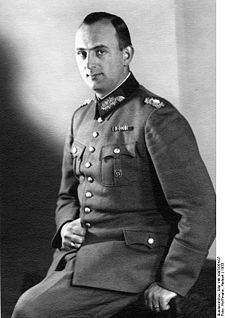 The Orpo was under the control of Reichsführer-SS
Heinrich Himmler
who was the Chef der Deutschen Polizei im Ministerium des Innern (Chief of the German Police in the Ministry of the Interior). It was initially commanded by SS-Oberstgruppenführer
und Generaloberst der Polizei Kurt Daluege
. But in 1943, Daluege had a massive heart attack and was removed from duty. He was replaced by SS-Obergruppenführer
und General der Waffen-SS
und der Polizei Alfred Wünnenberg
, who served until the end of the war.
By 1941, the Orpo had been divided into the following offices covering every aspect of German law enforcement:
, construction of defense works (i.e. Atlantic Wall
), and support of combat troops. Specific duties varied widely from unit to unit from one year to another. Generally, the SS Polizei units were not directly involved in combat. Some Police Battalions were primarily focused on traditional security roles of an occupying force while others were directly involved in the Holocaust
. This latter role was obscured in the immediate aftermath of World War II, both by accident and by deliberate obfuscation, when most of the focus was on the better-known Einsatzgruppen
("Operational groups") who reported to the Reichssicherheitshauptamt (RSHA — Reich Main Security Office) under Reinhard Heydrich
.
The Police Battalions consisted of approximately 500 men armed with light infantry weapons. The battalions were originally numbered in series from 1 to 325, but in February 1943 were renamed and renumbered from 1 to about 37 to distinguish from Schutzmannschaft
, auxiliary police battalions recruited from local population in German-occupied areas. The Police Battalions were organizationally and administratively under Chief of Police Kurt Daluege
but operationally they were under the authority of regional SS- und Polizeiführer (SS and Police Leaders), who reported up a separate chain of command
, bypassing Daluege, directly to Reichsführer SS Heinrich Himmler
. While these units were similar to Waffen-SS
divisions, they were not part of the Waffen-SS and should not be confused with the 4th SS Polizei Division
.
During the invasion of Poland in 1939, Police Battalions committed atrocities against both the Catholic and the Jewish populations and as security forces patrolled the perimeters of the Jewish ghettos in Poland
(SS, SD, and in some cases the Criminal Police were responsible for internal ghetto security issues in conjunction with Jewish ghetto administration). Starting in 1941 Police Battalions and local Order Police units helped to transport Jews from the ghettos in both Poland and the USSR (and elsewhere in occupied Europe) to the concentration and extermination camps, as well as operations to hunt down and kill Jews outside the ghettos.
Operating both independently and in conjunction with the Einsatzgruppen, Police Battalions were also an integral part of the "Final Solution
" in Operation Barbarossa
, the invasion of the Soviet Union which began on 22 July 1941. Police Battalions, whether as part of Police Regiments or as separate units or reporting directly to the local SS-und-Polizeiführer were part of the first and second waves of killing in 1941–2 in the USSR and also in killing operations in Poland. Police Battalion involvement in direct killing operations are responsible for at least 1 million deaths.
The Order Police were one of the two primary sources from which the Einsatzgruppen drew personnel in accordance with manpower needs (the other being the Waffen-SS
).
The majority of police battalions formed 28 Police Regiments as of 1942, many of which saw combat on the Eastern Front
during the retreat of the German army.
The regular military police
of the Wehrmacht
(Feldgendarmerie
) were separate from the Ordnungspolizei.
Division of the Waffen-SS
. Mainly used as a rear guard
and reserve formation, the Polizei Division was historically known as being undertrained and lacking in skilled combat tactics. The division consisted of four police regiments composed of Orpo personnel and was typically used to rotate police members into a military situation, so as not to lose police personnel to the general draft of the Wehrmacht or to the full SS divisions of the regular Waffen-SS
.
Very late in the war several Orpo SS-Police regiments were transferred to the Waffen-SS to form the 35th SS and Police Grenadier Division.
ranks in August 1944 when Himmler was appointed Chef der Ersatzheeres (Chief of Home Army), because they had authority over the prisoner-of-war camp
s in their area.
Heinrich Himmler's ultimate aim was to replace the regular police forces of Germany with a combined racial/state protection corps (Staatsschutzkorps) of pure SS units. Local law enforcement would be undertaken by the Allgemeine-SS with the Waffen-SS providing homeland-security and political-police functions. Historical analysis of the Third Reich has revealed that senior Orpo personnel knew of Himmler's plan and were opposed to it.
, the Orpo ceased to exist; but many of its personnel continued with business as usual, performing police services for the Allied occupation forces. The traditions of the Orpo continued in East Germany, which maintained a state police force (Volkspolizei
) designed after the SS structures, being based on a centralized system. In West Germany
, the police were decentralized again, as they had been before 1936, with each of the new federal states (called Bundesländer
) establishing its own police force Landespolizei
, each of which survives to this day. Many Landespolizei regulations, procedures, and even some uniforms, which are green, and insignia, can be traced back to the pre-1936 forces.
Nazi Germany
Nazi Germany , also known as the Third Reich , but officially called German Reich from 1933 to 1943 and Greater German Reich from 26 June 1943 onward, is the name commonly used to refer to the state of Germany from 1933 to 1945, when it was a totalitarian dictatorship ruled by...
between 1936 and 1945. It was increasingly absorbed into the Nazi police system. Owing to their green uniforms, they were also referred to as Grüne Polizei (green police). The Orpo was established as a centralized organisation uniting the municipal, city, and rural uniformed forces that had been organised on a state-by-state basis. Eventually the Orpo embraced virtually all of the Third Reich's law-enforcement and emergency response organizations, including fire brigades, coast guard, civil defence, and even night watchmen.
History
On 17 June 1936, Reichsführer-SS Heinrich HimmlerHeinrich Himmler
Heinrich Luitpold Himmler was Reichsführer of the SS, a military commander, and a leading member of the Nazi Party. As Chief of the German Police and the Minister of the Interior from 1943, Himmler oversaw all internal and external police and security forces, including the Gestapo...
was named Chef der Deutschen Polizei im Reichsministerium des Innern (Chief of German Police in the Interior Ministry) after Hitler announced a decree that was to "unify the control of Police duties in the Reich". Traditionally, law enforcement in Germany had been a state and local matter. In this role, Himmler was nominally subordinate to Interior Minister Wilhelm Frick
Wilhelm Frick
Wilhelm Frick was a prominent German Nazi official serving as Minister of the Interior of the Third Reich. After the end of World War II, he was tried for war crimes at the Nuremberg Trials and executed...
. However, the decree effectively subordinated the police to the SS, making it virtually independent of Frick's control. Himmler gained authority as all of Germany's uniformed law enforcement agencies were amalgamated into the new Ordnungspolizei, whose main office became populated by officers of the SS.
The police were divided into the Ordnungspolizei (Orpo or regular police) and the Sicherheitspolizei
Sicherheitspolizei
The Sicherheitspolizei , often abbreviated as SiPo, was a term used in Nazi Germany to describe the state political and criminal investigation security agencies. It was made up by the combined forces of the Gestapo and the Kripo between 1936 and 1939...
(SiPo or security police), which had been established in June 1936. The Orpo assumed duties of regular uniformed law enforcement while the SiPo consisted of the secret state police (Geheime Staatspolizei or Gestapo
Gestapo
The Gestapo was the official secret police of Nazi Germany. Beginning on 20 April 1934, it was under the administration of the SS leader Heinrich Himmler in his position as Chief of German Police...
) and criminal investigation police (Kriminalpolizei
Kriminalpolizei
is the standard term for the criminal investigation agency within the police forces of Germany, Austria and the German-speaking cantons of Switzerland. In Nazi Germany during 1936, the Kripo became the Criminal Police Department for the entire Reich...
or Kripo). The Kriminalpolizei was a corps of professional detectives involved in fighting crime and the task of the Gestapo was combating espionage and political dissent. On 27 September 1939, the SS security service, the Sicherheitsdienst
Sicherheitsdienst
Sicherheitsdienst , full title Sicherheitsdienst des Reichsführers-SS, or SD, was the intelligence agency of the SS and the Nazi Party in Nazi Germany. The organization was the first Nazi Party intelligence organization to be established and was often considered a "sister organization" with the...
(SD) and the SiPo were folded into the Reich Main Security Office (Reichssicherheitshauptamt or RSHA). The RSHA symbolized the close connection between the SS (a party organization) and the police (a state organization).
Generalmajor der Ordnungspolizei und SS-Brigadefuhrer Wilhelm Fritz von Roettig
Wilhelm Fritz von Roettig
Wilhelm Fritz von Roettig was a general in the Waffen-SS who participated in the invasion of Poland. He carries the dubious distinction of being the first general to have been killed in World War II...
was the first general to be killed in World War II, in Opoczno
Opoczno
Opoczno is a town in south-central Poland, within the eastern part of Łódź Voivodeship , previously in Piotrków Trybunalski Voivodeship . Important communication routes run through the town, namely the central railway line, which connects Silesia with Warsaw, and road 12, which creates a...
, Poland
Poland
Poland , officially the Republic of Poland , is a country in Central Europe bordered by Germany to the west; the Czech Republic and Slovakia to the south; Ukraine, Belarus and Lithuania to the east; and the Baltic Sea and Kaliningrad Oblast, a Russian exclave, to the north...
on 10 September 1939.
The Order Police played a central role in carrying out the Holocaust, as stated by Professor Browning:
It is no longer seriously in question that members of the German Order Police, both career professionals and reservists, in both battalion formations and precinct service or Einzeldienst, were at the center of the Holocaust, providing a major manpower source for carrying out numerous deportations, ghetto-clearing operations, and massacres.
Organization
Reichsführer-SS
was a special SS rank that existed between the years of 1925 and 1945. Reichsführer-SS was a title from 1925 to 1933 and, after 1934, the highest rank of the German Schutzstaffel .-Definition:...
Heinrich Himmler
Heinrich Himmler
Heinrich Luitpold Himmler was Reichsführer of the SS, a military commander, and a leading member of the Nazi Party. As Chief of the German Police and the Minister of the Interior from 1943, Himmler oversaw all internal and external police and security forces, including the Gestapo...
who was the Chef der Deutschen Polizei im Ministerium des Innern (Chief of the German Police in the Ministry of the Interior). It was initially commanded by SS-Oberstgruppenführer
Oberstgruppenführer
Oberst-Gruppenführer was the highest commissioned SS rank with the exception of Reichsführer-SS, which was a special rank held by Heinrich Himmler...
und Generaloberst der Polizei Kurt Daluege
Kurt Daluege
Kurt Daluege was a German Nazi SS-Oberstgruppenführer and Generaloberst der Polizei as chief of the Ordnungspolizei and ruled the Protectorate Bohemia and Moravia as Deputy Protector after Reinhard Heydrich's assassination.-Early life and career:Kurt Daluege, a son of a Prussian state official,...
. But in 1943, Daluege had a massive heart attack and was removed from duty. He was replaced by SS-Obergruppenführer
Obergruppenführer
Obergruppenführer was a Nazi Party paramilitary rank that was first created in 1932 as a rank of the SA and until 1942 it was the highest SS rank inferior only to Reichsführer-SS...
und General der Waffen-SS
Waffen-SS
The Waffen-SS was a multi-ethnic and multi-national military force of the Third Reich. It constituted the armed wing of the Schutzstaffel or SS, an organ of the Nazi Party. The Waffen-SS saw action throughout World War II and grew from three regiments to over 38 divisions, and served alongside...
und der Polizei Alfred Wünnenberg
Alfred Wünnenberg
Alfred Bernhard Julius Ernst Wünnenberg was SS-Obergruppenführer und General der Waffen SS and the commander of the 4th SS Polizei Panzer Grenadier Division during World War II who was awarded the Knight's Cross with Oakleaves.-World War I:Alfred Wünnenberg was born on 20 July 1891 at Sarrebourg,...
, who served until the end of the war.
By 1941, the Orpo had been divided into the following offices covering every aspect of German law enforcement:
- Headquarters (Hauptamt Ordungspolizei) was the central command office of the entire Ordnungspolizei and from 1943 was considered a full SS-Headquarters command.
- Administration (Verwaltungspolizei) was the administrative branch of the Orpo and had overall command authority for all Orpo police stations. The Verwaltungspolizei also was the central office for record keeping and was the command authority for civilian law enforcement groups, which included the Gesundheitspolizei (health police), Gewerbepolizei (commercial or trade police), and the Baupolizei (building police). In the main towns, Verwaltungspolizei, Schutzpolizei and Kriminalpolizei would be organised into a police administration known as the Polizeipraesidium or Polizeidirektion, which had authority over these police forces in the urban district.
- Municipal police (SchutzpolizeiSchutzpolizeiThe Schutzpolizei , or Schupo for short, is a branch of the Landespolizei, the state level police of the German states. Schutzpolizei literally means security or protection police but is best translated as Uniformed Police....
; "protection police") served as Germany's municipal police force and was tasked with maintaining order in German cities and larger towns. The Schutzpolizei was further divided into the following:- Schutzpolizei des Reiches (cities and large towns), which included police-station duties (Revierdienst) and barracked police units for riots and public safety (Kasernierte Polizei)
- Schutzpolizei der Gemeinden (smaller towns)
- Gendarmerie (rural police) were tasked with frontier law enforcement to include small communities, rural districts, and mountainous terrain. Members of the Gendarmerie were mainly employed to combat poachingPoachingPoaching is the illegal taking of wild plants or animals contrary to local and international conservation and wildlife management laws. Violations of hunting laws and regulations are normally punishable by law and, collectively, such violations are known as poaching.It may be illegal and in...
and also as Alpine troops for homeland defense. With the development of a network of motorways or Autobahnen, motorized gendarmerie companies were set up in 1937 to secure the traffic. - Traffic police (Verkehrspolizei) was the traffic-law enforcement agency and road safety administration of Germany. The organization patrolled Germany's roads (other than motorways which were controlled by Motorized Gendarmerie) and responded to major accidents. The Verkehrspolizei was also the primary escort service for high Nazi leaders who traveled great distances by automobile.
- Water police (WasserschutzpolizeiWasserschutzpolizeiThe Wasserschutzpolizei is the water police that patrols the waterways, lakes and harbours of Germany around the clock. The WSP are part of the Landespolizei ....
) was the equivalent of the coast guard and river police. Tasked with the safety and security of Germany's rivers, harbors, and inland waterways, the group also had authority over the SS-Hafensicherungstruppen ("harbour security troops") which were Allgemeine-SS units assigned as port security personnel. - Railway police (Bahnschutzpolizei) was made up of part-time police officers who were also employees of the Reichsbahn (state railway). The Bahnschutzpolizei was tasked with railway safety and also preventing espionage and sabotage of railway property.
- Postal police (Postschutz) comprised roughly 4,500 members and was tasked with the security of Germany's Reichspost, which was responsible not only for the mail but other communications media such as the telephoneTelephoneThe telephone , colloquially referred to as a phone, is a telecommunications device that transmits and receives sounds, usually the human voice. Telephones are a point-to-point communication system whose most basic function is to allow two people separated by large distances to talk to each other...
and telegraph systems. - Fire guards (Feuerschutzpolizei) consisted of all professional fire departments under a national command structure. The Orpo Hauptamt also had authority over the Freiwillige Feuerwehren, the local volunteer civilian fire brigades. At the height of the Second World War, in response to heavy bombing of Germany's cities, the combined Feuerschutzpolizei and Freiwillige Feuerwehren numbered nearly two million members.
- Air raid protection (Luftschutzpolizei) was the civil protection service in charge of air raid defence and rescue victims of bombings in connection with the Technische Nothilfe (Technical Emergency Service) and the Feuerschutzpolizei (Fire Brigades). Created as the Security and Assistance Service (Sicherheits und Hilfsdienst) in 1935, it was renamed Luftschutzpolizei in April 1942. The air raid network was supported by the ReichsluftschutzbundReichsluftschutzbundThe Reichsluftschutzbund was a paramilitary organization of Nazi Germany founded in the 1933 as a branch of the German Aviation Ministry. The group's first function was to serve as Air Defense Crews during a period when Germany was forbidden an Air Force by the Treaty of Versailles...
(Reich Association for Air Raid Precautions) an organization controlled from 1935 by the Air Ministry under Hermann GöringHermann GöringHermann Wilhelm Göring, was a German politician, military leader, and a leading member of the Nazi Party. He was a veteran of World War I as an ace fighter pilot, and a recipient of the coveted Pour le Mérite, also known as "The Blue Max"...
. The RLB set up an organization of air raid wardens who were responsible for the safety of a building or a group of houses. - Technical Emergency Corps (Technische Nothilfe or TeNo) was a corps of engineers, technicians and specialists in construction work. TeNo was created in 1919 to keep the public utilities and essential industries running during the wave of strikes. From 1937 TeNo became a technical auxiliary corps of the police and was absorbed into Orpo Hauptamt. By 1943, the TeNo had over 100,000 members.
- Radio guard (Funkschutz) was made up of SS and Orpo security personnel assigned to protect German broadcasting stations from attack and sabotage. The Funkschutz was also the primary investigating service which detected illegal reception of foreign radio broadcasts.
- Factory protection (Werkschutzpolizei) were the night watchmenSecurity guardA security guard is a person who is paid to protect property, assets, or people. Security guards are usually privately and formally employed personnel...
of the Third Reich. Its personnel were civilians who answered to a central Orpo office and typically were issued paramilitary uniforms, mostly surplus black or grey Allgemeine-SS jackets with Orpo insignia.
Police Battalions
Between 1939 and 1945, the Ordnungspolizei also maintained separate military formations, independent of the main police offices within Germany. The first such formations were the Police Battalions (SS-Polizei-Bataillone), for various auxiliary duties outside of Germany, including anti-partisan operationsAnti-partisan operations in World War II
Anti-partisan operations were operations against the various resistance movements during World War II by the Axis powers...
, construction of defense works (i.e. Atlantic Wall
Atlantic Wall
The Atlantic Wall was an extensive system of coastal fortifications built by Nazi Germany between 1942 and 1944 along the western coast of Europe as a defense against an anticipated Allied invasion of the mainland continent from Great Britain.-History:On March 23, 1942 Führer Directive Number 40...
), and support of combat troops. Specific duties varied widely from unit to unit from one year to another. Generally, the SS Polizei units were not directly involved in combat. Some Police Battalions were primarily focused on traditional security roles of an occupying force while others were directly involved in the Holocaust
The Holocaust
The Holocaust , also known as the Shoah , was the genocide of approximately six million European Jews and millions of others during World War II, a programme of systematic state-sponsored murder by Nazi...
. This latter role was obscured in the immediate aftermath of World War II, both by accident and by deliberate obfuscation, when most of the focus was on the better-known Einsatzgruppen
Einsatzgruppen
Einsatzgruppen were SS paramilitary death squads that were responsible for mass killings, typically by shooting, of Jews in particular, but also significant numbers of other population groups and political categories...
("Operational groups") who reported to the Reichssicherheitshauptamt (RSHA — Reich Main Security Office) under Reinhard Heydrich
Reinhard Heydrich
Reinhard Tristan Eugen Heydrich , also known as The Hangman, was a high-ranking German Nazi official.He was SS-Obergruppenführer and General der Polizei, chief of the Reich Main Security Office and Stellvertretender Reichsprotektor of Bohemia and Moravia...
.
The Police Battalions consisted of approximately 500 men armed with light infantry weapons. The battalions were originally numbered in series from 1 to 325, but in February 1943 were renamed and renumbered from 1 to about 37 to distinguish from Schutzmannschaft
Schutzmannschaft
Schutzmannschaft or Hilfspolizei were the collaborationist auxiliary police battalions of native policemen in occupied countries in East, which were created to fight the resistance during World War II mostly in the Eastern European countries occupied by Nazi Germany. Hilfspolizei refers also to...
, auxiliary police battalions recruited from local population in German-occupied areas. The Police Battalions were organizationally and administratively under Chief of Police Kurt Daluege
Kurt Daluege
Kurt Daluege was a German Nazi SS-Oberstgruppenführer and Generaloberst der Polizei as chief of the Ordnungspolizei and ruled the Protectorate Bohemia and Moravia as Deputy Protector after Reinhard Heydrich's assassination.-Early life and career:Kurt Daluege, a son of a Prussian state official,...
but operationally they were under the authority of regional SS- und Polizeiführer (SS and Police Leaders), who reported up a separate chain of command
Chain of Command
Chain of Command may refer to:* Chain of command, in a military context, the line of authority and responsibility along which orders are passed* "Chain of Command" , the fifth episode of the first season of Beast Wars...
, bypassing Daluege, directly to Reichsführer SS Heinrich Himmler
Heinrich Himmler
Heinrich Luitpold Himmler was Reichsführer of the SS, a military commander, and a leading member of the Nazi Party. As Chief of the German Police and the Minister of the Interior from 1943, Himmler oversaw all internal and external police and security forces, including the Gestapo...
. While these units were similar to Waffen-SS
Waffen-SS
The Waffen-SS was a multi-ethnic and multi-national military force of the Third Reich. It constituted the armed wing of the Schutzstaffel or SS, an organ of the Nazi Party. The Waffen-SS saw action throughout World War II and grew from three regiments to over 38 divisions, and served alongside...
divisions, they were not part of the Waffen-SS and should not be confused with the 4th SS Polizei Division
4th SS Polizei Division
The SS Polizei Division was one of the thirty-eight divisions fielded as part of the Waffen-SS during World War II.The division was formed in 1939 as part of the Ordnungspolizei...
.
During the invasion of Poland in 1939, Police Battalions committed atrocities against both the Catholic and the Jewish populations and as security forces patrolled the perimeters of the Jewish ghettos in Poland
Poland
Poland , officially the Republic of Poland , is a country in Central Europe bordered by Germany to the west; the Czech Republic and Slovakia to the south; Ukraine, Belarus and Lithuania to the east; and the Baltic Sea and Kaliningrad Oblast, a Russian exclave, to the north...
(SS, SD, and in some cases the Criminal Police were responsible for internal ghetto security issues in conjunction with Jewish ghetto administration). Starting in 1941 Police Battalions and local Order Police units helped to transport Jews from the ghettos in both Poland and the USSR (and elsewhere in occupied Europe) to the concentration and extermination camps, as well as operations to hunt down and kill Jews outside the ghettos.
Operating both independently and in conjunction with the Einsatzgruppen, Police Battalions were also an integral part of the "Final Solution
Final Solution
The Final Solution was Nazi Germany's plan and execution of the systematic genocide of European Jews during World War II, resulting in the most deadly phase of the Holocaust...
" in Operation Barbarossa
Operation Barbarossa
Operation Barbarossa was the code name for Germany's invasion of the Soviet Union during World War II that began on 22 June 1941. Over 4.5 million troops of the Axis powers invaded the USSR along a front., the largest invasion in the history of warfare...
, the invasion of the Soviet Union which began on 22 July 1941. Police Battalions, whether as part of Police Regiments or as separate units or reporting directly to the local SS-und-Polizeiführer were part of the first and second waves of killing in 1941–2 in the USSR and also in killing operations in Poland. Police Battalion involvement in direct killing operations are responsible for at least 1 million deaths.
The Order Police were one of the two primary sources from which the Einsatzgruppen drew personnel in accordance with manpower needs (the other being the Waffen-SS
Waffen-SS
The Waffen-SS was a multi-ethnic and multi-national military force of the Third Reich. It constituted the armed wing of the Schutzstaffel or SS, an organ of the Nazi Party. The Waffen-SS saw action throughout World War II and grew from three regiments to over 38 divisions, and served alongside...
).
The majority of police battalions formed 28 Police Regiments as of 1942, many of which saw combat on the Eastern Front
Eastern Front (World War II)
The Eastern Front of World War II was a theatre of World War II between the European Axis powers and co-belligerent Finland against the Soviet Union, Poland, and some other Allies which encompassed Northern, Southern and Eastern Europe from 22 June 1941 to 9 May 1945...
during the retreat of the German army.
The regular military police
Military police
Military police are police organisations connected with, or part of, the military of a state. The word can have different meanings in different countries, and may refer to:...
of the Wehrmacht
Wehrmacht
The Wehrmacht – from , to defend and , the might/power) were the unified armed forces of Nazi Germany from 1935 to 1945. It consisted of the Heer , the Kriegsmarine and the Luftwaffe .-Origin and use of the term:...
(Feldgendarmerie
Feldgendarmerie
The Feldgendarmerie were the uniformed military police units of the armies of the German Empire from the mid 19th Century until the conclusion of World War II.- Early history :...
) were separate from the Ordnungspolizei.
Waffen-SS Police Division
The primary military arm of the Ordnungspolizei was the SS Polizei Division, 4th PanzergrenadierPanzergrenadier
is a German term for motorised or mechanized infantry, as introduced during World War II. It is used in the armies of Austria, Chile, Germany and Switzerland.-Forerunners:...
Division of the Waffen-SS
Waffen-SS
The Waffen-SS was a multi-ethnic and multi-national military force of the Third Reich. It constituted the armed wing of the Schutzstaffel or SS, an organ of the Nazi Party. The Waffen-SS saw action throughout World War II and grew from three regiments to over 38 divisions, and served alongside...
. Mainly used as a rear guard
Rear guard
A rear guard or rearguard is that part of a military force that protects it from attack from the rear, either during an advance or withdrawal...
and reserve formation, the Polizei Division was historically known as being undertrained and lacking in skilled combat tactics. The division consisted of four police regiments composed of Orpo personnel and was typically used to rotate police members into a military situation, so as not to lose police personnel to the general draft of the Wehrmacht or to the full SS divisions of the regular Waffen-SS
Waffen-SS
The Waffen-SS was a multi-ethnic and multi-national military force of the Third Reich. It constituted the armed wing of the Schutzstaffel or SS, an organ of the Nazi Party. The Waffen-SS saw action throughout World War II and grew from three regiments to over 38 divisions, and served alongside...
.
Very late in the war several Orpo SS-Police regiments were transferred to the Waffen-SS to form the 35th SS and Police Grenadier Division.
Orpo and SS Unity
The Ordnungspolizei was separate from the SS and maintained a system of insignia and Orpo ranks. It was possible for policemen to be members of the SS but without active duties. Police generals who were members of the SS were referred to simultaneously by both rank titles during the war. For instance, a Generalleutnant in the Police who was also an SS member would be referred to as SS Gruppenführer und Generalleutnant der Polizei. In addition, those Orpo police generals that undertook the duties of both Senior SS and Police Leader (Höhere SS und Polizeiführer) gained equivalent Waffen-SSWaffen-SS
The Waffen-SS was a multi-ethnic and multi-national military force of the Third Reich. It constituted the armed wing of the Schutzstaffel or SS, an organ of the Nazi Party. The Waffen-SS saw action throughout World War II and grew from three regiments to over 38 divisions, and served alongside...
ranks in August 1944 when Himmler was appointed Chef der Ersatzheeres (Chief of Home Army), because they had authority over the prisoner-of-war camp
Prisoner-of-war camp
A prisoner-of-war camp is a site for the containment of combatants captured by their enemy in time of war, and is similar to an internment camp which is used for civilian populations. A prisoner of war is generally a soldier, sailor, or airman who is imprisoned by an enemy power during or...
s in their area.
Heinrich Himmler's ultimate aim was to replace the regular police forces of Germany with a combined racial/state protection corps (Staatsschutzkorps) of pure SS units. Local law enforcement would be undertaken by the Allgemeine-SS with the Waffen-SS providing homeland-security and political-police functions. Historical analysis of the Third Reich has revealed that senior Orpo personnel knew of Himmler's plan and were opposed to it.
Orpo legacy
At the close of the Second World WarWorld War II
World War II, or the Second World War , was a global conflict lasting from 1939 to 1945, involving most of the world's nations—including all of the great powers—eventually forming two opposing military alliances: the Allies and the Axis...
, the Orpo ceased to exist; but many of its personnel continued with business as usual, performing police services for the Allied occupation forces. The traditions of the Orpo continued in East Germany, which maintained a state police force (Volkspolizei
Volkspolizei
The Volkspolizei , or VP, were the national police of the German Democratic Republic . The Volkspolizei were responsible for most law enforcement in East Germany, but its organisation and structure were such that it could be considered a paramilitary force as well...
) designed after the SS structures, being based on a centralized system. In West Germany
West Germany
West Germany is the common English, but not official, name for the Federal Republic of Germany or FRG in the period between its creation in May 1949 to German reunification on 3 October 1990....
, the police were decentralized again, as they had been before 1936, with each of the new federal states (called Bundesländer
States of Germany
Germany is made up of sixteen which are partly sovereign constituent states of the Federal Republic of Germany. Land literally translates as "country", and constitutionally speaking, they are constituent countries...
) establishing its own police force Landespolizei
Landespolizei
thumb|[[Germany|German]] police officer in [[Hamburg]]The Landespolizei are the main police forces of Germany. They are under the sole jurisdiction, funded and operated by the states of Germany.-History:...
, each of which survives to this day. Many Landespolizei regulations, procedures, and even some uniforms, which are green, and insignia, can be traced back to the pre-1936 forces.