


John William Draper

Encyclopedia
John William Draper was an American
(English
-born) scientist
, philosopher, physician
, chemist
, historian
, and photographer. He is credited with producing the first clear photograph of a female face (1839–1840) and the first detailed photograph of the Moon
(1840). He was also the first President of the American Chemical Society
(1876–1877) and a founder of the New York University School of Medicine. One of the Draper's books, History of the Conflict between Religion and Science, received worldwide recognition and was translated into several languages, but was banned by the Catholic Church. His son, Henry Draper
and his granddaughter, Antonia Maury
were astronomers and his eldest son, John Christopher Draper
was a chemist.
to John Christopher Draper, a Wesleyan
clergyman and Sarah (Ripley) Draper. He also had three sisters, Dorothy Catherine (August 6, 1807 – December 10, 1901), Elizabeth Johnson, and Sarah Ripley. On June 23, he was baptized by the Wesleyan
minister Jabez Bunting
. His father often needed to move the family due to serving various congregations throughout England. John Wm. Draper was home tutored until 1822, when he entered Woodhouse Grove School
. He returned to home instruction (1826) prior to entering University College London
in 1829.
On September 13, 1831, John William Draper married Antonia Coetana de Paiva Pereira Gardner (c. 1814–1870), the daughter of Daniel Gardner, a court physician to John VI of Portugal
and Charlotte of Spain
. Antonia was born in Brazil
after the royal family fled Portugal
with Napoleon's invasion. There is dispute as to the identity of Antonia's mother. Around 1830, she was sent with her brother Daniel to live with their aunt in London
.
Following his father's death in July, 1831, John William's mother was urged to move with her children to Virginia
. John William hoped to acquire a teaching position at a local Methodist college.
7½ miles (12 km) east (on Virginia State Route 47
) from Christiansville (now Chase City). Although he arrived too late to obtain the prospective teaching position, John William established a laboratory in Christiansville. Here he conducted experiments and published eight papers before entering medical school. His sister, Dorothy Catharine Draper provided finances through teaching drawing and painting for his medical education. In March 1836, he graduated from the University of Pennsylvania School of Medicine
. That same year, he began teaching at Hampden-Sydney College
in Virginia
.
; he was elected professor of chemistry and botany the next year. He was a professor in its school of medicine from 1840 to 1850, president of that school from 1850 to 1873, and professor of chemistry until 1881. He was a founder of the New York University Medical School.
, made portrait photography possible by his improvements (1839) on Louis Daguerre's process
, and published a textbook on Chemistry (1846), textbook on Natural Philosophy (1847), textbook on Physiology (1866), and Scientific Memoirs (1878) on radiant energy.
In 1839–1840, Draper produced clear photographs, which at that time were regarded as the first life photographs of a human face, but more likely were the first clear photographs of a female face. Draper took a series of pictures, in with 65-second exposure by sunlight, and the first ones were of his female assistant. Her face was covered with a thin layer of flour to increase contrast, and those photos were not preserved. Draper also photographed his sister, Dorothy Catherine Draper, and one of those pictures (see image) became known to the public via the letter which Draper sent to John Herschel
in 1840. Several copies were made of this picture in the 19th century, and the photograph attached with the Draper's letter was also likely a copy made by Draper himself.
In 1840 Draper became the first person to produce photographs of an astronomical object, the Moon
, considered the first astrophotographs
. In 1843 he made daguerreotypes which showed new features on the moon in the visible spectrum. In 1850 he was making photo-micrographs and engaged his then teenage son, Henry, into their production.
Draper developed the proposition in 1842 that only light rays that are absorbed can produce chemical change. It came to be known as the Grotthuss–Draper law when his name was teamed with a prior but apparently unknown promulgator Theodor Grotthuss of the same idea in 1817.
In 1847 he published the observation that all solids glow red at about the same temperature, about 977˚ F (798 K), which has come to be known as the Draper point
.
On Saturday 30 May the 1860 Oxford evolution debate
featured Draper's lecture on his paper "On the Intellectual Development of Europe, considered with reference to the views of Mr. Darwin and others, that the progression of organisms is determined by law." Draper's presentation was an early example of applying a Darwinian metaphor of adaptation
and environment to social and political studies, but was thought to be long and boring. The hall was crowded to hear Bishop Samuel Wilberforce
's views on Charles Darwin
's recent publication of On the Origin of Species, and the occasion was a historically significant part of the reaction to Darwin's theory
due to reports of Thomas Henry Huxley's response to Wilberforce.
Contributions to the discipline of history: Draper is well known also as the author of The History of the Intellectual Development of Europe (1862), applying the methods of physical science to history, a History of the American Civil War (3 vols., 1867–1870), and a History of the Conflict between Religion and Science (1874). The last book listed is among the most influential works on the conflict thesis
, which takes its name from Draper's title.
He served as the first president of the American Chemical Society
between 1876 and 1877.
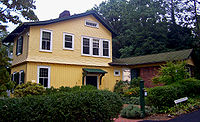 He died on January 4, 1882 at his home in Hastings-on-Hudson, New York
at the age of 70. The funeral was held at St Mark's Church in-the-Bowery
in New York City
. He was buried in Green-Wood Cemetery
, Brooklyn, New York.
in Hastings was designated a National Historic Landmark
.
In 1976, New York University
founded the John W. Draper Interdisciplinary Master's Program in Humanities and Social Thought (Draper Program) in honour of his life-long commitment to interdisciplinary study.
In 2001, Draper was designated an ACS National Historical Chemical Landmark
in recognition of his role as the first president of American Chemical Society
.
United States
The United States of America is a federal constitutional republic comprising fifty states and a federal district...
(English
England
England is a country that is part of the United Kingdom. It shares land borders with Scotland to the north and Wales to the west; the Irish Sea is to the north west, the Celtic Sea to the south west, with the North Sea to the east and the English Channel to the south separating it from continental...
-born) scientist
Scientist
A scientist in a broad sense is one engaging in a systematic activity to acquire knowledge. In a more restricted sense, a scientist is an individual who uses the scientific method. The person may be an expert in one or more areas of science. This article focuses on the more restricted use of the word...
, philosopher, physician
Physician
A physician is a health care provider who practices the profession of medicine, which is concerned with promoting, maintaining or restoring human health through the study, diagnosis, and treatment of disease, injury and other physical and mental impairments...
, chemist
Chemist
A chemist is a scientist trained in the study of chemistry. Chemists study the composition of matter and its properties such as density and acidity. Chemists carefully describe the properties they study in terms of quantities, with detail on the level of molecules and their component atoms...
, historian
Historian
A historian is a person who studies and writes about the past and is regarded as an authority on it. Historians are concerned with the continuous, methodical narrative and research of past events as relating to the human race; as well as the study of all history in time. If the individual is...
, and photographer. He is credited with producing the first clear photograph of a female face (1839–1840) and the first detailed photograph of the Moon
Moon
The Moon is Earth's only known natural satellite,There are a number of near-Earth asteroids including 3753 Cruithne that are co-orbital with Earth: their orbits bring them close to Earth for periods of time but then alter in the long term . These are quasi-satellites and not true moons. For more...
(1840). He was also the first President of the American Chemical Society
American Chemical Society
The American Chemical Society is a scientific society based in the United States that supports scientific inquiry in the field of chemistry. Founded in 1876 at New York University, the ACS currently has more than 161,000 members at all degree-levels and in all fields of chemistry, chemical...
(1876–1877) and a founder of the New York University School of Medicine. One of the Draper's books, History of the Conflict between Religion and Science, received worldwide recognition and was translated into several languages, but was banned by the Catholic Church. His son, Henry Draper
Henry Draper
Henry Draper was an American doctor and amateur astronomer. He is best known today as a pioneer of astrophotography.-Life and work:...
and his granddaughter, Antonia Maury
Antonia Maury
Antonia Caetana de Paiva Pereira Maury was an American astronomer who published an important early catalog of stellar spectra.-Early life:Antonia Maury was born in Cold Spring, New York...
were astronomers and his eldest son, John Christopher Draper
John Christopher Draper
John Christopher Draper was an American chemist and surgeon. He was a son of multidisciplinary scientist John William Draper and a brother of astronomer Henry Draper.-Life and work:...
was a chemist.
Early life
John William Draper was born May 5, 1811 in St. Helens, Merseyside, EnglandEngland
England is a country that is part of the United Kingdom. It shares land borders with Scotland to the north and Wales to the west; the Irish Sea is to the north west, the Celtic Sea to the south west, with the North Sea to the east and the English Channel to the south separating it from continental...
to John Christopher Draper, a Wesleyan
Wesleyanism
Wesleyanism or Wesleyan theology refers, respectively, to either the eponymous movement of Protestant Christians who have historically sought to follow the methods or theology of the eighteenth-century evangelical reformers, John Wesley and his brother Charles Wesley, or to the likewise eponymous...
clergyman and Sarah (Ripley) Draper. He also had three sisters, Dorothy Catherine (August 6, 1807 – December 10, 1901), Elizabeth Johnson, and Sarah Ripley. On June 23, he was baptized by the Wesleyan
Wesleyanism
Wesleyanism or Wesleyan theology refers, respectively, to either the eponymous movement of Protestant Christians who have historically sought to follow the methods or theology of the eighteenth-century evangelical reformers, John Wesley and his brother Charles Wesley, or to the likewise eponymous...
minister Jabez Bunting
Jabez Bunting
Jabez Bunting , English Wesleyan divine, was born of humble parentage at Manchester. He was educated at Manchester Grammar School, and at the age of nineteen began to preach, being received into full Connexion in 1803...
. His father often needed to move the family due to serving various congregations throughout England. John Wm. Draper was home tutored until 1822, when he entered Woodhouse Grove School
Woodhouse Grove School
Woodhouse Grove School is an independent, coeducational, day and boarding public school and Sixth Form college in Apperley Bridge, Bradford, West Yorkshire, England for children aged between 11 and 18...
. He returned to home instruction (1826) prior to entering University College London
University College London
University College London is a public research university located in London, United Kingdom and the oldest and largest constituent college of the federal University of London...
in 1829.
On September 13, 1831, John William Draper married Antonia Coetana de Paiva Pereira Gardner (c. 1814–1870), the daughter of Daniel Gardner, a court physician to John VI of Portugal
John VI of Portugal
John VI John VI John VI (full name: João Maria José Francisco Xavier de Paula Luís António Domingos Rafael; (13 May 1767 – 10 March 1826) was King of the United Kingdom of Portugal, Brazil and the Algarves (later changed to just King of Portugal and the Algarves, after Brazil was recognized...
and Charlotte of Spain
Charlotte of Spain
Doña Carlota Joaquina of Spain was a Queen consort of Portugal as wife of John VI...
. Antonia was born in Brazil
Brazil
Brazil , officially the Federative Republic of Brazil , is the largest country in South America. It is the world's fifth largest country, both by geographical area and by population with over 192 million people...
after the royal family fled Portugal
Portugal
Portugal , officially the Portuguese Republic is a country situated in southwestern Europe on the Iberian Peninsula. Portugal is the westernmost country of Europe, and is bordered by the Atlantic Ocean to the West and South and by Spain to the North and East. The Atlantic archipelagos of the...
with Napoleon's invasion. There is dispute as to the identity of Antonia's mother. Around 1830, she was sent with her brother Daniel to live with their aunt in London
London
London is the capital city of :England and the :United Kingdom, the largest metropolitan area in the United Kingdom, and the largest urban zone in the European Union by most measures. Located on the River Thames, London has been a major settlement for two millennia, its history going back to its...
.
Following his father's death in July, 1831, John William's mother was urged to move with her children to Virginia
Virginia
The Commonwealth of Virginia , is a U.S. state on the Atlantic Coast of the Southern United States. Virginia is nicknamed the "Old Dominion" and sometimes the "Mother of Presidents" after the eight U.S. presidents born there...
. John William hoped to acquire a teaching position at a local Methodist college.
Virginia
In 1832, the family settled in Mecklenburg County, VirginiaMecklenburg County, Virginia
As of the census of 2010, there were 32,727 people, 12,951 households, and 8,962 families residing in the county. The population density was 52 people per square mile . There were 17,403 housing units at an average density of 28 per square mile...
7½ miles (12 km) east (on Virginia State Route 47
Virginia State Route 47
Virginia State Route 47 is a primary state highway in the U.S. state of Virginia. The state highway runs from U.S. Route 1 and US 58 Business in South Hill north to US 460 Business in Pamplin City, Virginia...
) from Christiansville (now Chase City). Although he arrived too late to obtain the prospective teaching position, John William established a laboratory in Christiansville. Here he conducted experiments and published eight papers before entering medical school. His sister, Dorothy Catharine Draper provided finances through teaching drawing and painting for his medical education. In March 1836, he graduated from the University of Pennsylvania School of Medicine
University of Pennsylvania School of Medicine
The Perelman School of Medicine , formerly the University of Pennsylvania School of Medicine, was founded in 1765, making it the oldest American medical school. As part of the University of Pennsylvania, it is located in the University City section of Philadelphia, Pennsylvania. It is widely...
. That same year, he began teaching at Hampden-Sydney College
Hampden-Sydney College
Hampden–Sydney College is a liberal arts college for men located in Hampden Sydney, Virginia, United States. Founded in 1775, Hampden–Sydney is the oldest private charter college in the Southern U.S., the last college founded before the American Revolution, and one of only three four-year,...
in Virginia
Virginia
The Commonwealth of Virginia , is a U.S. state on the Atlantic Coast of the Southern United States. Virginia is nicknamed the "Old Dominion" and sometimes the "Mother of Presidents" after the eight U.S. presidents born there...
.
New York
In 1837, he took an appointment at New York UniversityNew York University
New York University is a private, nonsectarian research university based in New York City. NYU's main campus is situated in the Greenwich Village section of Manhattan...
; he was elected professor of chemistry and botany the next year. He was a professor in its school of medicine from 1840 to 1850, president of that school from 1850 to 1873, and professor of chemistry until 1881. He was a founder of the New York University Medical School.
Work
Draper did important research in photochemistryPhotochemistry
Photochemistry, a sub-discipline of chemistry, is the study of chemical reactions that proceed with the absorption of light by atoms or molecules.. Everyday examples include photosynthesis, the degradation of plastics and the formation of vitamin D with sunlight.-Principles:Light is a type of...
, made portrait photography possible by his improvements (1839) on Louis Daguerre's process
Daguerreotype
The daguerreotype was the first commercially successful photographic process. The image is a direct positive made in the camera on a silvered copper plate....
, and published a textbook on Chemistry (1846), textbook on Natural Philosophy (1847), textbook on Physiology (1866), and Scientific Memoirs (1878) on radiant energy.
In 1839–1840, Draper produced clear photographs, which at that time were regarded as the first life photographs of a human face, but more likely were the first clear photographs of a female face. Draper took a series of pictures, in with 65-second exposure by sunlight, and the first ones were of his female assistant. Her face was covered with a thin layer of flour to increase contrast, and those photos were not preserved. Draper also photographed his sister, Dorothy Catherine Draper, and one of those pictures (see image) became known to the public via the letter which Draper sent to John Herschel
John Herschel
Sir John Frederick William Herschel, 1st Baronet KH, FRS ,was an English mathematician, astronomer, chemist, and experimental photographer/inventor, who in some years also did valuable botanical work...
in 1840. Several copies were made of this picture in the 19th century, and the photograph attached with the Draper's letter was also likely a copy made by Draper himself.
In 1840 Draper became the first person to produce photographs of an astronomical object, the Moon
Moon
The Moon is Earth's only known natural satellite,There are a number of near-Earth asteroids including 3753 Cruithne that are co-orbital with Earth: their orbits bring them close to Earth for periods of time but then alter in the long term . These are quasi-satellites and not true moons. For more...
, considered the first astrophotographs
Astrophotography
Astrophotography is a specialized type of photography that entails recording images of astronomical objects and large areas of the night sky. The first photographs of an astronomical object were taken in the 1840s, but it was not until the late 19th century that advances in technology allowed for...
. In 1843 he made daguerreotypes which showed new features on the moon in the visible spectrum. In 1850 he was making photo-micrographs and engaged his then teenage son, Henry, into their production.
Draper developed the proposition in 1842 that only light rays that are absorbed can produce chemical change. It came to be known as the Grotthuss–Draper law when his name was teamed with a prior but apparently unknown promulgator Theodor Grotthuss of the same idea in 1817.
In 1847 he published the observation that all solids glow red at about the same temperature, about 977˚ F (798 K), which has come to be known as the Draper point
Draper point
The Draper point is the approximate temperature above which almost all solid materials visibly glow as a result of blackbody radiation. It was established at 977˚ F by John William Draper in 1847....
.
On Saturday 30 May the 1860 Oxford evolution debate
1860 Oxford evolution debate
The 1860 Oxford evolution debate took place at the Oxford University Museum on 30 June 1860, seven months after the publication of Charles Darwin's On the Origin of Species. Several prominent British scientists and philosophers participated, including Thomas Henry Huxley, Bishop Samuel...
featured Draper's lecture on his paper "On the Intellectual Development of Europe, considered with reference to the views of Mr. Darwin and others, that the progression of organisms is determined by law." Draper's presentation was an early example of applying a Darwinian metaphor of adaptation
Adaptation
An adaptation in biology is a trait with a current functional role in the life history of an organism that is maintained and evolved by means of natural selection. An adaptation refers to both the current state of being adapted and to the dynamic evolutionary process that leads to the adaptation....
and environment to social and political studies, but was thought to be long and boring. The hall was crowded to hear Bishop Samuel Wilberforce
Samuel Wilberforce
Samuel Wilberforce was an English bishop in the Church of England, third son of William Wilberforce. Known as "Soapy Sam", Wilberforce was one of the greatest public speakers of his time and place...
's views on Charles Darwin
Charles Darwin
Charles Robert Darwin FRS was an English naturalist. He established that all species of life have descended over time from common ancestry, and proposed the scientific theory that this branching pattern of evolution resulted from a process that he called natural selection.He published his theory...
's recent publication of On the Origin of Species, and the occasion was a historically significant part of the reaction to Darwin's theory
Reaction to Darwin's theory
The immediate reaction to Darwin's theory followed closely on his publication of On the Origin of Species, and Charles Darwin's book sparked off international debate, though the heat of controversy was less than that over earlier works such as Vestiges of Creation...
due to reports of Thomas Henry Huxley's response to Wilberforce.
Contributions to the discipline of history: Draper is well known also as the author of The History of the Intellectual Development of Europe (1862), applying the methods of physical science to history, a History of the American Civil War (3 vols., 1867–1870), and a History of the Conflict between Religion and Science (1874). The last book listed is among the most influential works on the conflict thesis
Conflict thesis
The conflict thesis proposes an intrinsic intellectual conflict between religion and science. The original historical usage of the term denoted that the historical record indicates religion’s perpetual opposition to science. Later uses of the term denote religion’s epistemological opposition to...
, which takes its name from Draper's title.
He served as the first president of the American Chemical Society
American Chemical Society
The American Chemical Society is a scientific society based in the United States that supports scientific inquiry in the field of chemistry. Founded in 1876 at New York University, the ACS currently has more than 161,000 members at all degree-levels and in all fields of chemistry, chemical...
between 1876 and 1877.
Children
- John Christopher DraperJohn Christopher DraperJohn Christopher Draper was an American chemist and surgeon. He was a son of multidisciplinary scientist John William Draper and a brother of astronomer Henry Draper.-Life and work:...
(1835–1885) - Henry DraperHenry DraperHenry Draper was an American doctor and amateur astronomer. He is best known today as a pioneer of astrophotography.-Life and work:...
(1837–1882) - Virginia Draper Maury (1839–1885)
- Daniel Draper (1841–1931)
- William Draper (1845–1853)
- Antonia Draper Dixon (1849–1923)
Death
Hastings-on-Hudson, New York
Hastings-on-Hudson is a village in Westchester County, New York, United States. It is located in the southwest part of the town of Greenburgh. As of the 2010 census, it had a population of 7,849. It lies on U.S. Route 9, "Broadway" in Hastings...
at the age of 70. The funeral was held at St Mark's Church in-the-Bowery
St Mark's Church in-the-Bowery
St. Mark's Church in-the-Bowery is located at 131 East 10th Street, at the intersection of Stuyvesant Streets and Second Avenue in the East Village neighborhood of Manhattan in New York City...
in New York City
New York City
New York is the most populous city in the United States and the center of the New York Metropolitan Area, one of the most populous metropolitan areas in the world. New York exerts a significant impact upon global commerce, finance, media, art, fashion, research, technology, education, and...
. He was buried in Green-Wood Cemetery
Green-Wood Cemetery
Green-Wood Cemetery was founded in 1838 as a rural cemetery in Brooklyn, Kings County , New York. It was granted National Historic Landmark status in 2006 by the U.S. Department of the Interior.-History:...
, Brooklyn, New York.
Legacy
In 1975, Draper's houseJohn William Draper House
The John William Draper House, also known as Draper Park, is located on US 9 in Hastings-on-Hudson, New York, USA. It was the home of John William Draper, 1811-1882. His son Henry Draper, 1837-1882, created an observatory on the estate...
in Hastings was designated a National Historic Landmark
National Historic Landmark
A National Historic Landmark is a building, site, structure, object, or district, that is officially recognized by the United States government for its historical significance...
.
In 1976, New York University
New York University
New York University is a private, nonsectarian research university based in New York City. NYU's main campus is situated in the Greenwich Village section of Manhattan...
founded the John W. Draper Interdisciplinary Master's Program in Humanities and Social Thought (Draper Program) in honour of his life-long commitment to interdisciplinary study.
In 2001, Draper was designated an ACS National Historical Chemical Landmark
ACS National Historical Chemical Landmarks
The National Historic Chemical Landmarks Program was launched by the American Chemical Society in 1992 and has recognized more than 60 landmarks to date. The program celebrates the centrality of chemistry...
in recognition of his role as the first president of American Chemical Society
American Chemical Society
The American Chemical Society is a scientific society based in the United States that supports scientific inquiry in the field of chemistry. Founded in 1876 at New York University, the ACS currently has more than 161,000 members at all degree-levels and in all fields of chemistry, chemical...
.
Draper's publications
- Elements of Chemistry, Including the Most Recent Discoveries and Applications of the Science to Medicine and Pharmacy, and to the Arts. by Robert KaneRobert Kane (chemist)Sir Robert John Kane was an Irish chemist.-Youth:His father, John Kean, was involved in the Irish Rebellion of 1798 and fled for a time to France where he studied chemistry...
and John William Draper. New York: Harper and Brothers, 1842. - History of the American Civil War. New York: Harper & Brothers, 1867–70.
- History of the Conflict Between Religion and Science. New York: D. Appleton, 1874.
- History of the Intellectual Development of Europe. New York: Harper & Brothers, 1864., 1900 edition, v.1,v.2
- Human Physiology, Statistical and Dynamical; or, the Conditions and Course of the Life of Man. New York: Harper & Brothers, 1856.
- Life of Franklin, Edited by Ronald S. Wilkinson. Washington, D.C.: Library of Congress: U.S. Government Printing Office, 1977.
- Science in America: Inaugural address of Dr. John W. Draper, as president of the American Chemical Society New York: J.F. Trow & Son, Printers, 1876.
- Scientific Memoirs; Being Experimental Contributions to a Knowledge of Radiant Energy. New York: Harper & Brothers, 1878.
- Text-Book on Chemistry. For the Use of Schools and Colleges. New York: Harper & Brothers, 1851., 1861 edition
- Text-Book on Natural Philosophy. New York: Harper & Brothers, 1847.
- Thoughts on the Future Civil Policy of America. 3rd ed. New York: Harper & Brothers, 1867.
- Treatise on the Forces Which Produce the Organization of Plants. With an Appendix Containing Several Memoirs on Capillary Attraction, Electricity, and the Chemical Action of Light. New York: Harper & Brothers, 1844.
External links
- THE DAGUERREOTYPE PORTRAIT OF DOROTHY DRAPER. The Photographic Journal (Royal Photographic Society), December 1970, vol. 110, pp. 478–482
- Draper Family Collection, ca. 1826–1936 at the National Museum of American HistoryNational Museum of American HistoryThe National Museum of American History: Kenneth E. Behring Center collects, preserves and displays the heritage of the United States in the areas of social, political, cultural, scientific and military history. Among the items on display are the original Star-Spangled Banner and Archie Bunker's...
- Draper Family Collection, 1836–1982 at the New York UniversityNew York UniversityNew York University is a private, nonsectarian research university based in New York City. NYU's main campus is situated in the Greenwich Village section of Manhattan...
Archives - Harper's Magazine articles by John William Draper
- Renaissance man at the ACS National Historical Chemical LandmarksACS National Historical Chemical LandmarksThe National Historic Chemical Landmarks Program was launched by the American Chemical Society in 1992 and has recognized more than 60 landmarks to date. The program celebrates the centrality of chemistry...
- Dorothy Catherine Draper, taken by John W. Draper
- NYU First Medical Faculty, 1841 J.W. Draper lower right corner
- New York University John W. Draper Interdisciplinary Master's Program in Humanities and Social Thought (Draper Program)
- Draper Society (NYU Club)