


Japanese martial arts

Encyclopedia
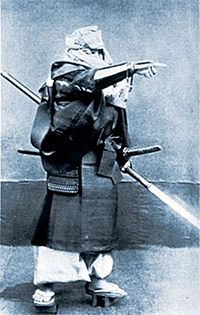
Martial arts
Martial arts are extensive systems of codified practices and traditions of combat, practiced for a variety of reasons, including self-defense, competition, physical health and fitness, as well as mental and spiritual development....
native to Japan
Japan
Japan is an island nation in East Asia. Located in the Pacific Ocean, it lies to the east of the Sea of Japan, China, North Korea, South Korea and Russia, stretching from the Sea of Okhotsk in the north to the East China Sea and Taiwan in the south...
. At least three Japanese terms are often used interchangeably with the English phrase "Japanese martial arts": , literally meaning "martial way", , which has no perfect translation but means something like science, art, or craft
Craft
A craft is a branch of a profession that requires some particular kind of skilled work. In historical sense, particularly as pertinent to the Medieval history and earlier, the term is usually applied towards people occupied in small-scale production of goods.-Development from the past until...
of war, and , literally meaning "martial art." The term "budō" is a modern one, and is normally intended to indicate the practice of martial arts as a way of life, and encompassing physical, spiritual
Spirituality
Spirituality can refer to an ultimate or an alleged immaterial reality; an inner path enabling a person to discover the essence of his/her being; or the “deepest values and meanings by which people live.” Spiritual practices, including meditation, prayer and contemplation, are intended to develop...
, and moral
Moral
A moral is a message conveyed or a lesson to be learned from a story or event. The moral may be left to the hearer, reader or viewer to determine for themselves, or may be explicitly encapsulated in a maxim...
dimensions with a focus of self-improvement, fulfillment, or personal growth. The terms bujutsu and bugei have more discrete definitions, at least historically speaking. Bujutsu refers specifically to the practical application of martial tactics and techniques in actual combat. Bugei refers to the adaptation or refinement of those tactics and techniques to facilitate systematic instruction and dissemination within a formal learning environment.
History
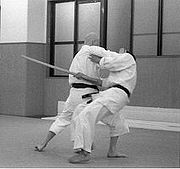
Samurai
is the term for the military nobility of pre-industrial Japan. According to translator William Scott Wilson: "In Chinese, the character 侍 was originally a verb meaning to wait upon or accompany a person in the upper ranks of society, and this is also true of the original term in Japanese, saburau...
and the caste system that restricted the use of weapons by members of the non-warrior classes. Originally, samurai were expected to be proficient in many weapons, as well as unarmed combat, and attain the highest possible mastery of combat skills, for the purpose of glorifying either themselves or their liege
Feudalism
Feudalism was a set of legal and military customs in medieval Europe that flourished between the 9th and 15th centuries, which, broadly defined, was a system for ordering society around relationships derived from the holding of land in exchange for service or labour.Although derived from the...
. Over time, this purpose gave way to a philosophy of achieving spiritual goals by striving to perfect their martial skills.
Ordinarily, the development of combative techniques is intertwined with the tools used to execute those techniques. In a rapidly changing world, those tools are constantly changing, requiring that the techniques to use them be continuously reinvented. The history of Japan is somewhat unique in its relative isolation. Compared with the rest of the world, the Japanese tools of war evolved slowly. Many people believe that this afforded the warrior class the opportunity to study their weapons with greater depth than other cultures. Nevertheless, the teaching and training of these martial arts did evolve, first with conditions on the battlefield (archery giving way to the sword; giving way to spear), then through a long period of peace, and finally into modern times. Over time two trends defined the arts - first there was increasing specialization, and second, many of the arts evolved towards more peaceful practices and took on the teachings of budō
Budo
is a Japanese term describing martial arts. In English, it is used almost exclusively in reference to Japanese martial arts.-Etymology:Budō is a compound of the root bu , meaning war or martial; and dō , meaning path or way. Specifically, dō is derived from the Buddhist Sanskrit mārga...
which implies a higher purpose than just the mastering of arms.
The martial arts developed or originating in Japan are extraordinarily diverse, with vast differences in training tools, methods, and philosophy across innumerable schools and styles. That said, Japanese martial arts may generally be divided into koryū
Koryu
is a Japanese word that is used in association with the ancient Japanese martial arts. This word literally translates as "old school" or "traditional school"...
and gendai budō
Gendai Budo
, meaning "modern martial way", are modern Japanese martial arts which were established after the Meiji Restoration . Koryū are the opposite: ancient martial arts established before the Meiji Restoration.-Scope and tradition:...
based on whether they existed prior to or after the Meiji Restoration, respectively. Since gendai budō and koryū often share the same historical origin, one will find various types of martial arts (such as jujutsu
Jujutsu
Jujutsu , also known as jujitsu, ju-jitsu, or Japanese jiu-jitsu, is a Japanese martial art and a method of close combat for defeating an armed and armored opponent in which one uses no weapon, or only a short weapon....
, kenjutsu
Kenjutsu
, meaning "the method, or technique, of the sword." This is opposed to kendo, which means the way of the sword. Kenjutsu is the umbrella term for all traditional schools of Japanese swordsmanship, in particular those that predate the Meiji Restoration...
, or naginatajutsu
Naginatajutsu
is the Japanese martial art of wielding the . This is a weapon resembling the medieval European glaive. Most naginatajutsu practiced today is in a modernized form, a gendai budō, in which competitions also are held.-Debated origins:...
) on both sides of the divide.
- A note on the organization of this article; it would be impossible to discuss Japanese martial arts in terms of the thousands of individual schools or styles, such as Ittō-ryūItto-ryu, meaning "one-sword school", is the ancestor school of several Japanese Koryū kenjutsu styles, including Ono-ha, Mizoguchi-ha, Nakanishi-ha, Kogen, Hokushin, and Itto Shoden. The style was developed by Ittōsai Kagehisa.-Ono-ha Ittō-ryū:...
, Daitō-ryūDaito-ryu, originally called , is a Japanese martial art that first became widely known in the early 20th century under the headmastership of Takeda Sokaku. Takeda had extensive training in several martial arts and referred to the style he taught as "Daitō-ryū"...
, or Tenshin Shōden Katori Shintō-ryūTenshin Shoden Katori Shinto-ryuis one of the oldest extant Japanese martial arts, and an exemplar of koryū bujutsu. The Tenshin Shōden Katori Shintō-ryū was founded by Iizasa Ienao, born 1387 in Iizasa village , who was living near Katori Shrine at the time...
. Instead, major sections are divided based on when the art originated (regardless of whether it is still practiced), and subsections are dedicated to the root type of martial art, such as jujutsu (the art of empty-handed combat through use of indirect application of force) or the modern kendo (Japanese sport fencing), wherein notable styles or major differences between styles may be discussed.
Koryū
, meaning traditional school, or old school, refers specifically to schools of martial arts, originating in Japan, either prior to the beginning of the Meiji RestorationMeiji Restoration
The , also known as the Meiji Ishin, Revolution, Reform or Renewal, was a chain of events that restored imperial rule to Japan in 1868...
in 1868, or the Haitōrei edict in 1876.
The term also is used generally to indicate that a particular style or art is "traditional", rather than "modern". However, what it means for an art to be either "traditional" or "modern" is subject to some debate. As a general rule of thumb, the primary purpose of a koryū martial art was for use in war. The most extreme example of a koryū school is one that preserves its traditional, and often ancient, martial practices even in the absence of continuing wars in which to test them. Other koryū schools may have made modifications to their practices that reflect the passage of time (which may or may not have resulted in the loss of "koryū" status in the eyes of its peers). This is as opposed to "modern" martial arts, whose primary focus is generally upon the self-improvement (mental, physical, or spiritual) of the individual practitioner, with varying degrees of emphasis on the practical application of the martial art for either sport or self defence purposes.
The following subsections represent not individual schools of martial arts, but rather generic "types" of martial arts. These are generally distinguishable on the basis of their training methodology and equipment, though wide variation still exists within each.
Sumo
, considered by many to be Japan's national sport, has its origins in the distant past. The earliest written records of Japan, which are dated from the 8th century AD, record the first sumo match in 23 BC, occurring specifically at the request of the emperor and continuing until one man was too wounded to continue. Beginning in 728 AD, the emperor Shōmu TennōEmperor Shomu
was the 45th emperor of Japan, according to the traditional order of succession.Shōmu's reign spanned the years 724 through 723.-Traditional narrative:...
(聖武 天皇, 701–756) began holding official sumo matches at the annual harvest festivals. This tradition of having matches in the presence of the emperor continued, but gradually spread, with matches also held at Shinto festivals, and sumo training was eventually incorporated into military training. By the 17th century, sumo was an organized professional sport, open to the public, enjoyed by both the upper class and commoners.
Today, sumo retains much of its traditional trappings, including a referee dressed as a Shinto priest, and a ritual where the competitors clap hands, stomp their feet, and throw salt in the ring prior to each match. To win a match, competitors employ throwing and grappling techniques to force the other man to the ground; the first man to touch the ground with a part of the body other than the bottom of the feet, or touch the ground outside the ring with any part of the body, loses. Six grand tournaments are held annually in Japan, and each professional fighter's name and relative ranking is published after each tournament in an official list, called the banzuke, which is followed religiously by sumo fans.
Jujutsu
, literally translates to "art of pliance". More accurately, however, it means the art of using indirect force, such as joint locks or throwing techniques, to defeat an opponent, as opposed to direct force such as a punch or a kick. This is not to imply that jujutsu does not teach or employ strikes, but rather that the art's aim is the ability to use an attacker's force against him or her, and counter-attack where they are weakest or least defended.Methods of combat included striking (kicking, punching), throwing (body throws, joint-lock throws, unbalance throws), restraining (pinning, strangulating, grappling, wrestling) and weaponry. Defensive tactics included blocking, evading, off balancing, blending and escaping. Minor weapons such as the tantō
Tanto
A is one of the traditional Japanese swords that were worn by the samurai class of feudal Japan. The tantō dates to the Heian period, when it was mainly used as a weapon but evolved in design over the years to become more ornate...
(dagger), ryufundo kusari (weighted chain), jutte (helmet smasher), and kakushi buki (secret or disguised weapons) were almost always included in koryū jujutsu.
Most of these were battlefield-based systems to be practiced as companion arts to the more common and vital weapon systems. At the time, these fighting arts went by many different names, including kogusoku, yawara, kumiuchi, and hakuda. In reality, these grappling systems were not really unarmed systems of combat, but are more accurately described as means whereby an unarmed or lightly armed warrior could defeat a heavily armed and armored enemy on the battlefield. Ideally, the samurai would be armed and would not need to rely on such techniques.
In later times, other koryū developed into systems more familiar to the practitioners of the jujutsu commonly seen today. These systems are generally designed to deal with opponents neither wearing armor nor in a battlefield environment. For this reason, they include extensive use of atemi waza (vital-striking technique). These tactics would be of little use against an armored opponent on a battlefield. They would, however, be quite valuable to anyone confronting an enemy or opponent during peacetime dressed in normal street attire. Occasionally, inconspicuous weapons such as knives or tessen (iron fans) were included in the curriculum.
Today, jujutsu is practiced in many forms, both ancient and modern. Various methods of jujutsu have been incorporated or synthesized into judo and aikido
Aikido
is a Japanese martial art developed by Morihei Ueshiba as a synthesis of his martial studies, philosophy, and religious beliefs. Aikido is often translated as "the Way of unifying life energy" or as "the Way of harmonious spirit." Ueshiba's goal was to create an art that practitioners could use to...
, as well as being exported throughout the world and transformed into sport wrestling systems, adopted in whole or part by schools of karate or other unrelated martial arts, still practiced as they were centuries ago, or all of the above.
Swordsmanship
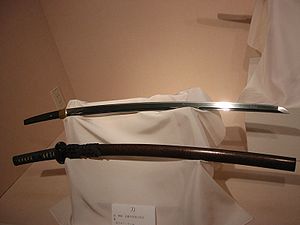
Sword
A sword is a bladed weapon used primarily for cutting or thrusting. The precise definition of the term varies with the historical epoch or the geographical region under consideration...
, has an almost mythological ethos, and is believed by some to be the paramount martial art, surpassing all others. Regardless of the truth of that belief, the sword itself has been the subject of stories and legends through virtually all cultures in which it has been employed as a tool for violence. In Japan, the use of the katana
Katana
A Japanese sword, or , is one of the traditional bladed weapons of Japan. There are several types of Japanese swords, according to size, field of application and method of manufacture.-Description:...
is no different. Although originally the most important skills of the warrior class were proficiency at horse-riding and shooting the bow, this eventually gave way to swordsmanship. The earliest swords, which can be dated as far back as the Kofun era (3rd and 4th centuries) were primarily straight bladed. According to legend, curved swords made strong by the famous folding process were first forged by the smith Amakuni Yasutsuna (天國 安綱, c.700 AD).
Other sources explain that the folding process was brought to Japan from China
China
Chinese civilization may refer to:* China for more general discussion of the country.* Chinese culture* Greater China, the transnational community of ethnic Chinese.* History of China* Sinosphere, the area historically affected by Chinese culture...
.
The primary development of the sword occurred between 987 AD and 1597 AD. This development is characterized by profound artistry during peaceful eras, and renewed focus on durability, utility, and mass production during the intermittent periods of warfare, most notably civil warfare
Kamakura period
The is a period of Japanese history that marks the governance by the Kamakura Shogunate, officially established in 1192 in Kamakura by the first shogun Minamoto no Yoritomo....
during the 12th century and the Mongolian invasions
Mongol invasions of Japan
The ' of 1274 and 1281 were major military efforts undertaken by Kublai Khan to conquer the Japanese islands after the submission of Goryeo to vassaldom. Despite their ultimate failure, the invasion attempts are of macrohistorical importance, because they set a limit on Mongol expansion, and rank...
during the 13th century (which in particular saw the transition from mostly horseback archery to hand to hand ground fighting).
This development of the sword is paralleled by the development of the methods used to wield it. During times of peace, the warriors trained with the sword, and invented new ways to implement it. During war, these theories were tested. After the war ended, those who survived examined what worked and what didn't, and passed their knowledge on. In 1600 AD, Tokugawa Ieyasu
Tokugawa Ieyasu
was the founder and first shogun of the Tokugawa shogunate of Japan , which ruled from the Battle of Sekigahara in 1600 until the Meiji Restoration in 1868. Ieyasu seized power in 1600, received appointment as shogun in 1603, abdicated from office in 1605, but...
(徳川 家康, 1543–1616) gained total control of all of Japan, and the country entered a period of prolonged peace that would last until the Meiji Restoration
Meiji Restoration
The , also known as the Meiji Ishin, Revolution, Reform or Renewal, was a chain of events that restored imperial rule to Japan in 1868...
. During this period, the techniques to use the sword underwent a transition from a primarily utilitarian art for killing, to one encompassing a philosophy of personal development and spiritual perfection.
The terminology used to describe the Japanese art of swordsmanship is somewhat ambiguous. Many names have been used to describe various aspects of the art, or to encompass the art as a whole.
Kenjutsu
literally means "the art/science of the sword". Although the term has been used as a general term to refer to swordsmanship as a whole, in modern times, kenjutsu is more often used to refer to the specific aspect of swordsmanship dealing with partnered sword training. It is the oldest form of training, and at its simplest level, consists of two partners with swords drawn, practicing combat drills. Historically practiced with wooden katana (bokkenBokken
A bokken , "wood", and ken, "sword") , is a Japanese wooden sword used for training. It is usually the size and shape of a katana, but is sometimes shaped like other swords, such as the wakizashi and tantō...
), this most often consists of pre-determined forms, called kata
Kata
is a Japanese word describing detailed choreographed patterns of movements practised either solo or in pairs. The term form is used for the corresponding concept in non-Japanese martial arts in general....
, or sometimes called kumitachi, and similar to the partner drills practiced in kendo. Among advanced students, kenjutsu training may also include increasing degrees of freestyle practice.
Battōjutsu
, literally meaning "the art/science of drawing a sword", and developed in the mid-15th century, is the aspect of swordsmanship focused upon the efficient draw of the sword, cutting down one's enemy, and returning the sword to its scabbardScabbard
A scabbard is a sheath for holding a sword, knife, or other large blade. Scabbards have been made of many materials over the millennia, including leather, wood, and metals such as brass or steel.-Types of scabbards:...
(saya). The term came into use specifically during the Warring States Period
Warring States Period
The Warring States Period , also known as the Era of Warring States, or the Warring Kingdoms period, covers the Iron Age period from about 475 BC to the reunification of China under the Qin Dynasty in 221 BC...
(15th–17th cent.). Closely related to, but predating iaijutsu, battōjutsu training emphasizes defensive counter-attacking. Battōjutsu training technically incorporates kata, but generally consist of only a few moves, focusing on stepping up to an enemy, drawing, performing one or more cuts, and sheathing the weapon. Battōjutsu exercises tend to lack the elaborateness, as well as the aesthetic considerations of iaijutsu or iaidō kata. Finally, note that use of the name alone is not dispositive; what is battōjutsu to one school may be iaijutsu to another.
Iaijutsu and Iaidō
, approximately "the art/science of mental presence and immediate reaction", is also the Japanese art of drawing the sword. However, unlike battōjutsu, iaijutsu tends to be technically more complex, and there is a much stronger focus upon perfecting form. The primary technical aspects are smooth, controlled movements of drawing the sword from its scabbard, striking or cutting an opponent, removing blood from the blade, and then replacing the sword in the scabbard., which would be "the way of mental presence and immediate reaction", is nominally the modernization of iaijutsu, but in practice is frequently identical to iaijutsu. The replacement of jutsu with dō is part of the 20th century emphasis upon personal and spiritual development; an evolution that took place in many martial arts. In the case of iaidō, some schools merely changed in name without altering the curriculum, and others embraced the wholesale change from a combat-orientation to spiritual growth.
Naginatajutsu
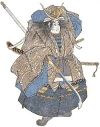
Glaive
A glaive is a European polearm weapon, consisting of a single-edged blade on the end of a pole. It is similar to the Japanese naginata and the Chinese Guan Dao....
or guisarme
Guisarme
A guisarme was a pole weapon used in Europe primarily between 1000-1400. Like many medieval polearms, the exact form of the weapon is hard to define from literary references and the identification of surviving weapons can be speculative...
. Most naginata practice today is in a modernized form (gendai budō) called the "way of naginata" (naginata-dō) or "new naginata" (atarashii naginata), in which competitions are also held.
However, many koryu maintain naginatajutsu in their curriculum. Also of note, during the late Edo period
Edo period
The , or , is a division of Japanese history which was ruled by the shoguns of the Tokugawa family, running from 1603 to 1868. The political entity of this period was the Tokugawa shogunate....
, naginata were used to train women and ladies in waiting. Thus, most naginatajutsu styles are headed by women and most naginata practitioners in Japan are women. This has led to the impression overseas that naginatajutsu is a martial art that was not used by male warriors. In fact, naginatajutsu was developed by the warrior monks of early medieval Japan and was widely used by samurai
Samurai
is the term for the military nobility of pre-industrial Japan. According to translator William Scott Wilson: "In Chinese, the character 侍 was originally a verb meaning to wait upon or accompany a person in the upper ranks of society, and this is also true of the original term in Japanese, saburau...
.
Sōjutsu
is the Japanese art of fighting with the spearSpear
A spear is a pole weapon consisting of a shaft, usually of wood, with a pointed head.The head may be simply the sharpened end of the shaft itself, as is the case with bamboo spears, or it may be made of a more durable material fastened to the shaft, such as flint, obsidian, iron, steel or...
(yari
Yari
is the term for one of the traditionally made Japanese blades in the form of a spear, or more specifically, the straight-headed spear...
). For most of Japan's history, sōjutsu was practiced extensively by traditional schools. In times of war, it was a primary skill of many soldiers. Today it is a minor art taught in very few schools.
Ninjutsu
Ninjutsu was developed by groups of people mainly from the Iga ProvinceIga Province
was an old province of Japan in the area that is today western Mie Prefecture. It was sometimes called . Iga bordered on Ise, Ōmi, Yamato, and Yamashiro Provinces.-Geography:...
and Kōka, Shiga
Koka, Shiga
is a city located in the southern part of Shiga Prefecture, Japan....
of Japan
Japan
Japan is an island nation in East Asia. Located in the Pacific Ocean, it lies to the east of the Sea of Japan, China, North Korea, South Korea and Russia, stretching from the Sea of Okhotsk in the north to the East China Sea and Taiwan in the south...
. Throughout history the shinobi have been seen as assassin
Assassination
To carry out an assassination is "to murder by a sudden and/or secret attack, often for political reasons." Alternatively, assassination may be defined as "the act of deliberately killing someone, especially a public figure, usually for hire or for political reasons."An assassination may be...
s, scouts and spies. They are mainly noted for their use of stealth and deception. Throughout history many different schools (ryū
Ryu (school)
A Ryū , or ryūha , is a Japanese word referring to a school of thought in any discipline...
) have taught their unique versions of ninjutsu. An example of these is the Togakure-ryū
Togakure-ryū
is a historical tradition of Ninjutsu known as the "School of the Hidden Door", founded during the Oho period by Daisuke Nishina , who learned his original fighting techniques from a Chinese monk named Kain Dōshi. However, the history and early lineage of Togakure-ryū may be impossible to verify...
. This ryū was developed after a defeated samurai warrior called Daisuke Togakure escaped to the region of Iga. Later he came in contact with the warrior-monk Kain Doshi who taught him a new way of viewing life and the means of survival (ninjutsu).
Ninjutsu was developed as a collection of fundamental survivalist techniques in the warring state of feudal Japan in the 14th century. The ninja used their art to ensure their survival in a time of violent political turmoil. Ninjutsu included methods of gathering information, and techniques of non-detection, avoidance, and misdirection. Ninjutsu can also involve training in disguise
Disguise
A disguise can be anything which conceals or changes a person's physical appearance, including a wig, glasses, makeup, costume or other ways. Camouflage is one type of disguise for people, animals and objects...
, escape
Escapology
For the Jessica Mauboy song, see Inescapable.Escapology is the practice of escaping from restraints or other traps. Escapologists escape from handcuffs, straitjackets, cages, coffins, steel boxes, barrels, bags, burning buildings, fish-tanks and other perils, often in combination.-History:The art...
, concealment, archery
Archery
Archery is the art, practice, or skill of propelling arrows with the use of a bow, from Latin arcus. Archery has historically been used for hunting and combat; in modern times, however, its main use is that of a recreational activity...
, medicine
Medicine
Medicine is the science and art of healing. It encompasses a variety of health care practices evolved to maintain and restore health by the prevention and treatment of illness....
, explosives, and poisons.
Other koryū martial arts
The original martial art schools of Japan were almost entirely sogo (comprehensive) bujutsu. With the long peace of the Tokugawa shogunateTokugawa shogunate
The Tokugawa shogunate, also known as the and the , was a feudal regime of Japan established by Tokugawa Ieyasu and ruled by the shoguns of the Tokugawa family. This period is known as the Edo period and gets its name from the capital city, Edo, which is now called Tokyo, after the name was...
there was an increase in specialization with many schools identifying themselves with particular major battlefield weapons. However, there were many additional weapons employed by the warriors of feudal Japan, and an art to wielding each. Usually they were studied as secondary or tertiary weapons within a school but there are exceptions, such as the art of wielding the short staff, (jōdō
Jodo
, meaning "the way of the jō", or is a Japanese martial art using short staffs called jō. The art is similar to bōjutsu, and is strongly focused upon defense against the Japanese sword. The jō is a short staff, usually about 3 to 5 feet long...
) which was the primary art taught by the Shintō Musō-ryū
Shinto Muso-ryu
, most commonly known by its practice of jōdō, is a traditional school of the Japanese martial art of jōjutsu, or the art of wielding the short staff . The technical purpose of the art is to learn how to defeat a swordsman in combat using the jō, with an emphasis on proper combative distance,...
.
Other arts existed to teach military skills other than the use of weaponry. Examples of these include marine
Marine (ocean)
Marine is an umbrella term. As an adjective it is usually applicable to things relating to the sea or ocean, such as marine biology, marine ecology and marine geology...
skills such as swimming and river-fording
Ford (crossing)
A ford is a shallow place with good footing where a river or stream may be crossed by wading or in a vehicle. A ford is mostly a natural phenomenon, in contrast to a low water crossing, which is an artificial bridge that allows crossing a river or stream when water is low.The names of many towns...
(suijutsu
Suijutsu
Suijutsu or suieijutsu is the Japanese martial art of combative swimming. Literal translation of the term from Japanese is "water skills".- Sources :* by Iwasaki Hisashi, of the Shudokan Martial Arts Association* by Dr. William Durbin...
), equestrianism
Equestrianism
Equestrianism more often known as riding, horseback riding or horse riding refers to the skill of riding, driving, or vaulting with horses...
(bajutsu), arson
Arson
Arson is the crime of intentionally or maliciously setting fire to structures or wildland areas. It may be distinguished from other causes such as spontaneous combustion and natural wildfires...
and demolition
Demolition
Demolition is the tearing-down of buildings and other structures, the opposite of construction. Demolition contrasts with deconstruction, which involves taking a building apart while carefully preserving valuable elements for re-use....
(kajutsu).
Gendai budō
, literally meaning "modern martial way", is a generic term used to describe Japanese martial arts that are considered "modern". That is, either the art was founded after the beginning of the Meiji Restoration in 1868, or an art which changed its methodology in such a way that it lost koryū status, and is now considered gendai budō. AikidoAikido
is a Japanese martial art developed by Morihei Ueshiba as a synthesis of his martial studies, philosophy, and religious beliefs. Aikido is often translated as "the Way of unifying life energy" or as "the Way of harmonious spirit." Ueshiba's goal was to create an art that practitioners could use to...
and judo are examples of gendai budō that were founded in the modern era, while iaidō represents the modernization of a practice that has existed for centuries.
The core difference is, as was explained under "koryū", above, that koryū arts are practiced as they were when their primary utility was for use in war, while the primary purpose of gendai budō is for self-improvement, with application as a secondary purpose. Additionally, many of the gendai budō have included a modern sporting element to them. Judo and modern kendo are both examples of this.
Judo
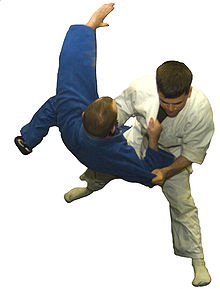
Grappling
Grappling refers to techniques, maneuvers, and counters applied to an opponent in order to gain a physical advantage, such as improving relative position, escaping, submitting, or injury to the opponent. Grappling is a general term that covers techniques used in many disciplines, styles and martial...
-based martial art, practiced primarily as a sport. It contains substantially the same emphasis on the personal, spiritual, and physical self-improvement of its practitioners as can be found throughout gendai budō.
Judo was created by Kano Jigoro
Kano Jigoro
was the founder of judo. Judo was the first Japanese martial art to gain widespread international recognition, and the first to become an official Olympic sport. Pedagogical innovations attributed to Kanō include the use of black and white belts, and the introduction of dan ranking to show the...
(嘉納 治五郎 Kanō Jigorō, 1860–1938) at the end of the 19th century. Kano was a brilliant martial artist educated at the Tokyo Imperial University. The combination of martial talent and formal education enabled Kano to take the koryū martial arts he learned (specifically Kitō-ryū
Kito-ryu
is a traditional school of the Japanese martial art of jujutsu. Its syllabus comprises atemi-waza , nage-waza , kansetsu-waza and shime-waza...
and Tenjin Shin'yo-ryū
Tenjin Shinyo-ryu
, literally meaning "Divine True Willow School", can be classified as a traditional school of jujutsu. It was founded by Iso Mataemon Minamoto no Masatari in the 1830s...
jujutsu), and systematically reinvent them into a martial art with an emphasis on freestyle practice and competition. Kano devised a powerful system of new techniques and training methods, which famously culminated on June 11, 1886, in a tournament that would later be dramatized by celebrated Japanese filmmaker Akira Kurosawa
Akira Kurosawa
was a Japanese film director, producer, screenwriter and editor. Regarded as one of the most important and influential filmmakers in the history of cinema, Kurosawa directed 30 filmsIn 1946, Kurosawa co-directed, with Hideo Sekigawa and Kajiro Yamamoto, the feature Those Who Make Tomorrow ;...
(黒沢 明 Kurosawa Akira, 1910–1998), in the film "Sanshiro Sugata
Sanshiro Sugata
was the directorial debut of the Academy Award-winning Japanese film director Akira Kurosawa. First released in Japan on 25 March 1943 by Toho film studios, the film was eventually released in the United States on 28 April 1974. The film is based on the novel of the same name written by Tsuneo...
" (1943). In that tournament, fifteen of Kano's students faced fifteen students from a rival jujutsu school. The result was two losses, one draw, and twelve victories for the judo students.
Judo became an Olympic
Olympic Games
The Olympic Games is a major international event featuring summer and winter sports, in which thousands of athletes participate in a variety of competitions. The Olympic Games have come to be regarded as the world’s foremost sports competition where more than 200 nations participate...
sport in 1964, and has spread throughout the world. Kano Jigoro's original school, the "Kodokan
Kodokan
, or the Kodokan Institute, is the headquarters of the worldwide judo community. Literally, kō means "to lecture" or "to spread information," dō means "the way," and kan is "a public building or hall," together translating roughly as "a place for the study or promotion of the way." The Kodokan was...
", has students worldwide, and many other schools have been founded by Kano's students. Of particular note is Brazilian Jiu-Jitsu
Brazilian Jiu-Jitsu
Brazilian Jiu-Jitsu is a martial art, combat sport, and a self defense system that focuses on grappling and especially ground fighting...
, which traces its history back to Kodokan judo practitioner Mitsuyo Maeda
Mitsuyo Maeda
,a Brazilian naturalized as Otávio Maeda,was a Japanese judōka and prizefighter in no holds barred competitions. He was also known as Count Combat or Conde Koma in Spanish and Brazilian Portuguese, a nickname he picked up in Spain in 1908...
(1880–1941), who emigrated to Brazil in the early 20th century and taught judo there. Today, Brazilian Jiu-Jitsu is a practice distinct from Olympic judo, which is the predominant form of judo practiced.
Kendo
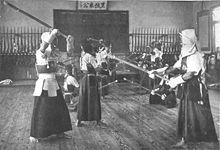
Shinai
is a weapon used for practice and competition in kendo representing a Japanese sword. Shinai are also used in other martial arts, but may be styled differently from kendo shinai, and represented with different characters....
, and the set of lightweight wooden armour, called bogu
Bogu
is training armour used primarily in the Japanese martial art of kendo, with variants used for jukendo, naginatajutsu, and sojutsu. The name consists of two parts: bō meaning "protect" or "defend," and gu meaning "equipment" or "tool." A set of bogu has four components:: combined face mask and...
, by Naganuma Sirōzaemon Kunisato (長沼 四郎左衛門 国郷, 1688–1767), which allowed for the practice of strikes at full speed and power without risk of injury to the competitors.
Today, virtually the entire practice of modern kendo is governed by the All Japan Kendo Federation
All Japan Kendo Federation
The All Japan Kendo Federation or Zen Nihon Kendō Renmei is a non-governmental organization to promote and popularize kendō, iaidō and jōdō. The federation was founded in 1952....
, founded in 1951. Competitions are judged by points, with the first competitor to score two points on their opponent declared the winner. One point may be scored with a successful and properly executed strike to any of several targets: a thrust to the throat, or a strike to the top of the head, sides of the head, sides of the body, or forearms. Practitioners also compete in forms (kata) competitions, using either wooden or blunted metal swords, according to a set of forms promulgated by the AJKF.
Aikido
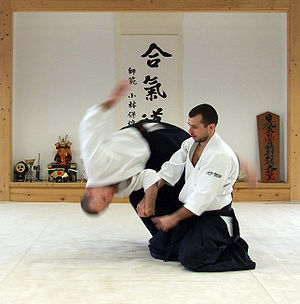
Morihei Ueshiba
was a famous martial artist and founder of the Japanese martial art of aikido. He is often referred to as "the founder" or , "Great Teacher".-Early years:Morihei Ueshiba was born in Tanabe, Wakayama Prefecture, Japan on December 14, 1883....
(植芝 盛平 Ueshiba Morihei, 1883 – 1969). The art consists of "striking", "throwing" and "joint locking" techniques and is known for its fluidity and blending with an attacker, rather than meeting "force with force". Emphasis is upon joining with the rhythm and intent of the opponent in order to find the optimal position and timing with which to apply force. Aikidō is also known for emphasizing the spiritual and philosophical development of its students reflecting the religious background of its founder.
Morihei Ueshiba developed aikido mainly from Daitō-ryū aiki-jūjutsu incorporating training movements such as those for the yari (spear), jō
Jo
JO, Jo or jo may refer to:*Jō, a ~4-foot-long wooden staff used in some Japanese martial arts*Cho , , also spelled Jo, a common Korean family name*Jo , a 1971 French comedy...
(a short quarterstaff
Quarterstaff
A quarterstaff , also short staff or simply staff is a traditional European pole weapon and a technique of stick fighting, especially as in use in England during the Early Modern period....
), and perhaps also juken (bayonet
Bayonet
A bayonet is a knife, dagger, sword, or spike-shaped weapon designed to fit in, on, over or underneath the muzzle of a rifle, musket or similar weapon, effectively turning the gun into a spear...
). Arguably the strongest influence is that of kenjutsu and in many ways, an aikidō practitioner moves as an empty handed swordsman.
Kyūdō
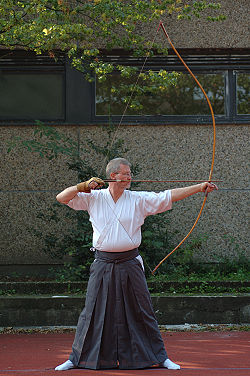
Bow (weapon)
The bow and arrow is a projectile weapon system that predates recorded history and is common to most cultures.-Description:A bow is a flexible arc that shoots aerodynamic projectiles by means of elastic energy. Essentially, the bow is a form of spring powered by a string or cord...
", is the modern name for Japanese archery
Archery
Archery is the art, practice, or skill of propelling arrows with the use of a bow, from Latin arcus. Archery has historically been used for hunting and combat; in modern times, however, its main use is that of a recreational activity...
. Originally in Japan, kyujutsu, the “art of the bow", was a discipline of the samurai, the Japanese warrior class
Social class
Social classes are economic or cultural arrangements of groups in society. Class is an essential object of analysis for sociologists, political scientists, economists, anthropologists and social historians. In the social sciences, social class is often discussed in terms of 'social stratification'...
. The bow is a long range weapon that allowed a military unit to engage an opposing force while it was still far away. If the archers were mounted on horseback, they could be used to even more devastating effect as a mobile weapons platform. Archers were also used in sieges and sea battles.
However, from the 16th century onward, firearms slowly displaced the bow as the dominant battlefield weapon. As the bow lost its significance as a weapon of war, and under the influence of Buddhism
Buddhism
Buddhism is a religion and philosophy encompassing a variety of traditions, beliefs and practices, largely based on teachings attributed to Siddhartha Gautama, commonly known as the Buddha . The Buddha lived and taught in the northeastern Indian subcontinent some time between the 6th and 4th...
, Shinto
Shinto
or Shintoism, also kami-no-michi, is the indigenous spirituality of Japan and the Japanese people. It is a set of practices, to be carried out diligently, to establish a connection between present day Japan and its ancient past. Shinto practices were first recorded and codified in the written...
, Daoism and Confucianism
Confucianism
Confucianism is a Chinese ethical and philosophical system developed from the teachings of the Chinese philosopher Confucius . Confucianism originated as an "ethical-sociopolitical teaching" during the Spring and Autumn Period, but later developed metaphysical and cosmological elements in the Han...
, Japanese archery evolved into kyudō, the “way of the bow". In some schools kyudō is practiced as a highly refined contemplative practice, while in other schools it is practiced as a modern day sport.
Karate
literally means "empty hand". However, the word "karate" written with homophonic ideograms means "China hand", rather than "empty hand". It is also sometimes called .Modern karate originated in Okinawa, formerly known as the Ryūkyū Kingdom
Ryukyu Kingdom
The Ryūkyū Kingdom was an independent kingdom which ruled most of the Ryukyu Islands from the 15th century to the 19th century. The Kings of Ryūkyū unified Okinawa Island and extended the kingdom to the Amami Islands in modern-day Kagoshima Prefecture, and the Sakishima Islands near Taiwan...
, but now a part of present-day Japan. Karate is a fusion of pre-existing Okinawan martial arts
Okinawan martial arts
Okinawan martial arts refers to the martial arts which originated among the indigenous people of Okinawa Island in Japan, most notably karate, tegumi, and Okinawan kobudō....
, called "te", and Chinese martial arts
Chinese martial arts
Chinese martial arts, also referred to by the Mandarin Chinese term wushu and popularly as kung fu , are a number of fighting styles that have developed over the centuries in China. These fighting styles are often classified according to common traits, identified as "families" , "sects" or...
. It is an art that has been adopted and developed by practitioners on the Japanese main island of Honshu
Honshu
is the largest island of Japan. The nation's main island, it is south of Hokkaido across the Tsugaru Strait, north of Shikoku across the Inland Sea, and northeast of Kyushu across the Kanmon Strait...
.
Karate's route to Honshu
Honshu
is the largest island of Japan. The nation's main island, it is south of Hokkaido across the Tsugaru Strait, north of Shikoku across the Inland Sea, and northeast of Kyushu across the Kanmon Strait...
began with Gichin Funakoshi
Gichin Funakoshi
was the creator of Shotokan karate, perhaps the most widely known style of karate, and is attributed as being the 'father of modern karate.' Following the teachings of Anko Itosu, he was one of the Okinawan karate masters who introduced karate to the Japanese mainland in 1921...
(船越 義珍 Funakoshi Gichin, 1868–1957), who is called the father of modern karate, and is the founder of Shotokan
Shotokan
is a style of karate, developed from various martial arts by Gichin Funakoshi and his son Gigo Funakoshi . Gichin was born in Okinawa and is widely credited with popularizing karate through a series of public demonstrations, and by promoting the development of university karate clubs, including...
karate. Although some Okinawan karate practitioners were already living and teaching in Honshū
Honshu
is the largest island of Japan. The nation's main island, it is south of Hokkaido across the Tsugaru Strait, north of Shikoku across the Inland Sea, and northeast of Kyushu across the Kanmon Strait...
, Funakoshi gave public demonstrations of karate in Tokyo
Tokyo
, ; officially , is one of the 47 prefectures of Japan. Tokyo is the capital of Japan, the center of the Greater Tokyo Area, and the largest metropolitan area of Japan. It is the seat of the Japanese government and the Imperial Palace, and the home of the Japanese Imperial Family...
at a physical education exhibition sponsored by the ministry of education in 1917, and again in 1922. As a result, karate training was subsequently incorporated into Japan's public school system. It was also at this time that the white uniforms and the kyū
Kyu
is a Japanese term used in martial arts, chadō, ikebana, go, shogi such as Japanese traditional culture, and academic tests and in other similar activities to designate various grades or levels or class of proficiency or experience...
/dan
Dan rank
The ranking system is a Japanese mark of level, which is used in modern fine arts and martial arts. Originally invented in a Go school in the Edo period, this system was applied to martial arts by Kanō Jigorō, the founder of judo and later introduced to other East Asia countries.In the modern...
ranking system (both originally implemented by judo's founder, Kano Jigoro) were adopted.
Karate practice is primarily characterized by linear punching and kicking techniques executed from a stable, fixed stance. Many styles of karate practiced today incorporate the forms (kata
Kata
is a Japanese word describing detailed choreographed patterns of movements practised either solo or in pairs. The term form is used for the corresponding concept in non-Japanese martial arts in general....
) originally developed by Funakoshi and his teachers, and many different weapons originally used as farm implements by the peasants of Okinawa, such as the sai
Sai (weapon)
The sai is a traditional Okinawan martial arts weapon. The basic form of the weapon is that of a pointed, dagger-shaped metal truncheon, with two curved prongs called yoku projecting from the handle...
, sickle (kama
Kama (weapon)
The is a traditional Filipino and Japanese farming implement similar to a small scythe used for reaping crops and also employed as a weapon...
), and quarterstaff (bō
Bo
-People:*Bo , name origin, plus people with the name*Bo , name origin, plus people with the surname**Bo , Chinese family names*Bo people , extinct minority population in Southern China famous for hanging coffins...
). Many modern karate practitioners also participate in full, light, and no-contact competitions.
Aiki
The principle of is particularly difficult to describe or explain. The most simple translation of aiki, as "joining energy", belies its philosophical depth. Generally, it is the principle of matching your opponent in order to defeat him. It is this concept of "matching", or "joining", or even "harmonizing" (all valid interpretations of ai) that contains the complexity. One may "match" the opponent in a clash of force, possibly even resulting in a mutual kill. This is not aiki. Aiki is epitomized by the notion of joining physically and mentally with the opponent for the express purpose of avoiding a direct clash of force. In practice, aiki is achieved by first joining with the motion of the opponent (the physical aspect) as well as the intent (the mental portion), then overcoming the will of the opponent, redirecting their motion and intent.Historically, this principle was used for destructive purposes; to seize an advantage and kill one's opponent. The modern art of aikido is founded upon the principle that the control of the opponent achieved by the successful application of aiki may be used to defeat one's opponent without harming them.
Attitude
Kokoro (心:こころ) is a concept that crosses through many martial arts, but has no single discrete meaning. Literally translating as "heart", in context it can also mean "character" or "attitude." Character is a central concept in karate, and in keeping with the do nature of modern karate, there is a great emphasis on improving oneself. It is often said that the art of karate is for self-defense; not injuring one's opponent is the highest expression of the art. Some popularly repeated quotes implicating this concept include:- "The ultimate aim of Karate lies not in victory or defeat, but in the perfection of the character of its participants." -Gichin FunakoshiGichin Funakoshiwas the creator of Shotokan karate, perhaps the most widely known style of karate, and is attributed as being the 'father of modern karate.' Following the teachings of Anko Itosu, he was one of the Okinawan karate masters who introduced karate to the Japanese mainland in 1921...
Budō
Literately "the way of war", used in a similar way as the term martial artsMartial arts
Martial arts are extensive systems of codified practices and traditions of combat, practiced for a variety of reasons, including self-defense, competition, physical health and fitness, as well as mental and spiritual development....
but specifically relating to Japanese styles.
Bushidō
A code of honor for samurai way of life, in principle similar to chivalryChivalry
Chivalry is a term related to the medieval institution of knighthood which has an aristocratic military origin of individual training and service to others. Chivalry was also the term used to refer to a group of mounted men-at-arms as well as to martial valour...
but culturally very different. Literally "the way of the warrior", those dedicated to Bushido have exemplary skill with a sword or bow, and can withstand great pain and discomfort. It emphasizes courage, bravery, and loyalty to their lord (daimyo) above all.
Courtesy
Shigeru EgamiShigeru Egami
was a pioneering Japanese master of Shotokan karate who founded the Shōtōkai style. He was a student of Gichin Funakoshi, who is widely recognized as the founder of modern karate.-Early life:...
:
Words that I have often heard are that "everything begins with rei and ends with rei." The word itself, however, can be interpreted in several ways; it is the rei of reigi meaning "etiquette, courtesy, politeness" and it is also the rei of keirei, "salutation" or "bow." The meaning of rei is sometimes explained in terms of kata or katachi ("formal exercises" and "form" or "shape" ). It is of prime importance not only in karate but in all modern martial arts. For the purpose in modern martial arts, let us understand rei as the ceremonial bow in which courtesy and decorum are manifest.
He who would follow the way of karate must be courteous, not only in training but in daily life. While humble and gentle, he should never be servile. His performance of the kata should reflect boldness and confidence. This seemingly paradoxical combination of boldness and gentleness leads ultimately to harmony. It is true, as Master Funakoshi used to say, that the spirit of karate would be lost without courtesy.
Hard and soft methods
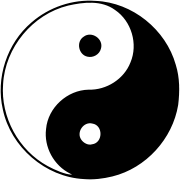
Yin and yang
In Asian philosophy, the concept of yin yang , which is often referred to in the West as "yin and yang", is used to describe how polar opposites or seemingly contrary forces are interconnected and interdependent in the natural world, and how they give rise to each other in turn. Opposites thus only...
(Jap.: in and yō).
The hard method is characterized by the direct application of counter-force to an opposing force. In practice, this may be a direct attack, consisting of movement directly towards the opponent, coinciding with a strike towards the opponent. A defensive technique where the defender stands their ground to block or parry (directly opposing the attack by stopping it or knocking it aside) would be an example of a hard method of defense. Hard method techniques are generally conceptualized as being linear.
The soft method is characterized by the indirect application of force, which either avoids or redirects the opposing force. For example, receiving an attack by slipping past it, followed by adding force to the attacker's limb for the purpose of unbalancing an attacker is an example of soft method. Soft method techniques are generally conceptualized as being circular.
These definitions give rise to the often illusory distinction between "hard-style" and "soft-style" martial arts. In truth, most styles technically practice both, regardless of their internal nomenclature. Analyzing the difference in accordance with yin and yang principles, philosophers would assert that the absence of either one would render the practitioner's skills unbalanced or deficient, as yin and yang alone are each only half of a whole.
Openings, initiative and timing
Openings, initiative, and timing are deeply interrelated concepts applicable to self defense and competitive combat. They each describe different considerations relevant to successfully initiating or countering an attack.are the foundation of a successful attack. Although possible to successfully injure an opponent who is ready to receive an attack, it is obviously preferable to attack when and where one's opponent is open. What it means to be open may be as blatant as an opponent becoming tired and lowering their guard (as in physically lowering their hands), or as subtle as a momentary lapse in concentration. In the classical form of combat between masters, each would stand almost entirely motionless until the slightest opening was spotted; only then would they launch as devastating an attack as they could muster, with the goal of incapacitating their opponent with a single blow.
In Japanese martial arts, refers to "the decisive moment when a killing action is initiated."
There are two types of initiative in Japanese martial arts, , and . Each type of initiative complements the other, and has different advantages and weaknesses. Early initiative is the taking advantage of an opening in an opponent's guard or concentration (see suki, supra). To fully take the early initiative, the attack launched must be with total commitment and lacking in any hesitation, and virtually ignoring the possibility of a counter-attack by the opponent. Late initiative involves an active attempt to induce an attack by the opponent that will create a weakness in the opponent's defenses, often by faking an opening that is too enticing for the opponent to pass up.
All of the above concepts are integrated into the idea of the combat . Maai is a complex concept, incorporating not just the distance between opponents, but also the time it will take to cross the distance, and angle and rhythm of attack. It is specifically the exact "position" from which one opponent can strike the other, after factoring in the above elements. For example, a faster opponent's maai is farther away than a slower opponent. It is ideal for one opponent to maintain maai while preventing the other from doing so.
The Three Attacks
- Go no sen - meaning “late attack” involves a defensive or counter movement in response to an attack.
- Sen no sen - a defensive initiative launched simultaneously with the attack of the opponent.
- Sensen no sen - an initiative launched in anticipation of an attack where the opponent is fully committed to their attack and thus psychologically beyond the point of no return.
States of mind: empty, immovable, remaining, and beginner's
Schools
Literally meaning "flow" in Japanese, is the term used to describe a particular school of an art.U.S.A. school of Japanese martial arts.
Instructors
is the title used for a teacher, in a similar manner to a college 'Professor' in the US. translates as "headmaster" meaning the head of a ryu.Seniors and juniors
The relationship between and is one with its origins not in martial arts, but rather in Japanese and Asian culture generally. It underlies Japanese interpersonal relationships in many contexts, such as business, school, and sports. It has become part of the teaching process in Japanese martial arts schools. A senior student is senior to all students who either began training after him or her, or who they outrank. The role of the senior student is crucial to the indoctrination of the junior students to etiquette, work ethic, and other virtues important to the school. The junior student is expected to treat their seniors with respect, and plays an important role in giving the senior students the opportunity to learn leadership skills. Senior students may or may not teach formal classes, but in every respect their role is as a teacher to the junior students, by example and by providing encouragement.Ranking systems
There are ultimately two systems of education in the Japanese martial arts, although some schools have been known to blend these two systems together. The old education system prior 1868 was based on a curriculum in order to preserved the tradition. The curriculum is organized by a very few series of level that would be passed down within the Ryu (tradition). The curriculum would culminate in the student achieving a "license of total transmission" (menkyo kaiden), which was a license permitting the student to teach the ryu's tradition outside of the ryu.The modern system after 1868 (dan'i), the invention of which is credited to judo founder Kano Jigoro, awards belts in accordance with students reaching a particular rank. Students progress by promotion through a series of "grades" (kyū), followed by a series of "degrees" (dan), pursuant to formal testing procedures. Some arts use only white and black belts to distinguish between skill levels, while others use a progression of colored belts for kyū levels.