

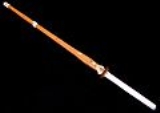
Shinai

Encyclopedia
Kendo
, meaning "Way of The Sword", is a modern Japanese martial art of sword-fighting based on traditional Japanese swordsmanship, or kenjutsu.Kendo is a physically and mentally challenging activity that combines strong martial arts values with sport-like physical elements.-Practitioners:Practitioners...
representing a Japanese sword
Sword
A sword is a bladed weapon used primarily for cutting or thrusting. The precise definition of the term varies with the historical epoch or the geographical region under consideration...
. Shinai are also used in other martial arts, but may be styled differently from kendo shinai, and represented with different characters
Kanji
Kanji are the adopted logographic Chinese characters hanzi that are used in the modern Japanese writing system along with hiragana , katakana , Indo Arabic numerals, and the occasional use of the Latin alphabet...
.
The word "shinai" is derived from the verb , meaning "to bend, to flex", and was originally short for shinai-take (flexible bamboo). Shinai is written with the kanji
Kanji
Kanji are the adopted logographic Chinese characters hanzi that are used in the modern Japanese writing system along with hiragana , katakana , Indo Arabic numerals, and the occasional use of the Latin alphabet...
, meaning "bamboo sword", and is an irregular kanji reading.
In kendo, it is most common to use a single shinai, sometimes called itto style. Some kendoka choose to use two shinai. This kendo style is usually called , a style that has its roots in the two-sword schools of swordsmanship such as Hyōhō Niten Ichi-ryū
Hyoho Niten Ichi-ryu
, which can be loosely translated as "the school of the strategy of two heavens as one", is a koryū , transmitting a style of classical Japanese swordsmanship conceived by the warrior Miyamoto Musashi...
. A ni-to combatant uses a long shinai called the , which is usually held in the left hand, and a shorter shinai, called the , which is usually held in the right hand. The daitō may be slightly shorter and lighter than a shinai used in the itto style of kendo. Specifications for shinai used in kendo competitions that follow the International Kendo Federation
International Kendo Federation
The International Kendo Federation was founded in 1970. It is an international federation of national and regional kendo associations and the world governing body for kendo. The FIK is a non-governmental organisation, and its aim is to promote and popularise kendo, iaido and jōdō.Seventeen...
(FIK) rules, are below.
History
The origin of the shinai can be found in the Edo periodEdo period
The , or , is a division of Japanese history which was ruled by the shoguns of the Tokugawa family, running from 1603 to 1868. The political entity of this period was the Tokugawa shogunate....
. The shinai was developed when a group of swordsmen, in an effort to reduce the number of practitioners being seriously injured during practice, undertook to create a practice weapon that was less dangerous than , the hard wooden swords they were previously using. This is also the motivation behind the development of , the armour that protects the kendoka.
Construction

The slats of a shinai are usually made from dried bamboo
Bamboo
Bamboo is a group of perennial evergreens in the true grass family Poaceae, subfamily Bambusoideae, tribe Bambuseae. Giant bamboos are the largest members of the grass family....
. Some may also be treated by smoking them, or soaking them in resin. Shinai slats are also made of carbon fibre, reinforced resin, or other approved alternative materials.
The shinai comprises four slats known as , which are held together by three leather
Leather
Leather is a durable and flexible material created via the tanning of putrescible animal rawhide and skin, primarily cattlehide. It can be produced through different manufacturing processes, ranging from cottage industry to heavy industry.-Forms:...
fittings: a hilt, or handle fitting ; a fitting at the tip and a leather strip that binds the four slats. The parts are all secured with a string .
The nakayui is tied about one-third of the length of the exposed bamboo from the tip . This holds the slats together and also marks the proper kendo striking portion of the shinai, or .
Inserted between the ends of the slats, under the saki-gawa, is a plastic
Plastic
A plastic material is any of a wide range of synthetic or semi-synthetic organic solids used in the manufacture of industrial products. Plastics are typically polymers of high molecular mass, and may contain other substances to improve performance and/or reduce production costs...
plug , and under the tsuka-gawa there is a small square of metal , that holds the slats in place.
A hand-guard is then fitted at the point where the tsuka-gawa ends and the bamboo slats begin. This is held in place by a rubber ring .
Care of Shinai
A shinai must be properly taken care of or it can pose a danger to both the user and the people around it. Shinai should be inspected for splinters and breaks before and after use, and maintained in a manner considered most appropriate by one's style, dōjōDojo
A is a Japanese term which literally means "place of the way". Initially, dōjōs were adjunct to temples. The term can refer to a formal training place for any of the Japanese do arts but typically it is considered the formal gathering place for students of any Japanese martial arts style to...
, or sensei
Sensei
' is a Japanese word that basically means "person born before another." In general usage, it means "master" or "teacher," and the word is used as a title to refer to or address teachers, professors, professionals such as lawyers, CPA and doctors, politicians, clergymen, and other figures of authority...
.
Many people believe that oiling and sanding a shinai prior to its first use, and then periodically during use, can greatly extend its life. However, some disagreement exists on what is considered proper shinai care.
To properly inspect a shinai, one first examines the area around the datotsu-bu, inspecting all sides of the shinai for splinters. This is very important, as bamboo splinters can easily cause injury. The saki-gawa should be intact and the tsuru should be tight so that the saki-gawa does not slip off the end of the shinai during use. In addition, the nakayui should be tight enough as not to rotate easily.
When not in use, shinai are rested against a wall with the handle pointing downward. When a shinai is placed on the ground, it is considered very poor etiquette to step over it.
Regulations
In kendo competitions that follow the FIK rules, there are regulated weights and lengths for the use of shinai.| Specification | Gender | Junior High School (12–15 yrs) | Senior High School (15–18 yrs) | University students and Adults (18yrs+) |
|---|---|---|---|---|
| Maximum length | Male & female | 114cm | 117cm | 120cm |
| Minimum weight | Male | 440g | 480g | 510g |
| Female | 400g | 420g | 440g | |
| Minimum diameter of sakigawa | Male | 25mm | 26mm | 26mm |
| Female | 24mm | 25mm | 25mm | |
| Minimum length of sakigawa | Male and Female | 50mm | 50mm | 50mm |
Shinai are weighed complete with leather fittings, but without tsuba or tsuba-dome. The full length is measured. Maximum diameter of the tsuba is 9cm.
| Specification | Gender | Daito (long shinai) | Shoto (short shinai) |
|---|---|---|---|
| Maximum length | Male & female | 114cm | 62cm |
| Weight | Male | 440g minimum | 280~300g maximum |
| Female | 400g minimum | 250~280g maximum | |
| Minimum diameter of sakigawa | Male | 25mm | 24mm |
| Female | 24mm | 24mm | |
Shinai are weighed complete with leather fittings, but without tsuba or tsuba-dome. The full length is measured. Maximum diameter of the tsuba is 9cm.
| Size | Length | Size | Length | |||
|---|---|---|---|---|---|---|
| 28 | 36" | 92 cm | 36 | 44" | 112 cm | |
| 30 | 38" | 97 cm | 37 | 45" | 114 cm | |
| 32 | 40" | 102 cm | 38 | 46" | 117 cm | |
| 34 | 42" | 107 cm | 39 | 47" | 120 cm | |
Fukuro-shinai
The ancestor of the modern kendo shinai is the , which is still in use in koryūKoryu
is a Japanese word that is used in association with the ancient Japanese martial arts. This word literally translates as "old school" or "traditional school"...
kenjutsu
Kenjutsu
, meaning "the method, or technique, of the sword." This is opposed to kendo, which means the way of the sword. Kenjutsu is the umbrella term for all traditional schools of Japanese swordsmanship, in particular those that predate the Meiji Restoration...
. This is a length of bamboo, split multiple times on one end, and covered by a leather sleeve. This explains the name fukuro, which means bag, sack or pouch. Sometimes the more old and rare kanji tō (韜) is used, but has the same meaning as fukuro.
Some schools cover the entire bamboo in the sleeve and add a tsuba, like Kashima Shinden Jikishinkage-ryū
Kashima Shinden Jikishinkage-ryu
, often referred to simply as Jikishinkage-ryū or Kashima Shinden, is a traditional school of the Japanese martial art of swordsmanship...
does. In Shinkage-ryū
Shinkage-ryu
' meaning "new shadow school", is a traditional school of Japanese martial arts, founded by Kamiizumi Ise-no-Kami Nobutsuna in the mid-sixteenth century...
, the sleeve is lacquered
Lacquer
In a general sense, lacquer is a somewhat imprecise term for a clear or coloured varnish that dries by solvent evaporation and often a curing process as well that produces a hard, durable finish, in any sheen level from ultra matte to high gloss and that can be further polished as required...
Kamakura Red, and rather than covering the entire length, is tied off at the non-split end. This particular kind of fukuro-shinai is also called a , or toad-skin shinai. The name comes from how the leather looks after lacquering; the sleeves are actually made of cow or horse-hide.
Other uses
Shinais are commonly used as a prop in professional wrestlingProfessional wrestling
Professional wrestling is a mode of spectacle, combining athletics and theatrical performance.Roland Barthes, "The World of Wrestling", Mythologies, 1957 It takes the form of events, held by touring companies, which mimic a title match combat sport...
, where they are often referred to as Kendo sticks or incorrectly as Singapore canes.