

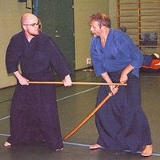
Shinto Muso-ryu

Encyclopedia
, most commonly known by its practice of jōdō
, is a traditional school (koryū
) of the Japanese martial art of jōjutsu, or the art of wielding the short staff (jō
). The technical purpose of the art is to learn how to defeat a swordsman in combat using the jō, with an emphasis on proper combative distance, timing and concentration. The system includes teachings of other weapon systems which are contained in Shintō Musō-ryū as auxiliary arts (Fuzoku ryuha). The school is sometimes abbreviated as SMR.
The art was founded by the samurai
Musō Gonnosuke Katsuyoshi
(夢想 權之助 勝吉, fl.
c.1605, dates of birth and death unknown) in the early Edo period (1603–1868) and, according to legend, first put to use in a duel
with Miyamoto Musashi
(宮本 武蔵, 1584–1645). The original art created by Musō Gonnosuke has evolved and been added upon ever since its inception and up to modern times. The art was successfully brought outside of its original domain in Fukuoka
and outside of Japan itself in the 19th and 20th century. The spreading of Shintō Musō-ryū beyond Japan was largely the effort of Takaji Shimizu, 1896–1978), considered the 25th headmaster. With the assistance of his own students and the cooperation of the kendō
community, Shimizu spread Shintō Musō-ryū worldwide.
 According to its own history, Shintō Musō-ryū was founded in the Keichō era
(1594–1614) by Musō Gonnosuke, a samurai with considerable martial arts experience. His experiences, which would climax in his two duels with the famous swordsman Miyamoto Musashi, led him to create a set of techniques for the jō. These techniques constituted the core of his new school which he named Shintō Musō-ryū. Gonnosuke used his training in kenjutsu, naginatajutsu, sōjutsu and bōjutsu, which he acquired in part from Tenshin Shōden Katori Shintō-ryū
and Kashima Jikishinkage-ryū
, to develop a new way of handling the jō in combat.
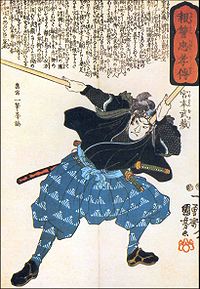 Gonnosuke was said to have fully mastered the secret form called The Sword of One Cut (Ichi no Tachi), a form that was developed by the founder of the Kashima Shintō-ryū
and later spread to other Kashima schools such as Kashima Jikishinkage-ryū and Kashima Shin-ryū. Gonnosuke developed several techniques for the jō that were to be used against an opponent armed with a sword, partially by using the superior length of the jō to keep the swordsman at a disadvantage. The legend states that Musō Gonnosuke fought two duels with Miyamoto Musashi. Gonnosuke was defeated in the first, but was victorious in the second, using his newly developed jōjutsu techniques to either defeat Musashi or force the duel into a draw. One of several legends says that while resting near a fire in a certain temple, Gonnosuke heard a voice say, . Supposedly that was his inspiration to develop his new techniques and go fight Musashi a second time. After the creation of his jō techniques and his establishment as a skilled jōjutsu practitioner he was invited by the Kuroda clan of Fukuoka, in northern Kyūshū
, to teach his art to their warriors. Gonnosuke accepted the invitation and settled down there.
Shintō Musō-ryū survived the abolishment of the samurai in 1877, and the Second World War. With the efforts made by Shiraishi Hanjiro and his successor Takaji Shimizu, the art's 24th and 25th unofficial headmasters, respectively, the art progressed into an international martial art with numerous dōjo
all over the world.
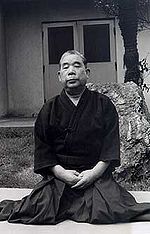 Partially because Shintō Musō-ryū has no single head-organization or single governing body, there exist no standardized way of conducting training. Dōjos belonging to individual SMR groups have individual ways of training and passing on the tradition. As with several other arts, such as iaidō
and aikidō
, Shintō Musō-ryū was renamed from "jōjutsu" to "jōdō" by Shimizu Takaji in 1940. Note that the use of the appellation "jōdō" is not universal for all SMR practitioners. Shimizu Takaji never held a formal position of leader of SMR. The words jōjutsu and jōdō are normally used interchangeably by the various groups.
The SMR tradition has been shaped over the centuries as to teach the student, besides the actual fighting techniques, the proper value and application of combative distance to the opponent (Ma-ai), posture (shisei), mental awareness (zanshin) among other skills. As a traditional Japanese martial art there is also a high emphasize on etiquette, bowing (ritsurei) and attaining proper mental attitude in the student and approach to his/her training.
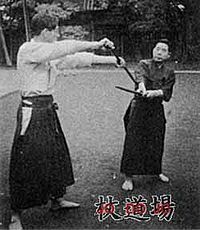 In the fighting art of SMR the aim is to defeat an opponent armed with one or two swords using the staff. In SMR the staff is a flexible weapon and can be used in several ways. A staff-wielder can use the superior length of the staff to keep the opponent at a distance which gives the wielder an advantage. The staff is also used, when applicable, to get very close to the opponent and use the staff to control the opponents arms or hands. The staff can be used in a manner that enables the wielder to defeat the opponent without killing him. Common methods is controlling the opponents hands, wrists, and other targets by using the staff to either strike at, thrust or otherwise manipulating the target-areas. When applicable, more lethal strikes are aimed at the opponents more vital areas such as the head, solar plexus and temples
are used.
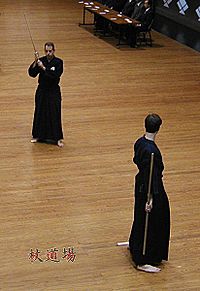 The forms (kata
) and fundamentals (kihon
) are at the center of what is taught in SMR, and there exists no form of organized and standardized sparring (kumite) such as in karate
, kendō and judō
. A common procedure is to teach new students the twelve basic techniques and then progressing into practicing the training forms. There are approximately 64 forms with the staff, although the number can vary from the individual SMR groups and organizations. The auxiliary arts incorporate their own sets of forms with their respective weapons.
A normal training session is very systematic with the senior student commanding the pace and direction of the session with the entire group often training as one, especially during warm-ups and drills. A normal session usually begins with a repetition of fundamental exercises for all students. Sometimes drills are added to further sharpen the basic techniques. Drills and forms involving newer students are often performed with a more senior student taking on the role of the attacker. In all paired techniques and drills, in addition to the uchidachi, there is always a receiver of the attack, . When applicable, the uchidachi is always the senior to the shidachi in terms of experience. This is done as a way to develop the younger shidachi increase his skills by having him face a more experienced and confident swordsman and thus heighten the combative feeling.
Training with the staff under a responsible leader is done with a high emphasis on student safety. Unlike the wooden-sword, which is generally not lethal and only used in training, there is no safe traditional training-version of the staff and the weapon used in training is the same weapon that would have been used in actual combat. When applying strikes or thrusts to vital area the student is taught not to use full force but to halt the staff within a few centimeters of a particular vital area such as the temples or other parts of the head. Other less sensitive areas on the human body are struck, though with much reduced force. The practice of forms and techniques is conducted under the supervision of a senior student that ensures the techniques and forms are proper and within safety margins.
 A typical Shintō Musō-ryū dōjo practices the same courtesy and manners as found in Japanese society generally; placing great emphasis on etiquette and tradition
. In some dōjo, Japanese verbal commands are used to guide basics, warm-ups, and the training of the "standard forms" (seiteigata).
The traditional Japanese bow (ritsurei) is practiced in all Japanese and Western dōjo. Although not all dōjo use the exact same routine, they do generally contain the same set of principles. Students bow to the front of the dōjo (shōmen) when entering the dōjo or leaving it, and observes the hierarchy with instructors (sensei
), seniors (senpai
), and juniors (kōhai).
During the practice of basics and forms, certain rules of behavior are applied when switching positions and weapons between shidachi and uchidachi. This is done in order to have an orderly training session and to reflect good manners, as well as for safety reasons. The students bow before and after performing a kata, drill or any other exercise. The switching of weapons is, by tradition and experience, a way to minimize any threatening appearance and show respect for the training partner.
Kazari 飾り(かざり) is the traditional SMR-way of initiating and ending kata-training. Kazari (meaning ”ornament”) is also done in all the auxiliary arts. Kazari starts with the two practitioners crossing their weapons and placing them crossed on the floor, retiring a few steps to perform a squatted bow (rei), and ends which the practitioners going forward to retain their weapons and start kata-training.
The practice of forms (kata) is an old way of teaching traditional martial arts in Japan, and is the core of many "old school/flow" (koryū) martial arts. Forms are used as a way to teach advanced techniques and maneuvers through a series of scripted movements and actions against one or several opponents. In the majority of the old martial arts, forms are at the center of the art with little or no sparring as compared to modern martial arts (gendai budō
) such as Karate
, Kendō
or Jūdō
.
The modern Shintō Musō-ryū system holds approximately 64 staff-forms divided into several series, though this number is including variations and is not always counted as an individual form. Students following the teachings of Shimizu Takaji normally learn 5 more kata in a separate series called Gohon-no-midare. This series is not taught in all SMR-groups. A common procedure is for new students to begin their form training by learning two or more forms from the "standard staff forms" (seitei jōdō) due to their (relative) technical simplicity.
The series Gohon no midare, was created by Shimizu in the late 1930s and are not part of the original "scroll of transmission" (denshō), which contains the list of official SMR techniques. Thus, the Gohon no midare is not taught in all Shintō Musō-ryū dōjo.
The "basic techniques of striking and thrusting" (kihon no uchi tsuki waza) is a system of twelve techniques drawn from the existing staff-forms with minor modifications. They are used as a way to better introduce a new student to jōdō and is also a good tool for further skill development for seniors. The basic techniques were developed and systematized mainly by Shimizu Takaji at his Tokyo
dōjo for the purpose of easing the introduction to (complex) forms training. Shimizu's peer, Takayama Kiroku, leader of the Fukuoka Shintō Musō-ryū Dōjo, saw the value of these basic techniques and introduced them into his own training sessions. Shimizu would eventually remove or modify some of the more dangerous techniques and beginner-level forms so as not to cause injuries to newer students.
The basic techniques are trained both individually (tandoku dosa) and in pairs (sotai dosa), with the defender using the staff and the attacker using the sword. Today, new students normally begin with tandoku dosa, learning the staff first and later switching to the sword, and then finally learning the entire technique with a training partner. The techniques are normally trained in sequence.
During the Edo period and well into the 20th century the attacker was always the senior student, with the defender (being the junior), starting and training only the staff forms for several years before learning the attacker's role . In modern times for the most part, a beginner learns both the sword and staff right from the beginning of his training.
The following are the twelve basic techniques:
The twelve basic techniques are used in both Shintō Musō-ryū and in the Seitei jōdō of the All Japan Kendō Federation (Zen Nihon Kendō Renmei, ZNKR), although the latter uses a slightly modified version.
tasked with the creation of a compact Jōdō system to be taught in Kendō dojos. The result was the Zen Ken Renmei Seitei Jōdō system consisting of twelve forms and twelve basic techniques. Ten of these forms are drawn from the existing Shintō Musō-ryū Jō forms with minor modifications, and two other forms were created specifically for Seitei Jōdō. The two specific Seitei jōdō forms are taught in various Shintō Musō-ryū dōjos outside the main series of Kata.
A person with a fully valid Menkyo Kaiden has the right to teach the art to whoever he chooses and also holds the right to issue scrolls of transmissions to his students. The Menkyo Kaiden holder may also, if he so chooses, implement modifications in the SMR system to techniques or kata. As Shintō Musō-ryū does not have a single organization with a single leader, these changes will only be relevant to that teacher's direct students, and will not be universal. Instead, every person who has been issued a Menkyo Kaiden can technically be described as teaching their own variation of the ryū, known as "ha". "Ha" is a variation of a martial arts system taught by a Menkyo Kaiden but is still a part of the main ryū. However, if a Menkyo Kaiden decided to make radical changes to the system, such as adding or removing parts of the art, he would be departing from belonging to a ha, and in effect be creating a new style.
A recent example of a ha turning into its own style is found in the iaidō
art Musō Shinden-ryū
created by Nakayama Hakudo
. Nakayama trained in Musō Jikiden Eishin-ryū
iaijutsu
, and decided to modify what he had learned and officially label it Musō Shinden-ryū, thus creating a new style with no official ties to Eishin-ryū.
There are five classical ranks in Shintō Musō-ryū, as follows in ascending order of seniority:
EJF is headed by Pascal Krieger and incorporates three separate grade systems.
IJA follows the grading system used by Kuroda Ichitaro. Students grade up to 5th dan and thereafter receive licenses of transmission. Students must also grade with the Zen Nippon Kendō Renmei in the Seitei series of Kata.
NJK is headed by Kaminoda Tsunemori and incorporates two separate grade-systems.
Ranks attainable in the Omote series:
Ranks attainable in the Chūdan series:
Ranks attainable in the Kage series:
Classical ranking system
 Essentially the jō is a wooden staff approx 128 cm in length. In modern times the measurements has been fixed to 128 cm in length and between 2.4-2.6 cm in width, though in the Edo-period the length of the jō was customized as to suit the height of the wielder. The jō is used in several gendai
and koryu
martial arts such as aikidō
and Tendo-ryu
respectively.
According to legend, Gonnosuke was inspired to create and use the jō from a divine vision some time after he was defeated by Miyamoto Musashi in a duel. In this vision, a divine being in the form of a child appeared, brandishing a stick (or log in one version) and proclaiming "maruki o motte, suigetsu o shire" ("Holding a round stick, know the suigetsu"). The jō, however, as a simple staff or walking-stick cannot be claimed to have a single inventor.
The jō, like its larger sibling the Bō
, was never an effective killing-weapon on the battlefield in comparison to the sword, spear, glaive and bow. Although the jō and most other staves could be used to lethal effect when thrust at vital points of the body, when faced with a fully armored opponent those vital points would in most cases be covered by armour-plating. As a result there were very few ryu
that were dedicated to the staff-arts in the warring era with other more effective weapons were available. There are several ryu that include jō-techniques in its system. One example is the jō-tradition found in the koryū art Tendo-ryu
Naginatajutsu, founded in 1582. In Tendo-ryū, which uses the Naginata as the primary weapon, there are techniques with the jō that simulates a scenario where the naginata has been cut in two and the wielder has to defend himself with the staff-portion only. With the onset of peace with the start of the Edo-period (1603–1867), the conflicts with heavy armored warriors became a thing of the past. In this era, the jō-art would come into its own against non-armored
samurai, ronin, bandits and other opponents. It was extensively used to police the local clan domains.
Various other martial arts also include elements of jō that are not necessarily related to Shintō Musō-ryū. One of the most famous promoter of the jō outside of Shintō Musō-ryū in modern times, and indeed in the martial arts community as a whole, was the founder of Aikidō, Morihei Ueshiba
. Ueshiba trained in a variety of ryu including Yagyu swordsmanship, but is not known to have trained in Shintō Musō-ryū. Ueshiba also used the long staff bō
to perform the same techniques.
The Japanese Samurai sword, with its long history and many variations, has a prominent role in Shintō Musō-ryū. In the early Edo period the Samurai wore the Daishō, or two swords which was only allowed to be carried by Samurai and was an undeniable symbol of their status in the Tokugawa's Japan
. The Daishō consisted of the katana
(long sword) and the wakizashi
(short sword) and they were the weapons of choice for samurai during their regular duties. When the Samurai went to war a heavier and curved sword (tachi
) would be used instead. In SMR the katana is the weapon used, but for training purposes a wooden sword (bokken
) is used to minimize risk of injuries. Every form (kata
) starts with the attacker, called uchidachi, attacking the defender (shidachi), who in turn defeats the opponent. In addition to the Katana, the wakizashi/kodachi is also used. In some of the staff and sword forms of SMR, the long sword is used in tandem with the short sword and sometimes only the short sword is used. In addition to the sword training provided in jo-kata, an addition of twelve kenjutsu-kata is found in SMR.
uwagi
(jacket), an obi
(belt, often the same type as used in iaidō), a blue or black hakama
(wide trousers used by samurai). The type of clothing worn is not universal for all Shintō Musō-ryū dōjos. In some dōjos, which in addition to jōdō also may also have aikido practitioners, the white keikogi and regular white trousers are allowed. All-white keikogi and Hakama are also used in various dōjo and/or on special occasions such as public demonstrations or competitions.
From the Edo period to the Meiji period
, several other arts were assimilated fuzoku into the various branches of Shintō Musō-ryū and were meant to be trained alongside the main jo-forms. but For all intents and purposes, each of the fuzoku ryuha retain a separate identity with their own history and tradition and are generally not taught to people outside the SMR-tradition. Over the years several lineages of Gonnosuke's original art have added or dropped other Fuzuku Ryuha.
Matsuzaki Kin'emon was the third headmaster of SMR and he is credited with the creation of the Ittatsu-ryū and the Ikkaku-ryū. These two arts were taught in the Kuroda-domain as a complement to the combat-arts of the bushi (warriors) which included the staff, sword and musketry. The arts were not specifically SMR-arts though they were taught to the same students. After the fall of the Samurai the two arts found their way into the SMR-tradition as taught by Shiraishi Hanjiro, the arts 24th unofficial headmaster.
In many Shintō Musō-ryū dōjo, the assimilated arts are not normally taught to a student until he/she has reached a designated level of experience & expertise and a certain level of proficiency in the jō-forms. These designated levels are not standard but vary according to each organizations preference.
system Isshin-ryu

in the late 19th century. The twelve kata, which at the time of their inception were loosely organised into a system called "sutteki-jutsu", were derived mainly from Shintō Musō-ryū and Ikkaku-ryū techniques. "Sutteki" was the Japanese pronouncement of the english word "stick". Sutteki-jutsu was further developed by his son Uchida Ryohei
, who systematized his father's work and brought about the modern Uchida-ryū tanjōjutsu system. The art was first known as Sutekki-Jutsu and later named Uchida-ryū in honor of its creator. The art was adopted into SMR to be taught alongside the other arts. Chuwa-ryū tankenjutsu is another name used for this art.
The jutte (or jitte) was a widespread Edo period
police weapon used to control, disarm and subdue a criminal who would most likely be armed with a sword, without killing him (except in extreme situations). There exists at least 200 known variations of the jutte. The jutte used in Shintō Musō-ryū is approx 45 cm in length. In the integrated art of Ikkaku-ryū juttejutsu, the tessen, or war fan, approximately 30 cm in length, is used in tandem with the jutte in some of the kata.
The Kusarigama is a chain-and-sickle weapon. The weapon is used in several ryu and the design varies from school to school. The kusarigama used in Isshin-ryū has a straight, double-edged 30 cm blade with a wooden handle approx 36 cm long with an iron guard to protect the hand. The chain (kusari) has a heavy iron weight and is attached to the bottom of the handle. The chain is 12 shaku long (3.6 meters) and the attached weight can be thrown against an opponent's weapon, hands or body, either disarming him or otherwise preventing him from properly defending himself against the kama. In some kata, the iron weight is thrown directly at the attackers body causing injury or stunning the opponent.
The kusarigama also has non-lethal kata designed to trap and apprehend a swordsman, partially by using the long chain as a restraint. A famous user of the kusarigama outside of Shintō Musō-ryū was Shishido Baiken
, who was killed in a duel with the legendary Miyamoto Musashi. During kata practice a safer, all-wooden version, (except the metal handguard), is used with softer materials replacing the chain and weight. For demonstrations (embu) a kusarigama with a metal blade is sometimes used.
, which is used in other martial arts.
The modern tanjō is the same width as a standard jō. The tanjō of the Meiji era were thicker at the top and thinner at the bottom, as was the design of the walking-stick at the time. The original inspiration for the tanjō was the western
walking-stick which soon found a practical use in self-defense in the Meiji era.
From the end of the Samurai reign in 1877 to the early 20th century, SMR was still largely confined, (though slowly spreading), to Fukuoka city on the southern Japanese island of Kyushu where the art first was created and thrived. The main proponent of SMR in Fukuoka during this time was Shiraishi Hanjiro, a former Kuroda-clan warrior (ashigaru
), who had trained in and received a joint-license from the two largest surviving jo-branches of SMR. Among Shiraishis top students were Shimizu Takaji, Otofuji Ichizô (1899–1998) and Takayama Kiroku (d.1938), Takayama being the senior. After receiving an invitation from the Tokyo martial arts scene to perform a demonstration of SMR, Shimizu and Takayama established a Tokyo SMR-group which held a close working relationship with martial arts supporters such as Jigoro Kano, the founder of Judo. Shiraishi died in 1927 and there now existed two main lines of SMR. The oldest of the two was found in Fukuoka, now under the leadership of Otofuji with the one in Tokyo under Shimizu. Takayama, the senior of the three students of Shiraishi, died in 1938 leaving Shimizu with a position of great influence in the SMR-scene as the senior-most student of Shiriashi, (Otofuji being his junior), that would last up to his death in 1978. Although Otofuji was one of Shiraishis top-students he was unable to assume the role that Shimizu had held in Tokyo. By the 1970s the Tokyo and Fukuoka SMR-communities had fully developed into separate branches with their own leaders. Unlike Otofuji, Shimizu was a senior of both the Fukuoka and Tokyo SMR, with great knowledge and influence over both. With Shimizu's death, Otofuji was not in a strong enough position to claim the authority over the Tokyo SMR and no sort of agreement could be made over who should succeed Shimizu. The informal position of headmaster over the SMR-community as a whole could not be filled. Otofuji would remain the leader of Kyushu SMR until his death in 1998.
From these two lineages, the Fukuoka and the Tokyo, there stems today several SMR-based organisations all over the world. One of the largest is the All-Japan Jodo Federation (ZNJR), established in the 1960s as a branch of the All-Japan Kendo Federation (ZNKR). The ZNJR was established to further promote Jo through the teaching of ZNKR Jodo, also called Seitei Jodo. It remains the most wide-spread form of Jo in the world today.
only. Seitei Jodo holds competitions on which the performance of the uchidachi and shidachi are judged when performing kata. Shintō Musō-ryū holds no competitions of any sort. The name "Kasumi" Shintō-ryū is not the universal way of naming the 12 sword kata. The discovery of the name "Kasumi" was made from recent research into the history of Shintō Musō-ryū but is yet to be confirmed. The most common and older way of naming the 12 sword kata in SMR is "Shintō-ryu kenjutsu". The number of headmasters is counted by combining all the known headmasters of all the branches of Shintō Musō-ryū Jōdō including the founder of Katori Shintō-ryū, the latter which the founder of SMR also held a Menkyo Kaiden, and Matsumoto Bizen-no-kami, the founder of the Kashima school that Musō Gonnosuke also trained in.
Jodo
, meaning "the way of the jō", or is a Japanese martial art using short staffs called jō. The art is similar to bōjutsu, and is strongly focused upon defense against the Japanese sword. The jō is a short staff, usually about 3 to 5 feet long...
, is a traditional school (koryū
Koryu
is a Japanese word that is used in association with the ancient Japanese martial arts. This word literally translates as "old school" or "traditional school"...
) of the Japanese martial art of jōjutsu, or the art of wielding the short staff (jō
Jo (weapon)
A is an approximately 1.276 m long wooden staff, used in some Japanese martial arts. The martial art of wielding the jō is called jōjutsu or jōdō. Also, aiki-jō is a set of techniques in aikido which uses the jō to illustrate aikido's principles with a weapon. The jō staff is shorter than the bō...
). The technical purpose of the art is to learn how to defeat a swordsman in combat using the jō, with an emphasis on proper combative distance, timing and concentration. The system includes teachings of other weapon systems which are contained in Shintō Musō-ryū as auxiliary arts (Fuzoku ryuha). The school is sometimes abbreviated as SMR.
The art was founded by the samurai
Samurai
is the term for the military nobility of pre-industrial Japan. According to translator William Scott Wilson: "In Chinese, the character 侍 was originally a verb meaning to wait upon or accompany a person in the upper ranks of society, and this is also true of the original term in Japanese, saburau...
Musō Gonnosuke Katsuyoshi
Muso Gonnosuke
Musō Gonnosuke Katsuyoshi was a samurai of the early 17th century and the traditional founder of the Koryu school of jojutsu known as Shintō Musō-ryū...
(夢想 權之助 勝吉, fl.
Floruit
Floruit , abbreviated fl. , is a Latin verb meaning "flourished", denoting the period of time during which something was active...
c.1605, dates of birth and death unknown) in the early Edo period (1603–1868) and, according to legend, first put to use in a duel
Duel
A duel is an arranged engagement in combat between two individuals, with matched weapons in accordance with agreed-upon rules.Duels in this form were chiefly practised in Early Modern Europe, with precedents in the medieval code of chivalry, and continued into the modern period especially among...
with Miyamoto Musashi
Miyamoto Musashi
, also known as Shinmen Takezō, Miyamoto Bennosuke or, by his Buddhist name, Niten Dōraku, was a Japanese swordsman and rōnin. Musashi, as he was often simply known, became renowned through stories of his excellent swordsmanship in numerous duels, even from a very young age...
(宮本 武蔵, 1584–1645). The original art created by Musō Gonnosuke has evolved and been added upon ever since its inception and up to modern times. The art was successfully brought outside of its original domain in Fukuoka
Fukuoka Prefecture
is a prefecture of Japan located on Kyūshū Island. The capital is the city of Fukuoka.- History :Fukuoka Prefecture includes the former provinces of Chikugo, Chikuzen, and Buzen....
and outside of Japan itself in the 19th and 20th century. The spreading of Shintō Musō-ryū beyond Japan was largely the effort of Takaji Shimizu, 1896–1978), considered the 25th headmaster. With the assistance of his own students and the cooperation of the kendō
Kendo
, meaning "Way of The Sword", is a modern Japanese martial art of sword-fighting based on traditional Japanese swordsmanship, or kenjutsu.Kendo is a physically and mentally challenging activity that combines strong martial arts values with sport-like physical elements.-Practitioners:Practitioners...
community, Shimizu spread Shintō Musō-ryū worldwide.
History
Keicho
was a after Bunroku and before Genna. This period spanned from October 1596 to July 1615. The reigning emperors were and .-Change of era:* 1596 : The era name was changed to Keichō to mark the passing of various natural disasters...
(1594–1614) by Musō Gonnosuke, a samurai with considerable martial arts experience. His experiences, which would climax in his two duels with the famous swordsman Miyamoto Musashi, led him to create a set of techniques for the jō. These techniques constituted the core of his new school which he named Shintō Musō-ryū. Gonnosuke used his training in kenjutsu, naginatajutsu, sōjutsu and bōjutsu, which he acquired in part from Tenshin Shōden Katori Shintō-ryū
Tenshin Shoden Katori Shinto-ryu
is one of the oldest extant Japanese martial arts, and an exemplar of koryū bujutsu. The Tenshin Shōden Katori Shintō-ryū was founded by Iizasa Ienao, born 1387 in Iizasa village , who was living near Katori Shrine at the time...
and Kashima Jikishinkage-ryū
Kashima Shinden Jikishinkage-ryu
, often referred to simply as Jikishinkage-ryū or Kashima Shinden, is a traditional school of the Japanese martial art of swordsmanship...
, to develop a new way of handling the jō in combat.
Kashima Shinto-ryu
' is a traditional school of Japanese martial arts founded by Tsukahara Bokuden in the Muromachi period .Due to its formation during the tumultuous Sengoku Jidai, a time of feudal war, the school's techniques are based on battlefield experience and revolve around finding weak points in the...
and later spread to other Kashima schools such as Kashima Jikishinkage-ryū and Kashima Shin-ryū. Gonnosuke developed several techniques for the jō that were to be used against an opponent armed with a sword, partially by using the superior length of the jō to keep the swordsman at a disadvantage. The legend states that Musō Gonnosuke fought two duels with Miyamoto Musashi. Gonnosuke was defeated in the first, but was victorious in the second, using his newly developed jōjutsu techniques to either defeat Musashi or force the duel into a draw. One of several legends says that while resting near a fire in a certain temple, Gonnosuke heard a voice say, . Supposedly that was his inspiration to develop his new techniques and go fight Musashi a second time. After the creation of his jō techniques and his establishment as a skilled jōjutsu practitioner he was invited by the Kuroda clan of Fukuoka, in northern Kyūshū
Kyushu
is the third largest island of Japan and most southwesterly of its four main islands. Its alternate ancient names include , , and . The historical regional name is referred to Kyushu and its surrounding islands....
, to teach his art to their warriors. Gonnosuke accepted the invitation and settled down there.
Shintō Musō-ryū survived the abolishment of the samurai in 1877, and the Second World War. With the efforts made by Shiraishi Hanjiro and his successor Takaji Shimizu, the art's 24th and 25th unofficial headmasters, respectively, the art progressed into an international martial art with numerous dōjo
Dojo
A is a Japanese term which literally means "place of the way". Initially, dōjōs were adjunct to temples. The term can refer to a formal training place for any of the Japanese do arts but typically it is considered the formal gathering place for students of any Japanese martial arts style to...
all over the world.
Jōdō and jōjutsu
Iaido
is a modern Japanese martial art associated with the smooth, controlled movements of drawing the sword from its scabbard, striking or cutting an opponent, removing blood from the blade, and then replacing the sword in the scabbard...
and aikidō
Aikido
is a Japanese martial art developed by Morihei Ueshiba as a synthesis of his martial studies, philosophy, and religious beliefs. Aikido is often translated as "the Way of unifying life energy" or as "the Way of harmonious spirit." Ueshiba's goal was to create an art that practitioners could use to...
, Shintō Musō-ryū was renamed from "jōjutsu" to "jōdō" by Shimizu Takaji in 1940. Note that the use of the appellation "jōdō" is not universal for all SMR practitioners. Shimizu Takaji never held a formal position of leader of SMR. The words jōjutsu and jōdō are normally used interchangeably by the various groups.
Staff methods
Being a koryū, an old school with a traditional way of teaching, SMR uses verbal teachings that are passed on from teacher to student in order to teach the large majority of the practical applications in the art. The training forms (kata) alone do not (and cannot for practical reasons) reveal all the large number of practical applications and variations of the arts techniques. This can only be done properly by an experienced teacher who spends many years passing on the teachings to the student. Many koryū arts have deliberately hidden the main applications inside their training forms making it visible for all to see, but still hidden, unless properly explained by a teacher knowledgeable in the art. This was done as a way of making sure the secrets and principles could not be copied by rival schools or individuals.The SMR tradition has been shaped over the centuries as to teach the student, besides the actual fighting techniques, the proper value and application of combative distance to the opponent (Ma-ai), posture (shisei), mental awareness (zanshin) among other skills. As a traditional Japanese martial art there is also a high emphasize on etiquette, bowing (ritsurei) and attaining proper mental attitude in the student and approach to his/her training.
Temple (anatomy)
Temple indicates the side of the head behind the eyes. The bone beneath is the temporal bone as well as part of the sphenoid bone.-Anatomy:Cladists classify land vertebrates based on the presence of an upper hole, a lower hole, both, or neither in the cover of dermal bone which formerly covered the...
are used.
Training
Kata
is a Japanese word describing detailed choreographed patterns of movements practised either solo or in pairs. The term form is used for the corresponding concept in non-Japanese martial arts in general....
) and fundamentals (kihon
Kihon
is a Japanese term meaning "basics" or "fundamentals." The term is used to refer to the basic techniques that are taught and practiced as the foundation of most Japanese martial arts....
) are at the center of what is taught in SMR, and there exists no form of organized and standardized sparring (kumite) such as in karate
Karate
is a martial art developed in the Ryukyu Islands in what is now Okinawa, Japan. It was developed from indigenous fighting methods called and Chinese kenpō. Karate is a striking art using punching, kicking, knee and elbow strikes, and open-handed techniques such as knife-hands. Grappling, locks,...
, kendō and judō
Judo
is a modern martial art and combat sport created in Japan in 1882 by Jigoro Kano. Its most prominent feature is its competitive element, where the object is to either throw or takedown one's opponent to the ground, immobilize or otherwise subdue one's opponent with a grappling maneuver, or force an...
. A common procedure is to teach new students the twelve basic techniques and then progressing into practicing the training forms. There are approximately 64 forms with the staff, although the number can vary from the individual SMR groups and organizations. The auxiliary arts incorporate their own sets of forms with their respective weapons.
A normal training session is very systematic with the senior student commanding the pace and direction of the session with the entire group often training as one, especially during warm-ups and drills. A normal session usually begins with a repetition of fundamental exercises for all students. Sometimes drills are added to further sharpen the basic techniques. Drills and forms involving newer students are often performed with a more senior student taking on the role of the attacker. In all paired techniques and drills, in addition to the uchidachi, there is always a receiver of the attack, . When applicable, the uchidachi is always the senior to the shidachi in terms of experience. This is done as a way to develop the younger shidachi increase his skills by having him face a more experienced and confident swordsman and thus heighten the combative feeling.
Safety
Training with the staff under a responsible leader is done with a high emphasis on student safety. Unlike the wooden-sword, which is generally not lethal and only used in training, there is no safe traditional training-version of the staff and the weapon used in training is the same weapon that would have been used in actual combat. When applying strikes or thrusts to vital area the student is taught not to use full force but to halt the staff within a few centimeters of a particular vital area such as the temples or other parts of the head. Other less sensitive areas on the human body are struck, though with much reduced force. The practice of forms and techniques is conducted under the supervision of a senior student that ensures the techniques and forms are proper and within safety margins.
Etiquette and traditions in the dōjo
Customs and etiquette of Japan
The code of etiquette in Japan governs the expectations of social behavior in the country and is considered very important. Like many social cultures, etiquette varies greatly depending on your status with the person in question. Many books instruct readers on its minutiae.Some conventions may be...
. In some dōjo, Japanese verbal commands are used to guide basics, warm-ups, and the training of the "standard forms" (seiteigata).
The traditional Japanese bow (ritsurei) is practiced in all Japanese and Western dōjo. Although not all dōjo use the exact same routine, they do generally contain the same set of principles. Students bow to the front of the dōjo (shōmen) when entering the dōjo or leaving it, and observes the hierarchy with instructors (sensei
Sensei
' is a Japanese word that basically means "person born before another." In general usage, it means "master" or "teacher," and the word is used as a title to refer to or address teachers, professors, professionals such as lawyers, CPA and doctors, politicians, clergymen, and other figures of authority...
), seniors (senpai
Senpai
and are an essential element of Japanese seniority-based status relationships, similar to the way that family and other relationships are decided based on age, with even twins being divided into elder and younger sibling...
), and juniors (kōhai).
During the practice of basics and forms, certain rules of behavior are applied when switching positions and weapons between shidachi and uchidachi. This is done in order to have an orderly training session and to reflect good manners, as well as for safety reasons. The students bow before and after performing a kata, drill or any other exercise. The switching of weapons is, by tradition and experience, a way to minimize any threatening appearance and show respect for the training partner.
Kazari 飾り(かざり) is the traditional SMR-way of initiating and ending kata-training. Kazari (meaning ”ornament”) is also done in all the auxiliary arts. Kazari starts with the two practitioners crossing their weapons and placing them crossed on the floor, retiring a few steps to perform a squatted bow (rei), and ends which the practitioners going forward to retain their weapons and start kata-training.
Forms (kata)
The practice of forms (kata) is an old way of teaching traditional martial arts in Japan, and is the core of many "old school/flow" (koryū) martial arts. Forms are used as a way to teach advanced techniques and maneuvers through a series of scripted movements and actions against one or several opponents. In the majority of the old martial arts, forms are at the center of the art with little or no sparring as compared to modern martial arts (gendai budō
Gendai Budo
, meaning "modern martial way", are modern Japanese martial arts which were established after the Meiji Restoration . Koryū are the opposite: ancient martial arts established before the Meiji Restoration.-Scope and tradition:...
) such as Karate
Karate
is a martial art developed in the Ryukyu Islands in what is now Okinawa, Japan. It was developed from indigenous fighting methods called and Chinese kenpō. Karate is a striking art using punching, kicking, knee and elbow strikes, and open-handed techniques such as knife-hands. Grappling, locks,...
, Kendō
Kendo
, meaning "Way of The Sword", is a modern Japanese martial art of sword-fighting based on traditional Japanese swordsmanship, or kenjutsu.Kendo is a physically and mentally challenging activity that combines strong martial arts values with sport-like physical elements.-Practitioners:Practitioners...
or Jūdō
Judo
is a modern martial art and combat sport created in Japan in 1882 by Jigoro Kano. Its most prominent feature is its competitive element, where the object is to either throw or takedown one's opponent to the ground, immobilize or otherwise subdue one's opponent with a grappling maneuver, or force an...
.
The modern Shintō Musō-ryū system holds approximately 64 staff-forms divided into several series, though this number is including variations and is not always counted as an individual form. Students following the teachings of Shimizu Takaji normally learn 5 more kata in a separate series called Gohon-no-midare. This series is not taught in all SMR-groups. A common procedure is for new students to begin their form training by learning two or more forms from the "standard staff forms" (seitei jōdō) due to their (relative) technical simplicity.
The series Gohon no midare, was created by Shimizu in the late 1930s and are not part of the original "scroll of transmission" (denshō), which contains the list of official SMR techniques. Thus, the Gohon no midare is not taught in all Shintō Musō-ryū dōjo.
Basic techniques
The "basic techniques of striking and thrusting" (kihon no uchi tsuki waza) is a system of twelve techniques drawn from the existing staff-forms with minor modifications. They are used as a way to better introduce a new student to jōdō and is also a good tool for further skill development for seniors. The basic techniques were developed and systematized mainly by Shimizu Takaji at his Tokyo
Tokyo
, ; officially , is one of the 47 prefectures of Japan. Tokyo is the capital of Japan, the center of the Greater Tokyo Area, and the largest metropolitan area of Japan. It is the seat of the Japanese government and the Imperial Palace, and the home of the Japanese Imperial Family...
dōjo for the purpose of easing the introduction to (complex) forms training. Shimizu's peer, Takayama Kiroku, leader of the Fukuoka Shintō Musō-ryū Dōjo, saw the value of these basic techniques and introduced them into his own training sessions. Shimizu would eventually remove or modify some of the more dangerous techniques and beginner-level forms so as not to cause injuries to newer students.
The basic techniques are trained both individually (tandoku dosa) and in pairs (sotai dosa), with the defender using the staff and the attacker using the sword. Today, new students normally begin with tandoku dosa, learning the staff first and later switching to the sword, and then finally learning the entire technique with a training partner. The techniques are normally trained in sequence.
During the Edo period and well into the 20th century the attacker was always the senior student, with the defender (being the junior), starting and training only the staff forms for several years before learning the attacker's role . In modern times for the most part, a beginner learns both the sword and staff right from the beginning of his training.
The following are the twelve basic techniques:
- ;
The twelve basic techniques are used in both Shintō Musō-ryū and in the Seitei jōdō of the All Japan Kendō Federation (Zen Nihon Kendō Renmei, ZNKR), although the latter uses a slightly modified version.
Seitei Jōdō Kata
The Seitei Jōdō kata were developed by Shimizu Takaji in the 1960s and presented to a committeeCommittee
A committee is a type of small deliberative assembly that is usually intended to remain subordinate to another, larger deliberative assembly—which when organized so that action on committee requires a vote by all its entitled members, is called the "Committee of the Whole"...
tasked with the creation of a compact Jōdō system to be taught in Kendō dojos. The result was the Zen Ken Renmei Seitei Jōdō system consisting of twelve forms and twelve basic techniques. Ten of these forms are drawn from the existing Shintō Musō-ryū Jō forms with minor modifications, and two other forms were created specifically for Seitei Jōdō. The two specific Seitei jōdō forms are taught in various Shintō Musō-ryū dōjos outside the main series of Kata.
Grades – new and classical
For many of the classical martial arts organizations the highest rank available in is the "License of Complete Transmission" (Menkyo Kaiden) of the teachings of the system, and includes the technical as well as oral tradition. This rank is used in many classical martial arts of Japan. In SMR, a student considered for a Menkyo Kaiden must first attain the separate rank of Menkyo. This process will take many years, depending upon the skill, dedication and maturity of the student. Shimizu Takaji himself was issued his Menkyo Kaiden very early in his life in comparison to modern western standards.A person with a fully valid Menkyo Kaiden has the right to teach the art to whoever he chooses and also holds the right to issue scrolls of transmissions to his students. The Menkyo Kaiden holder may also, if he so chooses, implement modifications in the SMR system to techniques or kata. As Shintō Musō-ryū does not have a single organization with a single leader, these changes will only be relevant to that teacher's direct students, and will not be universal. Instead, every person who has been issued a Menkyo Kaiden can technically be described as teaching their own variation of the ryū, known as "ha". "Ha" is a variation of a martial arts system taught by a Menkyo Kaiden but is still a part of the main ryū. However, if a Menkyo Kaiden decided to make radical changes to the system, such as adding or removing parts of the art, he would be departing from belonging to a ha, and in effect be creating a new style.
A recent example of a ha turning into its own style is found in the iaidō
Iaido
is a modern Japanese martial art associated with the smooth, controlled movements of drawing the sword from its scabbard, striking or cutting an opponent, removing blood from the blade, and then replacing the sword in the scabbard...
art Musō Shinden-ryū
Muso Shinden-ryu
is a iaijutsu koryū founded by Nakayama Hakudō , last sōke of the Shimomura branch of Hasegawa Eishin-ryū. The term "iaidō" appeared in 1932 and was popularized by Nakayama Hakudō .-Particularities:...
created by Nakayama Hakudo
Nakayama Hakudo
, also known as Nakayama Hiromichi, was a Japanese martial artist and founder of the iaidō style Musō Shinden-ryū. He is the only person to have received both jūdan and hanshi ranks in kendō, iaidō, and jōdō from the All Japan Kendo Federation...
. Nakayama trained in Musō Jikiden Eishin-ryū
Muso Jikiden Eishin-ryu
, is a koryū sword art, and one of the most widely practiced schools of iaijutsu in the world. Often referred to simply as "Eishin-ryū," it claims an unbroken lineage dating back to the sixteenth century....
iaijutsu
Iaijutsu
, the art of drawing the Japanese sword. One of Japanese martial disciplines in education of the classical warrior .-Etymology:"Iaijutsu" was known before the Tokugawa period but it is unclear exactly when the term "iaijutsu" first came into use, or when exactly drawing the katana from its...
, and decided to modify what he had learned and officially label it Musō Shinden-ryū, thus creating a new style with no official ties to Eishin-ryū.
There are five classical ranks in Shintō Musō-ryū, as follows in ascending order of seniority:
- – Awarded after the first of the five Gokui-kata have been taught.
- – Once all five Gokui-kata have been learned, the Menkyo scroll is officially stamped by the senior instructor and thus becomes a Menkyo Kaiden.
Grades in Seitei Jōdō
The Seitei Jōdō system has a dan/kyu system but due to different grade demands the Seitei Jōdō rank is not valid as a Shintō Musō-ryū rank. The system also includes the Renshi, Kyoshi, and Hanshi ranks.Other forms of Grades
Modern-day Shintō Musō-ryū is practiced within several large independent organizations which includes the European Jodo Federation, Nihon Jōdōkai, International Jōdō Federation, International Jodo Association, Sei Ryu Kai to name a few. As such the individual organizations has different grading requirements and in some cases different type of grades.European Jōdō Federation
EJF is headed by Pascal Krieger and incorporates three separate grade systems.
- 1. The danShodan, literally meaning "beginning degree," is the lowest black belt rank in Japanese martial arts and the game of Go. The 2nd dan is higher than Shodan, but the 1st dan is called Shodan traditionally and the 1st dan is not called "Ichidan"...
/kyuKyuis a Japanese term used in martial arts, chadō, ikebana, go, shogi such as Japanese traditional culture, and academic tests and in other similar activities to designate various grades or levels or class of proficiency or experience...
system used in the majority of modern Japanese martial arts today. - 2. The "Shoden, Chûden and Kuden" system put into effect by Donn F. DraegerDonn F. DraegerDonald 'Donn' Frederick Draeger was an expert practitioner of Asian martial arts, an author of several martial arts books, and a United States Marine...
, used today by the International Jodo Federation. - 3. The classical system of giving licenses of transmission: "Oku-iri", "Shomokuroku", "Gomokuroku", "Menkyo" and "Menkyo Kaiden".
Grades in the International Jōdō Association
IJA follows the grading system used by Kuroda Ichitaro. Students grade up to 5th dan and thereafter receive licenses of transmission. Students must also grade with the Zen Nippon Kendō Renmei in the Seitei series of Kata.
- 1. The dan/kyu system. Grades are issued up to 5th dan.
- 2. The classical system of giving licenses of transmission: "Oku-iri", "Shomokuroku", "Gomokuroku", "Menkyo" and "Menkyo Kaiden".
Grades in the Nihon Jōdōkai
NJK is headed by Kaminoda Tsunemori and incorporates two separate grade-systems.
- The classical system of giving licenses of transmission: "Oku-iri", "Sho-mokuroku", "Go-mokuroku", "Menkyo" and "Menkyo Kaiden".
- A new system developed by Kaminoda Tsunemori's organization to replace the Dan/Kyū system. The new system involves three ranks in three jō-kata series, , and , after which the classical grade-system is used.
Ranks attainable in the Omote series:
Ranks attainable in the Chūdan series:
Ranks attainable in the Kage series:
Classical ranking system
- Oku-iri-sho
- Sho-mokuroku
- Go-mokuroku
- Menkyo
- Menkyo Kaiden
Jō – The staff
- The jō is featured in several Japanese martial arts. For more information see the jōJoJO, Jo or jo may refer to:*Jō, a ~4-foot-long wooden staff used in some Japanese martial arts*Cho , , also spelled Jo, a common Korean family name*Jo , a 1971 French comedy...
and JodoJodo, meaning "the way of the jō", or is a Japanese martial art using short staffs called jō. The art is similar to bōjutsu, and is strongly focused upon defense against the Japanese sword. The jō is a short staff, usually about 3 to 5 feet long...
articles.
Gendai Budo
, meaning "modern martial way", are modern Japanese martial arts which were established after the Meiji Restoration . Koryū are the opposite: ancient martial arts established before the Meiji Restoration.-Scope and tradition:...
and koryu
Koryu
is a Japanese word that is used in association with the ancient Japanese martial arts. This word literally translates as "old school" or "traditional school"...
martial arts such as aikidō
Aikido
is a Japanese martial art developed by Morihei Ueshiba as a synthesis of his martial studies, philosophy, and religious beliefs. Aikido is often translated as "the Way of unifying life energy" or as "the Way of harmonious spirit." Ueshiba's goal was to create an art that practitioners could use to...
and Tendo-ryu
Tendo-ryu
Tendo-ryu may refer to:* Tendo-ryu bujutsu, a bujutsu koryu specializing in the use of the naginata* An aikido style founded by Kenji Shimizu* The style of "Anything-Goes Martial Arts" practiced by the Tendo family in the anime/manga series Ranma ½...
respectively.
According to legend, Gonnosuke was inspired to create and use the jō from a divine vision some time after he was defeated by Miyamoto Musashi in a duel. In this vision, a divine being in the form of a child appeared, brandishing a stick (or log in one version) and proclaiming "maruki o motte, suigetsu o shire" ("Holding a round stick, know the suigetsu"). The jō, however, as a simple staff or walking-stick cannot be claimed to have a single inventor.
The jō, like its larger sibling the Bō
Bo
-People:*Bo , name origin, plus people with the name*Bo , name origin, plus people with the surname**Bo , Chinese family names*Bo people , extinct minority population in Southern China famous for hanging coffins...
, was never an effective killing-weapon on the battlefield in comparison to the sword, spear, glaive and bow. Although the jō and most other staves could be used to lethal effect when thrust at vital points of the body, when faced with a fully armored opponent those vital points would in most cases be covered by armour-plating. As a result there were very few ryu
Ryu
* Ryū , a school of thought or discipline ., a book by Ryūnosuke Akutagawa* Ryū , a series by Masao Yajima and Akira Oze* Ryu , a common Korean family name...
that were dedicated to the staff-arts in the warring era with other more effective weapons were available. There are several ryu that include jō-techniques in its system. One example is the jō-tradition found in the koryū art Tendo-ryu
Tendo-ryu
Tendo-ryu may refer to:* Tendo-ryu bujutsu, a bujutsu koryu specializing in the use of the naginata* An aikido style founded by Kenji Shimizu* The style of "Anything-Goes Martial Arts" practiced by the Tendo family in the anime/manga series Ranma ½...
Naginatajutsu, founded in 1582. In Tendo-ryū, which uses the Naginata as the primary weapon, there are techniques with the jō that simulates a scenario where the naginata has been cut in two and the wielder has to defend himself with the staff-portion only. With the onset of peace with the start of the Edo-period (1603–1867), the conflicts with heavy armored warriors became a thing of the past. In this era, the jō-art would come into its own against non-armored
O-yoroi
The Ō-Yoroi is a prominent example of early Japanese armor worn by the samurai class of feudal Japan. The term ō-yoroi means "great armor."-History:...
samurai, ronin, bandits and other opponents. It was extensively used to police the local clan domains.
Various other martial arts also include elements of jō that are not necessarily related to Shintō Musō-ryū. One of the most famous promoter of the jō outside of Shintō Musō-ryū in modern times, and indeed in the martial arts community as a whole, was the founder of Aikidō, Morihei Ueshiba
Morihei Ueshiba
was a famous martial artist and founder of the Japanese martial art of aikido. He is often referred to as "the founder" or , "Great Teacher".-Early years:Morihei Ueshiba was born in Tanabe, Wakayama Prefecture, Japan on December 14, 1883....
. Ueshiba trained in a variety of ryu including Yagyu swordsmanship, but is not known to have trained in Shintō Musō-ryū. Ueshiba also used the long staff bō
Bo
-People:*Bo , name origin, plus people with the name*Bo , name origin, plus people with the surname**Bo , Chinese family names*Bo people , extinct minority population in Southern China famous for hanging coffins...
to perform the same techniques.
Ken – The sword
- The Ken is featured in several Japanese martial arts. For more information see the KenjutsuKenjutsu, meaning "the method, or technique, of the sword." This is opposed to kendo, which means the way of the sword. Kenjutsu is the umbrella term for all traditional schools of Japanese swordsmanship, in particular those that predate the Meiji Restoration...
article.
The Japanese Samurai sword, with its long history and many variations, has a prominent role in Shintō Musō-ryū. In the early Edo period the Samurai wore the Daishō, or two swords which was only allowed to be carried by Samurai and was an undeniable symbol of their status in the Tokugawa's Japan
Tokugawa shogunate
The Tokugawa shogunate, also known as the and the , was a feudal regime of Japan established by Tokugawa Ieyasu and ruled by the shoguns of the Tokugawa family. This period is known as the Edo period and gets its name from the capital city, Edo, which is now called Tokyo, after the name was...
. The Daishō consisted of the katana
Katana
A Japanese sword, or , is one of the traditional bladed weapons of Japan. There are several types of Japanese swords, according to size, field of application and method of manufacture.-Description:...
(long sword) and the wakizashi
Wakizashi
The is one of the traditional Japanese swords worn by the samurai class in feudal Japan.-Description:...
(short sword) and they were the weapons of choice for samurai during their regular duties. When the Samurai went to war a heavier and curved sword (tachi
Tachi
The is one type of traditional Japanese sword worn by the samurai class of feudal Japan.-History and description:With a few exceptions katana and tachi can be distinguished from each other if signed, by the location of the signature on the tang...
) would be used instead. In SMR the katana is the weapon used, but for training purposes a wooden sword (bokken
Bokken
A bokken , "wood", and ken, "sword") , is a Japanese wooden sword used for training. It is usually the size and shape of a katana, but is sometimes shaped like other swords, such as the wakizashi and tantō...
) is used to minimize risk of injuries. Every form (kata
Kata
is a Japanese word describing detailed choreographed patterns of movements practised either solo or in pairs. The term form is used for the corresponding concept in non-Japanese martial arts in general....
) starts with the attacker, called uchidachi, attacking the defender (shidachi), who in turn defeats the opponent. In addition to the Katana, the wakizashi/kodachi is also used. In some of the staff and sword forms of SMR, the long sword is used in tandem with the short sword and sometimes only the short sword is used. In addition to the sword training provided in jo-kata, an addition of twelve kenjutsu-kata is found in SMR.
Clothing
In the majority of dōjos today, the jōdōka essentially uses the same clothing as practitioners of kendō, minus the armour and other protective padding: A blue/indigoIndigo
Indigo is a color named after the purple dye derived from the plant Indigofera tinctoria and related species. The color is placed on the electromagnetic spectrum between about 420 and 450 nm in wavelength, placing it between blue and violet...
uwagi
Uwagi
An Uwagi is a kimono-like jacket worn in Japan. It is most familiar as the top half of a martial arts uniform.The third element, the obi belt, ties closed the uwagi and holds up the zubon....
(jacket), an obi
Obi (sash)
is a sash for traditional Japanese dress, keikogi worn for Japanese martial arts, and a part of kimono outfits.The obi for men's kimono is rather narrow, wide at most, but a woman's formal obi can be wide and more than long. Nowadays, a woman's wide and decorative obi does not keep the kimono...
(belt, often the same type as used in iaidō), a blue or black hakama
Hakama
are a type of traditional Japanese clothing. They were originally worn only by men, but today they are worn by both sexes. Hakama are tied at the waist and fall approximately to the ankles. Hakama are worn over a kimono ....
(wide trousers used by samurai). The type of clothing worn is not universal for all Shintō Musō-ryū dōjos. In some dōjos, which in addition to jōdō also may also have aikido practitioners, the white keikogi and regular white trousers are allowed. All-white keikogi and Hakama are also used in various dōjo and/or on special occasions such as public demonstrations or competitions.
Fuzoku Ryuha (Assimilated Schools) of Shintō Musō-ryū
The modern Shintō Musō-ryū tradition is composed of approximately 64 jo-kata and is divided into eight sets. Together with the 12 kenjutsu kata they compose the core of the SMR-tradition.From the Edo period to the Meiji period
Meiji period
The , also known as the Meiji era, is a Japanese era which extended from September 1868 through July 1912. This period represents the first half of the Empire of Japan.- Meiji Restoration and the emperor :...
, several other arts were assimilated fuzoku into the various branches of Shintō Musō-ryū and were meant to be trained alongside the main jo-forms. but For all intents and purposes, each of the fuzoku ryuha retain a separate identity with their own history and tradition and are generally not taught to people outside the SMR-tradition. Over the years several lineages of Gonnosuke's original art have added or dropped other Fuzuku Ryuha.
Matsuzaki Kin'emon was the third headmaster of SMR and he is credited with the creation of the Ittatsu-ryū and the Ikkaku-ryū. These two arts were taught in the Kuroda-domain as a complement to the combat-arts of the bushi (warriors) which included the staff, sword and musketry. The arts were not specifically SMR-arts though they were taught to the same students. After the fall of the Samurai the two arts found their way into the SMR-tradition as taught by Shiraishi Hanjiro, the arts 24th unofficial headmaster.
In many Shintō Musō-ryū dōjo, the assimilated arts are not normally taught to a student until he/she has reached a designated level of experience & expertise and a certain level of proficiency in the jō-forms. These designated levels are not standard but vary according to each organizations preference.
Isshin-ryū kusarigamajutsu
Isshin-ryū kusarigamajutsu is a school of handling the chain and sickle weapon. The 24th unofficial headmaster of Shinto Musō Ryu, Shirashi Hanjiro, received a full license (Menkyo) in Isshin-ryū from Morikata Heisaku in the late 19th century,. Shiraishi would later transmit the Isshin-ryū to his own Jōdō students. Isshin-ryū should not be confused with the modern Okinawan karateKarate
is a martial art developed in the Ryukyu Islands in what is now Okinawa, Japan. It was developed from indigenous fighting methods called and Chinese kenpō. Karate is a striking art using punching, kicking, knee and elbow strikes, and open-handed techniques such as knife-hands. Grappling, locks,...
system Isshin-ryu
Isshin-ryu
is a style of Okinawan karate founded by Tatsuo Shimabuku and named by him on 15 January 1956. Isshin-Ryū karate is largely a synthesis of Shorin-ryū karate, Gojū-ryū karate, and kobudō. The name means, literally, "one heart method"...
Ikkaku-ryū juttejutsu
Ikkakū-ryū juttejutsu utilizes the jutte as a way of self-defense for use against an attacker armed with a sword (katana). It was originally created by Matsuzaki Kin'emon, the third headmaster of SMR and originally did not limit itself to jutte training but had a variety of weapons. It was mainly used by police-forces of the late Edo-period of Japan.Kasumi Shintō-ryū kenjutsu (Shintō-ryū kenjutsu)
A collection of eight long-sword and four short-sword kata, including one two-sword kata are found in Shintō Musō-ryū. Neither the twelve kata nor the art itself had any known name in the Shintō Musō-ryū until the mid-19th century when "Shintō-ryū kenjutsu" started to be used and specific names were given for each of the twelve kata. In the 20th century, "Kasumi Shintō-ryū" or more recently "Shintō Kasumi-ryū" has surfaced as the original name for the twelve kata as taught in the Shintō Musō-ryū, though it is as of yet not an official name.Uchida-ryū tanjōjutsu – (Sutekki-jutsu)
The art of using the tanjō, (a 90 cm staff), that were originally created by SMR menkyo Uchida RyogoroUchida Ryogoro
Uchida Ryōgorō Shigeyoshi , , was a Japanese jojutsu practitioner, ranked menkyo in the Japanese martial art of Shintō Musō-ryū...
in the late 19th century. The twelve kata, which at the time of their inception were loosely organised into a system called "sutteki-jutsu", were derived mainly from Shintō Musō-ryū and Ikkaku-ryū techniques. "Sutteki" was the Japanese pronouncement of the english word "stick". Sutteki-jutsu was further developed by his son Uchida Ryohei
Ryohei Uchida
was a Japanese ultranationalist political theorist. Pan-Asianist, and martial artist, active in the pre-war Empire of Japan.-Biography:Uchida was born in Fukuoka prefecture. He was the son of Shinto Muso-ryu practitioner Uchida Ryōgorō, and from an early age was interested in many forms of Japanese...
, who systematized his father's work and brought about the modern Uchida-ryū tanjōjutsu system. The art was first known as Sutekki-Jutsu and later named Uchida-ryū in honor of its creator. The art was adopted into SMR to be taught alongside the other arts. Chuwa-ryū tankenjutsu is another name used for this art.
Ittatsu-ryū hojōjutsu
A school of restraining a person using cord or rope for use by police forces of the Edo-period and up to modern times. Matsuzaki Kinueumon Tsunekatsu, the third headmaster is credited with creating the Ittatsu-ryū.Weapons for integrated arts
As with the staff, the weapons found in the integrated arts were not inventions of Shintō Musō-ryū headmasters, but had been created and used long before they were chosen to be taught alongside the Shintō Musō-ryū Jo forms.Jutte(jitte) and tessen
- The Jutte is featured in several Japanese martial arts. For more information see the Jutte article.
The jutte (or jitte) was a widespread Edo period
Edo period
The , or , is a division of Japanese history which was ruled by the shoguns of the Tokugawa family, running from 1603 to 1868. The political entity of this period was the Tokugawa shogunate....
police weapon used to control, disarm and subdue a criminal who would most likely be armed with a sword, without killing him (except in extreme situations). There exists at least 200 known variations of the jutte. The jutte used in Shintō Musō-ryū is approx 45 cm in length. In the integrated art of Ikkaku-ryū juttejutsu, the tessen, or war fan, approximately 30 cm in length, is used in tandem with the jutte in some of the kata.
Kusarigama
- The Kusarigama is featured in several Japanese martial arts. For more information see the KusarigamaKusarigamaThe is a traditional Japanese weapon that consists of a kama on a metal chain with a heavy iron weight at the end. The kusarigama is said to have developed during the Muromachi period...
article.
The Kusarigama is a chain-and-sickle weapon. The weapon is used in several ryu and the design varies from school to school. The kusarigama used in Isshin-ryū has a straight, double-edged 30 cm blade with a wooden handle approx 36 cm long with an iron guard to protect the hand. The chain (kusari) has a heavy iron weight and is attached to the bottom of the handle. The chain is 12 shaku long (3.6 meters) and the attached weight can be thrown against an opponent's weapon, hands or body, either disarming him or otherwise preventing him from properly defending himself against the kama. In some kata, the iron weight is thrown directly at the attackers body causing injury or stunning the opponent.
The kusarigama also has non-lethal kata designed to trap and apprehend a swordsman, partially by using the long chain as a restraint. A famous user of the kusarigama outside of Shintō Musō-ryū was Shishido Baiken
Miyamoto Musashi
, also known as Shinmen Takezō, Miyamoto Bennosuke or, by his Buddhist name, Niten Dōraku, was a Japanese swordsman and rōnin. Musashi, as he was often simply known, became renowned through stories of his excellent swordsmanship in numerous duels, even from a very young age...
, who was killed in a duel with the legendary Miyamoto Musashi. During kata practice a safer, all-wooden version, (except the metal handguard), is used with softer materials replacing the chain and weight. For demonstrations (embu) a kusarigama with a metal blade is sometimes used.
Tanjō
The tanjō (literally short staff) is a 90 cm short staff used in the assimilated art Uchida-ryū tanjōjutsu. Although of the same length, the tanjo should not be confused with the hanboHanbo
The hanbō is a staff used in martial arts. Traditionally, the hanbō was approximately three shaku or about long, half the length of the usual staff, the rokushakubō . Diameter was...
, which is used in other martial arts.
The modern tanjō is the same width as a standard jō. The tanjō of the Meiji era were thicker at the top and thinner at the bottom, as was the design of the walking-stick at the time. The original inspiration for the tanjō was the western
Western world
The Western world, also known as the West and the Occident , is a term referring to the countries of Western Europe , the countries of the Americas, as well all countries of Northern and Central Europe, Australia and New Zealand...
walking-stick which soon found a practical use in self-defense in the Meiji era.
Organizations
After the death of Shimizu Takaji in 1978, SMR in Tokyo was left without a clear leader or appointed successor. This led to a splintering of the SMR dōjos in Japan, and eventually all over the world. With no single organization or individual with complete authority over SMR as a whole, several of the various fully licensed (menkyo) SMR-practitioners established their own organizations both in the West and in Japan.From the end of the Samurai reign in 1877 to the early 20th century, SMR was still largely confined, (though slowly spreading), to Fukuoka city on the southern Japanese island of Kyushu where the art first was created and thrived. The main proponent of SMR in Fukuoka during this time was Shiraishi Hanjiro, a former Kuroda-clan warrior (ashigaru
Ashigaru
The Japanese ashigaru were foot-soldiers of medieval Japan. The first known reference to ashigaru was in the 1300s, but it was during the Ashikaga Shogunate-Muromachi period that the use of ashigaru became prevalent by various warring factions.-Origins:Attempts were made in Japan by the Emperor...
), who had trained in and received a joint-license from the two largest surviving jo-branches of SMR. Among Shiraishis top students were Shimizu Takaji, Otofuji Ichizô (1899–1998) and Takayama Kiroku (d.1938), Takayama being the senior. After receiving an invitation from the Tokyo martial arts scene to perform a demonstration of SMR, Shimizu and Takayama established a Tokyo SMR-group which held a close working relationship with martial arts supporters such as Jigoro Kano, the founder of Judo. Shiraishi died in 1927 and there now existed two main lines of SMR. The oldest of the two was found in Fukuoka, now under the leadership of Otofuji with the one in Tokyo under Shimizu. Takayama, the senior of the three students of Shiraishi, died in 1938 leaving Shimizu with a position of great influence in the SMR-scene as the senior-most student of Shiriashi, (Otofuji being his junior), that would last up to his death in 1978. Although Otofuji was one of Shiraishis top-students he was unable to assume the role that Shimizu had held in Tokyo. By the 1970s the Tokyo and Fukuoka SMR-communities had fully developed into separate branches with their own leaders. Unlike Otofuji, Shimizu was a senior of both the Fukuoka and Tokyo SMR, with great knowledge and influence over both. With Shimizu's death, Otofuji was not in a strong enough position to claim the authority over the Tokyo SMR and no sort of agreement could be made over who should succeed Shimizu. The informal position of headmaster over the SMR-community as a whole could not be filled. Otofuji would remain the leader of Kyushu SMR until his death in 1998.
From these two lineages, the Fukuoka and the Tokyo, there stems today several SMR-based organisations all over the world. One of the largest is the All-Japan Jodo Federation (ZNJR), established in the 1960s as a branch of the All-Japan Kendo Federation (ZNKR). The ZNJR was established to further promote Jo through the teaching of ZNKR Jodo, also called Seitei Jodo. It remains the most wide-spread form of Jo in the world today.
Notable Shintō Musō-ryū practitioners
- Donn F. DraegerDonn F. DraegerDonald 'Donn' Frederick Draeger was an expert practitioner of Asian martial arts, an author of several martial arts books, and a United States Marine...
(1922–1982) – U.S. Menkyo of TSKR and Menkyo of SMR (the latter awarded posthumously) – The first foreign student of Shimizu Takaji and the first foreign Menkyo of Katori Shintō-ryū. - Hosho Shiokawa – Japanese Menkyo SMR – Student of Shimizu Takaji and Nakajima Asakichi – Head of Shiokawa-ha of SMR – 15th Soke of Mugai-ryuMugai-ryuis a Japanese koryū martial art school founded by in 23rd June 1680.- History :The founder of Mugai ryu, Tsuji Gettan Sukemochi 辻月丹資茂 was born to Tsuji Yadayū descendant of Sasaki Takadzuna, in the second year of Keihan ,in the Miya-mura-aza village area 宮村字 of Masugi 馬杉, in the Kōka-gun district...
Iaido. - Kuroda Ichitaro (1911–2000) – Japanese Menkyo SMR – Was the most senior student of Shimizu Takaji for many years until his death – At time of death held 10th dan in arts of KendoKendo, meaning "Way of The Sword", is a modern Japanese martial art of sword-fighting based on traditional Japanese swordsmanship, or kenjutsu.Kendo is a physically and mentally challenging activity that combines strong martial arts values with sport-like physical elements.-Practitioners:Practitioners...
, Jodo, IaidoIaidois a modern Japanese martial art associated with the smooth, controlled movements of drawing the sword from its scabbard, striking or cutting an opponent, removing blood from the blade, and then replacing the sword in the scabbard...
and ShodoShodo"Shōdō" is the fortieth single by B'z, released on January 25, 2006. This song is one of B'z many number-one singles in Oricon charts. This song was the opening theme of Case Closed.- External links :*...
. - Kaminoda Tsunemori – Japanese Menkyo SMR – Student of Shimizu Takaji – Head of Nihon Jodokai – Soke of Isshin Ryu Kusarigamajutsu.
- Matsui Kenji – Japanese Menkyo SMR Fukuoka line – Menkyo of Asayama Ichiden-ryuAsayama Ichiden-ryuis a Japanese koryū martial art founded in the late Muromachi period by .-Asayama Ichidensai Shigetatsu:There are often conflicting stories among Martial art schools that have many branches about who actually founded the school and how. In some cases this steams from Japanese Samurai being fond of...
– student of Shimizu Takaji and Otofuji Ichizô – Scholar and author of several works on SMR-history and lineage. - Matsumura Shigehiro – Japanese Menkyo in Suio-ryu and of SMR Fukuoka line – student of Shimizu Takaji and Otofuji Ichizô – Head of the Kobujodokai organisation.
- Nishioka TsuneoNishioka TsuneoNishioka Tsuneo - is a Japanese martial artist and the founder of the Shinto Muso-ryu Jōdō group Sei Ryu Kai . As of 2002, Nishioka has been teaching at the Bunbukan in Tokyo, Japan....
– Japanese Menkyo SMR – student of Shimizu Takaji, founder of the SMR-group "Sei ryu kai" – technical advisor to European Jodo Federation since 1994. - Phil Relnick – US Menkyo in SMR and TSKR – Student of Nishioka Tsuneo and Shimizu Takaji – Pan-American Jo Federation.
- Steven BellamySteven BellamySteven John Bellamy is a British martial artist, author, and lecturer.-Biography:Steve Bellamy practiced judo and boxing at school. He began studying karate in the early sixties, crediting the seminal book Karate the Art of Empty Hand Fighting by Nishiyama and Brown as his inspirational source...
– GB Menkyo SMR – Student of Shimizu Takaji and Kuroda Ichitaro – International Jodo Association. Hanshi 8th dan Musō Shinden-ryū Iaido.
Footnotes
The names Shintō and Shindō, as used in Shintō Musō-ryū, are both equally correct. Different SMR-groups use the name Shintō or Shindō depending on their own tradition, no sort of consensus has been made as to which name should be used. Competitions are held in Seitei JodoSeitei Jodo
Zen Nihon Kendō Renmei Jōdō, or Seitei Jōdō in short, is a modern form of jōdō created by Japanese martial artist Shimizu Takaji and presented to the All Japan Kendo Federation in 1968.-Seitei Jodo:...
only. Seitei Jodo holds competitions on which the performance of the uchidachi and shidachi are judged when performing kata. Shintō Musō-ryū holds no competitions of any sort. The name "Kasumi" Shintō-ryū is not the universal way of naming the 12 sword kata. The discovery of the name "Kasumi" was made from recent research into the history of Shintō Musō-ryū but is yet to be confirmed. The most common and older way of naming the 12 sword kata in SMR is "Shintō-ryu kenjutsu". The number of headmasters is counted by combining all the known headmasters of all the branches of Shintō Musō-ryū Jōdō including the founder of Katori Shintō-ryū, the latter which the founder of SMR also held a Menkyo Kaiden, and Matsumoto Bizen-no-kami, the founder of the Kashima school that Musō Gonnosuke also trained in.
See also
- Bujutsu/BudōBudois a Japanese term describing martial arts. In English, it is used almost exclusively in reference to Japanese martial arts.-Etymology:Budō is a compound of the root bu , meaning war or martial; and dō , meaning path or way. Specifically, dō is derived from the Buddhist Sanskrit mārga...
– The "Way of War" or the "Way of the warrior". Both terms are used interchangeably to describe both the warrior arts and their ideals. - DaimyoDaimyois a generic term referring to the powerful territorial lords in pre-modern Japan who ruled most of the country from their vast, hereditary land holdings...
– The feudal aristocraticAristocracy (class)The aristocracy are people considered to be in the highest social class in a society which has or once had a political system of Aristocracy. Aristocrats possess hereditary titles granted by a monarch, which once granted them feudal or legal privileges, or deriving, as in Ancient Greece and India,...
landowner of feudal Japan. They employed samurai as warriors in a vassalFeudalismFeudalism was a set of legal and military customs in medieval Europe that flourished between the 9th and 15th centuries, which, broadly defined, was a system for ordering society around relationships derived from the holding of land in exchange for service or labour.Although derived from the...
/lordFeudalismFeudalism was a set of legal and military customs in medieval Europe that flourished between the 9th and 15th centuries, which, broadly defined, was a system for ordering society around relationships derived from the holding of land in exchange for service or labour.Although derived from the...
relationship to both protect and expand the Daimyos domains before and during the Sengoku Jidai period. The Daimyo as a position lasted until the Meiji restoration and abolishment of the feudal system. - Iaido/IaijutsuIaidois a modern Japanese martial art associated with the smooth, controlled movements of drawing the sword from its scabbard, striking or cutting an opponent, removing blood from the blade, and then replacing the sword in the scabbard...
– Martial Art – The art of drawing the Japanese sword. - KoryuKoryuis a Japanese word that is used in association with the ancient Japanese martial arts. This word literally translates as "old school" or "traditional school"...
– A term used to describe Japanese martial arts created before the 1876 banning of the samurai sword. Any art created that was created post-1876, such as JudoJudois a modern martial art and combat sport created in Japan in 1882 by Jigoro Kano. Its most prominent feature is its competitive element, where the object is to either throw or takedown one's opponent to the ground, immobilize or otherwise subdue one's opponent with a grappling maneuver, or force an...
, KarateKarateis a martial art developed in the Ryukyu Islands in what is now Okinawa, Japan. It was developed from indigenous fighting methods called and Chinese kenpō. Karate is a striking art using punching, kicking, knee and elbow strikes, and open-handed techniques such as knife-hands. Grappling, locks,...
, AikidoAikidois a Japanese martial art developed by Morihei Ueshiba as a synthesis of his martial studies, philosophy, and religious beliefs. Aikido is often translated as "the Way of unifying life energy" or as "the Way of harmonious spirit." Ueshiba's goal was to create an art that practitioners could use to...
, TaidoTaidoTaidō is a Japanese martial art created in 1965 by Seiken Shukumine . The word taidō means "way of the body." Taidō has its roots in traditional Okinawan Karate...
, are considered to be Gendai BudōGendai Budo, meaning "modern martial way", are modern Japanese martial arts which were established after the Meiji Restoration . Koryū are the opposite: ancient martial arts established before the Meiji Restoration.-Scope and tradition:...
. Karate, although preceding 1876, does not qualify as koryū due to the fact it did not evolve in Japan but on the Ryūkyū IslandsRyukyu IslandsThe , also known as the , is a chain of islands in the western Pacific, on the eastern limit of the East China Sea and to the southwest of the island of Kyushu in Japan. From about 1829 until the mid 20th century, they were alternately called Luchu, Loochoo, or Lewchew, akin to the Mandarin...
(modern Okinawa PrefectureOkinawa Prefectureis one of Japan's southern prefectures. It consists of hundreds of the Ryukyu Islands in a chain over long, which extends southwest from Kyūshū to Taiwan. Okinawa's capital, Naha, is located in the southern part of Okinawa Island...
) which did not become a part of Japan until the 17th century. - SamuraiSamuraiis the term for the military nobility of pre-industrial Japan. According to translator William Scott Wilson: "In Chinese, the character 侍 was originally a verb meaning to wait upon or accompany a person in the upper ranks of society, and this is also true of the original term in Japanese, saburau...
– The warrior elite of feudal Japan. The Samurai caste was abolished in the Meiji restoration's aftermath.- AshigaruAshigaruThe Japanese ashigaru were foot-soldiers of medieval Japan. The first known reference to ashigaru was in the 1300s, but it was during the Ashikaga Shogunate-Muromachi period that the use of ashigaru became prevalent by various warring factions.-Origins:Attempts were made in Japan by the Emperor...
– Originally the conscripted footsoldiers of Samurai-armies, after Tokugawa came into power they became professional soldiers and the lowest ranking samurai.
- Ashigaru
Other
Ryu from the Kuroda-han area.- Ise Jitoku Tenshin-ryū
- Jigo Tenshin-ryū
- Shiten-ryū (Hoshino-ha)
- Sosuishi ryuSosuishi ryuis a traditional Japanese martial art founded in 1650 that focuses on Kumi Uchi and Koshi no Mawari . The title of the school also appears in ancient densho as Sōsuishi-ryū Kumi Uchi Koshi No Mawari and in the book Sekiryūkan No Chōsen, which was approved and published by the Shadanhōjin...
- Takenouchi Santo-ryū