


Japanese calendar

Encyclopedia
Gregorian calendar
The Gregorian calendar, also known as the Western calendar, or Christian calendar, is the internationally accepted civil calendar. It was introduced by Pope Gregory XIII, after whom the calendar was named, by a decree signed on 24 February 1582, a papal bull known by its opening words Inter...
. Before 1873, the Chinese style lunisolar calendar
Lunisolar calendar
A lunisolar calendar is a calendar in many cultures whose date indicates both the moon phase and the time of the solar year. If the solar year is defined as a tropical year then a lunisolar calendar will give an indication of the season; if it is taken as a sidereal year then the calendar will...
had been in use since 7th century. Japanese eras are still in use.
System
To say that Japan's present official calendar is the Gregorian calendar is correct, however strictly speaking Japan has refused to accept some elements of the Gregorian calendarGregorian calendar
The Gregorian calendar, also known as the Western calendar, or Christian calendar, is the internationally accepted civil calendar. It was introduced by Pope Gregory XIII, after whom the calendar was named, by a decree signed on 24 February 1582, a papal bull known by its opening words Inter...
itself. The present Japanese Solar calendar does not include following events:
- March 21 as the fixed Vernal Equinox Day
- EpactEpactThe epact was originally defined as the age of the moon in days on January 1, and occurs primarily in connection with tabular methods for determining the date of Easter...
- Sunday as religious SabbathSabbathSabbath in Christianity is a weekly day of rest or religious observance, derived from the Biblical Sabbath.Seventh-day Sabbath observance, i.e. resting from labor from Friday sunset to Saturday sunset, is practiced by seventh-day Sabbatarians...
- The leap yearLeap yearA leap year is a year containing one extra day in order to keep the calendar year synchronized with the astronomical or seasonal year...
calculating system based on Anno DominiAnno Dominiand Before Christ are designations used to label or number years used with the Julian and Gregorian calendars....
Vernal equinox day is a national holiday in Japan and an important religious holiday in both Japanese Buddhism and Shinto
Shinto
or Shintoism, also kami-no-michi, is the indigenous spirituality of Japan and the Japanese people. It is a set of practices, to be carried out diligently, to establish a connection between present day Japan and its ancient past. Shinto practices were first recorded and codified in the written...
. But this holiday is determined completely on astronomy
Astronomy
Astronomy is a natural science that deals with the study of celestial objects and phenomena that originate outside the atmosphere of Earth...
. The date of next year's this holiday is announced by National Astronomical Observatory of Japan
National Astronomical Observatory of Japan
The is an astronomical research organisation comprising several facilities in Japan, as well as an observatory in Hawaii. It was established in 1988 as an amalgamation of three existing research organizations - the Tokyo Astronomical Observatory of the University of Tokyo, International Latitude...
every year, so the day is not fixed on the calendar.
Japanese official calendar has no relation with Easter
Easter
Easter is the central feast in the Christian liturgical year. According to the Canonical gospels, Jesus rose from the dead on the third day after his crucifixion. His resurrection is celebrated on Easter Day or Easter Sunday...
, therefore it does not include Epact
Epact
The epact was originally defined as the age of the moon in days on January 1, and occurs primarily in connection with tabular methods for determining the date of Easter...
.
Sunday and Saturday are not regarded as religious Sabbath, but just "Western style take-a-rest days". Many Japanese retailers do not close on Saturdays or Sundays, because many office workers and their families are expected to visit the shops during the weekend. An old Japanese imperial navy
Navy
A navy is the branch of a nation's armed forces principally designated for naval and amphibious warfare; namely, lake- or ocean-borne combat operations and related functions...
song says "We have neither Sundays nor Saturdays!" which means "We work throughout the week."
Even now leap year in the Japanese solar calendar has still been legally determined based on kōki since 1899. But this law sets the number "kōki-660" to be the base of calculation, so the leap year calculation in Japanese solar calendar is completely aligned with that of the Gregorian calendar.
Years
Since the adoption of the Gregorian calendarCalendar
A calendar is a system of organizing days for social, religious, commercial, or administrative purposes. This is done by giving names to periods of time, typically days, weeks, months, and years. The name given to each day is known as a date. Periods in a calendar are usually, though not...
, three different systems for counting years have been used in Japan:
- The based on the mythical founding of Japan by Emperor JimmuEmperor Jimmuwas the first Emperor of Japan, according to the traditional order of succession. He is also known as Kamuyamato Iwarebiko and personally as Wakamikenu no Mikoto or Sano no Mikoto....
in 660 BC. - The based on the reign of the current emperorEmperor of JapanThe Emperor of Japan is, according to the 1947 Constitution of Japan, "the symbol of the state and of the unity of the people." He is a ceremonial figurehead under a form of constitutional monarchy and is head of the Japanese Imperial Family with functions as head of state. He is also the highest...
, the year being Heisei - The designation
Of these three, the last two are still in current use. The imperial calendar was used from 1873 to the end of World War II
Pacific War
The Pacific War, also sometimes called the Asia-Pacific War refers broadly to the parts of World War II that took place in the Pacific Ocean, its islands, and in East Asia, then called the Far East...
.
Common names
The modern Japanese names for the months literally translate to "first month", "second month", and so on. The corresponding number is combined with the suffix -gatsu ("month"):In addition, every month has a traditional name, still used by some in fields such as poetry
Poetry
Poetry is a form of literary art in which language is used for its aesthetic and evocative qualities in addition to, or in lieu of, its apparent meaning...
; of the twelve, shiwasu is still widely used today. The opening paragraph of a letter or the greeting in a speech might borrow one of these names to convey a sense of the season. Some, such as yayoi
Yayoi (given name)
is a feminine Japanese given name.-Possible writings:Yayoi can be written using different kanji characters and can mean:*弥生, "March"as a given name*彌生, "extensive, life"The given name can also be written in hiragana or katakana.-People:...
and satsuki
Satsuki
is a traditional name for in Japanese. It is also a common feminine Japanese given name which is rarely used as a surname and boy's name.- Possible writings :Satsuki can be written using different kanji characters and can mean:* 五月, "May"* 皐月, "May"...
, do double duty as given name
Given name
A given name, in Western contexts often referred to as a first name, is a personal name that specifies and differentiates between members of a group of individuals, especially in a family, all of whose members usually share the same family name...
s (for women). These month names also appear from time to time on jidaigeki
Jidaigeki
is a genre of film, television, and theatre in Japan. The name means "period drama" and is usually the Edo period of Japanese history, from 1603 to 1868. Some, however, are set much earlier—Portrait of Hell, for example, is set during the late Heian period—and the early Meiji era is also a popular...
, contemporary television shows and movies set in the Edo period
Edo period
The , or , is a division of Japanese history which was ruled by the shoguns of the Tokugawa family, running from 1603 to 1868. The political entity of this period was the Tokugawa shogunate....
or earlier.
The names of the months are as follows:
- 1st month:
- 2nd month: or
- 3rd month:
- 4th month: The u-no-hana (卯の花) is a flower, of the genus DeutziaDeutziaDeutzia is a genus of about 60 species of shrubs in the family Hydrangeaceae, native to eastern and central Asia , and Central America and also Europe. By far the highest species diversity is in China, where 50 species occur.The species are shrubs ranging from 1–4 m in height...
. - 5th month: or
- 6th month: . The 無 character, which normally means "absent" or "there is no", is here atejiAtejiIn modern Japanese, primarily refers to kanji used phonetically to represent native or borrowed words, without regard to the meaning of the underlying characters. This is analogous to man'yōgana in pre-modern Japanese...
, that is, used only for the sound "na". In this name the na is actually a possessive particle, so Minazuki means "month of water", not "month without water", and this is in reference to the flooding of the rice fields, which require large quantities of water. - 7th month:
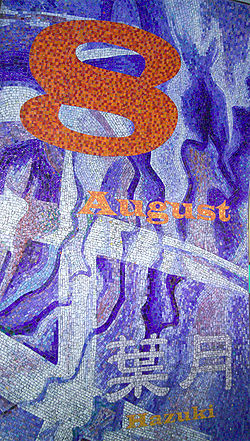
- 8th month: . In old Japanese, the month was called 葉落ち月 (haochizuki, or Month of Falling Leaves).
- 9th month:
- 10th month: 神無月 (kaminazuki or kannazukiKannazukiis a traditional name for the tenth month in the traditional Japanese calendar.The name can be translated literally as "the month when there are no gods". In Shinto tradition it was said that the eight million gods of Japan left their shrines and congregated annually at Izumo Taisha...
, "month of the gods "). The 無 character, which normally means "absent" or "there is not", was here probably originally used as atejiAtejiIn modern Japanese, primarily refers to kanji used phonetically to represent native or borrowed words, without regard to the meaning of the underlying characters. This is analogous to man'yōgana in pre-modern Japanese...
, that is used only for the sound "na". In this name the na is actually a possessive particle, so kaminazuki means "month of the gods", not "month without gods" ("kaminakizuki"), similarly to minatsuki, the "month of water". However, by false etymologyFalse etymologyFolk etymology is change in a word or phrase over time resulting from the replacement of an unfamiliar form by a more familiar one. Unanalyzable borrowings from foreign languages, like asparagus, or old compounds such as samblind which have lost their iconic motivation are...
this became commonly interpreted to mean that because in that month all the ShintoShintoor Shintoism, also kami-no-michi, is the indigenous spirituality of Japan and the Japanese people. It is a set of practices, to be carried out diligently, to establish a connection between present day Japan and its ancient past. Shinto practices were first recorded and codified in the written...
kamiKamiis the Japanese word for the spirits, natural forces, or essence in the Shinto faith. Although the word is sometimes translated as "god" or "deity", some Shinto scholars argue that such a translation can cause a misunderstanding of the term...
gather at Izumo ShrineIzumo Taishais one of the most ancient and important Shinto shrines in Japan. No record gives the date of establishment. Located in Izumo, Shimane Prefecture, it is home to two major festivals. It is dedicated to the god Ōkuninushi , famous as the Shinto deity of marriage.A style of architecture,...
shrine in Izumo provinceIzumo Provincewas an old province of Japan which today consists of the eastern part of Shimane Prefecture. It was sometimes called . The province is in the Chūgoku Region.- History :It was one of the regions of ancient Japan where major political powers arose...
(modern-day Shimane PrefectureShimane Prefectureis a prefecture of Japan located in the Chūgoku region on Honshū island. The capital is Matsue. It is the second least populous prefecture in Japan, after its eastern neighbor Tottori. The prefecture has an area elongated from east to west facing the Chūgoku Mountain Range on the south side and to...
), there are no gods in the rest of the country. Thus in Izumo Province, the month is called .This interpretation is the one commonly cited in western works. Various other etymologies have also been suggested from time to time. - 11th month:
- 12th month: . This is in reference to priests being busy at the end of the year for New Year's preparations and blessings.
Note:' the old Japanese calendar was an adjusted lunar calendar based on the Chinese calendar, and the year—and with it the months—started anywhere from about 3 to 7 weeks later than the modern year, so it is not entirely accurate to equate the first month with January.
Subdivisions of the month
Japan uses a seven-day weekSeven-day week
The seven-day week is used by the majority of the world and is the international standard as specified in ISO 8601.- Origins :The origin of the seven-day week is the religious significance that was placed on the seventh day by ancient cultures, including the Babylonian civilization and the Jewish...
, aligned with the Western calendar. The seven day week, with names for the days corresponding directly to those used in Europe, was brought to Japan around AD 800 with Buddhism
Buddhism
Buddhism is a religion and philosophy encompassing a variety of traditions, beliefs and practices, largely based on teachings attributed to Siddhartha Gautama, commonly known as the Buddha . The Buddha lived and taught in the northeastern Indian subcontinent some time between the 6th and 4th...
calendar. The system was used for astrological purposes and little else until 1876. Since late 19th century, Sunday has been regarded as a "full-time holiday", and Saturday a "half-time holiday(半ドン)". These holidays have no religious meaning (except those who believe Christianity
Christianity
Christianity is a monotheistic religion based on the life and teachings of Jesus as presented in canonical gospels and other New Testament writings...
, Judaism
Judaism
Judaism ) is the "religion, philosophy, and way of life" of the Jewish people...
or Islam
Islam
Islam . The most common are and . : Arabic pronunciation varies regionally. The first vowel ranges from ~~. The second vowel ranges from ~~~...
). The names come from the five visible planets, which in turn are named after the five Chinese elements
Five elements (Chinese philosophy)
The Wu Xing, also known as the Five Phases, the Five Agents, the Five Movements, and the Five Steps/Stages, are chiefly an ancient mnemonic device, in many traditional Chinese fields....
(gold, wood, water, fire, earth), and from the moon and sun (yin and yang
Yin and yang
In Asian philosophy, the concept of yin yang , which is often referred to in the West as "yin and yang", is used to describe how polar opposites or seemingly contrary forces are interconnected and interdependent in the natural world, and how they give rise to each other in turn. Opposites thus only...
). On the origin of the names of the days of the week, also see East Asian Seven Luminaries.
| Japanese | Romanization | Element | English name |
|---|---|---|---|
| 日曜日 | nichiyōbi | Sun | Sunday |
| 月曜日 | getsuyōbi | Moon | Monday |
| 火曜日 | kayōbi | Fire (Mars Mars Mars is the fourth planet from the Sun in the Solar System. The planet is named after the Roman god of war, Mars. It is often described as the "Red Planet", as the iron oxide prevalent on its surface gives it a reddish appearance... ) |
Tuesday |
| 水曜日 | suiyōbi | Water (Mercury Mercury (planet) Mercury is the innermost and smallest planet in the Solar System, orbiting the Sun once every 87.969 Earth days. The orbit of Mercury has the highest eccentricity of all the Solar System planets, and it has the smallest axial tilt. It completes three rotations about its axis for every two orbits... ) |
Wednesday |
| 木曜日 | mokuyōbi | Wood/Tree (Jupiter Jupiter Jupiter is the fifth planet from the Sun and the largest planet within the Solar System. It is a gas giant with mass one-thousandth that of the Sun but is two and a half times the mass of all the other planets in our Solar System combined. Jupiter is classified as a gas giant along with Saturn,... ) |
Thursday |
| 金曜日 | kin'yōbi | Metal/Gold (Venus Venus Venus is the second planet from the Sun, orbiting it every 224.7 Earth days. The planet is named after Venus, the Roman goddess of love and beauty. After the Moon, it is the brightest natural object in the night sky, reaching an apparent magnitude of −4.6, bright enough to cast shadows... ) |
Friday |
| 土曜日 | doyōbi | Earth (Saturn Saturn Saturn is the sixth planet from the Sun and the second largest planet in the Solar System, after Jupiter. Saturn is named after the Roman god Saturn, equated to the Greek Cronus , the Babylonian Ninurta and the Hindu Shani. Saturn's astronomical symbol represents the Roman god's sickle.Saturn,... ) |
Saturday |
Japanese people also use 10-day periods called "Jun(旬)". Each month is divided roughly into three 10-day periods. The first (from 1st to 10th day) is "jōjun" (上旬 "upper Jun"); the second(from 11th to 20th), chūjun (中旬 "middle Jun"); the last(from 21st to 31st), gejun (下旬 "bottom Jun" ). These are frequently used to indicate approximate times, for example, "the temperatures are typical of the jōjun of April"; "a vote on a bill is expected during the gejun of this month."
Days of the month
Each day of the month has a semi-systematic but irregularly formed name:| 1 | 一日 | tsuitachi ("ippi" is also in legal or business use) | 17 | 十七日 | jūshichinichi |
| 2 | 二日 | futsuka | 18 | 十八日 | jūhachinichi |
| 3 | 三日 | mikka | 19 | 十九日 | jūkunichi |
| 4 | 四日 | yokka | 20 | 二十日 | hatsuka |
| 5 | 五日 | itsuka | 21 | 二十一日 | nijūichinichi |
| 6 | 六日 | muika | 22 | 二十二日 | nijūninichi |
| 7 | 七日 | nanoka | 23 | 二十三日 | nijūsannichi |
| 8 | 八日 | yōka | 24 | 二十四日 | nijūyokka |
| 9 | 九日 | kokonoka | 25 | 二十五日 | nijūgonichi |
| 10 | 十日 | tōka | 26 | 二十六日 | nijūrokunichi |
| 11 | 十一日 | jūichinichi | 27 | 二十七日 | nijūshichinichi |
| 12 | 十二日 | jūninichi | 28 | 二十八日 | nijūhachinichi |
| 13 | 十三日 | jūsannichi | 29 | 二十九日 | nijūkunichi |
| 14 | 十四日 | jūyokka | 30 | 三十日 | sanjūnichi |
| 15 | 十五日 | jūgonichi | 31 | 三十一日 | sanjūichinichi |
| 16 | 十六日 | jūrokunichi | |||
(Note that using Arabic numerals, as 14日, is extremely common in everyday communication, almost the norm.)
"Tsuitachi" is a worn-down form of tsuki-tachi, which means "the month beginning". The last day of the month was called "tsugomori", which means "Moon hidden". This classic word comes from the tradition of lunisolar calendar.
The 30th day of the month was also called "misoka" just as 20th day called "hatsuka". Nowadays, the terms for the numbers 28-31 plus nichi are much more common. However, misoka is much used in contracts, etc., specifying that a payment should be made on or by the last day of the month, whatever the number is. The last day of the year is 大晦日 ōmisoka
Omisoka
, New Year's Eve, is the second-most important day in Japanese tradition because it is the final day of the old year and the eve of New Year's Day, which is the most important day of the year....
(the big 30th day), and that term is still in use.
There is a tradition to use a term kichijitsu (good day) for ceremonial events such as the preparation day of a wedding invitation letter and the build day of a memorial stone tablet. It is, however, not recognized as a legally valid date indication. So, for example, a will with kichijitsu as its preparation date is not legally valid.
National holidays
After WW2, names of Japanese national holidays were completely changed because of the secular state principle (Article 20, The Constitution of Japan). Although many of them are actually originated from ShintoShinto
or Shintoism, also kami-no-michi, is the indigenous spirituality of Japan and the Japanese people. It is a set of practices, to be carried out diligently, to establish a connection between present day Japan and its ancient past. Shinto practices were first recorded and codified in the written...
, Buddhism
Buddhism
Buddhism is a religion and philosophy encompassing a variety of traditions, beliefs and practices, largely based on teachings attributed to Siddhartha Gautama, commonly known as the Buddha . The Buddha lived and taught in the northeastern Indian subcontinent some time between the 6th and 4th...
and some important events of Japanese imperial family, it is not easy to understand the original meaning from its superficial and vague official name.
Notes: Single days between two national holidays are taken as a bank holiday. This applies to May 4, which is a holiday each year. When a national holiday falls on a Sunday the next day that is not a holiday (usually a Monday) is taken as a holiday.
| Date | English name | Official name | Romanization Romanization of Japanese The romanization of Japanese is the application of the Latin alphabet to write the Japanese language. This method of writing is known as , less strictly romaji, literally "Roman letters", sometimes incorrectly transliterated as romanji or rōmanji. There are several different romanization systems... |
|---|---|---|---|
| January 1 | New Year's Day Japanese New Year The is one of the most important annual festivals, with its own unique customs, and has been celebrated for centuries. Due to the importance of the holiday and the preparations required, the preceding days are quite busy, particularly the day before, known as Ōmisoka.The Japanese New Year has been... |
元日 | Ganjitsu |
| 2nd Monday of January | Coming of Age Day | 成人の日 | Seijin no hi |
| February 11 | National Foundation Day National Foundation Day is a national holiday in Japan celebrated annually on February 11. On this day, Japanese celebrate the founding of the nation and the imperial line by its legendary first emperor, Jimmu, who according to legend established his capital in Yamato in 660 BC.... † |
建国記念の日 | Kenkoku kinen no hi |
| March 20 or March 21 | Vernal Equinox Day Vernal Equinox Day is a public holiday in Japan that occurs on the date of the vernal equinox in Japan Standard Time , usually March 20 or 21. The date of the holiday is not declared official until February of the previous year, due to the need for recent astronomical measurements.Vernal Equinox Day became a public... |
春分の日 | Shunbun no hi |
| April 29 | Shōwa Day Showa Day is a Japanese annual holiday held on April 29. It honors the birthday of the Shōwa Emperor , the reigning Emperor from 1926 to 1989. The purpose of the holiday is to encourage public reflection on the turbulent 63 years of Hirohito's reign.-History:... * |
昭和の日 | Shōwa no hi !! |
| May 3 | Constitution Memorial Day Constitution Memorial Day is a national holiday in Japan. It takes place on May third in celebration of the promulgation of the 1947 Constitution of Japan. It is a part of the collection of holidays known as Golden Week.... * |
憲法記念日 | Kenpō kinenbi |
| May 4 | Greenery Day Greenery Day is a Japanese holiday. Between 1989 and 2006 it was celebrated on April 29. In 2007 Greenery Day was moved to May 4.The present observation of Greenery Day as a national holiday in Japan stems from the celebration of the Emperor Shōwa's birthday on April 29 every year during the Shōwa era... * |
みどり(緑)の日 | Midori no hi |
| May 5 | Children's Day Children's Day "Children Day", as an event, is celebrated on various days in many places around the world, in particular to honor children. Major global variants include a Universal Children's Day on November 20, by United Nations recommendation... * |
子供の日 | Kodomo no hi Kodomo no hi is a Japanese national holiday which takes place annually on May 5, the fifth day of the fifth month, and is part of the Golden Week. It is a day set aside to respect children's personalities and to celebrate their happiness... |
| 3rd Monday of July | Marine Day Marine Day , known as 'Ocean Day' or 'Sea Day' is a Japanese national holiday celebrated on the third Monday in July. Many people take advantage of the holiday and summer weather to take a beach trip.-History:... |
海の日 | Umi no hi |
| 3rd Monday of September | Respect for the Aged Day Respect for the Aged Day is a Japanese holiday celebrated annually to honor elderly citizens. A national holiday since 1966, this was previously held on September 15. Beginning in 2003, Respect for the Aged Day is held on the third Monday of September due to the Happy Monday System.... |
敬老の日 | Keirō no hi |
| September 23 or September 24 | Autumnal Equinox Day Autumnal Equinox Day is one of the public holidays in Japan that usually occurs on September 22 or 23, at the date of autumnal equinox in Japan Standard Time . Due to the necessity of recent astronomical measurements, the date of the holiday is not declared official until February of the previous year... |
秋分の日 | Shūbun no hi |
| 2nd Monday of October | Health-Sports Day Health and Sports Day , also known as Health-Sports Day or Sports Day, is a national holiday in Japan held annually on the second Monday in October. It commemorates the opening of the 1964 Summer Olympics being held in Tokyo, and exists to promote sports and an active lifestyle.-History and current practice:The first ... |
体育の日 | Taiiku no hi |
| November 3 | Culture Day Culture Day is a national holiday held annually in Japan on November 3 for the purpose of promoting culture, the arts, and academic endeavour. Festivities typically include art exhibitions, parades, and award ceremonies for distinguished artists and scholars.-History:... |
文化の日 | Bunka no hi |
| November 23 | Labour Thanksgiving Day Labour Thanksgiving Day is a national holiday in Japan. It takes place annually on November 23. The law establishing the holiday cites it as an occasion for commemorating labor and production and giving one another thanks.... |
勤労感謝の日 | Kinrō kansha no hi |
| December 23 | The Emperor's Birthday The Emperor's Birthday is a national holiday in the Japanese calendar. It is currently celebrated on 23 December. The date is determined by the present Emperor's birthdate. Emperor Akihito was born on this date in 1933.... |
天皇誕生日 | Tennō tanjōbi |
† Traditional date on which according to legend Emperor Jimmu
Emperor Jimmu
was the first Emperor of Japan, according to the traditional order of succession. He is also known as Kamuyamato Iwarebiko and personally as Wakamikenu no Mikoto or Sano no Mikoto....
founded Japan in 660 BC.
Timeline of changes to the national holidays
- 1948: The following national holidays were introduced: New Year's Day, Coming-of-Age Day, Constitution Memorial Day, Children's Day, Autumnal Equinox Day, Culture Day, Labour Thanksgiving Day.
- 1966: Health and Sports Day was introduced in memory of the 1964 Tokyo Olympics. Vernal Equinox Day was also introduced.
- 1985: Reform to the national holiday law made May 4, sandwiched between two other national holidays also a holiday.
- 1989: After Emperor Showa died on January 7, the Emperor's Birthday became December 23 and Greenery Day took place of the former Emperor's birthday.
- 2000, 2003: moved several holidays to Monday. Starting with 2000: Coming-of-Age Day (formerly January 15) and Health and Sports Day (formerly October 10). Starting with 2003: Marine Day (formerly July 20) and Respect for the Aged Day (formerly September 15).
- 2005, 2007: According to a May 2005 decision, starting with 2007 Greenery Day will be moved from April 29 to May 4 replacing a that existed after 1985 reform, while April 29 will be known as Shōwa Day.
- 2009: September 22 may become sandwiched between two holidays, which would make this day a national holiday.
Gregorian months and the "One Month Delay"
Clearly in contrast to other East Asian countries such as ChinaChina
Chinese civilization may refer to:* China for more general discussion of the country.* Chinese culture* Greater China, the transnational community of ethnic Chinese.* History of China* Sinosphere, the area historically affected by Chinese culture...
, Taiwan
Taiwan
Taiwan , also known, especially in the past, as Formosa , is the largest island of the same-named island group of East Asia in the western Pacific Ocean and located off the southeastern coast of mainland China. The island forms over 99% of the current territory of the Republic of China following...
, Vietnam
Vietnam
Vietnam – sometimes spelled Viet Nam , officially the Socialist Republic of Vietnam – is the easternmost country on the Indochina Peninsula in Southeast Asia. It is bordered by China to the north, Laos to the northwest, Cambodia to the southwest, and the South China Sea –...
, Korea
Korea
Korea ) is an East Asian geographic region that is currently divided into two separate sovereign states — North Korea and South Korea. Located on the Korean Peninsula, Korea is bordered by the People's Republic of China to the northwest, Russia to the northeast, and is separated from Japan to the...
and Mongolia
Mongolia
Mongolia is a landlocked country in East and Central Asia. It is bordered by Russia to the north and China to the south, east and west. Although Mongolia does not share a border with Kazakhstan, its western-most point is only from Kazakhstan's eastern tip. Ulan Bator, the capital and largest...
, Japan has almost completely forgotten Chinese calendar
Chinese calendar
The Chinese calendar is a lunisolar calendar, incorporating elements of a lunar calendar with those of a solar calendar. It is not exclusive to China, but followed by many other Asian cultures as well...
. Since 1876, January is officially regarded as "1st month" even when setting the date of every Japanese traditional folklore
Folklore
Folklore consists of legends, music, oral history, proverbs, jokes, popular beliefs, fairy tales and customs that are the traditions of a culture, subculture, or group. It is also the set of practices through which those expressive genres are shared. The study of folklore is sometimes called...
event (other months are the same: February as the 2nd month, March as the 3rd, and so on). But this system often brings strong seasonal sense of gap. The modern Japanese culture invented a kind of "compromised" calendar. This calendar, which is called "Tsuki-okure (One Month Delay)" or "Chūreki(The Eclectic Calendar"), regards February as "1st Month". Although this is just de facto and costomary, it is broadly used when setting the dates of many folklore events and religious festivals. But Japanese New Year
Japanese New Year
The is one of the most important annual festivals, with its own unique customs, and has been celebrated for centuries. Due to the importance of the holiday and the preparations required, the preceding days are quite busy, particularly the day before, known as Ōmisoka.The Japanese New Year has been...
is the great exception. This festival is never set on February 1.
Seasonal days
Some days have special names to mark the change in seasons. The are days that divide the solar year into twenty four equal sections. is a collective term for the seasonal days other than the 24 Sekki. days are made from dividing the 24 Sekki of a year further by three. These were named based upon the climate of Northern ChinaChina
Chinese civilization may refer to:* China for more general discussion of the country.* Chinese culture* Greater China, the transnational community of ethnic Chinese.* History of China* Sinosphere, the area historically affected by Chinese culture...
, so many of the names do not fit in with the climate of Japanese archipelago. But some of these names, such as Shunbun, Risshū and Tōji, are still used quite frequently in everyday life in Japan.
24 Sekki
: February 4—Beginning of spring: February 19—Rain water: March 5—awakening of hibernated (insects): March 20—Vernal equinox, middle of spring: April 5—Clear and bright: April 20—Grain rain: May 5—Beginning of summer: May 21—Grain full: June 6—Grain in ear: June 21—Summer solsticeSolstice
A solstice is an astronomical event that happens twice each year when the Sun's apparent position in the sky, as viewed from Earth, reaches its northernmost or southernmost extremes...
, middle of summer: July 7—Small heat: July 23—Large heat: August 7—Beginning of autumn: August 23—Limit of heat: September 7—White dew: September 23—Autumnal equinox, middle of autumn: October 8—Cold dew: October 23—Frost descent: November 7—Beginning of winter: November 22—Small snow: December 7—Large snow: December 22—Winter solstice
Winter solstice
Winter solstice may refer to:* Winter solstice, astronomical event* Winter Solstice , former band* Winter Solstice: North , seasonal songs* Winter Solstice , 2005 American film...
, middle of winter: January 5 Small Cold—a.k.a. 寒の入り (Kan no iri) entrance of the cold: January 20—Major cold
Days can vary by ±1 day. See also: Jieqi.
Zassetsu
| Day | Kanji | Romaji | Comment |
|---|---|---|---|
| February 3 | 節分 | Setsubun Setsubun is the day before the beginning of spring in Japan. The name literally means "seasonal division", but usually the term refers to the spring Setsubun, properly called Risshun celebrated yearly on February 3 as part of the... |
The eve of Risshun by one definition. |
| March 18–March 24 | 春彼岸 | Haru higan | The seven days surrounding Shunbun. |
| Vernal Equinox day | 春社日 | Haru shanichi | in Shinto Shinto or Shintoism, also kami-no-michi, is the indigenous spirituality of Japan and the Japanese people. It is a set of practices, to be carried out diligently, to establish a connection between present day Japan and its ancient past. Shinto practices were first recorded and codified in the written... . 彼岸中日(Higan Chunichi) in Buddhism Buddhism Buddhism is a religion and philosophy encompassing a variety of traditions, beliefs and practices, largely based on teachings attributed to Siddhartha Gautama, commonly known as the Buddha . The Buddha lived and taught in the northeastern Indian subcontinent some time between the 6th and 4th... |
| May 2 | 八十八夜 | Hachijū hachiya | Literally meaning 88 nights (since Risshun). |
| June 11 | 入梅 | Nyūbai | Literally meaning entering tsuyu East Asian rainy season The East Asian rainy season, commonly called the plum rain , is caused by precipitation along a persistent stationary front known as the Meiyu front for nearly two months during the late spring and early summer between eastern China, Taiwan, South Korea, and Japan... . |
| July 2 | 半夏生 | Hangeshō | One of the 72 Kō. Farmers take five days off in some regions. |
| July 15 | 中元 | Chūgen | Officially July 15. August 15 in many region(Tsuki-okure) |
| July 20 | 夏の土用 | Natsu no doyō | custom of eating eel Eel Eels are an order of fish, which consists of four suborders, 20 families, 111 genera and approximately 800 species. Most eels are predators... on this day |
| September 1 | 二百十日 | Nihyaku tōka | Literally meaning 210 days (since Risshun). It means Typhoon alert |
| September 11 | 二百二十日 | Nihyaku hatsuka | Literally meaning 220 days. |
| September 20–September 26 | 秋彼岸 | Aki higan | |
| Autumal Equinox | 秋社日 | Aki shanichi | in Shinto Shinto or Shintoism, also kami-no-michi, is the indigenous spirituality of Japan and the Japanese people. It is a set of practices, to be carried out diligently, to establish a connection between present day Japan and its ancient past. Shinto practices were first recorded and codified in the written... . 彼岸中日 in Buddhism Buddhism Buddhism is a religion and philosophy encompassing a variety of traditions, beliefs and practices, largely based on teachings attributed to Siddhartha Gautama, commonly known as the Buddha . The Buddha lived and taught in the northeastern Indian subcontinent some time between the 6th and 4th... |
Shanichi days can vary as much as ±5 days.
Chūgen has a fixed day. All other days can vary by ±1 day.
Many zassetsu days occur on multiple seasons: refers to the day before each season, or the eves of Risshun, Rikka, Rishū, and Rittō; especially the eve of Risshun.
refers to the 18 days before each season, especially the one before fall which is known as the hottest period of a year.
is the seven middle days of spring and autumn, with Shunbun at the middle of the seven days for spring, Shūbun for fall.
is the day closest to Shunbun (middle of spring) or Shūbun (middle of fall), which can be as much as -5 to +4 days away from Shunbun/Shūbun.
Seasonal festivals
The following are known as the five seasonal festivals (節句 sekku, also 五節句 go sekku). The Sekku were made official holidays during Edo era on Chinese lunisolar calendarLunisolar calendar
A lunisolar calendar is a calendar in many cultures whose date indicates both the moon phase and the time of the solar year. If the solar year is defined as a tropical year then a lunisolar calendar will give an indication of the season; if it is taken as a sidereal year then the calendar will...
. The dates of these festivals are confused nowadays. Some on the Gregorian calendar, others on "Tsuki-okure".
- 7th day of the 1st Month: 人日 (Jinjitsu), 七草の節句 (Nanakusa no sekku) held on 7 January today
- 3rd day of the 3rd Month: 上巳 (Jōshi), 桃の節句 (Momo no sekku) held on 3 March in many area, but in some area on 3 April
- 雛祭り (Hina matsuriHinamatsuriThe Japanese , or Girls' Day, is held on March 3. Platforms covered with a red carpet are used to display a set of representing the Emperor, Empress, attendants, and musicians in traditional court dress of the Heian period.- Origin and customs :...
), Girls' Day.
- 雛祭り (Hina matsuri
- 5th day of the 5th Month: Tango (端午): mostly held on 5 May
- 端午の節句 (Tango no sekku), 菖蒲の節句 (Ayame no sekku)
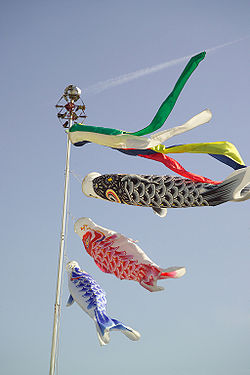
- Boys' Day. Overlaps with the national holiday Children's DayChildren's Day"Children Day", as an event, is celebrated on various days in many places around the world, in particular to honor children. Major global variants include a Universal Children's Day on November 20, by United Nations recommendation...
.
- 7th day of the 7th Month: 七夕 (Shichiseki, TanabataTanabatais a Japanese star festival, originating from the Chinese Qixi Festival. It celebrates the meeting of the deities Orihime and Hikoboshi . According to legend, the Milky Way separates these lovers, and they are allowed to meet only once a year on the seventh day of the seventh lunar month of the...
), 星祭り (Hoshi matsuri ) held on 7 July in many areas, but in northern Japan held on 7 August(e.g. in Sendai) - 9th day of the 9th Month: 重陽 (Chōyō), 菊の節句 (Kiku no sekku) almost out of vogue today
Not Sekku:
- January 1: Japanese New YearJapanese New YearThe is one of the most important annual festivals, with its own unique customs, and has been celebrated for centuries. Due to the importance of the holiday and the preparations required, the preceding days are quite busy, particularly the day before, known as Ōmisoka.The Japanese New Year has been...
- August 15: ObonObónObón is a municipality located in the province of Teruel, Aragon, Spain. According to the 2004 census , the municipality has a population of 75 inhabitants....
- the date is "Tsuki-okure". In central TokyoTokyo, ; officially , is one of the 47 prefectures of Japan. Tokyo is the capital of Japan, the center of the Greater Tokyo Area, and the largest metropolitan area of Japan. It is the seat of the Japanese government and the Imperial Palace, and the home of the Japanese Imperial Family...
Obon is held on July 15 (The local culture of Tokyo tends to dislike Tsuki-okure custom.) - December 31: ŌmisokaOmisoka, New Year's Eve, is the second-most important day in Japanese tradition because it is the final day of the old year and the eve of New Year's Day, which is the most important day of the year....
Rokuyō
The are a series of six days culculated from the date of Chinese calendarChinese calendar
The Chinese calendar is a lunisolar calendar, incorporating elements of a lunar calendar with those of a solar calendar. It is not exclusive to China, but followed by many other Asian cultures as well...
that supposedly predict whether there will be good or bad fortune during that day. The rokuyō are commonly found on Japanese calendars and are often used to plan weddings and funerals, though most people ignore them in ordinary life. The rokuyō are also known as the . In order, they are:
| Kanji | Romanization | Meaning |
|---|---|---|
| 先勝 | Senshō | Good luck before noon, bad luck after noon. Good day for beginnings (in the morning). |
| 友引 | Tomobiki | Bad things will happen to your friends. Funerals avoided on this day (tomo = friend, biki = pull, thus a funeral might pull friends toward the deceased). Typically crematoriums are closed this day. |
| 先負 | Senbu | Bad luck before noon, good luck after noon. |
| 仏滅 | Butsumetsu | Symbolizes the day Buddha Gautama Buddha Siddhārtha Gautama was a spiritual teacher from the Indian subcontinent, on whose teachings Buddhism was founded. In most Buddhist traditions, he is regarded as the Supreme Buddha Siddhārtha Gautama (Sanskrit: सिद्धार्थ गौतम; Pali: Siddhattha Gotama) was a spiritual teacher from the Indian... died. Considered the most unlucky day. Weddings are best avoided. Some Shinto Shinto or Shintoism, also kami-no-michi, is the indigenous spirituality of Japan and the Japanese people. It is a set of practices, to be carried out diligently, to establish a connection between present day Japan and its ancient past. Shinto practices were first recorded and codified in the written... shrines close their offices on this day. |
| 大安 | Taian | The most lucky day. Good day for weddings and events like shop openings. |
| 赤口 | Shakkō | The hour of the horse (11 am–1 pm) is lucky. The rest is bad luck. |
The rokuyō days are easily calculated from the Japanese Lunisolar calendar. Lunisolar January 1 is always senshō, with the days following in the order given above until the end of the month. Thus, January 2 is tomobiki, January 3 is senbu, and so on. Lunisolar February 1 restarts the sequence at tomobiki. Lunisolar March 1 restarts at senbu, and so on for each month. The last six months repeat the patterns of the first six, so July 1 = senshō, December 1 is shakkō and the moon-viewing day of "August 15th" is always a "butsumetsu."
This system did not become popular in Japan until the end of the Edo period.
April 1
The first day of April has broad significance in Japan. It marks the beginning of the government's fiscal year. Many corporations follow suit. In addition, corporations often form or merge on that date. In recent years, municipalities have preferred it for mergers. On this date, many new employees begin their jobs, and it is the start of many real-estate leases. The school year begins on April 1. (For more see also academic termAcademic term
An academic term is a division of an academic year, the time during which a school, college or university holds classes. These divisions may be called terms...
.)
External links
- Japanese calendar tables and zodiac signs, in Kanji, Hiragana, Romaji, and English,
- Japanese calendar history by the National Diet Library
- The Lunar Calendar in Japan
- The Japanese Lunar Calendar Mechanics of the Japanese lunar calendar and hints on using NengoCalc (see below)
- Koyomi no page in Japanese
- Koyomi no hanashi in Japanese
- Rokuyō calculator in Japanese
- Rokuyō calendar in English
- Convert Western Years to Japanese Years converts Gregorian calendar years to Japanese Emperor Era years (known as nengo)
- Japanese Year Dates Detailed explanations of Reign years, Era years, Cyclic years, Western years, Imperial years
- NengoCalc (Tool for converting Japanese dates into Western equivalents)
- This Year in Japan Shows what the current year in Japan is
- Convert a Western year into a Japanese year (sci.lang.japan FAQ pages)