

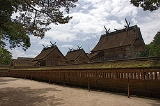
Izumo Taisha

Encyclopedia
is one of the most ancient and important Shinto shrines in Japan
. No record gives the date of establishment. Located in Izumo
, Shimane Prefecture
, it is home to two major festivals. It is dedicated to the god Ōkuninushi (Ōkuninushi-no-mikoto), famous as the Shinto deity of marriage.
A style of architecture, taisha-zukuri
, takes its name from the main hall of Izumo-taisha. That hall, and the attached buildings, were designated National Treasures of Japan
in 1952. According to tradition, the hall was previously much taller than presently. The discovery in the year 2000 of the remains of enormous pillars has lent credence to this.
Several other buildings in the shrine compound are on the list of Important Cultural Properties of Japan
.
and Nihon Shoki
, when Ninigi-no-Mikoto
, grandson of the Sun Goddess Amaterasu
, descended from the heavens, the god Ōkuninushi granted his country to Ninigi-no-Mikoto. Amaterasu was much pleased by this action and she presented Izumo-taisha to Ōkuninushi.
At one time, the Japanese islands were controlled from Izumo, according to Shinto myths. Izumo, known as the realm of gods or the land of myths, is Izumo-taisha's province. Its main structure was originally constructed to glorify the great achievement of Ōkuninushi, considered the creator of Japan. Ōkuninushi was devoted to the building of the nation, in which he shared many joys and sorrows with the ancestors of the land. In addition to being the savior, Ōkuninushi is considered the guardian god and god of happiness, as well as the god who establishes good relationships.
 According to the Nihon Shoki
, the sun goddess Amaterasu said, "From now on, my descendants shall administer the affairs of state. You shall cast a spell of establishing good relationship over people to lead them a happy life. I will build your residence with colossal columns and thick and broad planks in the same architectural style as mine and name it Amenohisu-no-miya." The other gods were gathered and ordered by Amaterasu to build the grand palace at the foot of Mt. Uga.
There is no knowledge of exactly when Izumo-taisha was built, but a record compiled around 950 (Heian period
) describes the shrine as the highest building, reaching approximately 48 meters, which exceeds in height the 45 meter-tall temple that enshrined the Great Image of Buddha, Tōdai-ji
. This was due to early Shinto cosmology, when the people believed the gods (kami) were above the human world and belonged to the most extraordinary and majestic parts of nature. Therefore, Izumo-taisha could have been an attempt to create a place for the kami
that would be above humans.
According to Kojiki, the legendary stories of old Japan, and Nihon Shoki, the chronicles of old Japan, Izumo-taisha was considered the largest wooden structure in Japan when it was originally constructed. Before being known as Izumo Ōyashiro or Izumo-taisha, the shrine was known as Okami-no-miya in Izumo, Itsukashinokami-no-miya, Kizuki-no-Oyashiro, Kizuki-no-miya, or Iwakumanoso-no-miya.
Evidence of the original Grand Shrine has been found. For example, part of one of the pillars for the structure was found: three cedar trees with a three-meter diameter at its base. It is on display at the shrine. Although there is not much early evidence one can see when visiting, there is a shop just before the main entrance that has a smaller scale model of the original main structure made by local college students.
 During the Kamakura era, around 1200, the main structure was reduced in size. Then in 1744, the shrine was reconstructed to the present size of 24 meters high and 11 meters square at its base.
In the 18th and 19th centuries, as travel became more common in Japan, the shrine became a central place of pilgrimage
.
Since the shrine spirit was settled in the inner shrine in 1744, it has been relocated three times for renovation of the inner shrine, using a traditional ceremony. The relocations took place in 1809, 1881, and 1953.
From 1871 through 1946, the Izumo-taisha was officially designated one of the Kanpei-taisha (官幣大社), meaning that it stood in the first rank of government supported shrines.
In April 2008, the spirit was moved to temporary housing in the front shrine of Izumo-taisha in preparation for the Heisei-era renovations. Izumo-taisha's inner shrine was opened to the public for the first time in 60 years in the summer of 2008.
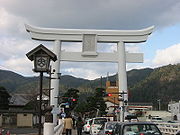 The main structure of Izumo Oyashiro was built in the Taisha style
, the oldest style of building shrines. An impressive sized gable-entrance structure is built for the main structure, which gave the name of The Great Shrine or The Grand Shrine. The main hall (honden
) bears an enormous chigi
(scissor-shaped finials at the front and back ends of the roof). A Japanese architecture book states, “In plan, the present Main Shrine resembles that of the Daijoe Shoden, built for the accession of each new emperor. The main shrine at Izumo is thought, therefore, to preserve a floor plan characteristic of ancient domestic architecture” (Nishi & Hozumi, 1985, p.41). From the view of architectures, the original height of the main structure of Izumo Taisha makes it difficult to study the historical building styles and methods. However, what is known is that from the construction of a building as big as the main structure, major problems were presented. Because of this, structural and stylistic changes occurred each time the main structure was rebuilt, which caused the outer form to be less reflective of the original construction of the main structure. Although the outside of the structure changed with each reconstruction, the floor plan remained virtually unchanged. The layout consists of eight support pillars arranged so that the inside is divided into four sections and causes the entrance to be off-centered. A significant characteristic that is common among most shrines is the symmetrical design, making the main structure of Izumo-taisha peculiar for its asymmetrical floor plan. The main structure was built more like a home rather than a shrine which suggests that between the people and kami there was a less formal relationship than at other shrines.
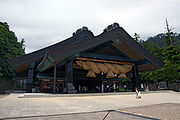 Izumo-taisha's Kaguraden
(神楽殿 Kagura
hall) was first built in 1776 by the Senge family, Izumo Kokusō, or governor of Izumo
, as a grand hall for performance of traditional rituals. It was rebuilt in 1981 to commemorate the centennial of the foundation of the Izumo Oyashiro-kyo order.
Traditional prayer by Izumo Kokuso, wedding ceremonies of believers, and the performances of sacred dance to ancient Japanese music involve the Oracle
with 240 mats. Also worshipped with prayer is a frame with four dyed Chinese
characters, meaning “the Oracle Filled with Aureole,” by Prince Arisugawa above the altar
.
The Kagura-den features the largest shimenawa
(sacred straw rope) in Japan; it is 13.5 meters long and weighs around 5 tons. The rope is one of the most easily recognized and distinctive features of Izumo-taisha.
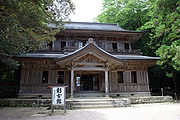 The Shōkokan (彰古館) consists of two floors. The first floor is the reception office for Kaguraden. The second floor consists of a museum for important items.
Some items in the museum are items designated as national treasure and important cultural assets, like jewelry, household articles, paintings, swords, and musical instruments.
Considered most important in Shōkokan are a set of Japan’s oldest wooden pestle and an igniting board and a small boat that was hollowed out of a piece of wood. The small boat was believed to have come from the upper stream of the Yoshino River, through the Seto Inland Sea, and to the Inasa Beach near Izumo-taisha.
Some other major festivals are January 1, Omike Festival; January 3, Fukumukae Festival; January 5, Beginning Sermon Festival; February 17, Kikoku (prayer for abundant crops) Festival; April 1, Kyoso Festival; June 1, Suzumidono Festival; and August 6–9 is Izumo Oyashiro-kyo Religion Festival. In October of the lunar calendar, a festival is held to welcome all the gods to Izumo Grand Shrine. It is believed that the gods gather at Izumo Shrine in October to discuss the coming year’s marriages, deaths, and births. For this reason, people around the Izumo area call October kamiarizuki
("the month with gods"), but the rest of Japan calls October kannazuki'
' ("the month without gods").
Japan
Japan is an island nation in East Asia. Located in the Pacific Ocean, it lies to the east of the Sea of Japan, China, North Korea, South Korea and Russia, stretching from the Sea of Okhotsk in the north to the East China Sea and Taiwan in the south...
. No record gives the date of establishment. Located in Izumo
Izumo, Shimane
is a city located in Shimane, Japan. Izumo is known for Izumo soba noodles and the Izumo Taisha Shinto shrine.-Demographics:The modern city was founded on November 3, 1941....
, Shimane Prefecture
Shimane Prefecture
is a prefecture of Japan located in the Chūgoku region on Honshū island. The capital is Matsue. It is the second least populous prefecture in Japan, after its eastern neighbor Tottori. The prefecture has an area elongated from east to west facing the Chūgoku Mountain Range on the south side and to...
, it is home to two major festivals. It is dedicated to the god Ōkuninushi (Ōkuninushi-no-mikoto), famous as the Shinto deity of marriage.
A style of architecture, taisha-zukuri
Taisha-zukuri
is the oldest Shinto shrine style. Named after Izumo Taisha's honden , like Ise Grand Shrine's shinmei-zukuri style it features a bark roof decorated with poles called chigi and katsuogi, plus archaic features like gable-end pillars and a single central pillar...
, takes its name from the main hall of Izumo-taisha. That hall, and the attached buildings, were designated National Treasures of Japan
National treasures of Japan
National Treasures are the most precious of Japan's Tangible Cultural Properties, as determined and designated by the Agency for Cultural Affairs...
in 1952. According to tradition, the hall was previously much taller than presently. The discovery in the year 2000 of the remains of enormous pillars has lent credence to this.
Several other buildings in the shrine compound are on the list of Important Cultural Properties of Japan
Important Cultural Properties of Japan
The term is often shortened into just are items officially already classified as Tangible Cultural Properties of Japan by the Japanese Agency for Cultural Affairs and judged to be of particular importance to the Japanese people....
.
Origins
According to the two oldest chronicles of Japan, the KojikiKojiki
is the oldest extant chronicle in Japan, dating from the early 8th century and composed by Ō no Yasumaro at the request of Empress Gemmei. The Kojiki is a collection of myths concerning the origin of the four home islands of Japan, and the Kami...
and Nihon Shoki
Nihon Shoki
The , sometimes translated as The Chronicles of Japan, is the second oldest book of classical Japanese history. It is more elaborate and detailed than the Kojiki, the oldest, and has proven to be an important tool for historians and archaeologists as it includes the most complete extant historical...
, when Ninigi-no-Mikoto
Ninigi-no-Mikoto
is in Japanese mythology the son of Ame no Oshihomimi no Mikoto, and grandson of Amaterasu, who sent him down to earth to plant rice there. He was the great-grandfather of Emperor Jimmu. His name also appears as .Amaterasu sent him to pacify Japan by bringing the three celestial gifts used by the...
, grandson of the Sun Goddess Amaterasu
Amaterasu
, or is apart of the Japanese myth cycle and also a major deity of the Shinto religion. She is the goddess of the sun, but also of the universe. the name Amaterasu derived from Amateru meaning "shining in heaven." The meaning of her whole name, Amaterasu-ōmikami, is "the great August kami who...
, descended from the heavens, the god Ōkuninushi granted his country to Ninigi-no-Mikoto. Amaterasu was much pleased by this action and she presented Izumo-taisha to Ōkuninushi.
At one time, the Japanese islands were controlled from Izumo, according to Shinto myths. Izumo, known as the realm of gods or the land of myths, is Izumo-taisha's province. Its main structure was originally constructed to glorify the great achievement of Ōkuninushi, considered the creator of Japan. Ōkuninushi was devoted to the building of the nation, in which he shared many joys and sorrows with the ancestors of the land. In addition to being the savior, Ōkuninushi is considered the guardian god and god of happiness, as well as the god who establishes good relationships.
Nihon Shoki
The , sometimes translated as The Chronicles of Japan, is the second oldest book of classical Japanese history. It is more elaborate and detailed than the Kojiki, the oldest, and has proven to be an important tool for historians and archaeologists as it includes the most complete extant historical...
, the sun goddess Amaterasu said, "From now on, my descendants shall administer the affairs of state. You shall cast a spell of establishing good relationship over people to lead them a happy life. I will build your residence with colossal columns and thick and broad planks in the same architectural style as mine and name it Amenohisu-no-miya." The other gods were gathered and ordered by Amaterasu to build the grand palace at the foot of Mt. Uga.
There is no knowledge of exactly when Izumo-taisha was built, but a record compiled around 950 (Heian period
Heian period
The is the last division of classical Japanese history, running from 794 to 1185. The period is named after the capital city of Heian-kyō, or modern Kyōto. It is the period in Japanese history when Buddhism, Taoism and other Chinese influences were at their height...
) describes the shrine as the highest building, reaching approximately 48 meters, which exceeds in height the 45 meter-tall temple that enshrined the Great Image of Buddha, Tōdai-ji
Todai-ji
, is a Buddhist temple complex located in the city of Nara, Japan. Its Great Buddha Hall , the largest wooden building in the world, houses the world's largest bronze statue of the Buddha Vairocana, known in Japanese simply as Daibutsu . The temple also serves as the Japanese headquarters of the ...
. This was due to early Shinto cosmology, when the people believed the gods (kami) were above the human world and belonged to the most extraordinary and majestic parts of nature. Therefore, Izumo-taisha could have been an attempt to create a place for the kami
Kami
is the Japanese word for the spirits, natural forces, or essence in the Shinto faith. Although the word is sometimes translated as "god" or "deity", some Shinto scholars argue that such a translation can cause a misunderstanding of the term...
that would be above humans.
According to Kojiki, the legendary stories of old Japan, and Nihon Shoki, the chronicles of old Japan, Izumo-taisha was considered the largest wooden structure in Japan when it was originally constructed. Before being known as Izumo Ōyashiro or Izumo-taisha, the shrine was known as Okami-no-miya in Izumo, Itsukashinokami-no-miya, Kizuki-no-Oyashiro, Kizuki-no-miya, or Iwakumanoso-no-miya.
Evidence of the original Grand Shrine has been found. For example, part of one of the pillars for the structure was found: three cedar trees with a three-meter diameter at its base. It is on display at the shrine. Although there is not much early evidence one can see when visiting, there is a shop just before the main entrance that has a smaller scale model of the original main structure made by local college students.
History
In the 18th and 19th centuries, as travel became more common in Japan, the shrine became a central place of pilgrimage
Pilgrimage
A pilgrimage is a journey or search of great moral or spiritual significance. Typically, it is a journey to a shrine or other location of importance to a person's beliefs and faith...
.
Since the shrine spirit was settled in the inner shrine in 1744, it has been relocated three times for renovation of the inner shrine, using a traditional ceremony. The relocations took place in 1809, 1881, and 1953.
From 1871 through 1946, the Izumo-taisha was officially designated one of the Kanpei-taisha (官幣大社), meaning that it stood in the first rank of government supported shrines.
In April 2008, the spirit was moved to temporary housing in the front shrine of Izumo-taisha in preparation for the Heisei-era renovations. Izumo-taisha's inner shrine was opened to the public for the first time in 60 years in the summer of 2008.
Architecture
Taisha-zukuri
is the oldest Shinto shrine style. Named after Izumo Taisha's honden , like Ise Grand Shrine's shinmei-zukuri style it features a bark roof decorated with poles called chigi and katsuogi, plus archaic features like gable-end pillars and a single central pillar...
, the oldest style of building shrines. An impressive sized gable-entrance structure is built for the main structure, which gave the name of The Great Shrine or The Grand Shrine. The main hall (honden
Honden
The , is the most sacred building at a Shinto shrine, intended purely for the use of the enshrined kami, usually symbolized by a mirror or sometimes by a statue. The building is normally in the rear of the shrine and closed to the general public. In front of its usually stands the haiden, or...
) bears an enormous chigi
Chigi (architecture)
, or are forked roof finials found in Japanese and Shinto Architecture. Chigi predate Buddhist influence and are an architectural element endemic to Japan. They are an important aesthetic aspect of Shinto shrines, where they are often paired with katsuogi, another type of roof ornamentation...
(scissor-shaped finials at the front and back ends of the roof). A Japanese architecture book states, “In plan, the present Main Shrine resembles that of the Daijoe Shoden, built for the accession of each new emperor. The main shrine at Izumo is thought, therefore, to preserve a floor plan characteristic of ancient domestic architecture” (Nishi & Hozumi, 1985, p.41). From the view of architectures, the original height of the main structure of Izumo Taisha makes it difficult to study the historical building styles and methods. However, what is known is that from the construction of a building as big as the main structure, major problems were presented. Because of this, structural and stylistic changes occurred each time the main structure was rebuilt, which caused the outer form to be less reflective of the original construction of the main structure. Although the outside of the structure changed with each reconstruction, the floor plan remained virtually unchanged. The layout consists of eight support pillars arranged so that the inside is divided into four sections and causes the entrance to be off-centered. A significant characteristic that is common among most shrines is the symmetrical design, making the main structure of Izumo-taisha peculiar for its asymmetrical floor plan. The main structure was built more like a home rather than a shrine which suggests that between the people and kami there was a less formal relationship than at other shrines.
Kaguraden
Kagura
- Fictional characters :*Kagura Tsuchimiya, the protagonist of Ga-rei*Kagura, an InuYasha character*Kagura Sohma , a Fruits Basket character*Kagura, an Azumanga Daioh character*Ten'nōzu Kagura, a Speed Grapher character...
(神楽殿 Kagura
Kagura
- Fictional characters :*Kagura Tsuchimiya, the protagonist of Ga-rei*Kagura, an InuYasha character*Kagura Sohma , a Fruits Basket character*Kagura, an Azumanga Daioh character*Ten'nōzu Kagura, a Speed Grapher character...
hall) was first built in 1776 by the Senge family, Izumo Kokusō, or governor of Izumo
Izumo Province
was an old province of Japan which today consists of the eastern part of Shimane Prefecture. It was sometimes called . The province is in the Chūgoku Region.- History :It was one of the regions of ancient Japan where major political powers arose...
, as a grand hall for performance of traditional rituals. It was rebuilt in 1981 to commemorate the centennial of the foundation of the Izumo Oyashiro-kyo order.
Traditional prayer by Izumo Kokuso, wedding ceremonies of believers, and the performances of sacred dance to ancient Japanese music involve the Oracle
Oracle
In Classical Antiquity, an oracle was a person or agency considered to be a source of wise counsel or prophetic predictions or precognition of the future, inspired by the gods. As such it is a form of divination....
with 240 mats. Also worshipped with prayer is a frame with four dyed Chinese
China
Chinese civilization may refer to:* China for more general discussion of the country.* Chinese culture* Greater China, the transnational community of ethnic Chinese.* History of China* Sinosphere, the area historically affected by Chinese culture...
characters, meaning “the Oracle Filled with Aureole,” by Prince Arisugawa above the altar
Altar
An altar is any structure upon which offerings such as sacrifices are made for religious purposes. Altars are usually found at shrines, and they can be located in temples, churches and other places of worship...
.
The Kagura-den features the largest shimenawa
Shimenawa
Shimenawa are lengths of braided rice straw rope used for ritual purification in the Shinto religion. They can vary in diameter from a few centimetres to several metres, and are often seen festooned with shide...
(sacred straw rope) in Japan; it is 13.5 meters long and weighs around 5 tons. The rope is one of the most easily recognized and distinctive features of Izumo-taisha.
Shōkokan
Some items in the museum are items designated as national treasure and important cultural assets, like jewelry, household articles, paintings, swords, and musical instruments.
Considered most important in Shōkokan are a set of Japan’s oldest wooden pestle and an igniting board and a small boat that was hollowed out of a piece of wood. The small boat was believed to have come from the upper stream of the Yoshino River, through the Seto Inland Sea, and to the Inasa Beach near Izumo-taisha.
Festivals
Festivals in Izumo are a time when the people gather around the god to fulfill their wish to live a happy life. One of the most important festivals in Izumo-taisha is the Imperial Festival held on May 14. Following the Imperial Festival is the Grand Festival on May 14 and 15.Some other major festivals are January 1, Omike Festival; January 3, Fukumukae Festival; January 5, Beginning Sermon Festival; February 17, Kikoku (prayer for abundant crops) Festival; April 1, Kyoso Festival; June 1, Suzumidono Festival; and August 6–9 is Izumo Oyashiro-kyo Religion Festival. In October of the lunar calendar, a festival is held to welcome all the gods to Izumo Grand Shrine. It is believed that the gods gather at Izumo Shrine in October to discuss the coming year’s marriages, deaths, and births. For this reason, people around the Izumo area call October kamiarizuki
Kannazuki
is a traditional name for the tenth month in the traditional Japanese calendar.The name can be translated literally as "the month when there are no gods". In Shinto tradition it was said that the eight million gods of Japan left their shrines and congregated annually at Izumo Taisha...
("the month with gods"), but the rest of Japan calls October kannazuki'
Kannazuki
is a traditional name for the tenth month in the traditional Japanese calendar.The name can be translated literally as "the month when there are no gods". In Shinto tradition it was said that the eight million gods of Japan left their shrines and congregated annually at Izumo Taisha...
' ("the month without gods").
Administrator's Family
The descendants of Amenohohi-no-mikoto, the second son of the sun goddess and ancestor of the imperial family, have been, in the name of Izumo Kokuso or governor of Izumo, taking over rituals because when Izumo-taisha was founded Amenohohi-no-mikoto rendered service to Okuninushi-no-kami. Takatoshi Senge, the 83rd-generation Izumo Kokuso, died in February 2002 at the age of 89. He was chosen to be the chief priest of Izumo-taisha in 1947.See also
- List of National Treasures of Japan (crafts-others)
- List of National Treasures of Japan (shrines)
- Ōkuninushi
- IzumoIzumoIzumo can refer to:* Izumo Province, one of the old provinces of Japan* Izumo, Shimane, a city in former Izumo province* Izumo-taisha, a famous Shinto shrine in Izumo city...
- Ko-shinto (Jomon)
- Shinto shrine
- Tourism in JapanTourism in JapanTourism in Japan attracted 8.3 million foreign visitors in 2008, slightly more than Singapore and Ireland. Japan has 16 World Heritage Sites, including Himeji Castle and Historic Monuments of Ancient Kyoto . Kyoto receives over 30 million tourists annually...