


Tanabata

Encyclopedia
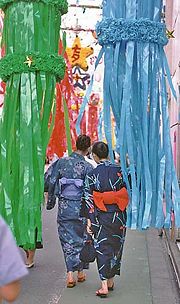
Vega
Vega is the brightest star in the constellation Lyra, the fifth brightest star in the night sky and the second brightest star in the northern celestial hemisphere, after Arcturus...
and Altair respectively). According to legend, the Milky Way
Milky Way
The Milky Way is the galaxy that contains the Solar System. This name derives from its appearance as a dim un-resolved "milky" glowing band arching across the night sky...
separates these lovers, and they are allowed to meet only once a year on the seventh day of the seventh lunar month of the lunisolar calendar
Lunisolar calendar
A lunisolar calendar is a calendar in many cultures whose date indicates both the moon phase and the time of the solar year. If the solar year is defined as a tropical year then a lunisolar calendar will give an indication of the season; if it is taken as a sidereal year then the calendar will...
. The date of Tanabata varies by region of the country, but the first festivities begin on July 7 of the Gregorian calendar
Gregorian calendar
The Gregorian calendar, also known as the Western calendar, or Christian calendar, is the internationally accepted civil calendar. It was introduced by Pope Gregory XIII, after whom the calendar was named, by a decree signed on 24 February 1582, a papal bull known by its opening words Inter...
. The celebration is held at various days between July and August.
History
The festival was imported to Japan by the Empress KōkenEmpress Koken
, also known as , was the 46th and the 48th emperor of Japan respectively, according to the traditional order of succession. Empress Kōken first reigned from 749 to 758, then she reascended the throne as Empress Shōtoku from 765 until her death in 770....
in 755. It originated from , an alternative name for Qixi, which was celebrated in China and also was adopted in the Kyoto Imperial Palace
Kyoto Gosho
The is an imperial palace of Japan, though the Emperor of Japan is not in residence. The Emperor has resided at the Tokyo Imperial Palace since 1869 and ordered the preservation of the Kyōto Imperial Palace in 1877....
from the Heian period
Heian period
The is the last division of classical Japanese history, running from 794 to 1185. The period is named after the capital city of Heian-kyō, or modern Kyōto. It is the period in Japanese history when Buddhism, Taoism and other Chinese influences were at their height...
.
The festival gained widespread popularity amongst the general public by the early Edo period
Edo period
The , or , is a division of Japanese history which was ruled by the shoguns of the Tokugawa family, running from 1603 to 1868. The political entity of this period was the Tokugawa shogunate....
, when it became mixed with various Obon
Bon Festival
or just is a Japanese Buddhist custom to honor the spirits of one's ancestors. This Buddhist-Confucian custom has evolved into a family reunion holiday during which people return to ancestral family places and visit and clean their ancestors' graves, and when the spirits of ancestors are supposed...
or Bon traditions (because Bon was held on 15th of the seventh month then), and developed into the modern Tanabata festival. Popular customs relating to the festival varied by region of the country, but generally, girls wished for better sewing and craftsmanship, and boys wished for better handwriting by writing wishes on strips of paper. At this time, the custom was to use dew left on taro
Taro
Taro is a common name for the corms and tubers of several plants in the family Araceae . Of these, Colocasia esculenta is the most widely cultivated, and is the subject of this article. More specifically, this article describes the 'dasheen' form of taro; another variety is called eddoe.Taro is...
leaves to create the ink used to write wishes. Incidentally, Bon is now held on 15 August on the solar calendar
Solar calendar
A solar calendar is a calendar whose dates indicate the position of the earth on its revolution around the sun .-Tropical solar calendars:...
, close to its original date on the lunar calendar
Lunar calendar
A lunar calendar is a calendar that is based on cycles of the lunar phase. A common purely lunar calendar is the Islamic calendar or Hijri calendar. A feature of the Islamic calendar is that a year is always 12 months, so the months are not linked with the seasons and drift each solar year by 11 to...
, making Tanabata and Bon separate events.
The name Tanabata is remotely related to the Japanese reading of the Chinese characters 七夕, which used to be read as "Shichiseki". It is believed that a Shinto
Shinto
or Shintoism, also kami-no-michi, is the indigenous spirituality of Japan and the Japanese people. It is a set of practices, to be carried out diligently, to establish a connection between present day Japan and its ancient past. Shinto practices were first recorded and codified in the written...
purification ceremony existed around the same time, in which a Shinto miko
Miko
is a Japanese term that anciently meant a "female shaman, spirit medium" who conveyed oracles from kami , and currently means a "shrine maiden; virgin consecrated to a deity" who serves at Shinto shrines.-Word:...
wove a special cloth on a loom called a near waters and offered it to a god to pray for protection of rice crops from rain or storm and for good harvest later in autumn. Gradually this ceremony merged with Kikkōden to become Tanabata. The Chinese characters 七夕 and the Japanese reading Tanabata joined to mean the same festival, although originally they were two different things, an example of ateji
Ateji
In modern Japanese, primarily refers to kanji used phonetically to represent native or borrowed words, without regard to the meaning of the underlying characters. This is analogous to man'yōgana in pre-modern Japanese...
.
Story
Like Qixi and ChilseokChilseok
Chilseok is a Korean traditional festival which falls on the seventh day of the seventh month of the Korean lunisolar calendar. Chilseok is derived from the Chinese festival, Qi Xi. Chilseok is a period where the heat starts to pass away and the monsoon season begins, and the rain that falls during...
, Tanabata was inspired by the famous Chinese folklore
Chinese folklore
Chinese folklore includes songs, dances, puppetry, and tales. It often tells stories of human nature, historical or legendary events, love, and the supernatural, or stories explaining natural phenomena and distinctive landmarks.-Folktales:...
story, "The Princess and the Cowherd". Some versions were included in the Man'yōshū, the oldest extant collection of Japanese poetry
Japanese poetry
Japanese poets first encountered Chinese poetry during the Tang Dynasty. It took them several hundred years to digest the foreign impact, make it a part of their culture and merge it with their literary tradition in their mother tongue, and begin to develop the diversity of their native poetry. For...
.
The most popular version is as follows:
, daughter of the , wove beautiful clothes by the bank of the . Her father loved the cloth that she wove and so she worked very hard every day to weave it. However, Orihime was sad that because of her hard work she could never meet and fall in love with anyone. Concerned about his daughter, Tentei arranged for her to meet (also referred to as ) who lived and worked on the other side of the Amanogawa. When the two met, they fell instantly in love with each other and married shortly thereafter. However, once married, Orihime no longer would weave cloth for Tentei and Hikoboshi allowed his cows to stray all over Heaven. In anger, Tentei separated the two lovers across the Amanogawa and forbade them to meet. Orihime became despondent at the loss of her husband and asked her father to let them meet again. Tentei was moved by his daughter’s tears and allowed the two to meet on the 7th day of the 7th month if she worked hard and finished her weaving. The first time they tried to meet, however, they found that they could not cross the river because there was no bridge. Orihime cried so much that a flock of magpies came and promised to make a bridge with their wings so that she could cross the river. It is said that if it rains on Tanabata, the magpies cannot come and the two lovers must wait until another year to meet.
Names
Orihime and Hikoboshi are called various names in the different versions of the story.| Orihime | Hikoboshi |
|---|---|
| Tanabata-tsume Me-Tanabata-sama Asagao-hime ("Morning Glory Princess") Ito-ori-hime ("Thread-Weaving Princess") Momoko-hime ("Peach-Child Princess") Takimono-hime ("Incense Princess") Sasagani-hime ("Spider Princess") |
O-Tanabata-sama Kaiboshi Kengyu |
In fiction
The following variation of the story is known in China and Japan: A young farmer named Mikeran discovered on his farm a robe which, unbeknownst to him, belonged to a goddess named Tanabata. Soon after, Tanabata visited Mikeran and asked if he had found it. He lied and told the goddess that he hadn't but would help with her search. Eventually the pair fell in love, were wed and had many children. However, one day Tanabata noticed a piece of cloth which had once belonged to her robe on the roof of Mikeran's hut. His lie discovered, Tanabata agreed to forgive him on the condition that he weave a thousand pairs of straw shoes, but until that time, she would leave him. Mikeran was unable to weave the shoes in his lifetime and thus never met Tanabata again. However, it is said that the pair meet once a year when the stars Altair and Vega intersect.It is said that Tanabata asked Mikeran to weave one thousand sandals and bury them under the bamboo tree and they'd surely meet again. Mikeran wove the sandals and buried them under the bamboo tree as Tanabata had asked. When the tree grew, Mikeran climbed up to find that he was one step short. In his haste, he had used one sandal fewer than necessary, causing the tree to grow one step short. Mikeran called out to Tanabata and she came and lifted him up. Mikeran's father wasn't pleased so he gave Mikeran the difficult job of watching a melon field for three days and nights without touching a single melon. Mikeran however grew very thirsty watching the melons that he touched one. The melon immediately turned into a flowing river forever separating Mikeran and Tanabata. Tanabata pleaded with her father to let her see Mikeran again. Feeling sorry for his daughter, he allows them to see each other on the 7th day of the 7th month.
Customs
In present-day Japan, people generally celebrate this day by writing wishes, sometimes in the form of poetry, on , small pieces of paper, and hanging them on bambooBamboo
Bamboo is a group of perennial evergreens in the true grass family Poaceae, subfamily Bambusoideae, tribe Bambuseae. Giant bamboos are the largest members of the grass family....
, sometimes with other decorations. cf (Wish Tree
Wish Tree
A wish tree is an individual tree, usually distinguished by species, position or appearance, which is used as an object of wishes and offerings. Such trees are identified as possessing a special religious or spiritual value...
) The bamboo and decorations are often set afloat on a river or burned after the festival, around midnight or on the next day. This resembles the custom of floating paper ships and candles on rivers during Obon. Many areas in Japan have their own Tanabata customs, which are mostly related to local Obon
Obón
Obón is a municipality located in the province of Teruel, Aragon, Spain. According to the 2004 census , the municipality has a population of 75 inhabitants....
traditions. There is also a traditional Tanabata song:
Translation:
Date
The original Tanabata date was based on the Japanese lunisolar calendarLunisolar calendar
A lunisolar calendar is a calendar in many cultures whose date indicates both the moon phase and the time of the solar year. If the solar year is defined as a tropical year then a lunisolar calendar will give an indication of the season; if it is taken as a sidereal year then the calendar will...
, which is about a month behind the Gregorian calendar
Gregorian calendar
The Gregorian calendar, also known as the Western calendar, or Christian calendar, is the internationally accepted civil calendar. It was introduced by Pope Gregory XIII, after whom the calendar was named, by a decree signed on 24 February 1582, a papal bull known by its opening words Inter...
. As a result, some festivals are held on July 7, some are held on a few days around August 7, while the others are still held on the seventh day of the seventh lunar month of the traditional Japanese lunisolar calendar, which is usually in August in the Gregorian Calendar
Gregorian calendar
The Gregorian calendar, also known as the Western calendar, or Christian calendar, is the internationally accepted civil calendar. It was introduced by Pope Gregory XIII, after whom the calendar was named, by a decree signed on 24 February 1582, a papal bull known by its opening words Inter...
.
The Gregorian dates of "the seventh day of the seventh lunar month of the Japanese lunisolar calendar" for the coming years are:
- 2011-08-06
- 2012-08-24 (The Chinese date is 2012-08-23 because of the time difference.)
- 2013-08-13
- 2014-08-02
- 2015-08-20
- 2016-08-09
- 2017-08-28
- 2018-08-17
- 2019-08-07
- 2020-08-25
Festivals
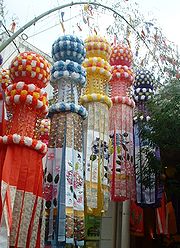
Sendai, Miyagi
is the capital city of Miyagi Prefecture, Japan, and the largest city in the Tōhoku Region. In 2005, the city had a population of one million, and was one of Japan's 19 designated cities...
from August 6 to August 8. In the Kantō
Kanto region
The is a geographical area of Honshu, the largest island of Japan. The region includes the Greater Tokyo Area and encompasses seven prefectures: Gunma, Tochigi, Ibaraki, Saitama, Tokyo, Chiba, and Kanagawa. Within its boundaries, slightly more than 40 percent of the land area is the Kantō Plain....
area, the biggest Tanabata festival is held in Hiratsuka, Kanagawa
Hiratsuka, Kanagawa
is a city located in Kanagawa Prefecture, Japan. As of 2010, the city had an estimated population of 259,991 and the density of 3,830 persons per km²...
for a few days around July 7. A Tanabata festival is also held in São Paulo, Brazil
Brazil
Brazil , officially the Federative Republic of Brazil , is the largest country in South America. It is the world's fifth largest country, both by geographical area and by population with over 192 million people...
around the first weekend of July.
Although Tanabata festivals vary by region, most festivals involve Tanabata decoration competitions. Other events may include parades and Miss Tanabata contests. Like other Japanese matsuri, many outdoor stalls sell food, provide carnival
Carnival
Carnaval is a festive season which occurs immediately before Lent; the main events are usually during February. Carnaval typically involves a public celebration or parade combining some elements of a circus, mask and public street party...
games, etc., and add to the festive atmosphere.
Tokyo Disneyland
Tokyo Disneyland
is a 115 acre theme park at the Tokyo Disney Resort located in Urayasu, Chiba, Japan, near Tokyo. Its main gate is directly adjacent to both Maihama Station and Tokyo Disneyland Station. It was the first Disney park to be built outside of the United States and opened on April 15, 1983...
often celebrates the Tanabata Festival featuring a greeting parade with Mickey as Altair and Minnie as Vega.
Sendai Tanabata Festival
The SendaiSendai, Miyagi
is the capital city of Miyagi Prefecture, Japan, and the largest city in the Tōhoku Region. In 2005, the city had a population of one million, and was one of Japan's 19 designated cities...
Tanabata festival began shortly after the city was founded in the early Edo Period. The Tanabata festival gradually developed and became larger over the years. Although the festival's popularity started to dwindle after the Meiji Restoration
Meiji Restoration
The , also known as the Meiji Ishin, Revolution, Reform or Renewal, was a chain of events that restored imperial rule to Japan in 1868...
, and almost disappeared during the economic depression that occurred after World War I
World War I
World War I , which was predominantly called the World War or the Great War from its occurrence until 1939, and the First World War or World War I thereafter, was a major war centred in Europe that began on 28 July 1914 and lasted until 11 November 1918...
, volunteers in Sendai revived the festival in 1928 and established the tradition of holding the festival from August 6 to August 8.
During World War II
World War II
World War II, or the Second World War , was a global conflict lasting from 1939 to 1945, involving most of the world's nations—including all of the great powers—eventually forming two opposing military alliances: the Allies and the Axis...
it was impossible to hold the festival, and almost no decorations were seen in the city from 1943 to 1945, but after the war, the first major Tanabata festival in Sendai was held in 1946, and featured 52 decorations. In 1947, the Showa Emperor Hirohito
Hirohito
, posthumously in Japan officially called Emperor Shōwa or , was the 124th Emperor of Japan according to the traditional order, reigning from December 25, 1926, until his death in 1989. Although better known outside of Japan by his personal name Hirohito, in Japan he is now referred to...
visited Sendai and was greeted by 5,000 Tanabata decorations. The festival subsequently developed into one of the three major summer festivals in the Tohoku region
Tohoku region
The is a geographical area of Japan. The region occupies the northeastern portion of Honshu, the largest island of Japan. The region consists of six prefectures : Akita, Aomori, Fukushima, Iwate, Miyagi and Yamagata....
and became a major tourist attraction. The festival now includes a fireworks
Fireworks
Fireworks are a class of explosive pyrotechnic devices used for aesthetic and entertainment purposes. The most common use of a firework is as part of a fireworks display. A fireworks event is a display of the effects produced by firework devices...
show that is held on August 5.
At the Sendai Tanabata festival, people traditionally use seven different kinds of decorations, which each represent different meanings. The seven decorations and their symbolic meanings are:
The ornamental ball (くす玉; Kusudama
Kusudama
The Japanese kusudama is a paper model that is usually created by sewing multiple identical pyramidal units together through their points to form a spherical shape. Alternately the individual components may be glued together. The Japanese kusudama (薬玉; lit. medicine ball) is a paper model that...
) often decorated above streamers in present-day Tanabata decorations was originally conceived in 1946 by the owner of a shop in downtown Sendai. The ball was originally modelled after the Dahlia
Dahlia
Dahlia is a genus of bushy, tuberous, perennial plants native to Mexico, Central America, and Colombia. There are at least 36 species of dahlia, some like D. imperialis up to 10 metres tall. Dahlia hybrids are commonly grown as garden plants...
flower. In recent years, box-shaped ornaments have become popular alternatives to the ornamental ball.
G8 summit
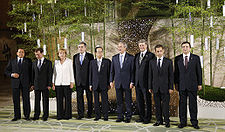
34th G8 summit
The 34th G8 summit took place in on the northern island of Hokkaidō, Japan from July 7–9, 2008. The locations of previous summits to have been hosted by Japan include: Tokyo ; and Nago, Okinawa . The G8 Summit has evolved beyond being a gathering of world political leaders...
in Tōyako, Hokkaidō
Toyako, Hokkaido
is a town in Abuta District, Iburi Subprefecture, Hokkaidō, Japan. This town was formed on 23 March 2006 through the merger of the town Abuta and the village of Tōya...
coincided with Tanabata. As host, Japanese Prime Minister Yasuo Fukuda
Yasuo Fukuda
was the 91st Prime Minister of Japan, serving from 2007 to 2008. He was previously the longest-serving Chief Cabinet Secretary in Japanese history, serving for three and a half years under Prime Ministers Yoshirō Mori and Junichiro Koizumi....
invited the G8 leaders to participate in the spirit of the festival. They were each asked to write a wish on a piece of paper called tanzaku, to hang the tanzaku on a bamboo tree, and then to take the necessary actions to change the world for better. As a symbolic gesture, the actual writing and the act of hanging up that note is at least a first step.
The Japanese Ministry of Foreign Affairs
Ministry of Foreign Affairs (Japan)
The is a cabinet level ministry of Japan responsible for the country's foreign relations.The ministry is due to the second term of the third article of the National Government Organization Act , and the Ministry of Foreign Affairs Establishment Act establishes the ministry...
made colored strips of paper and a bamboo tree for G8 wishes available in Roppongi
Roppongi
is a district of Minato, Tokyo, Japan, famous as home to the rich Roppongi Hills area and an active night club scene. Many foreign embassies are located in Roppongi, and the night life is popular with locals and foreigners alike...
during the summit.
Protesting organizations in Sapporo during the G8 summit also tried to use the spirit of Tanabata to focus attention on a somewhat different set of wishes. Non-governmental organizations like Oxfam
Oxfam
Oxfam is an international confederation of 15 organizations working in 98 countries worldwide to find lasting solutions to poverty and related injustice around the world. In all Oxfam’s actions, the ultimate goal is to enable people to exercise their rights and manage their own lives...
, and CARE International
CARE (relief)
CARE is a broad-spectrum secular relief, humanitarian, and development non-governmental organization fighting global poverty. It is non-political, non-sectarian and operates annually in more than 70 countries across the globe.One of the organization’s primary focuses in its fight to eradicate...
set up an online wish petition campaign to coincide with the G8 Summit and Tanabata.
Outside Japan, Fukuda's timely gesture had unanticipated consequences. For example, the Indian nationally circulated newspaper, The Hindu
The Hindu
The Hindu is an Indian English-language daily newspaper founded and continuously published in Chennai since 1878. According to the Audit Bureau of Circulations, it has a circulation of 1.46 million copies as of December 2009. The enterprise employed over 1,600 workers and gross income reached $40...
picked up on this festival theme by printing an editorial featuring unconventional Tanabata wishes.
Fukuda also invited his fellow citizens to try turning off the lights in their house and stepping outside to enjoy with their family the sight of the Milky Way in the night sky. On July 7, the Japanese Ministry of the Environment anticipated that over 70,000 facilities and households across Japan would switch off their lights from 20:00 to 22:00 as a symbolic step and as a wish for the future.
See also
- Sekidera Komachi, a famous NohNoh, or - derived from the Sino-Japanese word for "skill" or "talent" - is a major form of classical Japanese musical drama that has been performed since the 14th century. Many characters are masked, with men playing male and female roles. Traditionally, a Noh "performance day" lasts all day and...
play set during the Tanabata Festival - Mobara Tanabata Festival
- Qixi Festival
- ChilseokChilseokChilseok is a Korean traditional festival which falls on the seventh day of the seventh month of the Korean lunisolar calendar. Chilseok is derived from the Chinese festival, Qi Xi. Chilseok is a period where the heat starts to pass away and the monsoon season begins, and the rain that falls during...
- Japanese festivalsJapanese festivalsJapanese festivals are traditional festive occasions. Some festivals have their roots in Chinese festivals but have undergone dramatic changes as they mixed with local customs....