
All Topics  
Emperor Jimmu

 
Emperor Jimmu

   Email Print
   Bookmark   Link


Emperor Jimmu


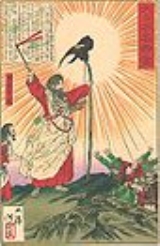
; also known as: Kamuyamato Iwarebiko; given name: Wakamikenu no Mikoto or Sano no Mikoto, was the mythical founder of Japan
Japan

Japan is an island country in East Asia. Located in the Pacific Ocean, it lies to the east of the Sea of Japan, People's Republic of China, North Korea, South Korea and Russia, stretching from the Sea of Okhotsk in the north to the East China Sea and Taiwan in the south....
 and is the first emperor named in the traditional lists of emperors.

The Imperial house
Emperor of Japan

The of Japan is the symbol of the state and of the unity of the Japanese people. He is the head of the Imperial House of Japan. Under Japan's present constitution, the Emperor is the "symbol of the state and the unity of the people," and is a ceremonial figurehead in a constitutional monarchy ....
 of Japan traditionally based its claim to the throne on its descent from Jimmu. No firm dates can be assigned to this early emperor's life or reign, nor for the reigns of his early successors.


Discussion
Ask a question about 'Emperor Jimmu'
Start a new discussion about 'Emperor Jimmu'
Answer questions from other users
Full Discussion Forum


Encyclopedia


; also known as: Kamuyamato Iwarebiko; given name: Wakamikenu no Mikoto or Sano no Mikoto, was the mythical founder of Japan
Japan

Japan is an island country in East Asia. Located in the Pacific Ocean, it lies to the east of the Sea of Japan, People's Republic of China, North Korea, South Korea and Russia, stretching from the Sea of Okhotsk in the north to the East China Sea and Taiwan in the south....
 and is the first emperor named in the traditional lists of emperors.

The Imperial house
Emperor of Japan

The of Japan is the symbol of the state and of the unity of the Japanese people. He is the head of the Imperial House of Japan. Under Japan's present constitution, the Emperor is the "symbol of the state and the unity of the people," and is a ceremonial figurehead in a constitutional monarchy ....
 of Japan traditionally based its claim to the throne on its descent from Jimmu. No firm dates can be assigned to this early emperor's life or reign, nor for the reigns of his early successors. The reign of Emperor Kimmei
Emperor Kimmei

Emperor Kimmei was the 29th emperor of Japan, according to the traditional order of succession. His reign is said to have spanned the years from 539 through 571....
 (509?-571), the 29th emperor of Japan
Japan

Japan is an island country in East Asia. Located in the Pacific Ocean, it lies to the east of the Sea of Japan, People's Republic of China, North Korea, South Korea and Russia, stretching from the Sea of Okhotsk in the north to the East China Sea and Taiwan in the south....
 according to the traditional order of succession, is the first for which contemporary historiography are able to assign verifiable dates.

Legendary narrative

Jimmu is regarded by historians as a "legendary emperor" because of the paucity of information about him: there is insufficient material available to determine whether he existed or not. According to the legendary account in the Kojiki
Kojiki

, is the oldest surviving book in Japan. The body of the Kojiki is written in Chinese language, but it includes numerous Japanese names and some phrases....
, this historical figure would have been born on February 13, 711 BCE (January 1 of Chinese calendar
Chinese calendar

The Chinese calendar is lunisolar calendar, incorporating elements of a lunar calendar with those of a solar calendar. This measure of time was first introduced by the Babylonians ....
), and died, again according to legend, on March 11, 585 BCE (both dates according to the lunisolar
Lunisolar calendar

A lunisolar calendar is a calendar in many cultures whose date indicates both the moon phase and the time of the solar year. If the solar year is defined as a tropical year then a lunisolar calendar will give an indication of the season; if it is taken as a sidereal year then the calendar will predict the constellation near which the full moo...
 ).

The conventionally accepted names and dates of the early emperors were not to be confirmed as "traditional" until the reign of Emperor Kammu
Emperor Kammu

was the 50th Emperor of Japan of Japan, according to the traditional order of succession. His reign spanned the years from 781 through 806....
 (737–806), the 50th sovereign of the Yamato dynasty.

According to Shinto
Shinto

is the former state religion of Japan and remains the most common name for the nation's non-Buddhist ethnic religion practices. It was formed from disparate local mythologies, beginning with the Kojiki of 712, into an imperial cult called State Shinto that solidified in the Meiji period....
 belief, Jimmu is regarded as a direct descendant of the sun goddess, Amaterasu
Amaterasu

, or is in Japanese mythology a Solar deity and perhaps the most important Shinto . Her name, Amaterasu, means literally " illuminates Heaven"....
. Amaterasu had a son called Ame no Oshihomimi no Mikoto and through him a grandson named Ninigi-no-Mikoto
Ninigi-no-Mikoto

is in Japanese mythology the son of Ame no Oshihomimi no Mikoto, and grandson of Amaterasu, who sent him down to earth to plant rice there. He was the great-grandfather of Emperor Jimmu....
. She sent her grandson to the Japanese islands where he eventually married Konohana-Sakuya-hime. Among their three sons was Hikohohodemi no Mikoto, also called Yamasachi-hiko, who married Toyotama-hime
Toyotama-hime

, also known as , is a kami in Japanese mythology, and the daughter of Ryujin, the god of the sea. She married the hunter Hoori and gave birth to a son, who in turn produced Emperor Jimmu, the first Emperor of Japan....
. She was the daughter of Ryujin
Ryujin

, also known as Watatsumi, was the tutelary deity of the sea in Japanese mythology. This Japanese dragon symbolized the power of the ocean, had a large mouth, and was able to transform into a human shape....
, the Japanese sea
SEA

See also: Sea and seasThe three-letter acronym SEA may refer to:People/organizations/businesses*Scientists and Engineers for America, a pro-science political advocacy group....
 god. They had a single son called Hikonagisa Takeugaya Fukiaezu no Mikoto. The boy was abandoned by his parents at birth and consequently raised by Tamayori-hime, his mother's younger sister. They eventually married and had a total of four sons. The last of them became Emperor Jimmu.

It is said that soon after the beginning of Jimmu's reign, a Master of Ceremonies (saishu) was appointed. This office was commonly held by a member of the Nakatomi clan
Nakatomi clan

The Nakatomi clan was an influential clan in Classical Japan. Along with the Inbe clan, the Nakatomi were one of two priestly clans which oversaw certain important national rites, and one of many to claim descent from divine clan ancestors "only a degree less sublime than the imperial ancestors"....
 after the eighth century.

Jimmu's migration

Mythic records in the Kojiki
Kojiki

, is the oldest surviving book in Japan. The body of the Kojiki is written in Chinese language, but it includes numerous Japanese names and some phrases....
 and Nihonshoki tell us that Jimmu's brothers were originally born in Takachiho, the southern part of Kyushu (in modern day Miyazaki prefecture
Miyazaki Prefecture

is a Prefectures of Japan of Japan located on the island of Kyushu. The capital is the city of Miyazaki, Miyazaki....
), and decided to move eastward, as they found their location inappropriate for reigning over the entire country. Jimmu's older brother Itsuse no Mikoto originally led the migration, and they moved eastward through the Seto Inland Sea with the assistance of local chieftain Sao Netsuhiko. As they reached Naniwa (modern day Osaka
Osaka

is a Cities of Japan in Japan, located at the mouth of the Yodo River on Osaka Bay, in the Kansai region of the main island of Honshu.Osaka is a City designated by government ordinance under the Local Autonomy Law and the capital city of Osaka Prefecture....
), they encountered another local chieftain, Nagasunehiko (lit. the long-legged man"), and Itsuse was killed in the ensuing battle. Jimmu realized that they had been defeated because they battled eastward against the Sun, so he decided to land on the east side of Kii Peninsula and battle westward. They reached Kumano, and with the guidance of a three-legged bird
Three-legged bird

The three-legged bird is a creature found in various mythology and arts of Asia, Asia Minor, and North Africa. It is often thought to inhabit and represent the sun....
, Yatagarasu (lit. eight-span crow), moved to Yamato. There they once again battled Nagasunehiko and were victorious.

In Yamato, Nigihayahi no Mikoto, who also claims to be a descendant of the Takamagahara gods, was protected by Nagasunehiko. However, when Nigihayahi met Jimmu, he accepted Jimmu's legitimacy, and Jimmu ascended to the throne.

Emperor Jimmu's official Imperial misasagi, or tomb, can be found in Kashihara in Nara prefecture
Nara Prefecture

is a Prefectures of Japan in the Kansai region on Honshu Island, Japan. The capital is the city of Nara, Nara....
. This mausoleum is located a short distance from Kashihara Shrine.

According to the Kojiki, death came to Jimmu when he was aged 126. This emperor's posthumous name
Posthumous name

A posthumous name is an honorary name given to royalty, nobles, and sometimes others, in some cultures after the person's death. The posthumous name is commonly used when naming royalty of Table of Chinese monarchs, List of Korean monarchs, Vietnam and emperors of Japan....
 literally means "divine might" or "god-warrior." It is undisputed that this identification is Chinese in form and Buddhist in implication, which suggests that the name must have been regularized centuries after the lifetime ascribed to Jimmu, possibly during the time in which legends about the origins of the Yamato dynasty were compiled as the chronicles known today as the Kojiki
Kojiki

, is the oldest surviving book in Japan. The body of the Kojiki is written in Chinese language, but it includes numerous Japanese names and some phrases....
.

The Emperor and Imperial expansionism

New Year's Day in the Japanese lunisolar calendar
Lunisolar calendar

A lunisolar calendar is a calendar in many cultures whose date indicates both the moon phase and the time of the solar year. If the solar year is defined as a tropical year then a lunisolar calendar will give an indication of the season; if it is taken as a sidereal year then the calendar will predict the constellation near which the full moo...
 was traditionally celebrated as the regnal day of Emperor Jimmu.

In 1872, the Meiji government proclaimed February 11, 660 BCE, in the Gregorian calendar
Gregorian calendar

The Gregorian calendar is the internationally accepted civil calendar. It was first proposed by the Calabrian doctor Aloysius Lilius, and decreed by Pope Gregory XIII, after whom it was named, on 24 February 1582 by the papal bull Inter gravissimas....
 the foundation day of Japan. This mythical date was commemorated as the holiday Kigensetsu ("Era Day") from 1872 to 1948. The Kigensetsu celebration in 1940 is today considered controversial; but during that early Showa period
Showa period

The , or Showa era, is the period of Japanese history corresponding to the reign of Emperor Showa , from December 25, 1926 to January 7, 1989. In his coronation message which was read to the people and to the army, the newly enthroned emperor referenced this Japanese era name or nengo: "I have visited the battlefields of the Great War in...
, any questions were effectively side-stepped as the entire nation commemorated what was then calculated to have been 2,600 years since the accession of Emperor Jimmu. The holiday was suspended after the end of the Pacific War, and its celebration was reinstated in 1966 as the national holiday Kenkoku Kinen no hi ("National Foundation Day
National Foundation Day

is a national holiday in Japan celebrated annually on February 11. On this day, Japanese celebrate the founding of the nation and the :Category:Japanese emperors by its legendary first emperor, Emperor Jimmu, who established his capital in Yamato Province....
").

Starting around 1928, Emperor Showa and his reign became associated with the rediscovery of Hakko ichiu
Hakko ichiu

was a Japanese political slogan that became popular during the first part of the Showa era, and was popularized in a speech by Prime Minister of Japan Fumimaro Konoe on January 8, 1940....
 as an expansionist element of Japanese nationalistic beliefs. The naval limitations treaties of 1921, and especially 1930, were a tragic mistake in their unanticipated effect on internal political struggles in Japan; and the treaties provided an external motivating catalyst which provoked reactionary, militarist elements to desperate actions which eventually overwhelmed civilian and liberal elements in society. The evolution of Hakko ichiu serves as a changing litmus test of these factional relationships during the next decade.

In 1940, the Showa regime also constructed on the legendary site of Emperor Jimmu's palace, near Miyazaki
Miyazaki

Miyazaki can be:...
, the Hakko Tower, symbolizing the divine right of the Empire of Japan to "unify the eight corners of the world"
Hakko ichiu

was a Japanese political slogan that became popular during the first part of the Showa era, and was popularized in a speech by Prime Minister of Japan Fumimaro Konoe on January 8, 1940....
. The ancient phrase of Hakko ichi'u, used according to tradition by the Emperor to describe the unification of the world under his sacred rule, was an imperative to all Japan subjects.

See also

  • Emperor of Japan
    Emperor of Japan

    The of Japan is the symbol of the state and of the unity of the Japanese people. He is the head of the Imperial House of Japan. Under Japan's present constitution, the Emperor is the "symbol of the state and the unity of the people," and is a ceremonial figurehead in a constitutional monarchy ....
  • List of Emperors of Japan
    List of Emperors of Japan

    The following is a traditional list of Emperor of Japan. Dates for the first 28 emperors, and especially the first 16, are based on the Japanese era name system....
  • Imperial cult
    Imperial cult

    An Imperial cult is a form of state religion in which an emperor, or a dynasty of emperors , are worshiped as messiahs, demigods or deity. "Cult " here is used to mean "worship," not in the modern pejorative sense....


External links