

Kodomo no hi

Encyclopedia
is a Japan
ese national holiday
which takes place annually on May 5, the fifth day of the fifth month, and is part of the Golden Week. It is a day set aside to respect children's personalities and to celebrate their happiness. It was designated a national holiday by the Japanese government in 1948.
or Chinese calendar
. After Japan's switch to the Gregorian calendar
, the date was moved to May 5. The festival is still celebrated in China
, Taiwan
, Hong Kong
and Macau
as the Duanwu Festival or Tuen Ng Festival (Cantonese), in Korea as the Dano Festival, and Vietnam as the Tết Đoan Ngọ on the traditional lunar calendar date. It was originally for boy
s but has since been changed to include both boys and girls.
Sekku means a season's festival (there are five sekku per year). Tango no Sekku marks the beginning of summer
or the rainy season. Tan means "edge" or "first" and go means "noon". In Chinese culture, the fifth month of the Chinese calendar
was said to be a month for purification, and many rites that were said to drive away evil spirits were performed.
 Although it is not known precisely when this day started to be celebrated, it was probably during the reign of the Empress Suiko
(593–628 A.D.). In Japan
, Tango no Sekku was assigned to the fifth day of the fifth month after the Nara period
.
Until recently, Tango no Sekku was known as Boys' Day (also known as Feast of Banners) while Girls' Day (Hinamatsuri
) was celebrated on March 3. In 1948, the government decreed this day to be a national holiday to celebrate the happiness of all children and to express gratitude toward mothers. It was renamed Kodomo no Hi.
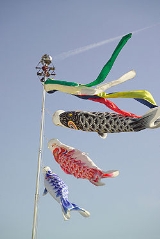
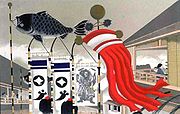
Before this day, families raise the carp
-shaped koinobori
flags (carp because of the Chinese legend that a carp that swims upstream becomes a dragon, and the way the flags blow in the wind looks like they are swimming), one for each boy (or child), display a Kintarō
doll usually riding on a large carp, and the traditional Japanese military helmet, kabuto
. Kintarō and the kabuto are symbols of a strong and healthy boy.
is the childhood name of Sakata no Kintoki who was a hero in the Heian period
, a subordinate samurai of Minamoto no Raikou, having been famous for his strength when he was a child. It is said that Kintarō rode a bear
, instead of a horse
, and played with animals in the mountains when he was a young boy.
Mochi
rice cakes wrapped in kashiwa (oak
) leaves—kashiwa-mochi (just like regular mochi, but is also filled with red beans jam) and chimaki (a kind of "sweet rice paste", wrapped in an iris or bamboo leaf)—are traditionally served on this day.
Japan
Japan is an island nation in East Asia. Located in the Pacific Ocean, it lies to the east of the Sea of Japan, China, North Korea, South Korea and Russia, stretching from the Sea of Okhotsk in the north to the East China Sea and Taiwan in the south...
ese national holiday
Holiday
A Holiday is a day designated as having special significance for which individuals, a government, or a religious group have deemed that observance is warranted. It is generally an official or unofficial observance of religious, national, or cultural significance, often accompanied by celebrations...
which takes place annually on May 5, the fifth day of the fifth month, and is part of the Golden Week. It is a day set aside to respect children's personalities and to celebrate their happiness. It was designated a national holiday by the Japanese government in 1948.
Tango no Sekku
The day was originally called , and was celebrated on the 5th day of the 5th moon in the lunar calendarLunar calendar
A lunar calendar is a calendar that is based on cycles of the lunar phase. A common purely lunar calendar is the Islamic calendar or Hijri calendar. A feature of the Islamic calendar is that a year is always 12 months, so the months are not linked with the seasons and drift each solar year by 11 to...
or Chinese calendar
Chinese calendar
The Chinese calendar is a lunisolar calendar, incorporating elements of a lunar calendar with those of a solar calendar. It is not exclusive to China, but followed by many other Asian cultures as well...
. After Japan's switch to the Gregorian calendar
Gregorian calendar
The Gregorian calendar, also known as the Western calendar, or Christian calendar, is the internationally accepted civil calendar. It was introduced by Pope Gregory XIII, after whom the calendar was named, by a decree signed on 24 February 1582, a papal bull known by its opening words Inter...
, the date was moved to May 5. The festival is still celebrated in China
China
Chinese civilization may refer to:* China for more general discussion of the country.* Chinese culture* Greater China, the transnational community of ethnic Chinese.* History of China* Sinosphere, the area historically affected by Chinese culture...
, Taiwan
Taiwan
Taiwan , also known, especially in the past, as Formosa , is the largest island of the same-named island group of East Asia in the western Pacific Ocean and located off the southeastern coast of mainland China. The island forms over 99% of the current territory of the Republic of China following...
, Hong Kong
Hong Kong
Hong Kong is one of two Special Administrative Regions of the People's Republic of China , the other being Macau. A city-state situated on China's south coast and enclosed by the Pearl River Delta and South China Sea, it is renowned for its expansive skyline and deep natural harbour...
and Macau
Macau
Macau , also spelled Macao , is, along with Hong Kong, one of the two special administrative regions of the People's Republic of China...
as the Duanwu Festival or Tuen Ng Festival (Cantonese), in Korea as the Dano Festival, and Vietnam as the Tết Đoan Ngọ on the traditional lunar calendar date. It was originally for boy
Boy
A boy is a young male human , as contrasted to its female counterpart, girl, or an adult male, a man.The term "boy" is primarily used to indicate biological sex distinctions, cultural gender role distinctions or both...
s but has since been changed to include both boys and girls.
Sekku means a season's festival (there are five sekku per year). Tango no Sekku marks the beginning of summer
Summer
Summer is the warmest of the four temperate seasons, between spring and autumn. At the summer solstice, the days are longest and the nights are shortest, with day-length decreasing as the season progresses after the solstice...
or the rainy season. Tan means "edge" or "first" and go means "noon". In Chinese culture, the fifth month of the Chinese calendar
Chinese calendar
The Chinese calendar is a lunisolar calendar, incorporating elements of a lunar calendar with those of a solar calendar. It is not exclusive to China, but followed by many other Asian cultures as well...
was said to be a month for purification, and many rites that were said to drive away evil spirits were performed.
Empress Suiko
was the 33rd emperor of Japan, according to the traditional order of succession.Suiko's reign spanned the years from 593 until her death in 628....
(593–628 A.D.). In Japan
Japan
Japan is an island nation in East Asia. Located in the Pacific Ocean, it lies to the east of the Sea of Japan, China, North Korea, South Korea and Russia, stretching from the Sea of Okhotsk in the north to the East China Sea and Taiwan in the south...
, Tango no Sekku was assigned to the fifth day of the fifth month after the Nara period
Nara period
The of the history of Japan covers the years from AD 710 to 794. Empress Gemmei established the capital of Heijō-kyō . Except for 5 years , when the capital was briefly moved again, it remained the capital of Japanese civilization until Emperor Kammu established a new capital, Nagaoka-kyō, in 784...
.
Until recently, Tango no Sekku was known as Boys' Day (also known as Feast of Banners) while Girls' Day (Hinamatsuri
Hinamatsuri
The Japanese , or Girls' Day, is held on March 3. Platforms covered with a red carpet are used to display a set of representing the Emperor, Empress, attendants, and musicians in traditional court dress of the Heian period.- Origin and customs :...
) was celebrated on March 3. In 1948, the government decreed this day to be a national holiday to celebrate the happiness of all children and to express gratitude toward mothers. It was renamed Kodomo no Hi.
Before this day, families raise the carp
Carp
Carp are various species of oily freshwater fish of the family Cyprinidae, a very large group of fish native to Europe and Asia. The cypriniformes are traditionally grouped with the Characiformes, Siluriformes and Gymnotiformes to create the superorder Ostariophysi, since these groups have certain...
-shaped koinobori
Koinobori
, meaning "carp streamer" in Japanese, are carp-shaped wind socks traditionally flown in Japan to celebrate , a traditional calendrical event which is now designated a national holiday; Children's Day. These wind socks are made by drawing carp patterns on paper, cloth or other nonwoven fabric. They...
flags (carp because of the Chinese legend that a carp that swims upstream becomes a dragon, and the way the flags blow in the wind looks like they are swimming), one for each boy (or child), display a Kintarō
Kintaro
is a folk hero from Japanese folklore. A child of superhuman strength, he was raised by a mountain hag on Mount Ashigara. He became friendly with the animals of the mountain, and later, after catching Shutendouji, the terror of the region around Mount Ooe, he became a loyal follower of Minamoto no...
doll usually riding on a large carp, and the traditional Japanese military helmet, kabuto
Kabuto
A kabuto is a helmet used with traditional Japanese armour as worn by the samurai class and their retainers in feudal Japan....
. Kintarō and the kabuto are symbols of a strong and healthy boy.
is the childhood name of Sakata no Kintoki who was a hero in the Heian period
Heian period
The is the last division of classical Japanese history, running from 794 to 1185. The period is named after the capital city of Heian-kyō, or modern Kyōto. It is the period in Japanese history when Buddhism, Taoism and other Chinese influences were at their height...
, a subordinate samurai of Minamoto no Raikou, having been famous for his strength when he was a child. It is said that Kintarō rode a bear
Bear
Bears are mammals of the family Ursidae. Bears are classified as caniforms, or doglike carnivorans, with the pinnipeds being their closest living relatives. Although there are only eight living species of bear, they are widespread, appearing in a wide variety of habitats throughout the Northern...
, instead of a horse
Horse
The horse is one of two extant subspecies of Equus ferus, or the wild horse. It is a single-hooved mammal belonging to the taxonomic family Equidae. The horse has evolved over the past 45 to 55 million years from a small multi-toed creature into the large, single-toed animal of today...
, and played with animals in the mountains when he was a young boy.
Mochi
Mochi
Mochi is a Japanese rice cake made of glutinous rice pounded into paste and molded into shape. In Japan it is traditionally made in a ceremony called mochitsuki. While also eaten year-round, mochi is a traditional food for the Japanese New Year and is commonly sold and eaten during that time...
rice cakes wrapped in kashiwa (oak
Oak
An oak is a tree or shrub in the genus Quercus , of which about 600 species exist. "Oak" may also appear in the names of species in related genera, notably Lithocarpus...
) leaves—kashiwa-mochi (just like regular mochi, but is also filled with red beans jam) and chimaki (a kind of "sweet rice paste", wrapped in an iris or bamboo leaf)—are traditionally served on this day.
See also
- Double Fifth
- Children's DayChildren's Day"Children Day", as an event, is celebrated on various days in many places around the world, in particular to honor children. Major global variants include a Universal Children's Day on November 20, by United Nations recommendation...
- Dragon Boat FestivalDragon Boat FestivalDuanwu Festival, also known as Dragon Boat Festival and the Double Fifth, is a traditional and statutory holiday originating in China and associated with a number of East Asian and Southeast Asian societies...
- Golden Week
- Tết Đoan Ngọ
- Aging of JapanAging of JapanThe ageing of Japan outweighs all other nations with the highest proportion of elderly citizens, 21% over the age of 65. In 1989, only 11.6% of the population was 65 years or older, but projections were that 25.6% would be in that age category by 2030...