
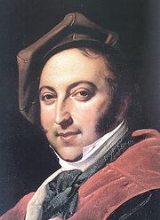
Gioachino Antonio Rossini (dʒoaˈkiːno anˈtɔːnjo rosˈsiːni (Giovacchino Antonio Rossini in the baptismal certificate) (29 February 1792 – 13 November 1868) was an Italian
composerA composer is a person who creates music, either by musical notation or oral tradition, for interpretation and performance, or through direct manipulation of sonic material through electronic media...
who wrote 39
operaOpera is an art form in which singers and musicians perform a dramatic work combining text and musical score, usually in a theatrical setting. Opera incorporates many of the elements of spoken theatre, such as acting, scenery, and costumes and sometimes includes dance...
s as well as sacred music,
chamber musicChamber music is a form of classical music, written for a small group of instruments which traditionally could be accommodated in a palace chamber. Most broadly, it includes any art music that is performed by a small number of performers with one performer to a part...
, songs, and some instrumental and piano pieces. His best-known operas include the Italian comedies
Il barbiere di Siviglia (
The Barber of SevilleThe Barber of Seville, or The Futile Precaution is an opera buffa in two acts by Gioachino Rossini with a libretto by Cesare Sterbini. The libretto was based on Pierre Beaumarchais's comedy Le Barbier de Séville , which was originally an opéra comique, or a mixture of spoken play with music...
) and
La CenerentolaLa Cenerentola, ossia La bontà in trionfo is an operatic dramma giocoso in two acts by Gioachino Rossini. The libretto was written by Jacopo Ferretti, based on the fairy tale Cinderella...
and the French-language epics
Moïse et Pharaon and
Guillaume Tell (
William TellGuillaume Tell is an opera in four acts by Gioachino Rossini to a French libretto by Etienne de Jouy and Hippolyte Bis, based on Friedrich Schiller's play Wilhelm Tell. Based on the legend of William Tell, this opera was Rossini's last, even though the composer lived for nearly forty more years...
). A tendency for inspired, song-like melodies is evident throughout his scores, which led to the nickname "The Italian Mozart." Until his retirement in 1829, Rossini had been the most popular opera composer in history.
Biography
Gioachino Antonio Rossini was born into a family of musicians in
PesaroPesaro is a town and comune in the Italian region of the Marche, capital of the Pesaro e Urbino province, on the Adriatic. According to the 2007 census, its population was 92,206....
, a town on the
AdriaticThe Adriatic Sea is a body of water separating the Italian Peninsula from the Balkan peninsula, and the system of the Apennine Mountains from that of the Dinaric Alps and adjacent ranges...
coast of Italy which was then part of the
Papal StatesThe Papal State, State of the Church, or Pontifical States were among the major historical states of Italy from roughly the 6th century until the Italian peninsula was unified in 1861 by the Kingdom of Piedmont-Sardinia .The Papal States comprised territories under...
. His father, Giuseppe, was a horn player and inspector of slaughterhouses. His mother, Anna, was a
singerSinging is the act of producing musical sounds with the voice, and augments regular speech by the use of both tonality and rhythm. One who sings is called a singer or vocalist. Singers perform music known as songs that can be sung either with or without accompaniment by musical instruments...
and a baker's daughter. Rossini's parents began his musical training early, and by the age of six he was playing the triangle in his father's musical group.
Rossini's father was sympathetic to the
French RevolutionThe French Revolution , sometimes distinguished as the 'Great French Revolution' , was a period of radical social and political upheaval in France and Europe. The absolute monarchy that had ruled France for centuries collapsed in three years...
and welcomed
Napoleon BonaparteNapoleon Bonaparte was a French military and political leader during the latter stages of the French Revolution.As Napoleon I, he was Emperor of the French from 1804 to 1815...
's troops when they arrived in northern Italy. When
AustriaAustria , officially the Republic of Austria , is a landlocked country of roughly 8.4 million people in Central Europe. It is bordered by the Czech Republic and Germany to the north, Slovakia and Hungary to the east, Slovenia and Italy to the south, and Switzerland and Liechtenstein to the...
restored the old regime in 1796, Rossini's father was sent to prison and his mother took him to
BolognaBologna is the capital city of Emilia-Romagna, in the Po Valley of Northern Italy. The city lies between the Po River and the Apennine Mountains, more specifically, between the Reno River and the Savena River. Bologna is a lively and cosmopolitan Italian college city, with spectacular history,...
, making a living as a leading singer at various theatres of the
RomagnaRomagna is an Italian historical region that approximately corresponds to the south-eastern portion of present-day Emilia-Romagna. Traditionally, it is limited by the Apennines to the south-west, the Adriatic to the east, and the rivers Reno and Sillaro to the north and west...
region. Her husband would ultimately join her in Bologna. During this time, Rossini was frequently left in the care of his aging grandmother, who had difficulty supervising the boy.
He remained at Bologna in the care of a pork butcher while his father played the horn in the orchestras of the theatres at which his wife sang. The boy had three years of instruction in the playing of the
harpsichordA harpsichord is a musical instrument played by means of a keyboard. It produces sound by plucking a string when a key is pressed.In the narrow sense, "harpsichord" designates only the large wing-shaped instruments in which the strings are perpendicular to the keyboard...
from Giuseppe Prinetti, originally from
NovaraNovara is the capital city of the province of Novara in the Piedmont region in northwest Italy, to the west of Milan. With c. 105,000 inhabitants, it is the second most populous city in Piedmont after Turin. It is an important crossroads for commercial traffic along the routes from Milan to Turin...
, who played the scale with two fingers only; Prinetti also owned a business selling beer and had a propensity to fall asleep while standing. These qualities made him a subject for ridicule in the eyes of the young Rossini.
Education
He was eventually taken from Prinetti and apprenticed to a blacksmith. In Angelo Tesei, he found a congenial music master, and learned to sight-read, play accompaniments on the
pianoThe piano is a musical instrument played by means of a keyboard. It is one of the most popular instruments in the world. Widely used in classical and jazz music for solo performances, ensemble use, chamber music and accompaniment, the piano is also very popular as an aid to composing and rehearsal...
and sing well enough to take solo parts in the church when he was ten years of age. Important from this period are six
sonate a quattro, or string sonatas, composed in three days, unusually scored for two violins, cello and double bass. The original scores were found in the Library of Congress in Washington DC after
World War IIWorld War II, or the Second World War , was a global conflict lasting from 1939 to 1945, involving most of the world's nations—including all of the great powers—eventually forming two opposing military alliances: the Allies and the Axis...
, dated from 1804 when the composer was twelve. Often transcribed for string orchestra, these sonatas reveal the young composer's affinity for
HaydnFranz Joseph Haydn , known as Joseph Haydn , was an Austrian composer, one of the most prolific and prominent composers of the Classical period. He is often called the "Father of the Symphony" and "Father of the String Quartet" because of his important contributions to these forms...
and
MozartWolfgang Amadeus Mozart , baptismal name Johannes Chrysostomus Wolfgangus Theophilus Mozart , was a prolific and influential composer of the Classical era. He composed over 600 works, many acknowledged as pinnacles of symphonic, concertante, chamber, piano, operatic, and choral music...
, already showing signs of operatic tendencies, punctuated by frequent rhythmic changes and dominated by clear, songlike melodies.
In 1805 he appeared at the theatre of the Commune in
Ferdinando Paer-Biography:Paer was born at Parma. His father was a trumpeter with the Ducal Bodyguards and also performed at church and court events. His name, Ferdinando, was after Duke Ferdinand of Parma and was given to him by Archduchess Maria Amalia of Austria, Duke Ferdinand's wife...
's
Camilla, his only public appearance as a singer. He was also a capable horn player, treading in the footsteps of his father. Around this time, he composed individual numbers to a libretto by Vincenza Mombelli called
Demetrio e PolibioDemetrio e Polibio is a two-act operatic dramma serio by Gioachino Rossini to a libretto by Vincenzina Viganò-Mombelli. The opera was orchestrated for strings only....
, which was handed to the boy in pieces. Though it was Rossini's first opera, written when he was thirteen or fourteen, the work was not staged until the composer was twenty years old, premiering as his sixth official opera.
In 1806 Rossini became a
celloThe cello is a bowed string instrument with four strings tuned in perfect fifths. It is a member of the violin family of musical instruments, which also includes the violin, viola, and double bass. Old forms of the instrument in the Baroque era are baryton and viol .A person who plays a cello is...
student under Cavedagni at the Conservatorio di Bologna. The following year he was admitted to the counterpoint class of Padre
Stanislao MatteiStanislao Mattei was an Italian composer, musicologist, and teacher. A pupil of Giovanni Battista Martini, Mattei's music bares a close resemblance to his style of composition...
(1750–1825). He learned to play the cello with ease, but the pedantic severity of Mattei's views on counterpoint only served to drive the young composer's views toward a freer school of composition. His insight into orchestral resources is generally ascribed not to the strict compositional rules that he learned from Mattei, but to knowledge gained independently while scoring the quartets and symphonies of Haydn and Mozart. At Bologna, he was known as "il Tedeschino" ("the Little German") on account of his devotion to Mozart.
Early career
Through the friendly interposition of the Marquis Cavalli, his first opera,
La cambiale di matrimonioLa cambiale di matrimonio is a one-act operatic farsa comica by Gioachino Rossini to a libretto by Gaetano Rossi. The libretto was based on the play by Camillo Federici and a previous libretto by Giuseppe Checcherini for Carlo Coccia's 1807 opera, Il matrimonio per lettera di cambio...
(The Marriage Contract), was produced at Venice when he was a youth of 18 years. But two years before this he had already received the prize at the Conservatorio of Bologna for his cantata
Il pianto d'Armonia sulla morte d’Orfeo. Between 1810 and 1813 at Bologna, Rome, Venice and Milan, Rossini produced operas of varying success, most notably
La pietra del paragoneLa pietra del paragone is an opera, or melodramma giocoso, in two acts by Gioachino Rossini, to an original Italian libretto by Luigi Romanelli.-Performance history:...
and
Il signor BruschinoIl signor Bruschino, ossia Il figlio per azzardo is a one act operatic farce by Gioachino Rossini to a libretto by Giuseppe Maria Foppa, based upon the play Le fils par hasard, ou ruse et folie by Alissan de Chazet and E.T.M. Ourry...
, with its brilliant and unique overture. In 1813,
TancrediTancredi is a melodramma eroico in two acts by composer Gioachino Rossini and librettist Gaetano Rossi, based on Voltaire's play Tancrède...
and
L'italiana in AlgeriL'italiana in Algeri is an operatic dramma giocoso in two acts by Gioachino Rossini to an Italian libretto by Angelo Anelli, based on his earlier text set by Luigi Mosca...
were even bigger successes, and catapulted the 20-year-old composer to international fame.
The
librettoA libretto is the text used in an extended musical work such as an opera, operetta, masque, oratorio, cantata, or musical. The term "libretto" is also sometimes used to refer to the text of major liturgical works, such as mass, requiem, and sacred cantata, or even the story line of a...
for
Tancredi was an arrangement by
Gaetano RossiGaetano Rossi was an Italian writer who wrote opera libretti for several composers including Mayr, Rossini, Donizetti, Mercadante, Pacini, and Meyerbeer.-Biography:...
of
VoltaireFrançois-Marie Arouet , better known by the pen name Voltaire , was a French Enlightenment writer, historian and philosopher famous for his wit and for his advocacy of civil liberties, including freedom of religion, free trade and separation of church and state...
's tragedy
Tancrède. Traces of
Ferdinando Paer-Biography:Paer was born at Parma. His father was a trumpeter with the Ducal Bodyguards and also performed at church and court events. His name, Ferdinando, was after Duke Ferdinand of Parma and was given to him by Archduchess Maria Amalia of Austria, Duke Ferdinand's wife...
and
Giovanni PaisielloGiovanni Paisiello was an Italian composer of the Classical era.-Life:Paisiello was born at Taranto and educated by the Jesuits there. He became known for his beautiful singing voice and in 1754 was sent to the Conservatorio di S. Onofrio at Naples, where he studied under Francesco Durante, and...
were undeniably present in fragments of the music. But any critical feeling on the part of the public was drowned by appreciation of such melodies as "Di tanti palpiti... Mi rivedrai, ti rivedrò", which became so popular that the Italians would sing it in crowds at the law courts until called upon by the judge to desist.
By his 21st birthday Rossini had established himself as the idol of the Italian opera public. He continued to write operas for Venice and Milan during the next few years, but their reception was tame and in some cases unsatisfactory after the success of
Tancredi. In 1815 he retired to his home in Bologna, where
Domenico BarbaiaDomenico Barbaia was an Italian impresario.An energetic man, Barbaia, who was born in Milan, began his career by running a coffee shop...
, the impresario of the
NaplesNaples is a city in Southern Italy, situated on the country's west coast by the Gulf of Naples. Lying between two notable volcanic regions, Mount Vesuvius and the Phlegraean Fields, it is the capital of the region of Campania and of the province of Naples...
theatre, contracted an agreement that made him musical director of the
Teatro di San CarloThe Real Teatro di San Carlo is an opera house in Naples, Italy. It is the oldest continuously active such venue in Europe.Founded by the Bourbon Charles VII of Naples of the Spanish branch of the dynasty, the theatre was inaugurated on 4 November 1737 — the king's name day — with a performance...
and the
Teatro del FondoThe Teatro del Fondo is a theatre in Naples, now known as the Teatro Mercadante. Together with the Teatro San Carlo, it was originally one of the two royal opera houses of the 18th and 19th-century city....
at Naples. He would compose one opera a year for each. His payment was to be 200 ducats per month; he was also to receive a share from the gambling tables set in the theatre's "ridotto", amounting to about 1000 ducats per annum. This was an extraordinarily lucrative arrangement for any professional musician at that time.
He visited the Naples conservatory, and, although less than four years senior to
MercadanteGiuseppe Saverio Raffaele Mercadante was an Italian composer, particularly of operas. While Mercadante may not have retained the international celebrity of Gaetano Donizetti or Gioachino Rossini beyond his own lifetime, he composed as impressive a number of works as either; and his development of...
, he said to the Director
Niccolò ZingarelliNiccolò Antonio Zingarelli was an Italian composer, chiefly of opera.-Early career:Zingarelli was born in Naples, where he studied at the Santa Maria di Loreto Conservatory under Fenaroli and Speranza....
, "My compliments Maestro – your young pupil Mercadante begins where we finish."
Some older composers in Naples, notably Zingarelli and Paisiello, were inclined to intrigue against the success of the youthful composer, but all hostility was rendered futile by the enthusiasm that greeted the court performance of his
Elisabetta, regina d'InghilterraElisabetta, regina d'Inghilterra, is a dramma per musica or opera in two acts by Gioachino Rossini to a libretto by Giovanni Schmidt, from the play The Page of Leicester by Carlo Federici...
, in which
Isabella ColbranIsabella Colbran was a Spanish opera singer, who was known in her native country as Isabel Colbrandt. Many sources note her as a dramatic coloratura soprano but, some believe that she was a mezzo-soprano with a high extension, a soprano sfogato...
, who subsequently became the composer's wife, took a leading part. The libretto of this opera by
Giovanni Schmidt-Life:He moved to Naples whilst still young and stayed there his whole life. Between 1800 and 1840 he wrote libretti for 45 operas, especially for the Teatro San Carlo, for which he was official poet. He and Andrea Leone Tottola were the two librettists who dominated theatrical life in Naples in...
was in many of its incidents an anticipation of those presented to the world a few years later in Sir
Walter ScottSir Walter Scott, 1st Baronet was a Scottish historical novelist, playwright, and poet, popular throughout much of the world during his time....
's
KenilworthKenilworth. A Romance is a historical novel by Sir Walter Scott, first published on 8 January 1821.-Plot introduction:Kenilworth is apparently set in 1575, and centers on the secret marriage of Robert Dudley, 1st Earl of Leicester, and Amy Robsart, daughter of Sir Hugh Robsart...
. The opera was the first in which Rossini wrote out the ornaments of the airs instead of leaving them to the fancy of the singers, and also the first in which the recitativo secco was replaced by a recitative accompanied by a
string quartetA string quartet is a musical ensemble of four string players – usually two violin players, a violist and a cellist – or a piece written to be performed by such a group...
.
The Barber of Seville (Il barbiere di Siviglia)
Rossini's most famous opera was produced on 20 February 1816, at the
Teatro ArgentinaThe Teatro Argentina is an opera house and theatre located in the Largo di Torre Argentina, a square in Rome, Italy. It is one of the oldest theatres in Rome, and was inaugurated on January 31, 1732 with Berenice by Domenico Sarro....
in Rome. The libretto, a version of
Pierre BeaumarchaisPierre-Augustin Caron de Beaumarchais was a French playwright, watchmaker, inventor, musician, diplomat, fugitive, spy, publisher, arms dealer, satirist, financier, and revolutionary ....
' stage play
Le Barbier de Séville, was newly written by
Cesare SterbiniCesare Sterbini was an Italian writer.Sterbini was born at Rome. He is known for two libretti for operas by Gioacchino Rossini: Torvaldo e Dorliska and The Barber of Seville ....
and not the same as that already used by
Giovanni PaisielloGiovanni Paisiello was an Italian composer of the Classical era.-Life:Paisiello was born at Taranto and educated by the Jesuits there. He became known for his beautiful singing voice and in 1754 was sent to the Conservatorio di S. Onofrio at Naples, where he studied under Francesco Durante, and...
in his own
Barbiere, an opera which had enjoyed European popularity for more than a quarter of a century. Much is made of how quickly Rossini's opera was written, scholarship generally agreeing upon two or three weeks. Later in life, Rossini claimed to have written the opera in only twelve days. It was a colossal failure when it premiered as
Almaviva; Paisiello's admirers were extremely indignant, sabotaging the production by whistling and shouting during the entire first act. However, not long after the second performance, the opera became so successful that the fame of Paisiello's opera was transferred to Rossini's, to which the title
The Barber of Seville passed as an inalienable heritage.
Later in 1822, a 30-year-old Rossini succeeded in meeting
Ludwig van BeethovenLudwig van Beethoven was a German composer and pianist. A crucial figure in the transition between the Classical and Romantic eras in Western art music, he remains one of the most famous and influential composers of all time.Born in Bonn, then the capital of the Electorate of Cologne and part of...
, who was then aged 51, deaf, cantankerous and in failing health. Communicating in writing, Beethoven noted: “Ah, Rossini. So you’re the composer of
The Barber of Seville. I congratulate you. It will be played as long as Italian opera exists. Never try to write anything else but opera buffa; any other style would do violence to your nature.”
Marriage and mid-career
Between 1815 and 1823 Rossini produced 20 operas. Of these
OtelloOtello is an opera in three acts by Gioachino Rossini to an Italian libretto by Francesco Maria Berio di Salsi, based on Shakespeare's play Othello....
formed the climax to his reform of serious opera, and offers a suggestive contrast with the treatment of the same subject at a similar point of artistic development by the composer
Giuseppe VerdiGiuseppe Fortunino Francesco Verdi was an Italian Romantic composer, mainly of opera. He was one of the most influential composers of the 19th century...
. In Rossini's time the tragic close was so distasteful to the public of Rome that it was necessary to invent a happy conclusion to
Otello.
Conditions of stage production in 1817 are illustrated by Rossini's acceptance of the subject of
Cinderella"Cinderella; or, The Little Glass Slipper" is a folk tale embodying a myth-element of unjust oppression/triumphant reward. Thousands of variants are known throughout the world. The title character is a young woman living in unfortunate circumstances that are suddenly changed to remarkable fortune...
for a libretto only on the condition that the supernatural element should be omitted. The opera
La CenerentolaLa Cenerentola, ossia La bontà in trionfo is an operatic dramma giocoso in two acts by Gioachino Rossini. The libretto was written by Jacopo Ferretti, based on the fairy tale Cinderella...
was as successful as Barbiere. The absence of a similar precaution in construction of his
Mosè in EgittoMosè in Egitto is a three-act opera written by Gioachino Rossini to a libretto by Andrea Leone Tottola, which was based on a play by Francesco Ringhieri, L'Osiride, of 1760....
led to disaster in the scene depicting the passage of the Israelites through the
Red SeaThe Red Sea is a seawater inlet of the Indian Ocean, lying between Africa and Asia. The connection to the ocean is in the south through the Bab el Mandeb strait and the Gulf of Aden. In the north, there is the Sinai Peninsula, the Gulf of Aqaba, and the Gulf of Suez...
, when the defects in stage contrivance always raised a laugh, so that the composer was at length compelled to introduce the chorus "Dal tuo stellato soglio" to divert attention from the dividing waves.
In 1822, four years after the production of this work, Rossini married the renowned opera singer
Isabella ColbranIsabella Colbran was a Spanish opera singer, who was known in her native country as Isabel Colbrandt. Many sources note her as a dramatic coloratura soprano but, some believe that she was a mezzo-soprano with a high extension, a soprano sfogato...
. In the same year, he moved from Italy to Vienna where his operas were the rage of the audiences. He directed his
Cenerentola in
ViennaVienna is the capital and largest city of the Republic of Austria and one of the nine states of Austria. Vienna is Austria's primary city, with a population of about 1.723 million , and is by far the largest city in Austria, as well as its cultural, economic, and political centre...
, where
ZelmiraZelmira is an opera in two acts by Gioachino Rossini to a libretto by Andrea Leone Tottola. Based on the French play, Zelmire by de Belloy, it was the last of the composer's Neapolitan operas...
was also performed. After this he returned to Bologna, but an invitation from Prince Metternich to come to Verona and "assist in the general re-establishment of harmony" was too tempting to refuse, and he arrived at the Congress in time for its opening on October 20, 1822. Here he made friends with
ChateaubriandFrançois-René, vicomte de Chateaubriand was a French writer, politician, diplomat and historian. He is considered the founder of Romanticism in French literature.-Early life and exile:...
and
Dorothea LievenHSH Princess Dorothea von Lieven , née Benckendorff , a Baltic German noblewoman and wife of Prince Khristofor Andreyevich Lieven, Russian ambassador to London, 1812 to 1834, was a political force in her own right....
.
In 1823, at the suggestion of the manager of the
King's TheatreHer Majesty's Theatre is a West End theatre, in Haymarket, City of Westminster, London. The present building was designed by Charles J. Phipps and was constructed in 1897 for actor-manager Herbert Beerbohm Tree, who established the Royal Academy of Dramatic Art at the theatre...
, London, he came to England, being much fêted on his way through Paris. In England he was given a generous welcome, which included an introduction to King
George IVGeorge IV was the King of the United Kingdom of Great Britain and Ireland and also of Hanover from the death of his father, George III, on 29 January 1820 until his own death ten years later...
and the receipt of £7000 after a residence of five months. The next year he became musical director of the Théâtre des Italiens in Paris at a salary of £800 per annum. Rossini’s popularity in Paris was so great that Charles X gave him a contract to write five new operas a year, and at the expiration of the contract he was to receive a generous pension for life.
End of career
During his Paris years, between 1824 and 1829, Rossini created the comic opera
Le Comte Ory and
Guillaume TellGuillaume Tell is an opera in four acts by Gioachino Rossini to a French libretto by Etienne de Jouy and Hippolyte Bis, based on Friedrich Schiller's play Wilhelm Tell. Based on the legend of William Tell, this opera was Rossini's last, even though the composer lived for nearly forty more years...
(
William Tell). The production of the latter in 1829 brought his career as a writer of opera to a close. He was thirty-eight years old and had already composed thirty-eight operas.
Guillaume Tell was a political epic adapted from Schiller’s play (1804) about the thirteenth-century Swiss patriot who rallied his country against the Austrians. The libretto was by Étienne Jouy and Hippolyte Bis, but their version was revised by
Armand MarrastArmand Marrast was a French politician and mayor of Paris.- See also :* List of Presidents of the French National Assembly* List of mayors of Paris...
. The music is remarkable for its freedom from the conventions discovered and utilized by Rossini in his earlier works, and marks a transitional stage in the history of opera,
the overtureThe William Tell Overture is the instrumental introduction to the opera Guillaume Tell by Gioachino Rossini. William Tell premiered in 1829 and was the last of Rossini's 39 operas, after which he went into semi-retirement, although he continued to compose cantatas, sacred music and secular vocal...
serving as a model for romantic overtures throughout the 19th century. Though an excellent opera, it is rarely heard uncut today, as the original score runs more than four hours in performance. The overture is one of the most famous and frequently recorded works in the classical repertoire.
In 1829 he returned to Bologna. His mother had died in 1827, and he was anxious to be with his father. Arrangements for his subsequent return to Paris on a new agreement were temporarily upset by the abdication of
Charles XCharles X was known for most of his life as the Comte d'Artois before he reigned as King of France and of Navarre from 16 September 1824 until 2 August 1830. A younger brother to Kings Louis XVI and Louis XVIII, he supported the latter in exile and eventually succeeded him...
and the
July RevolutionThe French Revolution of 1830, also known as the July Revolution or in French, saw the overthrow of King Charles X of France, the French Bourbon monarch, and the ascent of his cousin Louis-Philippe, Duke of Orléans, who himself, after 18 precarious years on the throne, would in turn be overthrown...
of 1830. Rossini, who had been considering the subject of
FaustFaust is the protagonist of a classic German legend; a highly successful scholar, but also dissatisfied with his life, and so makes a deal with the devil, exchanging his soul for unlimited knowledge and worldly pleasures. Faust's tale is the basis for many literary, artistic, cinematic, and musical...
for a new opera, did return, however, to Paris in November of that year.
Six movements of his
Stabat MaterRossini composed his Stabat Mater late in his career after retiring from the composition of opera. He began the work in 1831 but did not complete it until 1841.-Composition:...
were written in 1832 by Rossini himself and the other six by
Giovanni TadoliniGiovanni Tadolini was an Italian composer, conductor and singing instructor, who enjoyed a career that alternated between Bologna and Paris. Tadolini is probably best known for completing six sections of Rossini's 1833 version of the Stabat mater after the latter fell sick...
, a good musician who was asked by Rossini to complete the work. However, Rossini composed the rest of the score in 1841. The success of the work bears comparison with his achievements in opera, but his comparative silence during the period from 1832 to his death in 1868 makes his biography appear almost like the narrative of two lives—the life of swift triumph and the long life of seclusion, of which biographers give us pictures in stories of the composer's cynical wit, his speculations in fish culture, his mask of humility and indifference.
Later years
His first wife died in 1845, and on 16 August 1846, he married
Olympe PélissierOlympe Pélissier was a French artists' model and the second wife of the Italian composer Gioachino Rossini. She sat for Vernet for his painting of Judith and Holofernes....
, who had sat for
VernetÉmile Jean-Horace Vernet was a French painter of battles, portraits, and Orientalist Arab subjects.Vernet was born to Carle Vernet, another famous painter, who was himself a son of Claude Joseph Vernet. He was born in the Paris Louvre, while his parents were staying there during the French...
for his picture of
Judith and Holofernes. Political disturbances compelled Rossini to leave Bologna in 1848. After living for a time in
FlorenceFlorence is the capital city of the Italian region of Tuscany and of the province of Florence. It is the most populous city in Tuscany, with approximately 370,000 inhabitants, expanding to over 1.5 million in the metropolitan area....
, he settled in Paris in 1855, where he hosted many artistic and literary figures. Rossini had been a well-known
gourmandA gourmand is a person who takes great pleasure in food. The word has different connotations from the similar word gourmet, which emphasises an individual with a highly refined discerning palate, but in practice the two terms are closely linked, as both imply the enjoyment of good food.An older...
and an excellent amateur chef his entire life, but he indulged these two passions fully once he retired from composing, and today there are a number of dishes with the appendage "alla Rossini" to their names that were either created by or specifically for him. Probably the most famous of these is
Tournedos RossiniTournedos Rossini is a French steak dish, purportedly created for the composer Gioachino Rossini by Auguste Escoffier, although the identity of the creator of the dish remains a matter of dispute. The dish comprises a tournedos of beef, pan-fried in butter, served on a crouton, and topped with a...
, still served by many restaurants today.
In the meantime, after years of various physical and mental illnesses, he had slowly returned to music, composing obscure little works intended for private performance. These included his
Péchés de vieillesseIn Gioachino Rossini's Péchés de vieillesse , the opera composer gathered together 150 vocal and solo piano pieces into fourteen unpublished albums, under his self-deprecating and ironic title. The grouping of pieces in albums do not reflect the sequence or the dates of their composition, which...
("Sins of Old Age"), which are grouped into 14 volumes, mostly for solo piano, occasionally for voice and various chamber ensembles. Often whimsical, these pieces display Rossini’s natural ease of composition and gift for melody, showing obvious influences of Beethoven and Chopin, with many flashes of the composer’s long buried desire for serious, academic composition. He died at the age of 76 from pneumonia at his country house at
PassyPassy is an area of Paris, France, located in the XVIe arrondissement, on the Right Bank. It is traditionally home to many of the city's wealthiest residents.Passy was formerly a commune...
on Friday, 13 November 1868. He was buried in
Père Lachaise CemeteryPère Lachaise Cemetery is the largest cemetery in the city of Paris, France , though there are larger cemeteries in the city's suburbs.Père Lachaise is in the 20th arrondissement, and is reputed to be the world's most-visited cemetery, attracting hundreds of thousands of visitors annually to the...
in Paris, France. In 1887, his remains were moved to the
Basilica di Santa Croce di FirenzeThe Basilica di Santa Croce is the principal Franciscan church in Florence, Italy, and a minor basilica of the Roman Catholic Church. It is situated on the Piazza di Santa Croce, about 800 metres south east of the Duomo. The site, when first chosen, was in marshland outside the city walls...
, in Florence, at the request of the Italian government.
Honors and tributes
Rossini was a foreign associate of the institute, grand officer of the Legion of Honour and recipient of innumerable orders.
Immediately after Rossini's death,
Giuseppe VerdiGiuseppe Fortunino Francesco Verdi was an Italian Romantic composer, mainly of opera. He was one of the most influential composers of the 19th century...
proposed to
collaborateIn classical music, it is relatively rare for a work to be written in collaboration by multiple composers. This contrasts with popular music, where it is common for more than one person to contribute to the music for a song...
with twelve other Italian composers on a
Requiem for RossiniThe Messa per Rossini is a Requiem Mass composed to commemorate the first anniversary of Gioachino Rossini's death. It was a collaboration between 13 Italian composers, initiated by Giuseppe Verdi...
, to be performed on the first anniversary of Rossini's death, conducted by
Angelo MarianiAngelo Mariani was an Italian opera conductor and composer. His work as a conductor drew praise from Giuseppe Verdi, Giacomo Meyerbeer, Gioachino Rossini and Richard Wagner, and he was a longtime personal friend of Verdi's, although they became estranged towards the end of Mariani's life...
. The music was written, but the performance was abandoned shortly before its scheduled premiere. Verdi re-used the "Libera me, Domine" he had written for the Rossini Requiem in his 1872
Requiem for ManzoniThe Messa da Requiem by Giuseppe Verdi is a musical setting of the Roman Catholic funeral mass for four soloists, double choir and orchestra. It was composed in memory of Alessandro Manzoni, an Italian poet and novelist much admired by Verdi. The first performance in San Marco in Milan on 22 May...
. In 1989 the conductor
Helmuth RillingHelmuth Rilling is an internationally known German choral conductor, founder of the Gächinger Kantorei , the Bach-Collegium Stuttgart , the Oregon Bach Festival , the Internationale Bachakademie Stuttgart and other Bach Academies worldwide, and the "Festival Ensemble Stuttgart"...
recorded the original
Requiem for Rossini in its world premiere.
In 1900
Giuseppe CassioliGiuseppe Cassioli was an Italian painter and sculptor most famous for his Summer Olympic Games medal design.-Biography:...
created a monument to Rossini in the Basilica of Santa Croce, Florence.
Rossiniana
Mauro GiulianiMauro Giuseppe Sergio Pantaleo Giuliani was an Italian guitarist, cellist and composer, and is considered by many to be one of the leading guitar virtuosi of the early 19th century.- Biography :...
(who died in 1829) wrote six sets of variations for guitar on themes by Rossini, Opp. 119–124 (c. 1820-1828). Each set was called "Rossiniana", and collectively they are called "Rossiniane". This was the first known tribute by one composer to another using a title of the form
-ana-ana is a suffix of Latin origin, used in English to convert nouns, usually proper names, into mass nouns, as in Shakespeareana or Dickensiana, items or stories related to William Shakespeare or Charles Dickens....
.
In 1925,
Ottorino RespighiOttorino Respighi was an Italian composer, musicologist and conductor. He is best known for his orchestral "Roman trilogy": Fountains of Rome ; Pines of Rome ; and Roman Festivals...
orchestrated four pieces from
Péchés de vieillesseIn Gioachino Rossini's Péchés de vieillesse , the opera composer gathered together 150 vocal and solo piano pieces into fourteen unpublished albums, under his self-deprecating and ironic title. The grouping of pieces in albums do not reflect the sequence or the dates of their composition, which...
as the suite
RossinianaRossiniana, P. 148, is a 1925 orchestral suite by Ottorino Respighi, based on four piano pieces by Gioachino Rossini.Respighi had written the ballet La Boutique fantasque for Léonide Massine in 1919, basing it on short piano pieces by Rossini, from his collection Péchés de vieillesse...
(he had earlier used pieces from the same collection as the basis of his ballet
La Boutique fantasqueLa Boutique fantasque or The Magic Toy Shop was a ballet conceived by Léonide Massine who wrote the choreography and the libretto. Ottorino Respighi wrote the music based on piano pieces by Gioachino Rossini. Its world premiere was at the Alhambra Theatre in London on 5 June 1919 and was performed...
).
Works
External links
Texts, books
Scores (sheetmusic)
Historical recordings
- Rossini cylinder recordings, from the Cylinder Preservation and Digitization Project
The Cylinder Preservation and Digitization Project is a free digital collection maintained by the University of California, Santa Barbara Libraries with streaming and downloadable versions of over 10,000 phonograph cylinders manufactured between 1893 and the mid 1920s.- History :The project began...
at the University of California, Santa BarbaraThe University of California, Santa Barbara, commonly known as UCSB or UC Santa Barbara, is a public research university and one of the 10 general campuses of the University of California system. The main campus is located on a site in Goleta, California, from Santa Barbara and northwest of Los...
Library.
Films
Performance
- Recent and future performances of Rossini operas from Operabase
Operabase is an on-line database of opera performances, opera houses and companies, performers themselves as well as their agents. Operabase, found at operabase.com, is owned and operated by Operabase Ltd, a company located in Luton, England. The site started in 1996 as the hobby of Mike Gibb,...
Images