

Italian Argentine

Encyclopedia
An Italian Argentine is a person born in Argentina
of Italian
ancestry. It is estimated up to 25 million Argentines have some degree of Italian descent (up to 60% of the total population). Italians began arriving in Argentina in great numbers from 1857 to 1940, totaling 44.9% of the entire immigrant population; more than from any other country (including Spain at 31.5%), and this migratory flow continued to the 1960s, with Italy also having the most emigrants to Argentina for the decades 1980–2000. Because of this, Italian descent is likely the largest ethnic heritage of Argentina's population, with about 20 million descendants.
Italian settlement in Argentina, along with Spanish
settlement, formed the backbone of today's Argentine
society. Argentine culture has significant connections to Italian culture in terms of language, customs and traditions.
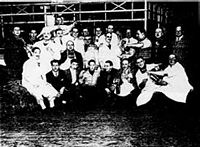 Small groups of Italians started to immigrate to Argentina as early as the second half of the 17th century. However, the stream of Italian immigration to Argentina became a mass phenomenon only in the years 1880-1920, peaking between 1900 and 1914, when 50% of the total 2 million Italians immigrated during the said period arrived in the country. In 1914, the city of Buenos Aires
alone had more than 300,000 Italian-born inhabitants, representing 20% of the total population. In the decades pre-1900, Italian immigrants initially arrived mainly from the northern region of Piedmont
, Veneto
and Lombardy
; after the turn of the century however, with the rapid industrialization of the North, immigration patterns shifted to rural and overpopulated Southern Italy, especially Campania
, Calabria
and Sicily
. The Italian migration was primarily male, between 14-50 and more than 50% literate; in terms of occupations, 78.7% in the active population were agricultural workers or unskilled laborers, 10.7% artisans, while only 3.7% worked in commerce or as professionals. The surge of World War I
and the rise of Fascism
in Italy caused a rapid fall of the immigration flows to Argentina, with a slight revival in 1923-27, but eventually stopped in coincidence with the Great Depression
and the Second World War. After the end of World War II, Italy was in rubble and occupied by foreign armies, like Germany
and other defeated Axis powers
. The period 1946-1957 brought another massive wave of 380,000 Italians to Argentina. The substantial recovery allowed by the Italian economic miracle
of the 1950-60s eventually caused the era of Italian diaspora
abroad to finish, and in the following decades Italy became a migration receiving country. Today, there are still 527,570 Italian citizens living in the Argentine Republic.

, Argentina has more than 1,500,000 Italian
speakers, making it the second most spoken language in the nation. In spite of the great many Italian immigrants, the Italian language
never truly took hold in Argentina, in part because at the time the great majority of Italians spoke only their local Italian dialect
and not the unified, standard Italian. This prevented any expansion of the use of the Italian language as a primary language in Argentina. The similarity of the Italian dialects with Spanish also enabled the immigrants to assimilate, by using the Spanish language, with relative ease.
Italian
immigration
from the second half of the 19th century to the beginning of the 20th century made a lasting and significant impact on the intonation of Argentina's vernacular Spanish. Preliminary research has shown that Rioplatense Spanish
, and particularly the speech of the city of Buenos Aires, has intonation patterns that resemble those of Italian dialects (especially Neapolitan)
, and differ markedly from the patterns of other forms of Spanish. This correlates well with immigration patterns as Argentina, and particularly Buenos Aires, had huge numbers of Italian settlers since the 19th century. According to a study conducted by National Scientific and Technical Research Council
of Argentina
, and published in Bilingualism: Language and Cognition (ISSN
1366-7289) The researchers note that this is a relatively recent phenomenon, starting in the beginning of the 20th century with the main wave of Southern Italian immigration. Before that, the porteño
accent was more similar to that of Spain, especially Andalusia
.
Much of Lunfardo
arrived with European immigrants, such as Italians, Spanish, Greek, Portuguese, and Poles. It should be noted that most Italian and Spanish immigrants spoke their regional languages and dialects and not standard Italian
or Spanish
; other words arrived from the pampa
by means of the gaucho
s; a small number originated in Argentina's native population. Most sources believe that Lunfardo originated in jails, as a prisoner-only argot. Circa 1900, the word lunfardo itself (originally a deformation of lombardo
in several Italian dialects) was used to mean "outlaw".
Lunfardo words are inserted in the normal flow of Rioplatense Spanish
sentences. Thus, a Mexican reading tango lyrics will need, at most, the translation of a discrete set of words, and not a grammar guide. Tango lyrics use lunfardo sparsely, but some songs (such as El Ciruja, or most lyrics by Celedonio Flores) employ lunfardo heavily. "Milonga Lunfarda" by Edmundo Rivero
is an instructive and entertaining primer on lunfardo usage.
Examples:
Between about 1880 and 1900, Argentina received a large number of peasants who arrived with little or no schooling in the Spanish language. As those immigrants strove to communicate with the local criollos
, they produced a variable mixture of Spanish with Italian and Italian dialects. This pidgin language was given the derogatory name cocoliche by the locals. Since the children of the immigrants grew up speaking Spanish at school, work, and military service, Cocoliche remained confined mostly to the first generation immigrants, and slowly fell out of use. The pidgin has been depicted humorously in literary works and in the Argentine sainete
theater, e.g. by Dario Vittori
.
.jpg)
 Argentine cuisine has been strongly influenced by Italian cuisine, the typical Argentine diet is a variation the Mediterranean diet.
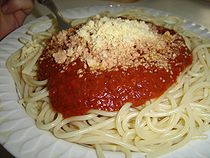
Italian staple dishes like pizza and pasta are common and it is a tradition among Argentines to choose different variations of pizzas. Pasta is extremely common, either simple unadorned pasta with butter or oil, or accompanied by tomato or bechamel-based sauce.
Pizza
(locally pronounced pisa or pitsa), for example, has been wholly subsumed and in its Argentine form more closely resembles Italian calzone
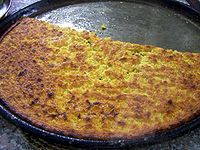
s than it does its Italian ancestor. Typical or exclusively Argentine pizzas include pizza canchera, pizza rellena (stuffed pizza), pizza por metro (pizza by the meter), and pizza à la parrilla (grilled pizza). While Argentine pizza, derives from Neapolitan
cuisine, the Argentine fugaza/fugazza comes from the focaccia xeneise (Genoa
n), but in any case its preparation is different from its Italian counterpart, and the addition of cheese to make the dish (fugaza con queso or fugazzeta) is an Argentine invention.
Fainá
is a type of thin bread made with chickpea
flour (adopted from northern Italy). During the 20th century, people in pizzerias in Buenos Aires, Rosario or Córdoba have commonly ordered a "combo" of moscato, pizza, and fainá. This is a large glass of a sweet wine called moscato
(muscat
), plus two triangular stacked pieces (the lower one being pizza and the upper one fainá). Despite both pizza and faina being Italian in origin, they are never served together in that country.
Nevertheless, the pasta
s (pasta, always in the plural) surpass pizzas in consumption levels. Among them are tallarines (fettuccine
), ravioles (ravioli
), ñoquis (gnocchi
), and canelones (cannelloni
). They are usually cooked, served, and consumed in Argentine fashion, called all'uso-nostro, a phrase of Italian origin.
For example, it is common for pasta to be eaten together with white bread ("French bread"), which is unusual in Italy. This can be explained by the low cost of bread and the fact that Argentine pastas tend to come together with a large amount of tuco sauce (Italian sugo), and accompanied by estofado (stew). Less commonly, pastas are eaten with a dressing of pesto
, a green sauce based on basil
, or salsa blanca (Béchamel sauce
).
Sorrentinos are also a local dish with a misleading name (they do not come from Sorrento
, but were invented in Mar del Plata). They look like big round ravioles stuffed with mozzarella
, cottage cheese
and basil
in tomato sauce
.
Polenta
comes from Northern Italy and is very common throughout Argentina. And, just like polenta concia in Italy, this cornmeal
is eaten as a main dish, with sauce and melted cheese.
Other dishes are milanesas (Its name derive from the original cotoletta alla milanese from Milan
, Italy
), or breaded meats. A common dish of this variety is the milanesa napolitana (the name comes from a restaurant that used to be in Buenos Aires, "El Napolitano"). Milanesa napolitana is an Argentine innovation despite its name and it consists of a breaded meat with cheese, tomatoes and in some special cases, ham on top of the meat. In addition to roast beef, bifes, and churrascos, a visitor to the central region will find many dishes of Italian origin that have been incorporated into the Argentine cuisine and heavily modified from their original forms.
The milanesa was brought to Argentina from Central European immigrants, its name reflecting the original Milan
ese preparation cotoletta
alla milanese, which also inspired the wiener schnitzel
. http://yosoymukenio.blogspot.com/2005/10/la-verdad-de-la-milanesa.html http://www.benettipecoraro.com/es_notas.htm
The Pasta Frola is a typical Argentine recipe heavily influenced by Southern Italian cuisine, also known as Pasta Frolla in Italy
. Pasta frola consists of a pastry base covered with a topping made of sweetened quince, sweet-potato or of milk
and adorned with thin strips of the same pastry, forming a squared pattern. It is an Argentine tradition
to eat pastafrola with mate
in the afternoon. The dish is also very popular in Paraguay
and Uruguay
.
The traditional Italian recipe was not prepared with latticework as it is in Argentina, but with a lid pierced with molds in forms of heart or flowers.
The Argentinian variant of ice cream (Spanish Helado
. Gelato is in Italian) has a very strong presence in Argentinian desserts, "going outs" and the phenomenon of "to-door" delivery. Its originality lies in the creamy texture given by the starring presence of cream in the creation, and the variety of flavors (from classical chocolate with almonds to Argentinian Dulce de Leche
to kiwi, wine or tangerine). This was also a product of Italian diaspora
.
Argentina
Argentina , officially the Argentine Republic , is the second largest country in South America by land area, after Brazil. It is constituted as a federation of 23 provinces and an autonomous city, Buenos Aires...
of Italian
Italian people
The Italian people are an ethnic group that share a common Italian culture, ancestry and speak the Italian language as a mother tongue. Within Italy, Italians are defined by citizenship, regardless of ancestry or country of residence , and are distinguished from people...
ancestry. It is estimated up to 25 million Argentines have some degree of Italian descent (up to 60% of the total population). Italians began arriving in Argentina in great numbers from 1857 to 1940, totaling 44.9% of the entire immigrant population; more than from any other country (including Spain at 31.5%), and this migratory flow continued to the 1960s, with Italy also having the most emigrants to Argentina for the decades 1980–2000. Because of this, Italian descent is likely the largest ethnic heritage of Argentina's population, with about 20 million descendants.
Italian settlement in Argentina, along with Spanish
Spanish Argentine
Spanish settlement in Argentina, that is the arrival of Spanish emigrants in Argentina, took place firstly in the period before Argentina's independence from Spain, and again in large numbers during the late 19th and early 20th centuries...
settlement, formed the backbone of today's Argentine
Argentina
Argentina , officially the Argentine Republic , is the second largest country in South America by land area, after Brazil. It is constituted as a federation of 23 provinces and an autonomous city, Buenos Aires...
society. Argentine culture has significant connections to Italian culture in terms of language, customs and traditions.
History
Buenos Aires
Buenos Aires is the capital and largest city of Argentina, and the second-largest metropolitan area in South America, after São Paulo. It is located on the western shore of the estuary of the Río de la Plata, on the southeastern coast of the South American continent...
alone had more than 300,000 Italian-born inhabitants, representing 20% of the total population. In the decades pre-1900, Italian immigrants initially arrived mainly from the northern region of Piedmont
Piedmont
Piedmont is one of the 20 regions of Italy. It has an area of 25,402 square kilometres and a population of about 4.4 million. The capital of Piedmont is Turin. The main local language is Piedmontese. Occitan is also spoken by a minority in the Occitan Valleys situated in the Provinces of...
, Veneto
Veneto
Veneto is one of the 20 regions of Italy. Its population is about 5 million, ranking 5th in Italy.Veneto had been for more than a millennium an independent state, the Republic of Venice, until it was eventually annexed by Italy in 1866 after brief Austrian and French rule...
and Lombardy
Lombardy
Lombardy is one of the 20 regions of Italy. The capital is Milan. One-sixth of Italy's population lives in Lombardy and about one fifth of Italy's GDP is produced in this region, making it the most populous and richest region in the country and one of the richest in the whole of Europe...
; after the turn of the century however, with the rapid industrialization of the North, immigration patterns shifted to rural and overpopulated Southern Italy, especially Campania
Campania
Campania is a region in southern Italy. The region has a population of around 5.8 million people, making it the second-most-populous region of Italy; its total area of 13,590 km² makes it the most densely populated region in the country...
, Calabria
Calabria
Calabria , in antiquity known as Bruttium, is a region in southern Italy, south of Naples, located at the "toe" of the Italian Peninsula. The capital city of Calabria is Catanzaro....
and Sicily
Sicily
Sicily is a region of Italy, and is the largest island in the Mediterranean Sea. Along with the surrounding minor islands, it constitutes an autonomous region of Italy, the Regione Autonoma Siciliana Sicily has a rich and unique culture, especially with regard to the arts, music, literature,...
. The Italian migration was primarily male, between 14-50 and more than 50% literate; in terms of occupations, 78.7% in the active population were agricultural workers or unskilled laborers, 10.7% artisans, while only 3.7% worked in commerce or as professionals. The surge of World War I
World War I
World War I , which was predominantly called the World War or the Great War from its occurrence until 1939, and the First World War or World War I thereafter, was a major war centred in Europe that began on 28 July 1914 and lasted until 11 November 1918...
and the rise of Fascism
Fascism
Fascism is a radical authoritarian nationalist political ideology. Fascists seek to rejuvenate their nation based on commitment to the national community as an organic entity, in which individuals are bound together in national identity by suprapersonal connections of ancestry, culture, and blood...
in Italy caused a rapid fall of the immigration flows to Argentina, with a slight revival in 1923-27, but eventually stopped in coincidence with the Great Depression
Great Depression
The Great Depression was a severe worldwide economic depression in the decade preceding World War II. The timing of the Great Depression varied across nations, but in most countries it started in about 1929 and lasted until the late 1930s or early 1940s...
and the Second World War. After the end of World War II, Italy was in rubble and occupied by foreign armies, like Germany
Nazi Germany
Nazi Germany , also known as the Third Reich , but officially called German Reich from 1933 to 1943 and Greater German Reich from 26 June 1943 onward, is the name commonly used to refer to the state of Germany from 1933 to 1945, when it was a totalitarian dictatorship ruled by...
and other defeated Axis powers
Axis Powers
The Axis powers , also known as the Axis alliance, Axis nations, Axis countries, or just the Axis, was an alignment of great powers during the mid-20th century that fought World War II against the Allies. It began in 1936 with treaties of friendship between Germany and Italy and between Germany and...
. The period 1946-1957 brought another massive wave of 380,000 Italians to Argentina. The substantial recovery allowed by the Italian economic miracle
Italian economic miracle
The Italian economic miracle is the name often used by historians, economists and mass media to designate the prolonged period of sustained economic growth in Italy comprised between the end of World War II and the late 1960s, and in particular the years 1950-63...
of the 1950-60s eventually caused the era of Italian diaspora
Italian diaspora
The term Italian diaspora refers to the large-scale migration of Italians away from Italy in the period roughly beginning with the unification of Italy in 1861 and ending with the Italian economic miracle in the 1960s...
abroad to finish, and in the following decades Italy became a migration receiving country. Today, there are still 527,570 Italian citizens living in the Argentine Republic.
Culture
Language
According to EthnologueEthnologue
Ethnologue: Languages of the World is a web and print publication of SIL International , a Christian linguistic service organization, which studies lesser-known languages, to provide the speakers with Bibles in their native language and support their efforts in language development.The Ethnologue...
, Argentina has more than 1,500,000 Italian
Italian language
Italian is a Romance language spoken mainly in Europe: Italy, Switzerland, San Marino, Vatican City, by minorities in Malta, Monaco, Croatia, Slovenia, France, Libya, Eritrea, and Somalia, and by immigrant communities in the Americas and Australia...
speakers, making it the second most spoken language in the nation. In spite of the great many Italian immigrants, the Italian language
Italian language
Italian is a Romance language spoken mainly in Europe: Italy, Switzerland, San Marino, Vatican City, by minorities in Malta, Monaco, Croatia, Slovenia, France, Libya, Eritrea, and Somalia, and by immigrant communities in the Americas and Australia...
never truly took hold in Argentina, in part because at the time the great majority of Italians spoke only their local Italian dialect
Italian dialects
Dialects of Italian are regional varieties of the Italian language, more commonly and more accurately referred to as Regional Italian. The dialects have features, most notably phonological and lexical, percolating from the underlying substrate languages...
and not the unified, standard Italian. This prevented any expansion of the use of the Italian language as a primary language in Argentina. The similarity of the Italian dialects with Spanish also enabled the immigrants to assimilate, by using the Spanish language, with relative ease.
Italian
Italy
Italy , officially the Italian Republic languages]] under the European Charter for Regional or Minority Languages. In each of these, Italy's official name is as follows:;;;;;;;;), is a unitary parliamentary republic in South-Central Europe. To the north it borders France, Switzerland, Austria and...
immigration
Immigration
Immigration is the act of foreigners passing or coming into a country for the purpose of permanent residence...
from the second half of the 19th century to the beginning of the 20th century made a lasting and significant impact on the intonation of Argentina's vernacular Spanish. Preliminary research has shown that Rioplatense Spanish
Rioplatense Spanish
Rioplatense Spanish or River Plate Spanish is a dialectal variant of the Spanish language spoken mainly in the areas in and around the Río de la Plata basin of Argentina and Uruguay, and also in Rio Grande do Sul, although features of the dialect are shared with the varieties of Spanish spoken...
, and particularly the speech of the city of Buenos Aires, has intonation patterns that resemble those of Italian dialects (especially Neapolitan)
Neapolitan language
Neapolitan is the language of the city and region of Naples , and Campania. On October 14, 2008 a law by the Region of Campania stated that the Neapolitan language had to be protected....
, and differ markedly from the patterns of other forms of Spanish. This correlates well with immigration patterns as Argentina, and particularly Buenos Aires, had huge numbers of Italian settlers since the 19th century. According to a study conducted by National Scientific and Technical Research Council
National Scientific and Technical Research Council
The National Scientific and Technical Research Council is an Argentine government agency which directs and co-ordinates most of the scientific and technical research done in universities and institutes....
of Argentina
Argentina
Argentina , officially the Argentine Republic , is the second largest country in South America by land area, after Brazil. It is constituted as a federation of 23 provinces and an autonomous city, Buenos Aires...
, and published in Bilingualism: Language and Cognition (ISSN
International Standard Serial Number
An International Standard Serial Number is a unique eight-digit number used to identify a print or electronic periodical publication. Periodicals published in both print and electronic form may have two ISSNs, a print ISSN and an electronic ISSN...
1366-7289) The researchers note that this is a relatively recent phenomenon, starting in the beginning of the 20th century with the main wave of Southern Italian immigration. Before that, the porteño
Porteño
Porteño in Spanish is used to refer to a person who is from or lives in a port city, but it can also be used as an adjective for anything related to those port cities....
accent was more similar to that of Spain, especially Andalusia
Andalusia
Andalusia is the most populous and the second largest in area of the autonomous communities of Spain. The Andalusian autonomous community is officially recognised as a nationality of Spain. The territory is divided into eight provinces: Huelva, Seville, Cádiz, Córdoba, Málaga, Jaén, Granada and...
.
Much of Lunfardo
Lunfardo
Lunfardo is a dialect originated and developed in the late 19th and early 20th centuries in the lower classes in Buenos Aires and the surrounding Gran Buenos Aires, and from there spread to other cities nearby, such as Rosario and Montevideo, cities with similar socio-cultural situations...
arrived with European immigrants, such as Italians, Spanish, Greek, Portuguese, and Poles. It should be noted that most Italian and Spanish immigrants spoke their regional languages and dialects and not standard Italian
Italian language
Italian is a Romance language spoken mainly in Europe: Italy, Switzerland, San Marino, Vatican City, by minorities in Malta, Monaco, Croatia, Slovenia, France, Libya, Eritrea, and Somalia, and by immigrant communities in the Americas and Australia...
or Spanish
Spanish language
Spanish , also known as Castilian , is a Romance language in the Ibero-Romance group that evolved from several languages and dialects in central-northern Iberia around the 9th century and gradually spread with the expansion of the Kingdom of Castile into central and southern Iberia during the...
; other words arrived from the pampa
Pampa
The Pampas are the fertile South American lowlands, covering more than , that include the Argentine provinces of Buenos Aires, La Pampa, Santa Fe, Entre Ríos and Córdoba, most of Uruguay, and the southernmost Brazilian State, Rio Grande do Sul...
by means of the gaucho
Gaucho
Gaucho is a term commonly used to describe residents of the South American pampas, chacos, or Patagonian grasslands, found principally in parts of Argentina, Uruguay, Southern Chile, and Southern Brazil...
s; a small number originated in Argentina's native population. Most sources believe that Lunfardo originated in jails, as a prisoner-only argot. Circa 1900, the word lunfardo itself (originally a deformation of lombardo
Lombardy
Lombardy is one of the 20 regions of Italy. The capital is Milan. One-sixth of Italy's population lives in Lombardy and about one fifth of Italy's GDP is produced in this region, making it the most populous and richest region in the country and one of the richest in the whole of Europe...
in several Italian dialects) was used to mean "outlaw".
Lunfardo words are inserted in the normal flow of Rioplatense Spanish
Rioplatense Spanish
Rioplatense Spanish or River Plate Spanish is a dialectal variant of the Spanish language spoken mainly in the areas in and around the Río de la Plata basin of Argentina and Uruguay, and also in Rio Grande do Sul, although features of the dialect are shared with the varieties of Spanish spoken...
sentences. Thus, a Mexican reading tango lyrics will need, at most, the translation of a discrete set of words, and not a grammar guide. Tango lyrics use lunfardo sparsely, but some songs (such as El Ciruja, or most lyrics by Celedonio Flores) employ lunfardo heavily. "Milonga Lunfarda" by Edmundo Rivero
Edmundo Rivero
Leonel Edmundo Rivero was an Argentine tango singer, composer, and impresario.-Early days:Rivero was born in the southern Buenos Aires suburb of Valentín Alsina. Joining his father in some of his travels, he was exposed to the lifestyle and the music of the gauchos of Buenos Aires Province from...
is an instructive and entertaining primer on lunfardo usage.
Examples:
- Parlar - To speak (from the ItalianItalian languageItalian is a Romance language spoken mainly in Europe: Italy, Switzerland, San Marino, Vatican City, by minorities in Malta, Monaco, Croatia, Slovenia, France, Libya, Eritrea, and Somalia, and by immigrant communities in the Americas and Australia...
parlare -to speak-) - Manyar - To know / to eat (from the ItalianItalian languageItalian is a Romance language spoken mainly in Europe: Italy, Switzerland, San Marino, Vatican City, by minorities in Malta, Monaco, Croatia, Slovenia, France, Libya, Eritrea, and Somalia, and by immigrant communities in the Americas and Australia...
mangiare -to eat-) - Mina - Female (from the ItalianItalian languageItalian is a Romance language spoken mainly in Europe: Italy, Switzerland, San Marino, Vatican City, by minorities in Malta, Monaco, Croatia, Slovenia, France, Libya, Eritrea, and Somalia, and by immigrant communities in the Americas and Australia...
femmina -Female-) - Laburar - To work (from ItalianItalian languageItalian is a Romance language spoken mainly in Europe: Italy, Switzerland, San Marino, Vatican City, by minorities in Malta, Monaco, Croatia, Slovenia, France, Libya, Eritrea, and Somalia, and by immigrant communities in the Americas and Australia...
lavorare - to work-) - Fiaca - laziness (from the Italian fiacco -weak-)
Between about 1880 and 1900, Argentina received a large number of peasants who arrived with little or no schooling in the Spanish language. As those immigrants strove to communicate with the local criollos
Criollo (people)
The Criollo class ranked below that of the Iberian Peninsulares, the high-born permanent residence colonists born in Spain. But Criollos were higher status/rank than all other castes—people of mixed descent, Amerindians, and enslaved Africans...
, they produced a variable mixture of Spanish with Italian and Italian dialects. This pidgin language was given the derogatory name cocoliche by the locals. Since the children of the immigrants grew up speaking Spanish at school, work, and military service, Cocoliche remained confined mostly to the first generation immigrants, and slowly fell out of use. The pidgin has been depicted humorously in literary works and in the Argentine sainete
Sainete
A sainete was a popular Spanish comic opera piece, a one-act dramatic vignette, with music. It was often placed at the end of entertainments, or between other types of performance. It was vernacular in style, and used scenes of low life. Active from the 18th to 20th centuries, it superseded the...
theater, e.g. by Dario Vittori
Dario Vittori
Darío Víttori was an Italian born, Argentine comic actor. His real name was Melito Darío Spartaco Margozzi and was born on 14 September 1921 in Montecelio, Lazio, Italy...
.
Cuisine
Italian staple dishes like pizza and pasta are common and it is a tradition among Argentines to choose different variations of pizzas. Pasta is extremely common, either simple unadorned pasta with butter or oil, or accompanied by tomato or bechamel-based sauce.
Pizza
Pizza
Pizza is an oven-baked, flat, disc-shaped bread typically topped with a tomato sauce, cheese and various toppings.Originating in Italy, from the Neapolitan cuisine, the dish has become popular in many parts of the world. An establishment that makes and sells pizzas is called a "pizzeria"...
(locally pronounced pisa or pitsa), for example, has been wholly subsumed and in its Argentine form more closely resembles Italian calzone
Calzone
A calzone Italian: , "stocking" or "trouser") is a turnover that originates from Italy. It is shaped like a semicircle, made of dough folded over and filled with ingredients common to pizza....
s than it does its Italian ancestor. Typical or exclusively Argentine pizzas include pizza canchera, pizza rellena (stuffed pizza), pizza por metro (pizza by the meter), and pizza à la parrilla (grilled pizza). While Argentine pizza, derives from Neapolitan
Naples
Naples is a city in Southern Italy, situated on the country's west coast by the Gulf of Naples. Lying between two notable volcanic regions, Mount Vesuvius and the Phlegraean Fields, it is the capital of the region of Campania and of the province of Naples...
cuisine, the Argentine fugaza/fugazza comes from the focaccia xeneise (Genoa
Genoa
Genoa |Ligurian]] Zena ; Latin and, archaically, English Genua) is a city and an important seaport in northern Italy, the capital of the Province of Genoa and of the region of Liguria....
n), but in any case its preparation is different from its Italian counterpart, and the addition of cheese to make the dish (fugaza con queso or fugazzeta) is an Argentine invention.
Fainá
Faina
Faina is a small town and municipality in central-west Goiás state, Brazil. The population was 6,918 in a total area of 1,944.9 km².-Location and Connections:...
is a type of thin bread made with chickpea
Chickpea
The chickpea is a legume of the family Fabaceae, subfamily Faboideae...
flour (adopted from northern Italy). During the 20th century, people in pizzerias in Buenos Aires, Rosario or Córdoba have commonly ordered a "combo" of moscato, pizza, and fainá. This is a large glass of a sweet wine called moscato
Moscato
Moscato can have several meanings see:*Muscat *Judah Moscato *Vincent Moscato...
(muscat
Muscat (grape and wine)
The Muscat variety of grapes of the species Vitis vinifera is widely grown for wine, raisins and table grapes. Their color ranges from white to near black. Muscat almost always has a pronounced sweet floral aroma. Muscat grapes are grown around the world...
), plus two triangular stacked pieces (the lower one being pizza and the upper one fainá). Despite both pizza and faina being Italian in origin, they are never served together in that country.
Nevertheless, the pasta
Pasta
Pasta is a staple food of traditional Italian cuisine, now of worldwide renown. It takes the form of unleavened dough, made in Italy, mostly of durum wheat , water and sometimes eggs. Pasta comes in a variety of different shapes that serve for both decoration and to act as a carrier for the...
s (pasta, always in the plural) surpass pizzas in consumption levels. Among them are tallarines (fettuccine
Fettuccine
Fettuccine is a type of pasta popular in Roman Cuisine. It is a flat thick noodle made of egg and flour wider than but similar to the tagliatelle typical of Bologna...
), ravioles (ravioli
Ravioli
Ravioli are a traditional type of Italian filled pasta. They are composed of a filling sealed between two layers of thin egg pasta dough and are served either in broth or with a pasta sauce. The word ravioli is reminiscent of the Italian verb riavvolgere , though the two words are not...
), ñoquis (gnocchi
Gnocchi
Gnocchi are various thick, soft dumplings. They may be made from semolina, ordinary wheat flour, flour and egg, flour, egg, and cheese, potato, bread crumbs, or similar ingredients. The smaller forms are called gnocchetti....
), and canelones (cannelloni
Cannelloni
Cannelloni are a cylindrical type of pasta generally served baked with a filling and covered by a sauce. Some type of cannelloni need to be boiled beforehand, for some others is enough to use runnier sauces/filling....
). They are usually cooked, served, and consumed in Argentine fashion, called all'uso-nostro, a phrase of Italian origin.
For example, it is common for pasta to be eaten together with white bread ("French bread"), which is unusual in Italy. This can be explained by the low cost of bread and the fact that Argentine pastas tend to come together with a large amount of tuco sauce (Italian sugo), and accompanied by estofado (stew). Less commonly, pastas are eaten with a dressing of pesto
Pesto
Pesto is a sauce originating in Genoa in the Liguria region of northern Italy , and traditionally consists of crushed garlic, basil and pine nuts blended with olive oil and Parmigiano Reggiano and Fiore Sardo...
, a green sauce based on basil
Basil
Basil, or Sweet Basil, is a common name for the culinary herb Ocimum basilicum , of the family Lamiaceae , sometimes known as Saint Joseph's Wort in some English-speaking countries....
, or salsa blanca (Béchamel sauce
Béchamel sauce
Béchamel sauce , also known as white sauce, is one of the mother sauces of French cuisine and is used in many recipes of Italian cuisine, for example lasagne. It is used as the base for other sauces . It is traditionally made by whisking scalded milk gradually into a white roux...
).
Sorrentinos are also a local dish with a misleading name (they do not come from Sorrento
Sorrento
Sorrento is the name of many cities and towns:*Sorrento, Italy*Sorrento, Florida, United States*Sorrento, Louisiana, United States*Sorrento, Maine, United States*Sorrento, Victoria, a township on the Mornington Peninsula, Victoria, Australia...
, but were invented in Mar del Plata). They look like big round ravioles stuffed with mozzarella
Mozzarella
Mozzarella is an Italian Traditional Speciality Guaranteed food product. The term is used for several kinds of Italian cheeses that are made using spinning and then cutting :...
, cottage cheese
Cottage cheese
Cottage cheese is a cheese curd product with a mild flavor. It is drained, but not pressed, so some whey remains and the individual curds remain loose. The curd is usually washed to remove acidity, giving sweet curd cheese. It is not aged or colored. Different styles of cottage cheese are made from...
and basil
Basil
Basil, or Sweet Basil, is a common name for the culinary herb Ocimum basilicum , of the family Lamiaceae , sometimes known as Saint Joseph's Wort in some English-speaking countries....
in tomato sauce
Tomato sauce
A tomato sauce is any of a very large number of sauces made primarily from tomatoes, usually to be served as part of a dish...
.
Polenta
Polenta
Polenta is a dish made from boiled cornmeal. The word "polenta" is borrowed from Italian.-Description:Polenta is made with ground yellow or white cornmeal , which can be ground coarsely or finely depending on the region and the texture desired.As it is known today, polenta derives from earlier...
comes from Northern Italy and is very common throughout Argentina. And, just like polenta concia in Italy, this cornmeal
Cornmeal
Cornmeal is flour ground from dried maize or American corn. It is a common staple food, and is ground to fine, medium, and coarse consistencies. In the United States, the finely ground cornmeal is also referred to as cornflour. However, the word cornflour denotes cornstarch in recipes from the...
is eaten as a main dish, with sauce and melted cheese.
Other dishes are milanesas (Its name derive from the original cotoletta alla milanese from Milan
Milan
Milan is the second-largest city in Italy and the capital city of the region of Lombardy and of the province of Milan. The city proper has a population of about 1.3 million, while its urban area, roughly coinciding with its administrative province and the bordering Province of Monza and Brianza ,...
, Italy
Italy
Italy , officially the Italian Republic languages]] under the European Charter for Regional or Minority Languages. In each of these, Italy's official name is as follows:;;;;;;;;), is a unitary parliamentary republic in South-Central Europe. To the north it borders France, Switzerland, Austria and...
), or breaded meats. A common dish of this variety is the milanesa napolitana (the name comes from a restaurant that used to be in Buenos Aires, "El Napolitano"). Milanesa napolitana is an Argentine innovation despite its name and it consists of a breaded meat with cheese, tomatoes and in some special cases, ham on top of the meat. In addition to roast beef, bifes, and churrascos, a visitor to the central region will find many dishes of Italian origin that have been incorporated into the Argentine cuisine and heavily modified from their original forms.
The milanesa was brought to Argentina from Central European immigrants, its name reflecting the original Milan
Milan
Milan is the second-largest city in Italy and the capital city of the region of Lombardy and of the province of Milan. The city proper has a population of about 1.3 million, while its urban area, roughly coinciding with its administrative province and the bordering Province of Monza and Brianza ,...
ese preparation cotoletta
Cotoletta
Cotoletta is an Italian word for a breaded veal cutlet....
alla milanese, which also inspired the wiener schnitzel
Wiener schnitzel
Schnitzel is a traditional Austrian dish made with boneless meat thinned with a mallet , coated in bread crumbs and fried. It is a popular part of Viennese, Austrian cuisine and German Cuisine...
. http://yosoymukenio.blogspot.com/2005/10/la-verdad-de-la-milanesa.html http://www.benettipecoraro.com/es_notas.htm
The Pasta Frola is a typical Argentine recipe heavily influenced by Southern Italian cuisine, also known as Pasta Frolla in Italy
Italy
Italy , officially the Italian Republic languages]] under the European Charter for Regional or Minority Languages. In each of these, Italy's official name is as follows:;;;;;;;;), is a unitary parliamentary republic in South-Central Europe. To the north it borders France, Switzerland, Austria and...
. Pasta frola consists of a pastry base covered with a topping made of sweetened quince, sweet-potato or of milk
Milk
Milk is a white liquid produced by the mammary glands of mammals. It is the primary source of nutrition for young mammals before they are able to digest other types of food. Early-lactation milk contains colostrum, which carries the mother's antibodies to the baby and can reduce the risk of many...
and adorned with thin strips of the same pastry, forming a squared pattern. It is an Argentine tradition
Tradition
A tradition is a ritual, belief or object passed down within a society, still maintained in the present, with origins in the past. Common examples include holidays or impractical but socially meaningful clothes , but the idea has also been applied to social norms such as greetings...
to eat pastafrola with mate
Mate
Mate may refer to one of the following meanings based on the generic dictionary definitions of the word:* One of a pair of animals involved in mating* Mate , a colloquialism used to refer to a friend* A naval officer:...
in the afternoon. The dish is also very popular in Paraguay
Paraguay
Paraguay , officially the Republic of Paraguay , is a landlocked country in South America. It is bordered by Argentina to the south and southwest, Brazil to the east and northeast, and Bolivia to the northwest. Paraguay lies on both banks of the Paraguay River, which runs through the center of the...
and Uruguay
Uruguay
Uruguay ,officially the Oriental Republic of Uruguay,sometimes the Eastern Republic of Uruguay; ) is a country in the southeastern part of South America. It is home to some 3.5 million people, of whom 1.8 million live in the capital Montevideo and its metropolitan area...
.
The traditional Italian recipe was not prepared with latticework as it is in Argentina, but with a lid pierced with molds in forms of heart or flowers.
The Argentinian variant of ice cream (Spanish Helado
Helado
Helado is a Spanish word for ice cream.Helado may also refer to:*Helados EFE, C.A., an ice cream company that is a subsidiary of Empresas Polar...
. Gelato is in Italian) has a very strong presence in Argentinian desserts, "going outs" and the phenomenon of "to-door" delivery. Its originality lies in the creamy texture given by the starring presence of cream in the creation, and the variety of flavors (from classical chocolate with almonds to Argentinian Dulce de Leche
Dulce de leche
Dulce de leche is a thick,creamy, caramel-like milk-based sauce or spread.Literally translated, dulce de leche means "sweet from milk". It is prepared by slowly heating sweetened milk to create a product that derives its taste from caramelised sugar. It is a popular sweet in Latin America, where...
to kiwi, wine or tangerine). This was also a product of Italian diaspora
Italian diaspora
The term Italian diaspora refers to the large-scale migration of Italians away from Italy in the period roughly beginning with the unification of Italy in 1861 and ending with the Italian economic miracle in the 1960s...
.
Statistics
| Italian immigrants to Argentina, 1861-1920 (by decade) | |||
|---|---|---|---|
| Period | Total | Italian | % |
| 1861–1870 | 159,570 | 113,554 | 71 |
| 1871–1880 | 260,885 | 152,061 | 58 |
| 1881–1890 | 841,122 | 493,885 | 59 |
| 1891–1900 | 648,326 | 425,693 | 57 |
| 1901–1910 | 1,764,103 | 796,190 | 45 |
| 1911–1920 | 1,204,919 | 347,388 | 29 |
| Total Italians | 2,270,525 | 47 |
See also
- White Latin Americans
- Argentine-Italian relations
- CarcamanoCarcamanoCarcamano is an ethnic slur used in Southern Brazil for the descendants of the non-Iberian European immigrants who arrived in Brazil in the late 19th century and in the early 20th century....
- Demographics of ArgentinaDemographics of ArgentinaThis article is about the demographic features of Argentina, including population density, ethnicity, economic status and other aspects of the population....
- German settlement in ArgentinaGerman settlement in ArgentinaGerman Argentines are Argentines of German descent. The term "German" usually refers to Ethnic Germans who immigrated to Argentina from Germany, Austria, France, Hungary, Poland, Romania, Russia, Switzerland, former Yugoslavia and elsewhere in Europe...
- Immigration in Argentina
- Spanish settlement in ArgentinaSpanish settlement in ArgentinaSpanish settlement in Argentina, that is the arrival of Spanish emigrants in Argentina, took place firstly in the period before Argentina's independence from Spain, and again in large numbers during the late 19th and early 20th centuries...