


Ravioli

Encyclopedia
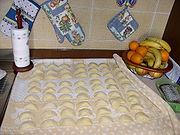
Ravioli are a traditional type of Italian filled pasta
. They are composed of a filling sealed between two layers of thin egg pasta dough and are served either in broth or with a pasta sauce. The word ravioli is reminiscent of the Italian
verb riavvolgere ("to wrap"), though the two words are not etymologically connected. The word may also be a diminutive of Italian
dialectal rava, or turnip
.
In Venice
, the mid-14th century manuscript Libro per cuoco offers ravioli of green herbs blanched and minced, mixed with beaten egg and fresh cheese, simmered in broth, a recipe that would be familiar today save for its medieval powdering of "sweet and strong spices". In Tuscany, some of the earliest mentions of the dish come from the personal letters of Francesco di Marco Datini
, a merchant of Prato
in the 14th century. In Rome, ravioli were already well-known when Bartolomeo Scappi
served them with boiled chicken to the papal conclave of 1549
.
Ravioli were already known in 14th century England, appearing in the Anglo-Norman
vellum
manuscript Forme of Cury
under the name of rauioles. Sicilian ravioli and Malta's ravjul may thus be older than North Italian ones. Maltese ravjul are stuffed with rikotta, the locally produced sheep's-milk ricotta, or with gbejna, the traditional fresh sheep's-milk cheese.
, and Zamboni. Italian fresh pasta has a shelf-life of 30 days. "Fresh" packed ravioli have in USA seven weeks of shelf life. Canned ravioli was pioneered by Chef Boyardee
. This type of ravioli is filled with either beef or processed cheese and served in a tomato, tomato-meat, or tomato-cheese sauce. Canned ravioli has more in common with other canned pastas than with traditional ravioli dishes. Its roots are in traditional American "red sauce
" Italian-American restaurants opened by Italian immigrants in Boston
, New York
and other cities. Toasted ravioli
, ravioli that have been breaded and deep fried, were first developed in St. Louis, Missouri, and are a popular appetizer or snack food.
festival, mainly in the northern, northwestern and central parts of India.
Similar dishes in other cultures include the Chinese jiaozi or wonton; in fact, ravioli and tortellini are sometimes collectively referred to as "Italian jiaozi" (意大利饺子) or "Italian wonton" (意大利馄饨). A similar dish called shishbarak contains pasta filled with minced beef meat and cooked in hot yogurt.
Pasta
Pasta is a staple food of traditional Italian cuisine, now of worldwide renown. It takes the form of unleavened dough, made in Italy, mostly of durum wheat , water and sometimes eggs. Pasta comes in a variety of different shapes that serve for both decoration and to act as a carrier for the...
. They are composed of a filling sealed between two layers of thin egg pasta dough and are served either in broth or with a pasta sauce. The word ravioli is reminiscent of the Italian
Italian language
Italian is a Romance language spoken mainly in Europe: Italy, Switzerland, San Marino, Vatican City, by minorities in Malta, Monaco, Croatia, Slovenia, France, Libya, Eritrea, and Somalia, and by immigrant communities in the Americas and Australia...
verb riavvolgere ("to wrap"), though the two words are not etymologically connected. The word may also be a diminutive of Italian
Italian language
Italian is a Romance language spoken mainly in Europe: Italy, Switzerland, San Marino, Vatican City, by minorities in Malta, Monaco, Croatia, Slovenia, France, Libya, Eritrea, and Somalia, and by immigrant communities in the Americas and Australia...
dialectal rava, or turnip
Turnip
The turnip or white turnip is a root vegetable commonly grown in temperate climates worldwide for its white, bulbous taproot. Small, tender varieties are grown for human consumption, while larger varieties are grown as feed for livestock...
.
History
The earliest mention of ravioli appear in the writings of Francesco di Marco, a merchant of Venice in the 14th century.In Venice
Venice
Venice is a city in northern Italy which is renowned for the beauty of its setting, its architecture and its artworks. It is the capital of the Veneto region...
, the mid-14th century manuscript Libro per cuoco offers ravioli of green herbs blanched and minced, mixed with beaten egg and fresh cheese, simmered in broth, a recipe that would be familiar today save for its medieval powdering of "sweet and strong spices". In Tuscany, some of the earliest mentions of the dish come from the personal letters of Francesco di Marco Datini
Francesco di Marco Datini
Francesco di Marco Datini was an Italian merchant born in Prato.-Biography:He was the only child of Marco di Datino and Monna Vermigilia, who both died as a result of the Black Death in 1348....
, a merchant of Prato
Prato
Prato is a city and comune in Tuscany, Italy, the capital of the Province of Prato. The city is situated at the foot of Monte Retaia , the last peak in the Calvana chain. The lowest altitude in the comune is 32 m, near the Cascine di Tavola, and the highest is the peak of Monte Cantagrillo...
in the 14th century. In Rome, ravioli were already well-known when Bartolomeo Scappi
Bartolomeo Scappi
Bartolomeo Scappi was a famous Renaissance chef. His origins had been the subject of speculation, but a recent research shows that he came from the town of Dumenza in Lombardy, according to the inscription on a stone plaque in the church of Luino...
served them with boiled chicken to the papal conclave of 1549
Papal conclave, 1549–1550
The papal conclave from November 29, 1549 to February 7, 1550, which was convened after the death of Pope Paul III, and eventually elected Giovanni Del Monte to the papacy as Pope Julius III. It was the second-longest papal conclave of the 16th century, and the largest papal conclave in history in...
.
Ravioli were already known in 14th century England, appearing in the Anglo-Norman
Normans
The Normans were the people who gave their name to Normandy, a region in northern France. They were descended from Norse Viking conquerors of the territory and the native population of Frankish and Gallo-Roman stock...
vellum
Vellum
Vellum is mammal skin prepared for writing or printing on, to produce single pages, scrolls, codices or books. It is generally smooth and durable, although there are great variations depending on preparation, the quality of the skin and the type of animal used...
manuscript Forme of Cury
Forme of Cury
The Forme of Cury is an extensive recipe collection of the 14th century whose author is given as "the chief Master Cooks of King Richard II". The modern name was given to it by Samuel Pegge, who published an edition of it in 1791. This name has since come into usage for almost all versions of the...
under the name of rauioles. Sicilian ravioli and Malta's ravjul may thus be older than North Italian ones. Maltese ravjul are stuffed with rikotta, the locally produced sheep's-milk ricotta, or with gbejna, the traditional fresh sheep's-milk cheese.
Overview
Today, ravioli are made in worldwide industrial lines supplied by Italian companies such as Arienti & Cattaneo, Ima, OstoniOstoni
Ostoni is a manufacturer of plants, machines, dies, accessories and spare parts used in pasta production operations. The company produces, refurbishes and sells new and second-hand equipment world wide and is known especially for its machines for filled products...
, and Zamboni. Italian fresh pasta has a shelf-life of 30 days. "Fresh" packed ravioli have in USA seven weeks of shelf life. Canned ravioli was pioneered by Chef Boyardee
Chef Boyardee
Chef Boyardee is a brand of canned pasta products sold internationally by ConAgra Foods. Named after its founder, Italian-American immigrant Ettore Boiardi, the company began production in the United States in the 1920s...
. This type of ravioli is filled with either beef or processed cheese and served in a tomato, tomato-meat, or tomato-cheese sauce. Canned ravioli has more in common with other canned pastas than with traditional ravioli dishes. Its roots are in traditional American "red sauce
Marinara Sauce
Marinara sauce is a southern Italian tomato sauce usually made with tomatoes, garlic, herbs , and onion. However, there are many variations. Some of these include the addition of capers, olives, anchovies, and/or spices....
" Italian-American restaurants opened by Italian immigrants in Boston
Boston
Boston is the capital of and largest city in Massachusetts, and is one of the oldest cities in the United States. The largest city in New England, Boston is regarded as the unofficial "Capital of New England" for its economic and cultural impact on the entire New England region. The city proper had...
, New York
New York
New York is a state in the Northeastern region of the United States. It is the nation's third most populous state. New York is bordered by New Jersey and Pennsylvania to the south, and by Connecticut, Massachusetts and Vermont to the east...
and other cities. Toasted ravioli
Toasted ravioli
Toasted ravioli, or breaded deep-fried ravioli, is an appetizer created and popularized, according to common claims, in St. Louis, Missouri. Toasted ravioli can be found on the menus of many St...
, ravioli that have been breaded and deep fried, were first developed in St. Louis, Missouri, and are a popular appetizer or snack food.
In other cultures
In India, a popular dish called Gujiya is similar to ravioli however its prepared sweet, with a filing of dry fruits, sugar and a mixture of sweet spices, then deep fried in vegetable oil. The dish is a popular food prepared during the HoliHoli
Holi , is a religious spring festival celebrated by Hindus. Holi is also known as festival of Colours. It is primarily observed in India, Nepal, Pakistan, and countries with large Indic diaspora populations following Hinduism, such as Suriname, Malaysia, Guyana, South Africa, Trinidad, United...
festival, mainly in the northern, northwestern and central parts of India.
Similar dishes in other cultures include the Chinese jiaozi or wonton; in fact, ravioli and tortellini are sometimes collectively referred to as "Italian jiaozi" (意大利饺子) or "Italian wonton" (意大利馄饨). A similar dish called shishbarak contains pasta filled with minced beef meat and cooked in hot yogurt.
See also
Sources
- Adamson, Melitta Weiss; editor (2002) Regional Cuisines of Medieval Europe: A Book of Essays ISBN 0-415-92994-6