

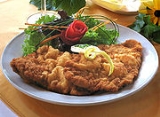
Wiener schnitzel

Encyclopedia
Austria
Austria , officially the Republic of Austria , is a landlocked country of roughly 8.4 million people in Central Europe. It is bordered by the Czech Republic and Germany to the north, Slovakia and Hungary to the east, Slovenia and Italy to the south, and Switzerland and Liechtenstein to the...
n dish made with boneless meat thinned with a mallet (escalope-style
Escalopes
Escalopes are pieces of boneless meat which have been thinned out using a mallet, rolling pin or beaten with the handle of a knife, or alternative, combined with, or merely 'butterflied'...
preparation), coated in bread crumbs and fried. It is a popular part of Viennese
Viennese cuisine
Viennese cuisine is the cuisine that is characteristic of Vienna, Austria, and its residents. Viennese cuisine is often treated as equivalent to Austrian cuisine, but while elements of Viennese cuisine have spread throughout Austria, other Austrian regions have their own unique variations...
, Austrian cuisine
Cuisine of Austria
Austrian cuisine is a style of cuisine native to Austria and composed of influences from throughout the former Austro-Hungarian Empire. Regional influences from Italy, Hungary, Germany and the Balkans have had an effect on Austrian cooking, and in turn this fusion of styles was influential...
and German Cuisine. In Austria, the dish called Wiener Schnitzel (Viennese schnitzel), is traditionally garnished with a lemon
Lemon
The lemon is both a small evergreen tree native to Asia, and the tree's ellipsoidal yellow fruit. The fruit is used for culinary and non-culinary purposes throughout the world – primarily for its juice, though the pulp and rind are also used, mainly in cooking and baking...
slice and either potato salad or potatoes with parsley
Parsley
Parsley is a species of Petroselinum in the family Apiaceae, native to the central Mediterranean region , naturalized elsewhere in Europe, and widely cultivated as an herb, a spice and a vegetable.- Description :Garden parsley is a bright green hairless biennial herbaceous plant in temperate...
and butter
Butter
Butter is a dairy product made by churning fresh or fermented cream or milk. It is generally used as a spread and a condiment, as well as in cooking applications, such as baking, sauce making, and pan frying...
. Although the traditional Wiener schnitzel is made of veal
Veal
Veal is the meat of young cattle , as opposed to meat from older cattle. Though veal can be produced from a calf of either sex and any breed, most veal comes from male calves of dairy cattle breeds...
, it is now often made of pork
Pork
Pork is the culinary name for meat from the domestic pig , which is eaten in many countries. It is one of the most commonly consumed meats worldwide, with evidence of pig husbandry dating back to 5000 BC....
. When made of pork
Pork
Pork is the culinary name for meat from the domestic pig , which is eaten in many countries. It is one of the most commonly consumed meats worldwide, with evidence of pig husbandry dating back to 5000 BC....
, it is often called Schnitzel Wiener Art in Germany. In Austria, by law it has to be called Wiener Schnitzel vom Schwein (vom Schwein meaning from pork or pig) to differentiate it from the original. In Austria and Germany, the term Wiener Schnitzel is protected by law, and any schnitzel called by that name has to be made from veal. There are also regional versions of schnitzel, such as Salzburger schnitzel, which is stuffed with mushroom
Mushroom
A mushroom is the fleshy, spore-bearing fruiting body of a fungus, typically produced above ground on soil or on its food source. The standard for the name "mushroom" is the cultivated white button mushroom, Agaricus bisporus; hence the word "mushroom" is most often applied to those fungi that...
s, bacon
Bacon
Bacon is a cured meat prepared from a pig. It is first cured using large quantities of salt, either in a brine or in a dry packing; the result is fresh bacon . Fresh bacon may then be further dried for weeks or months in cold air, boiled, or smoked. Fresh and dried bacon must be cooked before eating...
, onion
Onion
The onion , also known as the bulb onion, common onion and garden onion, is the most widely cultivated species of the genus Allium. The genus Allium also contains a number of other species variously referred to as onions and cultivated for food, such as the Japanese bunching onion The onion...
s, and various other herb
Herb
Except in botanical usage, an herb is "any plant with leaves, seeds, or flowers used for flavoring, food, medicine, or perfume" or "a part of such a plant as used in cooking"...
s.
There is a debate as to where schnitzel originated. Some claim Milan
Milan
Milan is the second-largest city in Italy and the capital city of the region of Lombardy and of the province of Milan. The city proper has a population of about 1.3 million, while its urban area, roughly coinciding with its administrative province and the bordering Province of Monza and Brianza ,...
, northern Italy
Italy
Italy , officially the Italian Republic languages]] under the European Charter for Regional or Minority Languages. In each of these, Italy's official name is as follows:;;;;;;;;), is a unitary parliamentary republic in South-Central Europe. To the north it borders France, Switzerland, Austria and...
, as cotoletta alla milanese
Cotoletta
Cotoletta is an Italian word for a breaded veal cutlet....
, though others say it appeared in Vienna during the 15th or 16th century. One hypothesis is that it could have been brought to Austria during the Battle of Vienna
Battle of Vienna
The Battle of Vienna took place on 11 and 12 September 1683 after Vienna had been besieged by the Ottoman Empire for two months...
in 1683 by Polish and German troops. According to another hypothesis, it was introduced in 1857 by Field Marshal Radetzky
Joseph Radetzky von Radetz
Johann Josef Wenzel Graf Radetzky von Radetz was a Czech nobleman and Austrian general, immortalised by Johann Strauss I's Radetzky March...
, who spent much of his life in Milan. The term Wiener Schnitzel itself dates to at least 1845. Variants of this dish are common around the world.

Argentina and Uruguay
In ArgentinaArgentina
Argentina , officially the Argentine Republic , is the second largest country in South America by land area, after Brazil. It is constituted as a federation of 23 provinces and an autonomous city, Buenos Aires...
and Uruguay
Uruguay
Uruguay ,officially the Oriental Republic of Uruguay,sometimes the Eastern Republic of Uruguay; ) is a country in the southeastern part of South America. It is home to some 3.5 million people, of whom 1.8 million live in the capital Montevideo and its metropolitan area...
, the milanesa
Milanesa
The milanesa is a common meat dish mostly in Argentina, Bolivia, Brazil, Chile, Colombia, Mexico, Panama, Paraguay, Peru, Uruguay, and Venezuela, as well as in other American countries to a lesser extent, where breaded meat fillet preparations are known as a milanesa The milanesa is a common meat...
, a dish similar to the schnitzel, is a typical dish. Its name means 'of Milan'. The milanesa is made of beef or veal, dipped in egg, and then bread crumbs, and fried. A milanesa napolitana is made with ham, melted mozzarella
Mozzarella
Mozzarella is an Italian Traditional Speciality Guaranteed food product. The term is used for several kinds of Italian cheeses that are made using spinning and then cutting :...
cheese and tomatoes.
Australia
ChickenChicken (food)
Chicken is the most common type of poultry in the world, and is prepared as food in a wide variety of ways, varying by region and culture.- History :...
schnitzel, and chicken Parmigiana
Parmigiana
Parmigiana is a Southern Italian dish made with a shallow-fried sliced filling, layered with cheese and tomato sauce, then baked. Parmigiana made with a filling of aubergine is the earliest version...
are very popular dishes in Australia
Australia
Australia , officially the Commonwealth of Australia, is a country in the Southern Hemisphere comprising the mainland of the Australian continent, the island of Tasmania, and numerous smaller islands in the Indian and Pacific Oceans. It is the world's sixth-largest country by total area...
, where chicken is more readily available than veal. As a home-cooked meal, schnitzel is generally accompanied by boiled, mashed or fried potatoes. Chicken Parmigiana is a large chicken schnitzel topped with Italian tomato sauce and mozzarella or Parmesan cheese. Chicken Parmigiana is often served as a pub meal, accompanied by chips
French fries
French fries , chips, fries, or French-fried potatoes are strips of deep-fried potato. North Americans tend to refer to any pieces of deep-fried potatoes as fries or French fries, while in the United Kingdom, Australia, Ireland and New Zealand, long, thinly cut slices of deep-fried potatoes are...
or salad
Salad
Salad is any of a wide variety of dishes, including vegetable salads; salads of pasta, legumes, eggs, or grains; mixed salads incorporating meat, poultry, or seafood; and fruit salads. They may include a mixture of cold and hot, often including raw vegetables or fruits.Green salads include leaf...
and sometimes bacon
Bacon
Bacon is a cured meat prepared from a pig. It is first cured using large quantities of salt, either in a brine or in a dry packing; the result is fresh bacon . Fresh bacon may then be further dried for weeks or months in cold air, boiled, or smoked. Fresh and dried bacon must be cooked before eating...
. It is known by a number of colloquial names such as such as "Parmi" or "Parma". The terms "Schnitty" or "Schnitter" are gaining popularity, particularly in South Australia
South Australia
South Australia is a state of Australia in the southern central part of the country. It covers some of the most arid parts of the continent; with a total land area of , it is the fourth largest of Australia's six states and two territories.South Australia shares borders with all of the mainland...
, where the schnitzel has reached almost cult or iconic status in local pub culture and on local menus. Veal
Veal
Veal is the meat of young cattle , as opposed to meat from older cattle. Though veal can be produced from a calf of either sex and any breed, most veal comes from male calves of dairy cattle breeds...
and chicken
Chicken (food)
Chicken is the most common type of poultry in the world, and is prepared as food in a wide variety of ways, varying by region and culture.- History :...
schnitzel are widely available. Beef schnitzels are also served as pub meals. Chicken schnitzels are served as fillings for sandwiches and bread rolls at sandwich bars, often with mayonnaise and lettuce. Australians from Austria and Germany preserve the tradition of the Wiener Schnitzel, accompanied by boiled potatoes and sauerkraut
Sauerkraut
Sauerkraut , directly translated from German: "sour cabbage", is finely shredded cabbage that has been fermented by various lactic acid bacteria, including Leuconostoc, Lactobacillus, and Pediococcus. It has a long shelf-life and a distinctive sour flavor, both of which result from the lactic acid...
with tomatoes and cumin
Cumin
Cumin is a flowering plant in the family Apiaceae, native from the east Mediterranean to India. Its seeds are used in the cuisines of many different cultures, in both whole and ground form.-Etymology:...
.
Belgium
In BelgiumBelgium
Belgium , officially the Kingdom of Belgium, is a federal state in Western Europe. It is a founding member of the European Union and hosts the EU's headquarters, and those of several other major international organisations such as NATO.Belgium is also a member of, or affiliated to, many...
, the dish is called Cordon bleu or Schnitzel cordon bleu and is made of chicken, beef or pork.
Bosnia and Herzegovina
In Bosnia and HerzegovinaBosnia and Herzegovina
Bosnia and Herzegovina , sometimes called Bosnia-Herzegovina or simply Bosnia, is a country in Southern Europe, on the Balkan Peninsula. Bordered by Croatia to the north, west and south, Serbia to the east, and Montenegro to the southeast, Bosnia and Herzegovina is almost landlocked, except for the...
, the dish is called Bečka Šnicla or Bečki Odrezak (Bečki = "Viennese" i.e. German Wiener; Šnicla = transliteration of German Schnitzel) and is made of veal or beef and usually served with mashed potatoes. Common garnishes include a slice of lemon or some lettuce.
Brazil
Due to the strong influence of Italian culture in BrazilBrazil
Brazil , officially the Federative Republic of Brazil , is the largest country in South America. It is the world's fifth largest country, both by geographical area and by population with over 192 million people...
, Wiener schnitzels are known as filé à milanesa (Milanese steak) or bife à milanesa. It is found easily on street restaurants and often cooked at most homes. Servings often include white rice, salted brown or black beans, mashed potatoes or french fries, lettuce and tomato salad. Milanesa sandwiches are somewhat less common, and there is also the parmigiana
Parmigiana
Parmigiana is a Southern Italian dish made with a shallow-fried sliced filling, layered with cheese and tomato sauce, then baked. Parmigiana made with a filling of aubergine is the earliest version...
version - filé à milanesa with tomato sauce, ham, and melted mozzarella
Mozzarella
Mozzarella is an Italian Traditional Speciality Guaranteed food product. The term is used for several kinds of Italian cheeses that are made using spinning and then cutting :...
cheese.
Bulgaria
Called шницел (shnitsel), it is made from ground veal formed as a thin patty, seasoned with salt and black pepper, then breaded and fried. The dish usually comes with a choice of mashed or roasted potatoes, french fries or simply a tomato salad.It is common at truck stops, and it is usually ordered á la carte, coming with a lemon wedge. But one can also find it in the frozen sections in supermarkets or premade and ready to cook.
Canada
In Canada, chicken schnitzel or Wiener Schnitzel (or veal schnitzels) can be found at family-oriented German, Bavarian, or Hungarian style restaurants. Perhaps more commonly, they can also be found at more 'generic' family restaurants, pubs, or delis. Because of the wide range of immigrants to Canada from Europe and South America, the Italian and Rio Platense versions of this dish are also widely available.Chile
The schnitzel is a very popular meal in ChileChile
Chile ,officially the Republic of Chile , is a country in South America occupying a long, narrow coastal strip between the Andes mountains to the east and the Pacific Ocean to the west. It borders Peru to the north, Bolivia to the northeast, Argentina to the east, and the Drake Passage in the far...
, the most common name is escalopa, and it is usually made of beef, pork or chicken. This dish is also known as milanesas, and it is prepared by breading and frying thin pieces of meat. Escalopas can be found from fancy to simple restaurants.
Colombia
The dish is called milanesa or chuleta valluna in ColombiaColombia
Colombia, officially the Republic of Colombia , is a unitary constitutional republic comprising thirty-two departments. The country is located in northwestern South America, bordered to the east by Venezuela and Brazil; to the south by Ecuador and Peru; to the north by the Caribbean Sea; to the...
. It is made with a thin cut of pork, breaded and fried.
Croatia
In CroatiaCroatia
Croatia , officially the Republic of Croatia , is a unitary democratic parliamentary republic in Europe at the crossroads of the Mitteleuropa, the Balkans, and the Mediterranean. Its capital and largest city is Zagreb. The country is divided into 20 counties and the city of Zagreb. Croatia covers ...
, the dish is called Bečki odrezak (šnicl) (Bečki = "Viennese" i.e., German Wiener; šnicl = transliteration of German Schnitzel) and it is made of pork and served with French fries. Common garnishes include a slice of lemon or some lettuce. A similar dish is called Zagrebački odrezak (šnicl) (a variation on Cordon Bleu
Chicken Cordon Bleu
Chicken Cordon Bleu is a popular dish of boneless chicken breast pounded and rolled around a pork meat and a soft cheese and then either fried or baked.-History:...
).
Cuban American cooking
The dish is served as steak milanesa, made with a thin cut of sirloin, breaded and fried, with tomato sauce on top and sometimes melted cheese. It is usually served with traditional Cuban side dishes.If not accompanied by the tomato sauce, it is merely known as bistec empanizado, bistec empanado or empanada. It is sometimes eaten with slices of lime or criollo lemon on the side to squirt on top.
Czech Republic
Schnitzel is also highly popular in the Czech RepublicCzech Republic
The Czech Republic is a landlocked country in Central Europe. The country is bordered by Poland to the northeast, Slovakia to the east, Austria to the south, and Germany to the west and northwest....
, where it is known as a smažený řízek or just řízek, and is made of pork, chicken or veal. It is often served with boiled or mashed potatoes or potato salad. During the communist period, imitation schnitzels were produced by blending meat and cheese.
Denmark
In DenmarkDenmark
Denmark is a Scandinavian country in Northern Europe. The countries of Denmark and Greenland, as well as the Faroe Islands, constitute the Kingdom of Denmark . It is the southernmost of the Nordic countries, southwest of Sweden and south of Norway, and bordered to the south by Germany. Denmark...
, the dish is called Wienerschnitzel. It is made of veal, and is usually served with fried potatoes, gravy, green or snow peas and a "boy" (dreng in Danish) consisting of a lemon slice topped with capers, horseradish
Horseradish
Horseradish is a perennial plant of the Brassicaceae family, which also includes mustard, wasabi, broccoli, and cabbages. The plant is probably native to south eastern Europe and the Arab World , but is popular around the world today...
and a slice of anchovy.
Finland
In FinlandFinland
Finland , officially the Republic of Finland, is a Nordic country situated in the Fennoscandian region of Northern Europe. It is bordered by Sweden in the west, Norway in the north and Russia in the east, while Estonia lies to its south across the Gulf of Finland.Around 5.4 million people reside...
, the dish called Wieninleike (Viennese cutlet), is almost always made of pork that is breaded and fried like the original. It is usually served with french fries, potato mash or wedge potatoes. There is a slice of lemon, a slice of anchovy and a few of capers on top of the cutlet. Usually, the dish also includes a small amount of salad made from fresh vegetables. The dish was extremely popular between the end of the Second World War and the 1990s, when it could be found in virtually any low-end restaurant across Finland. In the past decades, its popularity has been dimmed by the rise of fast food.
Germany
A Schnitzel in German is a slice of pork or veal haunch. Only if it is made of veal and coated in bread crumbs is it called Wiener Schnitzel; a pork version is called Schnitzel Wiener Art (Viennese type schnitzel). These are served with a slice of lemon and without a sauce. Both often are referred to as simply Schnitzel. Other kinds of Schnitzel may be served without the bread crumbs but with a sauce (other types).Hungary
Due to the strong Austrian influence of the Austro-HungarianAustria-Hungary
Austria-Hungary , more formally known as the Kingdoms and Lands Represented in the Imperial Council and the Lands of the Holy Hungarian Crown of Saint Stephen, was a constitutional monarchic union between the crowns of the Austrian Empire and the Kingdom of Hungary in...
era, Wiener schnitzel is very popular in Hungary
Hungary
Hungary , officially the Republic of Hungary , is a landlocked country in Central Europe. It is situated in the Carpathian Basin and is bordered by Slovakia to the north, Ukraine and Romania to the east, Serbia and Croatia to the south, Slovenia to the southwest and Austria to the west. The...
, known as bécsi szelet (Viennese slice), borjú bécsi (Viennese veal) or rántott hús (breaded meat). It is served in restaurants, and is a common meal in Hungarian homes, prepared often on Sundays or for festivities with spätzle, French fries, mashed potatoes or rice. Alternatively, green peas or other vegetables can be used as side dish. Bread and salad (or pickles) often accompanies the meal. Some restaurants offer the cordon bleu variant, a slice of Wiener schnitzel rolled and filled with cheese and ham.
Iran
Chicken breast schnitzel is popular in IranIran
Iran , officially the Islamic Republic of Iran , is a country in Southern and Western Asia. The name "Iran" has been in use natively since the Sassanian era and came into use internationally in 1935, before which the country was known to the Western world as Persia...
, where it is known as shenitsel . Thought to have been introduced in Persia during the World Wars, shenitsel is usually thicker, bigger, spicier, and fried with a more crispy breading
Breading
Breading is a dry grain-derived food coating for a piece of food such as meat, vegetable, poultry, fish, shellfish, crustacean, seitan, or textured soy, made from breadcrumbs or a breading mixture with seasonings. Breading can also refer to the process of applying a bread-like coating to a food...
than the standard Wiener schnitzel. It is customarily served with lemon, french fries and a variety of boiled vegetables.
There is another Iranian dish called kotlet , which should not be confused with shenitsel. They are small, oval-shaped patties made by deep-frying a mix of ground meat, onion, potato and herbs.
Israel

Israeli cuisine
Israeli cuisine comprises local dishes by Jews native to Israel and dishes brought to Israel by Jews from the Diaspora. Since before the establishment of the State of Israel in 1948, and particularly since the late 1970s, an Israeli Jewish fusion cuisine has developed.Israeli cuisine has adopted,...
. The meat is typically chicken
Chicken (food)
Chicken is the most common type of poultry in the world, and is prepared as food in a wide variety of ways, varying by region and culture.- History :...
or turkey breast, in conformance with dietary kashrut
Kashrut
Kashrut is the set of Jewish dietary laws. Food in accord with halakha is termed kosher in English, from the Ashkenazi pronunciation of the Hebrew term kashér , meaning "fit" Kashrut (also kashruth or kashrus) is the set of Jewish dietary laws. Food in accord with halakha (Jewish law) is termed...
laws, which do not allow pork to be used. Before frying, it is coated with a mixture of beaten eggs and bread crumbs, sometimes spiced with paprika
Paprika
Paprika is a spice made from the grinding of dried fruits of Capsicum annuum . In many European languages, the word paprika refers to bell peppers themselves. The seasoning is used in many cuisines to add color and flavor to dishes. Paprika can range from mild to hot...
or sesame
Sesame
Sesame is a flowering plant in the genus Sesamum. Numerous wild relatives occur in Africa and a smaller number in India. It is widely naturalized in tropical regions around the world and is cultivated for its edible seeds, which grow in pods....
seeds. The Israeli schnitzel is usually served with mashed potatoes, french fries
French fries
French fries , chips, fries, or French-fried potatoes are strips of deep-fried potato. North Americans tend to refer to any pieces of deep-fried potatoes as fries or French fries, while in the United Kingdom, Australia, Ireland and New Zealand, long, thinly cut slices of deep-fried potatoes are...
, rice, or pasta, accompanied by ketchup
Ketchup
Ketchup is a sweet-and-tangy condiment typically made from tomatoes, vinegar, sugar or high-fructose corn syrup and an assortment of...
, hummus
Hummus
Hummus is high in iron and vitamin C and also has significant amounts of folate and vitamin B6. The chickpeas make it a good source of protein and dietary fiber; the tahini consists mostly of sesame seeds, which are an excellent source of the amino acid methionine, complementing the proteins in the...
, or vegetable salad
Israeli salad
Israeli salad is a chopped salad of finely diced tomato and cucumber. "Distinguished by the tiny diced tomatoes and cucumbers," it is described as the "most well-known national dish of Israel."...
.
The schnitzel tradition was brought to Israel
Israel
The State of Israel is a parliamentary republic located in the Middle East, along the eastern shore of the Mediterranean Sea...
by Ashkenazi Jews
Ashkenazi Jews
Ashkenazi Jews, also known as Ashkenazic Jews or Ashkenazim , are the Jews descended from the medieval Jewish communities along the Rhine in Germany from Alsace in the south to the Rhineland in the north. Ashkenaz is the medieval Hebrew name for this region and thus for Germany...
coming from Europe, among them some of German
Germany
Germany , officially the Federal Republic of Germany , is a federal parliamentary republic in Europe. The country consists of 16 states while the capital and largest city is Berlin. Germany covers an area of 357,021 km2 and has a largely temperate seasonal climate...
origin. During the early years of the State of Israel, veal was unobtainable, and chicken or turkey proved an inexpensive and tasty substitute.
Packaged schnitzels are widely available from the frozen food section in all supermarkets. Some frozen schnitzels are breaded patties made from processed chicken or turkey meat, not whole poultry breasts. The Israeli food company Tiv′ol was the first to produce a vegetarian schnitzel from a soybean
Soybean
The soybean or soya bean is a species of legume native to East Asia, widely grown for its edible bean which has numerous uses...
meat analogue
Meat analogue
A meat analogue, also called a meat substitute, mock meat, faux meat, or imitation meat, approximates the aesthetic qualities and/or chemical characteristics of specific types of meat...
. Their corn
Maize
Maize known in many English-speaking countries as corn or mielie/mealie, is a grain domesticated by indigenous peoples in Mesoamerica in prehistoric times. The leafy stalk produces ears which contain seeds called kernels. Though technically a grain, maize kernels are used in cooking as a vegetable...
schnitzels are the most popular type of packaged schnitzel in Israel.
Italy
In ItalyItaly
Italy , officially the Italian Republic languages]] under the European Charter for Regional or Minority Languages. In each of these, Italy's official name is as follows:;;;;;;;;), is a unitary parliamentary republic in South-Central Europe. To the north it borders France, Switzerland, Austria and...
, cotoletta alla milanese is very similar to Wiener schnitzel. However, it is a cutlet
Cutlet
Cutlet refers to:# a thin slice of meat from the leg or ribs of veal, pork, or mutton # a fried cutlet# a croquette made of minced meat...
rather than an escalope, and it is traditionally cooked with its rib. Originally from Milan
Milan
Milan is the second-largest city in Italy and the capital city of the region of Lombardy and of the province of Milan. The city proper has a population of about 1.3 million, while its urban area, roughly coinciding with its administrative province and the bordering Province of Monza and Brianza ,...
, it can now be found all over the country.
Japan
In Japan, either chicken or pork is used for meat and pankoPanko
is a variety of flaky bread crumb used in Japanese cuisine as a crunchy coating for fried foods, such as tonkatsu. Panko is made from bread baked by passing an electric current through the dough, yielding bread without crusts, and it has a crisper, airier texture than most types of breading found...
breadcrumbs are used (see Tonkatsu
Tonkatsu
Tonkatsu , invented in the late 19th century, is a popular dish in Japan. It consists of a breaded, deep-fried pork cutlet one to two centimeters thick and sliced into bite-sized pieces, generally served with shredded cabbage and/or miso soup...
). In Hawai'i, "chicken katsu" is a popular component of local cuisine.
Korea
In KoreaKorea
Korea ) is an East Asian geographic region that is currently divided into two separate sovereign states — North Korea and South Korea. Located on the Korean Peninsula, Korea is bordered by the People's Republic of China to the northwest, Russia to the northeast, and is separated from Japan to the...
, various types of pork cutlet is called donggaseu, derived from Japanese tonkatsu. Beef, chicken or fish is also used, and the name of the cutlet differs according to meat.
Former Yugoslavian Republic of Macedonia
In the Former Yugoslavian Republic of Macedonia, the dish is called Шницла (shnitzla). It is a piece of beef steak seasoned with salt and black pepper, breaded and fried. Typically, it is served with mashed or fried potatoes with green salad garnish.Mexico
Thinly sliced beef, breaded and fried, known as milanesa, is a popular ingredient in tortas, the sandwiches sold in street stands and indoor restaurants in Mexico City.Namibia
Schnitzel, both chicken and pork, is common in Namibia due to the German colonial history. A majority of the restaurants in both Windhoek, Walvis Bay and Swakopmund offer it on their menus, often topped with a fried egg and accompanied by potato salad.It is often eaten in a brotchen (German sandwich roll) with tomatoes, cheese and other dressing.
Panama
Known as milanesa, it is most commonly made of thinly sliced beef (usually sirloin steaks) but also thin chicken fillets. The meat is seasoned with salt and pepper, dipped in beaten eggs and covered with flour or bread crumbs and fried in vegetable oil. If breaded, they are normally covered with flour first before being dipped in the egg. Lime juice is then squeezed over the cutlets before serving or eating them, and they are also seasoned with hot sauce often. Milanesas are eaten with white rice and other common side dishes, such as salad, lentils or beans. The latter two are poured over the rice as they are usually served in Panama while the salad is served off to the side where there is still space left on the plate. When served as sandwiches, they are known as emparedado de milanesa or sandwich de milanesa when tomatoes, onions, lettuce, ketchupKetchup
Ketchup is a sweet-and-tangy condiment typically made from tomatoes, vinegar, sugar or high-fructose corn syrup and an assortment of...
and/or American cheese
American cheese
American cheese is a processed cheese. It is orange, yellow, or white in color and mild in flavor, with a medium-firm consistency, and melts easily. American cheese was originally only white, but is usually now modified to yellow. In the past it was made from a blend of cheeses, most often Colby...
(known as queso amarillo i.e. yellow cheese). Sandwich bread
Pullman loaf
The pullman loaf, sometimes called the "sandwich loaf" or "pan bread," is a type of bread made with white flour and baked in a long, narrow, lidded pan. The French term for this style of loaf is pain de mie...
and pan flauta (a Panamanian type of baguette
Baguette
A baguette is "a long thin loaf of French bread" that is commonly made from basic lean dough...
that is thicker and softer) are the types used to make these sandwiches.
Poland
Polish kotlet schabowy is similar to the traditional Austrian dish, but made of pork. It is usually served with a side of potatoes and a salad of either raw vegetables (surówka) or, most commonly, of pickled cabbage, the latter akin to coleslaw.Portugal
In Portugal, a similar dish is called bife panado or just panado (which means "breaded" in PortuguesePortuguese language
Portuguese is a Romance language that arose in the medieval Kingdom of Galicia, nowadays Galicia and Northern Portugal. The southern part of the Kingdom of Galicia became independent as the County of Portugal in 1095...
). Different varieties of panado can be made with chicken (panado de frango), turkey (panado de peru), pork (costeleta panada for pork chop, febra panada for pork without bone), or veal (escalope de vitela panado). The meat is usually seasoned with black pepper, garlic, and lemon juice. It is commonly served with spaghetti, fried potatoes, or rice (plain or with beans). It is also popular as a sandwich, served in a bun with lettuce (sandes de panado).
Romania
Romanian şniţel (ˈʃnit͡sel) is very common in restaurants, fast food places, and homes across the country. Normally served simple and unadorned, the fast food version is differentiated by being served sandwich/burger style. Cordon bleu şniţel (made from pork loin stuffed with cheese and ham) is also very popular.The Romanian şniţel is made in the same manner as the Austrian one, but as a local characteristic is made of almost any type of meat (chicken, pork, veal or beef). A specialty from western Romania is the mosaic şniţel made of two thin meat layers (usually each layer of different meat) and a vegetable (usually mushroom) filling.
Russia
In RussiaRussia
Russia or , officially known as both Russia and the Russian Federation , is a country in northern Eurasia. It is a federal semi-presidential republic, comprising 83 federal subjects...
, the dish is called отбивная (Ot-biv-na-ya), which literally means a piece (piece of meat) which has been beaten. Russian cuisine
Russian cuisine
Russian cuisine is diverse, as Russia is the largest country in the world. Russian cuisine derives its varied character from the vast and multi-cultural expanse of Russia. Its foundations were laid by the peasant food of the rural population in an often harsh climate, with a combination of...
includes as recipes of schnitzel prepared of pork as well as beef/veal or even chicken meat.
Serbia
In SerbiaSerbia
Serbia , officially the Republic of Serbia , is a landlocked country located at the crossroads of Central and Southeast Europe, covering the southern part of the Carpathian basin and the central part of the Balkans...
, the dish is called bečka šnicla (Viennese schnitzel). A local urban legend states the dish originated in Serbia and not in Italy, but no one can say why.
Slovakia
Schnitzel is also highly popular in Austrian border country Slovakia, where it is referred to as vyprážaný rezeň. It is often made of pork or chicken, and is typically served with french fries, potato salad or rice.Slovenia
Schnitzel is called dunajski zrezek, meaning Viennese-style cutlets (Vienna is Dunaj in Slovenian). It is served with saurkraut and boiled potatoes. Restaurants serving the dish can be found throughout the country; though typically it is made of pork or chicken. In Slovenia, there is a similar dish called ljubljanski zrezek (after Ljubljana, the country's capital).South Africa
Schnitzels are also popular in South AfricaSouth Africa
The Republic of South Africa is a country in southern Africa. Located at the southern tip of Africa, it is divided into nine provinces, with of coastline on the Atlantic and Indian oceans...
, due to the European heritage in the country. Chicken schnitzels and cordon bleu schnitzels are a common item on most restaurant menus and hospitals, and in recent years, beef and pork schnitzels have also become widely available.
Spain
A similar dish popular in Spain, normally is called escalope milanesa in restaurants when served with french fries and a slice of lemon. When eaten in a sandwich, it is simply called filete empanado. It is usually made of veal or beef. Chicken is called pollo empanado, and pork is not usual, except in Catalonia.Sweden
In SwedenSweden
Sweden , officially the Kingdom of Sweden , is a Nordic country on the Scandinavian Peninsula in Northern Europe. Sweden borders with Norway and Finland and is connected to Denmark by a bridge-tunnel across the Öresund....
, the dish is called Schnitzel or Wienerschnitzel. It is made of pork or veal, and is usually decorated with a caper
Caper
Capparis spinosa, the caper bush, is a perennial winter-deciduous species that bears rounded, fleshy leaves and large white to pinkish-white flowers. A caper is also the pickled bud of this plant...
-filled circle of either genuine anchovies or the Swedish "fake" ansjovis (made of brine
Brine
Brine is water, saturated or nearly saturated with salt .Brine is used to preserve vegetables, fruit, fish, and meat, in a process known as brining . Brine is also commonly used to age Halloumi and Feta cheeses, or for pickling foodstuffs, as a means of preserving them...
-cured sprats). It is served with fried potatoes and green peas.
Switzerland
Schnitzel, Wiener schnitzel, and Rahm schnitzel are all popular dishes in Switzerland. Rahm schnitzel is a version made with either veal or pork and topped with a cream sauce, sometimes including mushrooms. The Cordon Bleu variant of schnitzel – two slices of schnitzel (or one with a pocket) filled with cheese, typically Emmentaler or Gruyere, and a slice of ham – is also popular in Switzerland.Taiwan
In Mandarin, the pork Schnitzel is called "Zhu-pai", and is a common cuisine found in many daily restaurants, but originated from Japanese influence. Usually accompanied with Rice, vegetables, such as broccoli or bell peppers.The other type of Schnitzel found in Taiwan would be made of chicken, called "Ji-pai", and is well-known in the region as a Taiwanese Night Market specialty.
Turkey
In Turkey the dish is spelled either Schnitzel or Şinitzel, and pronounced the same as in German. It is made of chicken, and is usually served with rice, french fries or pasta. Sometimes, it may have ham and grilled cheese in it. It is often cooked at home, as it is an easy-to-do kind of food, but most restaurants have it in their menus.United Kingdom
In the TeessideTeesside
Teesside is the name given to the conurbation in the north east of England made up of the towns of Middlesbrough, Stockton-on-Tees, Redcar, Billingham and surrounding settlements near the River Tees. It was also the name of a local government district between 1968 and 1974—the County Borough of...
area of the United Kingdom, the Parmo
Parmo
Parmo or Parmesan, a food dish originating in Middlesbrough, is popular in the North East of England, North Yorkshire and especially in the Teesside area, Hartlepool and Darlington. It typically consists of deep-fried chicken in bread crumbs topped with a white béchamel sauce and cheese...
is a popular take-out meal. Made from flattened, breaded pork or chicken rather than veal, it is topped with béchamel sauce
Béchamel sauce
Béchamel sauce , also known as white sauce, is one of the mother sauces of French cuisine and is used in many recipes of Italian cuisine, for example lasagne. It is used as the base for other sauces . It is traditionally made by whisking scalded milk gradually into a white roux...
, grated cheese and then grilled. It is common to find them offered with a selection of pizza-style toppings such as a "hotshot" (pepperoni
Pepperoni
Pepperoni is a spicy Italian-American variety of salami usually made from cured pork and beef, but poultry may be added, if labeled correctly, for less expensive versions. Pepperoni is characteristically soft, slightly smoky, and bright red in color...
, peppers and jalapeno
Jalapeño
The jalapeño is a medium-sized chili pepper that has a warm, burning sensation when eaten. A mature jalapeño fruit is 2–3½ inches long and is commonly picked and consumed while still green, but occasionally it is allowed to fully ripen and turn crimson red...
, for example)
Schnitzel is often referred to as escalope in the UK, particularly when made with chicken.
United States
In the U.S., Wienerschnitzel is most commonly found at German-style restaurants. These restaurants usually use the term Wienerschnitzel to refer to the dish made with veal cutlet, and may also serve other "Schnitzels" made with other meats.Chicken fried steak
Chicken fried steak
Chicken fried steak is a dish consisting of a piece of steak coated with seasoned flour and pan-fried. It is associated with Texas cuisine...
(also known as country fried steak) may have originated with German and Austrian immigrants to Texas in the 19th century. It is a piece of beef steak (tenderized cubed steak) coated with seasoned flour and fried. It is associated with Southern U.S. cuisine. Its name is likely related to the dish being prepared similarly to fried chicken. It is typically served with mashed potatoes with both the steak and potatoes covered with white, cracked pepper gravy
Gravy
Gravy is a sauce made often from the juices that run naturally from meat or vegetables during cooking. In North America the term can refer to a wider variety of sauces and gravy is often thicker than in Britain...
. Additionally, the pork tenderloin
Pork tenderloin
The pork tenderloin is a cut of pork. It is often sold as prepackaged products by large grocery stores. They are available plain and flavored with a marinade....
sandwich is a deep-fried, breaded pork escalope dwarfing the hamburger bun on which it is served.
A popular food chain known as Wienerschnitzel
Wienerschnitzel
Wienerschnitzel is an American fast food chain founded in 1961 that specializes in hot dogs, but is currently expanding to other items. Wienerschnitzel locations are found almost exclusively in California and Texas, though others are located in Arizona, Colorado, Illinois, Louisiana, New Mexico,...
does not have any specific relation to the food item (and does not serve them). The chain specializes in hot dogs, which are also known as wieners.
Venezuela
As in Argentina and Brazil, Venezuelans get the dish from Italian immigrants. Milanesas are usually accompanied with rice, beans and fried sweet plantains.Other types or similar foods
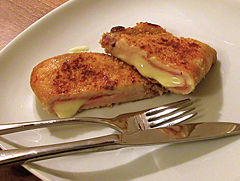
- Cordon bleuChicken Cordon BleuChicken Cordon Bleu is a popular dish of boneless chicken breast pounded and rolled around a pork meat and a soft cheese and then either fried or baked.-History:...
: "Blue ribbon" is a thinly pounded piece of meat stuffed with cheeseCheeseCheese is a generic term for a diverse group of milk-based food products. Cheese is produced throughout the world in wide-ranging flavors, textures, and forms....
and hamHamHam is a cut of meat from the thigh of the hind leg of certain animals, especiallypigs. Nearly all hams sold today are fully cooked or cured.-Etymology:...
. - Valdostana: Very similar to the cordon bleu, but cheese and ham are not inside but on the top, this dish is from an alpine region in Italy, the Val d'Aosta.
- Chicken KievChicken KievChicken Kiev is a popular dish of boneless chicken breast pounded and rolled around cold garlic butter with herbs, then breaded and either fried or baked.-Etymology:...
is unpounded chicken breast rolled around butter and sometimes garlic, then breaded and cooked in a manner similar to Cordon Bleu. - Milanesa Napolitana: This Argentinian variant, also very popular in Uruguay, is made from a beef schnitzel topped with ham, marinara sauce (tomato and garlic) and local mozzarella, then grilled to melt the cheese, usually served with french fries (British - chips).
- Jägerschnitzel: "Hunter's schnitzel", is not breaded, and is served with cream mushroom sauce. (Jägerschnitzel may also refer to an eastern German variant made of JagdwurstJagdwurstJagdwurst is a German cooked sausage made of lean beef and pork, as well as belly of pork, salt, pepper, garlic, mustard seed, capsicum, mace, cardamom and water, which makes the sausage juicy. Part of the meat is very finely minced, but another part retains its structure...
, which originated in the former East Germany.) - Zigeunerschnitzel: "Gypsy schnitzel", served with a tomato sauce containing bell pepperBell pepperBell pepper, also known as sweet pepper or a pepper and capsicum , is a cultivar group of the species Capsicum annuum . Cultivars of the plant produce fruits in different colors, including red, yellow, orange and green. Bell peppers are sometimes grouped with less pungent pepper varieties as...
and onion slices, is also called Paprikaschnitzel (bell pepper schnitzel). - Rahmschnitzel: "Cream schnitzel", served with a sauce based on cream, often contains mushrooms.
- Hamburger Schnitzel: "HamburgHamburg-History:The first historic name for the city was, according to Claudius Ptolemy's reports, Treva.But the city takes its modern name, Hamburg, from the first permanent building on the site, a castle whose construction was ordered by the Emperor Charlemagne in AD 808...
-style schnitzel", is topped with a fried egg. - Holsteiner Schnitzel: "HolsteinHolsteinHolstein is the region between the rivers Elbe and Eider. It is part of Schleswig-Holstein, the northernmost state of Germany....
-style schnitzel", is breaded, and is topped with a fried egg, and usually anchovies and capers. - Naturschnitzel: "Natural (i.e. unbreaded) schnitzel" is not breaded, but sautéed, and served with a simple sauce (e.g., pan drippings, to which sour cream may be added) or none at all.
- ChickenChicken (food)Chicken is the most common type of poultry in the world, and is prepared as food in a wide variety of ways, varying by region and culture.- History :...
schnitzel : Made of chicken breast fillet, it is usually a cheaper alternative to other meats. It is gaining in popularity because it is lower in fat and cholesterolCholesterolCholesterol is a complex isoprenoid. Specifically, it is a waxy steroid of fat that is produced in the liver or intestines. It is used to produce hormones and cell membranes and is transported in the blood plasma of all mammals. It is an essential structural component of mammalian cell membranes...
. The taste of the chicken schnitzel in the natural form (i.e., unbreaded and without a sauce) is milder than that of veal and pork schnitzels. - Turkey schnitzel : Made of fillet of turkey breast, this is very popular in IsraelIsraelThe State of Israel is a parliamentary republic located in the Middle East, along the eastern shore of the Mediterranean Sea...
, where it is often called the national dish. - Vegetarian schnitzel: Made of textured soyTextured vegetable proteinTextured or texturized vegetable protein , also known as textured soy protein , soy meat, or soya meat is a meat analogue or meat extender made from defatted soy flour, a by-product of extracting soybean oil...
, tofuTofuis a food made by coagulating soy milk and then pressing the resulting curds into soft white blocks. It is part of East Asian and Southeast Asian cuisine such as Chinese, Japanese, Korean, Indonesian, Vietnamese, and others. There are many different varieties of tofu, including fresh tofu and tofu...
or seitanWheat gluten (food)Wheat gluten, also called seitan , wheat meat, mock duck, gluten meat, or simply gluten, is a food made from the gluten of wheat...
, the seasoning is both in the meat substitute and in the breadingBreadingBreading is a dry grain-derived food coating for a piece of food such as meat, vegetable, poultry, fish, shellfish, crustacean, seitan, or textured soy, made from breadcrumbs or a breading mixture with seasonings. Breading can also refer to the process of applying a bread-like coating to a food...
so the consistencyDensityThe mass density or density of a material is defined as its mass per unit volume. The symbol most often used for density is ρ . In some cases , density is also defined as its weight per unit volume; although, this quantity is more properly called specific weight...
may differ slightly. - Singapore Hainanese pork chopPork chopA pork chop is a cut of pork cut perpendicularly to the spine of the pig and usually containing a rib or part of a vertebra, served as an individual portion.-Variations:...
: Served in a gravy with tomatoes, potato wedges, onions and peas, it can be enjoyed with steamed rice and chilli sauce. - PiccataPiccataPiccata is an Italian word. It is sometimes wrongly spelled "picatta" or "pichotta." The word "piccato", to which it may be related, may be a translation of the French piqué, past participle of piquer , though it doesn't seem to fit the culinary use of the Italian term which means "to be pounded...
: "Piccata" is breaded meat like schnitzel. - Chicken tenders: They are small pieces of breaded meat similar to schnitzel.
See also
- Austrian cuisineCuisine of AustriaAustrian cuisine is a style of cuisine native to Austria and composed of influences from throughout the former Austro-Hungarian Empire. Regional influences from Italy, Hungary, Germany and the Balkans have had an effect on Austrian cooking, and in turn this fusion of styles was influential...
- Chicken Cordon BleuChicken Cordon BleuChicken Cordon Bleu is a popular dish of boneless chicken breast pounded and rolled around a pork meat and a soft cheese and then either fried or baked.-History:...
- Chicken fried steakChicken fried steakChicken fried steak is a dish consisting of a piece of steak coated with seasoned flour and pan-fried. It is associated with Texas cuisine...
- Chicken KievChicken KievChicken Kiev is a popular dish of boneless chicken breast pounded and rolled around cold garlic butter with herbs, then breaded and either fried or baked.-Etymology:...
- CotolettaCotolettaCotoletta is an Italian word for a breaded veal cutlet....
, the Italian equivalent to schnitzel - Karađorđeva šnicla, similar to cordon bleu
- MilanesaMilanesaThe milanesa is a common meat dish mostly in Argentina, Bolivia, Brazil, Chile, Colombia, Mexico, Panama, Paraguay, Peru, Uruguay, and Venezuela, as well as in other American countries to a lesser extent, where breaded meat fillet preparations are known as a milanesa The milanesa is a common meat...
, breaded meat preparation similar to schnitzel, seen in Spain, Portugal, and Latin America - ParmigianaParmigianaParmigiana is a Southern Italian dish made with a shallow-fried sliced filling, layered with cheese and tomato sauce, then baked. Parmigiana made with a filling of aubergine is the earliest version...
- ParmoParmoParmo or Parmesan, a food dish originating in Middlesbrough, is popular in the North East of England, North Yorkshire and especially in the Teesside area, Hartlepool and Darlington. It typically consists of deep-fried chicken in bread crumbs topped with a white béchamel sauce and cheese...
, a dish invented on TeessideTeessideTeesside is the name given to the conurbation in the north east of England made up of the towns of Middlesbrough, Stockton-on-Tees, Redcar, Billingham and surrounding settlements near the River Tees. It was also the name of a local government district between 1968 and 1974—the County Borough of...
, EnglandEnglandEngland is a country that is part of the United Kingdom. It shares land borders with Scotland to the north and Wales to the west; the Irish Sea is to the north west, the Celtic Sea to the south west, with the North Sea to the east and the English Channel to the south separating it from continental... - TonkatsuTonkatsuTonkatsu , invented in the late 19th century, is a popular dish in Japan. It consists of a breaded, deep-fried pork cutlet one to two centimeters thick and sliced into bite-sized pieces, generally served with shredded cabbage and/or miso soup...
, Japanese style schnitzel made from pork - WienerschnitzelWienerschnitzelWienerschnitzel is an American fast food chain founded in 1961 that specializes in hot dogs, but is currently expanding to other items. Wienerschnitzel locations are found almost exclusively in California and Texas, though others are located in Arizona, Colorado, Illinois, Louisiana, New Mexico,...
, an American fast-food hot dog chain which, despite its name, does not serve schnitzel
External links
- Cooking Wiener Schnitzel in San Francisco - Instructional Cooking Video