

Pampa

Encyclopedia
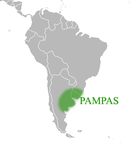
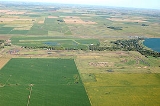
The Pampas are the fertile South America
South America
South America is a continent situated in the Western Hemisphere, mostly in the Southern Hemisphere, with a relatively small portion in the Northern Hemisphere. The continent is also considered a subcontinent of the Americas. It is bordered on the west by the Pacific Ocean and on the north and east...
n lowlands, covering more than 750000 km² (289,577 sq mi), that include the Argentine
Argentina
Argentina , officially the Argentine Republic , is the second largest country in South America by land area, after Brazil. It is constituted as a federation of 23 provinces and an autonomous city, Buenos Aires...
provinces
Provinces of Argentina
Argentina is subdivided into twenty-three provinces and one autonomous city...
of Buenos Aires
Buenos Aires Province
The Province of Buenos Aires is the largest and most populous province of Argentina. It takes the name from the city of Buenos Aires, which used to be the provincial capital until it was federalized in 1880...
, La Pampa
La Pampa Province
La Pampa is a sparsely populated province of Argentina, located in the Pampas in the center of the country. Neighboring provinces are from the north clockwise San Luis, Córdoba, Buenos Aires, Río Negro, Neuquén and Mendoza.-History:...
, Santa Fe, Entre Ríos and Córdoba, most of Uruguay
Uruguay
Uruguay ,officially the Oriental Republic of Uruguay,sometimes the Eastern Republic of Uruguay; ) is a country in the southeastern part of South America. It is home to some 3.5 million people, of whom 1.8 million live in the capital Montevideo and its metropolitan area...
, and the southernmost Brazil
Brazil
Brazil , officially the Federative Republic of Brazil , is the largest country in South America. It is the world's fifth largest country, both by geographical area and by population with over 192 million people...
ian State, Rio Grande do Sul
Rio Grande do Sul
Rio Grande do Sul is the southernmost state in Brazil, and the state with the fifth highest Human Development Index in the country. In this state is located the southernmost city in the country, Chuí, on the border with Uruguay. In the region of Bento Gonçalves and Caxias do Sul, the largest wine...
. These vast plains are only interrupted by the low Ventana and Tandil hills near Bahía Blanca
Bahía Blanca
Bahía Blanca is a city located in the south-west of the province of Buenos Aires, Argentina, by the Atlantic Ocean, and seat of government of Bahía Blanca Partido. It has a population of 274,509 inhabitants according to the...
and Tandil
Tandil
-Place name:The name of the city comes from the Mapuche words tan , and lil . It is probably a reference to the Piedra Movediza , a large boulder which stood seemingly miraculously balanced on the edge of a rocky foothill. The Moving Stone toppled on February 29, 1912, and split into two pieces at...
(Argentina), with a height of 1300 m (4,265 ft) and 500 m (1,640 ft) respectively. The climate is mild, with precipitation
Precipitation (meteorology)
In meteorology, precipitation In meteorology, precipitation In meteorology, precipitation (also known as one of the classes of hydrometeors, which are atmospheric water phenomena is any product of the condensation of atmospheric water vapor that falls under gravity. The main forms of precipitation...
of 600 mm (23.6 in) to 1200 mm (47.2 in), more or less evenly distributed through the year, making the soils appropriate for agriculture
Agriculture
Agriculture is the cultivation of animals, plants, fungi and other life forms for food, fiber, and other products used to sustain life. Agriculture was the key implement in the rise of sedentary human civilization, whereby farming of domesticated species created food surpluses that nurtured the...
. This area is also one of the distinct physiography provinces of the larger Paraná-Paraguay Plain division. These plains contain unique wildlife because of the different terrains around it. Some of this wildlife includes the rhea
Rhea (bird)
The rheas are ratites in the genus Rhea, native to South America. There are two existing species: the Greater or American Rhea and the Lesser or Darwin's Rhea. The genus name was given in 1752 by Paul Möhring and adopted as the English common name. Möhring's reason for choosing this name, from the...
, the pampas deer
Pampas Deer
Pampas deer, Ozotoceros bezoarticus, live in the grasslands of South America at low elevations. They are also known as Venado or Gama. Their habitat includes water and hills, often with winter drought, and grass that is high enough to cover a standing deer...
, several species of armadillos, the pampas fox
Pampas Fox
The Pampas fox , also known as graxaim, sorro, Azara's fox, or Azara's zorro, is a medium sized zorro or "false" fox native to South American pampas and its range is through central South America in Argentina, Uruguay, Paraguay and Brazil...
, the White-eared opossum
White-eared Opossum
The White-eared Opossum is an opossum species from South America. It is found in Argentina, Bolivia, Brazil, Ecuador, Guyana, Paraguay, Peru, Suriname, Uruguay and Venezuela....
, the Elegant Crested Tinamou
Elegant Crested Tinamou
The Elegant Crested Tinamou or Martineta Tinamou, Eudromia elegans, is a medium-sized tinamou that can be found in southern Chile and Argentina in shrubland.-Etymology:...
, and several other species.
Climate
The climate of the Pampas is generally temperate, gradually giving way to a more tropical climateTropical climate
A tropical climate is a climate of the tropics. In the Köppen climate classification it is a non-arid climate in which all twelve months have mean temperatures above...
in the north, and to an arid climate on the west and the south.
Summer temperatures are more uniform than winter temperatures, ranging from 20 °C (68 °F) to 32 °C (89.6 °F) in the north, 17 °C (62.6 °F) to 30 °C (86 °F) in most of the areas, and from 15 °C (59 °F) to 27 °C (80.6 °F) along the Atlantic coast. Extremely hot days might reach over 40ºC/104F.
Fall arrives gradually in March, and peaks in April and May. In April, highs will range from 20 to 25 °C (68 to 77 F) and lows from 9 to 13 °C (48.2 to 55.4 F). The first frosts arrive in mid-April in the south, and in late May or early June in the north.
Winters are generally mild, although cold waves do occur. Normal temperatures range from 12 to 19 °C (53.6 to 66.2 F) during the day, and from 1 to 6 °C (33.8 to 42.8 F) at night. With strong northerly winds, days of over 25 °C (77 °F) can be recorded almost everywhere, whereas during cold waves, high temperatures can be only 6ºC (43F). Frost occurs everywhere in the Pampas, although it is much more frequent in the southwest, and less so around the Parana and Uruguay rivers. Temperatures under −5 C can occur everywhere, whereas values of −10 C or lower are confined to the south and west. Snow never falls in the northernmost third, and is rare and light elsewhere, except for exceptional events where depths have reached 10 cm (4 inches).
Springs are very variable, it is warmer than fall in most areas (especially in the west) but significantly colder along the Atlantic. Violent storms are more common, as well as wide temperature variations: days of 35 °C (95 °F) can give way to nights of under 5 °C (41 °F) or even frost, all within the same week.
Precipitation ranges from 1200 millimetres (47 in) in the northeast, to about 500 millimetres (20 in) in the southern and western edges. In the west, it is highly seasonal, with some places recording averages of 120 millimetres (4.7 in) monthly in the summer, and only 20 millimetre (0.78740157480315 in) monthly in the winter. The eastern areas have small peaks in the fall and in the spring, with relatively rainy summers and winters that are only slightly drier. However, where summer rain falls as short, heavy storms, winter rain falls mostly as cold drizzle, so that the amount of rainy days is fairly constant. Violent thunderstorms are common in the spring and summer, bringing heavy rain, hail, winds and even tornadoes.
Vegetation
Frequent wildfireWildfire
A wildfire is any uncontrolled fire in combustible vegetation that occurs in the countryside or a wilderness area. Other names such as brush fire, bushfire, forest fire, desert fire, grass fire, hill fire, squirrel fire, vegetation fire, veldfire, and wilkjjofire may be used to describe the same...
s ensure that only small plants such as grasses
Poaceae
The Poaceae is a large and nearly ubiquitous family of flowering plants. Members of this family are commonly called grasses, although the term "grass" is also applied to plants that are not in the Poaceae lineage, including the rushes and sedges...
flourish, and tree
Tree
A tree is a perennial woody plant. It is most often defined as a woody plant that has many secondary branches supported clear of the ground on a single main stem or trunk with clear apical dominance. A minimum height specification at maturity is cited by some authors, varying from 3 m to...
s are rare. The dominant vegetation
Vegetation
Vegetation is a general term for the plant life of a region; it refers to the ground cover provided by plants. It is a general term, without specific reference to particular taxa, life forms, structure, spatial extent, or any other specific botanical or geographic characteristics. It is broader...
types are grassy prairie
Prairie
Prairies are considered part of the temperate grasslands, savannas, and shrublands biome by ecologists, based on similar temperate climates, moderate rainfall, and grasses, herbs, and shrubs, rather than trees, as the dominant vegetation type...
and grass steppe
Steppe
In physical geography, steppe is an ecoregion, in the montane grasslands and shrublands and temperate grasslands, savannas, and shrublands biomes, characterized by grassland plains without trees apart from those near rivers and lakes...
in which numerous species of the grass genus Stipa
Stipa
This article is about a type of grass.For Speech Transmission Index for Public Address Systems, see Speech transmission index.For the Italian aircraft designer, see Luigi Stipa...
are particularly conspicuous. "Pampas Grass" (Cortaderia selloana) is an iconic species of the Pampas. Vegetation typically includes perennial grasses and herb
Herb
Except in botanical usage, an herb is "any plant with leaves, seeds, or flowers used for flavoring, food, medicine, or perfume" or "a part of such a plant as used in cooking"...
s. Different strata of grasses occur because of gradients of water availability.
The World Wildlife Fund divides the Pampas into three distinct ecoregions. The Uruguayan Savannah lies east of the Uruguay River
Uruguay River
The Uruguay River is a river in South America. It flows from north to south and makes boundary with Brazil, Argentina, and Uruguay, separating some of the Argentine provinces of the Mesopotamia from the other two countries...
, and includes all of Uruguay and the southern portion of Brazil
Brazil
Brazil , officially the Federative Republic of Brazil , is the largest country in South America. It is the world's fifth largest country, both by geographical area and by population with over 192 million people...
's state of Rio Grande do Sul
Rio Grande do Sul
Rio Grande do Sul is the southernmost state in Brazil, and the state with the fifth highest Human Development Index in the country. In this state is located the southernmost city in the country, Chuí, on the border with Uruguay. In the region of Bento Gonçalves and Caxias do Sul, the largest wine...
. The Humid Pampas include eastern Buenos Aires Province, and southern Entre Ríos Province. The Semi-arid Pampas
Semi-arid Pampas
The Semi-arid Pampas, also known as the Dry Pampas, is a temperate grassland ecoregion of central Argentina.-Setting:The Semi-arid Pampas cover an area of , including western Buenos Aires Province, southern Cordoba and San Luis Provinces and most of La Pampa Province...
includes western Buenos Aires Province and adjacent portions of Santa Fe, Córdoba, and La Pampa provinces. The Pampas are bounded by the drier Argentine espinal grasslands, which form a semicircle around the north, east, and south of the Humid Pampas.
Winters are cool to mild and summers are very warm and humid. Rainfall is fairly uniform throughout the year but is a little heavier during the summer. Annual rainfall is heaviest near the coast and decreases gradually further inland. Rain during the late spring and summer usually arrives in the form of brief heavy showers and thunderstorms. More general rainfall occurs the remainder of the year as cold front
Cold front
A cold front is defined as the leading edge of a cooler mass of air, replacing a warmer mass of air.-Development of cold front:The cooler and denser air wedges under the less-dense warmer air, lifting it...
s and storm systems move through. Although cold spells during the winter often send nighttime temperatures below freezing, snow
Snow
Snow is a form of precipitation within the Earth's atmosphere in the form of crystalline water ice, consisting of a multitude of snowflakes that fall from clouds. Since snow is composed of small ice particles, it is a granular material. It has an open and therefore soft structure, unless packed by...
is quite rare. In most winters, a few light snowfalls occur over inland areas.
Central Argentina boasts a successful agricultural business, with crops grown on the Pampas south and west of Buenos Aires
Buenos Aires
Buenos Aires is the capital and largest city of Argentina, and the second-largest metropolitan area in South America, after São Paulo. It is located on the western shore of the estuary of the Río de la Plata, on the southeastern coast of the South American continent...
. Much of the area is also used for cattle
Cattle
Cattle are the most common type of large domesticated ungulates. They are a prominent modern member of the subfamily Bovinae, are the most widespread species of the genus Bos, and are most commonly classified collectively as Bos primigenius...
and more recently to grow vineyards in the Buenos Aires wine region
Buenos Aires wines
The Buenos Aires Province has become a producer of premium wines during the first decade of the 21st century. Vineyards are located at the southern part of the province, specially around Médanos. The activity was pioneered in lands previously dedicated to garlic and pastures...
. These farming regions (i.e., modified of disturbed Pampas) are particularly susceptible to flooding during heavy rainfall.
See also
- Humid PampaHumid PampaThe Humid Pampa is an extensive region of flat, fertile grassland of loessic origin in Argentina. It has a precipitation average of 900 mm per year, in contrast with the Dry Pampas to the west, which average less than 700 mm.-Setting:...
- Dry PampaSemi-arid PampasThe Semi-arid Pampas, also known as the Dry Pampas, is a temperate grassland ecoregion of central Argentina.-Setting:The Semi-arid Pampas cover an area of , including western Buenos Aires Province, southern Cordoba and San Luis Provinces and most of La Pampa Province...
- Pampas Republic
- GauchoGauchoGaucho is a term commonly used to describe residents of the South American pampas, chacos, or Patagonian grasslands, found principally in parts of Argentina, Uruguay, Southern Chile, and Southern Brazil...
- Médanos wines
- Médanos (dunes)
- EstanciaEstânciaEstância is a municipality located in the Brazilian state of Sergipe. Its population was 62,218 and its area is 642 km². The city is the seat of the Roman Catholic Diocese of Estância....
- Rio Grande do SulRio Grande do SulRio Grande do Sul is the southernmost state in Brazil, and the state with the fifth highest Human Development Index in the country. In this state is located the southernmost city in the country, Chuí, on the border with Uruguay. In the region of Bento Gonçalves and Caxias do Sul, the largest wine...