

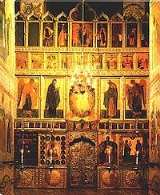
Iconostasis

Encyclopedia
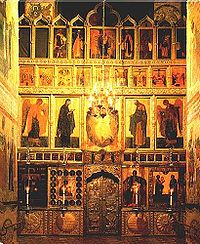
Eastern Christianity
Eastern Christianity comprises the Christian traditions and churches that developed in the Balkans, Eastern Europe, Asia Minor, the Middle East, Northeastern Africa, India and parts of the Far East over several centuries of religious antiquity. The term is generally used in Western Christianity to...
an iconostasis (plural: iconostases) is a wall of icon
Icon
An icon is a religious work of art, most commonly a painting, from Eastern Christianity and in certain Eastern Catholic churches...
s and religious paintings, separating the nave
Nave
In Romanesque and Gothic Christian abbey, cathedral basilica and church architecture, the nave is the central approach to the high altar, the main body of the church. "Nave" was probably suggested by the keel shape of its vaulting...
from the sanctuary
Sanctuary
A sanctuary is any place of safety. They may be categorized into human and non-human .- Religious sanctuary :A religious sanctuary can be a sacred place , or a consecrated area of a church or temple around its tabernacle or altar.- Sanctuary as a sacred place :#Sanctuary as a sacred place:#:In...
in a church. Iconostasis also refers to a portable icon stand that can be placed anywhere within a church. The iconostasis evolved from the Byzantine
Byzantine architecture
Byzantine architecture is the architecture of the Byzantine Empire. The empire gradually emerged as a distinct artistic and cultural entity from what is today referred to as the Roman Empire after AD 330, when the Roman Emperor Constantine moved the capital of the Roman Empire east from Rome to...
templon
Templon
A templon is a feature of Byzantine churches consisting of a barrier separating the nave from the sacraments at the altar....
, a process complete by the fifteenth century.
The word comes from the Greek
Greek language
Greek is an independent branch of the Indo-European family of languages. Native to the southern Balkans, it has the longest documented history of any Indo-European language, spanning 34 centuries of written records. Its writing system has been the Greek alphabet for the majority of its history;...
(eikonostási(-on), still in common use in Greece and Cyprus), which means "icon stand".
Location
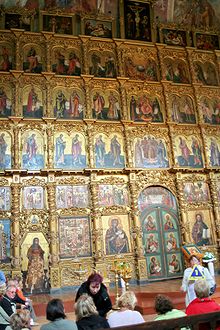
Nave
In Romanesque and Gothic Christian abbey, cathedral basilica and church architecture, the nave is the central approach to the high altar, the main body of the church. "Nave" was probably suggested by the keel shape of its vaulting...
is the main body of the church where most of the worshippers stand, and the sanctuary
Sanctuary
A sanctuary is any place of safety. They may be categorized into human and non-human .- Religious sanctuary :A religious sanctuary can be a sacred place , or a consecrated area of a church or temple around its tabernacle or altar.- Sanctuary as a sacred place :#Sanctuary as a sacred place:#:In...
is the area around the altar
Altar
An altar is any structure upon which offerings such as sacrifices are made for religious purposes. Altars are usually found at shrines, and they can be located in temples, churches and other places of worship...
, east of the nave. The sanctuary is usually one to three steps higher than the nave. The Iconostasis does not sit directly on the edge of the sanctuary, but is usually set a few feet back from the edge of the top step. This forms a walkway in front of the iconostasis for the clergy, called a soleas
Soleas
The soleas is an extension of the sanctuary platform in an Eastern Orthodox temple . The soleas projects beyond the iconostasis, forming a narrow walkway running the full length of the iconostasis....
. In the very center of the soleas is an extension (or thrust
Thrust stage
In theatre, a thrust stage is one that extends into the audience on three sides and is connected to the backstage area by its up stage end. A thrust has the benefit of greater intimacy between performers and the audience than a proscenium, while retaining the utility of a backstage area...
), often rounded, called the ambon
Ambon (liturgy)
The Ambon or Ambo is a projection coming out from the soleas in an Eastern Orthodox, Oriental Orthodox and Eastern Catholic church. The ambon stands directly in front of the Holy Doors...
, on which the deacon will stand to give litanies
Ektenia
Ektenia , often called simply Litany, is a prayerful petition in the Eastern Orthodox/Eastern Catholic liturgy...
during the services.
The iconostasis, though often tall, rarely touches the ceiling. Acoustically
Acoustics
Acoustics is the interdisciplinary science that deals with the study of all mechanical waves in gases, liquids, and solids including vibration, sound, ultrasound and infrasound. A scientist who works in the field of acoustics is an acoustician while someone working in the field of acoustics...
, this permits the ekphoneses (liturgical exclamations) of the clergy to be heard clearly by the faithful. In small, modern churches the iconostasis may be completely absent: in such cases it is replaced by a few small icons on analogia
Analogion
An Analogion is a lectern or slanted stand on which icons or the Gospel Book are placed for veneration by the faithful in the Eastern Orthodox Church and Eastern Catholic Churches...
(lecterns), forming a virtual divide.
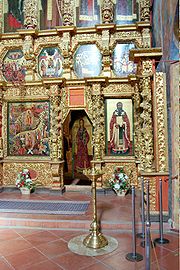
Royal Doors
The royal doors, holy doors, or beautiful gates are the central doors of the iconostasis in an Eastern Orthodox or Greek-Catholic Church....
or Holy Doors in the center, and the North and South Doors to either side. The Beautiful Gates are sometimes called the Royal Doors, but that name more properly belongs to the central doors connecting the narthex
Narthex
The narthex of a church is the entrance or lobby area, located at the end of the nave, at the far end from the church's main altar. Traditionally the narthex was a part of the church building, but was not considered part of the church proper...
, or porch, to the nave
Nave
In Romanesque and Gothic Christian abbey, cathedral basilica and church architecture, the nave is the central approach to the high altar, the main body of the church. "Nave" was probably suggested by the keel shape of its vaulting...
. They remain shut whenever a service is not being held. Modern custom as to when they should be opened during services varies depending upon jurisdiction and local custom.
The North and South Doors are often called Deacons' Doors because the deacon
Deacon
Deacon is a ministry in the Christian Church that is generally associated with service of some kind, but which varies among theological and denominational traditions...
s use them frequently. Icons of sainted deacons are often depicted on these doors (particularly St. Stephen the Protomartyr and St. Ephrem the Syrian
Ephrem the Syrian
Ephrem the Syrian was a Syriac and a prolific Syriac-language hymnographer and theologian of the 4th century. He is venerated by Christians throughout the world, and especially in the Syriac Orthodox Church, as a saint.Ephrem wrote a wide variety of hymns, poems, and sermons in verse, as well as...
). Alternatively, they may be called Angels' Doors, and the Archangel
Archangel
An archangel is an angel of high rank. Archangels are found in a number of religious traditions, including Judaism, Christianity and Islam. Michael and Gabriel are recognized as archangels in Judaism and by most Christians. Michael is the only archangel specifically named in the Protestant Bible...
s Michael
Michael (archangel)
Michael , Micha'el or Mîkhā'ēl; , Mikhaḗl; or Míchaël; , Mīkhā'īl) is an archangel in Jewish, Christian, and Islamic teachings. Roman Catholics, Anglicans, and Lutherans refer to him as Saint Michael the Archangel and also simply as Saint Michael...
and Gabriel
Gabriel
In Abrahamic religions, Gabriel is an Archangel who typically serves as a messenger to humans from God.He first appears in the Book of Daniel, delivering explanations of Daniel's visions. In the Gospel of Luke Gabriel foretells the births of both John the Baptist and of Jesus...
are often depicted there. The South Door is typically the "entrance" door, and Michael is depicted there because he is the "Defender"; the North Door is the "exit", and Gabriel is depicted here because he is the "Messenger" of God. These doors may also be casually referred to as the "side doors".
In many monastery
Monastery
Monastery denotes the building, or complex of buildings, that houses a room reserved for prayer as well as the domestic quarters and workplace of monastics, whether monks or nuns, and whether living in community or alone .Monasteries may vary greatly in size – a small dwelling accommodating only...
churches and chapels (though often not in the Katholikon
Katholikon
A Katholikon or Catholicon is the major temple of a monastery, or diocese in the Eastern Orthodox Church. The name derives from the fact that it is the largest temple where all gather together to celebrate the major feast days of the liturgical year. At other times, the smaller temples or...
, the monastery's main church) one may find iconostases with only two doors: the Holy Doors and the North Door. These churches are used for simpler monastic observances when only a hieromonk
Hieromonk
Hieromonk , also called a Priestmonk, is a monk who is also a priest in the Orthodox Church and Eastern Catholicism....
would be serving alone. Since the priest seldom uses the South Door when he is serving the Divine Liturgy, the chapel can be made smaller by omitting that door.
Placement of Icons
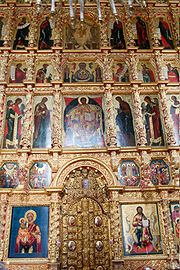
Rubric
A rubric is a word or section of text which is traditionally written or printed in red ink to highlight it. The word derives from the , meaning red ochre or red chalk, and originates in Medieval illuminated manuscripts from the 13th century or earlier...
s govern which icons are on which parts of the iconostasis, although there is some room for variation. In its fullest Slavic development it comprised five tiers of icons:
- The bottom tier is sometimes called Sovereign. On the right side of the Beautiful Gates (from the nave facing forward) is an icon of Christ (often PantokratorChrist PantocratorIn Christian iconography, Christ Pantokrator refers to a specific depiction of Christ. Pantocrator or Pantokrator is a translation of one of many Names of God in Judaism...
), which symbolizes his Second ComingSecond ComingIn Christian doctrine, the Second Coming of Christ, the Second Advent, or the Parousia, is the anticipated return of Jesus Christ from Heaven, where he sits at the Right Hand of God, to Earth. This prophecy is found in the canonical gospels and in most Christian and Islamic eschatologies...
and on the left side is an icon of the TheotokosTheotokosTheotokos is the Greek title of Mary, the mother of Jesus used especially in the Eastern Orthodox, Oriental Orthodox, and Eastern Catholic Churches. Its literal English translations include God-bearer and the one who gives birth to God. Less literal translations include Mother of God...
(Virgin Mary), symbolizing Christ's incarnation, and entrance into this world. Therefore, all things take place between Christ's first and second coming. Other icons on this tier beside those on the doors themselves usually include depictions of the patron saintPatron saintA patron saint is a saint who is regarded as the intercessor and advocate in heaven of a nation, place, craft, activity, class, clan, family, or person...
or feast day to which the church is dedicatedConsecrationConsecration is the solemn dedication to a special purpose or service, usually religious. The word "consecration" literally means "to associate with the sacred". Persons, places, or things can be consecrated, and the term is used in various ways by different groups...
, St. John the Baptist, St. Nicholas, one or more of the Four EvangelistsFour EvangelistsIn Christian tradition the Four Evangelists are Matthew, Mark, Luke, and John, the authors attributed with the creation of the four Gospel accounts in the New Testament that bear the following titles:*Gospel according to Matthew*Gospel according to Mark...
etc. Above this are two interchangeable tiers: the Deisis and the Twelve Great Feasts: - In the center of the Deisis is a large icon of Christ Enthroned. To the left and right are icons of John the Baptist and the Theotokos in attitudes of supplication. They are often flanked by icons of the Archangels MichaelMichael (archangel)Michael , Micha'el or Mîkhā'ēl; , Mikhaḗl; or Míchaël; , Mīkhā'īl) is an archangel in Jewish, Christian, and Islamic teachings. Roman Catholics, Anglicans, and Lutherans refer to him as Saint Michael the Archangel and also simply as Saint Michael...
and GabrielGabrielIn Abrahamic religions, Gabriel is an Archangel who typically serves as a messenger to humans from God.He first appears in the Book of Daniel, delivering explanations of Daniel's visions. In the Gospel of Luke Gabriel foretells the births of both John the Baptist and of Jesus...
, then Sts. PeterSaint PeterSaint Peter or Simon Peter was an early Christian leader, who is featured prominently in the New Testament Gospels and the Acts of the Apostles. The son of John or of Jonah and from the village of Bethsaida in the province of Galilee, his brother Andrew was also an apostle...
and PaulPaul of TarsusPaul the Apostle , also known as Saul of Tarsus, is described in the Christian New Testament as one of the most influential early Christian missionaries, with the writings ascribed to him by the church forming a considerable portion of the New Testament...
, and then any other important Church Fathers that may be desired for inclusion as space allows. - The Feasts tier contains icons of the twelve Great Feasts of the liturgical yearLiturgical yearThe liturgical year, also known as the church year, consists of the cycle of liturgical seasons in Christian churches which determines when feast days, including celebrations of saints, are to be observed, and which portions of Scripture are to be read. Distinct liturgical colours may appear in...
. Above this, the top two tiers are also interchangeable with each other: - The Old TestamentOld TestamentThe Old Testament, of which Christians hold different views, is a Christian term for the religious writings of ancient Israel held sacred and inspired by Christians which overlaps with the 24-book canon of the Masoretic Text of Judaism...
ProphetProphetIn religion, a prophet, from the Greek word προφήτης profitis meaning "foreteller", is an individual who is claimed to have been contacted by the supernatural or the divine, and serves as an intermediary with humanity, delivering this newfound knowledge from the supernatural entity to other people...
s and PatriarchPatriarchs (Bible)The Patriarchs of the Bible, when narrowly defined, are Abraham, the ancestor of all the Abrahamic nations; his son Isaac, the ancestor of the nations surrounding Israel/Judah; and Isaac's son Jacob, also named Israel, the ancestor of the Israelites...
s—the latter including the twelve sons of JacobJacobJacob "heel" or "leg-puller"), also later known as Israel , as described in the Hebrew Bible, the Talmud, the New Testament and the Qur'an was the third patriarch of the Hebrew people with whom God made a covenant, and ancestor of the tribes of Israel, which were named after his descendants.In the...
—often to either side of an icon of Our Lady of the SignOur Lady of the SignThe Icon of Our Lady of the Sign is the term for a particular type of icon of the Theotokos , facing the viewer directly, depicted either full length or half, with her hands raised in the orans position, and with the image of the Child Jesus depicted within a round aureole upon her breast.The icon...
; and - the Twelve Apostles, often to either side of and icon depicting either Christ at the Second Coming or the Holy Trinity.
Occasionally one may find yet more tiers of smaller icons depicting saints of specially fervent local devotion.
It is also not uncommon to find an icon of the Mystical Supper, which depicts the Last Supper, and by extension the Communion of Saints
Communion of Saints
The communion of saints , when referred to persons, is the spiritual union of the members of the Christian Church, living and the dead, those on earth, in heaven, and, for those who believe in purgatory, those also who are in that state of purification.They are all part of a single "mystical body",...
in the Kingdom of God
Kingdom of God
The Kingdom of God or Kingdom of Heaven is a foundational concept in the Abrahamic religions: Judaism, Christianity and Islam.The term "Kingdom of God" is found in all four canonical gospels and in the Pauline epistles...
, somewhere above the Beautiful Gates.
The Sovereign tier is always present, but all the others may be omitted. Preference is given to the Deisis or the Feasts tiers if only some of them can be included. Only the largest and most elaborate iconostases include all five.
Rubrics
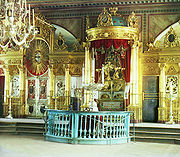
There are rules regarding who may enter or leave the sanctuary (altar), and by which door. Neither the Beautiful Gates (Holy/Tsar doors - central doors)) nor the space between them and the altar table may be used by laity under any circumstances, although infants are either carried into the altar through them in the "churching
Churching of women
In Christian tradition the Churching of Women is the ceremony wherein a blessing is given to mothers after recovery from childbirth. The ceremony includes thanksgiving for the woman's survival of childbirth, and is performed even when the child is stillborn, or has died unbaptized.Although the...
" rite if they are boys, or if they are girls, the infant is simply presented at the doors. Bishop
Bishop
A bishop is an ordained or consecrated member of the Christian clergy who is generally entrusted with a position of authority and oversight. Within the Catholic Church, Eastern Orthodox, Oriental Orthodox Churches, in the Assyrian Church of the East, in the Independent Catholic Churches, and in the...
s may enter through the Beautiful Gates at any time; priest
Priest
A priest is a person authorized to perform the sacred rites of a religion, especially as a mediatory agent between humans and deities. They also have the authority or power to administer religious rites; in particular, rites of sacrifice to, and propitiation of, a deity or deities...
s and deacons may do so only at specific times during the services when the Gates are open (but during Bright Week
Bright Week
Bright Week or Renewal Week is the name used by the Eastern Orthodox Church and Eastern Catholic Churches of the Byzantine Rite for the period of seven days beginning on Pascha and continuing up to the following Sunday, which is known as Thomas Sunday...
they always enter and exit through them). All others enter the sanctuary through the side doors.
In a convent
Convent
A convent is either a community of priests, religious brothers, religious sisters, or nuns, or the building used by the community, particularly in the Roman Catholic Church and in the Anglican Communion...
only the abbess
Abbess
An abbess is the female superior, or mother superior, of a community of nuns, often an abbey....
and elder nuns are permitted to enter the sanctuary(altar), and only by the side doors. The abbess may enter at any time, but the other nuns need a blessing to enter.

Cantor (church)
A cantor is the chief singer employed in a church with responsibilities for the ecclesiastical choir; also called the precentor....
s and choristers, altar server
Altar server
An altar server is a lay assistant to a member of the clergy during a Christian religious service. An altar server attends to supporting tasks at the altar such as fetching and carrying, ringing the altar bell and so on....
s/acolytes, church keeper
Sexton (office)
A sexton is a church, congregation or synagogue officer charged with the maintenance of its buildings and/or the surrounding graveyard. In smaller places of worship, this office is often combined with that of verger...
s and vestrymen
Vestryman
A vestryman is a member of his local church's vestry, or leading body. He is not a member of the clergy.In England especially, but also in other parts of The United Kingdom, Parish Councils have long been a level of local government rather than being solely ecclesiastical in nature...
, etc. Entering the sanctuary for no good reason or without a blessing is forbidden even if no religious service is being held at the time.
In the Romanian tradition
Romanian Orthodox Church
The Romanian Orthodox Church is an autocephalous Eastern Orthodox church. It is in full communion with other Eastern Orthodox churches, and is ranked seventh in order of precedence. The Primate of the church has the title of Patriarch...
, on the day of the consecration
Consecration
Consecration is the solemn dedication to a special purpose or service, usually religious. The word "consecration" literally means "to associate with the sacred". Persons, places, or things can be consecrated, and the term is used in various ways by different groups...
of the altar in the church, the laity, including women, are permitted to enter and venerate the altar up until the beginning of the Vespers
Vespers
Vespers is the evening prayer service in the Western Catholic, Eastern Catholic, and Eastern Orthodox, Anglican, and Lutheran liturgies of the canonical hours...
of Consecration.
These guidelines were developed over the course of many centuries, with both theologically symbolic and practical reasons for them.
Theological implications
The Iconostasis does not really "separate" the nave from the Holy of Holies; rather, it brings them together. The Iconostasis is the link between heaven (the Holy of Holies) and the nave (The Holy Place). Therefore everything is symbolic upon the Iconostasis. The Icons of Christ the Theotokos and various saints and feasts are there because Christ, the Theotokos, the saints etc., lead us and guide us into the Holy of Holies. Therefore the personages on the Icons upon the Iconostasis guide us into heaven, and therefore the Iconostasis connects not separates. The Icons upon the Iconostasis also are windows and bridges into heaven (although all icons, no matter where, are windows and bridges into heaven). Therefore, in a sense the Iconostasis represents Christ, who is the connection, the door, between both realms. The perfect explanation for the Iconostasis, and its uniting purpose, is seen in Hebrews 10:19-20, "Therefore, brethren, since we have confidence to enter the sanctuary by the blood of Jesus, by the new and living way which he opened for us through the curtain, that is through his flesh."Evolution
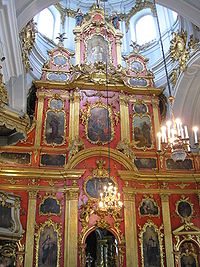
Stoudios
The Monastery of Stoudios, more fully Monastery of Saint John the Forerunner "at Stoudios" The Monastery of Stoudios, more fully Monastery of Saint John the Forerunner "at Stoudios" The Monastery of Stoudios, more fully Monastery of Saint John the Forerunner "at Stoudios" (Greek Μονή του Αγίου...
monastery in Constantinople suggests that the Iconostasis evolved from the early templon
Templon
A templon is a feature of Byzantine churches consisting of a barrier separating the nave from the sacraments at the altar....
. A basilica
Basilica
The Latin word basilica , was originally used to describe a Roman public building, usually located in the forum of a Roman town. Public basilicas began to appear in Hellenistic cities in the 2nd century BC.The term was also applied to buildings used for religious purposes...
dedicated to John the Baptist
John the Baptist
John the Baptist was an itinerant preacher and a major religious figure mentioned in the Canonical gospels. He is described in the Gospel of Luke as a relative of Jesus, who led a movement of baptism at the Jordan River...
was built in 463 AD. In it the chancel
Chancel
In church architecture, the chancel is the space around the altar in the sanctuary at the liturgical east end of a traditional Christian church building...
barrier surrounded the altar in a π shape, with one large door facing the nave and two smaller doors on the other sides. Twelve piers held chancel slabs of about 1.6 meters in length. The height of the slabs is not known. The chancel barrier was not merely a low parapet
Parapet
A parapet is a wall-like barrier at the edge of a roof, terrace, balcony or other structure. Where extending above a roof, it may simply be the portion of an exterior wall that continues above the line of the roof surface, or may be a continuation of a vertical feature beneath the roof such as a...
(a short wall); remains of colonnettes have been found, suggesting that the barrier carried an architrave
Architrave
An architrave is the lintel or beam that rests on the capitals of the columns. It is an architectural element in Classical architecture.-Classical architecture:...
on top of the columns.
In early churches, including the "Great Church" Hagia Sophia
Hagia Sophia
Hagia Sophia is a former Orthodox patriarchal basilica, later a mosque, and now a museum in Istanbul, Turkey...
in Constantinople
Constantinople
Constantinople was the capital of the Roman, Eastern Roman, Byzantine, Latin, and Ottoman Empires. Throughout most of the Middle Ages, Constantinople was Europe's largest and wealthiest city.-Names:...
, the altar, at least in large churches, was under a ciborium
Ciborium (architecture)
In ecclesiastical architecture, a ciborium is a canopy or covering supported by columns, freestanding in the sanctuary, that stands over and covers the altar in a basilica or other church. It may also be known by the more general term of baldachin, though ciborium is often considered more correct...
("ciborion": κιβωριου in Greek), usually a structure with four columns and a domed canopy. This had curtains on rods on all four sides, which were closed for sections of the liturgy, as is still performed in the Coptic and Armenia
Armenia
Armenia , officially the Republic of Armenia , is a landlocked mountainous country in the Caucasus region of Eurasia...
n churches. a comparison with the biblical Veil of the Temple was intended. The small domed structures, usually with red curtains, that are often shown near the writing saint in early Evangelist portrait
Evangelist portrait
Evangelist portraits are a specific type of miniature included in ancient and mediæval illuminated manuscript Gospel Books, and later in Bibles and other books, as well as other media. Each Gospel of the Four Evangelists, the books of Matthew, Mark, Luke, and John, may be prefaced by a portrait of...
s, especially in the East, represent a ciborium, as do the structures surrounding many manuscript portraits of medieval rulers. As the iconostasis grew, the ciborium declined, although some late examples, by now invisible to the congregation, were produced.
The templon gradually replaced all other forms of chancel barriers in Byzantine churches in the 6th, 7th, and 8th centuries except in Cappadocia
Cappadocia
Cappadocia is a historical region in Central Anatolia, largely in Nevşehir Province.In the time of Herodotus, the Cappadocians were reported as occupying the whole region from Mount Taurus to the vicinity of the Euxine...
. Sacred tradition
Sacred Tradition
Sacred Tradition or Holy Tradition is a theological term used in some Christian traditions, primarily in the Roman Catholic, Anglican, Eastern Orthodox and Oriental Orthodox traditions, to refer to the fundamental basis of church authority....
ascribes the invention of the solid iconostasis to Saint Basil the Great.
As late as the 10th century, a simple wooden chancel barrier separated the apse from the nave in the rock-cut churches in Derinkuyu
Derinkuyu
Derinkuyu is a town and district of Nevşehir Province in the Central Anatolia region of Turkey. According to 2010 census, population of the district is 22,114 of which 10,679 live in the town of Derinkuyu. The district covers an area of , and the average elevation is , with the highest point being Mt...
, though by the late 11th century, the templon had become standard. This may have been because of the veneration and imitation of the Great Church Hagia Sophia in Constantinople, though the columnar form of chancel barrier does predate Hagia Sophia.
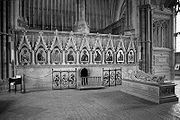
The rood screen
Rood screen
The rood screen is a common feature in late medieval church architecture. It is typically an ornate partition between the chancel and nave, of more or less open tracery constructed of wood, stone, or wrought iron...
s or pulpitum
Pulpitum
The pulpitum is a common feature in medieval cathedral and monastic architecture in Europe. It is a massive screen, most often constructed of stone, or occasionally timber, that divides the choir from the nave and ambulatory The pulpitum is a common feature in medieval cathedral and monastic...
s that most Roman Catholic large churches and cathedrals in many parts of Europe had acquired by late medieval times occupied a similar position between chancel and nave but had a different function. The choir was usually east of the screen. Many survive, often most completely in Scandinavia
Scandinavia
Scandinavia is a cultural, historical and ethno-linguistic region in northern Europe that includes the three kingdoms of Denmark, Norway and Sweden, characterized by their common ethno-cultural heritage and language. Modern Norway and Sweden proper are situated on the Scandinavian Peninsula,...
, and more were built in the Gothic Revival, particularly in Anglican churches in England
England
England is a country that is part of the United Kingdom. It shares land borders with Scotland to the north and Wales to the west; the Irish Sea is to the north west, the Celtic Sea to the south west, with the North Sea to the east and the English Channel to the south separating it from continental...
. In examples in wood painted panels typically only went up to about waist height, with a section with wooden tracery above allowing a view through, and then a large carved beam supporting a rood cross crucifix
Crucifix
A crucifix is an independent image of Jesus on the cross with a representation of Jesus' body, referred to in English as the corpus , as distinct from a cross with no body....
, often life-size, above. Larger churches had stone screens, which might impede virtually all view by the congregation.
Oriental Christianity
The Oriental Orthodox churches which follow non-Byzantine rites differ among themselves about the use of the iconostasis. The ArmenianArmenian Apostolic Church
The Armenian Apostolic Church is the world's oldest National Church, is part of Oriental Orthodoxy, and is one of the most ancient Christian communities. Armenia was the first country to adopt Christianity as its official religion in 301 AD, in establishing this church...
and Syriac
Syriac Christianity
Syriac or Syrian Christianity , the Syriac-speaking Christians of Mesopotamia, comprises multiple Christian traditions of Eastern Christianity. With a history going back to the 1st Century AD, in modern times it is represented by denominations primarily in the Middle East and in Kerala, India....
churches often use a curtain, but not a solid iconostasis. The Coptic and Ethiopian
Ethiopian Orthodox Tewahedo Church
The Ethiopian Orthodox Tewahedo Church is the predominant Oriental Orthodox Christian church in Ethiopia. The Ethiopian Church was administratively part of the Coptic Orthodox Church until 1959, when it was granted its own Patriarch by Coptic Orthodox Pope of Alexandria and Patriarch of All...
churches use an iconostasis often made of latticework, so that it is semi-transparent.
The name in Greek
Greek language
Greek is an independent branch of the Indo-European family of languages. Native to the southern Balkans, it has the longest documented history of any Indo-European language, spanning 34 centuries of written records. Its writing system has been the Greek alphabet for the majority of its history;...
for the Sanctuary is Ἱερόν Βῆμα (Hieron Vema, see Bemah), in Russian
Russian language
Russian is a Slavic language used primarily in Russia, Belarus, Uzbekistan, Kazakhstan, Tajikistan and Kyrgyzstan. It is an unofficial but widely spoken language in Ukraine, Moldova, Latvia, Turkmenistan and Estonia and, to a lesser extent, the other countries that were once constituent republics...
it is called Сватий Олтар (Svatiy Oltar), an in Romanian it is called Sfântul Altar.
The Eastern Orthodox Church
Eastern Orthodox Church
The Orthodox Church, officially called the Orthodox Catholic Church and commonly referred to as the Eastern Orthodox Church, is the second largest Christian denomination in the world, with an estimated 300 million adherents mainly in the countries of Belarus, Bulgaria, Cyprus, Georgia, Greece,...
has received the Tradition
Sacred Tradition
Sacred Tradition or Holy Tradition is a theological term used in some Christian traditions, primarily in the Roman Catholic, Anglican, Eastern Orthodox and Oriental Orthodox traditions, to refer to the fundamental basis of church authority....
of the Holy of Holies in the Temple area. The Holy Table (altar) in an Orthodox church is in a restricted area behind the iconostasis
Iconostasis
In Eastern Christianity an iconostasis is a wall of icons and religious paintings, separating the nave from the sanctuary in a church. Iconostasis also refers to a portable icon stand that can be placed anywhere within a church...
(icon screen). The entire area behind the iconostasis is known as the "Altar
Altar
An altar is any structure upon which offerings such as sacrifices are made for religious purposes. Altars are usually found at shrines, and they can be located in temples, churches and other places of worship...
" or the "Holy Place", and corresponds directly to the Holy of Holies in the Jerusalem Temple.
The iconostasis is usually punctuated by three doors, the middle one being the Holy Doors or Royal Doors (sometimes, in very small chapels, there will only be one side door). There will also be a veil
Veil
A veil is an article of clothing, worn almost exclusively by women, that is intended to cover some part of the head or face.One view is that as a religious item, it is intended to show honor to an object or space...
behind the Holy Doors, usually embroided with the symbol of the Cherubim or a cross. Only Orthodox clergy or those who have permission to do so may enter the holy space behind the iconostasis. Bishops, priests and deacons are allowed to enter the Royal Doors, but only at specific times during the services; and they alone may stand in front of the Holy Table, or touch it. All others are forbidden to touch the Holy Table and must walk round behind it when serving. At the churching
Churching of women
In Christian tradition the Churching of Women is the ceremony wherein a blessing is given to mothers after recovery from childbirth. The ceremony includes thanksgiving for the woman's survival of childbirth, and is performed even when the child is stillborn, or has died unbaptized.Although the...
of Orthodox children when they are 40 days old, if a male child has been baptized he will be brought inside the Sanctuary by the priest; the female child is instead placed in front of the icon
Icon
An icon is a religious work of art, most commonly a painting, from Eastern Christianity and in certain Eastern Catholic churches...
of the Theotokos
Theotokos
Theotokos is the Greek title of Mary, the mother of Jesus used especially in the Eastern Orthodox, Oriental Orthodox, and Eastern Catholic Churches. Its literal English translations include God-bearer and the one who gives birth to God. Less literal translations include Mother of God...
on the iconostasis.
Anyone lower in rank than a deacon must receive a blessing from the priest before he enters the Holy Place. Historically the only exceptions to the rule of non clerical males being forbidden to stand before the Holy Table have been the Russian Tsar
Tsar
Tsar is a title used to designate certain European Slavic monarchs or supreme rulers. As a system of government in the Tsardom of Russia and Russian Empire, it is known as Tsarist autocracy, or Tsarism...
s on the day of their coronation
Coronation
A coronation is a ceremony marking the formal investiture of a monarch and/or their consort with regal power, usually involving the placement of a crown upon their head and the presentation of other items of regalia...
. After his anointing
Anointing
To anoint is to pour or smear with perfumed oil, milk, water, melted butter or other substances, a process employed ritually by many religions. People and things are anointed to symbolize the introduction of a sacramental or divine influence, a holy emanation, spirit, power or God...
, the new Tsar would be escorted through the Holy Doors to a small table set near the Holy Table, and there he would be given Holy Communion by the Metropolitan of Moscow in the same manner as priests. For the most part, women are forbidden to enter the sanctuary, with the exception of elderly nun
Nun
A nun is a woman who has taken vows committing her to live a spiritual life. She may be an ascetic who voluntarily chooses to leave mainstream society and live her life in prayer and contemplation in a monastery or convent...
s who may be blessed to assist the priest during services, and an abbess
Abbess
An abbess is the female superior, or mother superior, of a community of nuns, often an abbey....
in her own monastery
Monastery
Monastery denotes the building, or complex of buildings, that houses a room reserved for prayer as well as the domestic quarters and workplace of monastics, whether monks or nuns, and whether living in community or alone .Monasteries may vary greatly in size – a small dwelling accommodating only...
, who is free to enter at any time. No one, male or female, typically is allowed to enter the sanctuary without good reason.