Altar server

Encyclopedia
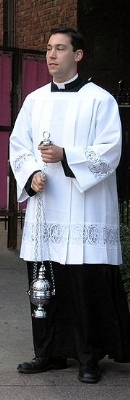
An altar server is a lay
assistant to a member of the clergy
during a Christian
religious service
. An altar server attends to supporting tasks at the altar
such as fetching and carrying, ringing the altar bell and so on.
of Lincoln, Nebraska as well as individual parishes retain the former practice, as do traditionalist Catholic
orders (eg, the FSSP
, the Institute of Christ the King and the SSPX
).
An acolyte
is one of the instituted orders which is installed by a Bishop. The title of acolyte is still only given to men as it is historically a minor order. This term is now usually reserved for the ministry that all who are to be promoted to the diaconate, whether permanent or transitory, must receive at least six months beforehand (Canon 1035 of the Code of Canon Law).
, provided no instituted acolyte
is participating, altar servers have the following responsibilities during
If a bishop celebrates Mass solemnly, two servers, wearing vimpas, hold the mitre
and the crosier
, and present them at the appropriate times.
 In Mass as in the 1962 Roman Missal
, which is an authorized extraordinary form of the Roman Rite
(Mass
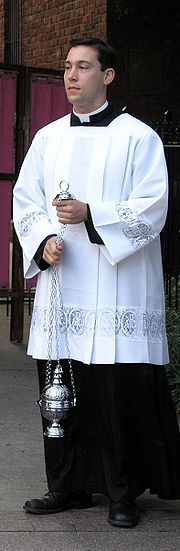
), altar servers have the following responsibilities at Low Mass
and Missa Cantata
.
(with cincture
and amice
unless the form of the alb makes these unnecessary), albs or any other appropriate attire, such as a cassock
and surplice
, may be worn by servers. Black and red are the most common colours for a server's cassock, if used.
, has not given the permission.
 In the Eastern Orthodox Church
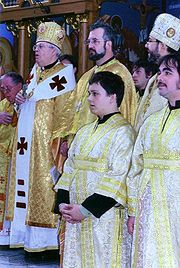
, altar servers assist the higher clergy during services. They might carry the cross, candles or liturgical fans
in processions
and entrances
; maintain the censer
, ensuring it has enough live charcoal, loading it with incense
and handing it to the priest or deacon when required; preparing the hot water (zeon
) in time for it to be added to the chalice
at the Divine Liturgy
; prepare the antidoron
for the people to receive after Holy Communion; and any other necessary tasks so that the celebrant need not be distracted during the service. An altar server is vested in the sticharion
only.
In the early Church, before someone could be a server he had to be tonsured. Nowadays, in many places it is not necessary to be tonsured before one is allowed to serve (since the tonsure must be done by a bishop or higher-ranking priest). The rites of "Setting Aside a Taper-bearer" and "Tonsuring a Reader" have now been combined into one service. It is the custom in some traditions, such as the Greek Orthodox
or Melkite
Catholic, to allow tonsured altar servers to also vest in the orarion
, worn crossed over the back like that of a subdeacon
but with the ends hanging parallel in front. Among the Russians
, however, the orarion is not usually worn by servers, but only by duly ordained subeacons and deacons, with the exception that laymen who are blessed to perform some of the functions of subdeacons may sometimes be blessed to wear the orar.
Before vesting, the server must fold his sticharion and bring it to the priest for him to bless. The priest blesses and lays his hand on the folded sticharion. The server kisses the priest's hand and the Cross on the vestment, and then withdraws to vest. Any server who has not been tonsured must remove the sticharion when he receives Holy Communion, because communicants receive the Mysteries according to their order within the Church (so tonsured clergy vest while laymen remove their vestments). Before divesting at the end of the service, the server must receive the priest's blessing.
The minimum age varies by local circumstance, but boys must be mature enough to carry out their duties without disrupting the sanctity of the altar. Although it is common in North America for boys to act as altar servers, in some places this practice is virtually unknown and these duties are always carried out by adult men. In other places where altar servers are normally boys, adult men will not vest if called upon to serve. In yet other places, boys are not permitted to serve in the Altar on reaching their teens on the grounds that the young man is no longer innocent enough to serve in the altar.
Altar servers, regardless of age, are subject to all the normal restrictions for those not of higher clerical position. Anyone who is bleeding, or has an open sore, is not permitted to enter the altar. They may not touch the altar table or anything on it under any circumstances, nor the prothesis without a blessing. They may not touch the sacred vessels, the chalice and diskos
(paten) at any time. They may not stand directly in front of the altar table or pass between the front of it and the iconostasis
, but must cross between the altar and the High Place
if they need to move to the opposite side.
Women may not serve in the altar except in women's monasteries
. In that case they do not receive the clerical tonsure (though they must be tonsured nun
s), and do not vest in the sticharion, but wear their normal religious habit
for attending services, and serve at a certain distance from the actual altar table. Normally, only older nuns may serve in the altar; but the Hegumen
ia (Abbess
) is permitted to enter even if she is younger.
Churches, and in the Methodist Church, all who serve in the above positions are called acolyte
s.
In Anglo-Catholic and some Episcopal Churches however, the vast majority of roles associated with an altar server are the same as those in the Catholic Church, and the same titles for each individual role are retained from Catholic tradition – mostly restored during the Oxford Movement
in the 19th century.
Laity
In religious organizations, the laity comprises all people who are not in the clergy. A person who is a member of a religious order who is not ordained legitimate clergy is considered as a member of the laity, even though they are members of a religious order .In the past in Christian cultures, the...
assistant to a member of the clergy
Clergy
Clergy is the generic term used to describe the formal religious leadership within a given religion. A clergyman, churchman or cleric is a member of the clergy, especially one who is a priest, preacher, pastor, or other religious professional....
during a Christian
Christianity
Christianity is a monotheistic religion based on the life and teachings of Jesus as presented in canonical gospels and other New Testament writings...
religious service
Church service
In Christianity, a church service is a term used to describe a formalized period of communal worship, often but not exclusively occurring on Sunday, or Saturday in the case of those churches practicing seventh-day Sabbatarianism. The church service is the gathering together of Christians to be...
. An altar server attends to supporting tasks at the altar
Altar
An altar is any structure upon which offerings such as sacrifices are made for religious purposes. Altars are usually found at shrines, and they can be located in temples, churches and other places of worship...
such as fetching and carrying, ringing the altar bell and so on.
Altar servers in the Catholic Church
Formerly, only young men, and seminarians could serve at the altar, until Canon 230 was changed with the promulgation of the Code of Canon Law in 1983 which provided the option for local ordinaries to permit females to serve at the altar. The term altar server is now widely used and accepted due to this. The entire dioceseDiocese
A diocese is the district or see under the supervision of a bishop. It is divided into parishes.An archdiocese is more significant than a diocese. An archdiocese is presided over by an archbishop whose see may have or had importance due to size or historical significance...
of Lincoln, Nebraska as well as individual parishes retain the former practice, as do traditionalist Catholic
Traditionalist Catholic
Traditionalist Catholics are Roman Catholics who believe that there should be a restoration of many or all of the liturgical forms, public and private devotions and presentations of Catholic teachings which prevailed in the Catholic Church before the Second Vatican Council...
orders (eg, the FSSP
Priestly Fraternity of St. Peter
The Priestly Fraternity of St. Peter is a traditionalist Catholic Society of Apostolic Life of priests and seminarians in good standing with the Holy See.-Canonical status:...
, the Institute of Christ the King and the SSPX
SSPX
SSPX may refer to:* Society of St. Pius X* Sustained Spheromak Physics Experiment...
).
An acolyte
Acolyte
In many Christian denominations, an acolyte is anyone who performs ceremonial duties such as lighting altar candles. In other Christian Churches, the term is more specifically used for one who wishes to attain clergyhood.-Etymology:...
is one of the instituted orders which is installed by a Bishop. The title of acolyte is still only given to men as it is historically a minor order. This term is now usually reserved for the ministry that all who are to be promoted to the diaconate, whether permanent or transitory, must receive at least six months beforehand (Canon 1035 of the Code of Canon Law).
Duties at Mass (ordinary form of the Roman Rite)
In the ordinary form of the Roman Rite of the celebration of MassMass (liturgy)
"Mass" is one of the names by which the sacrament of the Eucharist is called in the Roman Catholic Church: others are "Eucharist", the "Lord's Supper", the "Breaking of Bread", the "Eucharistic assembly ", the "memorial of the Lord's Passion and Resurrection", the "Holy Sacrifice", the "Holy and...
, provided no instituted acolyte
Acolyte
In many Christian denominations, an acolyte is anyone who performs ceremonial duties such as lighting altar candles. In other Christian Churches, the term is more specifically used for one who wishes to attain clergyhood.-Etymology:...
is participating, altar servers have the following responsibilities during
- Entrance: Servers are to act as thuriferThuribleA thurible is a metal censer suspended from chains, in which incense is burned during worship services. It is used in the Catholic Church as well as in Anglican, Eastern Orthodox, Oriental Orthodox, Armenian Apostolic, some Lutheran, Old Catholic, and in various Gnostic Churches. It is also used...
with burning incense (if incense is used at the Mass), as bearers of lighted candles flanking another carrying the crossCrossA cross is a geometrical figure consisting of two lines or bars perpendicular to each other, dividing one or two of the lines in half. The lines usually run vertically and horizontally; if they run obliquely, the design is technically termed a saltire, although the arms of a saltire need not meet...
and as other participants in the entrance procession. - Servers hold the liturgical books for the celebrant when he is not at the altar and is proclaiming the presidential prayers with outstretched hands. They bring and hold such things as books, thuribles, water and towel, plates, and microphones.
- Proclamation of the Gospel: At the preceding AlleluiaAlleluiaThe word "Alleluia" or "Hallelujah" , which at its most literal means "Praise Yah", is used in different ways in Christian liturgies....
or other chant, the thurible is presented to the priest for him to put incense in it, and then for the proclamation of the Gospel servers precede the priest or deacon to the ambo, perhaps carrying candles and incense. - Beginning of the Liturgy of the Eucharist: Servers arrange the corporal, the purificator, the chalice, the pall, and the Missal on the altar, and then assist the priest in receiving the bread and wine and perhaps other gifts that are presented to him. They present the cruetCruetA cruet , also called a caster, is a small flat-bottomed vessel with a narrow neck. Cruets often have an integral lip or spout, and may also have a handle. Unlike a small carafe, a cruet has a stopper, lid, or phoedelia...
s of wine and water for the priest or deacon to pour some into the chalice. If incense is used, the thurible and incense are presented to the priest and, at least if there is no deacon, a server then incenses the priest and the people. When the priest then washes his hands standing at the side of the altar, a server pours the water over them. - Consecration: A server rings a bell as a signal to the people shortly before the consecration and, where it is the local custom, rings the bell also when the priest displays the consecrated host and chalice to the people. If incense is used, a server incenses the host and the chalice while these are being shown.
- Sign of Peace: The servers receive the sign of peace from the priest or deacon within the sanctuary.
- Recessional: The servers accompany the priest as at the entrance procession.
If a bishop celebrates Mass solemnly, two servers, wearing vimpas, hold the mitre
Mitre
The mitre , also spelled miter, is a type of headwear now known as the traditional, ceremonial head-dress of bishops and certain abbots in the Roman Catholic Church, as well as in the Anglican Communion, some Lutheran churches, and also bishops and certain other clergy in the Eastern Orthodox...
and the crosier
Crosier
A crosier is the stylized staff of office carried by high-ranking Catholic, Eastern Orthodox, Anglican, and some Lutheran and Pentecostal prelates...
, and present them at the appropriate times.
Duties in the 1962 form
Roman Missal
The Roman Missal is the liturgical book that contains the texts and rubrics for the celebration of the Mass in the Roman Rite of the Catholic Church.-Situation before the Council of Trent:...
, which is an authorized extraordinary form of the Roman Rite
Extraordinary form of the Roman Rite
"An extraordinary form of the Roman Rite" is a phrase used in Pope Benedict XVI's motu proprio Summorum Pontificum to describe the liturgy of the 1962 Roman Missal, widely referred to as the "Tridentine Mass"...
(Mass
Tridentine Mass
The Tridentine Mass is the form of the Roman Rite Mass contained in the typical editions of the Roman Missal that were published from 1570 to 1962. It was the most widely celebrated Mass liturgy in the world until the introduction of the Mass of Paul VI in December 1969...
), altar servers have the following responsibilities at Low Mass
Low Mass
Low Mass is a Tridentine Mass defined officially in the Code of Rubrics included in the 1962 edition of the Roman Missal as Mass in which the priest does not chant the parts that the rubrics assign to him...
and Missa Cantata
Missa Cantata
Missa Cantata is a form of Tridentine Mass defined officially in 1960 as a sung Mass celebrated without sacred ministers, i.e., deacon and subdeacon.Other names in pre-1960 sources:...
.
- Mass of the Catechumens
- Processional: Servers carry the thuribleThuribleA thurible is a metal censer suspended from chains, in which incense is burned during worship services. It is used in the Catholic Church as well as in Anglican, Eastern Orthodox, Oriental Orthodox, Armenian Apostolic, some Lutheran, Old Catholic, and in various Gnostic Churches. It is also used...
, incense boat, processional crossCrossA cross is a geometrical figure consisting of two lines or bars perpendicular to each other, dividing one or two of the lines in half. The lines usually run vertically and horizontally; if they run obliquely, the design is technically termed a saltire, although the arms of a saltire need not meet...
and candles (flambeaux) in a Missa CantataMissa CantataMissa Cantata is a form of Tridentine Mass defined officially in 1960 as a sung Mass celebrated without sacred ministers, i.e., deacon and subdeacon.Other names in pre-1960 sources:...
. - After the sacristy bells are rung and first genuflection at the high altar, the server takes the priest's biretta, kisses it, and places on the Presidential Chair.
- Post-Epistle: Servers move MissalMissalA missal is a liturgical book containing all instructions and texts necessary for the celebration of Mass throughout the year.-History:Before the compilation of such books, several books were used when celebrating Mass...
from EpistleEpistleAn epistle is a writing directed or sent to a person or group of people, usually an elegant and formal didactic letter. The epistle genre of letter-writing was common in ancient Egypt as part of the scribal-school writing curriculum. The letters in the New Testament from Apostles to Christians...
side of the altar to the Gospel side of the altar.
- Processional: Servers carry the thurible
- Mass of the Faithful
- Servers ring the altar bellAltar bellIn the Latin Rite of the Catholic Church, in Lutheranism and Methodism, and in some churches of the Anglican Communion, an altar or sanctus bell is typically a small hand-held bell or set of bells. The primary reason for the use of sanctus/altar bell is to create a joyful noise to the Lord as a...
once as the priest unveils chalice and places veil on altar. - Preparation of the chalice: Servers present the cruets of water and wine for the deacon or priest to pour in the chaliceChalice (cup)A chalice is a goblet or footed cup intended to hold a drink. In general religious terms, it is intended for drinking during a ceremony.-Christian:...
. - Lavabo: A server administers the water to the Priest as he ritually washes his hands.
- Beginning of the Sanctus: Altar bell is rung thrice.
- Canon of Mass: When the priest extends his hands over the chalice, serverds ring altar bell once, stand, take the bell, without genuflecting kneel on either side of the priest.
- Consecration: At each consecration servers make a deep bow at the priest's first genuflection, and ring the bell once. During each major elevation, servers kneel erect, raising the back of the chasubleChasubleThe chasuble is the outermost liturgical vestment worn by clergy for the celebration of the Eucharist in Western-tradition Christian Churches that use full vestments, primarily in the Roman Catholic, Anglican and Lutheran churches, as well as in some parts of the United Methodist Church...
and ringing the bell thrice. During the priest's second genuflection, servers release chasuble, make a deep bow and ring the bell once. After the consecration, holding the bell, servers return to their posts and kneel. - Post Agnus Dei: Servers get patens from credence tableCredence tableA Credence table is a small side table in the sanctuary of a Christian church which is used in the celebration of the Eucharist. Etymology: from latin credens, -entis, believer)....
and go back to posts with genuflections and kneeling. When the priest genuflects and says the triple "Domine, non sum dignus..." servers ring the bell thrice. - Communion: Follow priest with patenPatenA paten, or diskos, is a small plate, usually made of silver or gold, used to hold Eucharistic bread which is to be consecrated. It is generally used during the service itself, while the reserved hosts are stored in the Tabernacle in a ciborium....
in hand and hand over breast for the Communion. - Ablutions: Get the water and wine cruets from credence table. For the first ablution at center of the altar, the server with the wine approaches as the priest tips the chalice toward the server. The server pours a little wine into the chalice, he bows and turns to his right and returns to the EpistleEpistleAn epistle is a writing directed or sent to a person or group of people, usually an elegant and formal didactic letter. The epistle genre of letter-writing was common in ancient Egypt as part of the scribal-school writing curriculum. The letters in the New Testament from Apostles to Christians...
corner and wait for the priest. When the priest approaches for the second ablution, the server makes a moderate bow, pours a little wine over his fingers and then as much water as he desires. Then, with genuflections, switch the chalice veil from the Gospel side to the Epistle side with the Missal at the same time. - Ending procession: Same as Processional.
- Servers ring the altar bell
Vestments
While ordained and instituted ministers must wear an albAlb
The alb , one of the liturgical vestments of the Roman Catholic, Anglican and many Protestant churches, is an ample white garment coming down to the ankles and usually girdled with a cincture. It is simply the long linen tunic used by the Romans...
(with cincture
Cincture
The cincture is a liturgical vestment, worn encircling the body around or above the waist. The term has two distinct meanings, the usage generally dividing along denominational lines...
and amice
Amice
The amice is a liturgical vestment used mainly in the Roman Catholic Church, Lutheran Church, in some Anglican churches, Armenian and Polish National Catholic churches. It consists of a white cloth connected to two long ribbon-like attachments, by which it is fastened around the shoulders of the...
unless the form of the alb makes these unnecessary), albs or any other appropriate attire, such as a cassock
Cassock
The cassock, an item of clerical clothing, is an ankle-length robe worn by clerics of the Roman Catholic Church, Eastern Orthodox Church, Anglican Church, Lutheran Church and some ministers and ordained officers of Presbyterian and Reformed churches. Ankle-length garment is the meaning of the...
and surplice
Surplice
A surplice is a liturgical vestment of the Western Christian Church...
, may be worn by servers. Black and red are the most common colours for a server's cassock, if used.
Female altar servers
Although not the norm in the Catholic Church, female altar servers, also called altar girls, are now allowed provided that the diocesan bishop and the parish priest or rector ecclesiae allows the practice. In the U.S. currently only one Roman Catholic diocese, the Diocese of Lincoln, NebraskaRoman Catholic Diocese of Lincoln
The Roman Catholic Diocese of Lincoln is a Roman Catholic diocese in Nebraska, and comprises the majority of the eastern and central portions of the state south of the Platte River. The episcopal see is in Lincoln, Nebraska. It was established on August 2, 1887, by Pope Leo XIII...
, has not given the permission.
Eastern Orthodox and Eastern Catholic Churches
Eastern Orthodox Church
The Orthodox Church, officially called the Orthodox Catholic Church and commonly referred to as the Eastern Orthodox Church, is the second largest Christian denomination in the world, with an estimated 300 million adherents mainly in the countries of Belarus, Bulgaria, Cyprus, Georgia, Greece,...
, altar servers assist the higher clergy during services. They might carry the cross, candles or liturgical fans
Flabellum
A flabellum , in Catholic liturgical use, is a fan made of metal, leather, silk, parchment or feathers, intended to keep away insects from the consecrated Body and Blood of Christ and from the priest, as well as to show honour. The ceremonial use of such fans dates back to ancient Egypt, and an...
in processions
Crucession
A Crucession, or Cross Procession , is a procession that takes place in the Eastern Orthodox and Eastern Catholic liturgical traditions. The name derives from the fact that the procession is headed by a cross....
and entrances
Entrance (Liturgical)
In Eastern Orthodoxy, an entrance is a procession during which the clergy enter into the sanctuary through the Holy Doors. The origin of these entrances goes back to the early church, when the liturgical books and sacred vessels were kept in special storage rooms for safe keeping and the procession...
; maintain the censer
Thurible
A thurible is a metal censer suspended from chains, in which incense is burned during worship services. It is used in the Catholic Church as well as in Anglican, Eastern Orthodox, Oriental Orthodox, Armenian Apostolic, some Lutheran, Old Catholic, and in various Gnostic Churches. It is also used...
, ensuring it has enough live charcoal, loading it with incense
Incense
Incense is composed of aromatic biotic materials, which release fragrant smoke when burned. The term "incense" refers to the substance itself, rather than to the odor that it produces. It is used in religious ceremonies, ritual purification, aromatherapy, meditation, for creating a mood, and for...
and handing it to the priest or deacon when required; preparing the hot water (zeon
Zeon (liturgy)
Zeon is a liturgical action which takes place in the Divine Liturgy of the Rite of Constantinople, during which hot water is added to the chalice. The same term is used as a noun to describe the vessel used for this purpose....
) in time for it to be added to the chalice
Chalice (cup)
A chalice is a goblet or footed cup intended to hold a drink. In general religious terms, it is intended for drinking during a ceremony.-Christian:...
at the Divine Liturgy
Divine Liturgy
Divine Liturgy is the common term for the Eucharistic service of the Byzantine tradition of Christian liturgy. As such, it is used in the Eastern Orthodox and Eastern Catholic Churches. Armenian Christians, both of the Armenian Apostolic Church and of the Armenian Catholic Church, use the same term...
; prepare the antidoron
Antidoron
The Antidoron is ordinary leavened bread which is blessed but not consecrated and distributed in Eastern Orthodox Churches and less often in Eastern Catholic Churches that use the Byzantine Rite...
for the people to receive after Holy Communion; and any other necessary tasks so that the celebrant need not be distracted during the service. An altar server is vested in the sticharion
Sticharion
The sticharion is a liturgical vestment of the Eastern Orthodox and Eastern Catholic Churches, roughly analogous in function to the alb of the Western Church...
only.
In the early Church, before someone could be a server he had to be tonsured. Nowadays, in many places it is not necessary to be tonsured before one is allowed to serve (since the tonsure must be done by a bishop or higher-ranking priest). The rites of "Setting Aside a Taper-bearer" and "Tonsuring a Reader" have now been combined into one service. It is the custom in some traditions, such as the Greek Orthodox
Greek Orthodox Church
The Greek Orthodox Church is the body of several churches within the larger communion of Eastern Orthodox Christianity sharing a common cultural tradition whose liturgy is also traditionally conducted in Koine Greek, the original language of the New Testament...
or Melkite
Melkite
The term Melkite, also written Melchite, refers to various Byzantine Rite Christian churches and their members originating in the Middle East. The word comes from the Syriac word malkāyā , and the Arabic word Malakī...
Catholic, to allow tonsured altar servers to also vest in the orarion
Orarion
The Orarion is the distinguishing vestment of the deacon and subdeacon in the Eastern Orthodox Church and Eastern Catholic Churches. It is a narrow stole, usually four to five inches wide and of various lengths, made of brocade, often decorated with crosses embroidered or appliquéd along its...
, worn crossed over the back like that of a subdeacon
Subdeacon
-Subdeacons in the Orthodox Church:A subdeacon or hypodeacon is the highest of the minor orders of clergy in the Orthodox Church. This order is higher than the reader and lower than the deacon.-Canonical Discipline:...
but with the ends hanging parallel in front. Among the Russians
Russian Orthodox Church
The Russian Orthodox Church or, alternatively, the Moscow Patriarchate The ROC is often said to be the largest of the Eastern Orthodox churches in the world; including all the autocephalous churches under its umbrella, its adherents number over 150 million worldwide—about half of the 300 million...
, however, the orarion is not usually worn by servers, but only by duly ordained subeacons and deacons, with the exception that laymen who are blessed to perform some of the functions of subdeacons may sometimes be blessed to wear the orar.
Before vesting, the server must fold his sticharion and bring it to the priest for him to bless. The priest blesses and lays his hand on the folded sticharion. The server kisses the priest's hand and the Cross on the vestment, and then withdraws to vest. Any server who has not been tonsured must remove the sticharion when he receives Holy Communion, because communicants receive the Mysteries according to their order within the Church (so tonsured clergy vest while laymen remove their vestments). Before divesting at the end of the service, the server must receive the priest's blessing.
The minimum age varies by local circumstance, but boys must be mature enough to carry out their duties without disrupting the sanctity of the altar. Although it is common in North America for boys to act as altar servers, in some places this practice is virtually unknown and these duties are always carried out by adult men. In other places where altar servers are normally boys, adult men will not vest if called upon to serve. In yet other places, boys are not permitted to serve in the Altar on reaching their teens on the grounds that the young man is no longer innocent enough to serve in the altar.
Altar servers, regardless of age, are subject to all the normal restrictions for those not of higher clerical position. Anyone who is bleeding, or has an open sore, is not permitted to enter the altar. They may not touch the altar table or anything on it under any circumstances, nor the prothesis without a blessing. They may not touch the sacred vessels, the chalice and diskos
Paten
A paten, or diskos, is a small plate, usually made of silver or gold, used to hold Eucharistic bread which is to be consecrated. It is generally used during the service itself, while the reserved hosts are stored in the Tabernacle in a ciborium....
(paten) at any time. They may not stand directly in front of the altar table or pass between the front of it and the iconostasis
Iconostasis
In Eastern Christianity an iconostasis is a wall of icons and religious paintings, separating the nave from the sanctuary in a church. Iconostasis also refers to a portable icon stand that can be placed anywhere within a church...
, but must cross between the altar and the High Place
High place
High Place, in the English version of the Old Testament, the literal translation of the Hebrew במה .This rendering is etymologically correct, as appears from the poetical use of the plural in such expressions as to ride, or stalk, or stand on the high places of the earth, the sea, the clouds, and...
if they need to move to the opposite side.
Women may not serve in the altar except in women's monasteries
Monastery
Monastery denotes the building, or complex of buildings, that houses a room reserved for prayer as well as the domestic quarters and workplace of monastics, whether monks or nuns, and whether living in community or alone .Monasteries may vary greatly in size – a small dwelling accommodating only...
. In that case they do not receive the clerical tonsure (though they must be tonsured nun
Nun
A nun is a woman who has taken vows committing her to live a spiritual life. She may be an ascetic who voluntarily chooses to leave mainstream society and live her life in prayer and contemplation in a monastery or convent...
s), and do not vest in the sticharion, but wear their normal religious habit
Religious habit
A religious habit is a distinctive set of garments worn by members of a religious order. Traditionally some plain garb recognisable as a religious habit has also been worn by those leading the religious eremitic and anachoritic life, although in their case without conformity to a particular uniform...
for attending services, and serve at a certain distance from the actual altar table. Normally, only older nuns may serve in the altar; but the Hegumen
Hegumen
Hegumen, hegumenos, igumen, or ihumen is the title for the head of a monastery of the Eastern Orthodox Church or Eastern Catholic Churches, similar to the one of abbot. The head of a convent of nuns is called hegumenia or ihumenia . The term means "the one who is in charge", "the leader" in...
ia (Abbess
Abbess
An abbess is the female superior, or mother superior, of a community of nuns, often an abbey....
) is permitted to enter even if she is younger.
Other churches
In lower Anglican churches, most LutheranLutheranism
Lutheranism is a major branch of Western Christianity that identifies with the theology of Martin Luther, a German reformer. Luther's efforts to reform the theology and practice of the church launched the Protestant Reformation...
Churches, and in the Methodist Church, all who serve in the above positions are called acolyte
Acolyte
In many Christian denominations, an acolyte is anyone who performs ceremonial duties such as lighting altar candles. In other Christian Churches, the term is more specifically used for one who wishes to attain clergyhood.-Etymology:...
s.
In Anglo-Catholic and some Episcopal Churches however, the vast majority of roles associated with an altar server are the same as those in the Catholic Church, and the same titles for each individual role are retained from Catholic tradition – mostly restored during the Oxford Movement
Oxford Movement
The Oxford Movement was a movement of High Church Anglicans, eventually developing into Anglo-Catholicism. The movement, whose members were often associated with the University of Oxford, argued for the reinstatement of lost Christian traditions of faith and their inclusion into Anglican liturgy...
in the 19th century.
External links
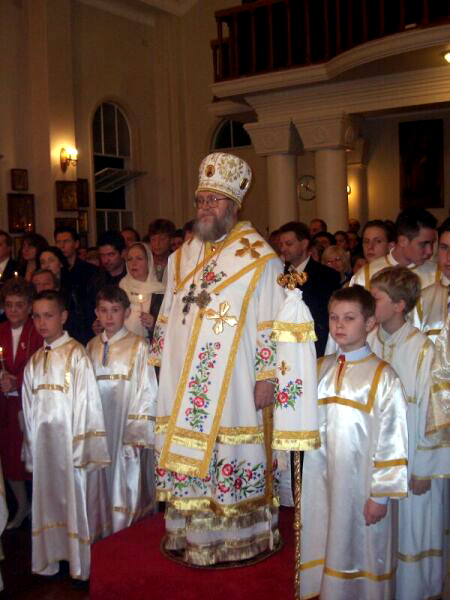
- Photo of Russian Orthodox bishop surrounded by servers
- http://classic-web.archive.org/web/20071030003448/http://www.theimproper.com/Template_Article.aspx?IssueId=3&ArticleId=1116 Confessions of an Altarboy -Article by Matt Kindelmann
- SanctaMissa.org's Online Altar Server Tutorial with Video and Guides (1962 Roman Missal)
- Altar Server Guide
- Parent's Training Manual for Altar Servers Gives parents tips on how to prepare their children for serving at the altar
- Another Altar Server Manual
- Official Website of the Ministry of Altar Servers San Roque Cathedral, Diocese of Caloocan, Philippines
- Official Website of the Ministry of Altar Servers of Sto. Niño Parish, Taguig City, Philippines