


Evangelist portrait

Encyclopedia
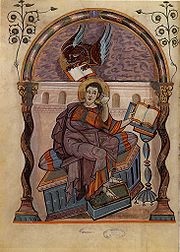
Miniature (illuminated manuscript)
The word miniature, derived from the Latin minium, red lead, is a picture in an ancient or medieval illuminated manuscript; the simple decoration of the early codices having been miniated or delineated with that pigment...
included in ancient and mediæval illuminated manuscript
Illuminated manuscript
An illuminated manuscript is a manuscript in which the text is supplemented by the addition of decoration, such as decorated initials, borders and miniature illustrations...
Gospel Book
Gospel Book
The Gospel Book, Evangelion, or Book of the Gospels is a codex or bound volume containing one or more of the four Gospels of the Christian New Testament...
s, and later in Bible
Bible
The Bible refers to any one of the collections of the primary religious texts of Judaism and Christianity. There is no common version of the Bible, as the individual books , their contents and their order vary among denominations...
s and other books, as well as other media. Each Gospel
Gospel
A gospel is an account, often written, that describes the life of Jesus of Nazareth. In a more general sense the term "gospel" may refer to the good news message of the New Testament. It is primarily used in reference to the four canonical gospels of Matthew, Mark, Luke, and John...
of the Four Evangelists
Four Evangelists
In Christian tradition the Four Evangelists are Matthew, Mark, Luke, and John, the authors attributed with the creation of the four Gospel accounts in the New Testament that bear the following titles:*Gospel according to Matthew*Gospel according to Mark...
, the books of Matthew
Gospel of Matthew
The Gospel According to Matthew is one of the four canonical gospels, one of the three synoptic gospels, and the first book of the New Testament. It tells of the life, ministry, death, and resurrection of Jesus of Nazareth...
, Mark
Gospel of Mark
The Gospel According to Mark , commonly shortened to the Gospel of Mark or simply Mark, is the second book of the New Testament. This canonical account of the life of Jesus of Nazareth is one of the three synoptic gospels. It was thought to be an epitome, which accounts for its place as the second...
, Luke
Gospel of Luke
The Gospel According to Luke , commonly shortened to the Gospel of Luke or simply Luke, is the third and longest of the four canonical Gospels. This synoptic gospel is an account of the life and ministry of Jesus of Nazareth. It details his story from the events of his birth to his Ascension.The...
, and John
Gospel of John
The Gospel According to John , commonly referred to as the Gospel of John or simply John, and often referred to in New Testament scholarship as the Fourth Gospel, is an account of the public ministry of Jesus...
, may be prefaced by a portrait of the Evangelist, usually occupying a full page. Their symbols may be shown with them, or separately. Often this is the only figurative illumination
Miniature (illuminated manuscript)
The word miniature, derived from the Latin minium, red lead, is a picture in an ancient or medieval illuminated manuscript; the simple decoration of the early codices having been miniated or delineated with that pigment...
in the manuscript. They are a common feature in larger Gospel Books from the earliest examples in the 7th century until the decline of that format for illustrated books in the High Middle Ages, by which time their conventions were being used for portraits of other authors.
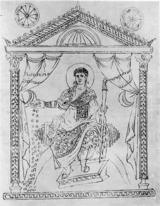
Author portraits
They originate in the classical secular tradition of the author portrait, which was often the only illustration in a classical manuscript, also used as a frontispieceBook frontispiece
A frontispiece is a decorative illustration facing a book's title page. The frontispiece is the verso opposite the recto title page. Elaborate engraved frontispieces were in frequent use, especially in Bibles and in scholarly books, and many are masterpieces of engraving...
(not unlike the contemporary author photo, though this is usually shown on the back cover or wrapper). A very few examples of Late Antique secular author portraits survive, and rather more later copies. Some examples also draw on the conventions of the Late Antique consular portrait, much used for the Emperors, who were also consul
Consul
Consul was the highest elected office of the Roman Republic and an appointive office under the Empire. The title was also used in other city states and also revived in modern states, notably in the First French Republic...
s. Examples of these, copied from the original, can be seen in the Chronography of 354
Chronography of 354
The Chronography of 354, also known as the Calendar of 354, was a 4th century illuminated manuscript, which was produced in 354 AD for a wealthy Roman Christian named Valentinus. It is the earliest dated codex to have full page illustrations. None of the original has survived...
(see also the Missorium of Theodosius I
Missorium of Theodosius I
The Missorium of Theodosius I is a large ceremonial silver dish preserved in the Real Academia de la Historia, in Madrid, Spain. It was probably made in Constantinople for the tenth anniversary in 388 of the reign of the Emperor Theodosius I, the last Emperor to rule both the Eastern and Western...
of 30 years later). The Evangelist may be holding a book, but is not writing in it, and he faces the front on a large throne, surrounded by an elaborate frame, usually domed or pedimented. These frameworks are thought to draw from the style of the Scaenae frons
Scaenae frons
The scaenae frons is the elaborately decorated background of a Roman theatre stage. This area usually has several entrances to the stage including a grand central entrance. The scaenae frons is two or sometime three stories in height and was central to the theatre's visual impact for this was what...
, or elaborate proscenium
Proscenium
A proscenium theatre is a theatre space whose primary feature is a large frame or arch , which is located at or near the front of the stage...
structures of Roman theatre
Roman theatre
Roman theatre may refer to:*Theatre of ancient Rome, the theatrical styles of Ancient Rome*Roman theatre , the theatre buildings of Ancient Rome...
s.
The Evangelists' symbols
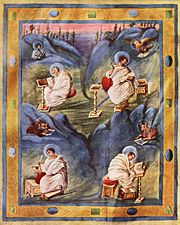
Insular art
Insular art, also known as Hiberno-Saxon art, is the style of art produced in the post-Roman history of Ireland and Great Britain. The term derives from insula, the Latin term for "island"; in this period Britain and Ireland shared a largely common style different from that of the rest of Europe...
tradition, either given their own additional images on a separate page, or used instead of an evangelist portrait. The symbols are: the Lion
Lion
The lion is one of the four big cats in the genus Panthera, and a member of the family Felidae. With some males exceeding 250 kg in weight, it is the second-largest living cat after the tiger...
of Mark, the Eagle
Eagle
Eagles are members of the bird family Accipitridae, and belong to several genera which are not necessarily closely related to each other. Most of the more than 60 species occur in Eurasia and Africa. Outside this area, just two species can be found in the United States and Canada, nine more in...
of John, the Ox
Ox
An ox , also known as a bullock in Australia, New Zealand and India, is a bovine trained as a draft animal. Oxen are commonly castrated adult male cattle; castration makes the animals more tractable...
or Calf
Calf
Calves are the young of domestic cattle. Calves are reared to become adult cattle, or are slaughtered for their meat, called veal.-Terminology:...
of Luke and the Angel
Angel
Angels are mythical beings often depicted as messengers of God in the Hebrew and Christian Bibles along with the Quran. The English word angel is derived from the Greek ἄγγελος, a translation of in the Hebrew Bible ; a similar term, ملائكة , is used in the Qur'an...
or Man of Matthew. Often all are shown with wings, as in the familiar winged lion used in the coat of arms of Venice
Venice
Venice is a city in northern Italy which is renowned for the beauty of its setting, its architecture and its artworks. It is the capital of the Veneto region...
, whose patron saint
Patron saint
A patron saint is a saint who is regarded as the intercessor and advocate in heaven of a nation, place, craft, activity, class, clan, family, or person...
was Mark. Sometimes, as in the example from Lorsch, the symbols are shown dictating the text to the evangelist.
Depictions and other media
Late Antique evangelist portraits often show standing figures, as in the ivory panels of the Throne of MaximianusMaximianus of Ravenna
Maximianus of Ravenna, or Maximian was bishop of Ravenna.Born in the Istrian city of Pula , Maximianus was consecrated bishop of Ravenna in 546 by Pope Vigilius in Patras, Greece. Maximianus was a forty-eight year old deacon from Pola when he became the twenty-sixth bishop of Ravenna...
in Milan
Milan
Milan is the second-largest city in Italy and the capital city of the region of Lombardy and of the province of Milan. The city proper has a population of about 1.3 million, while its urban area, roughly coinciding with its administrative province and the bordering Province of Monza and Brianza ,...
, but from the Insular art
Insular art
Insular art, also known as Hiberno-Saxon art, is the style of art produced in the post-Roman history of Ireland and Great Britain. The term derives from insula, the Latin term for "island"; in this period Britain and Ireland shared a largely common style different from that of the rest of Europe...
of the 7th to 10th centuries, evangelist portraits in manuscripts nearly always closely followed the seated classical models, showing the Evangelists at full-length, either looking out at the viewer or writing at a table or desk and seen at an oblique angle. These were derived from unknown classical prototypes, similar to those in the Codex Amiatinus
Codex Amiatinus
The Codex Amiatinus, designated by siglum A, is the earliest surviving manuscript of the nearly complete Bible in the Latin Vulgate version, and is considered to be the most accurate copy of St. Jerome's text. It is missing the Book of Baruch. It was produced in the Anglo-Saxon kingdom of...
and Saint Augustine Gospels, though both of these types are rather different from the general types. Usually a setting is provided for the figure. Details of the classical models, such as anachronistic scroll
Scroll
A scroll is a roll of parchment, papyrus, or paper, which has been drawn or written upon.Scroll may also refer to:*Scroll , the decoratively curved end of the pegbox of string instruments such as violins...
s and scroll-boxes, and a small writing-stand with a single dolphin-shaped support (see gallery below), survive well into the Middle Ages, sometimes clearly misunderstood by the artists concerned. Perhaps because of the secular origins of the typology, haloes
Halo (religious iconography)
A halo is a ring of light that surrounds a person in art. They have been used in the iconography of many religions to indicate holy or sacred figures, and have at various periods also been used in images of rulers or heroes...
are less likely to be worn than in other types of image. The level of detail shown in the furniture and fittings is unusual for Early Medieval art. An arch behind the author, often with curtains hanging across it, in some examples close to the classical models, gradually is turned into a decorative framing device for the whole scene.
Early Gospel Books often had a very elaborate and costly cover in metalwork, often with jewels and ivories. These most often featured a central panel with Christ in Majesty
Christ in Majesty
Christ in Majesty, or Christ in Glory, in Latin Majestas Domini, is the Western Christian image of Christ seated on a throne as ruler of the world, always seen frontally in the centre of the composition, and often flanked by other sacred figures, whose membership changes over time and according to...
, often including the Evangelists and/or their symbols in the corners. Versions of the same composition appear in all media used for Early Medieval religious art, including wall paintings. The Tassilo Chalice
Tassilo Chalice
The Tassilo Chalice is a bronze chalice, gilded with silver and gold, dating from the 8th century. The chalice is of Anglo-Saxon design, and has probably been at Kremsmünster Abbey, Austria since shortly after it was made.- History :Dating from c...
is an 8th century example of pure metalwork with five oval medallion portraits of Christ and the Evangelists (with symbols) round the cup.
Insular variants and decline
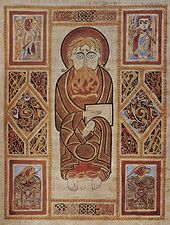
Christ in Majesty
Christ in Majesty, or Christ in Glory, in Latin Majestas Domini, is the Western Christian image of Christ seated on a throne as ruler of the world, always seen frontally in the centre of the composition, and often flanked by other sacred figures, whose membership changes over time and according to...
. Standing portraits were usual, however, for wall and later panel paintings (and in the Tree of Jesse
Tree of Jesse
The Tree of Jesse is a depiction in art of the Ancestors of Christ, shown in a tree which rises from Jesse of Bethlehem, the father of King David; the original use of the family tree as a schematic representation of a genealogy...
composition) with the Evangelists often treated as, and mixed with, other saints.
The Gospel book as a medium for heavily illustrated manuscripts declined in the West from the Romanesque period, and with it the use of the Evangelist portrait. In the Eastern Orthodox world, the Gospel Book remained a primary focus for illumination, and Evangelist portraits, derived from contemporary Byzantine versions, are heavily represented among the earliest illuminations from the new Slav national traditions, such as the 11th century Ostromir Gospels and the Khitrovo Gospels
Khitrovo Gospels
The Khitrovo Gospels is a Russian illuminated Gospel Book from the late 14th or early 15th century. The book has numerous similarities to the Koshka Gospels, Kiev Psalter of 1397, and other East Slavic manuscripts of the 1390s....
of about 1390 from Muscovy. In the West the portraits continued to be found in Bibles, more often as the picture within a historiated initial
Historiated initial
A historiated initial is an enlarged letter at the beginning of a paragraph or other section of text, which contains a picture. Strictly speaking, an inhabited initial contains figures that are decorative only, without forming a subject, whereas in a historiated initial there is an identifiable...
at the start of each Gospel. Other books sometimes contained them as well. Similar compositions began to be used for other saint-authors, especially for St Jerome
Jerome
Saint Jerome was a Roman Christian priest, confessor, theologian and historian, and who became a Doctor of the Church. He was the son of Eusebius, of the city of Stridon, which was on the border of Dalmatia and Pannonia...
, who is often shown in a book-lined study, often with his symbol, a lion, dozing at his feet. Similarly St Gregory the Great may be shown with a dove, representing his inspiration from the Holy Spirit, whispering in his ear.