


Veil

Encyclopedia
A veil is an article of clothing, worn almost exclusively by women, that is intended to cover some part of the head
or face
.
One view is that as a religious item, it is intended to show honor to an object or space. The actual sociocultural, psychological, and sociosexual functions of veils have not been studied extensively but most likely include the maintenance of social distance and the communication of social status and cultural identity. In Islamic society, various forms of the veil have been adopted from the Arab culture in which Islam arose.
n legal text from the 13th century BC, which restricted its use to noble women and forbade prostitutes and common women from adopting it. The Mycenaean Greek
term a-pu-ko-wo-ko meaning "craftsman of horse veil" written in Linear B
syllabic script is also attested since ca. 1300 BC. Ancient Greek texts have also spoken of veiling and seclusion of women
being practiced among the Persian elite. Statues from Persepolis
depict women both veiled and unveiled.
Classical Greek and Hellenistic statues sometimes depict Greek women with both their head and face covered by a veil. Caroline Galt and Lloyd Llewellyn-Jones have both argued from such representations and literary references that it was commonplace for women (at least those of higher status) in ancient Greece to cover their hair and face in public.
For many centuries, until around 1175, Anglo-Saxon
and then Anglo-Norman
women, with the exception of young unmarried girls, wore veils that entirely covered their hair, and often their necks up to their chins (see wimple
). Only in the Tudor period
(1485), when hood
s became increasingly popular, did veils of this type become less common.
For centuries, women have worn sheer veils, but only under certain circumstances. Sometimes a veil of this type was draped over and pinned to the bonnet
or hat of a woman in mourning
, especially at the funeral
and during the subsequent period of "high mourning". They would also have been used, as an alternative to a mask
, as a simple method of hiding the identity of a woman who was traveling to meet a lover, or doing anything she didn't want other people to find out about. More pragmatically, veils were also sometimes worn to protect the complexion from sun and wind damage (when un-tanned skin was fashionable), or to keep dust out of a woman's face, much as the keffiyeh
is used today.
, Christianity
and Islam
the concept of covering the head is or was associated with propriety and modesty. All traditional depictions of the Virgin Mary
, the mother of Christ
, show her veiled. Veiling was a common practice with church-going women until the 1960s, and a number of very traditional churches retain the custom. The wearing of various forms of the Muslim veil has provoked controversy in the West.
In India, Hindu women veil for traditional purposes, it is custom in rural areas to veil in front of male elders. This veil is called the ghoonghat.
Although religion stands as a commonly held reason for choosing to veil, it has also reflects on political regimes and personal conviction, allowing it to serve as a medium through which personal character can be revealed.
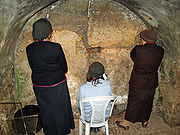 After the destruction of the Temple
in Jerusalem, the synagogue
s that were established took the design of the Tabernacle
as their plan. The Ark of the Law
, which contains the scroll
s of the Torah
, is covered with an embroidered curtain or veil called a parokhet
. (See also below regarding the veiling — and unveiling — of the bride.)
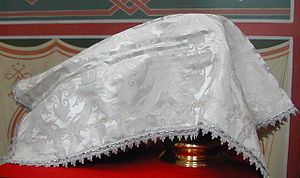
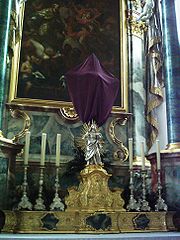
Among Christian churches
which have a liturgical
tradition, several different types of veils are used. These veils are often symbolically tied to the veils in the Tabernacle
in the wilderness and in Solomon's Temple
. The purpose of these veils was not so much to obscure as to shield the most sacred things from the eyes of sinful men.
The Veil of our Lady is a liturgical feast celebrating the protection afforded by the intercession
s of the Virgin Mary.
Traditionally, in Christianity, women were enjoined to cover their heads in church, just as it was (and still is) customary for men to remove their hat as a sign of respect. This practice is based on , where St. Paul writes:
In many traditional Eastern Orthodox Church
es, and in some very conservative Protestant
churches as well, the custom continues of women covering their heads in church (or even when praying privately at home).
In the Roman Catholic Church
, it was customary in most places before the 1960s for women to wear a headcovering in the form of a scarf, cap, veil or hat when entering a church. The practice now continues where it is seen as a matter of etiquette, courtesy, tradition or fashionable elegance rather than strictly of canon law. Traditionalist Catholic
s also maintain the practice.
The wearing of a headcovering was for the first time mandated as a universal rule for the Latin Rite by the Code of Canon Law of 1917
, which code was abrogated by the advent of the present (1983) Code of Canon Law, though many Traditional Catholics debate whether or not this actually occurred and many groups believe the original rule to still be in place. Canon 20 also states: "A later law abrogates, or derogates from, an earlier law if it states so expressly, is directly contrary to it, or completely reorders the entire matter of the earlier law." The photograph here of Mass in the Netherlands
in about 1946, two decades before the changes that followed the Second Vatican Council
, shows that, even at that time, when a hat was still considered part of formal dress for both women and men, wearing a headcovering at Mass was not a universal practice for Catholic women.
_roman_catholic_singing.jpg) A veil forms part of the headdress of some orders
A veil forms part of the headdress of some orders
of nun
s or religious sisters; this is why a woman who becomes a nun is said "to take the veil". In many orders, a white veil is used as the "veil of probation" during novitiate
, and a dark veil for the "veil of profession" once first or solemn vows are taken — the color scheme varies with the color scheme of the habit of the order. A veil of consecration
, longer and fuller, is used by some orders for final profession of solemn vow
s.
Nuns are the female counterparts of monk
s, and many monastic orders
of women have retained the veil. Regarding other orders of religious sisters who are not cloister
ed but who work as teachers, nurses or in other "active" apostolates outside of a nunnery or monastery, some wear the veil, while some others have abolished the use of the veil, a few never had a veil to start with, but used a bonnet-style headdress even a century ago, as in the case of St. Elizabeth Ann Seton.
The fullest versions of the nun's veil cover the top of the head and flow down around and over the shoulders. In Western Christianity, it does not wrap around the neck or face. In those orders that retain one, the starched white covering about the face neck and shoulders is known as a wimple
and is a separate garment.
The Catholic Church has revived the ancient practice of allowing women to profess a solemn vow as consecrated virgin
s. These women are
set aside as sacred persons who belong only to Christ and the service of the church. They are under the direct care of the local bishop
, without belonging to a particular order and receive the veil as a sign
of consecration
.
There has also been renewed interest in the last half century in the ancient practice of women and men dedicating themselves as anchorite
s or hermit
s, and there is a formal process whereby such persons can seek recognition of their vows by the local bishop — a veil for these women would also be traditional.
Some Anglican
women's religious orders also wear a veil, differing according to the traditions of each order.
and in the Eastern Rites
of the Catholic Church, a veil called an epanokamelavkion
is used by both nuns and monks, in both cases covering completely the kamilavkion
, a cylindrical hat they both wear. In Slavic practice, when the veil is worn over the hat, the entire headdress
is referred to as a klobuk
. Nuns wear an additional veil under the klobuk, called an apostolnik
, which is drawn together to cover the neck and shoulders as well as their heads, leaving the face itself open.
Note: , which the King James Version renders as: "And unto Sarah
he
said, Behold, I have given thy brother a thousand pieces of silver: behold, he is to thee a covering of the eyes
, unto all that are with thee, and with all other: thus she was reproved" has been interpreted in one source as implied advice to Sarah to conform to a supposed custom of married women, and wear a complete veil, covering the eyes as well as the rest of the face, but the phrase is generally taken to refer not to Sarah's eyes, but to the eyes of others, and to be merely a metaphorical expression concerning vindication of Sarah (NASB
, RSV
), silencing criticism (GWT
), allaying suspicions (NJB
), righting a wrong (BBE
, NLT
), covering or recompensing the problem caused her (NIV
, New Life Version, NIRV, TNIV
, JB
), a sign of her innocence (ESV
, CEV
, HCSB
). The final phrase in the verse, which KJV takes to mean "she was reproved", is taken by almost all other versions to mean instead "she was vindicated", and the word "הוא", which KJV interprets as "he" (Abraham), is interpreted as "it" (the money). Thus, the general view is that this passage has nothing to do with material veils.
in accordance with hijab
(the principle of dressing modestly) are sometimes referred to as veils. Many of these garments cover the hair, ears and throat, but do not cover the face. The khimar
is a type of headscarf
. The niqāb
and burqa
are two kinds of veils that cover most of the face except for a slit or hole for the eyes.
The Afghan
burqa covers the entire body, obscuring the face completely, except for a grille or netting over the eyes to allow the wearer to see. The boshiya
is a veil that may be worn over a headscarf; it covers the entire face and is made of a sheer fabric so the wearer is able to see through it. It has been suggested that the practice of wearing a veil
- uncommon among the Arab
tribes prior to the rise of Islam
- originated in the Byzantine Empire
, and then spread.
The wearing of head and especially face coverings by Muslim women has raised political issues in the West; see for example Hijab controversy in Quebec
, Islamic dress controversy in Europe, Islamic scarf controversy in France, and United Kingdom debate over veils
. There is also high debate of the veil in Turkey
, a Muslim majority country but secular, which banned the headscarves in universities and government buildings, due to the türban (a Turkish styled headscarf) being viewed as a political symbol of Islam
, see Headscarf controversy in Turkey
.
day. Bride
s once used to wear their hair flowing down their back at their wedding to symbolise their virginity. Veils covering the hair and face became a symbolic reference to the virginity of the bride thereafter. Often in modern weddings, the ceremony of removing a face veil after the wedding to present the groom with a virgin bride is skipped, since many couples have already entered into conjugal relations prior to their wedding day - the bride either wears no face veil, or it is lifted before the ceremony begins, but this is not always the case. Further, if a bride is a virgin, she often wears the face veil through the ceremony, and then either her father lifts the veil, presenting the bride to her groom, or the groom lifts the veil to symbolically consummate the marriage, which will later become literal. Brides who are virgins may make use of the veil to symbolize and emphasize their status of purity during their wedding however, and if they do, the lifting of the veil may be ceremonially recognized as the crowning event of the wedding, when the beauty of the bride is finally revealed to the groom and the guests. It is not altogether clear that the wedding veil is a non-religious use of this item, since weddings have almost always had religious underpinnings, especially in the West. Veils, however, had been used in the West for weddings long before this. Roman brides, for instance, wore an intensely flame-colored and fulsome veil, called the flammeum, apparently intended to protect the bride from evil spirits
on her wedding day. Later, the socalled velatio virginum became part of the rite of the consecration of virgins, the liturgical action in which the church celebrates an act of God who has called a Christian virgin to consecrate her virginity to Christ.
In the 19th century, wedding veils came to symbolise the woman's virginity
and modesty
. The tradition of a veiled bride's face continues even today wherein, a virgin bride, especially in Christian or Jewish culture, enters the marriage ritual with a veiled face and head, and remains fully veiled, both head and face, until the ceremony concludes. After the full conclusion of the wedding ceremony, either the bride's father lifts the veil giving the bride to the groom who then kisses her, or the new groom lifts her face veil in order to kiss her, which symbolizes the grooms right to enter into conjugal relations with his bride.
The lifting of the veil was often a part of ancient wedding ritual, symbolising the groom taking possession of the wife, either as lover or as property, or the revelation of the bride by her parents to the groom for his approval.
In Judaism, the tradition of wearing a veil dates back to biblical times. According to the Torah in , Isaac is brought Rebekah to marry by his father Abraham's servant. It is important to note that Rebekah did not veil herself when traveling with her lady attendants and Abraham's servant and his men to meet Isaac, but she only did so when Isaac was approaching. Just before the wedding ceremony the badeken
or bedeken is held. The groom places the veil over the bride's face, and either he or the officiating Rabbi gives her a blessing. The veil stays on her face until just before the end of the wedding ceremony - when they are legally married according to Jewish law - then the groom helps lift the veil from off her face.
The most often cited interpretation for the badeken
is that, according to , when Jacob went to marry Rachel, his father in law Laban tricked him into marrying Leah, Rachel's older and homlier sister. Many say that the veiling ceremony takes place to make sure that the groom is marrying the right bride! Some say that as the groom places the veil over his bride, he makes an implicit promise to clothe and protect her. Finally, by covering her face, the groom recognizes that he his marrying the bride for her inner beauty; while looks will fade with time, his love will be everlasting. In some ultra-orthodox traditions the bride wears an opaque veil as she is escorted down the aisle to meet her groom. This shows her complete willingness to enter into the marriage and her absolute trust that she is marrying the right man. In Judaism, a wedding is not considered valid unless the bride willingly consents to it.
In ancient Judaism
the lifting of the veil took place just prior to the consummation of the marriage in sexual union. The uncovering or unveiling that takes place in the Wedding ceremony is a symbol of what will take place in the marriage bed. Just as the two become one through their words spoken in wedding vows, so these words are a sign of the physical oneness that they will consummate later on. The lifting of the veil is a symbol and an anticipation of this.
In the Western world
, St. Paul's words concerning how marriage symbolizes the union of Christ and His Church may underlie part of the tradition of veiling in the marriage ceremony.
and harem
woman. Here, rather than the virginity of the bride's veil, modesty of the Muslim scarf or the piety of the nun's headdress, the mysterious veil hints at sensuality and the unknown. An example of the veil's erotic potential is the dance of the seven veils
.
In this context, the term may refer to a piece of sheer cloth approximately 3 x 1.5 metres, sometimes trimmed with sequins or coins, which is used in various styles of belly dancing
. A large repertoire of ways to wear and hold the veil exists, many of which are intended to frame the body from the perspective of the audience.
, Hausa
and Fulani of West Africa
, women do not traditionally wear the veil, while men do. The men's facial covering originates from the belief that such action wards off evil spirits, but most probably relates to protection against the harsh desert sands as well; in any event, it is a firmly established tradition. Men begin wearing a veil at age 25 which conceals their entire face excluding their eyes. This veil is never removed, even in front of family members.
vēlum, which also means "sail
".
There are two theories about the origin of the word vēlum:-
Head
In anatomy, the head of an animal is the rostral part that usually comprises the brain, eyes, ears, nose and mouth . Some very simple animals may not have a head, but many bilaterally symmetric forms do....
or face
Face
The face is a central sense organ complex, for those animals that have one, normally on the ventral surface of the head, and can, depending on the definition in the human case, include the hair, forehead, eyebrow, eyelashes, eyes, nose, ears, cheeks, mouth, lips, philtrum, temple, teeth, skin, and...
.
One view is that as a religious item, it is intended to show honor to an object or space. The actual sociocultural, psychological, and sociosexual functions of veils have not been studied extensively but most likely include the maintenance of social distance and the communication of social status and cultural identity. In Islamic society, various forms of the veil have been adopted from the Arab culture in which Islam arose.
History
The first recorded instance of veiling for women is recorded in an AssyriaAssyria
Assyria was a Semitic Akkadian kingdom, extant as a nation state from the mid–23rd century BC to 608 BC centred on the Upper Tigris river, in northern Mesopotamia , that came to rule regional empires a number of times through history. It was named for its original capital, the ancient city of Assur...
n legal text from the 13th century BC, which restricted its use to noble women and forbade prostitutes and common women from adopting it. The Mycenaean Greek
Mycenaean Greece
Mycenaean Greece was a cultural period of Bronze Age Greece taking its name from the archaeological site of Mycenae in northeastern Argolis, in the Peloponnese of southern Greece. Athens, Pylos, Thebes, and Tiryns are also important Mycenaean sites...
term a-pu-ko-wo-ko meaning "craftsman of horse veil" written in Linear B
Linear B
Linear B is a syllabic script that was used for writing Mycenaean Greek, an early form of Greek. It pre-dated the Greek alphabet by several centuries and seems to have died out with the fall of Mycenaean civilization...
syllabic script is also attested since ca. 1300 BC. Ancient Greek texts have also spoken of veiling and seclusion of women
Purdah
Purdah or pardeh is the practice of concealing women from men. According to one definition:This takes two forms: physical segregation of the sexes, and the requirement for women to cover their bodies and conceal their form....
being practiced among the Persian elite. Statues from Persepolis
Persepolis
Perspolis was the ceremonial capital of the Achaemenid Empire . Persepolis is situated northeast of the modern city of Shiraz in the Fars Province of modern Iran. In contemporary Persian, the site is known as Takht-e Jamshid...
depict women both veiled and unveiled.
Classical Greek and Hellenistic statues sometimes depict Greek women with both their head and face covered by a veil. Caroline Galt and Lloyd Llewellyn-Jones have both argued from such representations and literary references that it was commonplace for women (at least those of higher status) in ancient Greece to cover their hair and face in public.
For many centuries, until around 1175, Anglo-Saxon
Anglo-Saxons
Anglo-Saxon is a term used by historians to designate the Germanic tribes who invaded and settled the south and east of Great Britain beginning in the early 5th century AD, and the period from their creation of the English nation to the Norman conquest. The Anglo-Saxon Era denotes the period of...
and then Anglo-Norman
Anglo-Norman
The Anglo-Normans were mainly the descendants of the Normans who ruled England following the Norman conquest by William the Conqueror in 1066. A small number of Normans were already settled in England prior to the conquest...
women, with the exception of young unmarried girls, wore veils that entirely covered their hair, and often their necks up to their chins (see wimple
Wimple
A wimple is a garment worn around the neck and chin, and which usually covers the head. Its use developed among women in early medieval Europe . At many stages of medieval culture it was unseemly for a married woman to show her hair...
). Only in the Tudor period
Tudor period
The Tudor period usually refers to the period between 1485 and 1603, specifically in relation to the history of England. This coincides with the rule of the Tudor dynasty in England whose first monarch was Henry VII...
(1485), when hood
Hood (headgear)
A hood is a kind of headgear that covers most of the head and neck and sometimes the face. They may be worn for protection from the environment, for fashion, as a form of traditional dress or uniform, to prevent the wearer from seeing or to prevent the wearer from being identified.-History and...
s became increasingly popular, did veils of this type become less common.
For centuries, women have worn sheer veils, but only under certain circumstances. Sometimes a veil of this type was draped over and pinned to the bonnet
Bonnet (headgear)
Bonnets are a variety of headgear for both sexes, which have in common only the absence of a brim. Bonnet derives from the same word in French, where it originally indicated a type of material...
or hat of a woman in mourning
Mourning
Mourning is, in the simplest sense, synonymous with grief over the death of someone. The word is also used to describe a cultural complex of behaviours in which the bereaved participate or are expected to participate...
, especially at the funeral
Funeral
A funeral is a ceremony for celebrating, sanctifying, or remembering the life of a person who has died. Funerary customs comprise the complex of beliefs and practices used by a culture to remember the dead, from interment itself, to various monuments, prayers, and rituals undertaken in their honor...
and during the subsequent period of "high mourning". They would also have been used, as an alternative to a mask
Mask
A mask is an article normally worn on the face, typically for protection, disguise, performance or entertainment. Masks have been used since antiquity for both ceremonial and practical purposes...
, as a simple method of hiding the identity of a woman who was traveling to meet a lover, or doing anything she didn't want other people to find out about. More pragmatically, veils were also sometimes worn to protect the complexion from sun and wind damage (when un-tanned skin was fashionable), or to keep dust out of a woman's face, much as the keffiyeh
Keffiyeh
The keffiyeh/kufiya , also known as a ghutrah , ' , mashadah , shemagh or in Persian chafiye , Kurdish cemedanî and Turkish puşi, is a traditional Arab headdress fashioned from a square, usually cotton, scarf. It is typically worn by Arab men, as well as some Kurds...
is used today.
Religion
In JudaismJudaism
Judaism ) is the "religion, philosophy, and way of life" of the Jewish people...
, Christianity
Christianity
Christianity is a monotheistic religion based on the life and teachings of Jesus as presented in canonical gospels and other New Testament writings...
and Islam
Islam
Islam . The most common are and . : Arabic pronunciation varies regionally. The first vowel ranges from ~~. The second vowel ranges from ~~~...
the concept of covering the head is or was associated with propriety and modesty. All traditional depictions of the Virgin Mary
Mary (mother of Jesus)
Mary , commonly referred to as "Saint Mary", "Mother Mary", the "Virgin Mary", the "Blessed Virgin Mary", or "Mary, Mother of God", was a Jewish woman of Nazareth in Galilee...
, the mother of Christ
Christ
Christ is the English term for the Greek meaning "the anointed one". It is a translation of the Hebrew , usually transliterated into English as Messiah or Mashiach...
, show her veiled. Veiling was a common practice with church-going women until the 1960s, and a number of very traditional churches retain the custom. The wearing of various forms of the Muslim veil has provoked controversy in the West.
In India, Hindu women veil for traditional purposes, it is custom in rural areas to veil in front of male elders. This veil is called the ghoonghat.
Although religion stands as a commonly held reason for choosing to veil, it has also reflects on political regimes and personal conviction, allowing it to serve as a medium through which personal character can be revealed.
Judaism
Siege of Jerusalem (70)
The Siege of Jerusalem in the year 70 AD was the decisive event of the First Jewish-Roman War. The Roman army, led by the future Emperor Titus, with Tiberius Julius Alexander as his second-in-command, besieged and conquered the city of Jerusalem, which had been occupied by its Jewish defenders in...
in Jerusalem, the synagogue
Synagogue
A synagogue is a Jewish house of prayer. This use of the Greek term synagogue originates in the Septuagint where it sometimes translates the Hebrew word for assembly, kahal...
s that were established took the design of the Tabernacle
Tabernacle
The Tabernacle , according to the Hebrew Torah/Old Testament, was the portable dwelling place for the divine presence from the time of the Exodus from Egypt through the conquering of the land of Canaan. Built to specifications revealed by God to Moses at Mount Sinai, it accompanied the Israelites...
as their plan. The Ark of the Law
Ark (synagogue)
The Torah ark or ark in a synagogue is known in Hebrew as the Aron Kodesh by the Ashkenazim and as the Hekhál amongst most Sefardim. It is generally a receptacle, or ornamental closet, which contains each synagogue's Torah scrolls...
, which contains the scroll
Scroll
A scroll is a roll of parchment, papyrus, or paper, which has been drawn or written upon.Scroll may also refer to:*Scroll , the decoratively curved end of the pegbox of string instruments such as violins...
s of the Torah
Torah
Torah- A scroll containing the first five books of the BibleThe Torah , is name given by Jews to the first five books of the bible—Genesis , Exodus , Leviticus , Numbers and Deuteronomy Torah- A scroll containing the first five books of the BibleThe Torah , is name given by Jews to the first five...
, is covered with an embroidered curtain or veil called a parokhet
Parochet
Parochet is the curtain on the front of the Aron Kodesh in a synagogue that covers the Sifrei Torah...
. (See also below regarding the veiling — and unveiling — of the bride.)
Liturgy
Among Christian churches
Christian Church
The Christian Church is the assembly or association of followers of Jesus Christ. The Greek term ἐκκλησία that in its appearances in the New Testament is usually translated as "church" basically means "assembly"...
which have a liturgical
Liturgy
Liturgy is either the customary public worship done by a specific religious group, according to its particular traditions or a more precise term that distinguishes between those religious groups who believe their ritual requires the "people" to do the "work" of responding to the priest, and those...
tradition, several different types of veils are used. These veils are often symbolically tied to the veils in the Tabernacle
Tabernacle
The Tabernacle , according to the Hebrew Torah/Old Testament, was the portable dwelling place for the divine presence from the time of the Exodus from Egypt through the conquering of the land of Canaan. Built to specifications revealed by God to Moses at Mount Sinai, it accompanied the Israelites...
in the wilderness and in Solomon's Temple
Solomon's Temple
Solomon's Temple, also known as the First Temple, was the main temple in ancient Jerusalem, on the Temple Mount , before its destruction by Nebuchadnezzar II after the Siege of Jerusalem of 587 BCE....
. The purpose of these veils was not so much to obscure as to shield the most sacred things from the eyes of sinful men.
- Tabernacle veil
- Used to cover the church tabernacleChurch tabernacleA tabernacle is the fixed, locked box in which, in some Christian churches, the Eucharist is "reserved" . A less obvious container, set into the wall, is called an aumbry....
, particularly in the Roman CatholicRoman Catholic ChurchThe Catholic Church, also known as the Roman Catholic Church, is the world's largest Christian church, with over a billion members. Led by the Pope, it defines its mission as spreading the gospel of Jesus Christ, administering the sacraments and exercising charity...
tradition but in some others as well, when the EucharistEucharistThe Eucharist , also called Holy Communion, the Sacrament of the Altar, the Blessed Sacrament, the Lord's Supper, and other names, is a Christian sacrament or ordinance...
is actually stored in it. The veil, which is in part meant to remind worshippers that the (usually metal) tabernacle cabinet is meant to echo the tabernacle tent of the Hebrew ScripturesHebrew BibleThe Hebrew Bible is a term used by biblical scholars outside of Judaism to refer to the Tanakh , a canonical collection of Jewish texts, and the common textual antecedent of the several canonical editions of the Christian Old Testament...
, signals that the tabernacle is actually in use. It may be of any liturgical color, but is most often either white (always appropriate for the Eucharist), cloth of goldCloth of goldCloth of gold is a fabric woven with a gold-wrapped or spun weft - referred to as "a spirally spun gold strip". In most cases, the core yarn is silk wrapped with a band or strip of high content gold filé...
or cloth of silver (which may substitute for any liturgical color aside from violet), or of the liturgical color of the day (red, green or violet). It may be of simple, unadorned linen or silk, or it may be fringed or otherwise decorated. It is often designed to match the vestmentVestmentVestments are liturgical garments and articles associated primarily with the Christian religion, especially among Latin Rite and other Catholics, Eastern Orthodox, Anglicans, and Lutherans...
s of the celebrantPriestA priest is a person authorized to perform the sacred rites of a religion, especially as a mediatory agent between humans and deities. They also have the authority or power to administer religious rites; in particular, rites of sacrifice to, and propitiation of, a deity or deities...
s.- Ciborium veil
- The ciborium is a goblet-like metal vessel with a cover, used in the Roman Catholic Church and some others to hold the consecrated hostsSacramental breadSacramental bread, sometimes called the lamb, altar bread, host or simply Communion bread, is the bread which is used in the Christian ritual of the Eucharist.-Eastern Catholic and Orthodox:...
of the Eucharist when, for instance, it is stored in the tabernacle or when communionEucharistThe Eucharist , also called Holy Communion, the Sacrament of the Altar, the Blessed Sacrament, the Lord's Supper, and other names, is a Christian sacrament or ordinance...
is to be distributed. It may be veiled with a white cloth, usually of silk. This was formerly required but is now optional. In part, it signals that the ciborium actually contains the consecratedConsecrationConsecration is the solemn dedication to a special purpose or service, usually religious. The word "consecration" literally means "to associate with the sacred". Persons, places, or things can be consecrated, and the term is used in various ways by different groups...
Eucharist at the moment.- Chalice Veil
- During Eucharistic celebrations, a veil is often used to cover the chaliceChalice (cup)A chalice is a goblet or footed cup intended to hold a drink. In general religious terms, it is intended for drinking during a ceremony.-Christian:...
and patenPatenA paten, or diskos, is a small plate, usually made of silver or gold, used to hold Eucharistic bread which is to be consecrated. It is generally used during the service itself, while the reserved hosts are stored in the Tabernacle in a ciborium....
to prevent dust and flying insects from coming in contact with the bread and wine. Often made of rich material, the chalice veils have not only a practical purpose, but are also intended to show honor to vessels used for the sacramentSacramentA sacrament is a sacred rite recognized as of particular importance and significance. There are various views on the existence and meaning of such rites.-General definitions and terms:...
. - In the West, a single chalice veil is normally used. The veil will usually be of the same material and color as the priest's vestments, though it may always be white. It covers the chalice and paten when not actually in use on the altar.
- In the East, three veils are used: one for the chalice, one for the diskosPatenA paten, or diskos, is a small plate, usually made of silver or gold, used to hold Eucharistic bread which is to be consecrated. It is generally used during the service itself, while the reserved hosts are stored in the Tabernacle in a ciborium....
(paten), and a third one (the AërAërThe Aër is the largest and outermost of the veils covering the Chalice and Diskos in the Eastern Orthodox Church and the Eastern Catholic Churches which follow the Byzantine Rite. It is rectangular in shape and corresponds to the veil used to cover the chalice and paten in the Latin Rite, but is...
) is used to cover both. The veils for the chalice and diskos are usually square with four lappetLappetA lappet is a decorative flap or fold in a ceremonial headdress or garment. They were a feature of women's headgear until the early 20th century. They remain strongly associated with religion. A bishop's mitre has two lappets sewn to the back of it. The most famous usage of lappets occurs on the...
s hanging down the sides, so that when the veil is laid out flat it will be shaped like a cross. The Aër is rectangular and usually larger than the chalice veil used in the West. The Aër also figures prominently in other liturgical respects.- Humeral Veil
- The humeral veilHumeral veilThe humeral veil is one of the liturgical vestments of the Roman Rite, also used in some Anglican and Lutheran churches. It consists of a piece of cloth about 2.75 m long and 90 cm wide draped over the shoulders and down the front, normally of silk or cloth of gold...
is used in both Roman Catholic and Anglican Churches during the liturgy of Exposition and Benediction of the Blessed SacramentBenediction of the Blessed SacramentBenediction of the Blessed Sacrament is a devotional ceremony celebrated within the Latin Rite of the Roman Catholic Church, as well as in some Anglican and Lutheran Churches, Liberal Catholic churches, Western Rite Orthodox churches, and Latinised Eastern Catholic Churches.Benediction of the...
, and on some other occasions when special respect is to be demonstrated to the Eucharist. From the LatinLatinLatin is an Italic language originally spoken in Latium and Ancient Rome. It, along with most European languages, is a descendant of the ancient Proto-Indo-European language. Although it is considered a dead language, a number of scholars and members of the Christian clergy speak it fluently, and...
for "shoulders," it is an oblong piece of cloth worn as a short of shawlShawlA shawl is a simple item of clothing, loosely worn over the shoulders, upper body and arms, and sometimes also over the head. It is usually a rectangular or square piece of cloth, that is often folded to make a triangle but can also be triangular in shape...
, used to symbolize a more profound awareness of the respect due to the Eucharist by shielding the celebrant's hands from actually contacting the vessel holding the Eucharist, either a monstranceMonstranceA monstrance is the vessel used in the Roman Catholic, Old Catholic, and Anglican churches to display the consecrated Eucharistic host, during Eucharistic adoration or Benediction of the Blessed Sacrament. Created in the medieval period for the public display of relics, the monstrance today is...
or ciborium, or in some cases to shield the vessel itself from the eyes of participants. It is worn only by bishopBishopA bishop is an ordained or consecrated member of the Christian clergy who is generally entrusted with a position of authority and oversight. Within the Catholic Church, Eastern Orthodox, Oriental Orthodox Churches, in the Assyrian Church of the East, in the Independent Catholic Churches, and in the...
s, priestPriestA priest is a person authorized to perform the sacred rites of a religion, especially as a mediatory agent between humans and deities. They also have the authority or power to administer religious rites; in particular, rites of sacrifice to, and propitiation of, a deity or deities...
s or deaconDeaconDeacon is a ministry in the Christian Church that is generally associated with service of some kind, but which varies among theological and denominational traditions...
s.- Vimpa
- A vimpaVimpaA vimpa is a veil or shawl worn over the shoulders of servers who carry the miter and crosier during liturgical functions when they are not being used by the bishop, in the Roman Catholic, Anglican, and some other western churches....
is a veil or shawl worn over the shoulders of servers who carry the miterMitreThe mitre , also spelled miter, is a type of headwear now known as the traditional, ceremonial head-dress of bishops and certain abbots in the Roman Catholic Church, as well as in the Anglican Communion, some Lutheran churches, and also bishops and certain other clergy in the Eastern Orthodox...
and crosierCrosierA crosier is the stylized staff of office carried by high-ranking Catholic, Eastern Orthodox, Anglican, and some Lutheran and Pentecostal prelates...
in Roman Catholic liturgical functions when they are not being used by the bishop.- Chancel Veil
- In the early liturgies, there was often a veil that separated the sanctuary from the rest of the church (again, based upon the biblical description of the Tabernacle). In the Byzantine liturgy this veil developed into the iconostasisIconostasisIn Eastern Christianity an iconostasis is a wall of icons and religious paintings, separating the nave from the sanctuary in a church. Iconostasis also refers to a portable icon stand that can be placed anywhere within a church...
, but a veil or curtain is still used behind the Royal DoorsRoyal DoorsThe royal doors, holy doors, or beautiful gates are the central doors of the iconostasis in an Eastern Orthodox or Greek-Catholic Church....
(the main doors leading into the sanctuary), and is opened and closed at specific times during the liturgy. In the West, it developed into the Rood Veil, and later the Rood ScreenRood screenThe rood screen is a common feature in late medieval church architecture. It is typically an ornate partition between the chancel and nave, of more or less open tracery constructed of wood, stone, or wrought iron...
, and finally the chancelChancelIn church architecture, the chancel is the space around the altar in the sanctuary at the liturgical east end of a traditional Christian church building...
rail, the low sanctuary railing in those churches that still have this. In some of the Eastern ChurchesEastern ChristianityEastern Christianity comprises the Christian traditions and churches that developed in the Balkans, Eastern Europe, Asia Minor, the Middle East, Northeastern Africa, India and parts of the Far East over several centuries of religious antiquity. The term is generally used in Western Christianity to...
(for instance, the Syrian liturgyEast Syrian RiteThe East Syrian Rite is a Christian liturgy, also known as the Assyro-Chaldean Rite, Assyrian or Chaldean Rite, and the Persian Rite although it originated in Edessa, Mesopotamia...
) the use of a veil across the entire sanctuary has been retained.- Lenten Veiling
- Some churches veil their crosses during PassiontidePassiontidePassiontide is a name for the last two weeks of Lent, beginning on Passion Sunday and ending on Holy Saturday....
with a fine semi-transparent mesh. The color of the veil may be black, red, purple, or white, depending upon the liturgical day and practice of the church. In traditional churches, there will sometimes be curtains placed to either side of the altar.
The Veil of our Lady is a liturgical feast celebrating the protection afforded by the intercession
Intercession
Intercession is the act of interceding between two parties. In both Christian and Islamic religious usage, it is a prayer to God on behalf of others....
s of the Virgin Mary.
Traditionally, in Christianity, women were enjoined to cover their heads in church, just as it was (and still is) customary for men to remove their hat as a sign of respect. This practice is based on , where St. Paul writes:
Any man who prays or prophesies with his head covered brings shame upon his head. But any woman who prays or prophesies with her head unveiled brings shame upon her head, for it is one and the same thing as if she had had her head shaved. For if a woman does not have her head veiled, she may as well have her hair cut off. But if it is shameful for a woman to have her hair cut off or her head shaved, then she should wear a veil. A man, on the other hand, should not cover his head, because he is the image and glory of God, but woman is the glory of man. For man did not come from woman, but woman from man; nor was man created for woman, but woman for man; for this reason a woman should have a sign of authority on her head, because of the angels. Woman is not independent of man or man of woman in the Lord. For just as woman came from man, so man is born of woman; but all things are from God. Judge for yourselves: is it proper for a woman to pray to God with her head unveiled? Does not nature itself teach you that if a man wears his hair long it is a disgrace to him, whereas if a woman has long hair it is her glory, because long hair has been given (her) for a covering? But if anyone is inclined to be argumentative, we do not have such a custom, nor do the churches of God (New American BibleNew American BibleThe New American Bible is a Catholic Bible translation first published in 1970. It had its beginnings in the Confraternity Bible, which began to be translated from the original languages in 1948....
translation)
In many traditional Eastern Orthodox Church
Eastern Orthodox Church
The Orthodox Church, officially called the Orthodox Catholic Church and commonly referred to as the Eastern Orthodox Church, is the second largest Christian denomination in the world, with an estimated 300 million adherents mainly in the countries of Belarus, Bulgaria, Cyprus, Georgia, Greece,...
es, and in some very conservative Protestant
Protestantism
Protestantism is one of the three major groupings within Christianity. It is a movement that began in Germany in the early 16th century as a reaction against medieval Roman Catholic doctrines and practices, especially in regards to salvation, justification, and ecclesiology.The doctrines of the...
churches as well, the custom continues of women covering their heads in church (or even when praying privately at home).
In the Roman Catholic Church
Roman Catholic Church
The Catholic Church, also known as the Roman Catholic Church, is the world's largest Christian church, with over a billion members. Led by the Pope, it defines its mission as spreading the gospel of Jesus Christ, administering the sacraments and exercising charity...
, it was customary in most places before the 1960s for women to wear a headcovering in the form of a scarf, cap, veil or hat when entering a church. The practice now continues where it is seen as a matter of etiquette, courtesy, tradition or fashionable elegance rather than strictly of canon law. Traditionalist Catholic
Traditionalist Catholic
Traditionalist Catholics are Roman Catholics who believe that there should be a restoration of many or all of the liturgical forms, public and private devotions and presentations of Catholic teachings which prevailed in the Catholic Church before the Second Vatican Council...
s also maintain the practice.
The wearing of a headcovering was for the first time mandated as a universal rule for the Latin Rite by the Code of Canon Law of 1917
Canon law (Catholic Church)
The canon law of the Catholic Church, is a fully developed legal system, with all the necessary elements: courts, lawyers, judges, a fully articulated legal code and principles of legal interpretation. It lacks the necessary binding force present in most modern day legal systems. The academic...
, which code was abrogated by the advent of the present (1983) Code of Canon Law, though many Traditional Catholics debate whether or not this actually occurred and many groups believe the original rule to still be in place. Canon 20 also states: "A later law abrogates, or derogates from, an earlier law if it states so expressly, is directly contrary to it, or completely reorders the entire matter of the earlier law." The photograph here of Mass in the Netherlands
Netherlands
The Netherlands is a constituent country of the Kingdom of the Netherlands, located mainly in North-West Europe and with several islands in the Caribbean. Mainland Netherlands borders the North Sea to the north and west, Belgium to the south, and Germany to the east, and shares maritime borders...
in about 1946, two decades before the changes that followed the Second Vatican Council
Second Vatican Council
The Second Vatican Council addressed relations between the Roman Catholic Church and the modern world. It was the twenty-first Ecumenical Council of the Catholic Church and the second to be held at St. Peter's Basilica in the Vatican. It opened under Pope John XXIII on 11 October 1962 and closed...
, shows that, even at that time, when a hat was still considered part of formal dress for both women and men, wearing a headcovering at Mass was not a universal practice for Catholic women.
Women
Religious order
A religious order is a lineage of communities and organizations of people who live in some way set apart from society in accordance with their specific religious devotion, usually characterized by the principles of its founder's religious practice. The order is composed of initiates and, in some...
of nun
Nun
A nun is a woman who has taken vows committing her to live a spiritual life. She may be an ascetic who voluntarily chooses to leave mainstream society and live her life in prayer and contemplation in a monastery or convent...
s or religious sisters; this is why a woman who becomes a nun is said "to take the veil". In many orders, a white veil is used as the "veil of probation" during novitiate
Novitiate
Novitiate, alt. noviciate, is the period of training and preparation that a novice monastic or member of a religious order undergoes prior to taking vows in order to discern whether they are called to the religious life....
, and a dark veil for the "veil of profession" once first or solemn vows are taken — the color scheme varies with the color scheme of the habit of the order. A veil of consecration
Consecration
Consecration is the solemn dedication to a special purpose or service, usually religious. The word "consecration" literally means "to associate with the sacred". Persons, places, or things can be consecrated, and the term is used in various ways by different groups...
, longer and fuller, is used by some orders for final profession of solemn vow
Solemn vow
In Roman Catholic canon law, a solemn vow is a vow that the Church has recognized as such....
s.
Nuns are the female counterparts of monk
Monk
A monk is a person who practices religious asceticism, living either alone or with any number of monks, while always maintaining some degree of physical separation from those not sharing the same purpose...
s, and many monastic orders
Monasticism
Monasticism is a religious way of life characterized by the practice of renouncing worldly pursuits to fully devote one's self to spiritual work...
of women have retained the veil. Regarding other orders of religious sisters who are not cloister
Cloister
A cloister is a rectangular open space surrounded by covered walks or open galleries, with open arcades on the inner side, running along the walls of buildings and forming a quadrangle or garth...
ed but who work as teachers, nurses or in other "active" apostolates outside of a nunnery or monastery, some wear the veil, while some others have abolished the use of the veil, a few never had a veil to start with, but used a bonnet-style headdress even a century ago, as in the case of St. Elizabeth Ann Seton.
The fullest versions of the nun's veil cover the top of the head and flow down around and over the shoulders. In Western Christianity, it does not wrap around the neck or face. In those orders that retain one, the starched white covering about the face neck and shoulders is known as a wimple
Wimple
A wimple is a garment worn around the neck and chin, and which usually covers the head. Its use developed among women in early medieval Europe . At many stages of medieval culture it was unseemly for a married woman to show her hair...
and is a separate garment.
The Catholic Church has revived the ancient practice of allowing women to profess a solemn vow as consecrated virgin
Consecrated virgin
In the Catholic Church a consecrated virgin is a woman who has been conscrated by the church to a life of perpetual virginity in the service of God. Consecrated virgins are to spend their time in works of penance and mercy, in apostolic activity and in prayer, according to their state of life and...
s. These women are
set aside as sacred persons who belong only to Christ and the service of the church. They are under the direct care of the local bishop
Bishop (Catholic Church)
In the Catholic Church, a bishop is an ordained minister who holds the fullness of the sacrament of Holy Orders and is responsible for teaching the Catholic faith and ruling the Church....
, without belonging to a particular order and receive the veil as a sign
Insignia
Insignia or insigne pl -nia or -nias : a symbol or token of personal power, status or office, or of an official body of government or jurisdiction...
of consecration
Consecration
Consecration is the solemn dedication to a special purpose or service, usually religious. The word "consecration" literally means "to associate with the sacred". Persons, places, or things can be consecrated, and the term is used in various ways by different groups...
.
There has also been renewed interest in the last half century in the ancient practice of women and men dedicating themselves as anchorite
Anchorite
Anchorite denotes someone who, for religious reasons, withdraws from secular society so as to be able to lead an intensely prayer-oriented, ascetic, and—circumstances permitting—Eucharist-focused life...
s or hermit
Hermit
A hermit is a person who lives, to some degree, in seclusion from society.In Christianity, the term was originally applied to a Christian who lives the eremitic life out of a religious conviction, namely the Desert Theology of the Old Testament .In the...
s, and there is a formal process whereby such persons can seek recognition of their vows by the local bishop — a veil for these women would also be traditional.
Some Anglican
Anglicanism
Anglicanism is a tradition within Christianity comprising churches with historical connections to the Church of England or similar beliefs, worship and church structures. The word Anglican originates in ecclesia anglicana, a medieval Latin phrase dating to at least 1246 that means the English...
women's religious orders also wear a veil, differing according to the traditions of each order.
Eastern monasticism
In Eastern OrthodoxyEastern Orthodox Church
The Orthodox Church, officially called the Orthodox Catholic Church and commonly referred to as the Eastern Orthodox Church, is the second largest Christian denomination in the world, with an estimated 300 million adherents mainly in the countries of Belarus, Bulgaria, Cyprus, Georgia, Greece,...
and in the Eastern Rites
Eastern Christianity
Eastern Christianity comprises the Christian traditions and churches that developed in the Balkans, Eastern Europe, Asia Minor, the Middle East, Northeastern Africa, India and parts of the Far East over several centuries of religious antiquity. The term is generally used in Western Christianity to...
of the Catholic Church, a veil called an epanokamelavkion
Epanokamelavkion
An epanokamelavkion is an item of clerical clothing worn by Orthodox Christian monastics who are rassophor or above, including bishops...
is used by both nuns and monks, in both cases covering completely the kamilavkion
Kamilavka
A Kalimavkion , or kalymmavchi , or kamilavka , is an item of clerical clothing worn by Orthodox Christian and Eastern Catholic monks or awarded to clergy ....
, a cylindrical hat they both wear. In Slavic practice, when the veil is worn over the hat, the entire headdress
Headgear
Headgear, headwear or headdress is the name given to any element of clothing which is worn on one's head.Headgear serve a variety of purposes:...
is referred to as a klobuk
Klobuk
thumbA klobuk is an item of clerical clothing worn by Eastern Orthodox and Eastern Catholic monastics and bishops, especially in the Russian tradition...
. Nuns wear an additional veil under the klobuk, called an apostolnik
Apostolnik
An apostolnik or epimandylion is an item of clerical clothing worn by Orthodox Christian and Eastern Catholic nuns. It is a cloth veil that completely covers the head , neck, and shoulders similar to the hijab worn by Muslim women, it is usually black, but sometimes white...
, which is drawn together to cover the neck and shoulders as well as their heads, leaving the face itself open.
Biblical references
- Hebrew mitpahath (RuthBook of RuthThe Book of Ruth is one of the books of the Hebrew Bible, Tanakh, or Old Testament. In the Jewish canon the Book of Ruth is included in the third division, or the Writings . In the Christian canon the Book of Ruth is placed between Judges and 1 Samuel...
3:15; marg., "sheet" or "apron;" R.V., "mantle"). In IsaiahBook of IsaiahThe Book of Isaiah is the first of the Latter Prophets in the Hebrew Bible, preceding the books of Ezekiel, Jeremiah and the Book of the Twelve...
3:22 this word is plural, rendered "wimples;" R.V., "shawls" i.e. wraps.book of Isaiah 3:23 The glasses, and the fine linen, and the hoods, and the vails. - Massekah (Isaiah 25:7; in Isa. 28:20 rendered "covering"). The word denotes something spread out and covering or concealing something else (comp. 2 Cor. 3:13-15).
- Masveh (Exodus 34:33, 35), the veil on the face of MosesMosesMoses was, according to the Hebrew Bible and Qur'an, a religious leader, lawgiver and prophet, to whom the authorship of the Torah is traditionally attributed...
. This verse should be read, "And when Moses had done speaking with them, he put a veil on his face," as in the Revised VersionRevised VersionThe Revised Version of the Bible is a late 19th-century British revision of the King James Version of 1611. It was the first and remains the only officially authorized and recognized revision of the King James Bible. The work was entrusted to over 50 scholars from various denominations in Britain...
. When Moses spoke to them he was without the veil; only when he ceased speaking he put on the veil (comp. 2 Cor. 3:13, etc.). - Paroheth (Ex. 26:31-35), the veil of the tabernacleTabernacleThe Tabernacle , according to the Hebrew Torah/Old Testament, was the portable dwelling place for the divine presence from the time of the Exodus from Egypt through the conquering of the land of Canaan. Built to specifications revealed by God to Moses at Mount Sinai, it accompanied the Israelites...
and the templeTempleA temple is a structure reserved for religious or spiritual activities, such as prayer and sacrifice, or analogous rites. A templum constituted a sacred precinct as defined by a priest, or augur. It has the same root as the word "template," a plan in preparation of the building that was marked out...
, which hung between the holy place and the most holy (2 Chr. 3:14). In the temple a partition wall separated these two places. In it were two folding doors, which are supposed to have been always open, the entrance being concealed by the veil which the high priestKohen GadolThe High Priest was the chief religious official of Israelite religion and of classical Judaism from the rise of the Israelite nation until the destruction of the Second Temple of Jerusalem...
lifted when he entered into the sanctuary on the day of AtonementYom KippurYom Kippur , also known as Day of Atonement, is the holiest and most solemn day of the year for the Jews. Its central themes are atonement and repentance. Jews traditionally observe this holy day with a 25-hour period of fasting and intensive prayer, often spending most of the day in synagogue...
. This veil was rent when Christ died on the crossCrucifixionCrucifixion is an ancient method of painful execution in which the condemned person is tied or nailed to a large wooden cross and left to hang until dead...
(Matt. 27:51; Gospel of MarkGospel of MarkThe Gospel According to Mark , commonly shortened to the Gospel of Mark or simply Mark, is the second book of the New Testament. This canonical account of the life of Jesus of Nazareth is one of the three synoptic gospels. It was thought to be an epitome, which accounts for its place as the second...
15:38; LukeGospel of LukeThe Gospel According to Luke , commonly shortened to the Gospel of Luke or simply Luke, is the third and longest of the four canonical Gospels. This synoptic gospel is an account of the life and ministry of Jesus of Nazareth. It details his story from the events of his birth to his Ascension.The...
23:45). - Tza'iph (Genesis 24:65). RebekahRebeccaRebecca a biblical matriarch from the Book of Genesis and a common first name. In this book Rebecca was said to be a beautiful girl. As a name it is often shortened to Becky, Becki or Becca; see Rebecca ....
"took a veil and covered herself." (See also 38:14, 19.) HebrewHebrewsHebrews is an ethnonym used in the Hebrew Bible...
women generally appeared in public without veils (12:14; 24:16; 29:10; 1 Sam. 1:12). - Radhidh (Cant.Song of songsSong of Songs, also known as the Song of Solomon, is a book of the Hebrew Bible or Old Testament. It may also refer to:In music:* Song of songs , the debut album by David and the Giants* A generic term for medleysPlays...
5:7, R.V. "mantle;" Isaiah 3:23). The word probably denotes some kind of cloak or wrapper. - Masak, the veil which hung before the entrance to the holy place (Ex. 26:36, 37).
Note: , which the King James Version renders as: "And unto Sarah
Sarah
Sarah or Sara was the wife of Abraham and the mother of Isaac as described in the Hebrew Bible and the Quran. Her name was originally Sarai...
he
Abimelech
Abimelech was a common name of the Philistine kings.Abimelech was most prominently the name of a king of Gerar who is mentioned in two of the three wife-sister narratives in Genesis...
said, Behold, I have given thy brother a thousand pieces of silver: behold, he is to thee a covering of the eyes
Covering of the eyes
The phrase "covering of eyes" is found in . It is translated literally in Young's Literal Translation. The King James Version inserts the definite article "the", absent in the original text...
, unto all that are with thee, and with all other: thus she was reproved" has been interpreted in one source as implied advice to Sarah to conform to a supposed custom of married women, and wear a complete veil, covering the eyes as well as the rest of the face, but the phrase is generally taken to refer not to Sarah's eyes, but to the eyes of others, and to be merely a metaphorical expression concerning vindication of Sarah (NASB
New American Standard Bible
The New American Standard Bible , also informally called New American Standard Version , is an English translation of the Bible....
, RSV
Russian Synodal Bible
Russian Synodal Bible is a Russian non-Church Slavonic translation of the Bible commonly used by the Russian Orthodox Church, Russian Baptists and other Protestant, as well as Roman Catholic communities in Russia....
), silencing criticism (GWT
God's Word (bible translation)
The God's Word Translation is an English translation of the Bible translated by the God's Word to the Nations Society.-History:The God's Word Translation of the Bible was produced by the God's Word to the Nations Bible Mission Society in Cleveland, Ohio...
), allaying suspicions (NJB
New Jerusalem Bible
The New Jerusalem Bible is a Roman Catholic translation of the Bible published in 1985 by Darton, Longman & Todd and Les Editions du Cerf, and edited by the Reverend Henry Wansbrough.- Contents :...
), righting a wrong (BBE
Bible in Basic English
The Bible In Basic English is a translation of the Bible into Basic English. The BBE was translated by Professor S. H. Hooke using the standard 850 Basic English words. 100 words that were helpful to understand poetry were added along with 50 "Bible" words for a total of 1,000 words total...
, NLT
New Living Translation
The New Living Translation is a translation of the Bible into modern English. Originally starting out as an effort to revise The Living Bible, the project evolved into a new English translation from Hebrew and Greek texts...
), covering or recompensing the problem caused her (NIV
New International Version
The New International Version is an English translation of the Christian Bible. Published by Zondervan in the United States and by Hodder & Stoughton in the UK, it has become one of the most popular modern translations in history.-History:...
, New Life Version, NIRV, TNIV
Today's New International Version
Today's New International Version is an English translation of the Bible developed by the Committee on Bible Translation. The CBT also developed the New International Version in the 1970s. The TNIV is based on the NIV. It is explicitly Protestant like its predecessor; the deuterocanonical books...
, JB
Jerusalem Bible
The Jerusalem Bible is a Roman Catholic translation of the Bible which first was introduced to the English-speaking public in 1966 and published by Darton, Longman & Todd...
), a sign of her innocence (ESV
English Standard Version
The English Standard Version is an English translation of the Christian Bible. It is a revision of the 1971 edition of the Revised Standard Version...
, CEV
Contemporary English Version
The Contemporary English Version or CEV is a translation of the Bible into English,published by the American Bible Society...
, HCSB
Holman Christian Standard Bible
The Holman Christian Standard Bible is a modern English Bible translation from Holman Bible Publishers. The first full edition was completed in March 2004, with the New Testament alone having been previously published in 1999.- Beginnings :...
). The final phrase in the verse, which KJV takes to mean "she was reproved", is taken by almost all other versions to mean instead "she was vindicated", and the word "הוא", which KJV interprets as "he" (Abraham), is interpreted as "it" (the money). Thus, the general view is that this passage has nothing to do with material veils.
Islam
A variety of headdresses worn by Muslim womenWomen in Islam
The study of women in Islam investigates the role of women within the religion of Islam. The complex relationship between women and Islam is defined by Islamic texts, the history and culture of the Muslim world...
in accordance with hijab
Hijab
The word "hijab" or "'" refers to both the head covering traditionally worn by Muslim women and modest Muslim styles of dress in general....
(the principle of dressing modestly) are sometimes referred to as veils. Many of these garments cover the hair, ears and throat, but do not cover the face. The khimar
Hijab
The word "hijab" or "'" refers to both the head covering traditionally worn by Muslim women and modest Muslim styles of dress in general....
is a type of headscarf
Headscarf
Headscarves or head scarves are scarves covering most or all of the top of a woman's hair and her head. Headscarves may be worn for a variety of purposes, such as for warmth, for sanitation, for fashion or social distinction; with religious significance, to hide baldness, out of modesty, or other...
. The niqāb
Niqab
A niqab is a cloth which covers the face, worn by some Muslim women as a part of sartorial hijāb...
and burqa
Burqa
A burqa is an enveloping outer garment worn by women in some Islamic religion to cover their bodies in public places. The burqa is usually understood to be the woman's loose body-covering , plus the head-covering , plus the face-veil .-Etymology:A speculative and unattested etymology...
are two kinds of veils that cover most of the face except for a slit or hole for the eyes.
The Afghan
Afghanistan
Afghanistan , officially the Islamic Republic of Afghanistan, is a landlocked country located in the centre of Asia, forming South Asia, Central Asia and the Middle East. With a population of about 29 million, it has an area of , making it the 42nd most populous and 41st largest nation in the world...
burqa covers the entire body, obscuring the face completely, except for a grille or netting over the eyes to allow the wearer to see. The boshiya
Boshiya
A boshiya is a Middle Eastern- and specifically Persian Gulf-style full black veil which covers the wearer's face completely with no openings for the eyes and is traditionally worn with an abaya or other overgarment.A boshiyyah or bushiyyah is essentially a large square of thin, cotton gauze...
is a veil that may be worn over a headscarf; it covers the entire face and is made of a sheer fabric so the wearer is able to see through it. It has been suggested that the practice of wearing a veil
Byzantine dress
Byzantine dress changed considerably over the thousand years of the Empire, but was essentially conservative. The Byzantines liked colour and pattern, and made and exported very richly patterned cloth, especially Byzantine silk, woven and embroidered for the upper classes, and resist-dyed and...
- uncommon among the Arab
Arab
Arab people, also known as Arabs , are a panethnicity primarily living in the Arab world, which is located in Western Asia and North Africa. They are identified as such on one or more of genealogical, linguistic, or cultural grounds, with tribal affiliations, and intra-tribal relationships playing...
tribes prior to the rise of Islam
Islam
Islam . The most common are and . : Arabic pronunciation varies regionally. The first vowel ranges from ~~. The second vowel ranges from ~~~...
- originated in the Byzantine Empire
Byzantine Empire
The Byzantine Empire was the Eastern Roman Empire during the periods of Late Antiquity and the Middle Ages, centred on the capital of Constantinople. Known simply as the Roman Empire or Romania to its inhabitants and neighbours, the Empire was the direct continuation of the Ancient Roman State...
, and then spread.
The wearing of head and especially face coverings by Muslim women has raised political issues in the West; see for example Hijab controversy in Quebec
Reasonable accommodation
A reasonable accommodation is an adjustment made in a system to "accommodate" or make fair the same system for an individual based on a proven need. Accommodations can be religious, academic, or employment related and are often mandated by law. Each country has its own system of reasonable...
, Islamic dress controversy in Europe, Islamic scarf controversy in France, and United Kingdom debate over veils
United Kingdom debate over veils
The British debate over veils began in October 2006 when the MP and government minister Jack Straw wrote in his local newspaper, the Lancashire Evening Telegraph, that, while he did not want to be "prescriptive", he preferred talking to women who did not wear a niqab as he could see their face,...
. There is also high debate of the veil in Turkey
Turkey
Turkey , known officially as the Republic of Turkey , is a Eurasian country located in Western Asia and in East Thrace in Southeastern Europe...
, a Muslim majority country but secular, which banned the headscarves in universities and government buildings, due to the türban (a Turkish styled headscarf) being viewed as a political symbol of Islam
Political aspects of Islam
Political aspects of Islam are derived from the Qur'an, the Sunna , Muslim history, and elements of political movements outside Islam....
, see Headscarf controversy in Turkey
Headscarf controversy in Turkey
Turkey has been a secular state since it was founded by Mustafa Kemal Atatürk in 1923. He introduced the secularization of the state in the Turkish Constitution of 1924, alongside Atatürk's Reforms. These were in accordance with the Kemalist Ideology, with a strict appliance of laicite in the...
.
Hats
Veils pinned to hats have survived the changing fashions of the centuries and are still common today on formal occasions that require women to wear a hat. However, these veils are generally made of netting or another material not actually designed to hide the face from view, even if the veil can be pulled down.Wedding veils
An occasion on which a Western woman is likely to wear a veil is on her white weddingWhite wedding
A white wedding is a traditional formal or semi-formal wedding originating in Europe.The term originates from the white color of the wedding dress, which first became popular with Victorian era elites, after Queen Victoria wore a white lace dress at her wedding; however, the term now also...
day. Bride
Bride
A bride is a woman about to be married or newlywed.The word may come from the Proto-Germanic verb root *brū-, meaning 'to cook, brew, or make a broth' which was the role of the daughter-in-law in primitive families...
s once used to wear their hair flowing down their back at their wedding to symbolise their virginity. Veils covering the hair and face became a symbolic reference to the virginity of the bride thereafter. Often in modern weddings, the ceremony of removing a face veil after the wedding to present the groom with a virgin bride is skipped, since many couples have already entered into conjugal relations prior to their wedding day - the bride either wears no face veil, or it is lifted before the ceremony begins, but this is not always the case. Further, if a bride is a virgin, she often wears the face veil through the ceremony, and then either her father lifts the veil, presenting the bride to her groom, or the groom lifts the veil to symbolically consummate the marriage, which will later become literal. Brides who are virgins may make use of the veil to symbolize and emphasize their status of purity during their wedding however, and if they do, the lifting of the veil may be ceremonially recognized as the crowning event of the wedding, when the beauty of the bride is finally revealed to the groom and the guests. It is not altogether clear that the wedding veil is a non-religious use of this item, since weddings have almost always had religious underpinnings, especially in the West. Veils, however, had been used in the West for weddings long before this. Roman brides, for instance, wore an intensely flame-colored and fulsome veil, called the flammeum, apparently intended to protect the bride from evil spirits
Demon
call - 1347 531 7769 for more infoIn Ancient Near Eastern religions as well as in the Abrahamic traditions, including ancient and medieval Christian demonology, a demon is considered an "unclean spirit" which may cause demonic possession, to be addressed with an act of exorcism...
on her wedding day. Later, the socalled velatio virginum became part of the rite of the consecration of virgins, the liturgical action in which the church celebrates an act of God who has called a Christian virgin to consecrate her virginity to Christ.
In the 19th century, wedding veils came to symbolise the woman's virginity
Virginity
Virginity refers to the state of a person who has never engaged in sexual intercourse. There are cultural and religious traditions which place special value and significance on this state, especially in the case of unmarried females, associated with notions of personal purity, honor and worth...
and modesty
Modesty
Standards of modesty are aspects of the culture of a country or people, at a given point in time, and is a measure against which an individual in society may be judged....
. The tradition of a veiled bride's face continues even today wherein, a virgin bride, especially in Christian or Jewish culture, enters the marriage ritual with a veiled face and head, and remains fully veiled, both head and face, until the ceremony concludes. After the full conclusion of the wedding ceremony, either the bride's father lifts the veil giving the bride to the groom who then kisses her, or the new groom lifts her face veil in order to kiss her, which symbolizes the grooms right to enter into conjugal relations with his bride.
The lifting of the veil was often a part of ancient wedding ritual, symbolising the groom taking possession of the wife, either as lover or as property, or the revelation of the bride by her parents to the groom for his approval.
In Judaism, the tradition of wearing a veil dates back to biblical times. According to the Torah in , Isaac is brought Rebekah to marry by his father Abraham's servant. It is important to note that Rebekah did not veil herself when traveling with her lady attendants and Abraham's servant and his men to meet Isaac, but she only did so when Isaac was approaching. Just before the wedding ceremony the badeken
Badeken
Badeken, Bedeken, Badekenish, or Bedekung , is the ceremony where the groom veils the bride in a Jewish wedding....
or bedeken is held. The groom places the veil over the bride's face, and either he or the officiating Rabbi gives her a blessing. The veil stays on her face until just before the end of the wedding ceremony - when they are legally married according to Jewish law - then the groom helps lift the veil from off her face.
The most often cited interpretation for the badeken
Badeken
Badeken, Bedeken, Badekenish, or Bedekung , is the ceremony where the groom veils the bride in a Jewish wedding....
is that, according to , when Jacob went to marry Rachel, his father in law Laban tricked him into marrying Leah, Rachel's older and homlier sister. Many say that the veiling ceremony takes place to make sure that the groom is marrying the right bride! Some say that as the groom places the veil over his bride, he makes an implicit promise to clothe and protect her. Finally, by covering her face, the groom recognizes that he his marrying the bride for her inner beauty; while looks will fade with time, his love will be everlasting. In some ultra-orthodox traditions the bride wears an opaque veil as she is escorted down the aisle to meet her groom. This shows her complete willingness to enter into the marriage and her absolute trust that she is marrying the right man. In Judaism, a wedding is not considered valid unless the bride willingly consents to it.
In ancient Judaism
Judaism
Judaism ) is the "religion, philosophy, and way of life" of the Jewish people...
the lifting of the veil took place just prior to the consummation of the marriage in sexual union. The uncovering or unveiling that takes place in the Wedding ceremony is a symbol of what will take place in the marriage bed. Just as the two become one through their words spoken in wedding vows, so these words are a sign of the physical oneness that they will consummate later on. The lifting of the veil is a symbol and an anticipation of this.
In the Western world
Western world
The Western world, also known as the West and the Occident , is a term referring to the countries of Western Europe , the countries of the Americas, as well all countries of Northern and Central Europe, Australia and New Zealand...
, St. Paul's words concerning how marriage symbolizes the union of Christ and His Church may underlie part of the tradition of veiling in the marriage ceremony.
Dance
Veils are part of the stereotypical images of courtesans and harem women. Here, the mysterious veil hints at sensuality, an example being the dance of the seven veils. This is the context into which belly dancing veils fall, with a large repertoire of ways to wear and hold the veil, framing the body and accentuating movements. Dancing veils can be as small as a scarf or two, silk veils mounted on fans, a half circle, three-quarter circle, full circle, a rectangle up to four feet long, and as large as huge Isis wings with sticks for extensions. There is also a giant canopy type veil used by a group of dancers. Veils are made of rayon, silk, polyester, mylar and other fabrics (never wool, though). Rarely used in Egyptian cabaret style, veil dancing has always played an important part in the international world of belly dance, extending the range of the dance and offering lovely transitory imagery.Courtesans
Conversely, veils are often part of the stereotypical image of the courtesanCourtesan
A courtesan was originally a female courtier, which means a person who attends the court of a monarch or other powerful person.In feudal society, the court was the centre of government as well as the residence of the monarch, and social and political life were often completely mixed together...
and harem
Harem
Harem refers to the sphere of women in what is usually a polygynous household and their enclosed quarters which are forbidden to men...
woman. Here, rather than the virginity of the bride's veil, modesty of the Muslim scarf or the piety of the nun's headdress, the mysterious veil hints at sensuality and the unknown. An example of the veil's erotic potential is the dance of the seven veils
Dance of the Seven Veils
In several notable works of Western culture, the Dance of the Seven Veils is one of the elaborations on the biblical tale of the execution of John the Baptist...
.
In this context, the term may refer to a piece of sheer cloth approximately 3 x 1.5 metres, sometimes trimmed with sequins or coins, which is used in various styles of belly dancing
Belly dance
Belly dance or Bellydance is a "Western"-coined name for a traditional "Middle Eastern" dance, especially raqs sharqi . It is sometimes also called Middle Eastern dance or Arabic dance in the West, or by the Greco-Turkish term çiftetelli...
. A large repertoire of ways to wear and hold the veil exists, many of which are intended to frame the body from the perspective of the audience.
Male Veils
Among the Tuareg, Songhai, MoorsMoors
The description Moors has referred to several historic and modern populations of the Maghreb region who are predominately of Berber and Arab descent. They came to conquer and rule the Iberian Peninsula for nearly 800 years. At that time they were Muslim, although earlier the people had followed...
, Hausa
Hausa people
The Hausa are one of the largest ethnic groups in West Africa. They are a Sahelian people chiefly located in northern Nigeria and southeastern Niger, but having significant numbers living in regions of Cameroon, Ghana, Cote d'Ivoire, Chad and Sudan...
and Fulani of West Africa
West Africa
West Africa or Western Africa is the westernmost region of the African continent. Geopolitically, the UN definition of Western Africa includes the following 16 countries and an area of approximately 5 million square km:-Flags of West Africa:...
, women do not traditionally wear the veil, while men do. The men's facial covering originates from the belief that such action wards off evil spirits, but most probably relates to protection against the harsh desert sands as well; in any event, it is a firmly established tradition. Men begin wearing a veil at age 25 which conceals their entire face excluding their eyes. This veil is never removed, even in front of family members.
Etymology
"Veil" came from LatinLatin
Latin is an Italic language originally spoken in Latium and Ancient Rome. It, along with most European languages, is a descendant of the ancient Proto-Indo-European language. Although it is considered a dead language, a number of scholars and members of the Christian clergy speak it fluently, and...
vēlum, which also means "sail
Sail
A sail is any type of surface intended to move a vessel, vehicle or rotor by being placed in a wind—in essence a propulsion wing. Sails are used in sailing.-History of sails:...
".
There are two theories about the origin of the word vēlum:-
- Via the "covering" meaning, from (Indo-EuropeanProto-Indo-European rootThe roots of the reconstructed Proto-Indo-European language are basic parts of words that carry a lexical meaning, so-called morphemes. PIE roots always have verbal meaning like "to eat" or "to run", as opposed to nouns , adjectives , or other parts of speech. Roots never occur alone in the language...
rootRoot (linguistics)The root word is the primary lexical unit of a word, and of a word family , which carries the most significant aspects of semantic content and cannot be reduced into smaller constituents....
) *wel- = "to cover, to enclose". - Via the "sail" meaning, from Indo-European *weghslom, from root *wegh- = "way" or "carry in a vehicle", because it makes the ship move.
Further reading
- Heath, Jennifer (ed.). (2008). The Veil: Women Writers On Its History, Lore, And Politics. University of California Press. ISBN 0520255186.
External links
- Why Does a Bride Wear a Veil? - The Veil in Judaism
- Curtain article from the Jewish EncyclopediaJewish EncyclopediaThe Jewish Encyclopedia is an encyclopedia originally published in New York between 1901 and 1906 by Funk and Wagnalls. It contained over 15,000 articles in 12 volumes on the history and then-current state of Judaism and the Jews as of 1901...
- Hijab - The Muslim Veil