

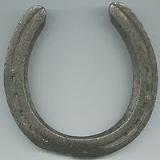
Horseshoe

Encyclopedia


Metal
A metal , is an element, compound, or alloy that is a good conductor of both electricity and heat. Metals are usually malleable and shiny, that is they reflect most of incident light...
, although sometimes made partially or wholly of modern synthetic materials, designed to protect a horse's hoof from wear and tear. Shoes are attached on the palmar surface of the hooves
Horse hoof
A horse hoof is a structure surrounding the distal phalanx of the 3rd digit of each of the four limbs of Equus species, which is covered by complex soft tissue and keratinised structures...
, usually nail
Nail (engineering)
In woodworking and construction, a nail is a pin-shaped, sharp object of hard metal or alloy used as a fastener. Formerly wrought iron, today's nails are typically made of steel, often dipped or coated to prevent corrosion in harsh conditions or improve adhesion...
ed through the insensitive hoof wall that is anatomically akin to the human toenail
Nail (anatomy)
A nail is a horn-like envelope covering the dorsal aspect of the terminal phalanges of fingers and toes in humans, most non-human primates, and a few other mammals. Nails are similar to claws, which are found on numerous other animals....
, though much larger and thicker. However, there are many cases where shoes are sometimes glue
Glue
This is a list of various types of glue. Historically, the term "glue" only referred to protein colloids prepared from animal flesh. The meaning has been extended to refer to any fluid adhesive....
d.
The fitting of horseshoes is a professional occupation, conducted by a farrier
Farrier
A farrier is a specialist in equine hoof care, including the trimming and balancing of horses' hooves and the placing of shoes on their hooves...
, who specializes in the preparation of feet, assessing potential lameness issues, and fitting appropriate shoes, including remedial features where required. In some countries, such as the United Kingdom, horseshoeing is legally restricted to only people with specific qualifications and experience. In other nations, such as the United States, where professional licensing is not legally required, professional organizations provide certification programs that publicly identify qualified individuals.
Horseshoes are available in a wide variety of materials and styles, developed for different types of horse and for the work they do. The most common materials are steel
Steel
Steel is an alloy that consists mostly of iron and has a carbon content between 0.2% and 2.1% by weight, depending on the grade. Carbon is the most common alloying material for iron, but various other alloying elements are used, such as manganese, chromium, vanadium, and tungsten...
and aluminum, but specialized shoes may include use of rubber
Rubber
Natural rubber, also called India rubber or caoutchouc, is an elastomer that was originally derived from latex, a milky colloid produced by some plants. The plants would be ‘tapped’, that is, an incision made into the bark of the tree and the sticky, milk colored latex sap collected and refined...
, plastic
Plastic
A plastic material is any of a wide range of synthetic or semi-synthetic organic solids used in the manufacture of industrial products. Plastics are typically polymers of high molecular mass, and may contain other substances to improve performance and/or reduce production costs...
, magnesium
Magnesium
Magnesium is a chemical element with the symbol Mg, atomic number 12, and common oxidation number +2. It is an alkaline earth metal and the eighth most abundant element in the Earth's crust and ninth in the known universe as a whole...
, titanium
Titanium
Titanium is a chemical element with the symbol Ti and atomic number 22. It has a low density and is a strong, lustrous, corrosion-resistant transition metal with a silver color....
, or copper
Copper
Copper is a chemical element with the symbol Cu and atomic number 29. It is a ductile metal with very high thermal and electrical conductivity. Pure copper is soft and malleable; an exposed surface has a reddish-orange tarnish...
. Steel tends to be preferred in sports where a strong, long-wearing shoe is needed, such as polo
Polo
Polo is a team sport played on horseback in which the objective is to score goals against an opposing team. Sometimes called, "The Sport of Kings", it was highly popularized by the British. Players score by driving a small white plastic or wooden ball into the opposing team's goal using a...
, eventing
Eventing
Eventing is an equestrian event comprising dressage, cross-country, and show jumping. This event has its roots in a comprehensive cavalry test requiring mastery of several types of riding...
, show jumping
Show jumping
Show jumping, also known as "stadium jumping," "open jumping," or "jumpers," is a member of a family of English riding equestrian events that also includes dressage, eventing, hunters, and equitation. Jumping classes commonly are seen at horse shows throughout the world, including the Olympics...
, and western riding
Western riding
Western riding is a style of horseback riding which evolved from the ranching and warfare traditions brought to the Americas by the Spanish Conquistadors, and both equipment and riding style evolved to meet the working needs of the cowboy in the American West...
events. Aluminum shoes are lighter, making them common in horse racing
Horse racing
Horse racing is an equestrian sport that has a long history. Archaeological records indicate that horse racing occurred in ancient Babylon, Syria, and Egypt. Both chariot and mounted horse racing were events in the ancient Greek Olympics by 648 BC...
, where a lighter shoe is desired; and often facilitate certain types of desired movement, and so are favored in the discipline of dressage
Dressage
Dressage is a competitive equestrian sport, defined by the International Equestrian Federation as "the highest expression of horse training." Competitions are held at all levels from amateur to the World Equestrian Games...
. Some horseshoes have "caulkin
Caulkin
A caulkin from the Latin calx is a blunt projection on a horseshoe that is often forged, welded or brazed onto the shoe. The term may also refer to traction devices screwed into the bottom of a horseshoe, also commonly called shoe studs or screw-in calks...
s", "caulks", or "calks": protrusions at the toe and/or heels of the shoe, to provide additional traction.
When kept as a talisman
Amulet
An amulet, similar to a talisman , is any object intended to bring good luck or protection to its owner.Potential amulets include gems, especially engraved gems, statues, coins, drawings, pendants, rings, plants and animals; even words said in certain occasions—for example: vade retro satana—, to...
, a horseshoe is said to bring good luck
Luck
Luck or fortuity is good fortune which occurs beyond one's control, without regard to one's will, intention, or desired result. There are at least two senses people usually mean when they use the term, the prescriptive sense and the descriptive sense...
. Many believe that to hang it with the ends pointing upwards is good luck as it acts as a storage container of sorts for any good luck that happens to be floating by, whereas to hang it with the ends pointing down, is bad luck as all the good luck will fall out. Others believe that the shoe should be hung the other way, as it will then release its luck to the people around it. A stylized variation of the horseshoe is used for a popular throwing game, horseshoes
Horseshoes
Horseshoes is an outdoor game played between two people using four horseshoes and two throwing targets set in a sandbox area. The game is played by the players alternating turns tossing horseshoes at stakes in the ground, which are traditionally placed 40 feet apart...
.
History

Domestication of the horse
There are a number of hypotheses on many of the key issues regarding the domestication of the horse. Although horses appeared in Paleolithic cave art as early as 30,000 BCE, these were truly wild horses and were probably hunted for meat. How and when horses became domesticated is disputed...
, working animal
Working animal
A working animal is an animal, usually domesticated, that is kept by humans and trained to perform tasks. They may be close members of the family, such as guide or service dogs, or they may be animals trained strictly to perform a job, such as logging elephants. They may also be used for milk, a...
s were found to be exposed to many conditions that created breakage or excessive hoof wear. Ancient people recognized the need for the walls (and sometimes the sole) of domestic horses' hooves to have additional protection over and above any natural hardness. An early form of hoof protection was seen in ancient Asia, where horses' hooves were wrapped in rawhide, leather or other materials for both therapeutic purposes and protection from wear.
The nailed shoe was a relatively late invention. The ancient Greek
Ancient Greece
Ancient Greece is a civilization belonging to a period of Greek history that lasted from the Archaic period of the 8th to 6th centuries BC to the end of antiquity. Immediately following this period was the beginning of the Early Middle Ages and the Byzantine era. Included in Ancient Greece is the...
horse trainer Xenophon
Xenophon
Xenophon , son of Gryllus, of the deme Erchia of Athens, also known as Xenophon of Athens, was a Greek historian, soldier, mercenary, philosopher and a contemporary and admirer of Socrates...
mentioned nothing about horseshoes in his treatise on the care of military cavalry, nor did the Digesta Artis Veterinariae by Vegetius Renatus, written in AD 480, mention nailed-on shoes, though he accurately enumerated everything connected with an army forge in the time. There are early literary references in the Koran, circa AD 632, to "war-horses… which strike fire, by dashing their hoofs against the stones…" which, if taken literally, is an effect that could be obtained only by shod horses, as barefoot hooves striking stone do not create sparks.
Because iron
Iron
Iron is a chemical element with the symbol Fe and atomic number 26. It is a metal in the first transition series. It is the most common element forming the planet Earth as a whole, forming much of Earth's outer and inner core. It is the fourth most common element in the Earth's crust...
was a valuable commodity, and any worn out items were generally melted down and reused, it is difficult to locate clear archaeological
Archaeology
Archaeology, or archeology , is the study of human society, primarily through the recovery and analysis of the material culture and environmental data that they have left behind, which includes artifacts, architecture, biofacts and cultural landscapes...
evidence of the earliest horseshoes. From archaeological finds in Great Britain
Great Britain
Great Britain or Britain is an island situated to the northwest of Continental Europe. It is the ninth largest island in the world, and the largest European island, as well as the largest of the British Isles...
, the Romans
Ancient Rome
Ancient Rome was a thriving civilization that grew on the Italian Peninsula as early as the 8th century BC. Located along the Mediterranean Sea and centered on the city of Rome, it expanded to one of the largest empires in the ancient world....
appeared to have attempted to protect their horses' feet with a strap-on, solid-bottomed "hipposandal
Hipposandal
The Hipposandal is a device that protected the hoof of a horse. It was commonplace in the countries of the Roman Empire and was a predecessor to the horseshoe....
" that has a slight resemblance to the modern hoof boot
Hoof boot
A hoof boot is a device made primarily of plastic or rubber and is designed to cover the hooves of a horse as an alternative to, and occasionally in addition to, horseshoes. It is often used as a protective device when the animal has a hoof injury that requires protection of the sole of the hoof,...
.
According to the Encyclopædia Britannica Eleventh Edition (1911),
There is very little evidence of nailed-on shoes prior to AD 500 or 600, though there is speculation that the Gauls
Gauls
The Gauls were a Celtic people living in Gaul, the region roughly corresponding to what is now France, Belgium, Switzerland and Northern Italy, from the Iron Age through the Roman period. They mostly spoke the Continental Celtic language called Gaulish....
were the first to nail on metal horseshoes. The nailed iron horseshoe first appeared in the archaeological record in Europe about 5th century A.D. when a horseshoe, complete with nails, was found in the tomb of the Frankish King Childeric I
Childeric I
Childeric I was a Merovingian king of the Salian Franks and the father of Clovis.He succeeded his father Merovech as king, traditionally in 457 or 458...
at Tournai, Belgium. The earliest clear written record of iron horseshoes is a reference to "crescent figured irons and their nails" in AD 910.
Around 1000 AD, cast bronze horseshoes with nail holes became common in Europe. Common was a design with a scalloped outer rim and six nail holes. The 13th and 14th centuries brought the widespread manufacturing of iron horseshoes. By the time of the Crusades
Crusades
The Crusades were a series of religious wars, blessed by the Pope and the Catholic Church with the main goal of restoring Christian access to the holy places in and near Jerusalem...
(1096–1270), horseshoes were widespread and frequently mentioned in various written sources. In that period, due to the value of iron, horseshoes were even accepted in lieu of coin to pay taxes.
By the 13th century, shoes were forged in large quantities and could be bought ready-made. Hot shoeing, the process of shaping a heated horseshoe immediately before placing it on the horse, became common in the 16th century. From the need for horseshoes, the craft of blacksmithing became "one of the great staple crafts of medieval and modern times and contributed to the development of metallurgy.” A treatise titled "No Foot, No Horse" was published in Great Britain in 1751.
In 1835, the first U.S. patent
Patent
A patent is a form of intellectual property. It consists of a set of exclusive rights granted by a sovereign state to an inventor or their assignee for a limited period of time in exchange for the public disclosure of an invention....
for a horseshoe manufacturing machine capable of making up to 60 horseshoes per hour was issued to Henry Burden.
In the mid 19th century Canada, marsh horseshoes kept horses from sinking into the soft intertidal mud during dike-building. In a common design, a metal horseshoe holds a flat wooden shoe in place.
Reasons for use of horseshoes

Environmental changes linked to domestication
.jpg)
Domestication of the horse
There are a number of hypotheses on many of the key issues regarding the domestication of the horse. Although horses appeared in Paleolithic cave art as early as 30,000 BCE, these were truly wild horses and were probably hunted for meat. How and when horses became domesticated is disputed...
have led to a need for shoes for number of reasons. Overall in captivity, horses' hooves harden much less and are more vulnerable to injury. In the wild, a horse may travel up to 50 miles per day to obtain adequate forage. While horses in the wild covered large areas of terrain, they usually did so at relatively slow speeds, unless being chased by a predator. They also tended to live in arid, steppe climates. The consequence of slow but nonstop travel in a dry climate is that horse's feet are naturally worn to a small, smooth, even and hard state. The continual stimulation of the sole of the foot keeps it thick and hard. However, in domestication
Domestication
Domestication or taming is the process whereby a population of animals or plants, through a process of selection, becomes accustomed to human provision and control. In the Convention on Biological Diversity a domesticated species is defined as a 'species in which the evolutionary process has been...
, the ways horses are used differs from their natural environment. Domesticated horses were moved in large numbers from the arid steppes to colder and wetter areas. These softer and heavier soils soften the hooves and have made them prone to splitting, making hoof protection necessary. Consequently, it was in northern Europe that the nailed horseshoe arose in its modern form.
Domesticated horses are also subject to inconsistent movement between stabling and work, they must carry or pull additional weight, and in modern times they are often kept and worked on very soft footing, such as irrigated land, arena footing, or stall bedding. In some cases, management is also inadequate. The hooves of horses that are kept in stalls or small turnouts, even when cleaned adequately, are still exposed to more moisture than would be encountered in the wild, as well as to ammonia from urine. The hoof capsule is mostly made from keratin, a protein
Protein
Proteins are biochemical compounds consisting of one or more polypeptides typically folded into a globular or fibrous form, facilitating a biological function. A polypeptide is a single linear polymer chain of amino acids bonded together by peptide bonds between the carboxyl and amino groups of...
, and is weakened by this exposure, becoming even more fragile and soft. Wearing shoes does not prevent or reduce damage from moisture and ammonia exposure. Rather, they protect already weakened hooves. Further, without the natural conditioning factors present in the wild, the feet of horses grow overly large and long unless trimmed regularly. Hence, protection from rocks, pebbles, and hard, uneven surfaces is lacking. A balanced diet with proper nutrition
Equine nutrition
Equine nutrition is the feeding of horses, ponies, mules, donkeys, and other equines. Correct and balanced nutrition is a critical component of proper horse care....
also is a factor. Without these precautions, cracks in overgrown and overly brittle hoof walls are a danger, as is bruising of the soft tissues within the foot because of inadequately thick and hard sole material.
Physical stresses requiring horseshoes
- Abnormal stress: Horses' hooves can become quite worn out when subjected to the added weight and stress of a rider, pack load, cart, or wagonWagonA wagon is a heavy four-wheeled vehicle pulled by draught animals; it was formerly often called a wain, and if low and sideless may be called a dray, trolley or float....
.
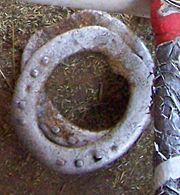
- Corrective shoeing: The shape, weight, and thickness of a horseshoe can significantly affect the horse's gait. FarrierFarrierA farrier is a specialist in equine hoof care, including the trimming and balancing of horses' hooves and the placing of shoes on their hooves...
s may forge custom shoes to help horses with bone or musculature problems in their legs, or fit commercially available remedial shoes. - Traction: Traction devices such as boriumBoriumBorium is a generic name for tungsten carbide granules embedded in a matrix of softer metal. Borium® is a registered trademark of Stoody Deloro Stellite, Inc., for a "Metal Alloy of Exceeding Hardness and Used For Drilling, Boring, and the Like". Borium is used in farriery to improve traction for...
for ice, horse shoe studs for muddy or slick conditions, calks, carbideTungsten carbideTungsten carbide is an inorganic chemical compound containing equal parts of tungsten and carbon atoms. Colloquially, tungsten carbide is often simply called carbide. In its most basic form, it is a fine gray powder, but it can be pressed and formed into shapes for use in industrial machinery,...
-tipped road nails and rims are useful for performance horses such as eventersEventingEventing is an equestrian event comprising dressage, cross-country, and show jumping. This event has its roots in a comprehensive cavalry test requiring mastery of several types of riding...
, show jumpersShow jumpingShow jumping, also known as "stadium jumping," "open jumping," or "jumpers," is a member of a family of English riding equestrian events that also includes dressage, eventing, hunters, and equitation. Jumping classes commonly are seen at horse shows throughout the world, including the Olympics...
, polo poniesPoloPolo is a team sport played on horseback in which the objective is to score goals against an opposing team. Sometimes called, "The Sport of Kings", it was highly popularized by the British. Players score by driving a small white plastic or wooden ball into the opposing team's goal using a...
, and other horses that perform at high speeds, over changing terrain, or in less-than-ideal footing. - Gait manipulation: Some breeds such as the Saddlebred, Tennessee Walking Horse, and other gaited horses are judged on their high-stepping movement. Special shoeing can help enhance their natural movement.
- Racing horses with weakness in their foot or leg require specialized horseshoes.
Horseshoeing theories and debates
Horseshoes have always been viewed as an aid to assist horses' hooves when subjected to the various unnatural conditions brought about by domestication, whether due to work conditions or stabling and management. Countless generations of domestic horses bred for size, color, speed, and many other traits with little regard for hoof quality and soundness make some breeds more dependent on horseshoes than feral horseFeral horse
A feral horse is a free-roaming horse of domesticated ancestry. As such, a feral horse is not a wild animal in the sense of an animal without domesticated ancestors. However, some populations of feral horses are managed as wildlife, and these horses often are popularly called "wild" horses...
s such as mustangs
Mustang (horse)
A Mustang is a free-roaming horse of the North American west that first descended from horses brought to the Americas by the Spanish. Mustangs are often referred to as wild horses, but there is intense debate over terminology...
, which develop strong hooves as a matter of natural selection
Natural selection
Natural selection is the nonrandom process by which biologic traits become either more or less common in a population as a function of differential reproduction of their bearers. It is a key mechanism of evolution....
.
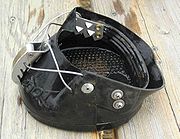
Farrier
A farrier is a specialist in equine hoof care, including the trimming and balancing of horses' hooves and the placing of shoes on their hooves...
s that when possible, a barefoot hoof, at least for part of every year, is a healthy option for most horses. However, other farriers are equally adamant that horseshoes have their place and can help prevent excess or abnormal hoof wear and injury to the foot. Many farriers agree that some horses may even be able to go without shoes year-round, using temporary protection such as hoof boot
Hoof boot
A hoof boot is a device made primarily of plastic or rubber and is designed to cover the hooves of a horse as an alternative to, and occasionally in addition to, horseshoes. It is often used as a protective device when the animal has a hoof injury that requires protection of the sole of the hoof,...
s for short-term use.
Recently, there has been a renewed debate over the traditional role of horseshoes. Observations of feral horse
Feral horse
A feral horse is a free-roaming horse of domesticated ancestry. As such, a feral horse is not a wild animal in the sense of an animal without domesticated ancestors. However, some populations of feral horses are managed as wildlife, and these horses often are popularly called "wild" horses...
s and barefoot domestic horses in natural boarding situations (including being kept on roomy pasture, not in stalls) have provided additional evidence that domesticated horses can grow hooves as healthy as those of feral horses and may not need shoes as often as many people think. Proponents of this idea, also known as the barefoot horse movement, argue that with proper care, horses may never need shoes at any time once they have been properly transitioned. Thus, the debate of when, where, why and whether to use horseshoes is a hot topic today.
Process of shoeing
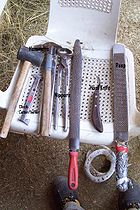
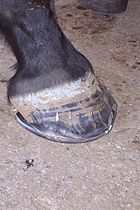
Manicure
A manicure is a cosmetic beauty treatment for the fingernails and hands performed at home or in a nail salon. A manicure treatment is not only a treatment for the natural nails but also for the hands. A manicure consists of filing, shaping of the free edge, treatments, massage of the hand and the...
on a human fingernail, only on a much larger scale.
Before beginning to shoe, the farrier removes the old shoe using pincers (shoe pullers) and trims the hoof wall to the desired length with nippers, a sharp pliers-like tool, and the sole and frog
Frog (horse)
The frog is a part of a horse's hoof, located on the underside, which should touch the ground if the horse is standing on soft footing. The frog is triangular in shape, and extends from the heels to mid-way toward the toe, covering around 25% of the bottom of the hoof...
of the hoof with a hoof knife. Shoes do not allow the hoof to wear down as it naturally would in the wild, and it can then become too long. The coffin bone inside the hoof should line up straight with both bones in the pastern
Pastern
The pastern is a part of the leg of a horse between the fetlock and the top of the hoof. It incorporates the long pastern bone and the short pastern bone , which are held together by two sets of paired ligaments to form the pastern joint...
. If the excess hoof is not trimmed, the bones will become misaligned, which would place stress on the legs of the animal.
Shoes are then measured to the foot and bent to the correct shape using a hammer and anvil, and other modifications, such as taps for shoe studs
Shoe studs
Shoe studs may refer to:*Caulkin or calks on a horseshoe*Cleat on a human shoe*The sole studs of Caulk boots, which are similar to cleats....
, are added. Farriers may either cold shoe, in which he bends the metal shoe without heating it, or hot shoe, in which he places the metal in a forge before bending it. Hot shoeing can be more time-consuming, and requires the farrier to have access to a forge; however, it usually provides a better fit, as the mark made on the hoof from the hot shoe can show how even it lies. It also allows the farrier to make more modifications to the shoe, such as drawing toe- and quarter-clips. The farrier must take care not to hold the hot shoe against the hoof too long, as the heat can damage the hoof.
Hot shoes are placed in water to cool them off. The farrier then nails the shoes on, by driving the nails into the hoof wall at the white line
Horse hoof
A horse hoof is a structure surrounding the distal phalanx of the 3rd digit of each of the four limbs of Equus species, which is covered by complex soft tissue and keratinised structures...
of the hoof. The nails are shaped in such a way that they bend outward as they are driven in, avoiding the sensitive inner part of the foot, so they emerge on the sides of the hoof. When the nail has been completely driven, the farrier cuts off the sharp points and uses a clincher (a form of tongs made especially for this purpose) or a clinching block with hammer to bend the rest of the nail so it is almost flush with the hoof wall. This prevents the nail from getting caught on anything, but also helps to hold the nail (and therefore the shoe) in place.
The farrier then uses a rasp (large file), to smooth the edge where it meets the shoe and eliminate any sharp edges left from cutting off the nails.
Shoeing mistakes
Mistakes are sometimes made by even a skilled farrier, especially if the horse does not stand still. This may sometimes result in a nail coming too close to the sensitive part of the hoof (putting pressure on it), or a nail that is driven slightly into the sensitive hoof, called "quicking" or nail pricking. This occurs when a nail penetrates the wall and hits the sensitive internal structures of the foot. Quicking results in bleeding and pain and the horse may show signs of lamenessLameness (equine)
Lameness in horses and other equidae is a term used to refer to any number of conditions where the animal fails to travel in a regular and sound manner on all four feet...
or may become lame in following days. Whenever it happens, the farrier must remove the offending nail. Usually a horse that is quicked will react immediately, though some cases where the nail is close to sensitive structures may not cause immediate problems. These mistakes are made occasionally by anyone who shoes horses, and in most cases is not an indication that the farrier is unskilled. It happens most commonly when horses move around while being shod, but also may occur if the hoof wall is particularly thin (common in Thoroughbred
Thoroughbred
The Thoroughbred is a horse breed best known for its use in horse racing. Although the word thoroughbred is sometimes used to refer to any breed of purebred horse, it technically refers only to the Thoroughbred breed...
s), or if the hoof wall is brittle or damaged. It may also occur with an inexperienced or unskilled horseshoer who misdrives a nail, uses a shoe that is too small, or has not fitted the shoe to the shape of the horse's hoof. Occasionally, manufacturing defects in nails or shoes may also cause a misdriven nail that quicks a horse.
However, the term "farrier" implies a professional horseshoer with skill, education, and training. Some people who shoe horses are untrained or unskilled, and likely to do more harm than good for the horse. People who do not understand the horse's foot will not trim the hoof correctly. This can cause serious problems for the animal, resulting in chronic lameness and damage to the hoof wall. Poor trimming will usually place the hoof at an incorrect angle, leave the foot laterally unbalanced and may cut too much off certain areas of the hoof wall, or trim too much of the frog or sole. Some horseshoers will rasp the hoof down to fit an improperly shaped or too-small size of shoe, which is damaging to the movement of the horse and can damage the hoof itself if trimmed or rasped too short. A poor horseshoer can also make mistakes in the shoeing process itself, not only quicking a horse, but also putting shoe on crooked, using the wrong type of shoe for the job at hand, shaping the shoe improperly, or setting it on too far forward or back.
Folklore
The horseshoe is presented as a talisman in The True Legend of St. DunstanDunstan
Dunstan was an Abbot of Glastonbury Abbey, a Bishop of Worcester, a Bishop of London, and an Archbishop of Canterbury, later canonised as a saint. His work restored monastic life in England and reformed the English Church...
and the Devil; Showing how the Horse-Shoe came to be a Charm against Witchcraft, written in 1871 by Edward G. Flight, with illustrations by George Cruikshank
George Cruikshank
George Cruikshank was a British caricaturist and book illustrator, praised as the "modern Hogarth" during his life. His book illustrations for his friend Charles Dickens, and many other authors, reached an international audience.-Early life:Cruikshank was born in London...
and engravings by John Thompson.

Superstition
Superstition is a belief in supernatural causality: that one event leads to the cause of another without any process in the physical world linking the two events....
sailors believe nailing a horseshoe to the mast will help their vessel avoid storms.
External links
- Historical development of the horseshoe 1891 Scientific AmericanScientific AmericanScientific American is a popular science magazine. It is notable for its long history of presenting science monthly to an educated but not necessarily scientific public, through its careful attention to the clarity of its text as well as the quality of its specially commissioned color graphics...
article from Project GutenbergProject GutenbergProject Gutenberg is a volunteer effort to digitize and archive cultural works, to "encourage the creation and distribution of eBooks". Founded in 1971 by Michael S. Hart, it is the oldest digital library. Most of the items in its collection are the full texts of public domain books... - The True Legend of St. Dunstan and the Devil by Edward G. Flight, illustrated by George CruikshankGeorge CruikshankGeorge Cruikshank was a British caricaturist and book illustrator, praised as the "modern Hogarth" during his life. His book illustrations for his friend Charles Dickens, and many other authors, reached an international audience.-Early life:Cruikshank was born in London...
, published in 1871, and available from Project GutenbergProject GutenbergProject Gutenberg is a volunteer effort to digitize and archive cultural works, to "encourage the creation and distribution of eBooks". Founded in 1971 by Michael S. Hart, it is the oldest digital library. Most of the items in its collection are the full texts of public domain books...