
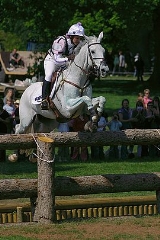
Eventing is an
equestrianEquestrianism more often known as riding, horseback riding or horse riding refers to the skill of riding, driving, or vaulting with horses...
event comprising
dressageDressage is a competitive equestrian sport, defined by the International Equestrian Federation as "the highest expression of horse training." Competitions are held at all levels from amateur to the World Equestrian Games...
,
cross-countryCross country equestrian jumping is an endurance test, and is one of the three phases of the sport of eventing; it may also be a competition in its own right, known as hunter trials or simply "cross-country" - these tend to be lower level, local competitions.The object of the endurance test is to...
, and
show jumpingShow jumping, also known as "stadium jumping," "open jumping," or "jumpers," is a member of a family of English riding equestrian events that also includes dressage, eventing, hunters, and equitation. Jumping classes commonly are seen at horse shows throughout the world, including the Olympics...
. This event has its roots in a comprehensive cavalry test requiring mastery of several types of riding. The competition may be run as a one-day event (ODE), where all three events are completed in one day (dressage, followed by show jumping and then cross country) or a three-day event (3DE), which is more commonly now run over four days, with dressage on the first two days followed by cross country the next day and then show jumping in reverse order on the final day. Eventing was previously known as Combined Training, but this usually now refers to a combination of just two of the events, most commonly dressage and show jumping.
The Phases
Eventing is an equestrian
triathlonA triathlon is a multi-sport event involving the completion of three continuous and sequential endurance events. While many variations of the sport exist, triathlon, in its most popular form, involves swimming, cycling, and running in immediate succession over various distances...
, in that it combines three different disciplines in one competition set out over one, two, or three days, depending on the length of courses and number of entries.
Dressage
The
dressageDressage is a competitive equestrian sport, defined by the International Equestrian Federation as "the highest expression of horse training." Competitions are held at all levels from amateur to the World Equestrian Games...
phase (held first) consists of an exact sequence of movements ridden in an enclosed arena (20x60m for International 3DE but usually 20x40 for ODE). The test is judged by one or more judges who are looking for balance, rhythm, suppleness, and most importantly, obedience of the horse and its harmony with the rider. The challenge is to demonstrate that a supremely fit horse, capable of completing the cross country phase on time, also has the training to perform in a graceful, relaxed and precise manner.
At the highest level of competition, the dressage test is roughly equivalent to the USDF Third Level, and may ask for
half-passThe half-pass is a lateral movement seen in dressage, in which the horse moves forward and sideways at the same time. Unlike the easier leg-yield, the horse is bent in the direction of travel, slightly around the rider's inside leg. The outside hind and forelegs should cross over the inside legs,...
at trot,
shoulder-inThe shoulder-in is a lateral movement in dressage used to supple and balance the horse and encourage use of its hindquarters. It is performed on three tracks, where the horse is bent around the rider's inside leg so that the horse's inside hind leg and outside foreleg travel on the same line...
,
traversHaunches-in is a lateral movement used in the dressage discipline of horse training. It has a close cousin, haunches-out , that is slightly more difficult...
, collected, medium and extended gaits, single flying changes, and counter-canter. The tests may
not ask for Grand Prix movements such as
piaffeThe piaffe[p] is a dressage movement where the horse is in a highly collected and cadenced trot, in place or nearly in place. The center of gravity of the horse should be more towards the hind end, with the hindquarters slightly lowered and great bending of the joints in the hind legs...
or
passageThe passage is a movement seen in upper-level dressage, in which the horse performs a highly elevated and extremely powerful trot. The horse is very collected and moves with great impulsion....
.
Each movement in the test is scored on a scale from 0 to 10, with a score of "10" being the highest possible mark and with the total maximum score for the test varying depending on the level of competition and the number of movements. Therefore, if one movement is poorly executed, it is still possible for the rider to get a good overall score if the remaining movements are very well executed. The marks are added together and any errors of course deducted. To convert this score to penalty points, the average marks of all judges are converted to a percentage of the maximum possible score, multiplied by a co-efficient decided by the governing body and then subtracted from 100.
- Once the bell rings the rider is allowed 45 seconds to enter the ring or is eliminated.
- If all four feet of the horse exit the arena during the test, this results in elimination.
- If the horse resists more than 20 seconds during the test, this results in elimination.
- Errors on course:
- 1st Error = minus 2 marks
- 2nd Error = minus 4 marks
- 3rd Error = elimination
Cross-country
The next phase,
cross-countryCross country equestrian jumping is an endurance test, and is one of the three phases of the sport of eventing; it may also be a competition in its own right, known as hunter trials or simply "cross-country" - these tend to be lower level, local competitions.The object of the endurance test is to...
, requires both horse and rider to be in excellent physical shape and to be brave and trusting of each other. This phase consists of approximately 12–20 fences (lower levels), or 30–40 at the higher levels, placed on a long outdoor circuit. These fences consist of very solidly built natural objects (telephone poles, stone walls, etc.) as well as various obstacles such as ponds and streams, ditches, drops and banks, and combinations including several jumping efforts based on objects that would commonly occur in the countryside. Sometimes, particularly at higher levels, fences are designed that would not normally occur in nature. However, these are still designed to be as solid as more natural obstacles. Safety regulations mean that some obstacles are now being built with a "frangible pin system," allowing part or all of the jump to collapse if hit with enough impact. Speed is also a factor, with the rider required to cross the finish line within a certain time frame (optimum time). Crossing the finish line after the optimum time results in penalties for each second over. At lower levels, there is also a speed fault time, incurring penalties for horse and rider pairs completing the course too quickly. For every "disobedience"(refusal or run-out of a jump) a horse and rider incur on course, penalities will be added to their dressage score. After 3 disobediences the pair is eliminated, meaning they can no longer participate in the competition. A horse and rider pair can also be eliminated for going off course, for example missing a fence. Should the horses shoulder or hind-quarter touch the ground, mandatory requirement is taken and they are not allowed to participate further in the competition. If the rider should fall off the horse they are eliminated. However in the US this rule is currently being revised for the Training level and below. The penalties for disobediences on cross country are weighted severely relative to the other phases of competition to emphasize the importance of courage, endurance and athleticism. Fitness is required as the time allowed will require a strong canter at the lower levels, all the way to a strong gallop at the higher events.
In recent years, a controversy has developed between supporters of short and long format three-day events. Traditionally, three day events had dressage, endurance and show jumping. Endurance day consisted of 4 phases, A, B, C and D. Phase A and C were roads and tracks, with A being a medium-paced warm up to prepare the horse and rider for Phase B, a steeplechase format at an extremely fast pace over steeplechase-style fences. Phase C was a slow-paced cool down coming off of Phase B, in preparation for the toughest and most demanding phase, D, or cross-country. Before embarking on Phase D, in the "ten-minute box," horses had to be approved to continue by a vet, who monitored their temperature and
heart rateThe circulatory system of the horse consists of the heart, the blood vessels, and the blood.-The heart:The equine heart is made of muscle tissue, more rounded in shape than a human's, built with the sole purpose of pumping blood throughout the body...
, ensuring that the horse was sound and fit.
Three day events are now offered in the classic format, with endurance day, or short-format, with no steeplechase (phase B) or roads and tracks (phases A and C). The 2004 Olympic Summer Games in Athens, Greece chose the short format, due to lack of facilities, time and financing, which sparked a large debate in the eventing community whether to keep the steeplechase phase or just offer cross-country. Today, most events are run short-format, except for a few one-star competitions.
Due to major injuries at Red Hills and Rolex in 2008, the rules were changed drastically. The change stated that a fall anywhere during the cross-country phase resulted in elimination, even if the rider was galloping on course and not approaching a jump, or in the middle of a combination. Also, a new rule created elimination for riding in jumping phases without a medical arm band carrying information about the rider's medical history, insurance, medications, and blood type.
Scoring
- Refusal, run-out, or circle at an obstacle: 20 penalties
- Second refusal, run-out, circle at the same obstacle: 40 penalties
- Third refusal, run-out, circle on cross-country course: Elimination (E)
- Fall of rider: Elimination (E)
- Fall of horse (shoulder and hind touch the ground): Elimination (E)
- Exceeding Optimum Time: 0.4 penalties per second
- Coming in under Speed Fault Time: 1 penalties per second (lower national levels in some countries only)
- Exceeding the Time Limit (twice the optimum time): Elimination (E)
Other faults
- Competing with improper saddlery: Elimination (E)
- Jumping without headgear or a properly fastened harness: Elimination (E)
- Error of course not rectified: Elimination (E)
- Omission of obstacle: Elimination (E)
- Jumping an obstacle in the wrong order: Elimination (E)
- Jumping an obstacle in the wrong direction: Elimination (E)
- Retaking an obstacle already jumped: Elimination (E)
- Dangerous riding, at determination of the Ground Jury: Elimination (usually with a warning before elimination) (E)
- Failure to wear medical armband: Elimination (at discretion of Ground Jury) (E)
Types of obstacles
A combination is always considered one obstacle, and the various elements within the combination are lettered "A", "B", "C" and so on. In Cross-country, the rider need only retake the element they refused rather than the whole complex. So a refusal at element B does not require them to jump A again. However, they have the option of retaking the previous elements if they wish. For example, in a bounce type obstacle it may be physically impossible to approach B without first clearing A. Yet for some in and outs, you can go to B and not have to rejump A.
Many cross-country obstacles have several possible routes to take (for example, at obstacle 5 there may be two A, two B, and two C elements), with one route usually being faster but requiring a more skillful ride or more physical effort from the horse. A rider may take any of the possible routes as long as they pass over each letter once. Additionally, after a refusal, they may jump a different obstacle in its place, as long as it is the same letter. For example, if a refusal occurs at B, the rider may jump an alternative obstacle that is marked B to help avoid a second refusal, but may not jump a second A element in place of the B element.
A refusal at A is a first refusal, and would receive 20 penalties. Whether the rider retakes A or not, a subsequent refusal at B is a second refusal and so on. Three refusals at any one obstacle results in elimination, as does 4 refusals on the entire course.
Veterinary inspection, or "Trot Up"/"Horse Inspection"
Before the beginning of a three-day event, and also before the last phase, horses are inspected by a vet to ensure that they are fit to compete further. It is usually a very formal affair, with well-groomed and braided horses, and nicely dressed riders. It is also a very nerve-racking time, as the "pass" or "fail" determines whether the horse may continue with the competition. A vet can request that a horse is sent to the holding box, when it will then be re-assessed before being allowed to continue.
In lower levels of competition the horse's movement may be analyzed as they finish the cross-country, where they will be asked to trot briefly after crossing the finishing line to satisfy the vet of their soundness.
Show jumping
Show jumping tests the technical jumping skills of the horse and rider, including suppleness, obedience, fitness and athleticism. In this phase, 12–20 fences are set up in a ring. These fences are typically brightly colored and consist of elements that can be knocked down, unlike cross country obstacles. This phase is also timed, with penalties being given for every second over the required time. In addition to normal jumping skills, eventing show jumping tests the fitness and stamina of the horse and rider, generally being held after the cross-country phase in higher level and international events.
Scoring
- Knocking down an obstacle: 4 penalties
- First Disobedience (refusal, run-out, circle, moving backwards): 4 penalties
- Second Disobedience in the whole round: 4 penalties
- First Fall of rider: Elimination
- Fall of horse: Elimination
- Exceeding the time allowed: 1 penalty per second
- Jumping an obstacle in the wrong order: Elimination
- Error of course not rectified: Elimination
An obstacle is defined as having been knocked down if any part of it is lowered. It is therefore possible to knock out a pole below the top pole and receive no penalties.
The winner is the horse and rider with the fewest penalties. Awards are usually presented while mounted, before the placed riders take a lap of honor around the arena.
The Olympic beginning
Eventing competition that resembles the current three-day were first held in 1902, at the Championnat du Cheval d'Armes in France, but were not introduced into the
Olympic GamesEquestrianism made its Summer Olympics debut at the 1900 Summer Olympics in Paris, France. It disappeared until 1912, but has appeared at every Summer Olympic Games since. The current Olympic equestrian disciplines are Dressage, Eventing, and Jumping...
until 1912.
DressageDressage is a competitive equestrian sport, defined by the International Equestrian Federation as "the highest expression of horse training." Competitions are held at all levels from amateur to the World Equestrian Games...
originally demonstrated the horse's ability to perform on the parade ground, where elegance and obedience were key.
Cross-countryCross country equestrian jumping is an endurance test, and is one of the three phases of the sport of eventing; it may also be a competition in its own right, known as hunter trials or simply "cross-country" - these tend to be lower level, local competitions.The object of the endurance test is to...
began as a test of stamina, courage, and bravery over difficult terrain, important for a charger on long marches or if the horse was asked to carry a dispatch across country. The
stadium jumpingShow jumping, also known as "stadium jumping," "open jumping," or "jumpers," is a member of a family of English riding equestrian events that also includes dressage, eventing, hunters, and equitation. Jumping classes commonly are seen at horse shows throughout the world, including the Olympics...
phase sought to prove the horse's continuing soundness and fitness after the difficult cross-country day.
The Olympic eventing competition was originally open only to male military officers in active duty, mounted only on military charges. In 1924, the event was open to male civilians, although
non-commissioned Army officersA non-commissioned officer , called a sub-officer in some countries, is a military officer who has not been given a commission...
could not participate in the Olympics until 1956. Women were first allowed to take part in 1964; equestrian sports are one of the few Olympic sports in which men and women compete against one another.
Format
The original format, used in the
1912 OlympicsThe individual eventing was an equestrian event held as part of the equestrian at the 1912 Summer Olympics programme. It was the first appearance of the event....
, was spread over several days:
- Day 1: Endurance Test – 55 km (34.2 mi) of roads and tracks (with a time allowed of 4 hours, giving a speed of approx. 230 meters per minute) immediately followed by 5 km of a flagged cross-country course at a speed of 333 meters per minute. Time penalties were given for exceeding the time allowed, but no bonus points were given for being fast.
- Day 2: Rest Day
- Day 3: Steeplechase
The steeplechase is a form of horse racing and derives its name from early races in which orientation of the course was by reference to a church steeple, jumping fences and ditches and generally traversing the many intervening obstacles in the countryside...
test of 3.5 km with 10 plain obstacles, at a speed of 600 mpm, with time penalties but no time bonus points
- Day 4: Jumping Test ("Prize Jumping"), which was considered easy by most of the spectators
- Day 5: Dressage Test ("Prize Riding")
The
Paris GamesThe 1924 Summer Olympics, officially known as the Games of the VIII Olympiad, were an international multi-sport event which was celebrated in 1924 in Paris, France...
in 1924 introduced a format very similar to the one of today: with Day 1 Dressage, Day 2 the Endurance Test, and Day 3 the Jumping Test. The Endurance Test has changed the most since that time. Originally, bonus points could be earned for a fast ride cross-country (less than the optimum time). This helped competitors make up for a poor dressage ride, with a clean, fast cross-country ride. This system, however, was dropped in 1971. The format for the endurance test occurred as below:
- Phase A: Short roads and tracks (with five penalties per 5 seconds over time)
- Phase B: Steeplechase, decreased in speed from 600 mpm to 550 mpm (with 10 penalties added per 5 seconds over the time, 3 bonus points per 5 seconds under time)
- Phase C: Long roads and tracks (with 5 penalties per 5 seconds over time)
- Compulsory Halt (now the 10-minute halt)
- Phase D: Cross-country (with 10 penalties added per 5 seconds over the time, 3 bonus points per 10 seconds under time)
- Phase E: 1¼ mile run on the flat (with 5 penalties per 5 seconds over time).
(Note: Phase E was abolished in 1967.)
In 1963, the 10-minute halt was introduced, to occur after the completion of phases A, B, and C. It took place in a marked out area (the 10-minute box), where the horse was checked by two judges and one veterinary official who would make sure the horse was fit to continue onto phase D. If the horse was unfit, the panel would pull it from the competition.
The format of the sport underwent major changes in 2004 and 2005, with the creation of the "short" or "modified format," which excluded phases A, B, and C from endurance day. The primary reason for excluding these phases was that the Olympic Committee was considering dropping the sport of eventing from the Olympics because of the cost and large area required for the speed and endurance phase with a steeplechase course and several miles of roads-and-tracks. To prevent the elimination of the sport from the Olympics program, the "short format" was developed by the FEI. The last Olympic Games that included the long, or "classic", three-day format was the 2000 Summer Games in Sydney, while
Rolex KentuckyThe Rolex Kentucky Three Day Event is an eventing competition held at the Kentucky Horse Park in Lexington, Kentucky. The Rolex Kentucky is a CCI**** eventing competition, and the only four-star show in the Western Hemisphere. Four stars is the highest level of competition, the same level of...
, the
Badminton Horse TrialsThe Badminton Horse Trials is a three-day event, one of only six annual Concours Complet International Four Star **** events as classified by the Fédération Équestre Internationale , which takes place in April or May each year in the park of Badminton House, the seat of the Dukes of Beaufort in...
, and
Burghley Horse TrialsThe Land Rover Burghley Horse Trials is an annual three day event held at Burghley House near Stamford, Lincolnshire, England, currently in early September...
ran their last long format three-day in 2005. The short format is now the standard for international competition, such as the Olympics and
World Equestrian GamesThe FEI World Equestrian Games are the major international championships for equestrianism, and administered by the Fédération Equestre Internationale . The games have been held every four years, halfway between sets of consecutive Summer Olympic Games, since 1990...
.
The change in format has brought about controversy. Some riders support the continuation of the classic format, believing it is the "true test of horse and rider". Others believe the classic format is superior because it teaches horsemanship, due to the extra preparation needed to condition the horse and the care required after the several miles of endurance day. However, some upper-level riders claim to prefer the short format, as they believe it saves wear-and-tear on their horses and allows the horse not only to compete in more three-day events each season, but decreases the chance of injury to the horse. However, this claim has not held true in several recent studies that compared injuries sustained in classic and in short format competitions over equivalent courses. Further, some research indicates that horses are more stressed by the short format than by the careful warm-up inherent in the classic format. Regardless, many upper-level riders prepare their horses for the short format using the same conditioning and training as for the long format. The short format has also been widely urged by breeders of heavier, warmblood-type horses. The long format has remained popular at the Preliminary, or one star, level in the United States, and with riders who feel it maximizes horsemanship.
Penalty point system
In 1971, the penalty point system was first introduced into eventing. This system converts the dressage score and all jump penalties on cross-country and show jumping into penalty points, with the horse and rider with the fewest number of points winning the event. Different weight is given for each phase, with the cross-country — the heart of eventing — being the most important, followed by the dressage, and then the show jumping. The intended ratio of cross-country:dressage:show jumping is theoretically 12:3:1. Therefore, an error in cross-country counts heavily. This prevents horses that are simply good in dressage (for example) from winning the event with a poor cross-country test.
In 1971, the following penalty system was instituted:
- Phase A and C: 1 penalty per second over the optimum time
- Phase B: 0.8 penalties per second over
- Phase D: 0.4 penalties per second over
In 1977, the dressage scoring was changed, with each movement marked out of ten rather than out of six. This increased the maximum number of dressage marks from 144 to 240. This number later increased to 250 marks in 1998, after additional movements were added. To keep the correct weight, a formula is used to convert good marks in dressage to penalty points. First, the marks of the judges (if there is more than one) are averaged. Then the raw mark is subtracted from the maximum points possible. This number is then multiplied by 0.6 to calculate the final penalty score.
Show jumping rules were also changed in 1977, with a knock-down or a foot in the water awarded only 5 penalties rather than ten. This prevented the show jumping phase from carrying too much weight, again, to keep the ratio between the phases correct.
Non-Olympic competition
In its early days, the sport was most popular in Britain, and the British gave the competition a new name, the "Three-Day Event," due to the three day time span of the competition. In America, the sport was also called "combined training," due to the three different disciplines and types of training methods needed for the horse. In the
United KingdomThe United Kingdom of Great Britain and Northern IrelandIn the United Kingdom and Dependencies, other languages have been officially recognised as legitimate autochthonous languages under the European Charter for Regional or Minority Languages...
, "combined training" competition includes only the dressage and show jumping phases.
The first annual, Olympic-level event developed was the
Badminton Horse TrialsThe Badminton Horse Trials is a three-day event, one of only six annual Concours Complet International Four Star **** events as classified by the Fédération Équestre Internationale , which takes place in April or May each year in the park of Badminton House, the seat of the Dukes of Beaufort in...
, held each year in England. First held in 1949, the Badminton event was created after a poor performance by the British Eventing Team at the 1948 Olympic Games, with the purpose of being a high-class preparation event, and as extra exposure for the military horses, who very rarely had the chance to compete. Initially, only British riders were allowed to compete (although women were allowed, despite being banned from riding in the Olympics), but the competition is now an international open to all riders from around the world who have qualified for this level of competition. Badminton is the most prestigious events to win in the world. Currently, the Olympic event is consider a CCI***, a rank lower than Badminton which is a CCI****.
The second three-day competition to be held at Olympic level each year was the
Burghley Horse TrialsThe Land Rover Burghley Horse Trials is an annual three day event held at Burghley House near Stamford, Lincolnshire, England, currently in early September...
, first held in 1961. Burghley is the longest running international event.
The first CCI held outside of Britain on an annual basis is the
Rolex Kentucky Three DayThe Rolex Kentucky Three Day Event is an eventing competition held at the Kentucky Horse Park in Lexington, Kentucky. The Rolex Kentucky is a CCI**** eventing competition, and the only four-star show in the Western Hemisphere. Four stars is the highest level of competition, the same level of...
, held each year in Lexington since 1978.
Importance of dressage training
In the early years, the dressage phase was fairly inconsequential in determining the final standings. It was quite possible for a horse to have a terrible dressage test, then run a clean cross-country and show jumping, and still finish near the top of the standings. Since then, correct dressage training has become increasingly important should a horse and rider wish to be placed (complete all sections, and finish in the top 12). This can be traced back to
Sheila WillcoxSheila Willcox is a Britain-born eventer who won many notional and international three-day events, including the Badminton Horse Trials and the European Championships. She won Badminton three consecutive years , and was the first woman rider in the UK to achieve international success.Born in 1937,...
who took a particular interest in dressage, becoming abundantly clear when she won Badminton three years running in the 1950s. She had a strong influence on
Mary KingMary Elizabeth King is a British Olympic equestrian sportswoman who has represented Great Britain at five Olympics from 1992 to 2008, winning one silver and one bronze medal in the team eventing...
and
Lucinda GreenLucinda Green MBE is a champion British equestrian and journalist who before her marriage was Lucinda Jane Prior-Palmer.-Family:...
amongst others.
After the 2000 Olympic Games, the
FEIFEI may refer to:* Financial Executives International , an American organization for senior-level financial executives* FEI Company, a supplier of electron microscopy tools...
hired British eventer and dressage rider
Christopher BartleChristopher Bartle is a British equestrian who has enjoyed success in both Dressage and Eventing. He is currently the Managing Director of the Yorkshire Riding Centre and from 2001 together with Hans Melzer, he is the German 3 Day Eventing National Team Trainer...
to write new dressage tests for the upper level events, which would include a greater deal of collection. This has since raised the standard even further in the dressage phase.
Additionally, the cross-country phase has become more technical, asking the horse to be adjustable and supple through combinations. A horse can no longer just be brave and athletic, but must have a good deal of dressage training should his rider wish to successfully negotiate odd distances or bending lines at a gallop. Also, in show jumping, a horse is asked to move with impulsion and engagement; this makes the jump more fluent, brings the horse to bascule more correctly, and is less jarring for both horse and rider.
Safety
Between 1997 and December 2008, at least 37 eventing riders died as a result of injuries incurred while competing in the cross-country phase of eventing at national or international level or at Pony Club. Of these, 18 riders died in the period 2006–2008. These 37 fatal falls have been at all levels of the sport, from domestic one-day events up to regional championships level, and they have occurred in most of the recognized eventing countries around the world, with concentrations in the United Kingdom (14) and the United States (8). At least 25 of these 37 deaths have resulted from a somersaulting (rotational) fall of the horse, with 11 of the 16 deaths in 2007 and 2008 being reported as having resulted from a rotational horse fall.
Information about horse fatalities is difficult to locate, but at least 19 eventing horses, many of them top-level performers, died in 2007 & 2008, most of them in the US.
Over time, course design has become increasingly more focused on the safety of the horse and rider. Fences are built more solidly than in the earlier days, encouraging a bold jump from the horse, which actually helps prevent falls. The layout of the course and the build of the obstacles encourage the horse to have a successful run. This includes a greater use of precision fences, such as corners and "skinny jumps," that are very good tests of the rider's ability and the horse's training, but allow the horse to simply run around the jump if the rider misjudges it. Safety measures such as filling in the area between corner-shaped jumps on cross-country or rails of a fence help prevent the entrapment of the legs of the horse decrease the number of serious falls or injuries.
The newest improvement in cross-country safety is the
frangible fence, which uses a pin and other techniques which allow the fence to "break or fall" in a controlled manner to minimize the risk of injury to horse and rider. This can help to prevent the most dangerous situation on cross-country, when the horse hits a solid fence between the forearm and chest, and somersaults over, sometimes falling on the rider. This type of fall has caused the deaths of several riders and horses.
Leg protection for horses has also improved. Very little was used in the early days, even on cross-country. Leg protection is now seen on nearly every horse at all levels. Boots have increased technologically, and include materials that either help absorb shock or are very hard and strong to prevent a serious injury.
Rules protecting riders have improved as well. Riders are now required to wear a safety vest (body protector) during cross-country, as well as an ASTM/
SEIThe Safety Equipment Institute is a private, non-profit organization established to administer non-governmental, third-party certification programs to test and certify a broad range of safety and protective products. It is accredited to ISO/IEC Guide 65:1996 by the American National Standards...
or
ISOThe International Organization for Standardization , widely known as ISO, is an international standard-setting body composed of representatives from various national standards organizations. Founded on February 23, 1947, the organization promulgates worldwide proprietary, industrial and commercial...
approved equestrian helmet equipped with a retention harness, which must be fastened while on the horse. Eventing was one of the first sports to require the use of a helmet with harness when jumping. As of 2010, more riders were wearing
air bag vestThe air bag vest is a personal safety device worn by some motorcyclists that has found greatest use among equestrian competitors. The device is worn over a standard padded vest and is automatically inflated by gas released from a carbon dioxide canister when a tether attached to the horse's saddle...
s, which automatically inflate if a rider falls off the horse.
Despite these measures, eventing remains a very dangerous sport, in which horse and rider fatalities do occur occasionally.
The Weight Rule
From the beginning, event horses had to carry a minimum weight of 165 lb (75 kg) (including rider and saddle) during the endurance test, since military horses were expected to be able to carry such weight. Lead weights were carried on the saddle, and the competitor had to be weighed-in with tack immediately following cross-country. The weight was reduced to 154 lb (69.9 kg) for the 1996 Olympic Games, after a study demonstrated that both the horse's arc over a fence became shallower and the leading leg took a great deal of extra force on landing when the horse was carrying dead weight than when free from the burden. The rule was eventually abolished January 1, 1998. By removing this rule, the stress on the joints and soft-tissue, as well as the chance of a fall, were decreased.
International competition
International events have specific categories and levels of competition and are conducted under the rules of the
FEIFEI may refer to:* Financial Executives International , an American organization for senior-level financial executives* FEI Company, a supplier of electron microscopy tools...
.
CCIThe Concours Complet International and the Concours International Combiné are ratings for the equestrian sport of eventing, given by the international governing body for the sport, the FEI....
(Concours Complet International, or International Complete Contest) is one such category and defines a three-day event that is open to competitors from any foreign nation as well as the host nation.
- CCI
The Concours Complet International and the Concours International Combiné are ratings for the equestrian sport of eventing, given by the international governing body for the sport, the FEI....
: International Three-day event (Concours Complet International)
- CIC: International One-day event (Concours International Combiné)
- CCIO: International Team Competitions (Concours Complet International Officiel). Includes the Olympics, the World Championships
The Eventing World Championship, or the eventing competition in the World Equestrian Games , began in 1966. It includes both a team and individual competition for the best horses and riders in the sport of eventing...
, the Pan Am Games, and other continental championships
The levels of international events are identified by the number of stars next to the category; there are four levels in total. A CCI* is for horses that are just being introduced to international competition. A CCI** is geared for horses that have some experience of international competition. CCI*** is the advanced level of competition.
The very highest level of competition is the CCI****, and with only six such competitions in the world (
BadmintonThe Badminton Horse Trials is a three-day event, one of only six annual Concours Complet International Four Star **** events as classified by the Fédération Équestre Internationale , which takes place in April or May each year in the park of Badminton House, the seat of the Dukes of Beaufort in...
,
BurghleyThe Land Rover Burghley Horse Trials is an annual three day event held at Burghley House near Stamford, Lincolnshire, England, currently in early September...
,
Rolex KentuckyThe Rolex Kentucky Three Day Event is an eventing competition held at the Kentucky Horse Park in Lexington, Kentucky. The Rolex Kentucky is a CCI**** eventing competition, and the only four-star show in the Western Hemisphere. Four stars is the highest level of competition, the same level of...
, Adelaide,
Luhmuhlen Horse TrialsThe Luhmühlen Horse Trials are an annual equestrian eventing competition held in Luhmühlen, Salzhausen, Germany. Riders compete at the highest level: the CCI****...
, and the
Stars of PauThe Étoiles de Pau or Stars of Pau Three Day Event is an eventing competition held in Pau, France. It is one of six annual CCI**** events in the world , in addition to the Burghley Horse Trials and Badminton Horse Trials, held in Great Britain, the Rolex Kentucky Three Day Event held in the United...
) it is the ultimate aim of many riders. The
World ChampionshipsThe Eventing World Championship, or the eventing competition in the World Equestrian Games , began in 1966. It includes both a team and individual competition for the best horses and riders in the sport of eventing...
are also considered CCI****. Rolex offer a financial prize for any rider who can win three of the biggest competitions in succession. These are Badminton, Burghley and Kentucky. So far, Pippa Funnell is the only rider to do this. Andrew Hoy did come close, however, and in 2010 Oliver Townend was competing for this coveted "Grand Slam" at Rolex Kentucky when he suffered a fall at obstacle #20 which eliminated him from competition.
One, two and three-star competitions are roughly comparable to the Novice, Intermediate and Advanced levels of British domestic competition, respectively, and to the Preliminary, Intermediate, and Advanced levels of American domestic competition, respectively.
Domestic competition
Eventing rules and the recognized levels in various nations are similar, but not always identical. While rules usually follow the
FEIFEI may refer to:* Financial Executives International , an American organization for senior-level financial executives* FEI Company, a supplier of electron microscopy tools...
to some degree, history and tradition of various nations has also influenced competition rules within a given country.
In addition to recognized events that prepare the best riders for international competition, many nations also offer eventing for beginner, youth, and amateur riders through organizations such as
Pony ClubPony Club is an international youth organization devoted to the educating youths about horses and riding. Pony Club organizations exist in over 30 countries worldwide...
,
4-H4-H in the United States is a youth organization administered by the National Institute of Food and Agriculture of the United States Department of Agriculture , with the mission of "engaging youth to reach their fullest potential while advancing the field of youth development." The name represents...
or other riding clubs, where most riders begin their competitive careers. At the most elementary levels, fence heights begin at around 18 inches to 2 ft (0.6096 m).
USA
In the United States, Eventing is broken down into the following levels, all of which are recognized by the USEA and are run in accordance to their rules:
- Beginner Novice: X-C fences: 2 in 7 in (0.7874 m), 14–18 efforts XC, ditch 4 ft (1.2 m), drops 3 in 3 in (0.9906 m), 300–350 m/min (meters per minute) on cross country; Stadium fences: 2 in 7 in (0.7874 m), 9–11 efforts.
- Novice: X-C fences 2 in 11 in (0.889 m), 16–20 efforts, ditch 6 in 7 in (2.01 m), drops 3 in 11 in (1.19 m), 350 to 400 m/min; Stadium fences 2 in 11 in (0.889 m), 9–11 efforts.
- Training: X-C fences 3 in 3 in (0.9906 m), 20–24 efforts, ditch 7 in 11 in (2.41 m), drops 4 in 7 in (1.4 m), 420 to 470 m/min; Stadium fences 3 in 3 in (0.9906 m), 10–12 efforts.
- Preliminary: X-C fences 3 in 7 in (1.09 m), 24–28 efforts, ditch 9 in 2 in (2.79 m), drops 5 in 3 in (1.6 m), 520 m/min; Stadium fences 3 in 7 in (1.09 m), 11–13 efforts.
- Intermediate: X-C fences 3 in 9 in (1.14 m), 28–32 efforts, ditch 10 in 6 in (3.2 m), drops 5 in 11 in (1.8 m), 550 m/min; Stadium fences 3 in 11 in (1.19 m), 12–14 efforts.
- Advanced: X-C fences 3 in 11 in (1.19 m), 32–40 efforts, ditch 11 in 10 in (3.61 m), drops 6 in 7 in (2.01 m), 570 m/min; Stadium fences 4 in 1 in (1.24 m), 13–15 efforts.
UK
British EventingBritish Eventing , formerly known as the British Horse Trials Association , is the Great Britain governing body for the equestrian sport of eventing, which combines a single rider and horse pairing competing in dressage, showjumping and cross country. The organisation both regulates the sport and...
(BE) levels of eventing are as follows:
- BE80(T) : max fence height 0.80m
- BE90 (formerly Introductory): maximum fence height 0.90 m
- BE100 (formerly Pre-Novice): max fence height 1.00 m
- Novice (comparable to the USEA's Preliminary level): max fence height 1.10 m XC, 1.15 m SJ
- Intermediate Novice: max fence height 1.10 XC; 1.20 m SJ
- Intermediate: max fence height 1.15 m XC; 1.25 m SJ
- Advanced Intermediate: max fence height 1.15 m XC; 1.30 SJ
- Advanced: max fence height 1.20 m XC; 1.30 m SJ
Australia
In Australia, where the
Equestrian Australia governs eventing competition the levels are as follows:
- Introductory: XC: fences maximum height 0.80 m ditch 1.40 m drops 1.0 m 400 m/min; Stadium fences: 0.8 m
- Preliminary: XC: fences maximum height 0.95 m ditch 2.00 m drops 1.2 m 450 m/min; Stadium fences: 0.95 m
- Pre Novice: XC: fences maximum height 1.05 m ditch 2.40 m drops 1.4, 500 m/min; Stadium fences: 1.05 m
- 1 Star: XC: fences maximum height 1.10 m ditch 2.80 m drops 1.6 m 520 m/min; Stadium fences: 1.15 m
- 2 Star: XC: fences maximum height 1.15 m ditch 3.20 m drops 1.8 m 550 m/min; Stadium fences: 1.20 m
- 3 Star: XC: fences maximum height 1.20 m ditch 3.60 m drops 2.0 m 570 m/min; Stadium fences: 1.25 m
Ireland
The Irish levels, governed by Eventing Ireland are as follows:
- Intro: X-C – max height with spread 0.90 m, max spread at highest point 1.00 m, max spread at base 1.50 m, max spread without height 1.20 m, max spread over water 2.0 m, max drop 1.20 m. Stadium – 0.90 m
- Pre-Novice Training CNCP*: X-C – max height with spread 1.10 m, max spread at highest point 1.40 m, max spread at base 2.10 m, max spread without height 2.80 m, max spread over water 3.05 m, max drop 1.60 m . Stadium – 1.00 m
- CNC* CNCP**:X-C – max height with spread 1.10 m, max spread at highest point 1.40 m, max spread at base 2.10 m, max spread without height 2.80 m, max spread over water 3.05 m, max drop 1.60 m . Stadium – 1.10 m
- CNC**: X-C – max height with spread 1.15 m, max spread at highest point 1.60 m, max spread at base 2.40 m, max spread without height 3.20 m, max spread over water 3.65 m, max drop 1.8 m . Stadium – 1.20 m
- CNC***: X-C – max height with spread 1.20 m, max spread at highest point 1.80 m, max spread at base 2.70 m, max spread without height 3.60 m, max spread over water 4.0 m, max drop 2.0 m . Stadium – 1.25 m
Canada
The Canadian levels, under the rules of Canadian Eventing, are as follows:
- Pre-Entry
- Entry (equatable to USEA Beginner Novice)
- Pre-Training (equatable to USEA Novice): XC: fences maximum height 0.91 m ditch 1.50 m drops 1.10 m; Stadium fences: 0.96 m
- Training: XC: fences maximum height 1.00 m ditch 1.80 m drops 1.40 m; Stadium fences: 1.05 m
- Preliminary: XC: fences maximum height 1.10 m ditch 2.80 m drops 1.60 m; Stadium fences: 1.15 m
- Intermediate: XC: fences maximum height 1.15 m ditch 3.20 m drops 1.80 m; Stadium fences: 1.20 m
- Advanced: XC: fences maximum height 1.20 m ditch 3.60 m drops 2.00 m; Stadium fences: 1.25 m
The horse
In the lower levels, it is possible for any
breed of horse, if it has the talent for it, to do well in eventing.
ThoroughbredThe Thoroughbred is a horse breed best known for its use in horse racing. Although the word thoroughbred is sometimes used to refer to any breed of purebred horse, it technically refers only to the Thoroughbred breed...
s and part-thoroughbreds currently dominate the sport at the top levels because of their stamina and athletic ability, although many
warmbloodWarmbloods are a group of middle-weight horse types and breeds, primarily originating in Europe, registered with organizations that are characterized by open studbook policy, studbook selection, and the aim of breeding for equestrian sport...
s and warmblood-thoroughbred crosses also do well. In the UK,
Irish sport horsesThe Irish Sport Horse , also known as the Irish Hunter, is mainly the result of a cross between the Irish Draught and the Thoroughbred. It has been given recognition as a separate breed,...
have been popular for many years.
Because larger horses are favored, animals with some
draft horseA draft horse , draught horse or dray horse , less often called a work horse or heavy horse, is a large horse bred for hard, heavy tasks such as ploughing and farm labour...
breeding are also seen, notably the
Irish DraughtThe Irish Draught horse is the national horse breed of Ireland which developed primarily for farm use. Today, they are especially popular for crossing with Thoroughbreds and warmbloods, producing the popular Irish Sport Horses which excel at the highest levels of eventing and show jumping.-...
and Clydesdale crossbreds. However, smaller horses can also excel; for example, the third place competitor in the 2007
Rolex Kentucky Three DayThe Rolex Kentucky Three Day Event is an eventing competition held at the Kentucky Horse Park in Lexington, Kentucky. The Rolex Kentucky is a CCI**** eventing competition, and the only four-star show in the Western Hemisphere. Four stars is the highest level of competition, the same level of...
CCI competition was Teddy O'Connor, a 14.1
handThe hand is a non-SI unit of measurement of length, now used only for the measurement of the height of horses in some English-speaking countries, including Australia, Canada, the UK and the USA. With origins in ancient Egypt, it was originally based on the breadth of a human hand...
gelding that was a cross of Thoroughbred,
ArabianThe Arabian or Arab horse is a breed of horse that originated on the Arabian Peninsula. With a distinctive head shape and high tail carriage, the Arabian is one of the most easily recognizable horse breeds in the world. It is also one of the oldest breeds, with archaeological evidence of horses...
and
Shetland ponyThe Shetland pony is a breed of pony originating in the Shetland Isles. Shetlands range in size from a minimum height of approximately 28 inches to an official maximum height of 42 inches at the withers. Shetland ponies have heavy coats, short legs and are considered quite intelligent...
breeding.
An event horse must be very responsive to succeed, as a horse that will not listen to a rider on the cross-country phase may end up taking a fall at a jump. The horse should be calm and submissive for the dressage phase, with good training on the flat. For cross-country, the horse must be brave, athletic, and (especially at the higher levels) fast with a good galloping stride and great stamina. The horse does not have to possess perfect jumping form, but should be safe over fences and have good scope. The best event horses are careful over jumps, as those who are not tend to have stadium rails knocked down on the last day. The horse also needs to have sound conformation and good
feetA horse hoof is a structure surrounding the distal phalanx of the 3rd digit of each of the four limbs of Equus species, which is covered by complex soft tissue and keratinised structures...
.
Riding attire
Riding attire is different for the three phases. Dressage and show jumping require very conservative attire, following the traditional turnout for each of those disciplines. Cross-country is much less formal, with many riders wearing clothing of personalized colors and the emphasis very much on safety equipment.
Dressage
For the intermediate and advanced levels, dressage attire is similar to that of Grand Prix Dressage. The rider must wear a dark coat (usually black or navy blue), with a shirt,
stock tieA stock-tie, or stock, is a white tie worn around the neck of a competitor riding in an equestrian event. It is required in fox hunting, dressage, and the dressage phase of eventing, and is also seen in show jumping...
, and pin. If the rider is riding at FEI level, only then can they wear a
shadbellyA Shadbelly is a type of riding coat worn in certain situations by Fox hunting Members, dressage riders, eventers , and occasionally by other hunt seat riders. Shadbellies are also standard attire for the Show hack classes at certain breed shows in the United States and Canada...
tailcoat and a
top hatA top hat, beaver hat, high hat silk hat, cylinder hat, chimney pot hat or stove pipe hat is a tall, flat-crowned, broad-brimmed hat, predominantly worn from the latter part of the 18th to the middle of the 20th century...
. Riding breeches are usually white, although any light colour is permitted.
Gloves are usually white, although other colors are permitted.
SpurA spur is a metal tool designed to be worn in pairs on the heels of riding boots for the purpose of directing a horse to move forward or laterally while riding. It is usually used to refine the riding aids and to back up the natural aids . The spur is used in every equestrian discipline...
s of certain lengths and types are required. Riding boots such as field or dress tall boots are usually black, in normal or patent leather.
The lower levels have less restrictive rules on dress. Though navy and black coats are preferred, riders may wear any conservatively colored dark or tweed hunting coat (shadbelly/tail coats are not permitted) with a white shirt and choker or, preferably, stock tie with pin. If a rider wishes to stay within normal requirements for higher-level competition, breeches should be white, but beige or another conservative light color is permissible. A black or navy hunt cap or
derbyDerby , is a city and unitary authority in the East Midlands region of England. It lies upon the banks of the River Derwent and is located in the south of the ceremonial county of Derbyshire. In the 2001 census, the population of the city was 233,700, whilst that of the Derby Urban Area was 229,407...
hat may be worn, although many riders use an equestrian helmet, which are considered safer. Boots may be field or dress style, black or brown in color. Gloves and spurs give a polished and professional appearance, but are not required at this level.
Cross-country
The rider is required to wear a protective vest, as well as a ASTM/SEI/BS approved equestrian helmet, properly fastened at all times when jumping (and may be eliminated if this is not done). A medical armband, containing the rider's medicinal history, is required. This is for safety purposes, allowing access to the information should the rider fall, be knocked unconscious, and require medical treatment.
Breeches may be any color, with some riders coordinating it with their shirt or vest color. All shirts must have long sleeves, and light-weight rugby or polo shirts are the most commonly worn type, usually without a stock or tie. Black and/or brown boots may be worn. Riding coats are not worn. This is the event where riders may choose anything from traditional hunter green or navy blue to tie-dye, zebra stripes, or fluorescent colors.
Lastly, many riders also wear a stop-watch to track their time as they go cross-country so that they may adjust their speed as needed to come in as close as possible to the optimum time, if not faster. However, in the UK this is only permitted at novice level or above.
Show jumping
Show jumping attire is similar to that of dressage. However, a protective equestrian helmet with harness is required, and riders always wear a short hunt coat, except when weather is unreasonably warm, when, at the discretion of the technical delegate, jackets may be considered optional. If helmet covers are used, they are required to be black or dark blue though some now include national colors where they are entitled to be worn.
As in cross-country, riders wear a medical armband.
Turn-out and grooming
Event horses are turned out similarly to dressage horses, with the legs and face (muzzle, jaw, sides of ears,
bridle pathThe bridle path is a shaved or clipped section of the mane, beginning behind the ears of a horse at the poll, delineating the area where the crownpiece of the bridle lies...
) neatly clipped. The tail is usually "banged" (cut straight across), usually to a length between the fetlock joint and lower hock. Additionally, most event riders clip the sides of their mount's tails, to give them a finer appearance. The braiding of tails is fairly uncommon, probably because the tail can not be braided if the hairs along the sides of the dock are clipped.
The
maneThe mane is the hair that grows from the top of the neck of a horse or other equine, reaching from the poll to the withers, and includes the forelock or foretop. It is thicker and coarser than the rest of the horse's coat, and naturally grows to roughly cover the neck...
is pulled to about 4 inches in length and is usually braided for dressage as well as the show jumping phase. However, most riders prefer to leave it loose for cross-country in case they need to grab it for security. Some riders also place quarter marks (decorative stenciling) on the hindquarters, although it is not particularly common as of 2007.
Tack
Most event riders have a jumping saddle as well as a dressage saddle, since each places them in a position better-suited for its purpose. At the lower levels, however, a rider can ride all three phases without difficulty in a well-fitted jumping saddle. At the upper levels, riders usually have a saddle specifically designed for cross-country, giving them more freedom for such fences as banks and drops.
Dressage tack is usually black in color, with a white square pad, giving a formal look. Except for the upper levels, where a
double bridleA double bridle, also called a full bridle or Weymouth bridle, is a bridle that has two bits and four reins . One bit is the bradoon , is a modified snaffle bit that is smaller in diameter and has smaller bit rings than a traditional snaffle, and it is adjusted so that it sits above and behind the...
is permitted, horses may only be ridden in snaffle bits. There are strict guidelines as to what type of snaffle may be used, and the more severe types (such as any twisted bit) are prohibited. If a double bridle is used, a plain cavesson or crank
nosebandA noseband is the part of a horse's bridle that encircles the nose and jaw of the horse. In English riding, where the noseband is separately attached to its own headstall or crownpiece, held independently of the bit, it is often called a cavesson or caveson noseband...
must be worn. With a snaffle bridle, the rider is also free to use the drop, flash, or figure-eight noseband, with the flash and plain cavesson being the most common.
BreastplatesA breastplate is a piece of riding equipment used on horses. Its purpose is to keep the saddle or harness from sliding back....
are also fairly common in dressage at an event, despite the fact that they are not seen at regular dressage shows. Other forms of equipment, such as
martingaleA martingale is any of several designs of tack that are used on horses to control head carriage. Martingales may be seen in a wide variety of equestrian disciplines, both riding and driving...
s, protective boots, gadgets/training devices, bit guards,
polo wrapsPolo wraps are bandage materials, usually made of fleece, for a horse's legs. They can be quite stretchy compared to other bandaging materials, and are used mainly for protection during ridden work, longeing, and turnout.-Uses of polo wraps:...
, or tail wraps are not allowed during the test.
In show jumping, the rider uses a jumping saddle, usually with a square or fitted white pad. Rules on tack are less-stringent, and most forms of bridling and bitting are allowed, including the use of
gag bitThe gag bit is a type of bit for a horse. With two sets of reins, the gag bit gives a rider the ability to use either a standard direct action or a gag action. In this, the gag bit is related to a Pelham bit and a double bridle...
s,
hackamoreA hackamore is a type of animal headgear which does not have a bit. Instead, it has a special type of noseband that works on pressure points on the face, nose, and chin...
s, and any type of noseband. Breastplates and protective boots are usually worn.
Running martingalesA martingale is any of several designs of tack that are used on horses to control head carriage. Martingales may be seen in a wide variety of equestrian disciplines, both riding and driving...
are also allowed, but must be used with rein stops. Standing and Irish martingales are not allowed.
For the cross-country phase, the rider usually uses similar tack as for the show jumping. However, protective boots are taped for extra security, to help prevent them from slipping as the horse jumps into water. Most horses that wear shoes are also fitted with horse shoe studs, to prevent slipping. At the upper levels, riders may also apply a grease or lard to the front of the horse's legs, to help the horse slide over fences if they hang a leg. Riders also tend to color-coordinate their cross-country tack to their colors. For example, using the same color saddle pad and tape for their boots, to match their shirt and protective vest.
External links