

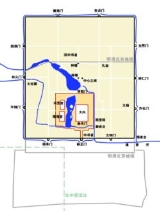
Khanbaliq

Encyclopedia
Khanbaliq or Dadu refers to a city which is now Beijing
, the current capital of the People's Republic of China
. The city was called Dadu or Ta-Tu (大都, pinyin
: Dàdū, Wade-Giles
: Ta-tu), meaning "great capital" or "grand capital" in Chinese
, the name for the capital of the Yuan Dynasty
founded by Kublai Khan
in China
, and was called Daidu by the Mongols, which was a transliteration directly from the Chinese. It is known as Khanbaliq (汗八里), also spelled as Khanbalikh in Turkic languages
, meaning "Great residence of the Khan
", and Marco Polo
wrote of it as Cambaluc, Cambuluc, or Kanbalu.
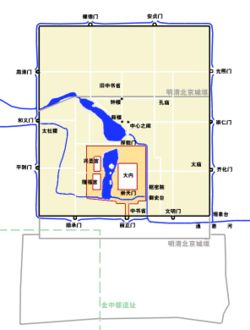 Under the name Zhongdu (中都, "central capital", pinyin
: Zhōngdū) the city had earlier served as the capital of the Jin Dynasty
, but was burned down in 1215 by Mongol forces. In 1264, in preparation to establish the Yuan Dynasty
, Kublai Khan
decided to rebuild this city as his new capital. The original architect and planner of the capital was Liu Bingzhong
, who also served as the supervisor of its construction, and one of the main people who designed and led the construction was Yeheidie'erding
(Amir al-Din). The construction of the walls of the city began in the same year, while the imperial palace was built from 1274 onwards. The design of Dadu followed the Confucianism
classic Zhouli
(周禮, "rites of Zhou"), in that the rules of “9 vertical axes, 9 horizontal axes”, “palaces in the front, markets in the rear”, “left ancestral worship, right god worship” were taken into consideration. It was broad in scale, strict in planning and execution, complete in equipment.
After the establishment of the Yuan Dynasty
in 1271, Kublai Khan renamed the city to Dadu (大都, "great capital", or Ta-tu in Wade-Giles
) in 1272, and it officially became the capital of the Yuan Dynasty, though some constructions in the city were not completed until 1293. The previous seat of Kublai Khan, Shangdu, became the summer capital
of the Yuan. During the reign of Kublai Khan, Venetian
merchant Marco Polo
arrived at Dadu and Shangdu, where it is said that he served Kublai Khan for seventeen years.
In 1368, Zhu Yuanzhang, soon after declaring himself the first emperor
of the Ming Dynasty
in Nanjing
, sent an army toward Dadu, still held by the Yuan. The last Yuan emperor fled north to Shangdu, and Zhu Yuanzhang razed the Yuan palaces in Dadu to the ground.
 After the fall of the Yuan Dynasty in 1368, the city was renamed Peiping (北平, pinyin
: Běipíng) by the Ming Dynasty
in the same year, and Shuntian (順天) prefecture was established in the area around the city. After the enthronement of Yongle Emperor
of Ming, he extended the city and commissioned the building of the Forbidden City
within the walls of the Imperial city of Yuan's Dadu. He renamed the city to Beijing
(北京, pinyin
: Běijīng, ‘Peking’, or Pekin
in other romanizations
), which continues to the present day - except for a short time in Republican China where it was again known as Beiping. Remains of parts of the ancient walls of Dadu, which lie slightly to the north of the later Ming Dynasty walls, are still extant in modern-day Beijing and are known as the Tucheng (土城, literally, the 'earth wall').
, saying "...Let's take back our Khanbaliq" before his invasion of China
. It was picked from them by Russians, whose 17th-century documents often referred to Beijing as "Kambalyk" (Камбалык), as it appears e.g. in the account of Fyodor Baykov
's embassy to Beijing in the 1650s.
When in the 16th century the Western Europeans reached China via Malacca
and South China
, they were not initially aware that China is the same country as "Cathay
" about which they had known from Marco Polo, or that the "Cambalu" of Marco Polo's fame is Peking. It was not until Matteo Ricci
's first visit in Beijing (1598), and his meetings with Central Asian visitors ("Arabian Turks, or Mohammedans", in Louis J. Gallagher
's translation) who told him that the city they are in is "Cambalu", that he became fully convinced that Cathay was China and Cambalu was Beijing. The learned Jesuit even folk-etymologized the name "Cambalu" as being "partly of Chinese and partly of Tartar
origin". According to Ricci's fanciful etymology, "Cam" (Khan
?) meant "great" in "Tartar language
", "Ba" came from Chinese bei (北), "north", and "Lu" was the usual way of referring to the "Tartars
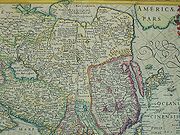
" in Chinese books. Despite Jesuits' reports about the identity of Cathay and China, and Cambalu and Beijing, many European maps continued to show "Cathay", with its capital "Cambalu", located somewhere northeast of China proper
, for much of the 17th century.
Beijing
Beijing , also known as Peking , is the capital of the People's Republic of China and one of the most populous cities in the world, with a population of 19,612,368 as of 2010. The city is the country's political, cultural, and educational center, and home to the headquarters for most of China's...
, the current capital of the People's Republic of China
People's Republic of China
China , officially the People's Republic of China , is the most populous country in the world, with over 1.3 billion citizens. Located in East Asia, the country covers approximately 9.6 million square kilometres...
. The city was called Dadu or Ta-Tu (大都, pinyin
Pinyin
Pinyin is the official system to transcribe Chinese characters into the Roman alphabet in China, Malaysia, Singapore and Taiwan. It is also often used to teach Mandarin Chinese and spell Chinese names in foreign publications and used as an input method to enter Chinese characters into...
: Dàdū, Wade-Giles
Wade-Giles
Wade–Giles , sometimes abbreviated Wade, is a romanization system for the Mandarin Chinese language. It developed from a system produced by Thomas Wade during the mid-19th century , and was given completed form with Herbert Giles' Chinese–English dictionary of 1892.Wade–Giles was the most...
: Ta-tu), meaning "great capital" or "grand capital" in Chinese
Chinese language
The Chinese language is a language or language family consisting of varieties which are mutually intelligible to varying degrees. Originally the indigenous languages spoken by the Han Chinese in China, it forms one of the branches of Sino-Tibetan family of languages...
, the name for the capital of the Yuan Dynasty
Yuan Dynasty
The Yuan Dynasty , or Great Yuan Empire was a ruling dynasty founded by the Mongol leader Kublai Khan, who ruled most of present-day China, all of modern Mongolia and its surrounding areas, lasting officially from 1271 to 1368. It is considered both as a division of the Mongol Empire and as an...
founded by Kublai Khan
Kublai Khan
Kublai Khan , born Kublai and also known by the temple name Shizu , was the fifth Great Khan of the Mongol Empire from 1260 to 1294 and the founder of the Yuan Dynasty in China...
in China
China
Chinese civilization may refer to:* China for more general discussion of the country.* Chinese culture* Greater China, the transnational community of ethnic Chinese.* History of China* Sinosphere, the area historically affected by Chinese culture...
, and was called Daidu by the Mongols, which was a transliteration directly from the Chinese. It is known as Khanbaliq (汗八里), also spelled as Khanbalikh in Turkic languages
Turkic languages
The Turkic languages constitute a language family of at least thirty five languages, spoken by Turkic peoples across a vast area from Eastern Europe and the Mediterranean to Siberia and Western China, and are considered to be part of the proposed Altaic language family.Turkic languages are spoken...
, meaning "Great residence of the Khan
Khan (title)
Khan is an originally Altaic and subsequently Central Asian title for a sovereign or military ruler, widely used by medieval nomadic Turko-Mongol tribes living to the north of China. 'Khan' is also seen as a title in the Xianbei confederation for their chief between 283 and 289...
", and Marco Polo
Marco Polo
Marco Polo was a Venetian merchant traveler from the Venetian Republic whose travels are recorded in Il Milione, a book which did much to introduce Europeans to Central Asia and China. He learned about trading whilst his father and uncle, Niccolò and Maffeo, travelled through Asia and apparently...
wrote of it as Cambaluc, Cambuluc, or Kanbalu.
History
Pinyin
Pinyin is the official system to transcribe Chinese characters into the Roman alphabet in China, Malaysia, Singapore and Taiwan. It is also often used to teach Mandarin Chinese and spell Chinese names in foreign publications and used as an input method to enter Chinese characters into...
: Zhōngdū) the city had earlier served as the capital of the Jin Dynasty
Jin Dynasty, 1115–1234
The Jīn Dynasty ; Khitan language: Nik, Niku; ; 1115–1234), also known as the Jurchen Dynasty, was founded by the Wanyan clan of the Jurchens, the ancestors of the Manchus who established the Qing Dynasty some 500 years later...
, but was burned down in 1215 by Mongol forces. In 1264, in preparation to establish the Yuan Dynasty
Yuan Dynasty
The Yuan Dynasty , or Great Yuan Empire was a ruling dynasty founded by the Mongol leader Kublai Khan, who ruled most of present-day China, all of modern Mongolia and its surrounding areas, lasting officially from 1271 to 1368. It is considered both as a division of the Mongol Empire and as an...
, Kublai Khan
Kublai Khan
Kublai Khan , born Kublai and also known by the temple name Shizu , was the fifth Great Khan of the Mongol Empire from 1260 to 1294 and the founder of the Yuan Dynasty in China...
decided to rebuild this city as his new capital. The original architect and planner of the capital was Liu Bingzhong
Liu Bingzhong
Liu Bingzhong , or Liu Kan was a Yuan Dynasty court adviser and architect. He was born in Ruizhou , during the Jin Dynasty. In 1233, he entered the Jin's bureaucracy. He still was an officer after the Mongol-Yuan Dynasty replaced the Jin, but later he became a monk...
, who also served as the supervisor of its construction, and one of the main people who designed and led the construction was Yeheidie'erding
Yeheidie'erding
Yeheidie'erding , also known as Amir al-Din , was a Muslim architect who help designed and led the construction of the capital of the Yuan Dynasty, Khanbaliq, located in present-day Beijing, the current capital of the People's Republic of China.-Construction of Khanbaliq:Yeheidie'erding learned...
(Amir al-Din). The construction of the walls of the city began in the same year, while the imperial palace was built from 1274 onwards. The design of Dadu followed the Confucianism
Confucianism
Confucianism is a Chinese ethical and philosophical system developed from the teachings of the Chinese philosopher Confucius . Confucianism originated as an "ethical-sociopolitical teaching" during the Spring and Autumn Period, but later developed metaphysical and cosmological elements in the Han...
classic Zhouli
Rites of Zhou
The Rites of Zhou , also known as Zhouguan, is one of three ancient ritual texts listed among the classics of Confucianism. It was later renamed Zhouli by Liu Xin to differentiate it from a chapter in the Classic of History which was also known as Zhouguan.Though tradition ascribed the text of the...
(周禮, "rites of Zhou"), in that the rules of “9 vertical axes, 9 horizontal axes”, “palaces in the front, markets in the rear”, “left ancestral worship, right god worship” were taken into consideration. It was broad in scale, strict in planning and execution, complete in equipment.
After the establishment of the Yuan Dynasty
Yuan Dynasty
The Yuan Dynasty , or Great Yuan Empire was a ruling dynasty founded by the Mongol leader Kublai Khan, who ruled most of present-day China, all of modern Mongolia and its surrounding areas, lasting officially from 1271 to 1368. It is considered both as a division of the Mongol Empire and as an...
in 1271, Kublai Khan renamed the city to Dadu (大都, "great capital", or Ta-tu in Wade-Giles
Wade-Giles
Wade–Giles , sometimes abbreviated Wade, is a romanization system for the Mandarin Chinese language. It developed from a system produced by Thomas Wade during the mid-19th century , and was given completed form with Herbert Giles' Chinese–English dictionary of 1892.Wade–Giles was the most...
) in 1272, and it officially became the capital of the Yuan Dynasty, though some constructions in the city were not completed until 1293. The previous seat of Kublai Khan, Shangdu, became the summer capital
Summer capital
A summer capital is a city used as an administrative capital during extended periods of particularly hot summer weather. The term is mostly of relevance in a historical context as political systems with ruling classes that would migrate to a summer capital are less prevalent in modern times...
of the Yuan. During the reign of Kublai Khan, Venetian
Republic of Venice
The Republic of Venice or Venetian Republic was a state originating from the city of Venice in Northeastern Italy. It existed for over a millennium, from the late 7th century until 1797. It was formally known as the Most Serene Republic of Venice and is often referred to as La Serenissima, in...
merchant Marco Polo
Marco Polo
Marco Polo was a Venetian merchant traveler from the Venetian Republic whose travels are recorded in Il Milione, a book which did much to introduce Europeans to Central Asia and China. He learned about trading whilst his father and uncle, Niccolò and Maffeo, travelled through Asia and apparently...
arrived at Dadu and Shangdu, where it is said that he served Kublai Khan for seventeen years.
In 1368, Zhu Yuanzhang, soon after declaring himself the first emperor
Hongwu Emperor
The Hongwu Emperor , known variably by his given name Zhu Yuanzhang and by his temple name Taizu of Ming , was the founder and first emperor of the Ming Dynasty of China...
of the Ming Dynasty
Ming Dynasty
The Ming Dynasty, also Empire of the Great Ming, was the ruling dynasty of China from 1368 to 1644, following the collapse of the Mongol-led Yuan Dynasty. The Ming, "one of the greatest eras of orderly government and social stability in human history", was the last dynasty in China ruled by ethnic...
in Nanjing
Nanjing
' is the capital of Jiangsu province in China and has a prominent place in Chinese history and culture, having been the capital of China on several occasions...
, sent an army toward Dadu, still held by the Yuan. The last Yuan emperor fled north to Shangdu, and Zhu Yuanzhang razed the Yuan palaces in Dadu to the ground.
Aftermath
Pinyin
Pinyin is the official system to transcribe Chinese characters into the Roman alphabet in China, Malaysia, Singapore and Taiwan. It is also often used to teach Mandarin Chinese and spell Chinese names in foreign publications and used as an input method to enter Chinese characters into...
: Běipíng) by the Ming Dynasty
Ming Dynasty
The Ming Dynasty, also Empire of the Great Ming, was the ruling dynasty of China from 1368 to 1644, following the collapse of the Mongol-led Yuan Dynasty. The Ming, "one of the greatest eras of orderly government and social stability in human history", was the last dynasty in China ruled by ethnic...
in the same year, and Shuntian (順天) prefecture was established in the area around the city. After the enthronement of Yongle Emperor
Yongle Emperor
The Yongle Emperor , born Zhu Di , was the third emperor of the Ming Dynasty of China from 1402 to 1424. His Chinese era name Yongle means "Perpetual Happiness".He was the Prince of Yan , possessing a heavy military base in Beiping...
of Ming, he extended the city and commissioned the building of the Forbidden City
Forbidden City
The Forbidden City was the Chinese imperial palace from the Ming Dynasty to the end of the Qing Dynasty. It is located in the middle of Beijing, China, and now houses the Palace Museum...
within the walls of the Imperial city of Yuan's Dadu. He renamed the city to Beijing
Beijing
Beijing , also known as Peking , is the capital of the People's Republic of China and one of the most populous cities in the world, with a population of 19,612,368 as of 2010. The city is the country's political, cultural, and educational center, and home to the headquarters for most of China's...
(北京, pinyin
Pinyin
Pinyin is the official system to transcribe Chinese characters into the Roman alphabet in China, Malaysia, Singapore and Taiwan. It is also often used to teach Mandarin Chinese and spell Chinese names in foreign publications and used as an input method to enter Chinese characters into...
: Běijīng, ‘Peking’, or Pekin
Pekin
-United States:*Pekin, Illinois*Pekin, Indiana*Pekin, Iowa*Pekin, Kentucky, now Paducah, Kentucky*Pekin, Maryland*Pekin Township, Michigan*Pekin, New York, hamlet in town of Cambria, New York*Pekin, North Dakota-Animals:*Red-billed Leiothrix, or Pekin Robin...
in other romanizations
Wade-Giles
Wade–Giles , sometimes abbreviated Wade, is a romanization system for the Mandarin Chinese language. It developed from a system produced by Thomas Wade during the mid-19th century , and was given completed form with Herbert Giles' Chinese–English dictionary of 1892.Wade–Giles was the most...
), which continues to the present day - except for a short time in Republican China where it was again known as Beiping. Remains of parts of the ancient walls of Dadu, which lie slightly to the north of the later Ming Dynasty walls, are still extant in modern-day Beijing and are known as the Tucheng (土城, literally, the 'earth wall').
Later history of the name
Despite the change of the name of the city in Chinese, the name "Khanbaliq" remained in use among Mongols for centuries after the fall of the Yuan Dynasty. Tayisung Khan Toghtoa Bukha's Taishi Esen appealed to Mongol noblesMongolian nobility
The Mongolian nobility arose in the 10-12th centuries, became prominent in the 13th century, and essentially governed Mongolia until the early 20th century....
, saying "...Let's take back our Khanbaliq" before his invasion of China
Tumu Crisis
The Tumu Crisis ; also called the Crisis of Tumubao or Battle of Tumu Fortress , was a frontier conflict between the Oirat Mongols and the Chinese Ming Dynasty which led to the capture of the Zhengtong Emperor on September 1, 1449 and the loss of an army of 500,000 men to a much smaller force....
. It was picked from them by Russians, whose 17th-century documents often referred to Beijing as "Kambalyk" (Камбалык), as it appears e.g. in the account of Fyodor Baykov
Fyodor Baykov
Fyodor Isakovich Baykov was the first Russian envoy to China . For background see Russo-Chinese Relations...
's embassy to Beijing in the 1650s.
When in the 16th century the Western Europeans reached China via Malacca
Malacca
Malacca , dubbed The Historic State or Negeri Bersejarah among locals) is the third smallest Malaysian state, after Perlis and Penang. It is located in the southern region of the Malay Peninsula, on the Straits of Malacca. It borders Negeri Sembilan to the north and the state of Johor to the south...
and South China
Northern and southern China
Northern China and southern China are two approximate regions within China. The exact boundary between these two regions has never been precisely defined...
, they were not initially aware that China is the same country as "Cathay
Cathay
Cathay is the Anglicized version of "Catai" and an alternative name for China in English. It originates from the word Khitan, the name of a nomadic people who founded the Liao Dynasty which ruled much of Northern China from 907 to 1125, and who had a state of their own centered around today's...
" about which they had known from Marco Polo, or that the "Cambalu" of Marco Polo's fame is Peking. It was not until Matteo Ricci
Matteo Ricci
Matteo Ricci, SJ was an Italian Jesuit priest, and one of the founding figures of the Jesuit China Mission, as it existed in the 17th-18th centuries. His current title is Servant of God....
's first visit in Beijing (1598), and his meetings with Central Asian visitors ("Arabian Turks, or Mohammedans", in Louis J. Gallagher
Louis J. Gallagher
Louis J. Gallagher, SJ was an American Jesuit, known for his educational and literary work.-Biography:Born in Boston, Louis J...
's translation) who told him that the city they are in is "Cambalu", that he became fully convinced that Cathay was China and Cambalu was Beijing. The learned Jesuit even folk-etymologized the name "Cambalu" as being "partly of Chinese and partly of Tartar
Mongolian language
The Mongolian language is the official language of Mongolia and the best-known member of the Mongolic language family. The number of speakers across all its dialects may be 5.2 million, including the vast majority of the residents of Mongolia and many of the Mongolian residents of the Inner...
origin". According to Ricci's fanciful etymology, "Cam" (Khan
Khan (title)
Khan is an originally Altaic and subsequently Central Asian title for a sovereign or military ruler, widely used by medieval nomadic Turko-Mongol tribes living to the north of China. 'Khan' is also seen as a title in the Xianbei confederation for their chief between 283 and 289...
?) meant "great" in "Tartar language
Mongolian language
The Mongolian language is the official language of Mongolia and the best-known member of the Mongolic language family. The number of speakers across all its dialects may be 5.2 million, including the vast majority of the residents of Mongolia and many of the Mongolian residents of the Inner...
", "Ba" came from Chinese bei (北), "north", and "Lu" was the usual way of referring to the "Tartars
Mongols
Mongols ) are a Central-East Asian ethnic group that lives mainly in the countries of Mongolia, China, and Russia. In China, ethnic Mongols can be found mainly in the central north region of China such as Inner Mongolia...
" in Chinese books. Despite Jesuits' reports about the identity of Cathay and China, and Cambalu and Beijing, many European maps continued to show "Cathay", with its capital "Cambalu", located somewhere northeast of China proper
China proper
China proper or Eighteen Provinces was a term used by Western writers on the Qing Dynasty to express a distinction between the core and frontier regions of China. There is no fixed extent for China proper, as many administrative, cultural, and linguistic shifts have occurred in Chinese history...
, for much of the 17th century.