


Ground attack aircraft

Encyclopedia
Ground-attack aircraft are military aircraft
with primary role of attacking targets on the ground with greater precision than bomber
s and prepared to face stronger low-level air defense. This class of aircraft is ideal for close air support
on the battlefield, but they are also employed in other missions, for example air interdiction
or offensive counter air
.
A more general category is an attack aircraft which, in addition to ground-attack types, includes aircraft for naval air-to-surface missions. To clarify a common mistake: as opposed to fighter aircraft
, attack aircraft are not necessarily intended for air-to-air combat. However, they are often equipped with air-to-air missiles for self-defense.
Until the precision-guided munition
s became standard in 1960s, the term "attack aircraft" implied a heavily armored aircraft armed with both bomb
s and with forward-firing automatic weapon—the former were more powerful, but the latter enabled strafing
attacks of much higher precision. Many fighter-bombers of the era fell into this category naturally, if sufficiently armored.
Currently, attack helicopter
s dominate the field of aircraft types built specifically for an attack role. Few fixed-wing designs are currently employed, as air forces tend to assign the task to the ubiquitous multirole combat aircraft
(sometimes described also as strike fighter
s). Notable exceptions include the American A-10 Thunderbolt II
and the Russian Sukhoi Su-25
Frogfoot.
A variety of light attack aircraft exist, usually based on adapted trainers
or other light fixed-wing aircraft.
defines it as an aircraft which most likely performs an attack mission, more than any other kind of mission. Confusingly, attack mission specifically means tactical air-to-ground action — in other words, neither air-to-air action nor strategic bombing
is considered an attack mission. In United States Navy
vocabulary, the alternative designation for the same activity is a strike mission. Attack missions are principally divided into two categories: air interdiction
and close air support
.
A key difference between attack aircraft and otherwise similar designs is the expectation that they will receive small arms fire and are generally armored to protect the pilot against this threat. In comparison to fighters, they will usually have less speed, less range, less beyond-visual-range missile ordnance, but more powerful air-to-ground weapons. Attack aircraft are best suited for use on tactical level rather than operational or strategic
, which means destroying targets of immediate military value, not the targets that could affect future military potential.
Presently, U.S. attack aircraft are identified by the prefix A-, as in "A-6 Intruder
". However, until the end of World War II
the A- designation was shared between attack planes and light bomber
s for the Army aircraft (as opposed to B- prefix for medium or heavy bombers). The US Navy used a separate designation system
and at the time preferred to call similar aircraft scout bombers (SB) or torpedo bombers (TB or BT).
In the last several decades, the rise of the ubiquitous multi-role fighter has created some confusion about the difference between attack and fighter aircraft. According to the current U.S. designation system, an attack aircraft (A) is designed primarily for air-to-surface missions (also known as "attack missions"), while a fighter category F incorporates not only aircraft designed primarily for air-to-air combat, but additionally multipurpose aircraft designed also for ground-attack missions. Just to mention one example amongst many, the F-111 "Aardvark"
is designated F, while having only minimal air-to-air capabilities. The single A-only aircraft in the USAF's current inventory is the A-10 Thunderbolt II
.
have included FB for fighter-bomber and more recently "G" for "Ground-attack" as in Harrier GR1 (meaning "Ground-attack/Reconnaisance, Mark
1").
The NATO reporting name
s for Soviet/Russian ground-attack aircraft usually classified them as "F" (fighters) instead of "B" (bombers) — possibly because (since Sukhoi Su-7 Fitter) they were similar in size, range, and weapons to Soviet fighters, or were simply derivatives of such.
and J-class
). They were put into use in autumn 1917, during World War I
. Most notable was the Junkers J.I
, which pioneered the idea of an armoured "bathtub", that was both fuselage structure and protection for engine and crew. The British experimented with the Sopwith TF series
(termed "trench fighters").
Between the World Wars, the United States Marine Corps Aviation
applied close air support
tactics in the Banana Wars. Not saying they pioneered dive bombing, marine aviators were the first to include it in their doctrine during United States occupation of Haiti and Nicaragua.
guaranteed by armor and construction; what for a bomber could be a very risky mission, nearly a suicide, remained an acceptable threat for a sturdy, armored attack aircraft.
Dedicated ground-attack aircraft
Some forces had the dedicated "attack" units, primarily trained for the role, and procured dedicated aircraft for them. An example was Junkers J.I
deployed during World War I. In the interwar period, USAAF was such a force, and although the aircraft such as Curtiss Shrike
were unarmored, they were certainly built with the ground attack task in mind. In the World War II, the most notable of this class was the Soviet
Ilyushin Il-2
Shturmovik often nicknamed a "flying tank". Nazi Germany did have a very similar class of Schlacht ("battle") aircraft, namely Henschel Hs 123
and Hs 129.
Before the war, the RAF did not believe in close support of ground forces but that its aircraft should be used to inderdict the enemy before it reached the battlefield.
Other than this, the concept of a ground-attack aircraft was not well-defined and various forces worldwide introduced different, often incomparable, categories of aircraft:
Army Co-operation aircraft
The British concept of a light aircraft mixing all the roles that required extensive communication with land forces: reconnaissance, liaison, artillery spotting, aerial supply, and, last but not least, occasional strikes on the battlefield. The concept was similar to front-line aircraft used in the World War I, which was called the CL
class in the German Empire. British experience showed types such as Westland Lysander
to be unacceptably vulnerable and it was replaced by faster fighter type for photo-reconnaissance, and light aircraft for artillery spotting.
Light bomber
The last British specification issued for a light bomber was B.20/40 described as a "Close Army Support Bomber" capable of dive bombing and photo-reconnaissance. The specification was dropped and no aircraft were built.
Dive bomber
In most forces dive bombers did not equip ground-attack units, but were treated as a separate class. Such was in Nazi Germany, which clearly distinguished the Stuka (Sturzkampf-, "dive bombing") units, equipped with Junkers Ju 87
from Schlacht ("battle") units. Wartime experience showed these types to be unacceptably vulnerable.
Scout-bomber
The United States Navy
used scout-bombers such as the Curtiss SB2C Helldiver.
Fighter-bomber
Although not a synonymous class with ground-attack aircraft, fighter-bombers were usually used for the role, and proved to excel at it, even when they were only lightly armored. The Royal Air Force
and United States Army Air Forces
chose to make use of obsolescent fighters, which they possessed in fairly large numbers, while more modern fighters would establish air superiority. These included the Hawker Hurricane
and Republic P-47 Thunderbolt. Some types were variants of fighters built specifically as such, including several versions of the German Focke-Wulf Fw 190
. The British Hawker Typhoon
, a fast low level fighter, was used first with bombs then rockets.
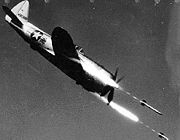
to good effect in North Africa Campaign (notably No. 6 Squadron RAF
). High explosive rockets were used by British, U.S., Soviet and German aircraft though they were (along with bombs) found to be "barely adequate" because of their inaccuracy. Though unlikely to hit and therefore destroy armoured vehicles, the rockets did have an significant effect on enemy morale; even the prospect of a rocket attack was unnerving, and the "taxi rank" patrols of rocket-armed aircraft over the Normandy battlefields disrupted or even paralysed movement of German units.
 In the immediate post war era the piston-engined ground-attack aircraft remained useful since all of the early jets lacked endurance due to the fuel consumption rates of the jet engines. The higher powered piston engine types that had been too late for World War II were still capable of holding their own against the jets as they were able to both out accelerate and out manoeuver the jets. The Royal Navy
Hawker Sea Fury
fighters and the U.S. Vought F4U Corsair and Douglas A-1 Skyraider were operated during the Korean War
while the latter continued to be used throughout the Vietnam War
.
Most of the post-World War II era air forces have been reluctant to develop fixed-wing combat aircraft specifically for ground-attack. Although close air support and interdiction remain crucial to the modern battlefield, attack aircraft are less glamorous than fighters, and both pilots and military planners have a certain well-cultivated contempt for 'mud-movers.' More practically, the cost of a specialized ground-attack aircraft is harder to justify as opposed to having multirole combat aircraft
.
Under the Key West Agreement
which governs the allocation of aircraft between the U.S. Army
and the U.S. Air Force
, fixed-wing ground-attack aircraft were generally allocated to the Air Force, while attack helicopters were generally allocated to the Army. The Army, wishing to have its own resources to support its troops in combat and faced with a lack of Air Force enthusiasm for the ground-attack role, developed the dedicated attack helicopter for roles such as destroying enemy tanks and supporting troops in combat.
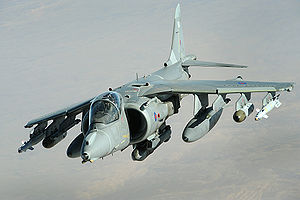
Ground attack has become the domain of converted trainers, like the BAE Hawk
or the Aero L-39 Albatros, and many trainers are built with this task in mind, like the CASA 101 or the Aermacchi MB-339
.
 On January 17, 1991, Task Force Normandy began its attack on two Iraqi anti-aircraft missile sites. TF Normandy, under the command of LTC Richard A. "Dick" Cody, consisted of nine AH-64 Apache
s, one UH-60 Black Hawk and four Air Force MH-53J Pave Low helicopters. The purpose of this mission was to create a safe corridor through the Iraqi air defense system. The attack was a huge success and cleared the way for the beginning of the Allied bombing campaign.
One concern involving the Apache arose when a unit of these helicopters was very slow to deploy during U.S. military involvement in Kosovo. According to the Army Times
, the Army is shifting its doctrine to favour ground-attack aircraft over attack helicopters for deep strike attack missions because ground-attack helicopters have proved to be highly vulnerable to small-arms fire; the U.S. Marine Corps has noted similar problems.
In the late 1960s the United States Air Force
requested a dedicated close air support
(CAS) plane that became the Fairchild Republic A-10 Thunderbolt II
. It eventually became a primarily anti-armor weapon with limited capability in the interdiction and tactical bombing role, and even in the anti-tank role it initially met with mixed feelings. The A-10's performance during Operation Desert Storm negated these criticisms. It remained the only dedicated fixed-wing ground-attack aircraft in U.S. service. Overall U.S. experience in the Gulf War
, Kosovo
, Afghanistan
, and Iraq War has resulted in renewed interest in such aircraft. Officially, the U.S. Air Force planned to replace the A-10, with its new "Joint Strike Fighter", the F-35 Lightning II
. Facing political concerns that the new fighters were not designed for the ground-attack role that had proven particularly useful in Iraq and Afghanistan, a plan to decommission the A-10 has been replaced with a plan to upgrade the existing aircraft with improved electronics, extending the service life of the planes until as late as 2028. The U.S. Air Force has not commissioned any new designs for this role (in part, out of concern for the F-35 program). Nevertheless, the current U.S. doctrine emphasizes the use of United States Army
helicopter
s for close air support and anti-tank missions.
The Soviets' similar Sukhoi Su-25
(Frogfoot) found greater success in the flying artillery
role, although it, too, shifted to anti-armor use in later versions and has largely been phased out in favour of fast-moving fighter-bomber versions of the MiG-29 and Su-27.
The UK is replacing its current ground-attack aircraft with the F-35
(replacing the Harriers) and the Eurofighter Typhoon
(Tornado IDS
).
The other major complication to plans of military forces to purchase new ground-attack aircraft is uncertainty over the degree to which manned fixed wing aircraft may be replaced by unmanned combat drones in this role, a possibility illustrated by the armed Predator
drone, which has been used in this capacity.
Military aircraft
A military aircraft is any fixed-wing or rotary-wing aircraft that is operated by a legal or insurrectionary armed service of any type. Military aircraft can be either combat or non-combat:...
with primary role of attacking targets on the ground with greater precision than bomber
Bomber
A bomber is a military aircraft designed to attack ground and sea targets, by dropping bombs on them, or – in recent years – by launching cruise missiles at them.-Classifications of bombers:...
s and prepared to face stronger low-level air defense. This class of aircraft is ideal for close air support
Close air support
In military tactics, close air support is defined as air action by fixed or rotary winged aircraft against hostile targets that are close to friendly forces, and which requires detailed integration of each air mission with fire and movement of these forces.The determining factor for CAS is...
on the battlefield, but they are also employed in other missions, for example air interdiction
Air interdiction
Air interdiction is the use of aircraft to attack tactical ground targets that are not in close proximity to friendly ground forces. It differs from close air support because it does not directly support ground operations and is not closely coordinated with ground units...
or offensive counter air
Offensive counter air
Offensive Counter-Air is a military term for the suppression of an enemy's military air power by destroying or disabling the aircraft—preferably on the ground. This includes disablement achieved by damaging the infrastructure or logistics.Operations include attacks on air bases...
.
A more general category is an attack aircraft which, in addition to ground-attack types, includes aircraft for naval air-to-surface missions. To clarify a common mistake: as opposed to fighter aircraft
Fighter aircraft
A fighter aircraft is a military aircraft designed primarily for air-to-air combat with other aircraft, as opposed to a bomber, which is designed primarily to attack ground targets...
, attack aircraft are not necessarily intended for air-to-air combat. However, they are often equipped with air-to-air missiles for self-defense.
Until the precision-guided munition
Precision-guided munition
A precision-guided munition is a guided munition intended to precisely hit a specific target, and to minimize damage to things other than the target....
s became standard in 1960s, the term "attack aircraft" implied a heavily armored aircraft armed with both bomb
Bomb
A bomb is any of a range of explosive weapons that only rely on the exothermic reaction of an explosive material to provide an extremely sudden and violent release of energy...
s and with forward-firing automatic weapon—the former were more powerful, but the latter enabled strafing
Strafing
Strafing is the practice of attacking ground targets from low-flying aircraft using aircraft-mounted automatic weapons. This means, that although ground attack using automatic weapons fire is very often accompanied with bombing or rocket fire, the term "strafing" does not specifically include the...
attacks of much higher precision. Many fighter-bombers of the era fell into this category naturally, if sufficiently armored.
Currently, attack helicopter
Attack helicopter
An attack helicopter is a military helicopter with the primary role of an attack aircraft, with the capability of engaging targets on the ground, such as enemy infantry and armored vehicles...
s dominate the field of aircraft types built specifically for an attack role. Few fixed-wing designs are currently employed, as air forces tend to assign the task to the ubiquitous multirole combat aircraft
Multirole combat aircraft
A multirole combat aircraft is an aircraft designed to act in at least two different roles in combat. The primary role is usually a fighter—hence, it is as often called a multirole fighter—while the secondary role is usually air-to-surface attack. More roles are added, such as air reconnaissance,...
(sometimes described also as strike fighter
Strike fighter
In a current military parlance, a strike fighter is a multi-role combat aircraft designed to operate primarily in the air-to-surface attack role while also incorporating certain performance characteristics of a fighter aircraft. As a category, it is distinct from fighter-bombers...
s). Notable exceptions include the American A-10 Thunderbolt II
A-10 Thunderbolt II
The Fairchild Republic A-10 Thunderbolt II is an American single-seat, twin-engine, straight-wing jet aircraft developed by Fairchild-Republic in the early 1970s. The A-10 was designed for a United States Air Force requirement to provide close air support for ground forces by attacking tanks,...
and the Russian Sukhoi Su-25
Sukhoi Su-25
The Sukhoi Su-25 is a single-seat, twin-engine jet aircraft developed in the Soviet Union by the Sukhoi Design Bureau. It was designed to provide close air support for the Soviet Ground Forces. The first prototype made its maiden flight on 22 February 1975...
Frogfoot.
A variety of light attack aircraft exist, usually based on adapted trainers
Trainer (aircraft)
A trainer is a class of aircraft designed specifically to facilitate in-flight training of pilots and aircrews. The use of a dedicated trainer aircraft with additional safety features—such as tandem flight controls, forgiving flight characteristics and a simplified cockpit arrangement—allows...
or other light fixed-wing aircraft.
United States definition and designations
As with many aircraft classifications, the definition of attack aircraft is somewhat vague and has tended to change over time. Current U.S. military doctrineMilitary doctrine
Military doctrine is the concise expression of how military forces contribute to campaigns, major operations, battles, and engagements.It is a guide to action, not hard and fast rules. Doctrine provides a common frame of reference across the military...
defines it as an aircraft which most likely performs an attack mission, more than any other kind of mission. Confusingly, attack mission specifically means tactical air-to-ground action — in other words, neither air-to-air action nor strategic bombing
Strategic bombing
Strategic bombing is a military strategy used in a total war with the goal of defeating an enemy nation-state by destroying its economic ability and public will to wage war rather than destroying its land or naval forces...
is considered an attack mission. In United States Navy
United States Navy
The United States Navy is the naval warfare service branch of the United States Armed Forces and one of the seven uniformed services of the United States. The U.S. Navy is the largest in the world; its battle fleet tonnage is greater than that of the next 13 largest navies combined. The U.S...
vocabulary, the alternative designation for the same activity is a strike mission. Attack missions are principally divided into two categories: air interdiction
Air interdiction
Air interdiction is the use of aircraft to attack tactical ground targets that are not in close proximity to friendly ground forces. It differs from close air support because it does not directly support ground operations and is not closely coordinated with ground units...
and close air support
Close air support
In military tactics, close air support is defined as air action by fixed or rotary winged aircraft against hostile targets that are close to friendly forces, and which requires detailed integration of each air mission with fire and movement of these forces.The determining factor for CAS is...
.
A key difference between attack aircraft and otherwise similar designs is the expectation that they will receive small arms fire and are generally armored to protect the pilot against this threat. In comparison to fighters, they will usually have less speed, less range, less beyond-visual-range missile ordnance, but more powerful air-to-ground weapons. Attack aircraft are best suited for use on tactical level rather than operational or strategic
Strategic level
Strategic level of war, as defined by the United States Department of Defense, is the level of war at which a nation, often as a member of a group of nations, determines national or multinational security objectives and guidance, and develops and uses national resources to accomplish these...
, which means destroying targets of immediate military value, not the targets that could affect future military potential.
Presently, U.S. attack aircraft are identified by the prefix A-, as in "A-6 Intruder
A-6 Intruder
The Grumman A-6 Intruder was an American, twin jet-engine, mid-wing attack aircraft built by Grumman Aerospace. In service with the U.S. Navy and U.S. Marine Corps between 1963 and 1997, the Intruder was designed as an all-weather medium attack aircraft to replace the piston-engined A-1 Skyraider...
". However, until the end of World War II
World War II
World War II, or the Second World War , was a global conflict lasting from 1939 to 1945, involving most of the world's nations—including all of the great powers—eventually forming two opposing military alliances: the Allies and the Axis...
the A- designation was shared between attack planes and light bomber
Light bomber
A light bomber is a relatively small and fast class of military bomber aircraft which were primarily employed before the 1950s. Such aircraft would typically not carry more than one ton of ordnance....
s for the Army aircraft (as opposed to B- prefix for medium or heavy bombers). The US Navy used a separate designation system
1922 United States Navy aircraft designation system
Until 1962, the United States Navy and the United States Marine Corps used a system to designate their aircraft that included information about a craft's role and its manufacturer.-The system:...
and at the time preferred to call similar aircraft scout bombers (SB) or torpedo bombers (TB or BT).
In the last several decades, the rise of the ubiquitous multi-role fighter has created some confusion about the difference between attack and fighter aircraft. According to the current U.S. designation system, an attack aircraft (A) is designed primarily for air-to-surface missions (also known as "attack missions"), while a fighter category F incorporates not only aircraft designed primarily for air-to-air combat, but additionally multipurpose aircraft designed also for ground-attack missions. Just to mention one example amongst many, the F-111 "Aardvark"
General Dynamics F-111
The General Dynamics F-111 "Aardvark" was a medium-range interdictor and tactical strike aircraft that also filled the roles of strategic bomber, reconnaissance, and electronic warfare in its various versions. Developed in the 1960s by General Dynamics, it first entered service in 1967 with the...
is designated F, while having only minimal air-to-air capabilities. The single A-only aircraft in the USAF's current inventory is the A-10 Thunderbolt II
A-10 Thunderbolt II
The Fairchild Republic A-10 Thunderbolt II is an American single-seat, twin-engine, straight-wing jet aircraft developed by Fairchild-Republic in the early 1970s. The A-10 was designed for a United States Air Force requirement to provide close air support for ground forces by attacking tanks,...
.
Other designations
British designationsBritish military aircraft designation systems
British military aircraft designations are used to refer to aircraft types and variants operated by the armed forces of the United Kingdom.Since the end of the First World War, aircraft types in British military service have generally been known by a name British military aircraft designations are...
have included FB for fighter-bomber and more recently "G" for "Ground-attack" as in Harrier GR1 (meaning "Ground-attack/Reconnaisance, Mark
Mark (designation)
The word Mark, followed by number, is a method of specifically designating a standardized, integrated, assumed to be functional and unique version of a mechanical and/or electrical hardware product that has completed the design process and has been approved to be put into final production, as well...
1").
The NATO reporting name
NATO reporting name
NATO reporting names are classified code names for military equipment of the Eastern Bloc...
s for Soviet/Russian ground-attack aircraft usually classified them as "F" (fighters) instead of "B" (bombers) — possibly because (since Sukhoi Su-7 Fitter) they were similar in size, range, and weapons to Soviet fighters, or were simply derivatives of such.
History
Germany was the first country to produce dedicated ground-attack aircraft (designated CL-classIdflieg aircraft designation system
The Idflieg designation system was used to designate German heavier-than-air military aircraft from the early days of the Luftstreitkräfte to the end of World War I. The system necessarily evolved during this period, as new aircraft types were produced. It was never extended to aircraft operated...
and J-class
Idflieg aircraft designation system
The Idflieg designation system was used to designate German heavier-than-air military aircraft from the early days of the Luftstreitkräfte to the end of World War I. The system necessarily evolved during this period, as new aircraft types were produced. It was never extended to aircraft operated...
). They were put into use in autumn 1917, during World War I
World War I
World War I , which was predominantly called the World War or the Great War from its occurrence until 1939, and the First World War or World War I thereafter, was a major war centred in Europe that began on 28 July 1914 and lasted until 11 November 1918...
. Most notable was the Junkers J.I
Junkers J.I
-See also:-References:NotesBibliography* Flight 18 March 1920* Grey, C. G. Jane's All the World's Aircraft 1919. London: Putnam, 1919.* Grosz, P.M. Junkers J.I, Windsock Datafile 39. Hertfordshire, UK: Albatros Productions Ltd., 1993. ISBN 0-948414-49-9.* Taylor, Michael J. H. Jane's Encyclopedia...
, which pioneered the idea of an armoured "bathtub", that was both fuselage structure and protection for engine and crew. The British experimented with the Sopwith TF series
Sopwith Salamander
-See also:-References:NotesBibliography...
(termed "trench fighters").
Between the World Wars, the United States Marine Corps Aviation
United States Marine Corps Aviation
United States Marine Corps Aviation is the air component of the United States Marine Corps. Marine aviation has a very different mission and operation than its ground counterpart, and thus, has many of its own histories, traditions, terms, and procedures....
applied close air support
Close air support
In military tactics, close air support is defined as air action by fixed or rotary winged aircraft against hostile targets that are close to friendly forces, and which requires detailed integration of each air mission with fire and movement of these forces.The determining factor for CAS is...
tactics in the Banana Wars. Not saying they pioneered dive bombing, marine aviators were the first to include it in their doctrine during United States occupation of Haiti and Nicaragua.
World War II
The attack aircraft as a class was defined by the battlefield support mission, not to say it was not able to attack targets in the rear. Until recently such mission required flying where light anti-aircraft fire is routinely observed, necessarily operating at low altitude to precisely identify targets. Since the times of World War I and into the interbellum, other classes of aircraft, light bombers, medium bombers, dive bombers, reconnaissance, fighters, fighter-bombers, could and did perform air strikes in the battlefield environment. All these types could significantly damage ground targets from a low level flight, either by bombing, machine guns, or both. Separation of the attack aircraft from those was done along two lines. One line was the intended primary use. While, for example, light bomber could be used in a battlefield, it was not primarily planned to, and attack aircraft was. A second, more narrow definition, was survivabilitySurvivability
Survivability is the ability to remain alive or continue to exist. The term has more specific meaning in certain contexts.-Engineering:In engineering, survivability is the quantified ability of a system, subsystem, equipment, process, or procedure to continue to function during and after a natural...
guaranteed by armor and construction; what for a bomber could be a very risky mission, nearly a suicide, remained an acceptable threat for a sturdy, armored attack aircraft.
Dedicated ground-attack aircraft
Some forces had the dedicated "attack" units, primarily trained for the role, and procured dedicated aircraft for them. An example was Junkers J.I
Junkers J.I
-See also:-References:NotesBibliography* Flight 18 March 1920* Grey, C. G. Jane's All the World's Aircraft 1919. London: Putnam, 1919.* Grosz, P.M. Junkers J.I, Windsock Datafile 39. Hertfordshire, UK: Albatros Productions Ltd., 1993. ISBN 0-948414-49-9.* Taylor, Michael J. H. Jane's Encyclopedia...
deployed during World War I. In the interwar period, USAAF was such a force, and although the aircraft such as Curtiss Shrike
Curtiss Shrike
Curtiss Shrike may refer to any of the following aircraft*Curtiss A-8, a low-wing monoplane ground-attack aircraft, first flight June 1931**YA-10 Shrike, a test and development version of the A-8 with a radial engine, first flight 1932...
were unarmored, they were certainly built with the ground attack task in mind. In the World War II, the most notable of this class was the Soviet
Soviet Union
The Soviet Union , officially the Union of Soviet Socialist Republics , was a constitutionally socialist state that existed in Eurasia between 1922 and 1991....
Ilyushin Il-2
Ilyushin Il-2
The Ilyushin Il-2 was a ground-attack aircraft in the Second World War, produced by the Soviet Union in very large numbers...
Shturmovik often nicknamed a "flying tank". Nazi Germany did have a very similar class of Schlacht ("battle") aircraft, namely Henschel Hs 123
Henschel Hs 123
The Henschel Hs 123 was a single-seat biplane dive bomber and close-support attack aircraft flown by the German Luftwaffe during the Spanish Civil War and the early to mid-point of World War II...
and Hs 129.
Before the war, the RAF did not believe in close support of ground forces but that its aircraft should be used to inderdict the enemy before it reached the battlefield.
Other than this, the concept of a ground-attack aircraft was not well-defined and various forces worldwide introduced different, often incomparable, categories of aircraft:
Army Co-operation aircraft
The British concept of a light aircraft mixing all the roles that required extensive communication with land forces: reconnaissance, liaison, artillery spotting, aerial supply, and, last but not least, occasional strikes on the battlefield. The concept was similar to front-line aircraft used in the World War I, which was called the CL
Idflieg aircraft designation system
The Idflieg designation system was used to designate German heavier-than-air military aircraft from the early days of the Luftstreitkräfte to the end of World War I. The system necessarily evolved during this period, as new aircraft types were produced. It was never extended to aircraft operated...
class in the German Empire. British experience showed types such as Westland Lysander
Westland Lysander
The Westland Lysander was a British army co-operation and liaison aircraft produced by Westland Aircraft used immediately before and during the Second World War...
to be unacceptably vulnerable and it was replaced by faster fighter type for photo-reconnaissance, and light aircraft for artillery spotting.
Light bomber
The last British specification issued for a light bomber was B.20/40 described as a "Close Army Support Bomber" capable of dive bombing and photo-reconnaissance. The specification was dropped and no aircraft were built.
Dive bomber
In most forces dive bombers did not equip ground-attack units, but were treated as a separate class. Such was in Nazi Germany, which clearly distinguished the Stuka (Sturzkampf-, "dive bombing") units, equipped with Junkers Ju 87
Junkers Ju 87
The Junkers Ju 87 or Stuka was a two-man German ground-attack aircraft...
from Schlacht ("battle") units. Wartime experience showed these types to be unacceptably vulnerable.
Scout-bomber
The United States Navy
United States Navy
The United States Navy is the naval warfare service branch of the United States Armed Forces and one of the seven uniformed services of the United States. The U.S. Navy is the largest in the world; its battle fleet tonnage is greater than that of the next 13 largest navies combined. The U.S...
used scout-bombers such as the Curtiss SB2C Helldiver.
Fighter-bomber
Although not a synonymous class with ground-attack aircraft, fighter-bombers were usually used for the role, and proved to excel at it, even when they were only lightly armored. The Royal Air Force
Royal Air Force
The Royal Air Force is the aerial warfare service branch of the British Armed Forces. Formed on 1 April 1918, it is the oldest independent air force in the world...
and United States Army Air Forces
United States Army Air Forces
The United States Army Air Forces was the military aviation arm of the United States of America during and immediately after World War II, and the direct predecessor of the United States Air Force....
chose to make use of obsolescent fighters, which they possessed in fairly large numbers, while more modern fighters would establish air superiority. These included the Hawker Hurricane
Hawker Hurricane
The Hawker Hurricane is a British single-seat fighter aircraft that was designed and predominantly built by Hawker Aircraft Ltd for the Royal Air Force...
and Republic P-47 Thunderbolt. Some types were variants of fighters built specifically as such, including several versions of the German Focke-Wulf Fw 190
Focke-Wulf Fw 190
The Focke-Wulf Fw 190 Würger was a German Second World War single-seat, single-engine fighter aircraft designed by Kurt Tank in the late 1930s. Powered by a radial engine, the 190 had ample power and was able to lift larger loads than its well-known counterpart, the Messerschmitt Bf 109...
. The British Hawker Typhoon
Hawker Typhoon
The Hawker Typhoon was a British single-seat fighter-bomber, produced by Hawker Aircraft. While the Typhoon was designed to be a medium-high altitude interceptor, and a direct replacement for the Hawker Hurricane, several design problems were encountered, and the Typhoon never completely satisfied...
, a fast low level fighter, was used first with bombs then rockets.
Weapons
While machine guns and cannon were sufficient against infantry and light vehicles, for operations against tanks heavier weapons were needed such as the 40 mm Vickers S gun which equipped the Hawker HurricaneHawker Hurricane
The Hawker Hurricane is a British single-seat fighter aircraft that was designed and predominantly built by Hawker Aircraft Ltd for the Royal Air Force...
to good effect in North Africa Campaign (notably No. 6 Squadron RAF
No. 6 Squadron RAF
No. 6 Squadron of the Royal Air Force operates the Eurofighter Typhoon FGR4 at RAF Leuchars.It was previously equipped with the Jaguar GR.3 in the close air support and tactical reconnaissance roles, and was based at RAF Coltishall, Norfolk until April 2006, moving to RAF Coningsby until...
). High explosive rockets were used by British, U.S., Soviet and German aircraft though they were (along with bombs) found to be "barely adequate" because of their inaccuracy. Though unlikely to hit and therefore destroy armoured vehicles, the rockets did have an significant effect on enemy morale; even the prospect of a rocket attack was unnerving, and the "taxi rank" patrols of rocket-armed aircraft over the Normandy battlefields disrupted or even paralysed movement of German units.
Post World War II
Royal Navy
The Royal Navy is the naval warfare service branch of the British Armed Forces. Founded in the 16th century, it is the oldest service branch and is known as the Senior Service...
Hawker Sea Fury
Hawker Sea Fury
The Hawker Sea Fury was a British fighter aircraft developed for the Royal Navy by Hawker during the Second World War. The last propeller-driven fighter to serve with the Royal Navy, it was also one of the fastest production single piston-engined aircraft ever built.-Origins:The Hawker Fury was an...
fighters and the U.S. Vought F4U Corsair and Douglas A-1 Skyraider were operated during the Korean War
Korean War
The Korean War was a conventional war between South Korea, supported by the United Nations, and North Korea, supported by the People's Republic of China , with military material aid from the Soviet Union...
while the latter continued to be used throughout the Vietnam War
Vietnam War
The Vietnam War was a Cold War-era military conflict that occurred in Vietnam, Laos, and Cambodia from 1 November 1955 to the fall of Saigon on 30 April 1975. This war followed the First Indochina War and was fought between North Vietnam, supported by its communist allies, and the government of...
.
Most of the post-World War II era air forces have been reluctant to develop fixed-wing combat aircraft specifically for ground-attack. Although close air support and interdiction remain crucial to the modern battlefield, attack aircraft are less glamorous than fighters, and both pilots and military planners have a certain well-cultivated contempt for 'mud-movers.' More practically, the cost of a specialized ground-attack aircraft is harder to justify as opposed to having multirole combat aircraft
Multirole combat aircraft
A multirole combat aircraft is an aircraft designed to act in at least two different roles in combat. The primary role is usually a fighter—hence, it is as often called a multirole fighter—while the secondary role is usually air-to-surface attack. More roles are added, such as air reconnaissance,...
.
Under the Key West Agreement
Key West Agreement
The Key West Agreement is the colloquial name for the policy paper Function of the Armed Forces and the Joint Chiefs of Staff drafted by James V. Forrestal, the first United States Secretary of Defense...
which governs the allocation of aircraft between the U.S. Army
United States Army
The United States Army is the main branch of the United States Armed Forces responsible for land-based military operations. It is the largest and oldest established branch of the U.S. military, and is one of seven U.S. uniformed services...
and the U.S. Air Force
United States Air Force
The United States Air Force is the aerial warfare service branch of the United States Armed Forces and one of the American uniformed services. Initially part of the United States Army, the USAF was formed as a separate branch of the military on September 18, 1947 under the National Security Act of...
, fixed-wing ground-attack aircraft were generally allocated to the Air Force, while attack helicopters were generally allocated to the Army. The Army, wishing to have its own resources to support its troops in combat and faced with a lack of Air Force enthusiasm for the ground-attack role, developed the dedicated attack helicopter for roles such as destroying enemy tanks and supporting troops in combat.
Ground attack has become the domain of converted trainers, like the BAE Hawk
BAE Hawk
The BAE Systems Hawk is a British single-engine, advanced jet trainer aircraft. It first flew in 1974 as the Hawker Siddeley Hawk. The Hawk is used by the Royal Air Force, and other air forces, as either a trainer or a low-cost combat aircraft...
or the Aero L-39 Albatros, and many trainers are built with this task in mind, like the CASA 101 or the Aermacchi MB-339
Aermacchi MB-339
The Aermacchi MB-339 is an Italian military trainer and light attack aircraft. It was developed as a replacement for the earlier MB-326.-Design and development:...
.
Recent history
AH-64 Apache
The Boeing AH-64 Apache is a four-blade, twin-engine attack helicopter with a tailwheel-type landing gear arrangement, and a tandem cockpit for a two-man crew. The Apache was developed as Model 77 by Hughes Helicopters for the United States Army's Advanced Attack Helicopter program to replace the...
s, one UH-60 Black Hawk and four Air Force MH-53J Pave Low helicopters. The purpose of this mission was to create a safe corridor through the Iraqi air defense system. The attack was a huge success and cleared the way for the beginning of the Allied bombing campaign.
One concern involving the Apache arose when a unit of these helicopters was very slow to deploy during U.S. military involvement in Kosovo. According to the Army Times
Army Times
Army Times is a weekly newspaper serving active, reserve, guard and retired United States Army personnel and their families, providing news, information and analysis as well as community and lifestyle features, educational supplements, and resource guides.Army Times is published by the Gannett...
, the Army is shifting its doctrine to favour ground-attack aircraft over attack helicopters for deep strike attack missions because ground-attack helicopters have proved to be highly vulnerable to small-arms fire; the U.S. Marine Corps has noted similar problems.
In the late 1960s the United States Air Force
United States Air Force
The United States Air Force is the aerial warfare service branch of the United States Armed Forces and one of the American uniformed services. Initially part of the United States Army, the USAF was formed as a separate branch of the military on September 18, 1947 under the National Security Act of...
requested a dedicated close air support
Close air support
In military tactics, close air support is defined as air action by fixed or rotary winged aircraft against hostile targets that are close to friendly forces, and which requires detailed integration of each air mission with fire and movement of these forces.The determining factor for CAS is...
(CAS) plane that became the Fairchild Republic A-10 Thunderbolt II
A-10 Thunderbolt II
The Fairchild Republic A-10 Thunderbolt II is an American single-seat, twin-engine, straight-wing jet aircraft developed by Fairchild-Republic in the early 1970s. The A-10 was designed for a United States Air Force requirement to provide close air support for ground forces by attacking tanks,...
. It eventually became a primarily anti-armor weapon with limited capability in the interdiction and tactical bombing role, and even in the anti-tank role it initially met with mixed feelings. The A-10's performance during Operation Desert Storm negated these criticisms. It remained the only dedicated fixed-wing ground-attack aircraft in U.S. service. Overall U.S. experience in the Gulf War
Gulf War
The Persian Gulf War , commonly referred to as simply the Gulf War, was a war waged by a U.N.-authorized coalition force from 34 nations led by the United States, against Iraq in response to Iraq's invasion and annexation of Kuwait.The war is also known under other names, such as the First Gulf...
, Kosovo
Kosovo
Kosovo is a region in southeastern Europe. Part of the Ottoman Empire for more than five centuries, later the Autonomous Province of Kosovo and Metohija within Serbia...
, Afghanistan
Afghanistan
Afghanistan , officially the Islamic Republic of Afghanistan, is a landlocked country located in the centre of Asia, forming South Asia, Central Asia and the Middle East. With a population of about 29 million, it has an area of , making it the 42nd most populous and 41st largest nation in the world...
, and Iraq War has resulted in renewed interest in such aircraft. Officially, the U.S. Air Force planned to replace the A-10, with its new "Joint Strike Fighter", the F-35 Lightning II
F-35 Lightning II
The Lockheed Martin F-35 Lightning II is a family of single-seat, single-engine, fifth generation multirole fighters under development to perform ground attack, reconnaissance, and air defense missions with stealth capability...
. Facing political concerns that the new fighters were not designed for the ground-attack role that had proven particularly useful in Iraq and Afghanistan, a plan to decommission the A-10 has been replaced with a plan to upgrade the existing aircraft with improved electronics, extending the service life of the planes until as late as 2028. The U.S. Air Force has not commissioned any new designs for this role (in part, out of concern for the F-35 program). Nevertheless, the current U.S. doctrine emphasizes the use of United States Army
United States Army
The United States Army is the main branch of the United States Armed Forces responsible for land-based military operations. It is the largest and oldest established branch of the U.S. military, and is one of seven U.S. uniformed services...
helicopter
Helicopter
A helicopter is a type of rotorcraft in which lift and thrust are supplied by one or more engine-driven rotors. This allows the helicopter to take off and land vertically, to hover, and to fly forwards, backwards, and laterally...
s for close air support and anti-tank missions.
The Soviets' similar Sukhoi Su-25
Sukhoi Su-25
The Sukhoi Su-25 is a single-seat, twin-engine jet aircraft developed in the Soviet Union by the Sukhoi Design Bureau. It was designed to provide close air support for the Soviet Ground Forces. The first prototype made its maiden flight on 22 February 1975...
(Frogfoot) found greater success in the flying artillery
Artillery
Originally applied to any group of infantry primarily armed with projectile weapons, artillery has over time become limited in meaning to refer only to those engines of war that operate by projection of munitions far beyond the range of effect of personal weapons...
role, although it, too, shifted to anti-armor use in later versions and has largely been phased out in favour of fast-moving fighter-bomber versions of the MiG-29 and Su-27.
The UK is replacing its current ground-attack aircraft with the F-35
F-35 Lightning II
The Lockheed Martin F-35 Lightning II is a family of single-seat, single-engine, fifth generation multirole fighters under development to perform ground attack, reconnaissance, and air defense missions with stealth capability...
(replacing the Harriers) and the Eurofighter Typhoon
Eurofighter Typhoon
The Eurofighter Typhoon is a twin-engine, canard-delta wing, multirole combat aircraft, designed and built by a consortium of three companies: EADS, Alenia Aeronautica and BAE Systems; working through a holding company, Eurofighter GmbH, which was formed in 1986...
(Tornado IDS
Panavia Tornado
The Panavia Tornado is a family of twin-engine, variable-sweep wing combat aircraft, which was jointly developed and manufactured by the United Kingdom, West Germany and Italy...
).
The other major complication to plans of military forces to purchase new ground-attack aircraft is uncertainty over the degree to which manned fixed wing aircraft may be replaced by unmanned combat drones in this role, a possibility illustrated by the armed Predator
RQ-1 Predator
The General Atomics MQ-1 Predator is an unmanned aerial vehicle used primarily by the United States Air Force and Central Intelligence Agency...
drone, which has been used in this capacity.
See also
- Air-to-ground weaponryAir-to-ground weaponryAir-to-ground weaponry is weapons used by combat aircraft to attack ground targets. The weapons include bombs, machine guns, autocannons, air-to-surface missiles, rockets, air-launched cruise missiles and grenade launchers.-See also:* Aircraft ordnance...
- Close air supportClose air supportIn military tactics, close air support is defined as air action by fixed or rotary winged aircraft against hostile targets that are close to friendly forces, and which requires detailed integration of each air mission with fire and movement of these forces.The determining factor for CAS is...
- Air interdictionAir interdictionAir interdiction is the use of aircraft to attack tactical ground targets that are not in close proximity to friendly ground forces. It differs from close air support because it does not directly support ground operations and is not closely coordinated with ground units...
- GunshipGunshipThe term "gunship" is used in several contexts, all sharing the general idea of a light craft armed with heavy guns.-In Navy:In the Navy, the term originally appeared in the mid-19th century as a less-common synonym for gunboat.-In military aviation:...
- Multirole combat aircraftMultirole combat aircraftA multirole combat aircraft is an aircraft designed to act in at least two different roles in combat. The primary role is usually a fighter—hence, it is as often called a multirole fighter—while the secondary role is usually air-to-surface attack. More roles are added, such as air reconnaissance,...
- Pace-Finletter MOU 1952Pace-Finletter MOU 1952On 4 November, 1952, a memorandum of understanding was signed between United States Air Force Secretary Thomas K. Finletter and United States Army Secretary Frank Pace that removed the weight restrictions on helicopters that the U.S. Army could use. It also widened the range of tasks the Army's...