
The
Westland Lysander was a
BritishThe United Kingdom of Great Britain and Northern IrelandIn the United Kingdom and Dependencies, other languages have been officially recognised as legitimate autochthonous languages under the European Charter for Regional or Minority Languages...
army co-operation and
liaison aircraftA liaison aircraft is a small, usually unarmed aircraft primarily used by military forces for artillery observation or transporting commanders and messages. The concept developed before World War II and included also battlefield reconnaissance, air ambulance, column control, light cargo delivery...
produced by
Westland AircraftWestland Aircraft was a British aircraft manufacturer located in Yeovil in Somerset. Formed as a separate company by separation from Petters Ltd just before the start of the Second World War, Westland had been building aircraft since 1915...
used immediately before and during the
Second World WarWorld War II, or the Second World War , was a global conflict lasting from 1939 to 1945, involving most of the world's nations—including all of the great powers—eventually forming two opposing military alliances: the Allies and the Axis...
. After becoming obsolete in the army co-operation role, the aircraft's exceptional
short-fieldSTOL is an acronym for short take-off and landing, a term used to describe aircraft with very short runway requirements.-Definitions:There is no one accepted definition of STOL and many different definitions have been used by different authorities and nations at various times and for a myriad of...
performance enabled clandestine missions using small, unprepared airstrips behind enemy lines to place or recover agents, particularly in occupied France. Like other British army air co-operation aircraft it was given the name of a mythical or legendary leader, in this case the
SpartanSparta or Lacedaemon, was a prominent city-state in ancient Greece, situated on the banks of the River Eurotas in Laconia, in south-eastern Peloponnese. It emerged as a political entity around the 10th century BC, when the invading Dorians subjugated the local, non-Dorian population. From c...
general
LysanderLysander was a Spartan general who commanded the Spartan fleet in the Hellespont which defeated the Athenians at Aegospotami in 405 BC...
.
Design and development
In 1934 the
Air MinistryThe Air Ministry was a department of the British Government with the responsibility of managing the affairs of the Royal Air Force, that existed from 1918 to 1964...
issued
Specification A.39/34 for an army co-operation aircraft to replace the
Hawker Hector-See also:-Bibliography:* Air Transport Auxiliary Ferry Pilots Notes . Elvington, York, UK: Yorkshire Air Museum, 1996. ISBN 0-9512379-8-5....
. Initially
Hawker AircraftHawker Aircraft Limited was a British aircraft manufacturer responsible for some of the most famous products in British aviation history.-History:...
,
AvroAvro was a British aircraft manufacturer, with numerous landmark designs such as the Avro 504 trainer in the First World War, the Avro Lancaster, one of the pre-eminent bombers of the Second World War, and the delta wing Avro Vulcan, a stalwart of the Cold War.-Early history:One of the world's...
and
BristolThe Bristol Aeroplane Company, originally the British and Colonial Aeroplane Company, was both one of the first and one of the most important British aviation companies, designing and manufacturing both airframes and aero engines...
were invited to submit designs, but after some debate within the Ministry, a submission from Westland was invited as well. The Westland design, internally designated
P.8, was the work of Arthur Davenport under the direction of "Teddy" Petter. It was Petter's second aircraft design and he spent considerable time interviewing
Royal Air ForceThe Royal Air Force is the aerial warfare service branch of the British Armed Forces. Formed on 1 April 1918, it is the oldest independent air force in the world...
pilots to find out what they wanted from such an aircraft. The result of Petter's enquiries suggested that field of view, low-speed handling characteristics and
STOLSTOL is an acronym for short take-off and landing, a term used to describe aircraft with very short runway requirements.-Definitions:There is no one accepted definition of STOL and many different definitions have been used by different authorities and nations at various times and for a myriad of...
performance were the most important requirements.
Davenport and Petter worked to design an aircraft around these features: the result was unconventional and looked, by its 15 June 1936 maiden flight, rather antiquated. The Lysander was powered by a
Bristol Mercury|-See also:-Bibliography:* Bridgman, L, Jane's fighting aircraft of World War II. Crescent. ISBN 0-517-67964-7* Gunston, Bill. World Encyclopedia of Aero Engines. Cambridge, England. Patrick Stephens Limited, 1989. ISBN 1-85260-163-9...
air-cooled
radial engineThe radial engine is a reciprocating type internal combustion engine configuration in which the cylinders point outward from a central crankshaft like the spokes on a wheel...
and had high wings and a fixed
conventional landing gearthumb|The [[Piper PA-18|Piper Super Cub]] is a popular taildragger aircraft.thumb|right|A [[Cessna 150]] converted to taildragger configuration by installation of an after-market modification kit....
faired inside large, streamlined spats. The spats had mountings for small, removable stub wings that could be used to carry light bombs or supply canisters. The wings had an unusual reverse taper towards the root, which gave the impression of a bent
gull wingThe gull wing is an aircraft's wing configuration with a prominent bend in the wing somewhere along the span, generally near the wing root. Its name is derived from the seabirds which it resembles. It has been incorporated in aircraft for many reasons....
, although in fact the spars were perfectly straight. It had a girder type construction with a light wood frame around that to give the aerodynamic shape. The forward part was
duraluminDuralumin is the trade name of one of the earliest types of age-hardenable aluminium alloys. The main alloying constituents are copper, manganese, and magnesium. A commonly used modern equivalent of this alloy type is AA2024, which contains 4.4% copper, 1.5% magnesium, 0.6% manganese and 93.5%...
tube joined with brackets and plates,and the after part welded stainless steel tubes. Plates and brackets were cut from channel
extrusionExtrusion is a process used to create objects of a fixed cross-sectional profile. A material is pushed or drawn through a die of the desired cross-section...
s rather than forming from sheet steel. The front spar and lift struts were extrusions. The wing itself was fabric covered. A somewhat similar wing layout was also successfully used in a later Polish
LWS-3 Mewa-Bibliography:* Glass, Andrzej. LWS 3 Mewa, Wydawnictwo Militaria 11. Warszawa, Poland: Wydawnictwo Militaria, 1996. ISBN 83-86209-61-5.* Glass, Andrzej. Polskie konstrukcje lotnicze 1893-1939 . Warszawa, Poland: Wydawnictwa Komunikacji i Łączności , 1977. .-See also:...
army co-operation aircraft and much earlier
RWD-6-See also:-References:*Andrzej Glass: "Polskie konstrukcje lotnicze 1893-1939" , WKiŁ, Warsaw 1977...
sports plane.
Despite its appearance, the Lysander was aerodynamically advanced; it was equipped with fully automatic wing
slotsA leading edge slot is an aerodynamic feature of the wing of some aircraft to reduce the stall speed and promote good low-speed handling qualities. A leading edge slot is a span-wise gap in each wing, allowing air to flow from below the wing to its upper surface...
and slotted
flapFlaps are normally hinged surfaces mounted on the trailing edges of the wings of a fixed-wing aircraft to reduce the speed an aircraft can be safely flown at and to increase the angle of descent for landing without increasing air speed. They shorten takeoff and landing distances as well as...
s and a
variable incidenceAngle of incidence is a measure of deviation of something from "straight on", for example:* in the approach of a ray to a surface, or* the angle at which the wing or horizontal tail of an airplane is installed on the fuselage, measured relative to the axis of the fuselage.-Optics:In geometric...
tailplane. These refinements gave the Lysander a stalling speed of only 65 mph (104 km/h, 56.5 knots). It also featured the largest
Elektron alloyElektron was a magnesium alloy developed in Germany during the First World War between 1914-18 as a substitute for aluminium alloy. Elektron is unusually light and has a specific gravity of about 1.8 compared with the 2.8 of aluminium alloy. Elektron was used to make incendiary bombs: the B-1E...
extrusion made at the time: a single piece inside the spats supporting the wheels. This a feature of British built aircraft only - Canadian built machines had a conventionally built up assembly due to the difficulties involved in manufacturing such a large extrusion. The Air Ministry requested two prototypes of the P.8 and the competing
Bristol Type 148The Bristol Type 148 was a two-seat, single-engine low-wing monoplane built in 1937 to an Air Ministry contact for prototype army co-operation aircraft...
, quickly selecting the Westland aircraft for production and issuing a contract in September 1936.
Operational history
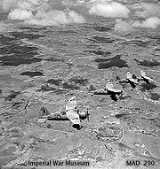
The first Lysanders entered service in June 1938, equipping squadrons for army co-operation and were initially used for message-dropping and artillery spotting. When war broke out in Europe, the earlier Mk Is had been largely replaced by Mk IIs, the older machines heading for the Middle East. Some of these aircraft, now designated type L.1, operated with the
ChinditsThe Chindits were a British India "Special Force" that served in Burma and India in 1943 and 1944 during the Burma Campaign in World War II. They were formed into long range penetration groups trained to operate deep behind Japanese lines...
of the
British Indian ArmyThe British Indian Army, officially simply the Indian Army, was the principal army of the British Raj in India before the partition of India in 1947...
in the
Burma CampaignThe Burma Campaign in the South-East Asian Theatre of World War II was fought primarily between British Commonwealth, Chinese and United States forces against the forces of the Empire of Japan, Thailand, and the Indian National Army. British Commonwealth land forces were drawn primarily from...
of the Second World War.
Four regular squadrons equipped with Lysanders accompanied the
British Expeditionary ForceThe British Expeditionary Force was the British force in Europe from 1939–1940 during the Second World War. Commanded by General Lord Gort, the BEF constituted one-tenth of the defending Allied force....
to
FranceThe French Republic , The French Republic , The French Republic , (commonly known as France , is a unitary semi-presidential republic in Western Europe with several overseas territories and islands located on other continents and in the Indian, Pacific, and Atlantic oceans. Metropolitan France...
in October 1939, and were joined by a further squadron early in 1940. Following the
German invasion of France and the low countriesIn the Second World War, the Battle of France was the German invasion of France and the Low Countries, beginning on 10 May 1940, which ended the Phoney War. The battle consisted of two main operations. In the first, Fall Gelb , German armoured units pushed through the Ardennes, to cut off and...
on 10 May 1940, the Lysanders were put into action as spotters and light bombers. In spite of occasional victories against German aircraft, they made very easy targets for the
LuftwaffeLuftwaffe is a generic German term for an air force. It is also the official name for two of the four historic German air forces, the Wehrmacht air arm founded in 1935 and disbanded in 1946; and the current Bundeswehr air arm founded in 1956....
even when escorted by
HurricanesThe Hawker Hurricane is a British single-seat fighter aircraft that was designed and predominantly built by Hawker Aircraft Ltd for the Royal Air Force...
. Withdrawn from France during the Dunkirk evacuation, they continued to fly supply-dropping missions to Allied forces from bases in England; on one mission to drop supplies to troops trapped at
CalaisCalais is a town in Northern France in the department of Pas-de-Calais, of which it is a sub-prefecture. Although Calais is by far the largest city in Pas-de-Calais, the department's capital is its third-largest city of Arras....
, 14 of 16 Lysanders and
Hawker Hector-See also:-Bibliography:* Air Transport Auxiliary Ferry Pilots Notes . Elvington, York, UK: Yorkshire Air Museum, 1996. ISBN 0-9512379-8-5....
s that set out were lost. A total of 118 Lysanders were lost in or over France and Belgium in May and June 1940, of a total of 175 deployed. With the fall of France, it was clear that the type was unsuitable for the army co-operation role, being described by Air Marshall
Arthur BarrattAir Chief Marshal Sir Arthur Sheridan Barratt KCB CMG MC was an officer in the Royal Flying Corps during World War I and a senior commander in the Royal Air Force during World War II.-RAF career:...
, commander-in-chief of the British Air Forces in France as "quite unsuited to the task; a faster, less vulnerable aircraft was required." It was replaced in the home-based army co-operation role from 1941 by camera-equipped fighters such as the
Curtiss TomahawkThe Curtiss P-40 Warhawk was an American single-engine, single-seat, all-metal fighter and ground attack aircraft that first flew in 1938. The P-40 design was a modification of the previous Curtiss P-36 Hawk which reduced development time and enabled a rapid entry into production and operational...
and
North American MustangThe North American Aviation P-51 Mustang was an American long-range, single-seat fighter and fighter-bomber used during World War II, the Korean War and in several other conflicts...
carrying out reconnaissance operations, while light planes such as the
Taylorcraft AusterThe Taylorcraft Auster was a British military liaison and observation aircraft produced by the Taylorcraft Aeroplanes Limited company during the Second World War.-Design and development:...
were used to direct artillery. Some UK-based Lysanders went to work operating air-sea rescue, dropping dinghies to downed RAF aircrew in the English Channel. Fourteen squadrons and flights were formed for this role in 1940 and 1941.
Special duties
In August 1941 a new squadron,
No. 138 (Special Duties)No. 138 Squadron RAF was a squadron of the Royal Air Force that served in a variety of roles during its career, last disbanded in 1962. It was the first 'V-bomber' squadron of the RAF, flying the Vickers Valiant between 1955 and 1962....
, was formed to undertake missions for the
Special Operations ExecutiveThe Special Operations Executive was a World War II organisation of the United Kingdom. It was officially formed by Prime Minister Winston Churchill and Minister of Economic Warfare Hugh Dalton on 22 July 1940, to conduct guerrilla warfare against the Axis powers and to instruct and aid local...
to maintain clandestine contact with the
French ResistanceThe French Resistance is the name used to denote the collection of French resistance movements that fought against the Nazi German occupation of France and against the collaborationist Vichy régime during World War II...
. Among its aircraft were Lysander Mk IIIs, which flew over and landed in occupied France. While general supply drops could be left to the rest of No. 138's aircraft, the Lysander could insert and remove agents from the continent or retrieve Allied aircrew who had been shot down over occupied territory and had evaded capture. For this role the Mk IIIs were fitted with a fixed ladder over the port side to hasten access to the rear cockpit and a large
drop tankIn aeronautics, a drop tank is used to describe auxiliary fuel tanks externally carried by aircraft. A drop tank is expendable and often jettisonable...
under the belly. In order to slip in unobtrusively the Lysanders were painted matt black; operations almost always took place within a week of a full moon, as moonlight was essential for navigation.
The Lysanders flew from secret airfields at Newmarket and later
TempsfordRAF Tempsford in Bedfordshire, England was perhaps the most secret Royal Air Force airfield in World War II. It was home to the Special Duties Squadrons, No. 138, which dropped Special Operations Executive agents and their supplies into occupied Europe, and No...
, but used regular RAF stations to fuel-up for the actual crossing, particularly
RAF TangmereRAF Tangmere was a Royal Air Force station famous for its role in the Battle of Britain, located at Tangmere village about 3 miles east of Chichester in West Sussex, England. American RAF pilot Billy Fiske died at Tangmere and was the first American aviator to die during World War II...
. Flying without any navigation equipment other than a map and compass, Lysanders would land on short strips of land, such as fields, marked out by four or five torches. They were designed to carry one passenger in the rear cockpit, but in case of urgent necessity three could be carried in extreme discomfort. The pilots of No. 138 and, from early 1942,
No. 161 SquadronNo. 161 Squadron was a highly secretive unit of the Royal Air Force tasked with missions of the Special Operations Executive during the Second World War. Their primary role was to drop and collect secret agents and equipment into and from Nazi-occupied Europe...
transported 101 agents to, and recovered 128 agents from
NaziNazism, the common short form name of National Socialism was the ideology and practice of the Nazi Party and of Nazi Germany...
-occupied Europe. The Lysander was successful in this role, and continued to undertake such duties until the liberation of France in 1944.
Free French
The Lysander also joined the ranks of the
Forces Aériennes Françaises Libres (
Free French Air ForceThe Free French Air Force was the air arm of the Free French Forces during the Second World War.-Fighting for Free France — the FAFL in French North Africa :...
, FAFL) when
Groupe Mixte de Combat (GMC) 1, formed at
RAF OdihamRAF Odiham is a Royal Air Force station situated a little to the south of the historic small village of Odiham in Hampshire, England. It is the home of the Royal Air Force's heavy lift helicopter, the Chinook HC2, HC2A and HC3...
on 29 August 1940, was sent to French North-West Africa in order to persuade the authorities in countries such as
GabonGabon , officially the Gabonese Republic is a state in west central Africa sharing borders with Equatorial Guinea to the northwest, Cameroon to the north, and with the Republic of the Congo curving around the east and south. The Gulf of Guinea, an arm of the Atlantic Ocean is to the west...
,
CameroonCameroon, officially the Republic of Cameroon , is a country in west Central Africa. It is bordered by Nigeria to the west; Chad to the northeast; the Central African Republic to the east; and Equatorial Guinea, Gabon, and the Republic of the Congo to the south. Cameroon's coastline lies on the...
and
ChadChad , officially known as the Republic of Chad, is a landlocked country in Central Africa. It is bordered by Libya to the north, Sudan to the east, the Central African Republic to the south, Cameroon and Nigeria to the southwest, and Niger to the west...
, which were still loyal to
Vichy FranceVichy France, Vichy Regime, or Vichy Government, are common terms used to describe the government of France that collaborated with the Axis powers from July 1940 to August 1944. This government succeeded the Third Republic and preceded the Provisional Government of the French Republic...
, to join the Gaullist cause against the
Axis powersThe Axis powers , also known as the Axis alliance, Axis nations, Axis countries, or just the Axis, was an alignment of great powers during the mid-20th century that fought World War II against the Allies. It began in 1936 with treaties of friendship between Germany and Italy and between Germany and...
, and to attack Italian ground forces in
LibyaLibya is an African country in the Maghreb region of North Africa bordered by the Mediterranean Sea to the north, Egypt to the east, Sudan to the southeast, Chad and Niger to the south, and Algeria and Tunisia to the west....
. As with all FAFL aircraft, the Lysanders sported the
Cross of LorraineThe Cross of Lorraine is originally a heraldic cross. The two-barred cross consists of a vertical line crossed by two smaller horizontal bars. In the ancient version, both bars were of the same length. In 20th century use it is "graded" with the upper bar being the shortest...
insignia on the fuselage and the wings instead of the French tricolor roundel first used in 1914, to distinguish their aircraft from those flying for the Vichy French Air Force. The Lysanders were mostly employed on reconnaissance missions, but were also used to carry out occasional attacks. In all, 24 Lysanders were used by the FAFL.
Canada
104 British-built Lysanders were delivered to Canada supplementing 225 that were built under license at
Malton, OntarioMalton is a neighbourhood in the northeastern part of the city of Mississauga, Ontario, Canada, located to the northwest of Toronto. The neighbourhood has a population of approximately 36,400 as of 2002....
(near
TorontoToronto is the provincial capital of Ontario and the largest city in Canada. It is located in Southern Ontario on the northwestern shore of Lake Ontario. A relatively modern city, Toronto's history dates back to the late-18th century, when its land was first purchased by the British monarchy from...
) with production starting in October 1938 and the first aircraft flying in August 1939.
The RCAF primarily operated them in the Army Co-operation role, where they represented a major improvement over the antiquated
Westland WapitiThe Westland Wapiti was a British two-seat general purpose military single-engined biplane of the 1920s. It was designed and built by Westland Aircraft Works to replace the Airco DH.9A in Royal Air Force service....
which could trace its origins back to 1916.
Initial training was conducted at Rockcliffe, Ontario (now a part of Ottawa, Ontario) with 123 Squadron running an Army Cooperation school there. Units that operated the Lysander for training in this role in Canada include 2 Squadron, 110 Squadron (which became 400 Squadron overseas) and 112 Squadron.
414 Squadron RCAF was formed overseas with Lysanders, joining 2 Squadron RCAF, 110 squadron RCAF and 112 Squadron RCAF and all four were ready to begin operations when the high losses suffered by RAF Lysanders put plans on hold but they continued training with the Lysanders until replacements were available.
118 Squadron and 122 Squadron would be the only units to use their Lysanders for active duty operations - 118 in
Saint John, New BrunswickCity of Saint John , or commonly Saint John, is the largest city in the province of New Brunswick, and the first incorporated city in Canada. The city is situated along the north shore of the Bay of Fundy at the mouth of the Saint John River. In 2006 the city proper had a population of 74,043...
, and 122 at various locations on
Vancouver IslandVancouver Island is a large island in British Columbia, Canada. It is one of several North American locations named after George Vancouver, the British Royal Navy officer who explored the Pacific Northwest coast of North America between 1791 and 1794...
where they performed anti-submarine patrols and conducted search and rescue operations.
During the same period, 121 Squadron used the Lysander for Target Towing duties, with a high visibility yellow and black striped paint job but by late 1944 all Lysanders had been withdrawn from flying duties.
Other duties
The type also filled other, less glamorous roles such as target-towing and communication aircraft. Two aircraft (T1443 and T1739) were transferred to
British Overseas Airways Corporation (BOAC)The British Overseas Airways Corporation was the British state airline from 1939 until 1946 and the long-haul British state airline from 1946 to 1974. The company started life with a merger between Imperial Airways Ltd. and British Airways Ltd...
for training and 18 were used by the
Fleet Air ArmThe Fleet Air Arm is the branch of the British Royal Navy responsible for the operation of naval aircraft. The Fleet Air Arm currently operates the AgustaWestland Merlin, Westland Sea King and Westland Lynx helicopters...
. All British Lysanders were withdrawn from service in 1946.
Export customers of the type included
FinlandThe Finnish Air Force is one of the branches of the Finnish Defence Forces. Its peacetime tasks are airspace surveillance, identification flights, and production of readiness formations for wartime conditions...
(Mk I: 4, Mk III: 9),
IrelandThe Air Corps is the air component of the Defence Forces of Ireland providing support to the Army and Naval Service, together with non-military air services such as search and rescue and the Ministerial Air Transport Service...
(Mk II: 6),
TurkeyThe Turkish Air Force is the aerial warfare service branch of the Turkish Armed Forces. It ranks 3rd in NATO in terms of fleet size behind the USAF and Royal Air Force with a current inventory of 798 aircraft .-Initial stages:...
(Mk II: 36),
PortugalThe Portuguese Air Force is the air force of Portugal. Formed on July 1, 1952, with the Aeronáutica Militar and Aviação Naval united in a single independent Air Force, it is one of the three branches of the Portuguese Armed Forces and its origins dates back to 1912, when the military aviation...
(Mk IIIA: 8), the
United StatesThe United States Army Air Forces was the military aviation arm of the United States of America during and immediately after World War II, and the direct predecessor of the United States Air Force....
(25),
IndiaThe Indian Air Force is the air arm of the Indian armed forces. Its primary responsibility is to secure Indian airspace and to conduct aerial warfare during a conflict...
(22) and
EgyptThe Egyptian Air Force, or EAF , is the aviation branch of the Egyptian Armed Forces. The EAF is headed by an Air Marshal . Currently, the commander of the Egyptian Air Force is Air Marshal Reda Mahmoud Hafez Mohamed...
(20). Egyptian Lysanders were the last to see active service, against Israel in the War of Independence in 1948.
A total of 1,786 were built, including 225 that were built under licence by National Steel Car in Toronto, Ontario, Canada during the late 1930s.
Civilian operation
After the war a number of surplus ex-
RCAFThe history of the Royal Canadian Air Force begins in 1920, when the air force was created as the Canadian Air Force . In 1924 the CAF was renamed the Royal Canadian Air Force and granted royal sanction by King George V. The RCAF existed as an independent service until 1968...
Lysanders were employed as aerial applicators with Westland Dusting Service, operating in Alberta and western Canada. Two of these were saved for inclusion in
Lynn GarrisonLynn Garrison is a Canadian pilot and political adviser. He was an RCAF fighter pilot from the 403 City of Calgary Squadron, commercial pilot, film producer, director and mercenary...
's collection to be displayed in Calgary, Alberta.
Variants
Lysander Mk.I
- Powered by one 890 hp (664 kW) Bristol Mercury
|-See also:-Bibliography:* Bridgman, L, Jane's fighting aircraft of World War II. Crescent. ISBN 0-517-67964-7* Gunston, Bill. World Encyclopedia of Aero Engines. Cambridge, England. Patrick Stephens Limited, 1989. ISBN 1-85260-163-9...
XII radial piston engine. Two forward-firing 0.303 in.303 British, or 7.7x56mmR, is a .311 inch calibre rifle and machine gun cartridge first developed in Britain as a blackpowder round put into service in December 1888 for the Lee-Metford rifle, later adapted to use smokeless powders...
(7.7 mm) Browning machine gunThe M1919 Browning is a .30 caliber medium machine gun that was widely used during the 20th century. It was used as a light infantry, coaxial, mounted, aircraft, and anti-aircraft machine gun by the U.S. and many other countries, especially during World War II, the Korean War, and the Vietnam War...
s in wheel fairings and one pintle-mounted 0.303 in (7.7 mm) LewisThe Lewis Gun is a World War I–era light machine gun of American design that was perfected and widely used by the British Empire. It was first used in combat in World War I, and continued in service with a number of armed forces through to the end of the Korean War...
or Vickers K machine gunNot to be confused with the Vickers light machine gunThe Vickers K machine gun, known as the Vickers Gas Operated in British service, was a rapid-firing machine gun developed and manufactured for use in aircraft by Vickers-Armstrongs...
in rear cockpit. Optional spat-mounted stub wings carried 500 lb (227 kg) of bombs. Four 20 lb (9 kg) bombs could be carried under rear fuselage.
Lysander TT Mk I
- Lysander Mk Is converted into target tugs.
Lysander Mk II
- Powered by one 905 hp (675 kW) Bristol Perseus
|-See also:-Bibliography:* Bridgman, L, Jane's Fighting Aircraft of World War II. Crescent . ISBN 0-517-67964-7* Gunston, Bill. World Encyclopedia of Aero Engines. Cambridge, England. Patrick Stephens Limited, 1989. ISBN 1-85260-163-9...
XII sleeve valveThe sleeve valve is a type of valve mechanism for piston engines, distinct from the usual poppet valve. Sleeve-valve engines saw use in a number of pre-World War II luxury cars and in USA in the Willys-Knight car and light truck...
radial piston engine.
Lysander TT Mk II
- Target tug conversion of the Lysander Mk.II.
Lysander Mk III
- Powered by one 870 hp (649 kW) Bristol Mercury XX or 30 radial piston engine, 350 delivered from July 1940. Twin 0.303 in (7.7 mm) Browning guns in rear cockpit.
Lysander Mk IIIA
- Similar to the Lysander Mk I. Mercury 20 engine. Twin 0.303 in (7.7 mm) Lewis guns in rear cockpit.
Lysander Mk III SCW
- Special version for clandestine operations. No armament, long-range 150 gallon fuel tank, fixed external ladder.
Lysander TT Mk III
- Lysander Mk Is, Mk IIs and Mk IIIs converted into target tugs.
Lysander TT Mk IIIA
- 100 dedicated target tugs.
P.12 Lysander Delanne
- Experiment to try adapting the Lysander as a turret fighter, with twin tail
A twin tail is a specific type of vertical stabilizer arrangement found on the empennage of some aircraft. Two vertical stabilizers — often smaller on their own than a single conventional tail would be — are mounted at the outside of the aircraft's horizontal stabilizer...
ed Delanne tandem wingthumb|right|QAC Quickie Q2A tandem wing aircraft usually involves two full-sized wings, both of which are full airfoils. Sometimes an aircraft of this configuration can look like a variation on the biplane, but is in fact very different. The forward wing is often technically a canard, fitted with...
and 4-gun Nash & ThomsonNash & Thompson was a British engineering firm that specialised in the production of hydraulically-operated gun turrets for aircraft. The company was also an important manufacturer of hydraulic powered radar scanners, used on radar systems such as H2S and AI Mark VIII.- History :Nash & Thompson was...
power-operated tail gun turret replacing the empennageThe empennage , also known as the tail or tail assembly, of most aircraft gives stability to the aircraft, in a similar way to the feathers on an arrow...
. Never proceeded past flying prototypeA prototype is an early sample or model built to test a concept or process or to act as a thing to be replicated or learned from.The word prototype derives from the Greek πρωτότυπον , "primitive form", neutral of πρωτότυπος , "original, primitive", from πρῶτος , "first" and τύπος ,...
with turret mock-up.
In 1940 at least one was trialled with a pair of 20mm cannon mounted on the undercarriage (replacing the stub wings); the intention was to use the aircraft for ground attack missions against the threatened German invasion of Britain.
Survivors
A number of Lysanders are preserved in museums in Canada, the United Kingdom, the United States, Belgium and elsewhere.
The
National Air and Space MuseumThe National Air and Space Museum of the Smithsonian Institution holds the largest collection of historic aircraft and spacecraft in the world. It was established in 1976. Located in Washington, D.C., United States, it is a center for research into the history and science of aviation and...
, Smithsonian Institution, in the Udvar-Hazy Center located in the Chantilly, Virginia, suburb of Washington DC near Dulles International Airport has a Westland Lysander Mk IIIA on display, painted in a night finish with grey and green topsides, and marked as AC-B
N7791, a
No. 138 Squadron RAFNo. 138 Squadron RAF was a squadron of the Royal Air Force that served in a variety of roles during its career, last disbanded in 1962. It was the first 'V-bomber' squadron of the RAF, flying the Vickers Valiant between 1955 and 1962....
aircraft famed for spy-dropping missions in wartime Europe.
Another example in the United States is owned by the
Fantasy of FlightFantasy of Flight is an aviation-related attraction in Polk City, Florida, USA that takes visitors back to the pioneering days of early flight, World War I, World War II and beyond. The attraction opened in November of 1995, and houses the world's largest private aircraft collection on display...
Museum but is currently on loan to and displayed at the nearby Florida Air Museum at the SUN 'n FUN Fly-In campus entrance, on the southwest corner of
Lakeland Linder Regional AirportLakeland Linder Regional Airport is a public airport located four miles southwest of the central business district of Lakeland, a city in Polk County, Florida, United States...
, in Lakeland, FL. It is painted in a temperate sea scheme (Extra Dark Sea Grey and Dark Slate Grey over Sky) and marked as BA-C serial
V9545.
In Belgium, Sabena Old Timers' volunteers and Sabena Airlines personnel restored the remains of a former RCAF Lysander during 1983-1988. It is registered as OO-SOP. The engine performance has been problematic, resulting in a forced landing and serious damage. Repairs were completed in December 2010. Ref. Jersey CI International Air Display '97 Programme, Pg.12; also GOOGLE citations. Also in Belgium, OO-SOT (Ex RCAF serial 2442) is being restored to flying condition.
A Westland built Lysander Mk III (serial no.
R9003) is at the Canada Aviation and Space Museum in Ottawa, Canada. This example was a composite, restored from three aircraft by the RCAF as a Centennial project in 1967 and is painted in the early war temperate land scheme (Dark Earth and Dark Green over Sky).
A Mk III (serial no. 2363) is in flying condition at the
Canadian Warplane Heritage MuseumThe Canadian Warplane Heritage Museum is a Canadian aviation museum located at the John C. Munro Hamilton International Airport near Hamilton, Ontario. The museum has 36 military jets, propeller-driven aircraft and helicopters on display....
in
OntarioOntario is a province of Canada, located in east-central Canada. It is Canada's most populous province and second largest in total area. It is home to the nation's most populous city, Toronto, and the nation's capital, Ottawa....
. It flew for the first time following its restoration a few weeks before the Museum's Flyfest on 20–21 June 2009. It is finished in a yellow & black 'bumblebee'
target tugA target tug is an aircraft which tows an unmanned drone, a fabric drogue or other kind of target, for the purposes of gun or missile target practice. Target tugs are often conversions of transport and utility aircraft, as well as obsolescent combat types...
scheme.
A Canadian built Mk III, construction number 1206, formerly RCAF s/n 2365, registered C-GVZZ, is being flown by
Vintage Wings of CanadaVintage Wings of Canada is an aviation museum of historically significant aircraft, organized as a charitable foundation. The facility is located at the Gatineau-Ottawa Executive Airport, Quebec, Canada. It was founded by former Cognos CEO and philanthropist Michael Potter...
. It is painted in No. 400 "City of Toronto"
RCAFThe history of the Royal Canadian Air Force begins in 1920, when the air force was created as the Canadian Air Force . In 1924 the CAF was renamed the Royal Canadian Air Force and granted royal sanction by King George V. The RCAF existed as an independent service until 1968...
Squadron markings, and is doped silver overall with RCAF serial number 416. After a full restoration, she first flew June 18, 2010 in Gatineau, QC.
Lysander Mk III construction number 1194, formerly RCAF s/n 2349 is on display at the
Canadian Museum of Flightthumb|right|De Havilland DH100 Vampire Mk.3 at Canadian Museum of FlightThe Canadian Museum of Flight is an aviation museum at the Langley Regional Airport in Langley, British Columbia, Canada...
in
LangleyThe Township of Langley is a district municipality immediately east of the City of Surrey in southwestern British Columbia, Canada. It extends south from the Fraser River to the U.S. border, and west of the City of Abbotsford...
,
British ColumbiaBritish Columbia is the westernmost of Canada's provinces and is known for its natural beauty, as reflected in its Latin motto, Splendor sine occasu . Its name was chosen by Queen Victoria in 1858...
without most of its fabric covering.
Lysander Mk IIIT (ex RCAF serial number
2375) was on display at the
Commonwealth Air Training Plan MuseumThe Commonwealth Air Training Plan Museum is an aviation museum located at Brandon Municipal Airport, Brandon, Manitoba. It is dedicated to the memory of the airmen from the British Commonwealth Air Training Plan, who trained at World War II air stations across Canada...
,
Brandon, ManitobaBrandon is the second largest city in Manitoba, Canada, and is located in the southwestern area of the province. Brandon is the largest city in the Westman region of Manitoba. The city is located along the Assiniboine River. Spruce Woods Provincial Park and CFB Shilo are a relatively short distance...
,
CanadaCanada is a North American country consisting of ten provinces and three territories. Located in the northern part of the continent, it extends from the Atlantic Ocean in the east to the Pacific Ocean in the west, and northward into the Arctic Ocean...
until July 2003 when it was shipped to a museum in
PortugalPortugal , officially the Portuguese Republic is a country situated in southwestern Europe on the Iberian Peninsula. Portugal is the westernmost country of Europe, and is bordered by the Atlantic Ocean to the West and South and by Spain to the North and East. The Atlantic archipelagos of the...
. Like many Lysanders used in Canada, it was resplendent in "trainer" yellow.
Another airworthy Lysander is part of the
Shuttleworth CollectionThe Shuttleworth Collection is an aeronautical and automotive museum located at the Old Warden airfield in Bedfordshire, England. It is one of the most prestigious in the world due to the variety of old and well-preserved aircraft.- History :...
based at
Old Warden AirfieldOld Warden is a village and civil parish in Bedfordshire, England, just west of the town of Biggleswade. It has a population of 275. The village grew up under the protection of the Cistercian Wardon or Warden Abbey nearby....
,
BedfordshireBedfordshire is a ceremonial county of historic origin in England that forms part of the East of England region.It borders Cambridgeshire to the north-east, Northamptonshire to the north, Buckinghamshire to the west and Hertfordshire to the south-east....
. It is a regular at vintage air shows, including the Shuttleworth displays and "Flying Legends" at
DuxfordDuxford Aerodrome is located south of Cambridge, within the Parish of Duxford, Cambridgeshire, England and nearly west of the village.The airfield is owned jointly by the Imperial War Museum and Cambridgeshire County Council and it is the site of the Imperial War Museum Duxford and the American...
. It is painted all black as another clandestine aircraft and is marked as MA-B
V9367 of No. 309 Squadron RAF.
RAF Museum Hendon near
LondonLondon is the capital city of :England and the :United Kingdom, the largest metropolitan area in the United Kingdom, and the largest urban zone in the European Union by most measures. Located on the River Thames, London has been a major settlement for two millennia, its history going back to its...
has a Lysander Mk III painted in the early war temperate land scheme marked LX-L
R9125 of
No. 225 Squadron RAFNo. 225 Squadron RAF was formed on 1 April 1918 at Alimini, Italy from part of No. 6 Wing RNAS, and was equipped with Sopwith Camels. The squadron disbanded on 18 December 1918....
.
Imperial War MuseumImperial War Museum is a British national museum organisation with branches at five locations in England, three of which are in London. The museum was founded during the First World War in 1917 and intended as a record of the war effort and sacrifice of Britain and her Empire...
at
DuxfordDuxford is a village in Cambridgeshire, England, some ten miles south of Cambridge.-History:The village formed on the banks of the River Cam, a little below its emergence from the hills of north Essex...
has a Lysander III painted similarly to the NASM example but marked as MA-J
V9673 also of
No. 161 Squadron RAFNo. 161 Squadron was a highly secretive unit of the Royal Air Force tasked with missions of the Special Operations Executive during the Second World War. Their primary role was to drop and collect secret agents and equipment into and from Nazi-occupied Europe...
.
Wessex Aviation and Transport had a Lysander IIIa marked as BA-C
V9545 No. 277 Squadron RAFNo. 277 Squadron RAF was a Royal Air Force Squadron formed as an air-sea rescue unit in World War II.-Formation in World War II:The squadron formed at Stapleford Tawney on 22 December 1941 equipped with the Lysander and Walrus...
as of 1996. Current dispostion is unknown. Aside from this example, several other Lysanders are in private hands.
A Lysander Mk IIIT (serial no. 1589) is a Canadian-built trainer on display at the Indian Air Force Museum (IAFM) at Palam, New Delhi, and is painted in spurious colours.
Specifications (Lysander Mk III)
See also
External links