


Goldberg Variations

Encyclopedia
Harpsichord
A harpsichord is a musical instrument played by means of a keyboard. It produces sound by plucking a string when a key is pressed.In the narrow sense, "harpsichord" designates only the large wing-shaped instruments in which the strings are perpendicular to the keyboard...
by Johann Sebastian Bach
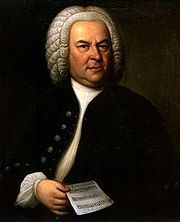
Johann Sebastian Bach
Johann Sebastian Bach was a German composer, organist, harpsichordist, violist, and violinist whose sacred and secular works for choir, orchestra, and solo instruments drew together the strands of the Baroque period and brought it to its ultimate maturity...
, consisting of an aria
Aria
An aria in music was originally any expressive melody, usually, but not always, performed by a singer. The term is now used almost exclusively to describe a self-contained piece for one voice usually with orchestral accompaniment...
and a set of 30 variations
Variation (music)
In music, variation is a formal technique where material is repeated in an altered form. The changes may involve harmony, melody, counterpoint, rhythm, timbre, orchestration or any combination of these.-Variation form:...
. First published in 1741, the work is considered to be one of the most important examples of variation form. The Variations are named after Johann Gottlieb Goldberg
Johann Gottlieb Goldberg
Johann Gottlieb Goldberg was a German virtuoso harpsichordist, organist, and composer of the late Baroque and early Classical period. He is most famous for lending his name, as the probable original performer, to the renowned Goldberg Variations of J.S...
, who may have been the first performer.
| Composition | Publication | Form |
| Aria |
| 1 2 3 4 5 6 7 8 9 10 11 12 13 14 15 16 17 18 19 20 21 22 23 24 25 26 27 28 29 30 |
| Aria da Capo |
| BWV1087 | Transcriptions | Editions |
| see also | Notes | References | External links |
Composition
The tale of how the variations came to be composed comes from an early biography of Bach by Johann Nikolaus ForkelJohann Nikolaus Forkel
Johann Nikolaus Forkel , was a German musician, musicologist and music theorist.-Biography:...
:
[For this work] we have to thank the instigation of the former Russian ambassador to the electoral court of SaxonySaxonyThe Free State of Saxony is a landlocked state of Germany, contingent with Brandenburg, Saxony Anhalt, Thuringia, Bavaria, the Czech Republic and Poland. It is the tenth-largest German state in area, with of Germany's sixteen states....
, Count Kaiserling, who often stopped in LeipzigLeipzigLeipzig Leipzig has always been a trade city, situated during the time of the Holy Roman Empire at the intersection of the Via Regia and Via Imperii, two important trade routes. At one time, Leipzig was one of the major European centres of learning and culture in fields such as music and publishing...
and brought there with him the aforementioned Goldberg, in order to have him given musical instruction by Bach. The Count was often ill and had sleepless nights. At such times, Goldberg, who lived in his house, had to spend the night in an antechamber, so as to play for him during his insomniaInsomniaInsomnia is most often defined by an individual's report of sleeping difficulties. While the term is sometimes used in sleep literature to describe a disorder demonstrated by polysomnographic evidence of disturbed sleep, insomnia is often defined as a positive response to either of two questions:...
. ... Once the Count mentioned in Bach's presence that he would like to have some clavierKeyboard instrumentA keyboard instrument is a musical instrument which is played using a musical keyboard. The most common of these is the piano. Other widely used keyboard instruments include organs of various types as well as other mechanical, electromechanical and electronic instruments...
pieces for Goldberg, which should be of such a smooth and somewhat lively character that he might be a little cheered up by them in his sleepless nights. Bach thought himself best able to fulfill this wish by means of Variations, the writing of which he had until then considered an ungrateful task on account of the repeatedly similar harmonic foundation. But since at this time all his works were already models of art, such also these variations became under his hand. Yet he produced only a single work of this kind. Thereafter the Count always called them his variations. He never tired of them, and for a long time sleepless nights meant: 'Dear Goldberg, do play me one of my variations.' Bach was perhaps never so rewarded for one of his works as for this. The Count presented him with a golden goblet filled with 100 louis-d'or. Nevertheless, even had the gift been a thousand times larger, their artistic value would not yet have been paid for.
Forkel wrote his biography in 1802, more than 60 years after the events related, and its accuracy has been questioned. The lack of dedication on the title page of the "Aria with Diverse Variations" also makes the tale of the commission unlikely. Goldberg's age at the time of publication (14 years) has also been cited as grounds for doubting Forkel's tale, although it must be said that he was known to be an accomplished keyboardist and sight-reader. In a recent book-length study, keyboardist and Bach scholar Peter Williams contends that the Forkel story is entirely spurious.
The aria
Aria
An aria in music was originally any expressive melody, usually, but not always, performed by a singer. The term is now used almost exclusively to describe a self-contained piece for one voice usually with orchestral accompaniment...
on which the variations are based was suggested by Arnold Schering
Arnold Schering
Arnold Schering was a German musicologist.He grew up in Dresden as the son of an art publisher. He learned violin at the Annengymnasium from which he graduated in 1896. Thereafter he studied violin at the Berlin School of Music under Joseph Joachim...
not to have been written by Bach. More recent scholarly literature (such as the edition by Christoph Wolff
Christoph Wolff
Christoph Wolff is a German-born musicologist, presently on the faculty of Harvard University. Born and educated in Germany, Wolff studied organ and historical keyboard instruments, musicology and art history at the Universities of Berlin, Erlangen, and the Music Academy of Freiburg, receiving a...
) suggests that there is no basis for such doubts.
Publication
Rather unusually for Bach's works, the Goldberg Variations were published in his own lifetime, in 1741. The publisher was Bach's friend Balthasar Schmid of NurembergNuremberg
Nuremberg[p] is a city in the German state of Bavaria, in the administrative region of Middle Franconia. Situated on the Pegnitz river and the Rhine–Main–Danube Canal, it is located about north of Munich and is Franconia's largest city. The population is 505,664...
. Schmid printed the work by making engraved copper plates (rather than using movable type); thus the notes of the first edition are in Schmid's own handwriting. The edition contains various printing errors.
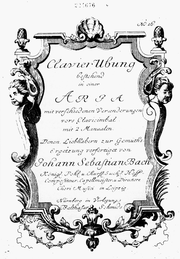
The title page, shown in the figure above, reads in German:
- Clavier Ubung / bestehend / in einer ARIA / mit verschiedenen Verænderungen / vors Clavicimbal / mit 2 Manualen. / Denen Liebhabern zur Gemüths- / Ergeizung verfertiget von / Johann Sebastian Bach / Königl. Pohl. u. Churfl. Sæchs. Hoff- / Compositeur, Capellmeister, u. Directore / Chori Musici in Leipzig. / Nürnberg in Verlegung / Balthasar Schmids
- "Keyboard exercise, consisting of an ARIA with diverse variations for harpsichord with two manuals. Composed for connoisseurs, for the refreshment of their spirits, by Johann Sebastian Bach, composer for the royal court of Poland and the Electoral court of Saxony, KapellmeisterKapellmeisterKapellmeister is a German word designating a person in charge of music-making. The word is a compound, consisting of the roots Kapelle and Meister . The words Kapelle and Meister derive from the Latin: capella and magister...
and Director of Choral Music in Leipzig. Nuremberg, Balthasar Schmid, publisher."
The term "Clavier Ubung" (nowadays spelled "Klavierübung") had been assigned by Bach to some of his previous keyboard works. Klavierübung part 1 was the six partitas, part 2 the Italian Concerto and French Overture
Overture in the French style, BWV 831
The Overture in the French style, BWV 831, original title Ouvertüre nach Französischer Art, also known as the French Overture and published as the second half of Clavier-Übung II in 1735 , is a suite in B minor for two-manual harpsichord written by Johann Sebastian Bach...
, and part 3 a series of chorale prelude
Chorale prelude
In music, a chorale prelude is a short liturgical composition for organ using a chorale tune as its basis. It was a predominant style of the German Baroque era and reached its culmination in the works of J.S. Bach, who wrote 46 examples of the form in his Orgelbüchlein.-Function:The liturgical...
s for organ framed by a prelude and fugue in E major). Although Bach also called his variations "Klavierübung", he did not specifically designate them as the fourth in this series.
Nineteen copies of the first edition survive today. Of these, the most valuable is the "handexemplar", kept in the Bibliothèque nationale de France
Bibliothèque nationale de France
The is the National Library of France, located in Paris. It is intended to be the repository of all that is published in France. The current president of the library is Bruno Racine.-History:...
, Paris, which includes corrections and additions made by the composer, including an appendix with fourteen canons based on the first eight bass notes of the aria, BWV 1087.
These copies provide virtually the only information available to modern editors trying to reconstruct Bach's intent; the autograph (hand-written) score has not survived. A handwritten copy of just the aria is found in the 1725
1725 in music
- Events :*Giovanni Battista Pergolesi goes to Naples to study under Gaetano Greco. Domenico Scarlatti is also in Naples at this time.*Nineteen-year-old Giovanni Battista Martini is appointed chapel-master of the Franciscan church at Bologna'...
Notebook for Anna Magdalena Bach
Notebook for Anna Magdalena Bach
The title Notebook for Anna Magdalena Bach refers to either of two manuscript notebooks that the German Baroque composer Johann Sebastian Bach presented to his second wife Anna Magdalena...
. Christoph Wolff suggests on the basis of handwriting evidence that Anna Magdalena copied the aria from the autograph score around 1740; it appears on two pages previously left blank.
Form
After a statement of the aria at the beginning of the piece, there are thirty variations. The variations do not follow the melody of the aria, but rather use its bass line and chord progressionChord progression
A chord progression is a series of musical chords, or chord changes that "aims for a definite goal" of establishing a tonality founded on a key, root or tonic chord. In other words, the succession of root relationships...
. Because of this the work is often said to be a chaconne
Chaconne
A chaconne ; is a type of musical composition popular in the baroque era when it was much used as a vehicle for variation on a repeated short harmonic progression, often involving a fairly short repetitive bass-line which offered a compositional outline for variation, decoration, figuration and...
— the difference being that the theme for a chaconne is usually just four bars long, whereas Bach's aria is in two sections of sixteen bars, each repeated.
The bass line is notated by Ralph Kirkpatrick
Ralph Kirkpatrick
Ralph Kirkpatrick was an American musician, musicologist and harpsichordist. He is most famous for his chronological catalog of Domenico Scarlatti's keyboard sonatas.-Life and work:...
in his performing edition as follows.
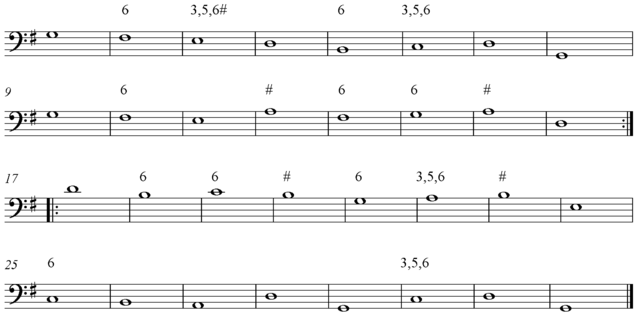
The digits above the notes indicate the specified chord in the system of figured bass
Figured bass
Figured bass, or thoroughbass, is a kind of integer musical notation used to indicate intervals, chords, and non-chord tones, in relation to a bass note...
; where digits are separated by comma, they indicate different options taken in different variations.
Every third variation in the series of 30 is a canon
Canon (music)
In music, a canon is a contrapuntal composition that employs a melody with one or more imitations of the melody played after a given duration . The initial melody is called the leader , while the imitative melody, which is played in a different voice, is called the follower...
, following an ascending pattern. Thus, variation 3 is a canon at the unison, variation 6 is a canon at the second (the second entry begins the interval of a second
Interval (music)
In music theory, an interval is a combination of two notes, or the ratio between their frequencies. Two-note combinations are also called dyads...
above the first), variation 9 is a canon at the third, and so on until variation 27, which is a canon at the ninth. The final variation, instead of being the expected canon in the tenth, is a quodlibet
Quodlibet
A quodlibet is a piece of music combining several different melodies, usually popular tunes, in counterpoint and often a light-hearted, humorous manner...
, discussed below.
As Ralph Kirkpatrick has pointed out, the variations that intervene between the canons are also arranged in a pattern. If we leave aside the initial and final material of the work (specifically, the Aria, the first two variations, the Quodlibet, and the aria da capo), the remaining material is arranged as follows. The variations found just after each canon are genre pieces of various types, among them three Baroque dance
Baroque dance
Baroque dance is dance of the Baroque era , closely linked with Baroque music, theatre and opera.- English country dance :...
s (4, 7, 19); a fughetta (10); a French overture
French overture
The French overture is a musical form widely used in the Baroque period. Its basic formal division is into two parts, which are usually enclosed by double bars and repeat signs. They are complementary in styles , and the first ends with a half-cadence that requires an answering structure with a...
(16); and two ornate aria
Aria
An aria in music was originally any expressive melody, usually, but not always, performed by a singer. The term is now used almost exclusively to describe a self-contained piece for one voice usually with orchestral accompaniment...
s for the right hand (13, 25). The variations located two after each canon (5, 8, 11, 14, 17, 20, 23, 26, and 29) are what Kirkpatrick calls "arabesques"; they are variations in lively tempo with a great deal of hand-crossing. This ternary pattern - canon, genre piece, arabesque — is repeated a total of nine times, until the Quodlibet breaks the cycle.
All the variations are in G major, apart from variations 15, 21, and 25, which are in G minor.
At the end of the thirty variations, Bach writes Aria da Capo è fine, meaning that the performer is to return to the beginning ("da capo") and play the aria again before concluding.
Variations for one and two manuals
The work was composed for a two-manualManual (music)
A manual is a keyboard designed to be played with the hands on a pipe organ, harpsichord, clavichord, electronic organ, or synthesizer. The term "manual" is used with regard to any hand keyboard on these instruments to distinguish it from the pedalboard, which is a keyboard that the organist plays...
harpsichord
Harpsichord
A harpsichord is a musical instrument played by means of a keyboard. It produces sound by plucking a string when a key is pressed.In the narrow sense, "harpsichord" designates only the large wing-shaped instruments in which the strings are perpendicular to the keyboard...
(see musical keyboard
Musical keyboard
A musical keyboard is the set of adjacent depressible levers or keys on a musical instrument, particularly the piano. Keyboards typically contain keys for playing the twelve notes of the Western musical scale, with a combination of larger, longer keys and smaller, shorter keys that repeats at the...
). Variations 8, 11, 13, 14, 17, 20, 23, 25, 26, 27 and 28 are specified in the score for two manuals, while variations 5, 7 and 29 are specified as playable with either one or two. With greater difficulty, the work can nevertheless be played on a single-manual harpsichord or piano.
Aria
The aria is a sarabandeSarabande
In music, the sarabande is a dance in triple metre. The second and third beats of each measure are often tied, giving the dance a distinctive rhythm of quarter notes and eighth notes in alternation...
in 3/4 time
Time signature
The time signature is a notational convention used in Western musical notation to specify how many beats are in each measure and which note value constitutes one beat....
, and features a heavily ornamented melody:

Wilhelm Kempff
Wilhelm Walter Friedrich Kempff was a German pianist and composer. Although his repertory included Bach, Liszt, Chopin, Schumann, and Brahms, Kempff was particularly well-known for his interpretations of the music of Ludwig van Beethoven and Franz Schubert, both of whose complete sonatas he also...
on piano) omit some or all ornaments and present the aria unadorned.
Peter Williams opines in Bach: The Goldberg Variations that this is not the theme at all, but actually the first variation (a view emphasising the idea of the work as a chaconne
Chaconne
A chaconne ; is a type of musical composition popular in the baroque era when it was much used as a vehicle for variation on a repeated short harmonic progression, often involving a fairly short repetitive bass-line which offered a compositional outline for variation, decoration, figuration and...
rather than a piece in true variation form).
Variatio 1. a 1 Clav.
This sprightly variation contrasts markedly with the slow, contemplative mood of the theme. The rhythm in the right hand forces the emphasis on the second beat, giving rise to syncopationSyncopation
In music, syncopation includes a variety of rhythms which are in some way unexpected in that they deviate from the strict succession of regularly spaced strong and weak but also powerful beats in a meter . These include a stress on a normally unstressed beat or a rest where one would normally be...
from bars 1 to 7. Hands cross at bar 13 from the upper register to the lower, bringing back this syncopation for another two bars. In the first two bars of the B part, the rhythm mirrors that of the beginning of the A part, but after this a different idea is introduced.
Williams sees this as a sort of polonaise
Polonaise
The polonaise is a slow dance of Polish origin, in 3/4 time. Its name is French for "Polish."The polonaise had a rhythm quite close to that of the Swedish semiquaver or sixteenth-note polska, and the two dances have a common origin....
. The characteristic rhythm in the left hand is also found in Bach's Partita No. 3 for solo violin
Partita for Violin No. 3 (Bach)
The Partita No. 3 in E major BWV 1006 by Johann Sebastian Bach for solo violin consists of the following movements:# Preludio# Loure# Gavotte en Rondeau# Menuets # Bourrée# GigaIt takes approximately 20 minutes to perform....
, in the A major prelude from the first book of The Well-Tempered Clavier
The Well-Tempered Clavier
The Well-Tempered Clavier , BWV 846–893, is a collection of solo keyboard music composed by Johann Sebastian Bach...
, and in the D minor prelude of the second book.
Variatio 2. a 1 Clav.
This is a simple three-part contrapuntal piece in 2/4 time, two voices engage in constant motivic interplay over an incessant bass line. The piece is almost a pure canonCanon (music)
In music, a canon is a contrapuntal composition that employs a melody with one or more imitations of the melody played after a given duration . The initial melody is called the leader , while the imitative melody, which is played in a different voice, is called the follower...
. Each section has an alternate ending to be played on the first and second repeat.
Variatio 3. a 1 Clav. Canone all’Unisono
The first of the regular canons, this is a canon at the unison: the follower begins on the same note as the leader, a bar later. As with all canons of the Goldberg Variations (except the 27th variation, canon at the ninth), there is a supporting bass line here. The time signature of 12/8 and the many sets of tripletsTuplet
In music a tuplet is "any rhythm that involves dividing the beat into a different number of equal subdivisions from that usually permitted by the...
suggest a kind of a simple dance.
Variatio 4. a 1 Clav.
Like the passepiedPassepied
The passepied is a 17th- and 18th-century dance that originated in Brittany. The term can also be used to describe the music to which a passepied is set...
, a Baroque dance movement, this variation is in 3/8 time with a preponderance of quaver rhythms. Bach uses close but not exact imitation
Imitation (music)
In music, imitation is when a melody in a polyphonic texture is repeated shortly after its first appearance in a different voice, usually at a different pitch. The melody may vary through transposition, inversion, or otherwise, but retain its original character...
: the musical pattern in one part reappears a bar later in another (sometimes inverted
Inversion (music)
In music theory, the word inversion has several meanings. There are inverted chords, inverted melodies, inverted intervals, and inverted voices...
).
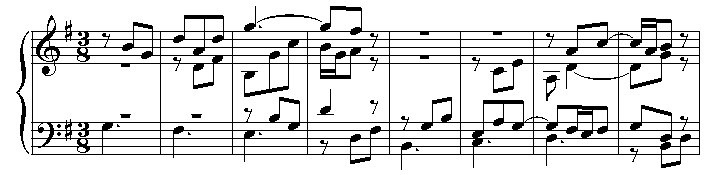
Variatio 5. a 1 ô vero 2 Clav.
This is the first of the hand-crossing, two-part variations. It is in 3/4 time. A rapid melodic line written predominantly in sixteenth notes is accompanied by another melody with longer note values, which features very wide leaps:
Register (music)
In music, a register is the relative "height" or range of a note, set of pitches or pitch classes, melody, part, instrument or group of instruments...
while the other hand stays in the middle of the keyboard, playing the fast passages.
Variatio 6. a 1 Clav. Canone alla Seconda
The sixth variation is a canon at the second: the follower starts a major secondInterval (music)
In music theory, an interval is a combination of two notes, or the ratio between their frequencies. Two-note combinations are also called dyads...
higher than the leader. The piece is based on a descending scale and is in 3/8 time. The harpsichordist Ralph Kirkpatrick
Ralph Kirkpatrick
Ralph Kirkpatrick was an American musician, musicologist and harpsichordist. He is most famous for his chronological catalog of Domenico Scarlatti's keyboard sonatas.-Life and work:...
describes this piece as having "an almost nostalgic tenderness". Each section has an alternate ending to be played on the first and second repeat.
Variatio 7. a 1 ô vero 2 Clav. al tempo di Giga
The variation is in 6/8 meter, suggesting several possible Baroque dances. In 1974, when scholars discovered Bach's own copy of the first printing of the Goldberg Variations, they noted that over this variation Bach had added the heading al tempo di GigaGigue
The gigue or giga is a lively baroque dance originating from the British jig. It was imported into France in the mid-17th century and usually appears at the end of a suite...
. But the implications of this discovery for modern performance have turned out to be less clear than was at first assumed. In his book The Keyboard Music of J. S. Bach the scholar and keyboardist David Schulenberg notes that the discovery "surprised twentieth-century commentators who supposed gigues were always fast and fleeting." However, "despite the Italian terminology [giga], this is a [less fleet] French gigue." Indeed, he notes, the dotted rhythmic pattern of this variation (pictured) is very similar to that of the gigue from Bach's second French suite and the gigue of the French Overture
Overture in the French style, BWV 831
The Overture in the French style, BWV 831, original title Ouvertüre nach Französischer Art, also known as the French Overture and published as the second half of Clavier-Übung II in 1735 , is a suite in B minor for two-manual harpsichord written by Johann Sebastian Bach...
.
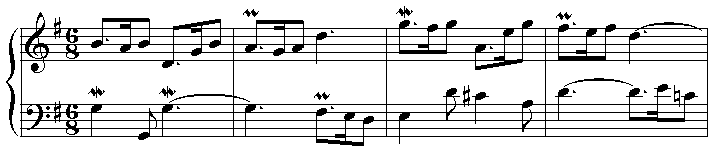
Trill (music)
The trill is a musical ornament consisting of a rapid alternation between two adjacent notes, usually a semitone or tone apart, which can be identified with the context of the trill....
and appoggiaturas" preclude too fast a tempo.
What, then, was Bach trying to convey by adding the al tempo di giga notation to his Handexemplar? Pianist Angela Hewitt, in the liner notes to her 1999 Hyperion recording, argues that he was trying to caution against taking too slow a tempo, and thus turning the dance into a forlane or siciliano. She does however argue, like Schulenberg, that it is a French gigue, not an Italian giga and does play it at an unhurried tempo.
Variatio 8. a 2 Clav.
This is another two-part hand-crossing variation, in 3/4 time. The French style of hand-crossing is employed, with both hands playing at the same part of the keyboard, one above the other. This is relatively easy to perform on a two-manual harpsichord, but quite hard to do on a piano.Most bars feature either a distinctive pattern of eleven sixteenth note
Sixteenth note
thumb|right|Figure 1. A sixteenth note with stem facing up, a sixteenth note with stem facing down, and a sixteenth rest.thumb|right|Figure 2. Four sixteenth notes beamed together....
s and a sixteenth rest, or ten sixteenth notes and a single eighth note
Eighth note
thumb|180px|right|Figure 1. An eighth note with stem facing up, an eighth note with stem facing down, and an eighth rest.thumb|right|180px|Figure 2. Four eighth notes beamed together....
. Large leaps in the melody can be observed, for instance, in bars 9-11: from B below middle C in bar 9, from A above middle C to an A an octave higher in bar 10, and from G above middle C to a G an octave higher in bar 11. Both sections end with descending passages in thirty-second note
Thirty-second note
In music, a thirty-second note or demisemiquaver is a note played for 1/32 of the duration of a whole note...
s.
Variatio 9. Canone alla Terza. a 1 Clav.
This is a canon at the third, in 4/4 time. The supporting bass line is slightly more active than in the previous canons. This short variation (16 bars) is usually played at a slow tempo.Variatio 10. Fughetta a 1 Clav.
Variation 10 is a four-voice fughetta, with a four-bar subject heavily decorated with ornamentOrnament (music)
In music, ornaments or embellishments are musical flourishes that are not necessary to carry the overall line of the melody , but serve instead to decorate or "ornament" that line. Many ornaments are performed as "fast notes" around a central note...
s and somewhat reminiscent of the opening aria's melody.
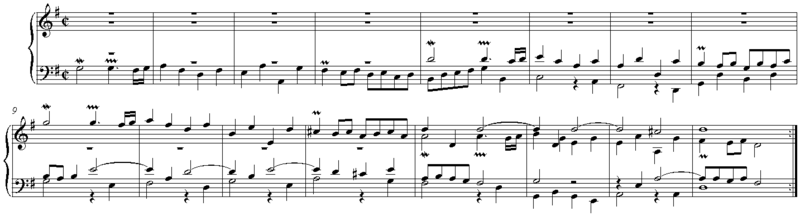
The second section develops using the same thematic material with slight changes. It resembles a counter-exposition: the voices enter one by one, all begin by stating the subject (sometimes a bit altered, like in the first section). The section begins with the subject heard once again, in the soprano voice, accompanied by an active bass line, making the bass part the only exception since it doesn't pronounce the subject until bar 25.
Variatio 11. a 2 Clav.
This is a virtuosic two-part toccataToccata
Toccata is a virtuoso piece of music typically for a keyboard or plucked string instrument featuring fast-moving, lightly fingered or otherwise virtuosic passages or sections, with or without imitative or fugal interludes, generally emphasizing the dexterity of the performer's fingers...
in 12/16 time. Specified for two manuals, it is largely made up of various scale passages, arpeggio
Arpeggio
An arpeggio is a musical technique where notes in a chord are played or sung in sequence, one after the other, rather than ringing out simultaneously...
s and trills, and features much hand-crossing of different kinds.
Variatio 12. Canone alla Quarta. a 1 Clav.
This is a canon at the fourth in 3/4 time, of the inverted variety: the follower enters in the second bar in contrary motionContrary motion
In music theory, contrapuntal motion is the general movement of two melodic lines with respect to each other. In traditional four-part harmony, it is important that lines maintain their independence, an effect which can be achieved by the judicious use of the four types of contrapuntal motion:...
to the leader. The follower appears inverted
Inversion (music)
In music theory, the word inversion has several meanings. There are inverted chords, inverted melodies, inverted intervals, and inverted voices...
in the second bar.
In the first section, the left hand accompanies with a bass line written out in repeated quarter notes, in bars 1, 2, 3, 5, 6, and 7. This repeated note motif also appears in the first bar of the second section (bar 17, two Ds and a C), and, slightly altered, in bars 22 and 23. In the second section, Bach changes the mood slightly by introducing a few appoggiaturas (bars 19 and 20) and trills (bars 29-30).
Variatio 13. a 2 Clav.
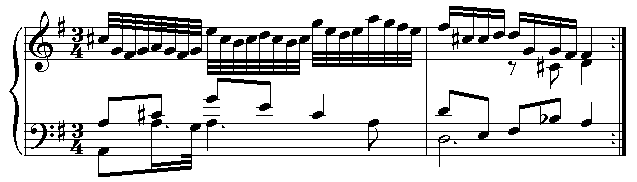
This variation is a slow, gentle and richly decorated sarabandeSarabande
In music, the sarabande is a dance in triple metre. The second and third beats of each measure are often tied, giving the dance a distinctive rhythm of quarter notes and eighth notes in alternation...
in 3/4 time. Most of the melody is written out using thirty-second note
Thirty-second note
In music, a thirty-second note or demisemiquaver is a note played for 1/32 of the duration of a whole note...
s, and ornamented with a few appoggiaturas (more frequent in the second section) and a few mordent
Mordent
In music, a mordent is an ornament indicating that the note is to be played with a single rapid alternation with the note above or below. Like trills, they can be chromatically modified by a small flat, sharp or natural accidental...
s. Throughout the piece, the melody is in one voice, and in bars 16 and 24 an interesting effect is produced by the use of an additional voice. Here are bars 15 and 16, the ending of the first section (bar 24 exhibits a similar pattern):
Variatio 14. a 2 Clav.
This is a rapid two-part hand-crossing toccata in 3/4 time, with many trills and other ornamentationOrnament (music)
In music, ornaments or embellishments are musical flourishes that are not necessary to carry the overall line of the melody , but serve instead to decorate or "ornament" that line. Many ornaments are performed as "fast notes" around a central note...
. It is specified for two manuals and features large jumps between registers. Both features (ornaments and leaps in the melody) are apparent from the first bar: the piece begins with a transition from the G two octaves below middle C, with a lower mordent, to the G two octaves above it with a trill with initial turn.
Contrasting it with Variation 15, Glenn Gould
Glenn Gould
Glenn Herbert Gould was a Canadian pianist who became one of the best-known and most celebrated classical pianists of the 20th century. He was particularly renowned as an interpreter of the keyboard music of Johann Sebastian Bach...
described this variation as "certainly one of the giddiest bits of neo-Scarlatti-ism imaginable."
Variatio 15. Canone alla Quinta. a 1 Clav.
This is a canon at the fifth in 2/4 time. Like Variation 12, it is in contrary motionContrary motion
In music theory, contrapuntal motion is the general movement of two melodic lines with respect to each other. In traditional four-part harmony, it is important that lines maintain their independence, an effect which can be achieved by the judicious use of the four types of contrapuntal motion:...
with the leader appearing inverted in the second bar. This is the first of the three variations in G minor, and its melancholic mood contrasts sharply with the playfulness of the previous variation. Pianist Angela Hewitt
Angela Hewitt
Angela Hewitt, OC, OBE is a Canadian classical pianist. She holds British nationality through her father, Godfrey, who was the organist and choirmaster at Christ Church Cathedral in Ottawa, Ontario for almost fifty years.-Career:...
notes that there is "a wonderful effect at the very end [of this variation]: the hands move away from each other, with the right suspended in mid-air on an open fifth. This gradual fade, leaving us in awe but ready for more, is a fitting end to the first half of the piece."
Glenn Gould
Glenn Gould
Glenn Herbert Gould was a Canadian pianist who became one of the best-known and most celebrated classical pianists of the 20th century. He was particularly renowned as an interpreter of the keyboard music of Johann Sebastian Bach...
said of this variation, "It’s the most severe and rigorous and beautiful canon...the most severe and beautiful that I know, the canon in inversion at the fifth. It’s a piece so moving, so anguished – and so uplifting at the same time – that it would not be in any way out of place in the St. Matthew’s Passion; matter of fact, I’ve always thought of Variation 15 as the perfect Good Friday spell."
Variatio 16. Ouverture. a 1 Clav.
The set of variations can be seen as being divided into two halves, clearly marked by this grand French overtureFrench overture
The French overture is a musical form widely used in the Baroque period. Its basic formal division is into two parts, which are usually enclosed by double bars and repeat signs. They are complementary in styles , and the first ends with a half-cadence that requires an answering structure with a...
, commencing with a particularly emphatic opening and closing chord
Chord (music)
A chord in music is any harmonic set of two–three or more notes that is heard as if sounding simultaneously. These need not actually be played together: arpeggios and broken chords may for many practical and theoretical purposes be understood as chords...
s. It consists of a slow prelude with dotted rhythm
Rhythm
Rhythm may be generally defined as a "movement marked by the regulated succession of strong and weak elements, or of opposite or different conditions." This general meaning of regular recurrence or pattern in time may be applied to a wide variety of cyclical natural phenomena having a periodicity or...
s with a following fugue-like contrapuntal
Counterpoint
In music, counterpoint is the relationship between two or more voices that are independent in contour and rhythm and are harmonically interdependent . It has been most commonly identified in classical music, developing strongly during the Renaissance and in much of the common practice period,...
section.
Variatio 17. a 2 Clav.
This variation is another two-part virtuosic toccata. Peter Williams sees echoes of Antonio VivaldiAntonio Vivaldi
Antonio Lucio Vivaldi , nicknamed because of his red hair, was an Italian Baroque composer, priest, and virtuoso violinist, born in Venice. Vivaldi is recognized as one of the greatest Baroque composers, and his influence during his lifetime was widespread over Europe...
and Domenico Scarlatti
Domenico Scarlatti
Giuseppe Domenico Scarlatti was an Italian composer who spent much of his life in the service of the Portuguese and Spanish royal families. He is classified as a Baroque composer chronologically, although his music was influential in the development of the Classical style...
here. Specified for 2 manuals, the piece features hand-crossing. It is in 3/4 time and usually played at a moderately fast tempo. Rosalyn Tureck
Rosalyn Tureck
Rosalyn Tureck was an American pianist and harpsichordist who was particularly associated with the music of Johann Sebastian Bach...
is one of the very few performers who recorded slow interpretations of the piece. In making his 1981 re-recording of the Goldberg Variations, Glenn Gould
Glenn Gould
Glenn Herbert Gould was a Canadian pianist who became one of the best-known and most celebrated classical pianists of the 20th century. He was particularly renowned as an interpreter of the keyboard music of Johann Sebastian Bach...
considered playing this variation at a slower tempo, in keeping with the tempo of the preceding variation (Variation 16), but ultimately decided not to because "Variation 17 is one of those rather skittish, slightly empty-headed collections of scales and arpeggios which Bach indulged when he wasn’t writing sober and proper things like fugues and canons, and it just seemed to me that there wasn't enough substance to it to warrant such a methodical, deliberate, Germanic tempo."
Variatio 18. Canone alla Sexta. a 1 Clav.
This is a canon at the sixth in 2/2 time. The canonic interplay in the upper voices features many suspensions. Commenting on the structure of the canons of the Goldberg Variations, Glenn GouldGlenn Gould
Glenn Herbert Gould was a Canadian pianist who became one of the best-known and most celebrated classical pianists of the 20th century. He was particularly renowned as an interpreter of the keyboard music of Johann Sebastian Bach...
cited this variation as the extreme example of "deliberate duality of motivic emphasis [...] the canonic voices are called upon to sustain the passacaille
Passacaglia
The passacaglia is a musical form that originated in early seventeenth-century Spain and is still used by contemporary composers. It is usually of a serious character and is often, but not always, based on a bass-ostinato and written in triple metre....
role which is capriciously abandoned by the bass." Gould spoke very fondly of this canon in a radio conversation with Tim Page
Tim Page (music critic)
Tim Page is a writer, editor, music critic, producer and professor. He is a Pulitzer Prize-winning music critic for the Washington Post and also played an essential role in the revival of American author Dawn Powell.-Career:Page grew up in Storrs, Connecticut, where his father, Ellis B...
: "The canon at the sixth – I adore it, it’s a gem. Well, I adore all the canons, really, but it’s one of my favorite variations, certainly."
Variatio 19. a 1 Clav.
This is a dance-like three-part variation in 3/8 time. The same sixteenth note figuration is continuously employed and variously exchanged between each of the three voices.Variatio 20. a 2 Clav.
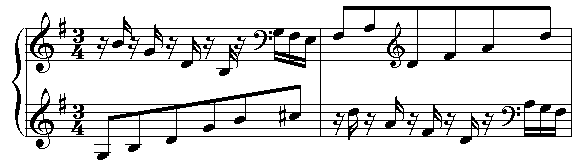
This variation is a virtuosic two-part toccata in 3/4 time. Specified for two manuals, it involves rapid hand-crossing. The piece consists mostly of variations on the texture introduced during its first eight bars, where one hand plays a string of eighth noteEighth note
thumb|180px|right|Figure 1. An eighth note with stem facing up, an eighth note with stem facing down, and an eighth rest.thumb|right|180px|Figure 2. Four eighth notes beamed together....
s and the other accompanies by plucking sixteenth note
Sixteenth note
thumb|right|Figure 1. A sixteenth note with stem facing up, a sixteenth note with stem facing down, and a sixteenth rest.thumb|right|Figure 2. Four sixteenth notes beamed together....
s after each eighth note. To demonstrate this, here are the first two bars of the first section:
Variatio 21. Canone alla Settima. a 1 Clav.
The second of the minor key variations, variation 21 is a canon at the seventh in 4/4 time; Kenneth GilbertKenneth Gilbert
Kenneth Gilbert, OC is a Canadian harpsichordist, organist, musicologist and music educator.Gilbert was trained at the Conservatoire de musique du Québec à Montréal where he was a pupil of Yvonne Hubert and Gabriel Cusson . He also studied the organ privately with Conrad Letendre in Montréal...
sees it as an allemande
Allemande
An allemande is one of the most popular instrumental dance forms in Baroque music, and a standard element of a suite...
. The bass line begins the piece with a low note, proceeds to a slow Lament bass
Lament bass
In music, the lament bass is a ground bass, built from a descending perfect fourth from tonic to dominant, with each step harmonized. The diatonic version is the upper tetrachord from the natural minor scale, known as the Phrygian tetrachord, while the chromatic version, the chromatic fourth, has...
and only picks up the pace of the canonic voices in bar 3:

Inversion (music)
In music theory, the word inversion has several meanings. There are inverted chords, inverted melodies, inverted intervals, and inverted voices...
.
Variatio 22. a 1 Clav. alla breve
This variation features four-part writing with many imitative passages and its development in all voices but the bass is much like that of a fugue. The only specified ornament is a trill which is performed on a whole noteWhole note
thumb|right|250px|Figure 1. A whole note and a whole rest.In music, a whole note or semibreve is a note represented by a hollow oval note head, like a half note , and no note stem . Its length is equal to four beats in 4/4 time...
and which lasts for two bars (11 and 12).
The ground bass on which the entire set of variations is built is heard perhaps most explicitly in this variation (as well as in the Quodlibet) due to the simplicity of the bass voice.
Variatio 23. a 2 Clav.
Another lively two-part virtuosic variation for two manuals, in 3/4 time. It begins with the hands chasing one another, as it were: the melodic line, initiated in the left hand with a sharp striking of the G above middle C, and then sliding down from the B one octave above to the F, is offset by the right hand, imitating the left at the same pitch, but a quaver late, for the first three bars, ending with a small flourish in the fourth:
Variatio 24. Canone all'Ottava. a 1 Clav.
This variation is a canon at the octave, in 9/8 time. The leader is answered both an octave below and an octave above; it is the only canon of the variations in which the leader alternates between voices in the middle of a section.Variatio 25. a 2 Clav.
Variation 25 is the third and last variation in G minor; a three-part piece, it is marked adagio in Bach's own copy and is in 3/4 time. The melody is written out predominantly in 16th and 32nd notes, with many chromaticismChromaticism
Chromaticism is a compositional technique interspersing the primary diatonic pitches and chords with other pitches of the chromatic scale. Chromaticism is in contrast or addition to tonality or diatonicism...
s. This variation generally lasts longer than any other piece of the set.
Wanda Landowska
Wanda Landowska
Wanda Landowska was a Polish harpsichordist whose performances, teaching, recordings and writings played a large role in reviving the popularity of the harpsichord in the early 20th century...
famously described this variation as "the black pearl" of the Goldberg Variations. Peter Williams writes that "the beauty and dark passion of this variation make it unquestionably the emotional high point of the work", and Glenn Gould said that "the appearance of this wistful, weary cantilena is a master-stroke of psychology." In an interview with Gould, Tim Page
Tim Page (music critic)
Tim Page is a writer, editor, music critic, producer and professor. He is a Pulitzer Prize-winning music critic for the Washington Post and also played an essential role in the revival of American author Dawn Powell.-Career:Page grew up in Storrs, Connecticut, where his father, Ellis B...
described this variation as having an "extraordinary chromatic texture"; Gould agreed: "I don't think there's been a richer lode of enharmonic
Enharmonic
In modern musical notation and tuning, an enharmonic equivalent is a note , interval , or key signature which is equivalent to some other note, interval, or key signature, but "spelled", or named, differently...
relationships any place between Gesualdo
Carlo Gesualdo
Carlo Gesualdo, known as Gesualdo di Venosa or Gesualdo da Venosa , Prince of Venosa and Count of Conza, was an Italian nobleman, lutenist, composer, and murderer....
and Wagner
Richard Wagner
Wilhelm Richard Wagner was a German composer, conductor, theatre director, philosopher, music theorist, poet, essayist and writer primarily known for his operas...
."
Variatio 26. a 2 Clav.
In sharp contrast with the introspective and passionate nature of the previous variation, this piece is another virtuosic two-part toccata, joyous and fast-paced. Underneath the rapid arabesques, this variation is basically a sarabandeSarabande
In music, the sarabande is a dance in triple metre. The second and third beats of each measure are often tied, giving the dance a distinctive rhythm of quarter notes and eighth notes in alternation...
. Two time signatures are used, 18/16 for the incessant melody written in 16th notes and 3/4 for the accompaniment in quarter and eighth notes; during the last 5 bars, both hands play in 18/16.
Variatio 27. Canone alla Nona. a 2 Clav.
Variation 27 is the last canon of the piece, at the ninth and in 6/8 time. This is the only canon where two manuals are specified (not due to hand-crossing difficulties), and the only pure canon of the work, because it does not have a bass line.Variatio 28. a 2 Clav.
This variation is a two-part toccata in 3/4 time that employs a great deal of hand crossing. Trills are written out using 32nd notes and are present in most of the bars. The piece begins with a pattern in which each hand successively picks out a melodic line while also playing trills. Following this is a section with both hands playing in contrary motion in a melodic contour marked by 16th notes (bars 9-12). The end of the first section features trills again, in both hands now and mirroring one another:
Variatio 29. a 1 ô vero 2 Clav.
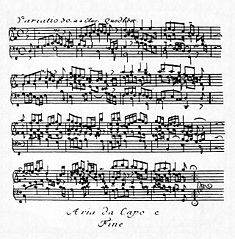
This variation consists mostly of heavy chords alternating with sections of brilliant arpeggios shared between the hands. It is in 3/4 time. A rather grand variation, it adds an air of resolution after the lofty brilliance of the previous variation. Glenn Gould states that variations 28 and 29 present the only case of "motivic collaboration or extension between successive variations."Variatio 30. Quodlibet. a 1 Clav.
Quodlibet
A quodlibet is a piece of music combining several different melodies, usually popular tunes, in counterpoint and often a light-hearted, humorous manner...
is based on multiple German folk songs, two of which are Ich bin solang nicht bei dir g'west, ruck her, ruck her ("I have so long been away from you, come closer, come closer") and Kraut und Rüben haben mich vertrieben, hätt mein' Mutter Fleisch gekocht, wär ich länger blieben ("Cabbage and turnips have driven me away, had my mother cooked meat, I'd have opted to stay"). The others have been forgotten. The Kraut und Rüben theme, under the title of La Capricciosa, had previously been used by Dietrich Buxtehude for his thirty-two partite in G major, BuxWV 250. Bach's biographer Forkel
Johann Nikolaus Forkel
Johann Nikolaus Forkel , was a German musician, musicologist and music theorist.-Biography:...
explains the Quodlibet by invoking a custom observed at Bach family reunions (Bach's relatives were almost all musicians):
As soon as they were assembled a choraleChoraleA chorale was originally a hymn sung by a Christian congregation. In certain modern usage, this term may also include classical settings of such hymns and works of a similar character....
was first struck up. From this devout beginning they proceeded to jokes which were frequently in strong contrast. That is, they then sang popular songs partly of comic and also partly of indecent content, all mixed together on the spur of the moment. ... This kind of improvised harmonizing they called a Quodlibet, and not only could laugh over it quite whole-heartedly themselves, but also aroused just as hearty and irresistible laughter in all who heard them.
Forkel's anecdote (which is likely to be true, given that he was able to interview Bach's sons), suggests fairly clearly that Bach meant the Quodlibet to be a joke.
Aria da Capo
A note for note repeat of the aria at the beginning. Williams writes that the work's "elusive beauty ... is reinforced by this return to the Aria. ... no such return can have a neutral Affekt. Its melody is made to stand out by what has gone on in the last five variations, and it is likely to appear wistful or nostalgic or subdued or resigned or sad, heard on its repeat as something coming to an end, the same notes but now final."Canons on the Goldberg ground, BWV 1087
Strasbourg
Strasbourg is the capital and principal city of the Alsace region in eastern France and is the official seat of the European Parliament. Located close to the border with Germany, it is the capital of the Bas-Rhin département. The city and the region of Alsace are historically German-speaking,...
(Alsace
Alsace
Alsace is the fifth-smallest of the 27 regions of France in land area , and the smallest in metropolitan France. It is also the seventh-most densely populated region in France and third most densely populated region in metropolitan France, with ca. 220 inhabitants per km²...
, France
France
The French Republic , The French Republic , The French Republic , (commonly known as France , is a unitary semi-presidential republic in Western Europe with several overseas territories and islands located on other continents and in the Indian, Pacific, and Atlantic oceans. Metropolitan France...
), forming an appendix to Bach's personal printed edition of the Goldberg Variations. Among those canons, the eleventh and the thirteenth are a sort of first version of BWV 1077 and BWV 1076, which is included in the famous portrait of Bach painted by Elias Gottlob Haussmann
Elias Gottlob Haussmann
Elias Gottlob Haussmann was a German painter in the late Baroque era. Haussmann served as court painter at Dresden, and from 1720 as the official portraitist at Leipzig...
in 1746.
Transcribed and popularized versions
The Goldberg Variations have been reworked freely by many performers, changing either the instrumentation, the notes, or both. Italian composer Ferruccio BusoniFerruccio Busoni
Ferruccio Busoni was an Italian composer, pianist, editor, writer, piano and composition teacher, and conductor.-Biography:...
prepared a massively altered transcription for piano. According to art critic Michael Kimmelman
Michael Kimmelman
Michael Kimmelman is an author, critic, columnist and pianist. He is the chief architecture critic for The New York Times and written on issues of public housing, community development and social responsibility. He was the paper's longtime chief art critic and, in 2007, created the Abroad column,...
, "Busoni shuffled the variations, skipping some, then added his own rather voluptuous coda to create a three-movement structure; each movement has a distinct, arcing shape, and the whole becomes a more tightly organized drama than the original." Other arrangements include:
- 1883 - Josef RheinbergerJosef RheinbergerJosef Gabriel Rheinberger was a German organist and composer, born in Liechtenstein.-Short biography:...
, transcription for two pianos, Op. 3 (rev. Max RegerMax RegerJohann Baptist Joseph Maximilian Reger was a German composer, conductor, pianist, organist, and academic teacher.-Life:...
) - 1912 - K. Eichler, transcription for piano four hands
- 1938 – Józef KofflerJózef KofflerJózef Koffler was a Polish composer, music teacher, musicologist and musical columnist.He was the first Polish composer living before the Second World War to apply the twelve tone composition technique .- Biography :...
, transcription for orchestraOrchestraAn orchestra is a sizable instrumental ensemble that contains sections of string, brass, woodwind, and percussion instruments. The term orchestra derives from the Greek ορχήστρα, the name for the area in front of an ancient Greek stage reserved for the Greek chorus...
/ string orchestraString orchestraA string orchestra is an orchestra composed solely or primarily of instruments from the string family. These instruments are the violin, the viola, the cello, the double bass , the piano, the harp, and sometimes percussion... - 1973 – Joel SpiegelmanJoel spiegelmanJoel Spiegelman is an American composer, conductor, concert pianist, harpsichordist, recording artist, arranger, author and teacher....
, transcribed to synthesizer by [Kurzweil 250 Digital Synthesizer] - 1975 – Charles RamirezCharles RamirezCharles Ramirez is a concert guitarist based in London. He is also Professor of guitar at the Royal College of Music.-Early life:Charles Ramirez was born on 2 September 1953 in Gibraltar...
and Helen Kalamuniak, transcription for two guitars - 1984 – Dmitry SitkovetskyDmitry SitkovetskyDmitry Sitkovetsky is a Russian violinist and conductor.- Early life :Dmitry Sitkovetsky was born in Baku, Azerbaijan, to violinist Julian Sitkovetsky and pianist Bella Davidovich. His father died in 1958, when Sitkovetsky was just three years old and the family moved to Moscow where Dmitry...
, transcription for string trioString trioA string trio is a group of three string instruments or a piece written for such a group. The term is generally used with reference to works of chamber music from the Classical period to the present.-History:...
(he has also made an arrangement for string orchestra) - 1987 – Jean GuillouJean GuillouJean Victor Arthur Guillou is a French composer, organist, pianist, and pedagogue.-Life:Following autodidactic studies in piano and organ performance, Guillou became organist at the church St. Serge in Angers at age 12. From 1945-1955, he studied at the Paris Conservatoire under Marcel Dupré,...
, transcription for organOrgan (music)The organ , is a keyboard instrument of one or more divisions, each played with its own keyboard operated either with the hands or with the feet. The organ is a relatively old musical instrument in the Western musical tradition, dating from the time of Ctesibius of Alexandria who is credited with... - 1997 – József EötvösJózsef Eötvös (musician)József Eötvös is a classical guitarist, from Pécs, Hungary. Eötvös studied with Roland Zimmer and Franz Just at the Hochschule für Musik "Franz Liszt", Weimar. He won several international competitions between 1985 and 1988...
, transcription for guitarGuitarThe guitar is a plucked string instrument, usually played with fingers or a pick. The guitar consists of a body with a rigid neck to which the strings, generally six in number, are attached. Guitars are traditionally constructed of various woods and strung with animal gut or, more recently, with... - 2000 – Jacques LoussierJacques LoussierJacques Loussier is a French pianist and composer. He is well-known for his jazz interpretations in trio formation of many of Johann Sebastian Bach's works, such as the Goldberg Variations.-Early life and education :...
, arrangement for jazz trio - 2003 – Karlheinz EsslKarlheinz EsslKarlheinz Essl is an Austrian composer, performer, sound artist, improviser and composition teacher.- Biography :Essl was born in Vienna. His studies at the University of Music in Vienna included: composition , electro-acoustic music and double bass...
(„Gold.Berg.Werk“) for string trio and live-electronics - 2009 – Catrin FinchCatrin FinchCatrin Anna Finch is a Welsh harpist born in Llanon, Ceredigion, Wales. She was the Official Harpist to the Prince of Wales from 2000 to 2004 and is Visiting Professor at the Royal Welsh College of Music & Drama and the Royal Academy of Music...
, complete transcription for harp - 2010 – Federico Sarudiansky, arrangement for string trioString trioA string trio is a group of three string instruments or a piece written for such a group. The term is generally used with reference to works of chamber music from the Classical period to the present.-History:...
- 2011 - James StraussJames Strauss (flutist)James Strauss is a Brazilian virtuoso flautist and musicologist. He is an internationally known performer whose virtuosity has drawn comparisons to Jascha Heifetz and Vladimir Horowitz.-Biography:...
, complete transcription for fluteFluteThe flute is a musical instrument of the woodwind family. Unlike woodwind instruments with reeds, a flute is an aerophone or reedless wind instrument that produces its sound from the flow of air across an opening...
and harpsichordHarpsichordA harpsichord is a musical instrument played by means of a keyboard. It produces sound by plucking a string when a key is pressed.In the narrow sense, "harpsichord" designates only the large wing-shaped instruments in which the strings are perpendicular to the keyboard...
or fluteFluteThe flute is a musical instrument of the woodwind family. Unlike woodwind instruments with reeds, a flute is an aerophone or reedless wind instrument that produces its sound from the flow of air across an opening...
and pianoPianoThe piano is a musical instrument played by means of a keyboard. It is one of the most popular instruments in the world. Widely used in classical and jazz music for solo performances, ensemble use, chamber music and accompaniment, the piano is also very popular as an aid to composing and rehearsal...
Editions of the score
- Ralph KirkpatrickRalph KirkpatrickRalph Kirkpatrick was an American musician, musicologist and harpsichordist. He is most famous for his chronological catalog of Domenico Scarlatti's keyboard sonatas.-Life and work:...
. New York/London: G. Schirmer, 1938. Contains an extensive preface by the editor and a facsimile of the original title page. - Hans BischoffHans Bischoff (pianist)Hans Bischoff was a German pianist most noted for his edition of Johann Sebastian Bach's keyboard works....
. New York: Edwin F. Kalmus, 1947 (editorial work dates from the nineteenth century). Includes interpretive markings by the editor not indicated as such. - Christoph WolffChristoph WolffChristoph Wolff is a German-born musicologist, presently on the faculty of Harvard University. Born and educated in Germany, Wolff studied organ and historical keyboard instruments, musicology and art history at the Universities of Berlin, Erlangen, and the Music Academy of Freiburg, receiving a...
. Vienna: Wiener Urtext Edition, 1996. An urtext edition, making use of the new findings (1975) resulting from the discovery of an original copy hand-corrected by the composer. Includes suggested fingerings and notes on interpretation by harpsichordist Huguette DreyfusHuguette DreyfusHuguette Dreyfus is a French harpsichordist born on November 30, 1928 in Mulhouse, Alsace, France.-Biography:Huguette Dreyfus began taking piano lessons at four years old. In 1946, she began working with renowned piano teacher Lazare Lévy...
. - Reinhard Böß. München: edition text + kritik, 1996. Verschiedene Canones ... von J.S. Bach (BWV 1087). ISBN 3-88377-523-1 Edition of the canons in BWV 1087 only. The editor suggests a complete complement of all fourteen canons.
See also Online Scores, below.
Interactive media
- Goldberg Variations BWV 988 Smith/Korevaar (Shockwave)
- Goldberg Quodlibet Smith/Korevaar (Flash)
- Fourteen Canons BWV 1087 Smith/Hall (Flash)
Online scores
- JS Bach works on Mutopia, including BWV 988
Essays
- The Goldberg Variations made new - Review of Glenn Gould's and Simone Dinnerstein's renditions
- Music of Intellect: the Goldberg Variations
- An essay on the Goldberg Variations by Yo Tomita
- Canons of the Goldberg Variations - graphical analysis enables you to see the leader and follower in the canons
- J.S. Bach, the architect and servant of the spiritual - a closer look at the Goldberg Variations
Recordings
- Complete midi recording by John Sankey
- Complete midi recording by David J. Grossman
- Public Domain Recording - Aria recording from MusopenMusopenMusopen is an online music library of copyright-free music. Musopen's mission is to record or obtain recordings that have no copyrights so that its visitors may listen, re-use, or in any way enjoy music; put simply, "to set music free."...
- Public Domain Recording - by S. D. Rodrian
- Glenn Gould Playing the Goldberg Variations 45 minutes
- Bach-cantatas.com: The Goldberg Variations - Comprehensive discography
- jsbach.org: BWV 988 - Reviews of many recordings
- Selections from Rosalyn Tureck's Goldberg Variations Performance
- In the BBC Discovering Music: Listening Library
- In the Book Classic Voice: Gianfranco Pappalardo Fiumara italian pianist Classic People CD