

.gif)
Inversion (music)

Encyclopedia
In music theory
, the word inversion has several meanings. There are inverted chords, inverted melodies, inverted intervals, and (in counterpoint
) inverted voices. The concept of inversion also plays a role in musical set theory.
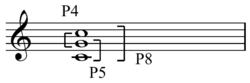 An interval
is inverted by raising or lowering either of the notes using displacement of the octave
(or octaves) so that both retain their names (pitch class
). For example, the inversion of an interval consisting of a C with an E above it is an E with a C above it - to work this out, the C may be moved up, the E may be lowered, or both may be moved.
Under inversion, perfect intervals remain perfect, major intervals become minor and the reverse, augmented intervals become diminished and the reverse. (Double diminished intervals become double augmented intervals, and the reverse.) Traditional interval names add together to make nine: seconds become sevenths and the reverse, thirds become sixes and the reverse, and fourths become fifths and the reverse. Thus a perfect fourth becomes a perfect fifth, an augmented fourth becomes a diminished fifth, and a simple interval (that is, one that is narrower than an octave) and its inversion, when added together, will equal an octave. See also complement (music)
.
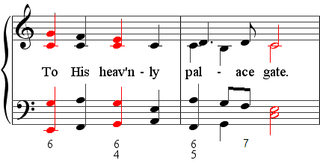 A chord's inversion describes the relationship of its bass to the other tones in the chord. For instance, a C major triad
contains the tones C, E and G; its inversion is determined by which of these tones is used as the bottom note in the chord.
The term inversion is often used to categorically refer to the different possibilities, although it may also be restricted to only those chords where the bass note is not also the root
of the chord (see root position below). In texts that make this restriction, the term position may be used instead to refer to all of the possibilities as a category.
 chord.
The following chord is also a C major triad in root position, since the root is still in the bass. The rearrangement of the notes above the bass into different octaves (here, the note E) and the doubling of notes (here, G), is known as voicing
.
, the root is not in the bass
(i.e., is not the lowest note). The inversions are numbered in the order their bass tones would appear in a closed root position chord (from bottom to top).
In the first inversion of a C major triad , the bass is E—the 3rd of the triad—with the 5th and the root stacked above it (the root now shifted an octave higher), forming the intervals of a 3rd and a 6th above the inverted bass of E, respectively. A first-inversion triad is also known as a chord.
In the second inversion , the bass is G—the 5th
of the triad—with the root and the 3rd above it (both again shifted an octave higher), forming a 4th and a 6th above the (inverted) bass of G, respectively. A second-inversion triad is also known as a chord. This inversion can be either consonant or dissonant
, and analytical notation sometimes treats it differently depending on the harmonic and voice-leading context in which it occurs (e.g. see Cadential six-four chord below).
Third inversions exist only for chords of four or more tones, such as 7th chords. In a third-inversion chord , the 7th of the chord is in the bass position. For example, a C major 7th chord in third inversion consists of B in the bass position, with C, E and G above it— being intervals of a 2nd, 4th and 6th above the (inverted) bass of B, respectively.
(figures) are written (placed vertically, in descending numerical order) below the bass note of each chord in a harmonic progression
, expressing the intervals resulting from the voices above it (usually assuming octave equivalence).
For example, in root-position triad C-E-G, the intervals above bass note C are a 3rd and a 5th, giving the figures . If this triad were inverted (e.g. E-G-C), the figures (
  ) would apply, due to the intervals of third and sixth appearing above bass note E. Figured bass is similarly applied to 7th chord
s, which have four tones.
Certain arbitrary conventions of abbreviation (and sometimes non-abbreviation) exist in the use of figured bass. In chords whose bass notes appear without symbols, position is to be understood by default. First-inversion triads (
  ) are customarily abbreviated as
  , i.e. presence of the 3rd is understood. Second-inversion triads (
  ) are not abbreviated. Root-position seventh-chords, i.e. 7-5-3, are abbreviated as
  . First inversion seventh-chords 6-5-3, are abbreviated as
  . Second inversion seventh-chords 6-4-3, are abbreviated as
  . Third inversion seventh-chords 6-4-2 are abbreviated as
  .
.
Figured bass numerals express distinct intervals in a chord only as they relate to the bass voice. They make no reference to the key of the progression (unlike roman-numeral harmonic analysis); They do not express intervals between pairs of upper voices themselves (for example, in a C-E-G triad, figured bass is unconcerned with the interval relationship E-G); They do not express tones in upper voices which double, or are unison with, the bass note. However, the figures are often used on their own (without the bass) in music theory simply to specify a chord's inversion. This is the basis for the terms given above such as " chord"; similarly, in harmonic analysis
the term refers to a tonic triad in first inversion.
music is to write the name of a chord followed by a forward slash and then the name of the bass note. For example, the C chord above, in first inversion (i.e., with E in the bass) may be notated as C/E. This notation works even when a note not present in a triad is the bass; for example, F/G is a way of notating a particular approach to voicing a F11th chord (G–F–A–C). (This is quite different from analytical notations of function; e.g., the use of IV/V or S/D to represent the subdominant of the dominant).
, and C3 the tone an octave below it.)
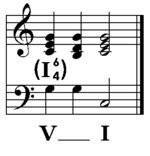 The cadential
  (Figure 3) is a common harmonic device that can be analyzed in two contrasting ways: the first labels it as a second-inversion chord; the second treats it instead as part of a horizontal progression involving voice leading
above a stationary bass.
, having accompanied each other once, do it again with the melody that had been in the high voice now in the low, and vice versa. Also called "double counterpoint" (if two voices are involved) or "triple counterpoint" (if three), themes that can be developed in this way are said to involve themselves in "invertible counterpoint." The action of changing the voices is called "textural inversion".
Invertible counterpoint can occur at various intervals, usually the octave (8va), less often at the 10th or 12th. To calculate the interval of inversion, add the intervals by which each voice has moved and subtract one. For example: If motive A in the high voice moves down a 6th, and motive B in the low voice moves up a 5th, in such a way as to result in A and B having exchanged registers, then the two are in double counterpoint at the 10th ((6+5)–1 = 10).
Invertible counterpoint achieves its highest expression in the four canons of J.S. Bach's Art of Fugue , with the first canon at the octave, the second canon at the 10th, the third canon at the 12th, and the fourth canon in augmentation and contrary motion. Other exemplars can be found in the fugues in G minor and B-flat major [external Shockwave movies] from Book II of Bach's Well-Tempered Clavier, both of which contain invertible counterpoint at the octave, 10th, and 12th.
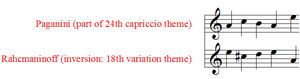 When applied to melodies
, the inversion of a given melody is the melody turned upside-down. For instance, if the original melody has a rising major third
, the inverted melody has a falling major third (or perhaps more likely, in tonal music, a falling minor third
, or even some other falling interval). See m. 24 of Bach's C#m fugue [external Shockwave movie], Well-Tempered Clavier 2, for an example of the subject in its melodic inversion.
Similarly, in twelve-tone technique
, the inversion of the tone row
is the so-called prime series turned upside-down, and is designated TnI.
s, chord
s, and other sets of pitches are the same when inverted. It is similar to enharmonic equivalency and octave equivalency and even transpositional equivalency. Inversional equivalency is used little in tonal
theory, though it is assumed a set which may be inverted onto another are remotely in common. However, taking them to be identical or near-identical is only assumed in musical set theory.
All sets of pitches with inversional symmetry have a center or axis of inversion. For example, the set C–E–F–F♯–G–B has one center at the dyad F and F♯ and another at the tritone, B/C, if listed F♯–G–B–C–E–F. For C–E♭–E–F♯–G–B♭ the center is F and B if listed F♯–G–B♭–C–E♭–E.
which equals
First invert the pitch or pitches, x = −x, then transpose, −x + n.
Pitch class
inversion by a pitch class interval may be defined as:
Inversion about a pitch axis is a compound operation much like set theory's transpositional inversion, however in pitch axis inversion the transposition may be chromatic or diatonic transposition.
The "pitch axis" works in the context of the compound operation transpositional inversion, where transposition
is carried out after inversion, however unlike musical set theory the transposition may be chromatic or diatonic transposition. Thus if D-A-G (P5 up, M2 down) is inverted to D-G-A (P5 down, M2 up) the "pitch axis" was or will be D. However, if it is inverted to C-F-G the pitch axis is G while if the pitch axis is A, the melody will invert to E-A-B.
Note that the notation of octave position may determine how many lines and spaces appears to share the axis. The pitch axis of D-A-G and its inversion A-D-E will either appear to be between C/B or the single pitch F.
(1722), chords in different positions were considered functionally equivalent. However, theories of counterpoint before Rameau spoke of different intervals in different ways, such as the regola delle terze e seste ("rule of sixths and thirds") which required the resolution of imperfect consonances to perfect ones, and would not propose a similarity between and
and  sonorities, for instance.
Music theory
Music theory is the study of how music works. It examines the language and notation of music. It seeks to identify patterns and structures in composers' techniques across or within genres, styles, or historical periods...
, the word inversion has several meanings. There are inverted chords, inverted melodies, inverted intervals, and (in counterpoint
Counterpoint
In music, counterpoint is the relationship between two or more voices that are independent in contour and rhythm and are harmonically interdependent . It has been most commonly identified in classical music, developing strongly during the Renaissance and in much of the common practice period,...
) inverted voices. The concept of inversion also plays a role in musical set theory.
Inverted intervals
Interval (music)
In music theory, an interval is a combination of two notes, or the ratio between their frequencies. Two-note combinations are also called dyads...
is inverted by raising or lowering either of the notes using displacement of the octave
Octave
In music, an octave is the interval between one musical pitch and another with half or double its frequency. The octave relationship is a natural phenomenon that has been referred to as the "basic miracle of music", the use of which is "common in most musical systems"...
(or octaves) so that both retain their names (pitch class
Pitch class
In music, a pitch class is a set of all pitches that are a whole number of octaves apart, e.g., the pitch class C consists of the Cs in all octaves...
). For example, the inversion of an interval consisting of a C with an E above it is an E with a C above it - to work this out, the C may be moved up, the E may be lowered, or both may be moved.
Under inversion, perfect intervals remain perfect, major intervals become minor and the reverse, augmented intervals become diminished and the reverse. (Double diminished intervals become double augmented intervals, and the reverse.) Traditional interval names add together to make nine: seconds become sevenths and the reverse, thirds become sixes and the reverse, and fourths become fifths and the reverse. Thus a perfect fourth becomes a perfect fifth, an augmented fourth becomes a diminished fifth, and a simple interval (that is, one that is narrower than an octave) and its inversion, when added together, will equal an octave. See also complement (music)
Complement (music)
In music the term complement refers to two distinct concepts.In traditional music theory a complement is the interval which, when added to the original interval, spans an octave in total. For example, a major 3rd is the complement of a minor 6th. The complement of any interval is also known as its...
.
| Interval quality under inversion | |
|---|---|
| Perfect | Perfect |
| Major | Minor |
| Augmented | Diminished |
| Interval name under inversion | |
|---|---|
| Unison | Octave |
| Second | Seventh |
| Third | Sixth |
| Fourth | Fifth |
Inverted chords
Triad (music)
In music and music theory, a triad is a three-note chord that can be stacked in thirds. Its members, when actually stacked in thirds, from lowest pitched tone to highest, are called:* the Root...
contains the tones C, E and G; its inversion is determined by which of these tones is used as the bottom note in the chord.
The term inversion is often used to categorically refer to the different possibilities, although it may also be restricted to only those chords where the bass note is not also the root
Root (chord)
In music theory, the root of a chord is the note or pitch upon which a triadic chord is built. For example, the root of the major triad C-E-G is C....
of the chord (see root position below). In texts that make this restriction, the term position may be used instead to refer to all of the possibilities as a category.
Root position
A root-position chord is sometimes known as the parent chord of its inversions. For example, C is the root of a C major triad and is in the bass when the triad is in root position; the 3rd and the 5th of the triad are sounded above the bass. Thus, a root-position chord is also known as a chord.The following chord is also a C major triad in root position, since the root is still in the bass. The rearrangement of the notes above the bass into different octaves (here, the note E) and the doubling of notes (here, G), is known as voicing
Voicing (music)
In music composition and arranging, a voicing is the instrumentation and vertical spacing and ordering of the pitches in a chord...
.
Inversions
In an inverted chordChord (music)
A chord in music is any harmonic set of two–three or more notes that is heard as if sounding simultaneously. These need not actually be played together: arpeggios and broken chords may for many practical and theoretical purposes be understood as chords...
, the root is not in the bass
Bass note
In music theory, the bass note of a chord or sonority is the lowest note played or notated. If there are multiple voices it is the note played or notated in the lowest voice. While the bass note is often the root or fundamental of the chord, it does not have to be, and sometimes one of the other...
(i.e., is not the lowest note). The inversions are numbered in the order their bass tones would appear in a closed root position chord (from bottom to top).
In the first inversion of a C major triad , the bass is E—the 3rd of the triad—with the 5th and the root stacked above it (the root now shifted an octave higher), forming the intervals of a 3rd and a 6th above the inverted bass of E, respectively. A first-inversion triad is also known as a
chord.In the second inversion , the bass is G—the 5th
Fifth (chord)
In music, the fifth factor of a chord is the note or pitch five scale degrees above the root or tonal center. When the fifth is the bass note, or lowest note, of the expressed chord, the chord is in second inversion ....
of the triad—with the root and the 3rd above it (both again shifted an octave higher), forming a 4th and a 6th above the (inverted) bass of G, respectively. A second-inversion triad is also known as a
chord. This inversion can be either consonant or dissonantConsonance and dissonance
In music, a consonance is a harmony, chord, or interval considered stable, as opposed to a dissonance , which is considered to be unstable...
, and analytical notation sometimes treats it differently depending on the harmonic and voice-leading context in which it occurs (e.g. see Cadential six-four chord below).
Third inversions exist only for chords of four or more tones, such as 7th chords. In a third-inversion chord , the 7th of the chord is in the bass position. For example, a C major 7th chord in third inversion consists of B in the bass position, with C, E and G above it— being intervals of a 2nd, 4th and 6th above the (inverted) bass of B, respectively.
Figured bass
Figured bass is notation convention used to specify chord inversion, in which Arabic numeralsArabic numerals
Arabic numerals or Hindu numerals or Hindu-Arabic numerals or Indo-Arabic numerals are the ten digits . They are descended from the Hindu-Arabic numeral system developed by Indian mathematicians, in which a sequence of digits such as "975" is read as a numeral...
(figures) are written (placed vertically, in descending numerical order) below the bass note of each chord in a harmonic progression
Chord progression
A chord progression is a series of musical chords, or chord changes that "aims for a definite goal" of establishing a tonality founded on a key, root or tonic chord. In other words, the succession of root relationships...
, expressing the intervals resulting from the voices above it (usually assuming octave equivalence).
For example, in root-position triad C-E-G, the intervals above bass note C are a 3rd and a 5th, giving the figures
. If this triad were inverted (e.g. E-G-C), the figures ( ) would apply, due to the intervals of third and sixth appearing above bass note E. Figured bass is similarly applied to 7th chordSeventh chord
A seventh chord is a chord consisting of a triad plus a note forming an interval of a seventh above the chord's root. When not otherwise specified, a "seventh chord" usually means a major triad with an added minor seventh...
s, which have four tones.
Certain arbitrary conventions of abbreviation (and sometimes non-abbreviation) exist in the use of figured bass. In chords whose bass notes appear without symbols,
position is to be understood by default. First-inversion triads ( ) are customarily abbreviated as , i.e. presence of the 3rd is understood. Second-inversion triads ( ) are not abbreviated. Root-position seventh-chords, i.e. 7-5-3, are abbreviated as . First inversion seventh-chords 6-5-3, are abbreviated as . Second inversion seventh-chords 6-4-3, are abbreviated as . Third inversion seventh-chords 6-4-2 are abbreviated as .Figured bass numerals express distinct intervals in a chord only as they relate to the bass voice. They make no reference to the key of the progression (unlike roman-numeral harmonic analysis); They do not express intervals between pairs of upper voices themselves (for example, in a C-E-G triad, figured bass is unconcerned with the interval relationship E-G); They do not express tones in upper voices which double, or are unison with, the bass note. However, the figures are often used on their own (without the bass) in music theory simply to specify a chord's inversion. This is the basis for the terms given above such as "
chord"; similarly, in harmonic analysisDiatonic function
In tonal music theory, a diatonic function is the specific, recognized role of each of the 7 notes and their chords in relation to the diatonic key...
the term
refers to a tonic triad in first inversion.Popular-music notation
A notation for chord inversion often used in popularPopular music
Popular music belongs to any of a number of musical genres "having wide appeal" and is typically distributed to large audiences through the music industry. It stands in contrast to both art music and traditional music, which are typically disseminated academically or orally to smaller, local...
music is to write the name of a chord followed by a forward slash and then the name of the bass note. For example, the C chord above, in first inversion (i.e., with E in the bass) may be notated as C/E. This notation works even when a note not present in a triad is the bass; for example, F/G is a way of notating a particular approach to voicing a F11th chord (G–F–A–C). (This is quite different from analytical notations of function; e.g., the use of IV/V or S/D to represent the subdominant of the dominant).
Lower-case letters
Lower-case letters may be placed after a chord symbol to indicate root position or inversion. Hence, in the key of C major, the C major chord below in first inversion may be notated as Ib, indicating chord I, first inversion. (Less commonly, the root of the chord is named, followed by a lower-case letter: Cb). If no letter is added, the chord is assumed to be in root inversion, as though a had been inserted.Hindu-Arabic numerals
A less common notation is to place the number 1, 2 or 3 etc. after a chord to indicate that it is in first, second, or third inversion respectively. The C chord above in root position is notated as C, and in first inversion as C1. (This notation is quite different from the Hindu-Arabic numerals placed after note names to indicate the octave of a tone, typically used in acoustical contexts; for example, C4 is often used to mean the single tone middle CMiddle C
C or Do is the first note of the fixed-Do solfège scale. Its enharmonic is B.-Middle C:Middle C is designated C4 in scientific pitch notation because of the note's position as the fourth C key on a standard 88-key piano keyboard...
, and C3 the tone an octave below it.)
Cadential six-four chord (or Appoggiatura six-four chord)
(Figure 3) is a common harmonic device that can be analyzed in two contrasting ways: the first labels it as a second-inversion chord; the second treats it instead as part of a horizontal progression involving voice leadingVoice leading
In musical composition, voice leading is the term used to refer to a decision-making consideration when arranging voices , namely, how each voice should move in advancing from each chord to the next.- Details :...
above a stationary bass.
- In the first designation, the cadential
 chord features the progression:
  . Most older harmony textbooks use this label, and it can be traced back to the early 19th century.
 - In the second designation, this chord is not considered an inversion of a tonic triad but as a dissonance resolving to a consonant dominant harmony. This is notated as
 , in which the
  is not the inversion of the
  chord, but a dissonance that resolves to
  (that is,
  ). This function is very similar to the resolution of a 4–3 suspension. Several modern textbooks prefer this conception of the cadential
  , which can also be traced back to the early 19th century.
Counterpoint
Contrapuntal inversion requires that two melodiesMelody
A melody , also tune, voice, or line, is a linear succession of musical tones which is perceived as a single entity...
, having accompanied each other once, do it again with the melody that had been in the high voice now in the low, and vice versa. Also called "double counterpoint" (if two voices are involved) or "triple counterpoint" (if three), themes that can be developed in this way are said to involve themselves in "invertible counterpoint." The action of changing the voices is called "textural inversion".
Invertible counterpoint can occur at various intervals, usually the octave (8va), less often at the 10th or 12th. To calculate the interval of inversion, add the intervals by which each voice has moved and subtract one. For example: If motive A in the high voice moves down a 6th, and motive B in the low voice moves up a 5th, in such a way as to result in A and B having exchanged registers, then the two are in double counterpoint at the 10th ((6+5)–1 = 10).
Invertible counterpoint achieves its highest expression in the four canons of J.S. Bach's Art of Fugue , with the first canon at the octave, the second canon at the 10th, the third canon at the 12th, and the fourth canon in augmentation and contrary motion. Other exemplars can be found in the fugues in G minor and B-flat major [external Shockwave movies] from Book II of Bach's Well-Tempered Clavier, both of which contain invertible counterpoint at the octave, 10th, and 12th.
Inverted melodies
Melody
A melody , also tune, voice, or line, is a linear succession of musical tones which is perceived as a single entity...
, the inversion of a given melody is the melody turned upside-down. For instance, if the original melody has a rising major third
Major third
In classical music from Western culture, a third is a musical interval encompassing three staff positions , and the major third is one of two commonly occurring thirds. It is qualified as major because it is the largest of the two: the major third spans four semitones, the minor third three...
, the inverted melody has a falling major third (or perhaps more likely, in tonal music, a falling minor third
Minor third
In classical music from Western culture, a third is a musical interval encompassing three staff positions , and the minor third is one of two commonly occurring thirds. The minor quality specification identifies it as being the smallest of the two: the minor third spans three semitones, the major...
, or even some other falling interval). See m. 24 of Bach's C#m fugue [external Shockwave movie], Well-Tempered Clavier 2, for an example of the subject in its melodic inversion.
Similarly, in twelve-tone technique
Twelve-tone technique
Twelve-tone technique is a method of musical composition devised by Arnold Schoenberg...
, the inversion of the tone row
Tone row
In music, a tone row or note row , also series and set, refers to a non-repetitive ordering of a set of pitch-classes, typically of the twelve notes in musical set theory of the chromatic scale, though both larger and smaller sets are sometimes found.-History and usage:Tone rows are the basis of...
is the so-called prime series turned upside-down, and is designated TnI.
Inversional equivalency
Inversional equivalency or inversional symmetry is the concept that intervalInterval (music)
In music theory, an interval is a combination of two notes, or the ratio between their frequencies. Two-note combinations are also called dyads...
s, chord
Chord (music)
A chord in music is any harmonic set of two–three or more notes that is heard as if sounding simultaneously. These need not actually be played together: arpeggios and broken chords may for many practical and theoretical purposes be understood as chords...
s, and other sets of pitches are the same when inverted. It is similar to enharmonic equivalency and octave equivalency and even transpositional equivalency. Inversional equivalency is used little in tonal
Tonality
Tonality is a system of music in which specific hierarchical pitch relationships are based on a key "center", or tonic. The term tonalité originated with Alexandre-Étienne Choron and was borrowed by François-Joseph Fétis in 1840...
theory, though it is assumed a set which may be inverted onto another are remotely in common. However, taking them to be identical or near-identical is only assumed in musical set theory.
All sets of pitches with inversional symmetry have a center or axis of inversion. For example, the set C–E–F–F♯–G–B has one center at the dyad F and F♯ and another at the tritone, B/C, if listed F♯–G–B–C–E–F. For C–E♭–E–F♯–G–B♭ the center is F and B if listed F♯–G–B♭–C–E♭–E.
Musical set theory
In musical set theory inversion may be usefully thought of as the compound operation transpositional inversion, which is the same sense of inversion as in the Inverted melodies section above, with transposition carried out after inversion. Pitch inversion by an ordered pitch interval may be defined as:
which equals

First invert the pitch or pitches, x = −x, then transpose, −x + n.
Pitch class
Pitch class
In music, a pitch class is a set of all pitches that are a whole number of octaves apart, e.g., the pitch class C consists of the Cs in all octaves...
inversion by a pitch class interval may be defined as:

Inversion about a pitch axis is a compound operation much like set theory's transpositional inversion, however in pitch axis inversion the transposition may be chromatic or diatonic transposition.
Pitch axis
In jazz theory, a pitch axis is the center about which a melody is inverted.The "pitch axis" works in the context of the compound operation transpositional inversion, where transposition
Transposition (music)
In music transposition refers to the process, or operation, of moving a collection of notes up or down in pitch by a constant interval.For example, one might transpose an entire piece of music into another key...
is carried out after inversion, however unlike musical set theory the transposition may be chromatic or diatonic transposition. Thus if D-A-G (P5 up, M2 down) is inverted to D-G-A (P5 down, M2 up) the "pitch axis" was or will be D. However, if it is inverted to C-F-G the pitch axis is G while if the pitch axis is A, the melody will invert to E-A-B.
Note that the notation of octave position may determine how many lines and spaces appears to share the axis. The pitch axis of D-A-G and its inversion A-D-E will either appear to be between C/B or the single pitch F.
History
In the theories of RameauJean-Philippe Rameau
Jean-Philippe Rameau was one of the most important French composers and music theorists of the Baroque era. He replaced Jean-Baptiste Lully as the dominant composer of French opera and is also considered the leading French composer for the harpsichord of his time, alongside François...
(1722), chords in different positions were considered functionally equivalent. However, theories of counterpoint before Rameau spoke of different intervals in different ways, such as the regola delle terze e seste ("rule of sixths and thirds") which required the resolution of imperfect consonances to perfect ones, and would not propose a similarity between
and sonorities, for instance.