
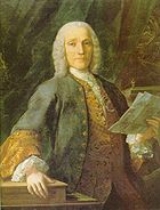
Giuseppe Domenico Scarlatti (26 October 1685 – 23 July 1757) was an Italian composer who spent much of his life in the service of the
PortuguesePortugal , officially the Portuguese Republic is a country situated in southwestern Europe on the Iberian Peninsula. Portugal is the westernmost country of Europe, and is bordered by the Atlantic Ocean to the West and South and by Spain to the North and East. The Atlantic archipelagos of the...
and Spanish royal families. He is classified as a
BaroqueBaroque music describes a style of Western Classical music approximately extending from 1600 to 1760. This era follows the Renaissance and was followed in turn by the Classical era...
composer chronologically, although his music was influential in the development of the
Classical styleThe dates of the Classical Period in Western music are generally accepted as being between about 1750 and 1830. However, the term classical music is used colloquially to describe a variety of Western musical styles from the ninth century to the present, and especially from the sixteenth or...
. Like his renowned father
Alessandro ScarlattiAlessandro Scarlatti was an Italian Baroque composer especially famous for his operas and chamber cantatas. He is considered the founder of the Neapolitan school of opera. He was the father of two other composers, Domenico Scarlatti and Pietro Filippo Scarlatti.-Life:Scarlatti was born in...
he composed in a variety of musical forms although today he is known mainly for his 555 keyboard sonatas.
Life and career
Domenico Scarlatti was born in
NaplesNaples is a city in Southern Italy, situated on the country's west coast by the Gulf of Naples. Lying between two notable volcanic regions, Mount Vesuvius and the Phlegraean Fields, it is the capital of the region of Campania and of the province of Naples...
,
Kingdom of NaplesThe Kingdom of Naples, comprising the southern part of the Italian peninsula, was the remainder of the old Kingdom of Sicily after secession of the island of Sicily as a result of the Sicilian Vespers rebellion of 1282. Known to contemporaries as the Kingdom of Sicily, it is dubbed Kingdom of...
, in 1685, the same year as
Johann Sebastian BachJohann Sebastian Bach was a German composer, organist, harpsichordist, violist, and violinist whose sacred and secular works for choir, orchestra, and solo instruments drew together the strands of the Baroque period and brought it to its ultimate maturity...
and
George Frideric HandelGeorge Frideric Handel was a German-British Baroque composer, famous for his operas, oratorios, anthems and organ concertos. Handel was born in 1685, in a family indifferent to music...
. He was the sixth of ten children and a younger brother to
Pietro Filippo ScarlattiPietro Filippo Scarlatti was an Italian composer, organist and choirmaster.He was born in Rome, the eldest of Alessandro Scarlatti's children and a brother of composer Domenico Scarlatti - began his musical career in 1705 as choirmaster of the cathedral of Urbino...
, also a musician. He probably first studied under his father, the composer and teacher
Alessandro ScarlattiAlessandro Scarlatti was an Italian Baroque composer especially famous for his operas and chamber cantatas. He is considered the founder of the Neapolitan school of opera. He was the father of two other composers, Domenico Scarlatti and Pietro Filippo Scarlatti.-Life:Scarlatti was born in...
; other composers who may have been his early teachers include
Gaetano Greco- External links :...
,
Francesco GaspariniFrancesco Gasparini was an Italian Baroque composer and teacher whose works were performed throughout Italy, and also on occasion in Germany and England....
, and
Bernardo Pasquiniright|thumb|Bernardo PasquiniBernardo Pasquini was an Italian composer of opera and church music.He was born at Massa in Val di Nievole . He was a pupil of Antonio Cesti and Loreto Vittori...
, all of whom may have influenced his musical style.
He became a composer and organist at the royal chapel in Naples in 1701. In 1704, he revised
Carlo Francesco PollaroloCarlo Francesco Pollarolo was an Italian composer, chiefly of operas. Born into a musical family, he became the cathedral organist of his home town of Brescia. In the 1680s he began composing operas for performance in nearby Venice. He wrote a total of 85 of them as well as 13 oratorios...
's opera
Irene for performance at Naples. Soon afterwards, his father sent him to
VeniceVenice is a city in northern Italy which is renowned for the beauty of its setting, its architecture and its artworks. It is the capital of the Veneto region...
. After this, nothing is known of Scarlatti's life until 1709, when he went to Rome in the service of the exiled Polish queen
Marie CasimireMarie Casimire Louise de La Grange d'Arquien, in Polish: Maria Kazimiera, known also by the diminutive form "Marysieńka" was consort to King John III Sobieski, from 1674 to 1696.-Biography:...
. He met
Thomas RoseingraveThomas Roseingrave was an Irish musician and organist.-Early years:He was born at Winchester but spent his early years in Dublin, studying music with his father, Daniel Roseingrave. In 1707 he entered Trinity College but failed to complete his degree...
there. Scarlatti was already an eminent
harpsichordA harpsichord is a musical instrument played by means of a keyboard. It produces sound by plucking a string when a key is pressed.In the narrow sense, "harpsichord" designates only the large wing-shaped instruments in which the strings are perpendicular to the keyboard...
ist: there is a story of a trial of skill with
George Frideric HandelGeorge Frideric Handel was a German-British Baroque composer, famous for his operas, oratorios, anthems and organ concertos. Handel was born in 1685, in a family indifferent to music...
at the palace of Cardinal Ottoboni in Rome where he was judged possibly superior to Handel on that instrument, although inferior on the
organThe organ , is a keyboard instrument of one or more divisions, each played with its own keyboard operated either with the hands or with the feet. The organ is a relatively old musical instrument in the Western musical tradition, dating from the time of Ctesibius of Alexandria who is credited with...
. Later in life, he was known to cross himself in veneration when speaking of Handel's skill. In Rome, Scarlatti composed several operas for Queen Casimira's private theatre. He was
Maestro Di Cappella at St. Peter's from 1715 to 1719. In 1719 he travelled to London to direct his opera
Narciso at the
King's TheatreHer Majesty's Theatre is a West End theatre, in Haymarket, City of Westminster, London. The present building was designed by Charles J. Phipps and was constructed in 1897 for actor-manager Herbert Beerbohm Tree, who established the Royal Academy of Dramatic Art at the theatre...
.
According to Vicente Bicchi (
Papal NuncioNuncio is an ecclesiastical diplomatic title, derived from the ancient Latin word, Nuntius, meaning "envoy." This article addresses this title as well as derived similar titles, all within the structure of the Roman Catholic Church...
at the time), Domenico Scarlatti arrived in
LisbonLisbon is the capital city and largest city of Portugal with a population of 545,245 within its administrative limits on a land area of . The urban area of Lisbon extends beyond the administrative city limits with a population of 3 million on an area of , making it the 9th most populous urban...
on 29 November 1719. There he taught music to the Portuguese princess
Maria Magdalena BarbaraBarbara of Portugal was an Infanta of Portugal and later Queen of Spain as wife of Ferdinand VI of Spain.-Life in Portugal:...
. He left Lisbon on 28 January 1727 for Rome, where he married Maria Caterina Gentili on 6 May 1728. In 1729 he moved to Sevilla, staying for four years and gaining a knowledge of
flamencoFlamenco is a genre of music and dance which has its foundation in Andalusian music and dance and in whose evolution Andalusian Gypsies played an important part....
. In 1733 he went to Madrid as music master to Princess Maria Barbara, who had married into the Spanish royal house. The Princess later became Queen of Spain. Scarlatti remained in the country for the remaining twenty-five years of his life, and had five children there. After the death of his first wife in 1742, he married a Spaniard, Anastasia Maxarti Ximenes. Among his compositions during his time in Madrid were a number of the 555 keyboard sonatas for which he is best known.
Scarlatti befriended the
castratoA castrato is a man with a singing voice equivalent to that of a soprano, mezzo-soprano, or contralto voice produced either by castration of the singer before puberty or one who, because of an endocrinological condition, never reaches sexual maturity.Castration before puberty prevents a boy's...
singer
FarinelliFarinelli , was the stage name of Carlo Maria Broschi, celebrated Italian castrato singer of the 18th century and one of the greatest singers in the history of opera.- Early years :...
, a fellow Neapolitan also enjoying royal patronage in Madrid. The musicologist
Ralph KirkpatrickRalph Kirkpatrick was an American musician, musicologist and harpsichordist. He is most famous for his chronological catalog of Domenico Scarlatti's keyboard sonatas.-Life and work:...
commented that
FarinelliFarinelli , was the stage name of Carlo Maria Broschi, celebrated Italian castrato singer of the 18th century and one of the greatest singers in the history of opera.- Early years :...
's correspondence provides "most of the direct information about Scarlatti that has transmitted itself to our day." Domenico Scarlatti died in
MadridMadrid is the capital and largest city of Spain. The population of the city is roughly 3.3 million and the entire population of the Madrid metropolitan area is calculated to be 6.271 million. It is the third largest city in the European Union, after London and Berlin, and its metropolitan...
, at the age of 71. His residence on Calle Leganitos is designated with a historical plaque, and his descendants still live in Madrid.
Music
|
Sonata in D minor K. 9, Allegretto
performed on a harpsichord by Martha GoldsteinMartha Goldstein is a player of the harpsichord and piano, who has given concerts in the United States, North Africa, the Middle East, and Europe...
|
Sonata in E major K. 20, Presto
performed on a harpsichord by Martha Goldstein |
Sonata in B minor K. 27, Allegro
performed on a piano by Raymond SmullyanRaymond Merrill Smullyan is an American mathematician, concert pianist, logician, Taoist philosopher, and magician.Born in Far Rockaway, New York, his first career was stage magic. He then earned a BSc from the University of Chicago in 1955 and his Ph.D. from Princeton University in 1959...
|
Sonata in F Minor K. 69
performed on a spinetA spinet is a smaller type of harpsichord or other keyboard instrument, such as a piano or organ.-Spinets as harpsichords:While the term spinet is used to designate a harpsichord, typically what is meant is the bentside spinet, described in this section... by Ulrich Metzner |
Sonata in C major K. 159 , Allegro
performed on a piano by Veronica van der Knaap |
MIDIMIDI is an industry-standard protocol, first defined in 1982 by Gordon Hall, that enables electronic musical instruments , computers and other electronic equipment to communicate and synchronize with each other... rendition |
Sonata in E major K. 380, Andante comodo
performed on a piano by Raymond Smullyan |
Sonata in E major K. 531, Allegro
performed on a piano by Raymond Smullyan |
Only a small fraction of Scarlatti's compositions were published during his lifetime; Scarlatti himself seems to have overseen the publication in 1738 of the most famous collection, his 30
Essercizi ("Exercises"). These were rapturously received throughout Europe, and were championed by the foremost English writer on music of the eighteenth century,
Charles BurneyCharles Burney FRS was an English music historian and father of authors Frances Burney and Sarah Burney.-Life and career:...
.
The many sonatas which were unpublished during Scarlatti's lifetime have appeared in print irregularly in the two and a half centuries since. Scarlatti has attracted notable admirers, including
Frédéric ChopinFrédéric François Chopin was a Polish composer and virtuoso pianist. He is considered one of the great masters of Romantic music and has been called "the poet of the piano"....
,
Johannes BrahmsJohannes Brahms was a German composer and pianist, and one of the leading musicians of the Romantic period. Born in Hamburg, Brahms spent much of his professional life in Vienna, Austria, where he was a leader of the musical scene...
,
Béla BartókBéla Viktor János Bartók was a Hungarian composer and pianist. He is considered one of the most important composers of the 20th century and is regarded, along with Liszt, as Hungary's greatest composer...
,
Dmitri ShostakovichDmitri Dmitriyevich Shostakovich was a Soviet Russian composer and one of the most celebrated composers of the 20th century....
,
Heinrich SchenkerHeinrich Schenker was a music theorist, best known for his approach to musical analysis, now usually called Schenkerian analysis....
,
Vladimir HorowitzVladimir Samoylovich Horowitz was a Russian-American classical virtuoso pianist and minor composer. His technique and use of tone color and the excitement of his playing were legendary. He is widely considered one of the greatest pianists of the 20th century.-Life and early...
,
Emil GilelsEmil Grigoryevich Gilels was a Soviet pianist, widely considered one of the greatest pianists of the 20th century.His last name is sometimes transliterated Hilels.-Biography:...
,
Arturo Benedetti MichelangeliArturo Benedetti Michelangeli was a virtuoso Italian classical pianist. He is widely regarded as one of the greatest pianists of the 20th century, as well as one of the most important Italian pianists along with Ferruccio Busoni and Maurizio Pollini.-Biography:Born in Brescia, Italy, he began...
, and
Marc-André HamelinMarc-André Hamelin, OC, CQ, is a French Canadian virtuoso pianist and composer.Born in Montreal, Quebec, Marc-André Hamelin began his piano studies at the age of five. His father, a pharmacist by trade who was also a pianist, introduced him to the works of Alkan, Godowsky, and Sorabji when he was...
.
Scarlatti's 555 keyboard sonatas are single movements, mostly in
binary formBinary form is a musical form in two related sections, both of which are usually repeated. Binary is also a structure used to choreograph dance....
, and mostly written for the
harpsichordA harpsichord is a musical instrument played by means of a keyboard. It produces sound by plucking a string when a key is pressed.In the narrow sense, "harpsichord" designates only the large wing-shaped instruments in which the strings are perpendicular to the keyboard...
or the earliest pianofortes. (There are four for organ, and a few for small instrumental group). Some of them display harmonic audacity in their use of discords, and also unconventional
modulationsIn music, modulation is most commonly the act or process of changing from one key to another. This may or may not be accompanied by a change in key signature. Modulations articulate or create the structure or form of many pieces, as well as add interest...
to remote
keysIn music theory, the term key is used in many different and sometimes contradictory ways. A common use is to speak of music as being "in" a specific key, such as in the key of C major or in the key of F-sharp. Sometimes the terms "major" or "minor" are appended, as in the key of A minor or in the...
.
Other distinctive attributes of Scarlatti's style are the following:
- The influence of Iberian (Portuguese and Spanish) folk music. An example is Scarlatti's use of the Phrygian mode
The Phrygian mode can refer to three different musical modes: the ancient Greek tonos or harmonia sometimes called Phrygian, formed on a particular set octave species or scales; the Medieval Phrygian mode, and the modern conception of the Phrygian mode as a diatonic scale, based on the latter...
and other tonal inflections more or less alien to European art music. Many of Scarlatti's figurations and dissonances are suggestive of the guitar.
- A formal device in which each half of a sonata leads to a pivotal point, which the Scarlatti scholar Ralph Kirkpatrick
Ralph Kirkpatrick was an American musician, musicologist and harpsichordist. He is most famous for his chronological catalog of Domenico Scarlatti's keyboard sonatas.-Life and work:...
termed "the crux", and which is sometimes underlined by a pause or fermata. Before the crux, Scarlatti sonatas often contain their main thematic variety, and after the crux the music makes more use of repetitive figurations as it modulates away from the home key (in the first half) or back to the home key (in the second half).
The harpsichordist
Ralph KirkpatrickRalph Kirkpatrick was an American musician, musicologist and harpsichordist. He is most famous for his chronological catalog of Domenico Scarlatti's keyboard sonatas.-Life and work:...
produced an edition of the sonatas in 1953, and the numbering from this edition is now nearly always used – the Kk. or K. number. Previously, the numbering commonly used was from the 1906 edition compiled by the Neapolitan pianist
Alessandro LongoAlessandro Longo was an Italian composer and musicologist.After studying at the Naples Conservatory under Beniamino Cesi , he began teaching piano at his alma mater in 1887, deputizing for Cesi as pianoforte professor, and succeeded him in 1897...
(L. numbers). Kirkpatrick's numbering is chronological, while Longo's ordering is a result of his grouping the sonatas into "suites". In 1967 the Italian musicologist
Giorgio PestelliGiorgio Pestelli is an Italian musicologist.He is perhaps most notable for his 1967 edition of the 555 keyboard sonatas of Domenico Scarlatti, which purports to correct some anachronisms and provides an alternative numbering system to those of Alessandro Longo and Ralph Kirkpatrick .-Notes:...
published a revised catalogue (using P. numbers), which corrected what he considered to be some anachronisms.
Aside from his many sonatas he composed a quantity of operas and cantatas, symphonias, and liturgical pieces. Well known works include the Stabat Mater of 1715 and the Salve Regina of 1757 that is thought to be his last composition.
Free scores
External links
- Converter for Scarlatti's Works Number
- Associazione Domenico Scarlatti
- Keyboard Tuning of Domenico Scarlatti
- Complete edition, harpsichord, downloadable recordings in MIDI
- The Life of Domenico Scarlatti
- Scarlatti Domenico – A new look at the keyboard sonatas; complete catalogue including newly discovered works
- "The mercurial maestro of Madrid" by Robert White, 20 July 2007, The Guardian
The Guardian, formerly known as The Manchester Guardian , is a British national daily newspaper in the Berliner format...
- 538 Piano Sonatas (mp3 files)
- Piano Society – A short biography and some free recordings in MP3 format, performed by Roberto Carnevale
Roberto Carnevale is an Italian composer, pianist and conductor.- Biography and career :Born in Catania, he started studying piano at the age of seven. He took a degree in Arts at the University of Catania and he attended the Accademia Musicale Chigiana in Siena...
, Chase Coleman, Graziella ConcasGraziella Concas is an Italian pianist and composer.- Biography and career :She started studying piano at the age of five. Later she studied piano under Franca Zinghinì-Spinnicchia at the Catania Musical Institute ‘Vincenzo Bellini’, and composition under Angela Giuffrida...
, Knut Erik JensenKnut Erik Jensen is a Norwegian film director, best known for his documentary Cool and Crazy. After studying French, Russian and history, he attended the London Film School. In 1978, he joined the staff of the Norwegian Broadcasting Corporation , and has since then made documentaries and short...