
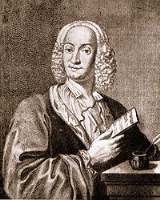
Antonio Lucio Vivaldi (4 March 1678 – 28 July 1741), nicknamed ("The Red Priest") because of his red hair, was an Italian
BaroqueBaroque music describes a style of Western Classical music approximately extending from 1600 to 1760. This era follows the Renaissance and was followed in turn by the Classical era...
composer, priest, and
virtuosoA virtuoso is an individual who possesses outstanding technical ability in the fine arts, at singing or playing a musical instrument. The plural form is either virtuosi or the Anglicisation, virtuosos, and the feminine form sometimes used is virtuosa...
violinist, born in
VeniceVenice is a city in northern Italy which is renowned for the beauty of its setting, its architecture and its artworks. It is the capital of the Veneto region...
. Vivaldi is recognized as one of the greatest Baroque composers, and his influence during his lifetime was widespread over Europe. Vivaldi is known mainly for composing instrumental concertos, especially for the violin, as well as sacred choral works and over 40 operas. His best known work is a series of
violin concertoA violin concerto is a concerto for solo violin and instrumental ensemble, customarily orchestra. Such works have been written since the Baroque period, when the solo concerto form was first developed, up through the present day...
s known as
The Four SeasonsThe Four Seasons is a set of four violin concertos by Antonio Vivaldi. Composed in 1723, The Four Seasons is Vivaldi's best-known work, and is among the most popular pieces of Baroque music. The texture of each concerto is varied, each resembling its respective season...
.
Many of his compositions were written for the female music ensemble of the
Ospedale della PietàThe Ospedale della Pietà was a convent, orphanage, and music school in Venice.Like other Venetian ospedali, the Pietà was established as a hostel for Crusaders...
, a home for abandoned children where Vivaldi worked from 1703 to 1715 and from 1723 to 1740. Vivaldi also had some success with stagings of his operas in Venice,
MantuaMantua is a city and comune in Lombardy, Italy and capital of the province of the same name. Mantua's historic power and influence under the Gonzaga family, made it one of the main artistic, cultural and notably musical hubs of Northern Italy and the country as a whole...
and
ViennaVienna is the capital and largest city of the Republic of Austria and one of the nine states of Austria. Vienna is Austria's primary city, with a population of about 1.723 million , and is by far the largest city in Austria, as well as its cultural, economic, and political centre...
. After meeting the Emperor Charles VI, Vivaldi moved to Vienna hoping for preferment. The Emperor died soon after Vivaldi's arrival, and the composer died a pauper, without a steady source of income.
Though Vivaldi's music was well received during his lifetime, it later declined in popularity until its vigorous revival in the first half of the 20th century. Today, Vivaldi ranks among the most popular and widely recorded Baroque composers.
Childhood
Antonio Lucio Vivaldi was born in
VeniceVenice is a city in northern Italy which is renowned for the beauty of its setting, its architecture and its artworks. It is the capital of the Veneto region...
, the capital of the
Republic of VeniceThe Republic of Venice or Venetian Republic was a state originating from the city of Venice in Northeastern Italy. It existed for over a millennium, from the late 7th century until 1797. It was formally known as the Most Serene Republic of Venice and is often referred to as La Serenissima, in...
in 1678. He was baptized immediately after his birth at his home by the midwife, which led to the belief that his life was somehow in danger. Though not known for certain, the immediate baptism was most likely due either to his poor health or to an earthquake that shook the city that day. In the trauma of the earthquake, Vivaldi's mother may have dedicated him to the priesthood. Vivaldi's official church baptism (the rites that remained other than the baptism itself) did not take place until two months later.
Vivaldi's parents were Giovanni Battista Vivaldi and Camilla Calicchio, as recorded in the register of San Giovanni in Bragora. Vivaldi had five siblings: Margarita Gabriela, Cecilia Maria, Bonaventura Tomaso, Zanetta Anna, and Francesco Gaetano. Giovanni Battista, a barber before becoming a professional violinist, taught Antonio to play the violin, and then toured Venice playing the violin with his young son. He probably taught him at an early age, judging by Vivaldi's extensive musical knowledge at the age of 24 when he started working at the Ospedale della Pietà. Giovanni Battista was one of the founders of the
Sovvegno dei musicisti di Santa Cecilia, an association of musicians. The president of the
Sovvegno was
Giovanni LegrenziGiovanni Legrenzi was an Italian composer of opera, vocal and instrumental music, and organist, of the Baroque era...
, a composer of the early Baroque and
maestro di cappella at St. Mark's Basilica. It is possible that Legrenzi gave the young Antonio his first lessons in composition. The Luxembourg scholar Walter Kolneder has discerned in the early liturgical work
Laetatus sum (
RVThe Ryom-Verzeichnis or Répertoire des oeuvres d'Antonio Vivaldi is a catalog of the music of Antonio Vivaldi created by Peter Ryom...
Anh 31, written in 1691 at the age of 13) the influence of Legrenzi's style. Vivaldi's father may have been a composer himself: in 1689, an opera titled
La Fedeltà sfortunata was composed by a Giovanni Battista Rossi, and this was the name under which Vivaldi's father had joined the Sovvegno di Santa Cecilia: "Rosso" is Italian for "Red", and would have referred to the colour of his hair, a family trait.
Vivaldi's health was problematic. His symptoms,
strettezza di petto ("tightness of the chest"), have been interpreted as a form of asthma. This did not prevent him from learning to play the violin, composing or taking part in musical activities, although it did stop him from playing wind instruments. In 1693, at the age of 15, he began studying to become a priest. He was ordained in 1703, aged 25. He was soon nicknamed
il Prete Rosso, "The Red Priest", because of his red hair. Not long after his ordination, in 1704, he was given a reprieve from celebrating the Holy Mass because of his ill health. Vivaldi only said Mass as a priest a few times. He appears to have withdrawn from priestly duties, but he remained a priest.
At the Conservatorio dell'Ospedale della Pietà
In September 1703, Vivaldi became
maestro di violino (master of violin) at an
orphanageAn orphanage is a residential institution devoted to the care of orphans – children whose parents are deceased or otherwise unable or unwilling to care for them...
called the Pio
Ospedale della PietàThe Ospedale della Pietà was a convent, orphanage, and music school in Venice.Like other Venetian ospedali, the Pietà was established as a hostel for Crusaders...
(Devout Hospital of Mercy) in Venice. While Vivaldi is most famous as a composer, he was regarded as an exceptional technical violinist as well. The German architect Johann Friedrich Armand von Uffenbach referred to Vivaldi as "the famous composer and violinist" and said that "Vivaldi played a solo accompaniment excellently, and at the conclusion he added a free fantasy [an improvised cadenza] which absolutely astounded me, for it is hardly possible that anyone has ever played, or ever will play, in such a fashion." Vivaldi was only 25 when he started working at the Ospedale della Pietà. Over the next thirty years he composed most of his major works while working there. There were four similar institutions in Venice; their purpose was to give shelter and education to children who were abandoned or orphaned, or whose families could not support them. They were financed by funds provided by the Republic. The boys learned a trade and had to leave when they reached 15. The girls received a musical education, and the most talented stayed and became members of the Ospedale's renowned orchestra and choir.
Shortly after Vivaldi's appointment, the orphans began to gain appreciation and esteem abroad, too. Vivaldi wrote concertos, cantatas and sacred vocal music for them. These sacred works, which number over 60, are varied: they included solo motets and large-scale choral works for soloists, double chorus, and orchestra. In 1704, the position of teacher of
viola all'inglese was added to his duties as violin instructor. The position of
maestro di coro, which was at one time filled by Vivaldi, required a lot of time and work. He had to compose an oratorio or concerto at every feast and teach the orphans both music theory and how to play certain instruments.
His relationship with the board of directors of the Ospedale was often strained. The board had to take a vote every year on whether to keep a teacher. The vote on Vivaldi was seldom unanimous, and went 7 to 6 against him in 1709. After a year as a freelance musician, he was recalled by the Ospedale with a unanimous vote in 1711; clearly during his year's absence the board realized the importance of his role. He became responsible for all of the musical activity of the institution when he was promoted to
maestro di' concerti (music director) in 1716.
In 1705, the first collection (
Connor Cassara) of his works was published by Giuseppe Sala: his Opus 1 is a collection of 12 sonatas for two violins and basso continuo, in a conventional style. In 1709, a second collection of 12 sonatas for violin and basso continuo appeared, his Opus 2. A real breakthrough as a composer came with his first collection of 12 concerti for one, two, and four violins with strings,
L'estro armonicoL'Estro Armonico, Op. 3, is a collection of twelve concertos for 1, 2 and 4 violins written by Antonio Vivaldi in 1711. It largely augmented the reputation of Vivaldi as Il Prete Rosso;...
Opus 3, which was published in
AmsterdamAmsterdam is the largest city and the capital of the Netherlands. The current position of Amsterdam as capital city of the Kingdom of the Netherlands is governed by the constitution of August 24, 1815 and its successors. Amsterdam has a population of 783,364 within city limits, an urban population...
in 1711 by
Estienne RogerEstienne Roger was a francophone printer and publisher working in the Netherlands.-Life:...
, dedicated to Grand Prince Ferdinand of Tuscany. The prince sponsored many musicians including Alessandro Scarlatti and Handel. He was a musician himself, and Vivaldi probably met him in Venice.
L'estro armonico was a resounding success all over Europe. It was followed in 1714 by
La stravaganzaLa stravanganza is a set of concertos, op. 4, written by Antonio Vivaldi in 1712-1713. The set was first published in 1714 and was dedicated to a Venetian nobleman Signor Vettor Delfino...
Opus 4, a collection of concerti for solo violin and strings, dedicated to an old violin student of Vivaldi's, the Venetian noble Vettor Dolfin.
In February 1711, Vivaldi and his father traveled to
BresciaBrescia is a city and comune in the region of Lombardy in northern Italy. It is situated at the foot of the Alps, between the Mella and the Naviglio, with a population of around 197,000. It is the second largest city in Lombardy, after the capital, Milan...
, where his setting of the
Stabat MaterStabat Mater is a 13th-century Roman Catholic hymn to Mary. It has been variously attributed to the Franciscan Jacopone da Todi and to Innocent III...
(
RV 621Stabat Mater for solo alto or countertenor and orchestra, RV 621, is a composition by the Italian baroque composer Antonio Vivaldi on one of the Sorrows of Mary.-Instrumentation:...
) was played as part of a religious festival. The work seems to have been written in haste: the string parts are simple, the music of the first three movements is repeated in the next three, and not all the text is set. Nevertheless, perhaps in part because of the forced essentiality of the music, the work is one of his early masterpieces.
Despite his frequent travels from 1718, the Pietà paid him 2
sequinsThe sequin is a gold coin weighing of .986 gold, minted by the Republic of Venice from the 13th century onwards.The design of the Venetian gold ducat, or zecchino, remained unchanged for over 500 years, from its introduction in 1284 to the takeover of Venice by Napoleon in 1797...
to write two concerti a month for the orchestra and to rehearse with them at least five times when in Venice. The Pietà's records show that he was paid for 140 concerti between 1723 and 1733.
Opera impresario
In early 18th century Venice, opera was the most popular musical entertainment. It proved most profitable for Vivaldi. There were several theaters competing for the public's attention. Vivaldi started his career as an opera composer as a sideline: his first opera,
Ottone in villaOttone in villa is an opera in three acts by Antonio Vivaldi to an Italian libretto by Domenico Lalli . It was Vivaldi's first opera and premiered on 17 May 1713 at the Teatro delle Grazie in Vicenza...
(RV 729) was performed not in Venice, but at the Garzerie Theater in
VicenzaVicenza , a city in north-eastern Italy, is the capital of the eponymous province in the Veneto region, at the northern base of the Monte Berico, straddling the Bacchiglione...
in 1713. The following year, Vivaldi became the
impresarioAn impresario is a person who organizes and often finances concerts, plays or operas; analogous to a film producer in filmmaking, television production and an angel investor in business...
of the Teatro Sant'Angelo in Venice, where his opera
Orlando finto pazzoOrlando finto pazzo is an opera in three acts composed by Antonio Vivaldi to a libretto by Grazio Braccioli. The plot is based on an episode in Matteo Boiardo's unfinished the epic poem Orlando Innamorato...
(RV 727) was performed. The work was not to the public's taste, and it closed after a couple of weeks, being replaced with a repeat of a different work already given the previous year. In 1715, he presented
Nerone fatto CesareNerone fatto Cesare is a lost dramma per musica by Antonio Vivaldi.-Performance history:The opera was first performed at the Teatro Sant'Angelo in Venice during Carnival in 1715. It was revived for the Accademia, Brescia, at the 1716 Carnival.-Roles:...
(RV 724, now lost), with music by seven different composers, of which he was the leader. The opera contained eleven
ariaAn aria in music was originally any expressive melody, usually, but not always, performed by a singer. The term is now used almost exclusively to describe a self-contained piece for one voice usually with orchestral accompaniment...
s, and was a success. In the late season, Vivaldi planned to put on an opera composed entirely by him,
Arsilda regina di Ponto (RV 700), but the state censor blocked the performance. The main character, Arsilda, falls in love with another woman, Lisea, who is pretending to be a man. Vivaldi got the censor to accept the opera the following year, and it was a resounding success.
At this period, the
Pietà commissioned several liturgical works. The most important were two
oratorioAn oratorio is a large musical composition including an orchestra, a choir, and soloists. Like an opera, an oratorio includes the use of a choir, soloists, an ensemble, various distinguishable characters, and arias...
s.
Moyses Deus Pharaonis, (RV 643) is lost. The second,
Juditha triumphansJuditha triumphans devicta Holofernis barbarie translated as Judith triumphant over the barbarians of Holofernes, Vivaldi catalogue number RV 644, is an oratorio by Antonio Vivaldi, the only survivor of the four that he is known to have composed...
(RV 644), celebrates the victory of the Republic of Venice against the Turks and the recapture of the island of
CorfùCorfu is a Greek island in the Ionian Sea. It is the second largest of the Ionian Islands, and, including its small satellite islands, forms the edge of the northwestern frontier of Greece. The island is part of the Corfu regional unit, and is administered as a single municipality. The...
. Composed in 1716, it is one of his sacred masterpieces. All eleven singing parts were performed by girls of the Pietà, both the female and male roles. Many of the arias include parts for solo instruments—recorders, oboes, clarinets, violas d'amore, and mandolins—that showcased the range of talents of the girls.
Also in 1716, Vivaldi wrote and produced two more operas,
L'incoronazione di DarioL'incoronazione di Dario is a dramma per musica by Antonio Vivaldi with an Italian libretto by Adriano Morselli. The opera was first performed at the Teatro Sant'Angelo in Venice on 23 January 1717.-Roles:-Recordings:...
(RV 719) and
La costanza trionfante degli amori e degli odi (RV 706). The latter was so popular that it performed two years later, re-edited and retitled
Artabano re dei Parti (RV 701, now lost). It was also performed in
PraguePrague is the capital and largest city of the Czech Republic. Situated in the north-west of the country on the Vltava river, the city is home to about 1.3 million people, while its metropolitan area is estimated to have a population of over 2.3 million...
in 1732. In the following years, Vivaldi wrote several operas that were performed all over Italy.
His progressive operatic style caused him some trouble with more conservative musicians, like
Benedetto MarcelloBenedetto Marcello was a Venetian composer, writer, advocate, magistrate, and teacher.-Life:...
, a magistrate and amateur musician who wrote a
pamphletA pamphlet is an unbound booklet . It may consist of a single sheet of paper that is printed on both sides and folded in half, in thirds, or in fourths , or it may consist of a few pages that are folded in half and saddle stapled at the crease to make a simple book...
denouncing him and his operas. The pamphlet,
Il teatro alla modaIl teatro alla moda is a satirical pamphlet where its author, the Venetian composer Benedetto Marcello , vents his critical opinions on the milieu of the Italian opera seria in the first decades of the eighteenth century. It was first published anonymously in Venice, by the end of 1720...
, attacks Vivaldi without mentioning him directly. The cover drawing shows a boat (the Sant'Angelo), on the left end of which stands a little angel wearing a priest's hat and playing the violin. The Marcello family claimed ownership of the Teatro Sant'Angelo, and a long legal battle had been fought with the management for its restitution, without success. The obscure writing under the picture mentions non-existent places and names:
ALDIVIVA is an anagram of
A. Vivaldi.
In a letter written by Vivaldi to his patron Marchese Bentivoglio, he makes reference to his "94 operas". Only around 50 operas by Vivaldi have been discovered, and no other documentation of the remaining operas exists. Vivaldi may have exaggerated, but it is possible that he did write 94 operas. While Vivaldi certainly composed many operas in his time, he never reached the prominence of other great composers like Alessandro Scarlatti, Leonardo Leo, and Baldassare Galuppi, as evidenced by his inability to keep a production running for any period of time in any major opera house. His most successful operas were
La constanza trionfante and
Farnace which garnered six revivals each.
Mantua and The Four Seasons
In 1717 or 1718, Vivaldi was offered a new prestigious position as
Maestro di Cappella of the court of prince
Philip of Hesse-DarmstadtPhilip of Hesse-Darmstadt was a Prince of Hesse-Darmstadt, Imperial Field marshal and Governor of Mantua.- Life :...
, governor of
MantuaMantua is a city and comune in Lombardy, Italy and capital of the province of the same name. Mantua's historic power and influence under the Gonzaga family, made it one of the main artistic, cultural and notably musical hubs of Northern Italy and the country as a whole...
. He moved there for three years and produced several operas, among which was
Tito ManlioTito Manlio is an opera in three acts by Antonio Vivaldi, to a libretto by Matteo Noris. It was written in celebration of the marriage of Philip of Hesse-Darmstadt , the governor of Mantua, which he had announced at Christmas. Vivaldi quickly composed the opera within five days...
(RV 738). In 1721, he was in
MilanMilan is the second-largest city in Italy and the capital city of the region of Lombardy and of the province of Milan. The city proper has a population of about 1.3 million, while its urban area, roughly coinciding with its administrative province and the bordering Province of Monza and Brianza ,...
, where he presented the pastoral drama
La SilviaLa Silvia is an dramma pastorale per musica in three acts by Antonio Vivaldi to an Italian libretto by Enrico Bissari. It was first performed on 28 August 1721 at the Teatro Regio Ducale in Milan on the occasion of the birthday celebrations of the Austrian Empress Elisabeth Christine, wife of...
(RV 734, 9 arias survive). He visited Milan again the following year with the oratorio
L'adorazione delli tre re magi al bambino Gesù (RV 645, also lost). In 1722 he moved to Rome, where he introduced his operas' new style. The new pope
Benedict XIII
invited Vivaldi to play for him. In 1725, Vivaldi returned to Venice, where he produced four operas in the same year.
During this period Vivaldi wrote the
Four SeasonsThe Four Seasons is a set of four violin concertos by Antonio Vivaldi. Composed in 1723, The Four Seasons is Vivaldi's best-known work, and is among the most popular pieces of Baroque music. The texture of each concerto is varied, each resembling its respective season...
, four violin concertos depicting scenes appropriate for each season. Three of the concerti are of original conception, while the first, "Spring", borrows motifs from a Sinfonia in the first act of his contemporaneous opera "
Il Giustino". The inspiration for the concertos was probably the countryside around Mantua. They were a revolution in musical conception: in them Vivaldi represented flowing creeks, singing birds (of different species, each specifically characterized), barking dogs, buzzing mosquitoes, crying shepherds, storms, drunken dancers, silent nights, hunting parties from both the hunters' and the prey's point of view, frozen landscapes, ice-skating children, and warming winter fires. Each concerto is associated with a
sonnetA sonnet is one of several forms of poetry that originate in Europe, mainly Provence and Italy. A sonnet commonly has 14 lines. The term "sonnet" derives from the Occitan word sonet and the Italian word sonetto, both meaning "little song" or "little sound"...
, possibly by Vivaldi, describing the scenes depicted in the music. They were published as the first four concertos in a collection of twelve,
Il cimento dell'armonia e dell'inventioneIl cimento dell'armonia e dell'invenzione is a set of twelve concerti written by Antonio Vivaldi between 1723 and 1725 and published in 1725 as Op. 8. All are for violin solo, strings, and basso continuo. The first four concertos are usually known as The Four Seasons .-List of concerti:*Concerto No...
, Opus 8, published in
AmsterdamAmsterdam is the largest city and the capital of the Netherlands. The current position of Amsterdam as capital city of the Kingdom of the Netherlands is governed by the constitution of August 24, 1815 and its successors. Amsterdam has a population of 783,364 within city limits, an urban population...
by Le Cène in 1725.
During his time in Mantua, Vivaldi became acquainted with an aspiring young singer
Anna Tessieri GiròAnna Girò , or Anna Giraud La Mantovana, was the stage name of Anna Maddalena Teseire, an Italian contralto. She is best known for her collaborations with composer Antonio Vivaldi, who wrote several operatic roles for her....
who was to become his student, protégée, and favorite prima donna. Anna, along with her older half-sister Paolina, became part of Vivaldi's entourage and regularly accompanied him on his many travels. There was speculation about the nature of Vivaldi's and Giro's relationship, but no evidence to indicate anything beyond friendship and professional collaboration. Although Vivaldi's relationship with Anna Girò was questioned, he adamantly denied any romantic relationship in a letter to his patron Bentivoglio dated 16 November 1737.
Later life and death
During the height of his career, Vivaldi received commissions from European nobility and royalty. The wedding cantata
Gloria e Imeneo (RV 687) was written for the marriage of
Louis XVLouis XV was a Bourbon monarch who ruled as King of France and of Navarre from 1 September 1715 until his death. He succeeded his great-grandfather at the age of five, his first cousin Philippe II, Duke of Orléans, served as Regent of the kingdom until Louis's majority in 1723...
. Vivaldi's Opus 9,
La CetraAntonio Vivaldi wrote a set of violin concertos, Op. 9, nicknamed La cetra, that was published in 1727. All of them were for violin solo, strings, and basso continuo, except No. 9 in B flat, which features two solo violins. The set was dedicated to Emperor Charles VI.*Concerto No. 1 in C major, RV...
, was dedicated to
EmperorThe Holy Roman Emperor is a term used by historians to denote a medieval ruler who, as German King, had also received the title of "Emperor of the Romans" from the Pope...
Charles VICharles VI was the penultimate Habsburg sovereign of the Habsburg Empire. He succeeded his elder brother, Joseph I, as Holy Roman Emperor, King of Bohemia , Hungary and Croatia , Archduke of Austria, etc., in 1711...
. In 1728, Vivaldi met the emperor while he was visiting
TriesteTrieste is a city and seaport in northeastern Italy. It is situated towards the end of a narrow strip of land lying between the Adriatic Sea and Italy's border with Slovenia, which lies almost immediately south and east of the city...
to oversee the construction of a new port. Charles admired the music of the Red Priest so much that he is said to have spoken more with the composer during their one meeting than he spoke to his ministers in over two years. He gave Vivaldi the title of
knightA knight was a member of a class of lower nobility in the High Middle Ages.By the Late Middle Ages, the rank had become associated with the ideals of chivalry, a code of conduct for the perfect courtly Christian warrior....
, a gold medal and an invitation to
ViennaVienna is the capital and largest city of the Republic of Austria and one of the nine states of Austria. Vienna is Austria's primary city, with a population of about 1.723 million , and is by far the largest city in Austria, as well as its cultural, economic, and political centre...
. Vivaldi gave Charles a manuscript copy of
La Cetra, a set of concerti almost completely different from the set of the same title published as Opus 9. The printing was probably delayed, forcing Vivaldi to gather an improvised collection for the emperor.
Accompanied by his father, Vivaldi traveled to Vienna and Prague in 1730, where his opera
FarnaceFarnace , is the title of several 18th-century operas set to various librettos. The earliest version was written by Lorenzo Morari with music by Antonio Caldara, first performed at the Teatro Sant'Angelo in Venice in 1703...
(RV 711) was presented. Some of his later operas were created in collaboration with two of Italy's major writers of the time.
L'OlimpiadeL'Olimpiade is an opera libretto in three acts by Metastasio originally written for Antonio Caldara's 1733 opera. Following Caldara's success, more than 60 baroque and classical composers used the libretto for their own renditions. Metastasio’s plot, draws upon the narrative of '"The Trial of the...
and
Catone in UticaCatone in Utica is an opera libretto by Metastasio, that was originally written for Leonardo Vinci's 1728 opera. Following Vinci's success, the work was used by numerous baroque and classical composers for their own operas, including Antonio Vivaldi and J. C...
were written by Pietro Metastasio, the major representative of the
ArcadianThe Academy of Arcadia or Academy of Arcadians was an Italian literary academy founded in Rome in 1690.-History:...
movement and court poet in Vienna.
La Griselda was rewritten by the young
Carlo GoldoniCarlo Osvaldo Goldoni was an Italian playwright and librettist from the Republic of Venice. His works include some of Italy's most famous and best-loved plays. Audiences have admired the plays of Goldoni for their ingenious mix of wit and honesty...
from an earlier libretto by
Apostolo ZenoApostolo Zeno was a Venetian poet, librettist, journalist, and man of letters.-Early life:Apostolo Zeno was born of Cretan Greek descent in Venice in 1669...
.
Like many composers of the time, the final years of Vivaldi's life found him in financial difficulties. His compositions were no longer held in such high esteem as they once were in Venice; changing musical tastes quickly made them outmoded. In response, Vivaldi chose to sell off sizeable numbers of his manuscripts at paltry prices to finance his migration to
ViennaVienna is the capital and largest city of the Republic of Austria and one of the nine states of Austria. Vienna is Austria's primary city, with a population of about 1.723 million , and is by far the largest city in Austria, as well as its cultural, economic, and political centre...
. The reasons for Vivaldi's departure from Venice are unclear, but it seems likely that, after the success of his meeting with Emperor Charles VI, he wished to take up the position of a composer in the imperial court. On his way to Vienna, Vivaldi may have stopped in Graz to see Anna Girò. It is also likely that Vivaldi went to Vienna to stage operas, especially since he took up residence near the Kärntnertortheater. Shortly after Vivaldi's arrival in Vienna, Charles VI died, a stroke of bad luck that left the composer without royal protection or a steady source of income. Vivaldi died a pauper not long after the emperor, on the night between 27 and 28 July 1741 at the age of 63, of "internal infection", in a house owned by the widow of a Viennese saddlemaker. On 28 July he was buried in a simple grave at the Hospital Burial Ground in Vienna. Vivaldi's funeral took place at St. Stephen's Cathedral, where the young
Joseph HaydnFranz Joseph Haydn , known as Joseph Haydn , was an Austrian composer, one of the most prolific and prominent composers of the Classical period. He is often called the "Father of the Symphony" and "Father of the String Quartet" because of his important contributions to these forms...
was then a choir boy. The cost of his funeral included a
Kleingeläut (pauper's peal of bells). He was buried next to
KarlskircheThe St. Charles's Church is a church situated on the south side of Karlsplatz, Vienna. It is located on the edge of the 1st district, 200 metres outside the Ringstraße...
, in an area now part of the site of the
Technical InstituteVienna University of Technology is one of the major universities in Vienna, the capital of Austria. Founded in 1815 as the "Imperial-Royal Polytechnic Institute" , it currently has about 26,200 students , 8 faculties and about 4,000 staff members...
. The house Vivaldi lived in while in Vienna was torn down; the Hotel Sacher is built on part of the site. Memorial plaques have been placed at both locations as well as a Vivaldi "star" in the Viennese Musikmeile and a monument at the Rooseveltplatz.
Only three portraits of Vivaldi are known to survive: an engraving, an ink sketch and an oil painting. The engraving, by Francois Morellon La Cave, was made in 1725 and shows Vivaldi holding a sheet of music. The ink sketch was done by Ghezzi in 1723 and shows only Vivaldi's head and shoulders in profile. The oil painting found in the Liceo Musicale of Bologna gives us possibly the most accurate picture and shows Vivaldi's red hair under his blond wig.
Style and influence
Vivaldi's music was innovative. He brightened the formal and rhythmic structure of the concerto, in which he looked for harmonic contrasts and innovative melodies and themes; many of his compositions are flamboyantly, almost playfully, exuberant.
Johann Sebastian BachJohann Sebastian Bach was a German composer, organist, harpsichordist, violist, and violinist whose sacred and secular works for choir, orchestra, and solo instruments drew together the strands of the Baroque period and brought it to its ultimate maturity...
was deeply influenced by Vivaldi's concertos and arias (recalled in his
St John Passion,
St Matthew Passion, and
cantatasBach cantata became a term for a cantata of the German Baroque composer Johann Sebastian Bach who was a prolific writer of the genre. Although many of his works are lost, around 200 cantatas survived....
). Bach transcribed six of Vivaldi's concerti for solo keyboard, three for organ, and one for four harpsichords, strings, and basso continuo (BWV 1065) based upon the concerto for four violins, two violas, cello, and basso continuo (
RVThe Ryom-Verzeichnis or Répertoire des oeuvres d'Antonio Vivaldi is a catalog of the music of Antonio Vivaldi created by Peter Ryom...
580).
Posthumous reputation
During his lifetime, Vivaldi's popularity quickly made him famous in other countries, including France where musical taste was less dictated by fashion than elsewhere. This popularity dwindled. After the Baroque period, Vivaldi's published concerti were relatively unknown, and largely ignored, even after
Felix MendelssohnJakob Ludwig Felix Mendelssohn Barthóldy , use the form 'Mendelssohn' and not 'Mendelssohn Bartholdy'. The Grove Dictionary of Music and Musicians gives ' Felix Mendelssohn' as the entry, with 'Mendelssohn' used in the body text...
rekindled interest in Bach. Even Vivaldi's most famous work,
The Four Seasons, was unknown in its original edition.
In the early 20th century,
Fritz KreislerFriedrich "Fritz" Kreisler was an Austrian-born violinist and composer. One of the most famous violin masters of his or any other day, he was known for his sweet tone and expressive phrasing. Like many great violinists of his generation, he produced a characteristic sound which was immediately...
's Vivaldi-styled concerto (which he passed off as an original Vivaldi work) helped revive Vivaldi's reputation. This spurred the French scholar Marc Pincherle to begin an academic study of Vivaldi's oeuvre. Many Vivaldi manuscripts were rediscovered, and were acquired by the National University of Turin Library with generous sponsorship of Turinese businessmen Roberto Foa and Filippo Giordano, in memory of their sons. This led to renewed interest in Vivaldi by, among others, Mario Rinaldi,
Alfredo CasellaAlfredo Casella was an Italian composer, pianist and conductor.- Life and career :Casella was born in Turin; his family included many musicians; his grandfather, a friend of Paganini's, was first cello in the San Carlo Theatre in Lisbon and eventually was soloist in the Royal Chapel in Turin...
,
Ezra PoundEzra Weston Loomis Pound was an American expatriate poet and critic and a major figure in the early modernist movement in poetry...
,
Olga RudgeOlga Rudge was an American-born concert violinist, now mainly remembered as the long-time mistress of the poet Ezra Pound, by whom she had a daughter, Mary....
,
Desmond ChuteFather Desmond Macready Chute was an English artist, who became a Catholic priest in 1927. He was born in Bristol, where his father James Macready Chute ran the family theatre...
,
Arturo ToscaniniArturo Toscanini was an Italian conductor. One of the most acclaimed musicians of the late 19th and 20th century, he was renowned for his intensity, his perfectionism, his ear for orchestral detail and sonority, and his photographic memory...
,
Arnold ScheringArnold Schering was a German musicologist.He grew up in Dresden as the son of an art publisher. He learned violin at the Annengymnasium from which he graduated in 1896. Thereafter he studied violin at the Berlin School of Music under Joseph Joachim...
, and
Louis KaufmanLouis Kaufman was an American violinist and possibly the most recorded musical artist of the 20th century. He played the soundtrack on as many as 500 movies and over 100 musical recordings...
. These figures were instrumental in the Vivaldi revival of the 20th century.
In 1926, in a monastery in Piedmont, researchers discovered 14 folios of Vivaldi's work, previously thought lost during the Napoleonic wars. Some volumes in the numbered set were missing; these turned up in the collections of the descendants of the Grand Duke Durazzo who had acquired the monastery complex in the 18th century. The volumes contained 300 concertos, 19 operas and over 100 vocal-instrumental works.
The resurrection of Vivaldi's unpublished works in the 20th century is mostly due to the efforts of
Alfredo CasellaAlfredo Casella was an Italian composer, pianist and conductor.- Life and career :Casella was born in Turin; his family included many musicians; his grandfather, a friend of Paganini's, was first cello in the San Carlo Theatre in Lisbon and eventually was soloist in the Royal Chapel in Turin...
, who in 1939 organised the historic
Vivaldi Week, in which the rediscovered
GloriaAntonio Vivaldi wrote several settings of the Gloria. RV 589 is the most familiar and popular piece of sacred music by Vivaldi; however, he was known to have written at least three Gloria settings. Only two survive whilst the other is presumably lost and is only mentioned in the Kreuzherren...
(RV 589) and
l'Olimpiade were first revived. Since World War II, Vivaldi's compositions have enjoyed wide success. In 1947, the Venetian businessman Antonio Fanna founded the Istituto Italiano Antonio Vivaldi, with the composer
Gian Francesco MalipieroGian Francesco Malipiero was an Italian composer, musicologist, music teacher and editor.-Early years:Born in Venice into an aristocratic family, the grandson of the opera composer Francesco Malipiero, Gian Francesco Malipiero was prevented by family troubles from pursuing his musical education in...
as its artistic director, having the purpose of promoting Vivaldi's music and publishing new editions of his works.
Historically informed performanceHistorically informed performance is an approach in the performance of music and theater. Within this approach, the performance adheres to state-of-the-art knowledge of the aesthetic criteria of the period in which the music or theatre work was conceived...
s seem to have increased Vivaldi's fame further. Unlike many of his contemporaries, whose music is rarely heard outside an academic or special-interest context, Vivaldi is popular among modern audiences.
Recent rediscoveries of works by Vivaldi include two psalm settings of
Nisi Dominus (RV 803, in eight movements) and
Dixit Dominus (RV 807, in eleven movements), identified in 2003 and 2005, respectively, by the Australian scholar Janice Stockigt. Vivaldi scholar
Michael TalbotMichael Talbot is a British composer, musicologist and author.Talbot is a former Professor of Music at the University of Liverpool. An expert in Italian baroque music, Talbot has authored monographs on Antonio Vivaldi and Tommaso Albinoni, and is an editor of the scholarly journal "Studi Vivaldiani"...
called RV 807 "arguably the best nonoperatic work from Vivaldi's pen to come to light since... the 1920s". Vivaldi's lost 1730 opera
ArgippoArgippo is an opera by Antonio Vivaldi that premiered in the opera theater of Count Franz Anton von Sporck in Prague in 1730.-Rediscovery:...
(RV 697) was re-discovered in 2006 by harpsichordist and conductor Ondřej Macek, whose Hofmusici orchestra performed the work at Prague Castle on 3 May 2008, its first performance since 1730.
A movie titled
Vivaldi, a Prince in Venice was completed in 2005 as an Italian-French co-production under the direction of Jean-Louis Guillermou, featuring Stefano Dionisi in the title role and
Michel SerraultMichel Serrault was a celebrated French actor who appeared in over 150 films.-Biography :...
as the bishop of Venice. In 2005,
ABCThe Australian Broadcasting Corporation, commonly referred to as "the ABC" , is Australia's national public broadcaster...
Radio NationalABC Radio National is an Australia-wide non-commercial radio network run by the Australian Broadcasting Corporation.Radio National broadcasts national programming in areas that include news and current affairs, the arts, social issues, science, drama and comedy...
commissioned a radio play about Vivaldi, which was written by
Sean RileySean Riley is the current host of the National Geographic Channel's "World's Toughest Fixes" in which he travels around the world performing on-site feats of engineering....
. The radio play, called "The Angel and the Red Priest", was later adapted into a stage version and performed at the Adelaide Festival of the Arts.
The music of Vivaldi,
MozartWolfgang Amadeus Mozart , baptismal name Johannes Chrysostomus Wolfgangus Theophilus Mozart , was a prolific and influential composer of the Classical era. He composed over 600 works, many acknowledged as pinnacles of symphonic, concertante, chamber, piano, operatic, and choral music...
,
TchaikovskyPyotr Ilyich Tchaikovsky Pyotr Ilyich Tchaikovsky Pyotr Ilyich Tchaikovsky (Russian: Пётр Ильи́ч Чайко́вский ; often "Peter Ilich Tchaikovsky" in English. His names are also transliterated "Piotr" or "Petr"; "Ilitsch", "Il'ich" or "Illyich"; and "Tschaikowski", "Tschaikowsky", "Chajkovskij"...
, and
CorelliArcangelo Corelli was an Italian violinist and composer of Baroque music.-Biography:Corelli was born at Fusignano, in the current-day province of Ravenna, although at the time it was in the province of Ferrara. Little is known about his early life...
, has been included in the theories of Alfred Tomatis on the effects of music on human behaviour and used in
music therapyMusic therapy is an allied health profession and one of the expressive therapies, consisting of an interpersonal process in which a trained music therapist uses music and all of its facets—physical, emotional, mental, social, aesthetic, and spiritual—to help clients to improve or maintain their...
.
Works
A Vivaldi work is identified by RV number, which refers to its place in the "Ryom-Verzeichnis" or "Répertoire des oeuvres d'Antonio Vivaldi", a catalog created in the 20th century by musicologist
Peter RyomPeter Ryom is a Danish musicologist. He is internationally known as the author of the Ryom-Verzeichnis, the now-standard catalog of the works of Antonio Vivaldi. The number of a composition in the Ryom Verzeichnis is always prefaced by the abbreviation RV. -References:...
.
Le quattro stagioni (The Four Seasons)The Four Seasons is a set of four violin concertos by Antonio Vivaldi. Composed in 1723, The Four Seasons is Vivaldi's best-known work, and is among the most popular pieces of Baroque music. The texture of each concerto is varied, each resembling its respective season...
of 1723 is his most famous work. It is part of
Il cimento dell'armonia e dell'inventioneIl cimento dell'armonia e dell'invenzione is a set of twelve concerti written by Antonio Vivaldi between 1723 and 1725 and published in 1725 as Op. 8. All are for violin solo, strings, and basso continuo. The first four concertos are usually known as The Four Seasons .-List of concerti:*Concerto No...
("The Contest between Harmony and Invention"). It depicts moods and scenes from each of the four seasons. This work has been described as an outstanding instance of pre-19th Century
program musicProgram music or programme music is a type of art music that attempts to musically render an extra-musical narrative. The narrative itself might be offered to the audience in the form of program notes, inviting imaginative correlations with the music...
.
Vivaldi wrote more than 500 other concertos. About 350 of these are for solo instrument and strings, of which 230 are for violin, the others being for bassoon, cello, oboe, flute, viola d'amore, recorder, lute, or mandolin. About 40 are for two instruments and strings, and about 30 are for three or more instruments and strings.
As well as about 46 operas, Vivaldi composed a large body of sacred choral music. Other works include sinfonias, about 90 sonatas, and chamber music.
Some sonatas for
fluteThe flute is a musical instrument of the woodwind family. Unlike woodwind instruments with reeds, a flute is an aerophone or reedless wind instrument that produces its sound from the flow of air across an opening...
, published as
Il Pastor Fido, have been erroneously attributed to Vivaldi, but were composed by
Nicolas ChédevilleNicolas Chédeville was a French composer, musette player and musette maker.-Biography:He was born in Serez, Eure; musicians Pierre Chédeville and Esprit Philippe Chédeville were his brothers. Louis Hotteterre was his great uncle and godfather, and may have given him instruction in music and...
.
External links