

Mordent

Encyclopedia
In music, a mordent is an ornament
indicating that the note is to be played with a single rapid alternation with the note above or below. Like trill
s, they can be chromatically
modified by a small flat, sharp
or natural accidental
. The term comes from the Latin
mordere, meaning "to bite".
The mordent is thought of as a rapid single alternation between an indicated note, the note above (the upper mordent) or below (the lower mordent) and the indicated note again.
The precise meaning of mordent has changed over the years. In the Baroque period
, a mordent was a lower mordent and an upper mordent was a pralltriller or schneller. In the 19th century, however, the name mordent was generally applied to what is now called the upper mordent, and the lower mordent became known as an inverted mordent.
In other languages the situation is different: for example in German Pralltriller and Mordent are still the upper and lower mordents respectively. Also note that this ornament in French, and sometimes in German, is spelled mordant.
Although mordents are now thought of as just a single alternation between notes, in the Baroque period it appears that a Mordent may sometimes have been executed with more than one alternation between the indicated note and the note below, making it a sort of inverted trill.
Also, mordents of all sorts might typically, in some periods, begin with an extra unessential note (the lesser, added note), rather than with the principal note as shown in the examples here. The same applies to trills, which in Baroque and Classical times would typically begin with the added, upper note. Practice, notation
, and nomenclature vary widely for all of these ornaments, and this article as a whole addresses an approximate nineteenth-century standard.
Ornament (music)
In music, ornaments or embellishments are musical flourishes that are not necessary to carry the overall line of the melody , but serve instead to decorate or "ornament" that line. Many ornaments are performed as "fast notes" around a central note...
indicating that the note is to be played with a single rapid alternation with the note above or below. Like trill
Trill (music)
The trill is a musical ornament consisting of a rapid alternation between two adjacent notes, usually a semitone or tone apart, which can be identified with the context of the trill....
s, they can be chromatically
Chromatic scale
The chromatic scale is a musical scale with twelve pitches, each a semitone apart. On a modern piano or other equal-tempered instrument, all the half steps are the same size...
modified by a small flat, sharp
Sharp (music)
In music, sharp, dièse , or diesis means higher in pitch and the sharp symbol raises a note by a half tone. Intonation may be flat, sharp, or both, successively or simultaneously...
or natural accidental
Accidental (music)
In music, an accidental is a note whose pitch is not a member of a scale or mode indicated by the most recently applied key signature. In musical notation, the symbols used to mark such notes, sharps , flats , and naturals , may also be called accidentals...
. The term comes from the Latin
Latin
Latin is an Italic language originally spoken in Latium and Ancient Rome. It, along with most European languages, is a descendant of the ancient Proto-Indo-European language. Although it is considered a dead language, a number of scholars and members of the Christian clergy speak it fluently, and...
mordere, meaning "to bite".
The mordent is thought of as a rapid single alternation between an indicated note, the note above (the upper mordent) or below (the lower mordent) and the indicated note again.
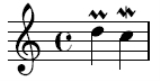
| The upper mordent is indicated by a short squiggle; the lower mordent is the same with a short vertical line through it: |
|
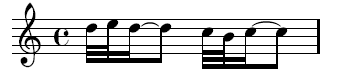
| As with the trill, the exact speed with which the mordent is performed will vary according to the tempo Tempo In musical terminology, tempo is the speed or pace of a given piece. Tempo is a crucial element of any musical composition, as it can affect the mood and difficulty of a piece.-Measuring tempo:... of the piece, but at moderate tempi the above might be executed as follows: |
 |
The precise meaning of mordent has changed over the years. In the Baroque period
Baroque music
Baroque music describes a style of Western Classical music approximately extending from 1600 to 1760. This era follows the Renaissance and was followed in turn by the Classical era...
, a mordent was a lower mordent and an upper mordent was a pralltriller or schneller. In the 19th century, however, the name mordent was generally applied to what is now called the upper mordent, and the lower mordent became known as an inverted mordent.
In other languages the situation is different: for example in German Pralltriller and Mordent are still the upper and lower mordents respectively. Also note that this ornament in French, and sometimes in German, is spelled mordant.
Although mordents are now thought of as just a single alternation between notes, in the Baroque period it appears that a Mordent may sometimes have been executed with more than one alternation between the indicated note and the note below, making it a sort of inverted trill.
Also, mordents of all sorts might typically, in some periods, begin with an extra unessential note (the lesser, added note), rather than with the principal note as shown in the examples here. The same applies to trills, which in Baroque and Classical times would typically begin with the added, upper note. Practice, notation
Musical notation
Music notation or musical notation is any system that represents aurally perceived music, through the use of written symbols.-History:...
, and nomenclature vary widely for all of these ornaments, and this article as a whole addresses an approximate nineteenth-century standard.