

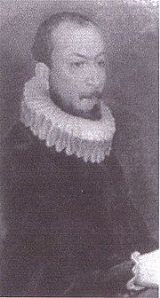

and Count of Conza
, was an Italian nobleman, lute
nist, composer
, and murderer.
As a composer of the late Renaissance
, he is remembered for writing intensely expressive madrigal
s and sacred music that use a chromatic
language not heard again until the late 19th century.
Early life
Gesualdo was part of the aristocraticfamily that had acquired the principality of Venosa in 1560. His uncle was Carlo Borromeo, later Saint Charles Borromeo. In addition, Gesualdo's mother, Girolama, was the niece of Pope Pius IV
.
Most likely he was born at Venosa
, then part of the Kingdom of Naples
, but little else is known about his early life. Even his birthdate — 1560, 1561 or 1566 — is a matter of some dispute, though a recently discovered letter from his mother indicates he was probably born in 1566. Gesualdo had a musical relationship with Pomponio Nenna
, though whether it was student to teacher, or colleague to colleague, is uncertain. At any rate, he had a single-minded devotion to music from an early age, and showed little interest in anything else. In addition to the lute, he also played the harpsichord
and guitar
.
In addition to Nenna, Gesualdo's accademia
included the composers Giovanni de Macque
, Scipione Dentice
, Scipione Stella
, Scipione Lacorcia
, Ascanio Mayone
, and the nobleman lutenist Ettorre de la Marra.
The murders
In 1586 Gesualdo married his first cousin, Donna Maria d'Avalos, the daughter of the Marquisof Pescara
. Two years later she began to have a love affair with Fabrizio Carafa
, the Duke of Andria
. Evidently, she was able to keep it secret from her husband for almost two years, even though the existence of the affair was well-known elsewhere. Finally, on October 16, 1590, at the Palazzo San Severo in Naples, when Gesualdo had allegedly gone away on a hunting trip, the two lovers took insufficient precaution at last (Gesualdo had arranged with his servants to have keys to the locks of his palace copied in wood so that he could gain entrance if it were locked). Gesualdo returned to the palace, caught them in flagrante delicto
and murdered them both in their bed. Afterward, he left their mutilated bodies in front of the palace for all to see. Being a nobleman he was immune to prosecution, but not to revenge
, so he fled to his castle at Venosa where he would be safe from any of the relatives of either his wife or her lover.
Details on the murders are not lacking, as the depositions of witnesses to the magistrates have survived in full. While they disagree on some details, they agree on the principal points, and it is apparent that Gesualdo had help from his servants, who may have done most of the killing; however, Gesualdo certainly stabbed Maria multiple times, shouting as he did, "she's not dead yet!" The Duke of Andria was found slaughtered by numerous deep sword wounds, as well as by a shot through the head. When he was found, he was dressed in women's clothing (specifically, Maria's night dress). His own clothing was found piled up by the bedside, unbloodied.
The murders were widely publicized, including in verse by poets such as Tasso
and an entire flock of Neapolitan poets, eager to capitalize on the sensation. The salacious details of the murders were broadcast in print, but nothing was done to apprehend the Prince of Venosa. The police report from the scene makes for shocking reading even after more than four hundred years.
Accounts on events after the murders differ. According to some sources, Gesualdo also murdered his second son by Maria, who was an infant, after looking into his eyes and doubting his paternity (according to a 19th century source he "swung the infant around in his cradle until the breath left his body"); another source indicates that he murdered his father-in-law as well, after the man had come seeking revenge. Gesualdo had employed a company of men-at-arms to ward off just such an event. However, contemporary documentation from official sources for either of these alleged murders is lacking.
Ferrara years
By 1594, Gesualdo had arranged for another marriage, this time to Leonora d'Este, the niece of Duke Alfonso II. In that year Gesualdo ventured to Ferrara, the home of the d'Este court and also one of the centers of progressive musical activity in Italy, especially the madrigal
; Gesualdo was especially interested in meeting (and evidently critiquing) Luzzasco Luzzaschi
, one of the most forward-looking composers in the genre. Leonora was married to Gesualdo and moved with him back to his estate in 1597. In the meantime, he engaged in more than two years of creative activity in the avant-garde atmosphere of Ferrara, surrounded by some of the finest musicians in Italy. While in Ferrara, he published his first book of madrigals. Also, he worked with the concerto delle donne
, the three virtuoso female singers who were among the most renowned performers in Italy, and for whom many other composers wrote music.
In a letter of June 25, 1594, Gesualdo indicated he was writing music for the three women in the concerto delle donne; however, it is probable that some of the music he wrote, for example that in the newly developing monodic
and/or concertato
styles, has not survived.
Return to Gesualdo, and final years
After returning to his castle at Gesualdo from Ferrara in 1595, he set up a situation similar to the one that existed in Ferrara, with a group of resident, virtuoso musicians who would sing his own music. While his estate became a center of music-making, it was for Gesualdo alone. With his considerable financial resources, he was able to hire singers and instrumentalists for his own pleasure. He rarely left his castle, taking delight in nothing but music. Most of his famous music was published in Naplesin 1603 and 1611, and the most notoriously chromatic and difficult portion of it was all written during his period of self-isolation.
The relationship between Gesualdo and his new wife was not good; she accused him of abuse, and the Este family attempted to obtain a divorce. She spent more and more time away from the isolated estate. Gesualdo wrote many angry letters to Modena
where she often went to stay with her brother. According to Cecil Gray, "She seems to have been a very virtuous lady ... for there is no record of his having killed her."
In 1600, Gesualdo's son by his second marriage died. It has been postulated that after this Gesualdo had a large painting commissioned for the church of the Capuchins
at Gesualdo, showing Gesualdo, his uncle Carlo Borromeo, his second wife Leonora, and his son, underneath a group of angelic figures; however, some sources suspect the painting was commissioned earlier, as the identity of the child is unclear.
Late in life he suffered from depression
. Whether or not it was related to the guilt over his multiple murders is difficult to prove, but the evidence is suggestive. According to Campanella, writing in Lyon
in 1635, Gesualdo had himself beaten daily by his servants, keeping a special servant whose duty it was to beat him "at stool", and he engaged in a relentless, and fruitless, correspondence with Cardinal Borromeo to obtain relic
s, i.e., skeletal remains, of his uncle Carlo, with which he hoped to obtain healing for his mental disorder and possibly absolution for his crimes. Gesualdo's late setting of Psalm 51, the Miserere
, is distinguished by its insistent and imploring musical repetitions, alternating lines of monophonic
chant with pungently chromatic polyphony
in a low vocal tessitura
.
Gesualdo died in isolation, at his castle Gesualdo
in Avellino
, three weeks after the death of his son Emanuele, his first son by his marriage to Maria. One twentieth-century biographer has suggested Gesualdo may have been murdered by his wife. He was buried in the chapel of Saint Ignatius, in the church of the Gesù Nuovo, in Naples. The sepulchre was destroyed in the earthquake of 1688. When the church was rebuilt, the tomb was covered over, and is now under the pavement of the church. The burial plaque, however, remains.
Music and style
The evidence that Gesualdo was tortured by guilt for the remainder of his life is considerable, and he may have given expression to it in his music. One of the most obvious characteristics of his music is the extravagant text setting of words representing extremes of emotion: "love", "pain", "death", "ecstasy", "agony" and other similar words occur frequently in his madrigal texts, most of which he probably wrote himself. While this type of word-painting is common among madrigalists of the late 16th century, it reached an extreme development in Gesualdo's music.His music is among the most experimental and expressive of the Renaissance, and without question is the most wildly chromatic. Progressions such as those written by Gesualdo did not appear again in music until the 19th century, and then in a context of tonality
.
Gesualdo's published music falls into three categories: sacred vocal music, secular vocal music, and instrumental music. His most famous compositions are his six published books of madrigals (between 1594 and 1611), as well as his Tenebrae Responsoria, which are very much like madrigals, except that they use texts from the Passion
, a form (Tenebrae
) used by many other composers. In addition to the works which he published, he left a large quantity of music in manuscript. This contains some of his richest experiments in chromaticism, as well as compositions in such contemporary avant-garde forms as monody
. Some of these were products of the years he spent in Ferrara, and some were specifically written for the virtuoso singers there, the three women of the concerto di donne.
The first books of madrigals that Gesualdo published are close in style to the work of other contemporary madrigalists. Experiments with harmonic progression
, cross-relation and violent rhythmic contrast increase in the later books, with Books Five and Six containing the most famous and extreme examples (for instance, the madrigals "Moro, lasso, al mio duolo" and "Beltà, poi che t'assenti", both of which are in Book Six, published in 1611). There is evidence that Gesualdo had these works in score form, in order to better display his contrapuntal inventions to other musicians, and also that Gesualdo intended his works to be sung by equal voices, as opposed to the concerted madrigal
style popular in the period, which involved doubling and replacing voices with instruments.
Characteristic of the Gesualdo style is a sectional format in which relatively slow-tempo passages of wild, occasionally shocking chromaticism alternate with quick-tempo diatonic passages. The text is closely wedded to the music, with individual words being given maximum attention. Some of the chromatic passages include all twelve notes of the chromatic scale within a single phrase, although scattered throughout different voices. Gesualdo was particularly fond of chromatic third relations, for instance juxtaposing the chords of A major
and F major
, or even C-sharp major and A minor
(as he does at the beginning of "Moro, lasso").
His most famous sacred composition is the set of Tenebrae Responsoria, published in 1611, which are stylistically madrigali spirituali — madrigals on sacred texts. As in the later books of madrigals, he uses particularly sharp dissonance
and shocking chromatic juxtapositions, especially in the parts highlighting text passages having to do with Christ's suffering, or the guilt of St. Peter in having betrayed Jesus
.
Influence and reputation
Gesualdo had a limited influence at the time, although Neapolitan composers of polyphonic madrigals imitated his work up to the 1620s. Composers including Sigismondo d'India, Antonio Cifra
, Michelangelo Rossi
, Giovanni de Macque
, Scipione Dentice
and Girolamo Frescobaldi
wrote polyphonic madrigals in imitation of Gesualdo's style. He was forgotten after the Renaissance and it was only in the 20th century that he was rediscovered. The life of Gesualdo provided inspiration for numerous works of fiction and music drama, including a novel by Anatole France
, a short story by Julio Cortázar
, and an opera by Franz Hummel
. In addition, 20th century composers responded to his music with tributes of their own: Alfred Schnittke
wrote an opera in 1995 based on his life, Igor Stravinsky
arranged Gesualdo's madrigal "Beltà, poi che t'assenti" as part of his Monumentum pro Gesualdo
(1960), and contemporary composer Salvatore Sciarrino
has also arranged several of his madrigals for an instrumental ensemble. In 1997, the Australian composer Brett Dean
paid homage to Gesualdo in 'Carlo' - an intense and affecting work for string orchestra, tape and sampler. Péter Eötvös
asserts his madrigals were influenced by Gesualdo.
In The Doors of Perception
, Aldous Huxley
writes of Gesualdo's madrigals:
Mozart's C-Minor Piano Concerto was interrupted after the first movement, and a recording of some madrigals by Gesualdo took its place.
'These voices' I said appreciatively, 'these voices – they're a kind of bridge back to the human world.'
And a bridge they remained even while singing the most startlingly chromatic of the mad prince's compositions. Through the uneven phrases of the madrigals, the music pursued its course, never sticking to the same key for two bars together. In Gesualdo, that fantastic character out of a Webster melodrama, psychological disintegration had exaggerated, had pushed to the extreme limit, a tendency inherent in modal as opposed to fully tonal music. The resulting works sounded as though they might have been written by the later Schoenberg
Arnold SchoenbergArnold Schoenberg was an Austrian composer, associated with the expressionist movement in German poetry and art, and leader of the Second Viennese School...
.
'And yet,' I felt myself constrained to say, as I listened to these strange products of a Counter-reformation
Counter-ReformationThe Counter-Reformation was the period of Catholic revival beginning with the Council of Trent and ending at the close of the Thirty Years' War, 1648 as a response to the Protestant Reformation.The Counter-Reformation was a comprehensive effort, composed of four major elements:#Ecclesiastical or...
psychosis working upon a late medieval art form, 'and yet it does not matter that he's all in bits. The whole is disorganized. But each individual fragment is in order, is a representative of a Higher Order. The Highest Order prevails even in the disintegration. The totality is present even in the broken pieces. More clearly present, perhaps, than in a completely coherent work. At least you aren't lulled into a sense of false security by some merely human, merely fabricated order. You have to rely on your immediate perception of the ultimate order. So in a certain sense disintegration may have its advantages. But of course it's dangerous, horribly dangerous. Suppose you couldn't get back, out of the chaos...'
Though Gesualdo's influence was exceptionally limited during his lifetime, his work has been rediscovered and appreciated as a precursor to later, equally expressive and technically difficult styles of music.
Contemporary tributes
In 1995, Werner Herzogmade a film for ZDF television
about the life and music of Gesualdo, called Death for Five Voices.
Bernardo Bertolucci
is said to be working on a biopic of Gesualdo with Joseph Fiennes
as Gesualdo. It is also known that frequent Bertolucci collaborator Mark Peploe worked on the screenplay at some point. Its previous titles include Heaven and Hell and Love Song.
Italian singer Franco Battiato
wrote a song about him, Gesualdo da Venosa, from the album L'ombrello e la macchina da cucire (1995).
Musician Anna Calvi
named Gesualdo as her ultimate cult hero quoting "Gesualdo was an Italian composer who, because of mental illness, murdered his wife and her lover, and wrote music in the 16th century that was so progressive and extreme that no one attempted to recreate his style until the 20th century... It wasn't until centuries later that he was rediscovered, and his work is a huge inspiration to me."
As for italian Jazz musicians, arranger/composer Corrado Guarino from Bergamo and the sax player from Livorno, Tino Tracanna, released a Cd "Gesualdo", Splas(h) CDH 677.2, 1998, with Maria Pia De Vito (voice), Tino Tracanna (sax), Claudio Pontiggia (french horn), Riccardo Parrucci (flute), Gloria Merani (violin), Alessandro Franconi (alto), Filippo Burchietti (cello), Paolino Dalla Porta (bass), Francesco Petreni (drums), Fulvio Maras (perc.), containing arrangements from I, IV and VI books of Madrigals.
Operas
"Gesualdo" (1993) by Alfred Schnittke.
"Gesualdo" (1998) by Franz Hummel
.
"The Prince Of Venosa" (1998) by Scott Glasgow
.
"Gesualdo" (2010) by Marc-André Dalbavie
, lyrics by Richard Millet
.
Other Musical Works
"Monumentum pro Gesualdo" (1960) by Igor Stravinsky
"Luci mie traditrici" (1998) by Salvatore Sciarrino
"Tenebre" for String Orchestra (1997) by Scott Glasgow
"Carlo" (1997) for Strings, Tape and Sampler by Brett Dean
"Tenebrae Super Gesualdo" (1972) for Alto Flute, Bass Clarinet, Cello, Glocenspiel, Guitar, Harpsichord, Marimba, Mezzo-Soprano, Viola, Violin and Celeste by Peter Maxwell Davies
Media
Madrigals
Place and year of publication follows after the book number. Poet given in parentheses, if known. Madrigals are listed alphabetically by book.Book I (Madrigali libro primo), five voices, Ferrara, 1594
- Baci soavi e cari (Giovanni Battista GuariniGiovanni Battista GuariniGiovanni Battista Guarini was an Italian poet, dramatist, and diplomat.- Life :He was born in Ferrara, and spent his early life both in Padua and Ferrara, entering the service of Alfonso II d'Este, Duke of Ferrara, in 1567...
) - Bella Angioletta, da le vaghe piume (Torquato TassoTorquato TassoTorquato Tasso was an Italian poet of the 16th century, best known for his poem La Gerusalemme liberata , in which he depicts a highly imaginative version of the combats between Christians and Muslims at the end of the First Crusade, during the siege of Jerusalem...
) - Come esser può ch'io viva (Alessandro Gatti)
- Felice primavera (Tasso)
- Gelo ha madonna il seno (Tasso)
- Madonna, io ben vorrei
- Mentre madonna il lasso fianco posa (Tasso)
- Mentre mia stella, miri
- Non mirar, non mirare (F. Alberti)
- O dolce mio martire
- Quanto ha di dolce amore
- Questi leggiadri odorosetti fiori
- Se da sí nobil mano (Tasso)
- Sí gioioso mi fanno i dolor miei
- Son sí belle le rose (Grillo)
- Tirsi morir volea (Guarini)
Book II (Madrigili libro secondo), five voices, Ferrara, 1594
- All'apparir di quelle luci ardenti
- Candida man qual neve
- Cara amoroso neo (Tasso)
- Dalle odorate spoglie
- Hai rotto e sciolto e spento
- In più leggiadro velo
- Non è questa la mano (Tasso)
- Non mai non cangerò
- Non mi toglia il ben mio
- O com'è gran martire (Guarini)
- Se così dolce e il duolo (Tasso)
- Sento che nel partire
- Se per lieve ferita
- Se taccio, il duol s'avanza (Tasso)
Book III (Madrigali libro terzo), five voices, Ferrara, 1595
- Ahi, disperata vita
- Ahi, dispietata e cruda
- Ancidetemi pur, grievi martiri
- Crudelissima doglia
- Deh, se già fu crudele
- Del bel de'bei vostri occhi
- Dolce spirto d'amore (Guarini)
- Dolcissimo sospiro (Annibale Pocaterra)
- Donna, se m'ancidente (six voices)
- Languisce e moro, ahi, cruda
- Meraviglia d'Amore
- Non t'amo, o voce ingrata
- Se piange, aime, la donna del mio core
- Se vi miro pietosa
- Voi volete ch'io mora (Guarini)
- Sospirava il mio core
- Veggio sí, dal mio sole
Book IV (Madrigali libro quarto), five voices, Ferrara, 1596
- Arde il mio cor, ed è si dolce il foco
- A voi, entre il mio core
- Che fai meco, mio cor
- Cor mio, deh, non piangete (Guarini)
- Ecco, morirò dunque
- Il sol, qualor più splende (six voices)
- Io tacerò, ma nel silenzio mio
- Luci serene e chiare
- Mentre gira costei
- Moro, e mentre sospiro
- Or, che in gioia credea
- Questa crudele e pia
- Se chiudete nel core
- Sparge la morte al mio Signor nel viso
- Talor sano desio
Book V (Madrigali libro quinto), five voices, Gesualdo, 1611
- Asciugate i begli occhi
- Correte, amanti, a prova
- Deh, coprite il bel seno (Ridolfo Arlotti)
- Dolcissima mia vita
- Felicissimo sonno
- Gioite voi col canto
- Itene, o miei sospiri
- Languisce al fin chi da la vita parte
- Mercè grido piangendo
- Occhi del mio cor vita (Guarini)
- O dolorosa gioia
- O tenebroso giorno
- O voi, troppo felici
- Poichè l'avida sete
- Qual fora, donna, undolce 'Ohimè'
- Se tu fuggi, io non resto
- Se vi duol il mio duolo
- S'io non miro non moro
- T'amo mia vita, la mia cara vita (Guarini)
- Tu m'uccidi, oh crudele
Book VI (Madrigali libro sesto), five voices, Gesualdo, 1611
- Alme d'Amor Rubelle
- Al mio gioir il ciel si fa sereno
- Ancide sol la morte
- Ancor che per amarti
- Ardita Zanzaretta
- Ardo per te, mio bene
- Beltà, poi che t'assenti
- Candido e verde fiore
- Chiaro risplender suole
- Deh, come invan sospiro
- Già piansi nel dolore
- Io parto, e non più dissi
- Io pur respiro in cosí gran dolore
- Mille volte il dí moro
- Moro, lasso, al mio duolo
- O dolce mio tesoro
- Quando ridente e bella
- Quel 'no' crudel che la mia speme ancise
- Resta di darmi noia
- Se la mia morte brami
- Volan quasi farfalle
- Tu piangi, o Filli mia
- Tu segui, o bella Clori
Sacred Works
Sacrae Cantiones I, five voices, 1603- Ave, Regina coelorum
- Venit lumen tuum Jerusalem
- Ave, dulcissima Maria
- Reminiscere miserationum tuarum
- Dignare me, laudare te
- Sancti Spiritus Domine
- Domine ne despicias
- Hei mihi Domine
- Laboravi in gemitu meo
- Peccantem me quotidie
- O vos omnesO vos omnesO vos omnes is a responsory, originally sung as part of Roman Catholic liturgies for Holy Week, and now often sung as a motet. The text is adapted from the Latin Vulgate translation of Lamentations 1:12. It was often set, especially in the sixteenth century, as part of the Tenebrae Responsories...
- Exaudi Deus deprecationem meam
- Precibus et meritis beatae Mariae
- O Crux benedicta
- Tribularer si nescirem
- Deus refugium et virtus
- Tribulationem et dolorem
- Illumina faciem tuam
- Maria mater gratiae
Tenebrae
Responsories
for Maundy Thursday
, six voices, 1611
- In monte Oliveti
- Tristis est anima mea
- Ecce vidimus eum
- Amicus meus osculi
- Judas mercator pessimus
- Unus ex discipulis meis
- Eram quasi agnus innocens
- Una hora non potuistis
- Seniores populi consilium
- Benedictus
- Christus factus est (versicle)
Tenebrae
Responsories
for Holy Saturday
, six voices, 1611
- Sicut ovis ad occisionem
- Jerusalem, surge
- Plange quasi virgo
- Recessit pastor noster
- O vos omnesO vos omnesO vos omnes is a responsory, originally sung as part of Roman Catholic liturgies for Holy Week, and now often sung as a motet. The text is adapted from the Latin Vulgate translation of Lamentations 1:12. It was often set, especially in the sixteenth century, as part of the Tenebrae Responsories...
- Ecce quomodo moritur justus
- Astiterunt reges terrae
- Aestimatus sum
- Sepulto Domino
Further reading
- Annibale Cogliano: Carlo Gesualdo. Il principe l'amante e la strega. Napoli: ESI, 2005. ISBN 88-495-0876-X.
- Annibale Cogliano: Carlo Gesualdo omicida fra storia e mito. Napoli: ESI, 2006. ISBN 88-495-1232-5.
- Annibale Cogliano: Inventario - Centro Studi e Documentazione Carlo Gesualdo. Avellino: Elio Sellino Editore, 2004.
- Salvatore La Vecchia, La Giostra del principe - Il dramma di Carlo Gesualdo (Prefazione di Ruggero Cappuccio), Atripalda (AV), Mephite Editore, 2010. ISBN 978-88-6320-063-8
- The Concise Edition of Baker's Biographical Dictionary of Musicians, 8th ed. Revised by Nicolas Slonimsky. New York, Schirmer Books, 1993. ISBN 0-02-872416-X
Laszlo Passuth: "Madrigal", 2nd ed. Szepirodalmi Konyvkiado, Budapest, 1968: ISBN 963-15-1021-2
Wesley Stace's novel (2010), "Charles Jessold, Considered as a Murderer", is based on a fictional early 20th century composer who has allegedly committed murders similar to Gesualdo's.
Recordings
- Gesualdo, Tenebrae. The Hilliard EnsembleHilliard EnsembleThe Hilliard Ensemble is a British male vocal quartet originally devoted to the performance of early music. Founded in 1974, the group is named after the Elizabethan miniaturist painter Nicholas Hilliard....
: ECM New Series. ECM 1422/23 843 867-2 - Gesualdo, Madrigaux. Les Arts FlorissantsLes Arts Florissants (ensemble)Les Arts Florissants is a Baroque musical ensemble in residence at the Théâtre de Caen in Caen, France. The organization was founded by conductor William Christie in 1979. The ensemble derives its name from the 1685 opera by Marc-Antoine Charpentier. The organization consists of a chamber orchestra...
: Harmonia Mundi France CD 901268 (selection from madrigal books 4 - 6) - Gesualdo, Complete Sacred Music for Five Voices. Oxford Camerata, Jeremy SummerlyJeremy SummerlyJeremy Summerly is a British conductor. He was educated at Lichfield Cathedral , at Winchester College and at New College, Oxford . While at Oxford he conducted the New College Chamber Orchestra and the Oxford Chamber Choir...
: Naxos 8.550742 - Gesualdo, Madrigali Libri I-III. Gesualdo Consort Amsterdam: CPO 777 138-2
- Gesualdo, Madrigali, Libro I. The Kassiopeia Quintet: GLO5221 (only complete edition of Gesualdo's madrigals currently available)
- Gesualdo, Madrigali, Libro II. The Kassiopeia Quintet: GLO5222
- Gesualdo, Madrigali, Libro III. The Kassiopeia Quintet: GLO5223
- Gesualdo, Madrigali, Libro IV. The Kassiopeia Quintet: GLO5224
- Gesualdo, Quarto Libri di Madrigali. La Venexiana: GLOSSA GCD920934
- Gesualdo, Madrigali, Libro V. The Kassiopeia Quintet: GLO5225
- Gesualdo, Madrigali, Libro VI. The Kassiopeia Quintet: GLO5226
- Gesualdo, IL Libro VI delli Madrigali. IL Complesso Barocco: SYMPHONIA SY94133
- Gesualdo, Tenebrae Responsories for Maundy Thursday. The King's SingersKing's SingersThe King's Singers is a British a cappella vocal ensemble who celebrated their 40th anniversary in 2008. Their name recalls King's College in Cambridge, England, where the group was formed by six choral scholars in 1968. In the United Kingdom, their popularity peaked in the 1970s and early 1980s...
: SIGCD048. - Gesualdo, Sabbato Sancto. Ensemble Vocal Européen de la Chapelle Royale, Philippe HerreweghePhilippe HerreweghePhilippe Herreweghe is a Flemish conductor.In his school years at the University of Ghent, Herreweghe combined studies in medical science and psychiatry with a musical education at the Ghent Conservatory, where Marcel Gazelle, Yehudi Menuhin's accompanist, was his piano teacher...
: HMC 1951320
External links
- Don Carlo Gesualdo
- Carlo Gesualdo to Gesualdo
- Proloco di Gesualdo
- Pictures of Gesualdo - Museum of "Conservatorio di musica S. Pietro a Maiella" (Naples-Italy)
- Free scores at the Mutopia ProjectMutopia projectThe Mutopia Project is a volunteer-run effort to create a library of free content sheet music, in a way similar to Project Gutenberg's library of public domain books.The music is reproduced from old scores that are out of copyright...