

Glider aircraft

Encyclopedia
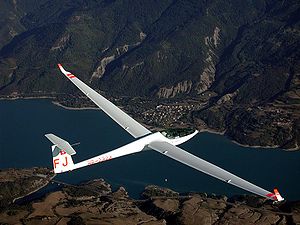
Gliding (flight)
Gliding flight is heavier-than-air flight without the use of thrust. It is employed by gliding animals and by aircraft such as gliders. The most common human application of gliding flight is in sport and recreation using aircraft designed for this purpose...
, though engine failure can force other types of aircraft to glide. Some gliders have engines for extending their flights and some have engines powerful enough to launch.
There are a wide variety of types differing in the construction of their wings, aerodynamic efficiency, location of the pilot and controls. Some may have power-plants to take off and/or extend flight. Some are designed simply to descend, but the most common varieties exploit meteorological phenomena to maintain or even gain height. Gliders are principally used for the air sports of gliding
Gliding
Gliding is a recreational activity and competitive air sport in which pilots fly unpowered aircraft known as gliders or sailplanes using naturally occurring currents of rising air in the atmosphere to remain airborne. The word soaring is also used for the sport.Gliding as a sport began in the 1920s...
, hang gliding
Hang gliding
Hang gliding is an air sport in which a pilot flies a light and unmotorized foot-launchable aircraft called a hang glider ....
and paragliding
Paragliding
Paragliding is the recreational and competitive adventure sport of flying paragliders: lightweight, free-flying, foot-launched glider aircraft with no rigid primary structure...
but are also used for recovering spacecraft
Spacecraft
A spacecraft or spaceship is a craft or machine designed for spaceflight. Spacecraft are used for a variety of purposes, including communications, earth observation, meteorology, navigation, planetary exploration and transportation of humans and cargo....
. Perhaps the most familiar type is the paper plane
Paper plane
A paper plane, paper aeroplane , paper airplane , paper glider, paper dart or dart is a toy aircraft, usually a glider made out of paper or paperboard; the practice of constructing paper planes is sometimes referred to as aerogami , after origami, the Japanese art of paper folding.-History:The...
.
Early attempts
Early pre-modern accounts of flight are in most cases sketchy and it is unclear whether each craft was a glider, kite or parachute and to what degree they were truly controllable. Often the event is only recorded at a great time interval after it allegedly took place. A 17th century account reports an attempt at flight by the 9th century poet Abbas Ibn FirnasAbbas Ibn Firnas
Abbas Ibn Firnas , also known as Abbas Qasim Ibn Firnas and عباس بن فرناس , was a Muslim Andalusian polymath: an inventor, engineer, aviator, physician, Arabic poet, and Andalusian musician. Of Berber descent, he was born in Izn-Rand Onda, Al-Andalus , and lived in the Emirate of Córdoba...
near Cordoba, Spain
Córdoba, Spain
-History:The first trace of human presence in the area are remains of a Neanderthal Man, dating to c. 32,000 BC. In the 8th century BC, during the ancient Tartessos period, a pre-urban settlement existed. The population gradually learned copper and silver metallurgy...
which ended in heavy back injuries. The monk Eilmer of Malmesbury
Eilmer of Malmesbury
Eilmer of Malmesbury was an 11th-century English Benedictine monk best known for his early attempt at a gliding flight using wings.- Life :...
is reported by William of Malmesbury
William of Malmesbury
William of Malmesbury was the foremost English historian of the 12th century. C. Warren Hollister so ranks him among the most talented generation of writers of history since Bede, "a gifted historical scholar and an omnivorous reader, impressively well versed in the literature of classical,...
(c. 1080-1143), a fellow monk and historian, to have flown off the roof of his Abbey in Malmesbury
Malmesbury Abbey
Malmesbury Abbey, at Malmesbury in Wiltshire, England, was founded as a Benedictine monastery around 676 by the scholar-poet Aldhelm, a nephew of King Ine of Wessex. In 941 AD, King Athelstan was buried in the Abbey. By the 11th century it contained the second largest library in Europe and was...
, England
England
England is a country that is part of the United Kingdom. It shares land borders with Scotland to the north and Wales to the west; the Irish Sea is to the north west, the Celtic Sea to the south west, with the North Sea to the east and the English Channel to the south separating it from continental...
, sometime between 1000 and 1010 AD, gliding about 200 metres (218.7 yd) before crashing and breaking his legs. Going by the sketchy reports, both used a set of (feathery) wings, and both blamed their crash on the lack of a tail.
19th century
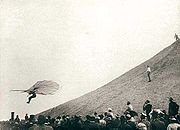
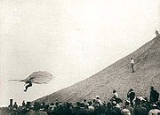
The first heavier-than-air (i.e. non-balloon) man-carrying aircraft that were based on published scientific principles were Sir George Cayley
George Cayley
Sir George Cayley, 6th Baronet was a prolific English engineer and one of the most important people in the history of aeronautics. Many consider him the first true scientific aerial investigator and the first person to understand the underlying principles and forces of flight...
's series of gliders which achieved brief wing-borne hops from around 1849. Thereafter gliders were built by pioneers such as Jean Marie Le Bris, John J. Montgomery
John J. Montgomery
John Joseph Montgomery was an aviation pioneer, inventor, professor at Santa Clara College.On August 28, 1883 he made the first manned, controlled, heavier-than-air flights of the United States, in the Otay Mesa area of San Diego, California...
, Otto Lilienthal
Otto Lilienthal
Otto Lilienthal was a German pioneer of human aviation who became known as the Glider King. He was the first person to make well-documented, repeated, successful gliding flights. He followed an experimental approach established earlier by Sir George Cayley...
, Percy Pilcher
Percy Pilcher
Percy Sinclair Pilcher was a British inventor and pioneer aviator who was his country's foremost experimenter in unpowered flight at the end of the 19th Century...
, Octave Chanute
Octave Chanute
Octave Chanute was a French-born American railway engineer and aviation pioneer. He provided the Wright brothers with help and advice, and helped to publicize their flying experiments. At his death he was hailed as the father of aviation and the heavier-than-air flying machine...
and Augustus Moore Herring
Augustus Moore Herring
Augustus Moore Herring was an American aviation pioneer, who flew a compressed-air powered aircraft in 1898, five years before the Wright Brothers made their own powered flight. It has been claimed that he was the first aviator of a motorized heavier-than-air aircraft.-Biography:Herring was born...
to develop aviation
Aviation
Aviation is the design, development, production, operation, and use of aircraft, especially heavier-than-air aircraft. Aviation is derived from avis, the Latin word for bird.-History:...
. Lilienthal was the first to make repeated successful flights (eventually totaling over 2,000) and was the first to use rising air to prolong his flight.
The Wright Brothers
Wright brothers
The Wright brothers, Orville and Wilbur , were two Americans credited with inventing and building the world's first successful airplane and making the first controlled, powered and sustained heavier-than-air human flight, on December 17, 1903...
developed a series of three manned gliders after preliminary tests with a kite
Kite
A kite is a tethered aircraft. The necessary lift that makes the kite wing fly is generated when air flows over and under the kite's wing, producing low pressure above the wing and high pressure below it. This deflection also generates horizontal drag along the direction of the wind...
as they worked towards achieving powered flight. They returned to glider testing in 1911 by removing the motor from one of their later designs.
Development of gliders
After World War IWorld War I
World War I , which was predominantly called the World War or the Great War from its occurrence until 1939, and the First World War or World War I thereafter, was a major war centred in Europe that began on 28 July 1914 and lasted until 11 November 1918...
recreational gliders
Glider (sailplane)
A glider or sailplane is a type of glider aircraft used in the sport of gliding. Some gliders, known as motor gliders are used for gliding and soaring as well, but have engines which can, in some cases, be used for take-off or for extending a flight...
were built in Germany (see link to Rhön-Rossitten Gesellschaft
Rhön-Rossitten Gesellschaft
The Rhön-Rossitten Gesellschaft or Rhön-Rossitten Society was a German gliding organization, the first one in the world that was officially recognised...
) and in the United States (Schweizer brothers
Schweizer brothers
Paul, William , and Ernest Schweizer were three brothers who started building gliders in 1930. In 1937, they formed the Schweizer Metal Aircraft Company. Their first commercial glider sale was an SGU 1-7 glider to Harvard University's Altosaurus Glider Club. At that time, Eliot Noyes was a...
). The sporting use of gliders rapidly evolved in the 1930s and is now the main application. As their performance improved gliders began to be used to fly cross-country and now regularly fly hundreds or even thousands of kilometers in a day, if the weather is suitable.
Military glider
Military glider
Military gliders have been used by the military of various countries for carrying troops and heavy equipment to a combat zone, mainly during the Second World War. These engineless aircraft were towed into the air and most of the way to their target by military transport planes, e.g...
s were developed during World War II
World War II
World War II, or the Second World War , was a global conflict lasting from 1939 to 1945, involving most of the world's nations—including all of the great powers—eventually forming two opposing military alliances: the Allies and the Axis...
by a number of countries for landing troops. A glider - the Colditz Cock
Colditz Cock
|-See also:-External links:*****...
- was even built secretly by POWs
Prisoner of war
A prisoner of war or enemy prisoner of war is a person, whether civilian or combatant, who is held in custody by an enemy power during or immediately after an armed conflict...
as a potential escape method at Oflag IV-C near the end of the war in 1944.
Development of flexible-wing hang gliders
Foot-launched aircraft had been flown by Lilienthal and at the meetings at WasserkuppeWasserkuppe
The Wasserkuppe is a high plateau , the highest peak in the Rhön Mountains within the German state of Hessen. Between the first and second World Wars, during the era of the so-called Golden Age of Aviation, great advances in sailplane development were made there.Remark: The German wording takes its...
in the 1920s. However the innovation that led to modern hang gliders was in 1951 when Francis Rogallo
Francis Rogallo
Francis Melvin Rogallo was an American aeronautical engineer inventor born in Sanger, California, U.S.A.; he is credited with the invention of the Rogallo wing, or "flexible wing", a precursor to the modern hang glider and paraglider...
and Gertrude Rogallo applied for a patent for a fully flexible wing with a stiffening structure. The American space agency NASA
NASA
The National Aeronautics and Space Administration is the agency of the United States government that is responsible for the nation's civilian space program and for aeronautics and aerospace research...
began testing in various flexible and semi-rigid configurations of this Rogallo wing
Rogallo wing
The Rogallo wing is a flexible type of airfoil. In 1948, Gertrude Rogallo, and her husband Francis Rogallo, a NASA engineer, invented a self-inflating flexible wing they called the Parawing, also known after them as the "Rogallo Wing" and flexible wing...
in 1957 in order to use it as a recovery system for the Gemini space capsule
Space capsule
A space capsule is an often manned spacecraft which has a simple shape for the main section, without any wings or other features to create lift during atmospheric reentry....
s. Charles Richards
Charles Richards (NASA engineer)
Designer engineer Charles Richard used data from NASA research over Francis Rogallo's mechanical inventions to produce a wing configuration for manned hung-pilot kite-gliders that was to be found copied only with slight ornamental variation in a decade of hang gliders. Richards was of the Flight...
and Paul Bikle
Paul Bikle
Paul F. Bikle Director of the U.S. National Aeronautics and Space Administration Dryden Flight Research Facility from 1959 until 1971, and author of more than 40 technical publications, has been associated with major aeronautical research programs including the supersonic X-15 rocket plane, and...
developed the concept producing a wing that was simple to build which was capable of slow flight and as gentle landing. Between 1960-1962 Barry Hill Palmer
Barry Hill Palmer
Barry Hill Palmer is an American aeronautical engineer , inventor, builder and pilot of the first hang glider based on the Rogallo wing or flexible wing...
used this concept to make foot-launched hang gliders, followed in 1963 by Mike Burns who built a kite-hang glider called Skiplane. In 1963, John W. Dickenson
John W. Dickenson
John Wallace Dickenson is an Australian inventor, who developed some liquid flow measuring devices and designed the most successful hang glider configuration.- The Ski Wing :...
began commercial production.
Development of paragliders
January 10, 1963 American Domina JalbertDomina Jalbert
Domina Jalbert invented the ram-air inflated flexible wing often called the "Jalbert parafoil".-Life:Settling into Boca Raton, Florida, after arriving from Quebec, Canada, he established his business Aerology....
filed a patent US Patent 3131894 on the Parafoil
Parafoil
A parafoil is a nonrigid airfoil with an aerodynamic cell structure which is inflated by the wind. Ram-air inflation forces the parafoil into a classic wing cross-section. Parafoils are most commonly constructed out of ripstop nylon....
which had sectioned cells in an aerofoil
Airfoil
An airfoil or aerofoil is the shape of a wing or blade or sail as seen in cross-section....
shape; an open leading edge and a closed trailing edge, inflated by passage through the air – the ram-air design. The 'Sail Wing' was developed further for recovery of NASA
NASA
The National Aeronautics and Space Administration is the agency of the United States government that is responsible for the nation's civilian space program and for aeronautics and aerospace research...
space capsules by David Barish. Testing was done by using ridge lift
Ridge lift
Ridge lift is created when a wind strikes an obstacle, usually a mountain ridge or cliff, that is large and steep enough to deflect the wind upward....
. After tests on Hunter Mountain, New York
New York
New York is a state in the Northeastern region of the United States. It is the nation's third most populous state. New York is bordered by New Jersey and Pennsylvania to the south, and by Connecticut, Massachusetts and Vermont to the east...
in September 1965, he went on to promote ‘slope soaring’ as a summer activity for ski resorts (apparently without great success). NASA originated the term ‘paraglider’ in the early 1960s, and ‘paragliding’ was first used in the early 1970s to describe foot-launching of gliding parachutes. Although their use is mainly recreational, unmanned paragliders have also been built for military applications e.g. Atair Insect
Atair Insect
The Atair Insect is a powered paraglider in the mode of unmanned aerial vehicle by Atair Aerospace Inc.The company showcased its LEAPP technology in 2006 at the Association of the United States Army Annual Meeting and Exposition.-Design:...
.
Recreational types
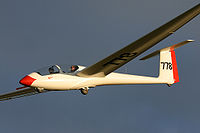
The main application today of glider aircraft is sport and recreation.Glider (sailplane)
Lift-to-drag ratio
In aerodynamics, the lift-to-drag ratio, or L/D ratio, is the amount of lift generated by a wing or vehicle, divided by the drag it creates by moving through the air...
. These allowed longer glides to the next source of 'lift
Lift (soaring)
Gliding flight is heavier-than-air flight without the use of thrust. It is employed by gliding animals and by aircraft such as gliders. The most common human application of gliding flight is in sport and recreation using aircraft designed for this purpose...
', and so increase their chances of flying long distances. This gave rise to the popular sport known as gliding
Gliding
Gliding is a recreational activity and competitive air sport in which pilots fly unpowered aircraft known as gliders or sailplanes using naturally occurring currents of rising air in the atmosphere to remain airborne. The word soaring is also used for the sport.Gliding as a sport began in the 1920s...
although the term can also be used to refer to merely descending flight.
Gliders were mainly built of wood and metal but the majority now have composite materials using glass, carbon fibre and aramid
Aramid
Aramid fibers are a class of heat-resistant and strong synthetic fibers. They are used in aerospace and military applications, for ballistic rated body armor fabric and ballistic composites, in bicycle tires, and as an asbestos substitute. The name is a portmanteau of "aromatic polyamide"...
fibres. To minimise drag, these types have a fuselage
Fuselage
The fuselage is an aircraft's main body section that holds crew and passengers or cargo. In single-engine aircraft it will usually contain an engine, although in some amphibious aircraft the single engine is mounted on a pylon attached to the fuselage which in turn is used as a floating hull...
and long narrow wings, i.e. a high aspect ratio. Both single-seat and two-seat gliders are available.
Initially training was done by short 'hops' in primary glider
Primary glider
Primary gliders are a category of aircraft that enjoyed worldwide popularity during the 1920s and 1930s as people strove for simple and inexpensive ways to learn to fly....
s which are very basic aircraft with no cockpit and minimal instruments. Since shortly after World War II
World War II
World War II, or the Second World War , was a global conflict lasting from 1939 to 1945, involving most of the world's nations—including all of the great powers—eventually forming two opposing military alliances: the Allies and the Axis...
training has always been done in two-seat dual control gliders, but high performance two-seaters are also used to share the workload and the enjoyment of long flights. Originally skids were used for landing, but the majority now land on wheels, often retractable. Some gliders, known as motor glider
Motor glider
A motor glider is a fixed-wing aircraft that can be flown with or without engine power. The FAI Gliding Commission Sporting Code definition is: A fixed wing aerodyne equipped with a means of propulsion ,...
s, are designed for unpowered flight, but can deploy piston, rotary
Rotary engine
The rotary engine was an early type of internal-combustion engine, usually designed with an odd number of cylinders per row in a radial configuration, in which the crankshaft remained stationary and the entire cylinder block rotated around it...
, jet
Jet engine
A jet engine is a reaction engine that discharges a fast moving jet to generate thrust by jet propulsion and in accordance with Newton's laws of motion. This broad definition of jet engines includes turbojets, turbofans, rockets, ramjets, pulse jets...
or electric engines
Electric motor
An electric motor converts electrical energy into mechanical energy.Most electric motors operate through the interaction of magnetic fields and current-carrying conductors to generate force...
. Gliders are classified by the FAI
Fédération Aéronautique Internationale
The Fédération Aéronautique Internationale is the world governing body for air sports and aeronautics and astronautics world records. Its head office is in Lausanne, Switzerland. This includes man-carrying aerospace vehicles from balloons to spacecraft, and unmanned aerial vehicles...
for competitions into glider competition classes
Glider Competition Classes
Competition classes in gliding, as in other sports, mainly exist to ensure fairness in competition. However the classes have not been targeted at fostering technological development as in other sports...
mainly on the basis of span and flaps.
A class of ultralight sailplanes, including some known as microlift glider
Microlift glider
Microlift gliders are recreational gliders that are able to exploit lifting forces weaker than the conventional lift used in traditional gliding. These weak lift conditions are called microlift.-Classification:...
s and some as 'airchairs', has been defined by the FAI based on a maximum weight. They are light enough to be transported easily, and can be flown without licensing in some countries. Ultralight gliders have performance similar to hang gliders
Hang gliding
Hang gliding is an air sport in which a pilot flies a light and unmotorized foot-launchable aircraft called a hang glider ....
, but offer some additional crash safety as the pilot can be strapped in an upright seat within a deformable structure. Landing is usually on one or two wheels which distinguishes these craft from hang gliders. Several commercial ultralight gliders have come and gone, but most current development is done by individual designers and home builders.
Hang gliders

Unlike a sailplane, a hang glider is capable of being carried, foot launched and landed solely by the use of the pilot’s legs.
- In the original and still most common designs, Class 1, the pilot is suspended from the center of the flexible wing and controls the aircraft by shifting his/her weight.
- Class 2 (designated by the FAIFédération Aéronautique InternationaleThe Fédération Aéronautique Internationale is the world governing body for air sports and aeronautics and astronautics world records. Its head office is in Lausanne, Switzerland. This includes man-carrying aerospace vehicles from balloons to spacecraft, and unmanned aerial vehicles...
as Sub-Class O-2) have a rigid primary structure with movable aerodynamic surfaces, such as spoilerSpoiler (aeronautics)In aeronautics, a spoiler is a device intended to reduce lift in an aircraft. Spoilers are plates on the top surface of a wing which can be extended upward into the airflow and spoil it. By doing so, the spoiler creates a carefully controlled stall over the portion of the wing behind it, greatly...
s, as the primary method of control. The pilot is often enclosed by means of a fairing. These offer the best performance and are the most expensive. - Class 4 hang gliders are unable to demonstrate consistent ability to safely take-off and/or land in nil-wind conditions, but otherwise are capable of being launched and landed by the use of the pilot's legs.
- Class 5 hang gliders have a rigid primary structure with movable aerodynamic surfaces as the primary method of control and can safely take-off and land in nil-wind conditions. No pilot fairings are permitted.
In a hang glider the shape of the wing is determined by a structure, and it is this that distinguishes them from the other main type of foot-launched aircraft, paragliders, technically Class 3. Some hang gliders have engines, and are known as powered hang glider
Powered Hang Glider
A foot-launched powered hang glider , also called powered harness, nanolight, or hangmotor, is a powered hang glider harness with a motor and propeller in pusher configuration...
s. Due to their commonality of parts, construction and design, they are usually considered by aviation authorities to be hang gliders, even though they may use the engine for the entire flight. Some flexible wing powered aircraft, Ultralight trikes, have a wheeled undercarriage, and so are not hang gliders.
Paragliders
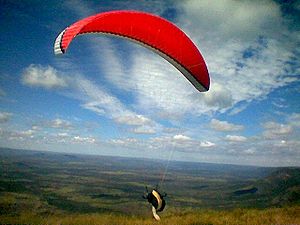
A paraglider as used in sport paragliding is a free-flying, foot-launched aircraft. The pilot sits in a harness suspended below a fabric wing. Unlike a hang glider whose wings have frames, the shape of a paraglider's wing is formed by its suspension lines and the pressure of air entering vents in the front of the wing. The concept of ram-air inflated wings has been refined so that the best of these have a glide ratio of 10 at 45 km/h (28 mph). Like sailplanes and hang gliders, paragliders use rising air to gain height and this process is the basis for most recreational flights and competitions, though aerobatics and 'spot landing competitions' also occur. Launching is often by stepping from a slope, but winch launches are also used. Paramotor
Paramotor
Paramotor is a generic name for the propulsive portion of a powered paraglider . It consists of a frame that combines the motor, propeller, harness and cage...
s are attached to some types which are known as powered paragliders
Powered paragliding
Powered paragliding, also known as paramotoring, is a form of ultralight aviation where the pilot wears a motor on his or her back which provides enough thrust to take off using an adapted paraglider or paramotor wing...
. These in turn have spawned paraplanes, which are wheeled and motorized but which still use ram-air wings.
Military gliders
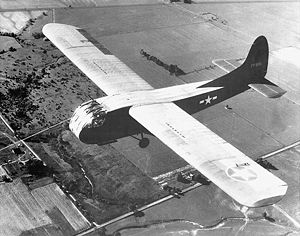
World War II
World War II, or the Second World War , was a global conflict lasting from 1939 to 1945, involving most of the world's nations—including all of the great powers—eventually forming two opposing military alliances: the Allies and the Axis...
for carrying troops and heavy equipment (see Glider infantry
Glider infantry
Glider infantry was a type of airborne infantry in which soldiers and their equipment were inserted into enemy controlled territory via military glider rather than parachute...
) to a combat zone. These aircraft were towed into the air and most of the way to their target by military transport planes, e.g. C-47 Dakota
C-47 Skytrain
The Douglas C-47 Skytrain or Dakota is a military transport aircraft that was developed from the Douglas DC-3 airliner. It was used extensively by the Allies during World War II and remained in front line operations through the 1950s with a few remaining in operation to this day.-Design and...
, or by bombers that had been relegated to secondary activities, e.g. Short Stirling
Short Stirling
The Short Stirling was the first four-engined British heavy bomber of the Second World War. The Stirling was designed and built by Short Brothers to an Air Ministry specification from 1936, and entered service in 1941...
. Once released from the tow near the target, they landed on as close to target as possible. The advantage over paratroopers were that heavy equipment could be landed and that the troops were quickly assembled rather than being dispersed over a drop zone. The gliders were treated as disposable leading to construction from common and inexpensive materials such as wood, though a few were retrieved and re-used. By the time of the Korean War, transport aircraft had also become larger and more efficient so that even light tanks could be dropped by parachute, causing gliders to fall out of favor.
Research aircraft

Unpowered flying wing
Flying wing
A flying wing is a tailless fixed-wing aircraft which has no definite fuselage, with most of the crew, payload and equipment being housed inside the main wing structure....
s are another type of aircraft that have been built for aerodynamic research. Examples are the Horten
Horten brothers
Walter Horten and Reimar Horten , sometimes credited as the Horten Brothers, were German aircraft pilots and enthusiasts, and members of the Hitler Youth and Nazi party...
flying wing
Flying wing
A flying wing is a tailless fixed-wing aircraft which has no definite fuselage, with most of the crew, payload and equipment being housed inside the main wing structure....
s, the scaled glider version of the Armstrong Whitworth A.W.52
Armstrong Whitworth A.W.52
-See also:- External links :*** at *...
jet powered flying wing and the Baynes Bat
Baynes Bat
|-See also:-References:* *...
(to give information for a planned military glider).
In contrast to the flying wings, lifting bodies
Lifting body
A lifting body is a fixed-wing aircraft configuration in which the body itself produces lift. In contrast to a flying wing, which is a wing with minimal or no conventional fuselage, a lifting body can be thought of as a fuselage with little or no conventional wing...
have been also developed using unpowered prototypes. Although the idea can be dated to Vincent Justus Burnelli in 1921, interest increased as an alternative for returning spacecraft. Traditional space capsules have very little control over where they land, whereas a steerable craft using wings would have more options. The lifting bodies use the fuselage itself to generate lift
Lift (force)
A fluid flowing past the surface of a body exerts a surface force on it. Lift is the component of this force that is perpendicular to the oncoming flow direction. It contrasts with the drag force, which is the component of the surface force parallel to the flow direction...
without employing the usual thin and flat wing. The objective of the lifting body is to minimize the drag and structure of a wing for very high supersonic
Supersonic
Supersonic speed is a rate of travel of an object that exceeds the speed of sound . For objects traveling in dry air of a temperature of 20 °C this speed is approximately 343 m/s, 1,125 ft/s, 768 mph or 1,235 km/h. Speeds greater than five times the speed of sound are often...
or hypersonic
Hypersonic
In aerodynamics, a hypersonic speed is one that is highly supersonic. Since the 1970s, the term has generally been assumed to refer to speeds of Mach 5 and above...
flight as might be experienced during the re-entry
Re-Entry
"Re-Entry" was the second album released by UK R&B / Hip Hop collective Big Brovaz. After the album was delayed in May 2006, the band finally release the follow-up to "Nu Flow" on 9 April 2007...
of a spacecraft
Spacecraft
A spacecraft or spaceship is a craft or machine designed for spaceflight. Spacecraft are used for a variety of purposes, including communications, earth observation, meteorology, navigation, planetary exploration and transportation of humans and cargo....
. This can be compared with a flying wing that seeks to minimise drag at subsonic speeds by eliminating non-lifting surfaces. Examples of type are the Northrop HL-10
Northrop HL-10
The Northrop HL-10 was one of five heavyweight lifting body designs flown at NASA's Flight Research Center , Edwards, California, from July 1966 to November 1975 to study and validate the concept of safely maneuvering and landing a low lift-over-drag vehicle designed for reentry from space...
and Martin-Marietta X-24.
Rocket gliders
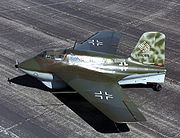
Rocket-powered aircraft consume their fuel quickly, and so most must land unpowered, unless there is another type of engine. The first was the Lippisch Ente. Later examples include the Messerschmitt Me 163
Messerschmitt Me 163
The Messerschmitt Me 163 Komet, designed by Alexander Lippisch, was a German rocket-powered fighter aircraft. It is the only rocket-powered fighter aircraft ever to have been operational. Its design was revolutionary, and the Me 163 was capable of performance unrivaled at the time. Messerschmitt...
rocket-powered interceptor. The American series of research aircraft starting with the Bell X-1
Bell X-1
The Bell X-1, originally designated XS-1, was a joint NACA-U.S. Army/US Air Force supersonic research project built by Bell Aircraft. Conceived in 1944 and designed and built over 1945, it eventually reached nearly 1,000 mph in 1948...
in 1946 up to the North American X-15
North American X-15
The North American X-15 rocket-powered aircraft/spaceplane was part of the X-series of experimental aircraft, initiated with the Bell X-1, that were made for the USAAF/USAF, NACA/NASA, and the USN. The X-15 set speed and altitude records in the early 1960s, reaching the edge of outer space and...
spent more time flying unpowered than under power. In the 1960s research was also done on unpowered lifting bodies and on the X-20 Dyna-Soar
X-20 Dyna-Soar
The X-20 Dyna-Soar was a United States Air Force program to develop a spaceplane that could be used for a variety of military missions, including reconnaissance, bombing, space rescue, satellite maintenance, and sabotage of enemy satellites...
project, but although the X20 was cancelled, this research eventually led to the Space Shuttle.
On April 12, 1981, the Space Shuttle orbiter
Space Shuttle Orbiter
The Space Shuttle orbiter was the orbital spacecraft of the Space Shuttle program operated by NASA, the space agency of the United States. The orbiter was a reusable winged "space-plane", a mixture of rockets, spacecraft, and aircraft...
first flew. The Shuttle re-entered at Mach
Mach number
Mach number is the speed of an object moving through air, or any other fluid substance, divided by the speed of sound as it is in that substance for its particular physical conditions, including those of temperature and pressure...
25 at the end of each spaceflight
Spaceflight
Spaceflight is the act of travelling into or through outer space. Spaceflight can occur with spacecraft which may, or may not, have humans on board. Examples of human spaceflight include the Russian Soyuz program, the U.S. Space shuttle program, as well as the ongoing International Space Station...
, and landed entirely as a glider. As with Buran the shuttles represented by far the fastest type of aircraft of all time. The latest examples of rocket glider are the privately funded SpaceshipOne which is intended for sub-orbital flight and the XCOR EZ-Rocket
XCOR EZ-Rocket
The XCOR EZ-Rocket is a test platform for the XCOR rocket propulsion system. The plane is a modified Rutan Long-EZ, with the propeller replaced by first one, then a pair of pressure-fed regeneratively cooled liquid-fuelled rocket engines and an underslung rocket-fuel tank. The engines are...
which is being used to test engines.
Rotary wing
Most unpowered rotary-wing aircraftRotorcraft
A rotorcraft or rotary wing aircraft is a heavier-than-air flying machine that uses lift generated by wings, called rotor blades, that revolve around a mast. Several rotor blades mounted to a single mast are referred to as a rotor. The International Civil Aviation Organization defines a rotorcraft...
are kites rather than gliders, i.e. they are usually towed behind a car or boat rather than being capable of free flight. These are known as rotor kite
Rotor kite
A rotor kite or gyroglider is an unpowered, rotary-wing aircraft. Like an autogyro or helicopter, it relies on lift created by one or more sets of rotors in order to fly...
s. However rotary-winged gliders, 'gyrogliders', were investigated that could descend like an autogyro
Autogyro
An autogyro , also known as gyroplane, gyrocopter, or rotaplane, is a type of rotorcraft which uses an unpowered rotor in autorotation to develop lift, and an engine-powered propeller, similar to that of a fixed-wing aircraft, to provide thrust...
or helicopter
Helicopter
A helicopter is a type of rotorcraft in which lift and thrust are supplied by one or more engine-driven rotors. This allows the helicopter to take off and land vertically, to hover, and to fly forwards, backwards, and laterally...
, using the lift
Lift (force)
A fluid flowing past the surface of a body exerts a surface force on it. Lift is the component of this force that is perpendicular to the oncoming flow direction. It contrasts with the drag force, which is the component of the surface force parallel to the flow direction...
from rotors
Helicopter rotor
A helicopter main rotor or rotor system is a type of fan that is used to generate both the aerodynamic lift force that supports the weight of the helicopter, and thrust which counteracts aerodynamic drag in forward flight...
to reduce the vertical speed. These were evaluated as a method of dropping people or equipment from other aircraft.
Paper airplane
A paper plane, paper aeroplane (UK), paper airplane (US), paper glider, paper dart or dart is a toy aircraft (usually a glider) made out of paper or paperboard; the practice of constructing paper planes is sometimes referred to as aerogami (Japanese: kamihikōki), after origami, the Japanese art of paper folding.Model gliders
Model glider aircraft are flying or non-flying models of existing or imaginary aircraftAircraft
An aircraft is a vehicle that is able to fly by gaining support from the air, or, in general, the atmosphere of a planet. An aircraft counters the force of gravity by using either static lift or by using the dynamic lift of an airfoil, or in a few cases the downward thrust from jet engines.Although...
, often scaled-down versions of full size planes, using lightweight materials such as polystyrene
Polystyrene
Polystyrene ) also known as Thermocole, abbreviated following ISO Standard PS, is an aromatic polymer made from the monomer styrene, a liquid hydrocarbon that is manufactured from petroleum by the chemical industry...
, balsa wood
Wood
Wood is a hard, fibrous tissue found in many trees. It has been used for hundreds of thousands of years for both fuel and as a construction material. It is an organic material, a natural composite of cellulose fibers embedded in a matrix of lignin which resists compression...
, foam
Foam
-Definition:A foam is a substance that is formed by trapping gas in a liquid or solid in a divided form, i.e. by forming gas regions inside liquid regions, leading to different kinds of dispersed media...
and fibreglass. Designs range from simple glider aircraft, to accurate scale model
Scale model
A scale model is a physical model, a representation or copy of an object that is larger or smaller than the actual size of the object, which seeks to maintain the relative proportions of the physical size of the original object. Very often the scale model is used as a guide to making the object in...
s, some of which can be very large.
Model glider aircraft are models of existing or imaginary gliders, often scaled-down versions of full size planes, using lightweight materials such as polystyrene
Polystyrene
Polystyrene ) also known as Thermocole, abbreviated following ISO Standard PS, is an aromatic polymer made from the monomer styrene, a liquid hydrocarbon that is manufactured from petroleum by the chemical industry...
, balsa wood
Wood
Wood is a hard, fibrous tissue found in many trees. It has been used for hundreds of thousands of years for both fuel and as a construction material. It is an organic material, a natural composite of cellulose fibers embedded in a matrix of lignin which resists compression...
, foam
Foam
-Definition:A foam is a substance that is formed by trapping gas in a liquid or solid in a divided form, i.e. by forming gas regions inside liquid regions, leading to different kinds of dispersed media...
and fibreglass. Larger outdoor models are usually radio-controlled glider
Radio-controlled glider
A radio-controlled glider is a type of radio-controlled aircraft that normally does not have any form of propulsion. They are able to sustain continuous flight by exploiting the lift produced by slopes and thermals, controlled remotely from the ground with a transmitter...
s that are piloted remotely from the ground with a transmitter
Transmitter
In electronics and telecommunications a transmitter or radio transmitter is an electronic device which, with the aid of an antenna, produces radio waves. The transmitter itself generates a radio frequency alternating current, which is applied to the antenna. When excited by this alternating...
. These can remain airborne for extended periods by using the lift produced by slopes and thermal
Thermal
A thermal column is a column of rising air in the lower altitudes of the Earth's atmosphere. Thermals are created by the uneven heating of the Earth's surface from solar radiation, and are an example of convection. The sun warms the ground, which in turn warms the air directly above it...
s. These can be winched into wind by a line attached to a hook under the fuselage with a ring, so that the line will drop when the model is overhead. Other methods of launching include towing aloft using a model powered aircraft, catapult-launching using an elastic bungee cord
Bungee cord
A bungee cord , also known as a shock cord, is an elastic cord composed of one or more elastic strands forming a core, usually covered in a woven cotton or polypropylene sheath...
and hand-launching. When hand-launching the newer "discus" style of wing-tip hand-launching has largely supplanted the earlier "javelin" type of launch.
Flying bombs
Glide bombGlide bomb
A glide bomb is an aerial bomb modified with aerodynamic surfaces to modify its flight path from a purely ballistic one to a flatter, gliding, one. This extends the range between the launch aircraft and the target. Glide bombs are often fitted with control systems, allowing the controlling aircraft...
s are bombs with aerodynamic surfaces to allow a gliding flightpath rather than a ballistic one. This increases the protection of the carrying aircraft that is attacking a heavily defended target. Remote control systems allow the carrying aircraft to direct the bomb to the target. These were developed in Germany from as early as 1915. In World War II
World War II
World War II, or the Second World War , was a global conflict lasting from 1939 to 1945, involving most of the world's nations—including all of the great powers—eventually forming two opposing military alliances: the Allies and the Axis...
they were most successful as anti-shipping weapons. Some air forces today are equipped with gliding devices that can remotely attack airbases with a cluster bomb
Cluster bomb
A cluster munition is a form of air-dropped or ground-launched explosive weapon that releases or ejects smaller sub-munitions. Commonly, this is a cluster bomb that ejects explosive bomblets that are designed to kill enemy personnel and destroy vehicles...
warhead.
See also
- FlightFlightFlight is the process by which an object moves either through an atmosphere or beyond it by generating lift or propulsive thrust, or aerostatically using buoyancy, or by simple ballistic movement....
- Unpowered aircraft
- Underwater glider
- BoomerangBoomerangA boomerang is a flying tool with a curved shape used as a weapon or for sport.-Description:A boomerang is usually thought of as a wooden device, although historically boomerang-like devices have also been made from bones. Modern boomerangs used for sport are often made from carbon fibre-reinforced...