
All Topics  
Helicopter rotor

 
Helicopter Rotor

   Email Print
   Bookmark   Link


Helicopter rotor


A helicopter rotor is the rotating part of a helicopter
Helicopter

A helicopter is an aircraft that is Lift and propelled by one or more horizontal plane Helicopter rotors, each rotor consisting of two or more rotor blades....
 which controls the blades that produce the aerodynamic Lift (force)
Lift (force)

In the context of a fluid flow relative to a body, the lift force is the Vector #Vector components of the aerodynamic force that is perpendicular to the oncoming flow direction....
 for the helicopter. The helicopter rotor, also called the rotor system, usually refers to the helicopter's main rotor which is mounted on a vertical mast over the top of the helicopter, although it can refer to the helicopter's tail rotor
Tail rotor

The tail rotor of a helicopter is mounted on the tail of a traditional single-rotor helicopter, close to perpendicular to the Helicopter rotor....
 as well. A helicopter's rotor is generally made up of two or more rotor blades, although several earlier helicopters had a rotor with a single main rotor blade.


Discussion
Ask a question about 'Helicopter rotor'
Start a new discussion about 'Helicopter rotor'
Answer questions from other users
Full Discussion Forum


Encyclopedia


A helicopter rotor is the rotating part of a helicopter
Helicopter

A helicopter is an aircraft that is Lift and propelled by one or more horizontal plane Helicopter rotors, each rotor consisting of two or more rotor blades....
 which controls the blades that produce the aerodynamic Lift (force)
Lift (force)

In the context of a fluid flow relative to a body, the lift force is the Vector #Vector components of the aerodynamic force that is perpendicular to the oncoming flow direction....
 for the helicopter. The helicopter rotor, also called the rotor system, usually refers to the helicopter's main rotor which is mounted on a vertical mast over the top of the helicopter, although it can refer to the helicopter's tail rotor
Tail rotor

The tail rotor of a helicopter is mounted on the tail of a traditional single-rotor helicopter, close to perpendicular to the Helicopter rotor....
 as well. A helicopter's rotor is generally made up of two or more rotor blades, although several earlier helicopters had a rotor with a single main rotor blade. The main rotor provides both lift
Lift (force)

In the context of a fluid flow relative to a body, the lift force is the Vector #Vector components of the aerodynamic force that is perpendicular to the oncoming flow direction....
 and thrust
Thrust

Thrust is a reaction force described quantitatively by Isaac Newton's Newton's laws of motion. When a system expels or acceleration mass in one direction the accelerated mass will cause a proportional but opposite force on that system....
, while the tail rotor provides thrust to compensate for the main rotor's torque
Torque

Torque is the tendency of a force to rotate an object about an axis . Just as a force is a push or a pull, a torque can be thought of as a twist....
.

History and development


Before the development of powered helicopters in the mid 20th century, autogyro
Autogyro

An autogyro is a type of rotorcraft invented by Juan de la Cierva in 1919, making its first successful flight on 9 January 1923, at Cuatro Vientos Airfield in Madrid....
 pioneer Juan de la Cierva
Juan de la Cierva

Juan De la Cierva was a Spain Civil Engineer and pilot. His most famous accomplishment was the invention in 1920 of the Autogiro, a single-rotor type of aircraft that came to be called autogyro in the English language....
 researched and developed many of the fundamentals of the rotor. Cierva is credited with successful development of multi-bladed, fully articulated rotor systems. This type of system is widely used today in many multi-bladed helicopters.

In the 1930s, Arthur Young
Arthur M. Young

Arthur Middleton Young was an American inventor, helicopter pioneer, cosmologist, philosopher and author. Young was the designer of Bell Helicopter's first helicopter, the Model 30, and inventor of the stabilizer bar used on many of Bell's early helicopter designs....
 improved stability of two bladed rotor systems with the introduction of a stabilizer bar. This system was used in several Bell and Hiller helicopter models. It is also used in many remote control model helicopters.

Rotor head design


The rotor head is a robust hub with attachment points for the blades and mechanical linkages designed to control the pitch of the blades.

Parts and functions


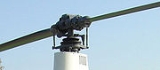
Robinson Rotorhead
The simple rotor of a Robinson R22
Robinson R22

The Robinson R22 is two-bladed, single-engine light utility helicopter manufactured by Robinson Helicopter. The two-seat R22 was designed in 1973 by Frank D....
 showing (from the top):
  • The following are driven by the link rods from the rotating part of the swashplate
    Swashplate (helicopter)

    A swashplate is a device that translates the Aviator's commands via the helicopter flight controls into motion of the main rotor blades. Because the main rotor blades are spinning, the swashplate is used to transmit three of the pilot's commands from the non-rotating fuselage to the rotating rotor hub and mainblades....
    .
    • Pitch hinges, allowing the blades to twist about the axis extending from blade root to blade tip.
  • Teeter hinge, allowing one blade to rise vertically while the other falls vertically. This motion occurs whenever translational relative wind is present, or in response to a cyclic control input.
  • Scissor link and counterweight, carries the main shaft rotation down to the upper swashplate
  • Rubber covers protect moving and stationary shafts
  • Swashplates, transmitting cyclic and collective pitch to the blades (the top one rotates)
  • Three non-rotating control rods transmit pitch information to the lower swashplate
  • Main mast leading down to main gearbox

Swash plate


The pitch of main rotor blades can be varied cyclically throughout its rotation in order to control the direction of rotor thrust vector. Collective pitch is used to vary the magnitude of rotor thrust. These blade pitch variations are controlled by tilting and/or raising or lowering the swash plate with the flight controls.

The swash plate is two concentric disks or plates, one plate rotates with the mast, connected by idle links, while the other does not rotate. The rotating plate is also connected to the individual blades through pitch links and pitch horns. The non-rotating plate is connected to links which are manipulated by pilot controls, specifically, the collective and cyclic controls.

The swash plate can shift vertically and tilt. Through shifting and tilting, the non-rotating plate controls the rotating plate, which in turn controls the individual blade pitch.

Fully articulated rotors


During the development of the autogyro, Juan de la Cierva built scale models to test his designs. After promising results, he built full size models. Just prior to takeoff, his autogyro rolled unexpectedly and was destroyed. Believing this to have been caused by sudden wind gusts, Cierva rebuilt it only to suffer an almost identical accident. These setbacks caused Cierva to consider why his models flew successfully, while the full-sized aircraft did not.

Cierva realized that the advancing blade on one side created greater lift than on the retreating side due to increased airspeed on the advancing side which creates a rolling force. The scale model was constructed with flexible materials, specifically rattan
Rattan

Rattan , is the name for the roughly 600 species of Arecaceae in the tribe Calameae, native to tropical regions of Africa, Asia and Australasia....
, which eliminated the rolling moment as the blades flapped, and compensated for dissymmetry of lift
Dissymmetry of lift

Dissymmetry of lift in helicopter aerodynamics refers to an uneven amount of Lift on opposite sides of the Helicopter rotor disc. It is a phenomenon that affects single-rotor helicopters in lateral flight, whether the direction of flight be forwards, sideways or in reverse....
. Cierva concluded that the full size steel rotor hub was far too rigid and introduced flapping hinges at the rotor hub.

Flapping hinges solved the rolling problem, but introduced lateral hub stresses as the blade center of mass moved as the blades flapped. Due to conservation of angular momentum
Angular momentum

In physics, the angular momentum of a particle about an origin is a vector quantity related to rotation, equal to the mass of the particle multiplied by the cross product of the position vector of the particle with its velocity vector....
, the blades accelerate and decelerate as their center of mass moves inward and outward, like a twirling ice skater. Cierva later added lead-lag hinges to reduce lateral stresses.

Semi-rigid rotor

The British Westland Lynx
Westland Lynx

The Westland Lynx is a British helicopter designed by and built Westland Helicopters at its factory in Yeovil. Originally intended as a utility craft for both civil and naval usage, military interest led to the development of both battlefield and naval variants, which went into operational usage in 1977 and were later adopted by the armed for...
 has a semi-rigid rotor design which enables the helicopter to perform more extreme manoeuvres.

Stabilizer bar


Arthur M. Young
Arthur M. Young

Arthur Middleton Young was an American inventor, helicopter pioneer, cosmologist, philosopher and author. Young was the designer of Bell Helicopter's first helicopter, the Model 30, and inventor of the stabilizer bar used on many of Bell's early helicopter designs....
 found that stability could be increased significantly with the addition of a stabilizer bar perpendicular to the two blades. The stabilizer bar has weighted ends which cause it to stay relatively stable in the plane of rotation. The stabilizer bar is linked with the swash plate in such a manner as to reduce the pitch rate. The two blades can flap as a unit and therefore do not require lag-lead hinges (the whole rotor slows down and accelerates per turn). Two bladed systems require a single teetering hinge and two coning hinges to permit modest coning of the rotor disk as thrust is increased. The configuration is known under multiple names, including Hiller panels, Hiller-system, Bell-Hiller-system, and flybar system.

In fly by wire helicopters or RC models, a computer with gyroscopes and a venturi sensor
Venturi effect

The Venturi effect is the reduction in fluid pressure that results when a fluid flows through a constricted section of pipe. The fluid velocity must increase through the constriction to satisfy the Derivation of the Navier?Stokes equations#Conservation of mass, while its pressure must decrease due to conservation of energy: the gain in kin...
 can replace the stabilizer. This flybar-less design has the advantage of easy reconfiguration.

Tail rotors


Tail rotors are generally simpler than main rotors since they require only thrust control via change in pitch. A simplified swash plate is used to control collective pitch. Two bladed tail rotors include a teetering hinge to compensate for asymmetry of lift.

Rotor configurations


Most helicopters have a single, main rotor but require a separate rotor to overcome torque. This is accomplished through a variable pitch, antitorque rotor or tail rotor. This is the design that Igor Sikorsky
Igor Sikorsky

Igor Sikorsky was born Igor Ivanovich Sikorsky . Sikorsky was a Russian-American pioneer of aviation who designed and flew the world's first multi-engine fixed-wing aircraft, developed the first of Pan American Airways' ocean-conquering flying boats in the 1930s....
 settled on for his VS-300
Vought-Sikorsky 300

The Vought-Sikorsky VS-300 was a helicopter designed by Igor Sikorsky. It first flew on 14 September 1939 and had a single three-blade rotor powered by a 75 horsepower engine....
 helicopter and it has become the recognized convention for helicopter design, although designs do vary. When viewed from above, designs from Germany, United Kingdom and the United States are said to rotate counter-clockwise, all others are said to rotate clockwise. This can make it difficult when discussing aerodynamic effects on the main rotor between different designs, since the effects may manifest on opposite sides of each aircraft.

Single main rotor


With a single main rotor helicopter, the creation of torque
Torque

Torque is the tendency of a force to rotate an object about an axis . Just as a force is a push or a pull, a torque can be thought of as a twist....
 as the engine turns the rotor creates a torque effect
Angular momentum

In physics, the angular momentum of a particle about an origin is a vector quantity related to rotation, equal to the mass of the particle multiplied by the cross product of the position vector of the particle with its velocity vector....
 that causes the body of the helicopter to turn in the opposite direction of the rotor. To eliminate this effect, some sort of antitorque control must be used, with a sufficient margin of power available to allow the helicopter to maintain its heading and provide yaw control. The three most common controls used today are the traditional tail rotor, Eurocopter's Fenestron
Fenestron

A Fenestron is a fully enclosed tail rotor of a helicopter that is essentially a ducted fan. The housing is integral with the tail skin, and, like the conventional tail rotor it replaces, is intended to counteract the torque of the main rotor....
 (also called a fantail), and MD Helicopters
MD Helicopters

MD Helicopters is an aerospace company that produces helicopters primarily for commercial use. Coverage here includes the company's tenure as McDonnell Douglas Helicopter Systems, a subsidiary of McDonnell Douglas....
' NOTAR
NOTAR

NOTAR, an acronym for NO TAil Rotor, is a helicopter anti-torque system developed by MD Helicopters which eliminates the use of the tail rotor on a helicopter, yielding quieter and safer operation....
.

Puma Tail Rotor
Tail rotor
The tail rotor is a smaller rotor mounted vertically or near-vertical on the tail of a traditional single-rotor helicopter. The tail rotor either pushes or pulls against the tail to counter the torque. The tail rotor drive system consists of a drive shaft powered from the main transmission and a gearbox mounted at the end of the tail boom. The drive shaft may consist of one long shaft or a series of shorter shafts connected at both ends with flexible couplings. The flexible couplings allow the drive shaft to flex with the tail boom. The gearbox at the end of the tailboom provides an angled drive for the tail rotor and may also include gearing to adjust the output to the optimum rotational speed typically measured in rotations per minute (RPM)
Revolutions per minute

Revolutions per minute is a units of measurement of frequency: the number of Turn completed in one minute around a rotation around a fixed axis....
 for the tail rotor. On some larger helicopters, intermediate gearboxes are used to transition the tail rotor drive shaft from along the tailboom or tailcone to the top of the tail rotor pylon, which also serves as a vertical stabilizing airfoil to alleviate the power requirement for the tail rotor in forward flight. It may also serve to provide limited antitorque within certain airspeed ranges in the event that the tail rotor or the tail rotor flight controls fail.

Ducted fan
Heli
Fenestron and FANTAIL are trademarks for a ducted fan
Ducted fan

A ducted fan is a propulsion arrangement whereby a fan, which is a type of propeller, is mounted within a cylindrical shroud or duct. The duct reduces losses in thrust from the Wingtip vortices of the fan, and varying the cross-section of the duct allows the designer to advantageously affect the velocity and pressure of the airflow according...
 mounted at the end of the tail boom of the helicopter and used in place of a tail rotor. Ducted fans have between eight and 18 blades arranged with irregular spacing, so that the noise is distributed over different frequencies. The housing is integral with the aircraft skin and allows a high rotational speed, therefore a ducted fan can have a smaller size than a conventional tail rotor.

The Fenestron was used for the first time at the end of the 1960s on the second experimental model of Sud Aviation's SA 340, and produced on the later model Aérospatiale
Aérospatiale

A?rospatiale was a French aerospace manufacturer that primarily built both civilian and military aircraft, rockets and satellites.History...
 SA 341 Gazelle
Aérospatiale Gazelle

The Gazelle is a France-designed helicopter, created by the company Sud Aviation, which later became A?rospatiale, and later still Eurocopter Group....
. Besides Eurocopter and its predecessors, a ducted fan tail rotor was also used on the canceled military helicopter project, the United States Army
United States Army

The United States Army is the branch of the United States Armed Forces responsible for Army operations. It is the largest and oldest established branch of the U.S....
's RAH-66 Comanche
RAH-66 Comanche

The Boeing Helicopters/Sikorsky Aircraft Corporation RAH-66 Comanche was an advanced United States Army military helicopter intended for the armed reconnaissance role, incorporating Stealth technology techniques....
, as the FANTAIL.

NOTAR
Notar Helicopter
NOTAR, an acronym for NO TAil Rotor, is a helicopter anti-torque system that eliminates the use of the tail rotor on a helicopter. Although the concept took some time to refine, the NOTAR system is simple in theory and works to provide antitorque the same way a wing develops lift using the Coanda effect
Coanda effect

The Coanda effect is the tendency of a fluid Jet to stay attached to an adjacent curved surface that is very well shaped. The principle was named after Romanian people Henri Coanda, who was the first to recognize the practical application of the phenomenon in aircraft development....
. A variable pitch fan is enclosed in the aft fuselage section immediately forward of the tail boom and driven by the main rotor transmission. This fan forces low pressure air through two slots on the right side of the tailboom, causing the downwash from the main rotor to hug the tailboom, producing lift, and thus a measure of antitorque proportional to the amount of airflow from the rotorwash. This is augmented by a direct jet thruster (which also provides directional yaw control) and vertical stabilizers.

Development of the NOTAR system dates back to 1975 when engineers at Hughes Helicopters
Hughes Helicopters

Hughes Helicopters was a major manufacturer of military aircraft and civil helicopters from the 1950s to the 1980s.The company began in 1947 as a unit of Hughes Aircraft, then was part of the Hughes Tool Company after 1955....
 began concept development work. In December 1981 Hughes flew a OH-6A
Hughes H-6

The Hughes Helicopters OH-6 Cayuse is a single-engine light helicopter with a four-bladed main rotor used for personnel transport, escort and attack missions, and observation....
 fitted with NOTAR for the first time. A more heavily modified prototype demonstrator first flew in March 1986 and successfully completed an advanced flight-test program, validating the system for future application in helicopter design. There are currently three production helicopters that incorporate the NOTAR design, all produced by MD Helicopters. This antitorque design also improves safety by eliminating the possibility of personnel walking into the tail rotor.

Tip jets
Another single main rotor configuration without a tail rotor is the tip jet rotor, where the main rotor is not driven by the mast, but from nozzles on the tip of the rotor blade; which are either pressurized from a fuselage-mounted gas turbine or have their own turbojet
Turbojet

Turbojets are the oldest kind of general purpose jet engines. Two engineers, Frank Whittle in the United Kingdom and Hans von Ohain in Germany, developed the concept independently into practical engines during the late 1930s, although credit for the first turbojet is given to Whittle who submitted the first proposal and held a UK patent that...
, ramjet
Ramjet

A ramjet, sometimes referred to as a stovepipe jet, or an athodyd, is a form of jet engine using the engine's forward motion to compress incoming air, without a rotary compressor....
 or rocket
Rocket engine

A rocket engine or simply rocket is a jet engineRocket Propulsion Elements; 7th edition- chapter 1 that uses only propellant mass for forming its high speed propulsive Jet ....
 thrusters. Although this method is simple and eliminates torque, the prototypes that have been built are less fuel efficient than conventional helicopters and produce more noise. One example, the Percival P.74
Percival P.74

The Percival P.74 was a United Kingdom experimental helicopter designed in the 1950s that was based on the use of Helicopter#Tip jets powered Helicopter rotor....
, was not even able to leave the ground, and the Hiller YH-32 Hornet
YH-32 Hornet

The Hiller YH-32 Hornet was an United States ultralight helicopter built by Hiller Aircraft in the early 1950s. It was a small and unique design because it was powered by two Hiller 8RJ2B ramjet engines mounted on the rotor blade tips....
 had good lifting capability but was otherwise poor. The Fairey Jet Gyrodyne
Fairey Jet Gyrodyne

The Fairey Jet Gyrodyne was a United Kingdom experimental compound autogyro built by the Fairey Aviation Company that incorporated helicopter, gyrodyne and autogyro characteristics....
 and 40-seat Fairey Rotodyne
Fairey Rotodyne

The Fairey Rotodyne was a United Kingdom compound gyroplane intended for commercial and military applications in the 1950s and early 1960s. A development of the earlier Fairey Gyrodyne prototypes which had established a number of British helicopter records, the Rotodyne featured a Tipjets powered rotor that burned a mixture of fuel and compr...
 flew very well indeed. Possibly the most unusual was the rocket tipped Rotary Rocket Roton ATV
Rotary Rocket

Rotary Rocket, Inc, was a rocketry company headquartered in a facility at Mojave Airport that developed the Roton concept in the late 1990s as a fully reusable SSTO manned spacecraft....
. None have made it into production.

Dual rotors (counterrotating)

Counterrotating rotors are rotorcraft
Rotorcraft

A rotorcraft is a heavier-than-air flying machine that uses lift generated by Airfoil, called rotor blades, that revolve around a mast. Several rotor blades mounted to a single mast is referred to as a helicopter rotor....
 configurations with a pair or more of large horizontal rotors turning in opposite directions to counteract the effects of torque on the aircraft without relying on an antitorque tail rotor. This allows the power normally required to drive the tail rotor to be applied to the main rotors, increasing the aircraft's lifting capacity. Primarily, there are three common configurations that use the counterrotating effect to benefit the rotorcraft. Tandem rotors are two rotors with one mounted behind the other. Coaxial rotors are two rotors that are mounted one above the other with the same axis. Intermeshing rotors are two rotors that are mounted close to each other at a sufficient angle to allow the rotors to intermesh over the top of the aircraft. Another configuration found on tiltrotors and some earlier helicopters is called transverse rotors where the pair of rotors are mounted at each end of wing-type structures or outriggers.

Tandem
Spanish Army Chinook
Tandem rotors are two horizontal main rotor assemblies mounted one behind the other. Tandem rotors achieve pitch attitude changes to accelerate and decelerate the helicopter through a process called differential collective pitch. To pitch forward and accelerate, the rear rotor increases collective pitch, raising the tail and the front rotor decreases collective pitch, simultaneously dipping the nose. To pitch upward while decelerating (or moving rearward), the front rotor increases collective pitch to raise the nose and the rear rotor decreases collective pitch to lower the tail. Yaw control is developed through opposing cyclic pitch in each rotor; to pivot right, the front rotor tilts right and the rear rotor tilts left, and to pivot left, the front rotor tilts left and the rear rotor tilts right.

Coaxial
Coaxial rotors are a pair of rotors turning in opposite directions on the same masthead. The advantage of the coaxial rotor is that, in forward flight, the lift provided by the advancing halves of each rotor compensates for the retreating half of the other, eliminating one of the key effects of dissymmetry of lift: retreating blade stall. However, other design considerations plague coaxial rotors. There is an increased mechanical complexity of the rotor system because it requires linkages and swashplates
Swashplate (helicopter)

A swashplate is a device that translates the Aviator's commands via the helicopter flight controls into motion of the main rotor blades. Because the main rotor blades are spinning, the swashplate is used to transmit three of the pilot's commands from the non-rotating fuselage to the rotating rotor hub and mainblades....
 for two rotor systems. Add that each rotor system needs to be turned in opposite directions means that the mast itself is more complex, and provisions for making pitch changes to the upper rotor system must pass through the lower rotor system.

Intermeshing
Intermeshing rotors on a helicopter are a set of two rotors turning in opposite directions, with each rotor mast mounted on the helicopter with a slight angle to the other so that the blades intermesh without colliding. This configuration is sometimes referred to as a synchropter. Intermeshing rotors have high stability and powerful lifting capability. The arrangement was successfully used in Nazi Germany
Germany

Germany , officially the Federal Republic of Germany , is a country in Central Europe. It is bordered to the north by the North Sea, Denmark, and the Baltic Sea; to the east by Poland and the Czech Republic; to the south by Austria and Switzerland; and to the west by France, Luxembourg, Belgium, and the Netherlands....
 for a small anti-submarine warfare
Anti-submarine warfare

Anti-submarine warfare is a branch of naval warfare that uses surface warships, aircraft, or other submarines to find, track and then damage or destroy enemy submarines....
 helicopter, the Flettner Fl 282 Kolibri
Flettner Fl 282

The Flettner Fl 282 Kolibri is a single-seat open cockpit intermeshing rotor helicopter, or synchropter, produced by Anton Flettner of Germany....
. During the Cold War
Cold War

The Cold War was the continuing state of conflict, tension and competition that existed between a number of world powers, including the United States, the Soviet Union, People's Republic of China, France, United Kingdom and those countries' respective allies from the mid-1940s to the early 1990s....
, the American company, Kaman Aircraft
Kaman Aircraft

Kaman Aircraft is an American aerospace company, with headquarters in Bloomfield, Connecticut. It was founded in 1945 in aviation by Charles Kaman....
 produced the HH-43 Huskie
HH-43 Huskie

The Kaman Aircraft HH-43 Huskie was a helicopter used by the United States Air Force, the United States Navy and the United States Marine Corps in the 1950s through 1970s....
 for the USAF firefighting and rescue missions. The latest Kaman model, the Kaman K-MAX
Kaman K-MAX

The Kaman K-MAX is an United States helicopter with intermeshing rotors built by Kaman Aircraft. It is optimized for external load operations....
, is a dedicated sky crane design.

Transverse
Mi 12
Transverse rotors are mounted on the end of wings or outriggers, perpendicular to the body of the aircraft. Similar to tandem rotors and intermeshing rotors, the transverse rotor also uses differential collective pitch. But like the intermeshing rotors, the transverse rotors use the concept for changes in the roll attitude of the rotorcraft. This configuration is found on two of the first viable helicopters, the Focke-Wulf Fw 61
Focke-Wulf Fw 61

The Focke-Wulf Fw 61 was the first fully controllable helicopter. It first flew in 1936. It is more popularly known as the Fa 61 as it was a research aircraft of the Focke Achgelis company....
 and the Focke-Achgelis Fa 223
Focke-Achgelis FA 223 Drache

The Focke-Achgelis Fa 223 Drache was a helicopter developed by Nazi Germany during World War II. Noted for being the first helicopter to attain production status, Allied offensive actions limited production and only approximately 20 were made....
, as well as the world's largest helicopter ever built, the Mil Mi-12
Mil Mi-12

The Soviet made Mil Moscow Helicopter Plant V-12 is the largest helicopter ever built. The name "Mi-12" would have been the name for the production helicopter....
. It is also the configuration found on tiltrotor
Tiltrotor

A tiltrotor aircraft combines the vertical lift capability of a helicopter with the speed and range of a turboprop fixed-wing aircraft....
s, such as Bell's XV-15
Bell XV-15

The United States Bell XV-15 was the second successful experimental tiltrotor VTOL aircraft and the first to demonstrate the concept's high speed performance relative to conventional helicopters....
 and the newer V-22 Osprey
V-22 Osprey

The V-22 Osprey is a multi-mission, military tiltrotor aircraft with both a vertical takeoff and landing and short takeoff and landing capability....
.

Blade design


The blades of a helicopter are long, narrow airfoil
Airfoil

An airfoil or aerofoil is the shape of a wing or blade or sail as seen in cross-section.An airfoil-shaped body moved through a fluid produces a force perpendicular to the motion called lift ....
s with a high aspect ratio
Aspect ratio (wing)

In aerodynamics, the aspect ratio of a wing is defined as the square of the wing span divided by the wing area.whereInformally, a high aspect ratio indicates long, narrow wings, whereas a low aspect ratio indicates short, stubby wings....
, a shape which minimises drag from tip vortices
Wingtip vortices

Wingtip vortex are tubes of circulating air which are left behind a wing as it generates Lift . One wingtip vortex trails from the Wing tip of each wing....
 (see the wings of a glider
Glider

Heavier-than-air unpowered aircraft do not need propulsion once airborne. Gliders, balloons and kites are unpowered aircraft.Gliders such as gliders, hang gliders and paragliders gain their initial flying speed from some launch mechanism, and then gain additional energy from gravity and from updrafts such as thermal currents....
 for comparison). They generally contain a degree of washout
Washout (aviation)

Washout refers to a feature of wing design to deliberately reduce the Lift distribution across the Wingspan of the wing of an aircraft. The wing is designed so that lift is strongest at the wing roots and decreases across the span, becoming weakest at the wing tip....
 to reduce the lift generated at the tips, where the airflow is fastest and vortex
Wingtip vortices

Wingtip vortex are tubes of circulating air which are left behind a wing as it generates Lift . One wingtip vortex trails from the Wing tip of each wing....
 generation would be a significant problem. Rotor blades are made out of various materials, including aluminium, composite structure and steel or titanium
Titanium

Titanium is a chemical element with the symbol Ti and atomic number 22. Sometimes called the ?space age metal?, it has a low density and is a strong, lustrous, corrosion-resistant transition metal with a silver colour....
 erosion shields along the leading edge.

Limitations and hazards


Helicopter
Helicopter

A helicopter is an aircraft that is Lift and propelled by one or more horizontal plane Helicopter rotors, each rotor consisting of two or more rotor blades....
s with teetering rotors, for example the two-blade system on the Bell, Robinson
Robinson Helicopter

The Robinson Helicopter Company of Torrance, California is the largest manufacturer of civilian helicopters in the world.The company was founded in 1973 by Frank D....
  and others, must not be subjected to a low-g condition
Low-G condition

Low-g condition is a phase of aerodynamic flight where the airframe is temporarily unloaded. The pilot—and the airframe—feel temporarily "Weightlessness" because the aircraft is in free-fall or decelerating vertically at the top of a climb....
 because such rotor systems do not control the fuselage attitude. This can result in the fuselage assuming an attitude controlled by momentum and tail rotor thrust that causes the tail boom to intersect the main rotor tip-path plane, or result in the blade roots pounding the main rotor drive shaft.

External links