
All Topics  
Flight

 
Flight

   Email Print
   Bookmark   Link


Flight


Flight is the process by which an object moves either through the air
AIR

Air is the part of Earth's atmosphere that humans breath and as such Air .Air may also refer to:...
, or movement beyond earth's atmosphere
Earth's atmosphere

The Earth's atmosphere is a layer of gases surrounding the planet Earth that is retained by the Earth's gravity. Dry air contains roughly 78.08% nitrogen, 20.95% oxygen, 0.93% argon, 0.038% Carbon dioxide in the Earth's atmosphere, and trace amounts of other gases....
 (as in the case of spaceflight
Spaceflight

Spaceflight is the use of space technology to achieve the flight of spacecraft into and through outer space.Spaceflight is used in space exploration, and also in commercial activities like space tourism and telecommunications satellite....
), by aerodynamically generating lift
Lift (force)

In the context of a fluid flow relative to a body, the lift force is the Vector #Vector components of the aerodynamic force that is perpendicular to the oncoming flow direction....
, propulsive thrust or aerostatically
Lighter than air

Lighter than air refers to gases which are buoyancy in air because they have density lower than density of air .Some of these gases are used as lifting gases in aerostat, which include balloon , moored balloons, and airships, to make the whole craft, on average, lighter than air....
 using buoyancy
Buoyancy

In physics, buoyancy is the upward force that keeps things afloat. The net upward buoyancy force is equal to the magnitude of the weight of fluid displaced by the body....
, or by simple ballistic movement.

ns, although not apparently other animals, have managed to construct lighter than air vehicles that fly due to their buoyancy
Buoyancy

In physics, buoyancy is the upward force that keeps things afloat. The net upward buoyancy force is equal to the magnitude of the weight of fluid displaced by the body....
 in air.

things that fly are not pushed forwards through the air and can only glide, for example flying squirrel
Flying squirrel

The flying squirrels, scientifically known as Pteromyini or Petauristini, are a tribe of squirrels . There are 43 species in this tribe, the largest of which is the woolly flying squirrel ....
s, this is termed gliding.


Discussion
Ask a question about 'Flight'
Start a new discussion about 'Flight'
Answer questions from other users
Full Discussion Forum


Encyclopedia


Flight is the process by which an object moves either through the air
AIR

Air is the part of Earth's atmosphere that humans breath and as such Air .Air may also refer to:...
, or movement beyond earth's atmosphere
Earth's atmosphere

The Earth's atmosphere is a layer of gases surrounding the planet Earth that is retained by the Earth's gravity. Dry air contains roughly 78.08% nitrogen, 20.95% oxygen, 0.93% argon, 0.038% Carbon dioxide in the Earth's atmosphere, and trace amounts of other gases....
 (as in the case of spaceflight
Spaceflight

Spaceflight is the use of space technology to achieve the flight of spacecraft into and through outer space.Spaceflight is used in space exploration, and also in commercial activities like space tourism and telecommunications satellite....
), by aerodynamically generating lift
Lift (force)

In the context of a fluid flow relative to a body, the lift force is the Vector #Vector components of the aerodynamic force that is perpendicular to the oncoming flow direction....
, propulsive thrust or aerostatically
Lighter than air

Lighter than air refers to gases which are buoyancy in air because they have density lower than density of air .Some of these gases are used as lifting gases in aerostat, which include balloon , moored balloons, and airships, to make the whole craft, on average, lighter than air....
 using buoyancy
Buoyancy

In physics, buoyancy is the upward force that keeps things afloat. The net upward buoyancy force is equal to the magnitude of the weight of fluid displaced by the body....
, or by simple ballistic movement.

Types


Buoyant flight

Humans, although not apparently other animals, have managed to construct lighter than air vehicles that fly due to their buoyancy
Buoyancy

In physics, buoyancy is the upward force that keeps things afloat. The net upward buoyancy force is equal to the magnitude of the weight of fluid displaced by the body....
 in air.

Gliding versus powered flight

Some things that fly are not pushed forwards through the air and can only glide, for example flying squirrel
Flying squirrel

The flying squirrels, scientifically known as Pteromyini or Petauristini, are a tribe of squirrels . There are 43 species in this tribe, the largest of which is the woolly flying squirrel ....
s, this is termed gliding. Others have a source of useful forward power and can climb, this is termed powered flight.

Animal

Female Mallard Flight   Natures Pics
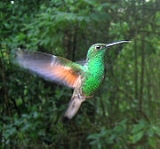
The most successful groups of living things that fly
Flying and gliding animals

A number of animals have evolution aerial locomotion, either by powered flight or by gliding . Flying and gliding animals have evolved separately many times, without any single ancestor....
 are insect
Insect

Insects are the biggest class of arthropods and the only ones with wings. They are the most diverse group of animals on the planet. They are most diverse at the equator and their diversity declines toward the poles....
s, bird
Bird

Birds are wing, Bipedalismal, endothermic , vertebrate animals that lay egg . There are around 10,000 living species, making them the most numerous tetrapod vertebrates....
s, and bat
Bat

Bats are mammals in the order Chiroptera. The forelimbs of all bats are developed as wings, making them the only mammals naturally capable of sustained flight ....
s. The extinct Pterosaur
Pterosaur

Pterosaurs were flying reptiles of the clade or Order Pterosauria. They existed from the late Triassic to the end of the Cretaceous Period . Pterosaurs are the earliest vertebrates known to have evolved powered flight....
s, an order
Order (biology)

In Biological classification used in biology, the order is a taxonomic rank between class and family . The superorder is a rank between class and order....
 of reptiles contemporaneous with the dinosaur
Dinosaur

Dinosaurs were the dominant vertebrate animals of Landform ecosystems for over 160 million years, from the late Triassic Period until the end of the Cretaceous Period , when most of them became extinct in the Cretaceous?Tertiary extinction event....
s, were also very successful flying animals. Each of these groups' wing
Wing

A wing is a surface used to produce Lift for flight through the Earth's atmosphere or another gaseous or fluid medium. The wing shape is usually an airfoil....
s evolved
Evolution

In biology, evolution is change in the heritability trait of a population of organisms from one generation to the next. These changes are caused by a combination of three main processes: variation, reproduction, and selection....
 independently
Convergent evolution

Convergent evolution describes the acquisition of the same biological trait in unrelated lineages.The wing is a classic example of convergent evolution in action....
. The wings of the flying vertebrate groups are all based on the forelimbs, but differ significantly in structure; those of insects are hypothesized to be highly-modified versions of structures that form gills in most other groups of arthropod
Arthropod

Arthropods are animals belonging to the Scientific classification Arthropoda , and include the insects, arachnids, crustaceans, and others....
s.

Bat
Bat

Bats are mammals in the order Chiroptera. The forelimbs of all bats are developed as wings, making them the only mammals naturally capable of sustained flight ....
s are the only mammal
Mammal

Mammals are a class of vertebrate animals whose name is derived from their distinctive feature, mammary glands, with which they feed their young....
s capable of sustaining level flight. However, there are several gliding mammals
Flying squirrel

The flying squirrels, scientifically known as Pteromyini or Petauristini, are a tribe of squirrels . There are 43 species in this tribe, the largest of which is the woolly flying squirrel ....
 which are able to glide from tree to tree using fleshy membranes between their limbs; some can travel hundreds of meters in this way with very little loss in height. Flying frog
Flying frog

The "flying" frog is a frog that has the ability to glide. That is, it can descend at an angle of less than 45? relative to the horizontal. Arboreal frogs can also descend vertically, but only at angles greater than 45?, which is referred to as parachuting....
s use greatly enlarged webbed feet for a similar purpose, and there are flying lizard
Draco blanfordii

Draco blanfordii is an agamid flying lizard capable of gliding from tree to tree found in China , E Thailand, W Malaysia, Myanmar, Vietnam, India and Bangladesh....
s which employ their unusually wide, flattened rib-cages to the same end. Certain snake
Snake

Snakes are elongate legless carnivore reptiles of the suborder Serpentes that can be distinguished from legless lizards by their lack of eyelids and external ears....
s also use a flattened rib-cage to glide, with a back and forth motion much the same as they use on the ground.

Flying fish can glide using enlarged wing-like fins, and have been observed soaring for hundreds of meters using the updraft on the leading edges of waves. It is thought that this ability was chosen by natural selection
Natural selection

Natural selection is the process by which favorable heritable trait become more common in successive generations of a population of Reproduction organisms, and unfavorable heritable traits become less common, due to differential reproduction of genotypes....
 because it was an effective means of escape from underwater predators. The longest recorded flight of a flying fish was 45 seconds.

Most bird
Bird

Birds are wing, Bipedalismal, endothermic , vertebrate animals that lay egg . There are around 10,000 living species, making them the most numerous tetrapod vertebrates....
s fly (see bird flight
Bird flight

Flight is the main mode of animal locomotion used by most of the world's bird species. Flight assists birds while feeding, breeding and avoiding predation....
), with some exceptions. The largest birds, the ostrich
Ostrich

The ostrich Struthio camelus is a large flightless bird native to Africa . It is the only living species of its family , Struthionidae, and its genus, Struthio....
 and the emu
Emu

The Emu , Dromaius novaehollandiae, is the largest bird native to Australia and the only Extant taxon member of the genus Dromaius. It is also the second-largest extant bird in the world by height, after its ratite relative, the ostrich....
, are earthbound, as were the now-extinct dodo
Dodo

The dodo was a flightless bird Endemism to the Indian Ocean island of Mauritius. Related to Columbidae, it stood about a meter tall, weighing about , living on fruit and nesting on the ground....
s and the Phorusrhacids, which were the dominant predators of South America in the Cenozoic
Cenozoic

The Cenozoic Era...
 period. The non-flying penguin
Penguin

Penguins are a group of Aquatic animal, flightless bird birds living almost exclusively in the Southern Hemisphere. Highly adapted for life in the water, penguins have countershading dark and white plumage, and their wings have become Flipper ....
s have wings adapted for use under water and use the same wing movements for swimming that most other birds use for flight. Most small flightless birds are native to small islands, and lead a lifestyle where flight would confer little advantage.

Among living animals that fly, the wandering albatross
Wandering Albatross

The Wandering Albatross, Snowy Albatross, or White-winged Albatross, Diomedea exulans, is a large seabird from the family Diomedeidae which has a circumpolar range in the Southern Ocean....
 has the greatest wingspan, up to 3.5 meters (11.5 ft); the great bustard
Great Bustard

The Great Bustard, Otis tarda, is in the bustard family, the only member of the genus Otis. It breeds in southern and central Europe, where it is the largest species of bird, and across temperate Asia....
 has the greatest weight, topping at 21 kilograms (46 pounds).

Among the many species
Species

In biology, a species is one of the basic units of biological classification and a taxonomic rank. A species is often defined as a group of organisms capable of interbreeding and producing fertile offspring....
 of insect
Insect

Insects are the biggest class of arthropods and the only ones with wings. They are the most diverse group of animals on the planet. They are most diverse at the equator and their diversity declines toward the poles....
s, some fly and some do not (See insect flight
Insect flight

Insects are the only group of invertebrates known to have evolved flight. Insects possess some remarkable flight characteristics and abilities, still far superior to attempts by humans to replicate their capabilities....
).

Mechanical


Flight
Mechanical flight is the use of a machine
Machine

A machine is any device that uses energy to perform some activity. In common usage, the meaning is that of a device having parts that perform or assist in performing any type of work....
 to fly. These machines include airplanes, glider
Glider aircraft

Glider aircraft are heavier-than-air craft that are supported in flight by the dynamic reaction of the air against their lifting surfaces, and whose free flight does not depend on an engine....
s, helicopter
Helicopter

A helicopter is an aircraft that is Lift and propelled by one or more horizontal plane Helicopter rotors, each rotor consisting of two or more rotor blades....
s, autogyro
Autogyro

An autogyro is a type of rotorcraft invented by Juan de la Cierva in 1919, making its first successful flight on 9 January 1923, at Cuatro Vientos Airfield in Madrid....
s, airship
Airship

An airship or dirigible is a aerostat that can be steered and propelled through the air using rudders and propellers or other thrust. Unlike other aerodynamics aircraft such as fixed-wing aircraft and helicopters, which produce lift by moving a wing, or airfoil, through the air, aerostatic aircraft, such as airships and Balloon , stay...
s, balloon
Balloon (aircraft)

A balloon is a type of aircraft that remains aloft due to its buoyancy. A balloon travels by moving with the wind. It is distinct from an airship, which is a buoyant aircraft that can be propelled through the air in a controlled manner....
s, ornithopters and spacecraft
Spacecraft

A spacecraft is a Craft or machine designed for spaceflight. On a sub-orbital spaceflight, a spacecraft enters outer space then returns to the Earth....
. Glider
Glider aircraft

Glider aircraft are heavier-than-air craft that are supported in flight by the dynamic reaction of the air against their lifting surfaces, and whose free flight does not depend on an engine....
s are capable of unpowered flight. Another form of mechanical flight is parasailing where a parachute-like object is pulled by a boat. In an airplane, lift is created by the wings; the shape of the wings of the airplane are designed specially for the type of flight desired. There are different types of wings: tempered, semi-tempered, sweptback, rectangular, and elliptical. An aircraft wing is sometimes called an airfoil
Airfoil

An airfoil or aerofoil is the shape of a wing or blade or sail as seen in cross-section.An airfoil-shaped body moved through a fluid produces a force perpendicular to the motion called lift ....
, which is a device that creates lift when air flows across it.

Supersonic
Supersonic flight is flight faster than the speed of sound. Supersonic flight is associated with the formation of shock wave
Shock wave

A shock wave is a type of propagating disturbance. Like an ordinary wave, it carries energy and can propagate through a medium or in some cases in the absence of a material medium, through a field such as the electromagnetic field....
s that form a sonic boom
Sonic boom

File:Mach cone.svgThe term 'sonic boom' is commonly used to refer to the shocks caused by the supersonic flight of an aircraft. Sonic booms generate enormous amounts of sound energy, sounding much like an explosion....
 that can be heard from the ground, and is frequently startling. This shockwave takes quite a lot of energy to create and this makes supersonic flight generally less efficient than subsonic flight at about 85% of the speed of sound.

Hypersonic
Hypersonic flight is very high speed flight where the heat generated by the compression of the air due to the motion through the air causes chemical changes to the air. Hypersonic flight is achieved by reentering spacecraft such as the Space Shuttle
Space Shuttle

NASA's Space Shuttle, officially called the Space Transportation System , is the spacecraft currently used by the United States government for its human spaceflight missions....
 and Soyuz
Soyuz

Soyuz is Russian language for "Union", and was often used as an abbreviation for the "Soviet Union" during the Communist era. In English, the term is left untranslated in the names of several Soviet-related concepts....
.

Ballistic

Some things generate little or no lift and move only or mostly under the action of momentum, gravity, air drag and in some cases thrust. This is termed ballistic flight. Examples include ballistic missile
Ballistic missile

A ballistic missile is a missile that follows a sub-orbital ballistics flightpath with the objective of delivering a warhead to a predetermined target....
s, ball
Ball

A ball is a round object with various uses. It is usually sphere but can be ovoid. It is used in ball games, where the play of the game follows the state of the ball as it is hit, kicked or thrown by players....
s, arrow
Archery

Archery is the art, practice or skill of shooting with Bow and arrow. Archery has historically been used in hunting and combat and has become a precision sport....
s, orbital spaceflight
Orbital spaceflight

An orbital spaceflight is a spaceflight in which a spacecraft is placed on a trajectory where it could remain in outer space for at least one orbit....
 etc.

Spaceflight

Essentially an extreme form of ballistic flight, spaceflight is the use of space technology
Space technology

Space technology is technology that is related to entering Outer space, maintaining and using systems during spaceflight and returning people and things from space....
 to achieve the flight
Flight

Flight is the process by which an object moves either through the air, or movement beyond earth's atmosphere , by aerodynamically generating Lift , propulsion or Lighter than air using buoyancy, or by simple ballistic movement....
 of spacecraft
Spacecraft

A spacecraft is a Craft or machine designed for spaceflight. On a sub-orbital spaceflight, a spacecraft enters outer space then returns to the Earth....
 into and through outer space
Outer space

Outer space comprises the relatively empty regions of the universe outside the atmospheres of celestial bodies. Outer space is used to distinguish it from airspace and terrestrial locations....
.

Spaceflight is used in space exploration
Space exploration

Space exploration is the use of astronomy and space technology to explore outer space. Physical exploration of space is conducted both by human spaceflights and by robotic spacecraft....
, and also in commercial activities like space tourism
Space tourism

Space tourism is the recent phenomenon of Tourism paying for Human spaceflight into space pioneered by Russia.As of 2009, orbital space tourism opportunities are limited and expensive, with only the Russian Space Agency providing transport....
 and satellite telecommunications. Additional non-commercial uses of spaceflight include space observatories
Space observatory

A space observatory is any instrument in outer space which is used for observation of distant planets, galaxies, and other outer space objects....
, reconnaissance satellites and other earth observation satellite
Earth observation satellite

Earth observation satellites are satellites specifically designed to observe Earth from orbit, similar toreconnaissance satellites but intended for non-military uses such as natural environmental monitoring, meteorology, map making etc....
s.

A spaceflight typically begins with a rocket
Rocket

A rocket or rocket vehicle is a missile, aircraft or other vehicle which obtains thrust by the Reaction of the rocket to the ejection of fast moving fluid exhaust from a rocket engine....
 launch
Rocket launch

A rocket launch is the first phase of the flight of a rocket. For orbital spaceflights, or for launches into interplanetary space, which is usually a fixed location on the ground but may also be on a floating platform such as the San Marco platform, or the Sea Launch launch vessel....
, which provides the initial thrust to overcome the force of gravity and propels the spacecraft from the surface of the Earth. Once in space, the motion of a spacecraft -- both when unpropelled and when under propulsion -- is covered by the area of study called astrodynamics
Astrodynamics

Orbital mechanics or astrodynamics is the application of celestial mechanics to the practical problems concerning the motion of rockets and other spacecraft....
. Some spacecraft remain in space indefinitely, some disintegrate during atmospheric reentry
Atmospheric reentry

Atmospheric reentry refers to the movement of human-made or natural objects as they enter the atmosphere of a planet from outer space, in the case of Earth from an altitude above the "edge of space." This article primarily addresses the process of controlled reentry of vehicles which are intended to reach the planetary surface intact, but th...
, and others reach a planetary or lunar surface for landing or impact.

Study of flight

In 8th century Cordoba
Córdoba, Spain

viktor chucchuc he sucsuck my dick||-||-|File:Cordoba Water Wheel.jpg|}Cordova is a city in Andalusia, southern Spain, and the capital of the C?rdoba ....
, Ibn Firnas studied the dynamism of flying and carried out a number of experiments. After one of his flights he fell on his back and he commented that he now understands the role played by the tail when birds alight on the ground, telling his close friends that birds normally land on the root of the tail which did not happen in that occasion, hence a reference to the missing tail. Durant in his book “the story of Civilisation”, quoting Al-Makkari who mentioned that Ibn Farnas indeed constructed a flying machine. However, he does not elaborate on how the machine works nor whether it was the one Ibn Farnas used nor on its destiny.

Leonardo da Vinci is one of the best-known early students of flight. He made many prototypes of parachutes wings and ornithopters.

Otto Lillienthal made over 200 gliding flights and was one of the first to understand flight scientifically. His work was replicated and extended by the Wright brothers
Wright brothers

The Wright brothers, Orville and Wilbur , were two United States who are generally credited with inventing and building the world's first successful fixed-wing aircraft and making the first controlled, powered and sustained heavier-than-air Flight#Mechanical flight, on December 17, 1903....
 who made gliding flights and finally the first controlled and extended, manned powered flights.

Physics


There are different approaches to flight. If an object has a lower density
Density

The density of a material is defined as its mass per unit volume. The symbol of density is ....
 than air, then it is buoyant
Buoyancy

In physics, buoyancy is the upward force that keeps things afloat. The net upward buoyancy force is equal to the magnitude of the weight of fluid displaced by the body....
 and is able to float in the air
Aerostat

The word aerostat was originally french language and is derived from the greek language aer + statos . An aerostat is a lighter than air object that can stay stationary in the air....
 without using energy. A heavier than air craft, known as an aerodyne
Aerodyne

Aerodyne may refer to:*Aircraft#Heavier than air—aerodynes, deriving lift from dynamic motion through the air.*K-100 Aerodyne ? a Kenworth truck....
, includes flighted animals and insects, fixed-wing aircraft
Fixed-wing aircraft

A fixed-wing aircraft is an aircraft capable of heavier-than-air flight whose Lift is generated not by wing motion relative to the aircraft, but by forward motion through the air....
 and rotorcraft
Rotorcraft

A rotorcraft is a heavier-than-air flying machine that uses lift generated by Airfoil, called rotor blades, that revolve around a mast. Several rotor blades mounted to a single mast is referred to as a helicopter rotor....
. Because the craft is heavier than air, it must use the force of lift
Lift (force)

In the context of a fluid flow relative to a body, the lift force is the Vector #Vector components of the aerodynamic force that is perpendicular to the oncoming flow direction....
 to overcome its weight
Weight

In the physical sciences, weight is a measurement of the gravitational force acting on an object. Near the surface of the Earth, the Earth's gravity is approximately constant; this means that an object's weight is roughly proportional to its mass....
. The wind resistance caused by the craft moving through the air is called drag
Drag (physics)

The term drag is widely used in Physics and Engineering and is central to the field of fluid dynamics. "Drag" refers to forces that oppose the motion of a solid object through a fluid ....
 and is overcome by propulsive thrust
Air propulsion

Air propulsion is the act of moving an object through the air. The most common types are propeller, jet engine, turboprop, ramjet, rocket propulsion, and, experimentally, scramjet, pulse jet, and pulse detonation engine....
 except in the case of gliding.

Some vehicles also use thrust for flight, for example rocket
Rocket

A rocket or rocket vehicle is a missile, aircraft or other vehicle which obtains thrust by the Reaction of the rocket to the ejection of fast moving fluid exhaust from a rocket engine....
s and Harrier Jump Jet
Harrier Jump Jet

The Harrier Jump Jet, often referred to as just "Harrier" or "the Jump Jet", is a British designed military turbofan aircraft capable of Vertical/Short Takeoff and Landing via thrust vectoring....
s.

Relevant forces


Forces relevant to flight are

  • Propulsive thrust
    Air propulsion

    Air propulsion is the act of moving an object through the air. The most common types are propeller, jet engine, turboprop, ramjet, rocket propulsion, and, experimentally, scramjet, pulse jet, and pulse detonation engine....
    : (except in gliders)
  • Lift
    Lift (force)

    In the context of a fluid flow relative to a body, the lift force is the Vector #Vector components of the aerodynamic force that is perpendicular to the oncoming flow direction....
    : created by the reaction to an airflow
  • Drag
    Drag (physics)

    The term drag is widely used in Physics and Engineering and is central to the field of fluid dynamics. "Drag" refers to forces that oppose the motion of a solid object through a fluid ....
    : created by aerodynamic friction
    Friction

    File:Friction alt.svgFriction is the force resisting the relative lateral motion of solid surfaces, fluid layers, or material elements in contact....
  • Weight
    Weight

    In the physical sciences, weight is a measurement of the gravitational force acting on an object. Near the surface of the Earth, the Earth's gravity is approximately constant; this means that an object's weight is roughly proportional to its mass....
    : (created by gravity)
  • Buoyancy
    Buoyancy

    In physics, buoyancy is the upward force that keeps things afloat. The net upward buoyancy force is equal to the magnitude of the weight of fluid displaced by the body....
    : for lighter than air flight


These forces must be balanced for stable flight to occur.

The stabilization of flight angles (roll
Roll

Roll can refer to:...
, yaw
Yaw angle

The yaw angle is the angle between a vehicle's heading and a reference heading . One of the Tait-Bryan angles. In aeronautics, robotics and marine control, it is typically assigned the shorthand notation ....
 and pitch) and the rates of change of these can involve horizontal stabilizers (i.e. 'a tail'), ailerons and other movable aerodynamic devices which control angular stability i.e. flight attitude
Attitude

Attitude may refer to:...
 (which in turn affects altitude
Altitude

Altitude has multiple uses depending on the context in which it is used . As a general definition, altitude is a distance measurement, usually in the vertical or "up" direction, between a reference datum and a point or object....
, heading
Heading

selfref|For Wikipedia's headings guideline, see...
).

Lift

In the context of a air flow relative to a flying body, the lift force is the component of the aerodynamic force that is perpendicular
Perpendicular

In geometry, two line or plane , are considered perpendicular to each other if they form congruence adjacent angles angles . The term may be used as a noun or adjective....
 to the flow direction. It contrasts with the drag
Drag (physics)

The term drag is widely used in Physics and Engineering and is central to the field of fluid dynamics. "Drag" refers to forces that oppose the motion of a solid object through a fluid ....
 force, which is the parallel
Parallel

From Greek language: pa???????? Parallel may refer to:...
 component of the aerodynamic force.

Lift is commonly associated with the wing
Wing

A wing is a surface used to produce Lift for flight through the Earth's atmosphere or another gaseous or fluid medium. The wing shape is usually an airfoil....
 of an aircraft
Fixed-wing aircraft

A fixed-wing aircraft is an aircraft capable of heavier-than-air flight whose Lift is generated not by wing motion relative to the aircraft, but by forward motion through the air....
, although lift is also generated by rotor
Helicopter rotor

A helicopter rotor is the rotating part of a helicopter which controls the blades that produce the aerodynamic Lift for the helicopter. The helicopter rotor, also called the rotor system, usually refers to the helicopter's main rotor which is mounted on a vertical mast over the top of the helicopter, although it can refer to the...
s on rotorcraft
Rotorcraft

A rotorcraft is a heavier-than-air flying machine that uses lift generated by Airfoil, called rotor blades, that revolve around a mast. Several rotor blades mounted to a single mast is referred to as a helicopter rotor....
. While common meanings of the word "lift" suggest that lift opposes gravity, aerodynamic lift can be in any direction. When an aircraft is in cruise
Cruise (flight)

Cruise is the level portion of aircraft travel where flight is most fuel efficient. It occurs between climb and Descent phases and is usually the majority of a journey....
 for example, lift does oppose gravity, but occurs at an angle when climbing, descending or banking.

Lift can also occur in a different way if the air is not still, especially if there is an updraft due to heat ("thermals") or wind blowing along sloping terrain or other meteorological conditions. This form of lift permits soaring
Soaring

Soaring is a mode of flight in which height or speed is gained by using the energy of air currents. It arises in the flight of both aircraft and birds....
 and is particularly important for gliding. It is used by birds and gliders to stay in the air for long periods with little effort.

Lift-to-drag ratio

Drag Curve 2
When lift is created by the motion of an object through the air, this deflects the air, and this is the source of lift. For sustained level flight lift must be greater than weight.

However, this lift inevitably causes some drag also, and it turns out that the efficiency of lift creation can be associated with a lift-to-drag ratio for a vehicle; the lift-to-drag ratios are approximately constant over a wide range of speeds.

Lift-to-drag ratios for practical aircraft vary from about 4:1 up to 60:1 or more. The lower ratios are generally for vehicles and birds with relatively short wings, and the higher ratios are for vehicles with very long wings, such as gliders.

Thrust to weight ratio

Thrust-to-weight ratio is, as its name suggests, the ratio of instantaneous thrust
Thrust

Thrust is a reaction force described quantitatively by Isaac Newton's Newton's laws of motion. When a system expels or acceleration mass in one direction the accelerated mass will cause a proportional but opposite force on that system....
 to weight
Weight

In the physical sciences, weight is a measurement of the gravitational force acting on an object. Near the surface of the Earth, the Earth's gravity is approximately constant; this means that an object's weight is roughly proportional to its mass....
 (where weight means weight at the Earth
Earth

Earth is the third planet from the Sun. Earth is the largest of the terrestrial planets in the Solar System in diameter, mass and density. It is also referred to as the World and Wiktionary:Terra.Note that by International Astronomical Union convention, the term "Terra" is used for naming extensive land masses, rather...
’s standard acceleration ). It is a dimensionless parameter characteristic of rocket
Rocket

A rocket or rocket vehicle is a missile, aircraft or other vehicle which obtains thrust by the Reaction of the rocket to the ejection of fast moving fluid exhaust from a rocket engine....
s and other jet engines and of vehicles propelled by such engines (typically space launch vehicle
Launch vehicle

In spaceflight, a launch vehicle or carrier rocket is a rocket used to carry a payload from the Earth's surface into outer space. A launch system includes the launch vehicle, the launch pad and other infrastructure....
s and jet aircraft
Aircraft

An aircraft is a vehicle which is able to flight by being supported by the air, or in general, the atmosphere, of a planet. Examples include balloons, airplanes and helicopters....
).

If the thrust-to-weight ratio
Thrust-to-weight ratio

Thrust-to-weight ratio is the ratio of thrust to weight of a rocket, jet engine, propeller engine, or a vehicle propelled by such an engine. It is a dimensionless quantity and is an indicator of the performance of the engine or vehicle....
 is greater than the local gravity strength (expressed in gs), then flight can occur without any forward motion or any aerodynamic lift being required.

If the thrust-to-weight ratio times the lift-to-drag ratio is greater than local gravity then takeoff
Takeoff

Takeoff is the phase of flight in which an aircraft goes through a transition from moving along the ground to flying in the air, usually starting on a runway....
 using aerodynamic lift is possible.

Energy efficiency

To create thrust to push through the air to overcome the drag associated with lift takes energy, and different objects and creatures capable of flight vary in the efficiency of their muscles, motors and how well this translates into forward thrust.

Propulsive efficiency determines how much thrust propeller and jet engine
Jet engine

A jet engine is a reaction engine that discharges a fast moving jet of fluid to generate thrust in accordance with Isaac Newton Newton's laws of motion....
s gain from a unit of fuel

Power to weight ratio

All animals and devices capable of sustained flight need relatively high power to weight ratios to be able to generate enough lift and/or thrust to achieve take off.

In religion, mythology and fiction

In religion
Religion

A religion is an organized approach to human spirituality which usually encompasses a set of myth, symbols, beliefs and practices, often with a supernatural or transcendence quality, that give meaning to the practitioner's experiences of life through reference to a higher power or truth....
, mythology
Mythology

The word mythology refers to a body of folklore/myths/legends that a particular culture believes to be true and that often use the supernatural to interpret natural events and to explain the nature of the universe and humanity....
 and fiction
Fiction

Fiction is an imaginative form of narrative, one of the four basic rhetorical modes. Although the word fiction is derived from the Latin fingo, fingere, finxi, fictum, "to form, create", works of fiction need not be entirely imaginary and may include real people, places, and events....
, human or anthropomorphic
Anthropomorphism

Anthropomorphism is the attribution of uniquely human characteristics to non-human creatures and beings, natural and supernatural phenomena, material states and objects or abstract concepts....
 characters sometimes have the ability to fly. Examples include angel
Ángel

?ngel is the third single from Belinda Peregr?n's debut album: Belinda. It was a massive hit in Mexico and an international hit for Belinda....
s in the Hebrew Bible
Hebrew Bible

The term Hebrew Bible is a generic reference to those books of the Bible originally written mostly in Biblical Hebrew with some Biblical Aramaic....
, Daedalus
Daedalus

In Greek mythology, Daedalus was a most skillful artificer, or craftsman, so skillful that he was said to have invented images that seemed to move about....
 in Greek mythology
Greek mythology

Greek mythology is the body of myths and legends belonging to the Ancient Greece concerning their List of Greek mythological figures#Immortals and Greek hero cult, Cosmology#Metaphysical cosmology, and the origins and significance of their own cult and ritual practices....
, and Superman
Superman

Superman is a Character , a comic book superhero widely considered to be an American cultural icon. Created by American writer Jerry Siegel and Canadian-born artist Joe Shuster in 1932 while both were living in Cleveland, Ohio, Ohio, and sold to DC Comics in 1938, the character first appeared in Action Comics Action Comics 1 and subseque...
 in comics
Comics

Comics is a graphic Mass media in which are utilized in order to convey a sequential narrative; the term, derived from massive early use to convey comic themes, came to be applied to all uses of this medium including those which are far from comic....
. Two other popular examples are Dumbo
Dumbo

Dumbo is a 1941 animated feature film produced by Walt Disney and first released on October 23, 1941 by RKO Radio Pictures. The fourth film in the Disney animated features canon, Dumbo is based upon a child's book of the same name by Helen Aberson and illustrated by Harold Perl....
, the elephant created by Disney who uses his ears to fly, and Santa Claus
Santa Claus

Santa Claus is a folklore figure in various cultures who distributes gifts to children, normally on Christmas Eve. Each name is a variation of Saint Nicholas, but refers to Santa Claus....
 whose sleigh is pulled by flying reindeers. Other non-human legendary creatures, such as some dragon
Dragon

File:Ukiyo-e dragon 2.jpgThe dragon is a legendary creature with serpentine shape or otherwise reptilian traits that features in the mythology of many cultures....
s and Pegasus
Pegasus

In Greek mythology, Pegasus was a winged horse sired by Poseidon, in his role as horse-god, and foaled by the Gorgon Medusa....
, are also depicted with an ability to fly.

The ability to fly may come from wings or other visible means of propulsion, from superhuman or god-like
Deity

A deity is a postulated preternatural or supernatural immortal being, who may be thought of as holy, divinity, or sacred, held in high regard, and respected by human beings....
 powers, or may simply be left unexplained.

See also


  • Aerodynamics
    Aerodynamics

    Aerodynamics is a branch of Dynamics concerned with studying the motion of air, particularly when it interacts with a moving object. Aerodynamics is a subfield of fluid dynamics and gas dynamics, with much theory shared between them....
  • Aviation
    Aviation

    File:Norwegian military Bell 412SP helicopters.jpgAviation refers to activities involving man-made flying devices , including the people, organizations, and regulatory bodies involved with them....
  • Flying and gliding animals
    Flying and gliding animals

    A number of animals have evolution aerial locomotion, either by powered flight or by gliding . Flying and gliding animals have evolved separately many times, without any single ancestor....
  • Aviation history
    Aviation history

    Aviation history deals with the development of mechanical flight, from the earliest attempts in kite-powered and gliding flight, to powered heavier-than-air flight, and beyond....
  • Levitation
    Levitation

    Levitation is the process by which an object is suspended against gravity, in a stable position, without physical contact.It is also a conjuring trick, appearingly raising a human being without any physical aid....
  • Transvection (flying)
    Transvection (flying)

    Transvection is the supernatural act of Levitation, floating or more specifically Flight through the air. While levitation and magical flight can equate to acts of Magic or astral projection through the use of Psychoactive drug entheogens, transvection usually refers to the experience of bodily movement in defiance of gravitational laws....
  • Aircraft
    Aircraft

    An aircraft is a vehicle which is able to flight by being supported by the air, or in general, the atmosphere, of a planet. Examples include balloons, airplanes and helicopters....


External links

  • Freeview video provided by the Vega Science Trust.