

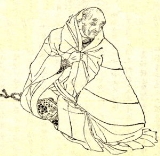
Taira no Kiyomori

Encyclopedia
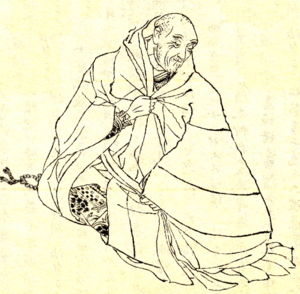
was a general of the late Heian period
Heian period
The is the last division of classical Japanese history, running from 794 to 1185. The period is named after the capital city of Heian-kyō, or modern Kyōto. It is the period in Japanese history when Buddhism, Taoism and other Chinese influences were at their height...
of Japan
Japan
Japan is an island nation in East Asia. Located in the Pacific Ocean, it lies to the east of the Sea of Japan, China, North Korea, South Korea and Russia, stretching from the Sea of Okhotsk in the north to the East China Sea and Taiwan in the south...
. He established the first samurai
Samurai
is the term for the military nobility of pre-industrial Japan. According to translator William Scott Wilson: "In Chinese, the character 侍 was originally a verb meaning to wait upon or accompany a person in the upper ranks of society, and this is also true of the original term in Japanese, saburau...
-dominated administrative government in the history of Japan
History of Japan
The history of Japan encompasses the history of the islands of Japan and the Japanese people, spanning the ancient history of the region to the modern history of Japan as a nation state. Following the last ice age, around 12,000 BC, the rich ecosystem of the Japanese Archipelago fostered human...
.
After the death of his father Taira no Tadamori
Taira no Tadamori
was a Taira clan samurai, father of Taira no Kiyomori, and member of the Kebiishi . Tadamori was also governor of the provinces of Harima, Ise, Bizen, and Tajima....
in 1153, Kiyomori assumed control of the Taira clan and ambitiously entered the political realm in which he had previously only held a minor post. In 1156, he and Minamoto no Yoshitomo
Minamoto no Yoshitomo
was the head of the Minamoto clan and a general of the late Heian period of Japanese history. His son Minamoto no Yoritomo became shogun and founded the Kamakura Shogunate, the first shogunate in the history of Japan.-Hōgen Rebellion:...
, head of the Minamoto clan, suppressed the Hōgen Rebellion
Hogen Rebellion
The was a short civil war fought in order to resolve a dispute about Japanese Imperial succession. The dispute was also about the degree of control exercised by the Fujiwara clan who had become hereditary Imperial regents during the Heian period....
. This established the Taira and Minamoto samurai clans as the top warrior clans in Kyoto
Kyoto
is a city in the central part of the island of Honshū, Japan. It has a population close to 1.5 million. Formerly the imperial capital of Japan, it is now the capital of Kyoto Prefecture, as well as a major part of the Osaka-Kobe-Kyoto metropolitan area.-History:...
. However, their new strength in effect caused the allies to become bitter rivals which culminated three years later during the Heiji Rebellion
Heiji Rebellion
The was a short civil war fought in order to resolve a dispute about political power. The Heiji no ran encompassed clashes between rival subjects of the cloistered Emperor Go-Shirakawa of Japan in 1159. It was preceded by the Hōgen Rebellion in 1156...
in 1159. Kiyomori, emerging victorious with Yoshitomo and his two eldest killed, was now the head of the single most powerful warrior family/clan in Kyoto. However, his clan's power and influence in the provinces at this time is a matter of debate. Kiyomori showed mercy and exiled a few of Yoshitomo's sons, including Yoritomo
Minamoto no Yoritomo
was the founder and the first shogun of the Kamakura Shogunate of Japan. He ruled from 1192 until 1199.-Early life and exile :Yoritomo was the third son of Minamoto no Yoshitomo, heir of the Minamoto clan, and his official wife, a daughter of Fujiwara no Suenori, who was a member of the...
, Noriyori
Minamoto no Noriyori
was a late Heian period general, who fought alongside his brothers Minamoto no Yoritomo and Minamoto no Yoshitsune at a number of battles of the Genpei War. The sixth son of Minamoto no Yoshitomo, he was spared along with his brothers in 1160 by Taira no Kiyomori following Yoshitomo's death.He...
, and Yoshitsune
Minamoto no Yoshitsune
was a general of the Minamoto clan of Japan in the late Heian and early Kamakura period. Yoshitsune was the ninth son of Minamoto no Yoshitomo, and the third and final son and child that Yoshitomo would father with Tokiwa Gozen. Yoshitsune's older brother Minamoto no Yoritomo founded the Kamakura...
– a benevolence that would turn out to be the Taira clan's downfall later on.
Due to his status as the head of the sole remaining courtier/warrior clan, Kiyomori was in a unique position to manipulate the court rivalry between the retired sovereign Go-Shirakawa and his son, Nijo tenno (tenno
Emperor of Japan
The Emperor of Japan is, according to the 1947 Constitution of Japan, "the symbol of the state and of the unity of the people." He is a ceremonial figurehead under a form of constitutional monarchy and is head of the Japanese Imperial Family with functions as head of state. He is also the highest...
- sovereign). Via this manipulation, Kiyomori was able to climb the ranks of government, though the majority of his promotions as well as the success of his family in gaining ranks and titles at court was due to the patronage of the retired sovereign Go-Shirakawa. This culminated in 1167, when Kiyomori became the first courtier of a warrior family to be appointed Daijō Daijin, chief minister of the government, and the de facto
De facto
De facto is a Latin expression that means "concerning fact." In law, it often means "in practice but not necessarily ordained by law" or "in practice or actuality, but not officially established." It is commonly used in contrast to de jure when referring to matters of law, governance, or...
administrator of the imperial government. As was the norm, he soon relinquished the position and leadership of the Taira clan, with the goal of maintaining the social and political prestige of having attained the highest office in the land, but being free of the attendant duties. This had been a common practice for many years in the highest levels of Japanese government and in doing so Kiyomori was asserting what he felt was his strong position in the Kyoto government. However, many of the courtiers from traditional (non-warrior noble families) were less than pleased with both Kiyomori's attainment of the rank of Daijō-daijin and how he comported himself with regard to other high ranking courtiers.
In 1171, Kiyomori arranged a marriage between the Emperor Takakura
Emperor Takakura
Emperor Takakura was the 80th emperor of Japan, according to the traditional order of succession. His reign spanned the years from 1168 through 1180.-Genealogy:...
and his daughter Taira no Tokuko
Taira no Tokuko
For the asteroid, see 5242 Kenreimonin, later known as , was the last Heike Imperial survivor from the modest vessel carrying the emperor in the great naval battle of Dan-no-ura....
. Their first son, Prince Tokihito was born in 1178. The next year, in 1179, Kiyomori staged a coup d'etat
Coup d'état
A coup d'état state, literally: strike/blow of state)—also known as a coup, putsch, and overthrow—is the sudden, extrajudicial deposition of a government, usually by a small group of the existing state establishment—typically the military—to replace the deposed government with another body; either...
forcing the resignation of his rivals from all government posts and subsequently banishing them. He then filled the open government positions with his allies and relatives, and imprisoned the cloistered Emperor Go-Shirakawa
Emperor Go-Shirakawa
Emperor Go-Shirakawa was the 77th emperor of Japan, according to the traditional order of succession...
. Finally, in 1180 Kiyomori forced the emperor Takakura to abdicate and give Prince Tokihito the throne, becoming the Emperor Antoku
Emperor Antoku
Emperor Antoku was the 81st emperor of Japan, according to the traditional order of succession. His reign spanned the years from 1180 through 1185. During this time, the imperial family was involved in a bitter struggle between warring clans...
.
Prince Mochihito
' , also known as the Takakura Prince, and as Minamoto Mochimitsu, was a son of Emperor Go-Shirakawa. He is noted for his role in starting the Genpei War....
, brother of Emperor Takakura, called on Kiyomori's old rivals of the Minamoto clan to rise against the Taira beginning the Genpei War
Genpei War
The was a conflict between the Taira and Minamoto clans during the late-Heian period of Japan. It resulted in the fall of the Taira clan and the establishment of the Kamakura shogunate under Minamoto Yoritomo in 1192....
in the middle of 1180. Kiyomori died early in the next year from sickness, leaving his son Munemori to preside over the downfall and destruction of the Taira at the hands of the Minamoto in 1185. Legend has it that at the time of his death, Kiyomori's fever was so high that anyone who attempted to even get near him would be burned by the heat & his corpse had to be left to cool for several hours before it could be removed.
Taira no Kiyomori in fiction and art
Taira no Kiyomori is the main character in the Kamakura periodKamakura period
The is a period of Japanese history that marks the governance by the Kamakura Shogunate, officially established in 1192 in Kamakura by the first shogun Minamoto no Yoritomo....
epic, the Tale of Heike.
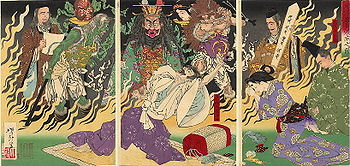
Taira no Kiyomori was featured by 19th century woodblock print artists as an exemplar of guilt and retribution, see the accompanying print by Yoshitoshi
Yoshitoshi
Tsukioka Yoshitoshi was a Japanese artist.He is widely recognized as the last great master of Ukiyo-e, a type of Japanese woodblock printing. He is additionally regarded as one of the form's greatest innovators. His career spanned two eras – the last years of feudal Japan, and the first years of...
. The famous print generally known as 'The Vision of Kiyomori' by Utagawa Hiroshige depicts the actor Nakamura Utayemon IV in the character of Kiyomori, confronted by the horrific vision of his snow-filled garden transformed into the heaped bones and skulls of his slaughtered enemies.
In video games, Kiyomori appears in Warriors Orochi 2 fighting for Orochi's army and using prayer beads as weapons. He also makes an appearance in Dynasty Warriors Strikeforce, as a boss in one of the game's Crossover Missions.
Kiyomori also features prominently as a sympathetic villain in Osamu Tezuka
Osamu Tezuka
was a Japanese cartoonist, manga artist, animator, producer, activist and medical doctor, although he never practiced medicine. Born in Osaka Prefecture, he is best known as the creator of Astro Boy, Kimba the White Lion and Black Jack...
's Phoenix series
Phoenix (manga)
is a manga series by Osamu Tezuka. Tezuka considered Phoenix his "life's work"; it consists of 12 books, each of which tells a separate, self-contained story and takes place in a different era. The plots go back and forth from the remote future to prehistoric times. The cycle remains unfinished...
in the first half of the ninth volume, Turbulent Times (retitled as Civil War in English), another Genpei War epic. Like most villains in the series he desires the titular bird for its immortality granting blood, due to his desire to continue to lead & protect the Taira clan & lack of confidence in his successors, but winds up being tricked into buying an imported Peacock instead.
The 2012 NHK Taiga drama
Taiga drama
is the name NHK gives to the annual, year-long historical fiction television series it broadcasts in Japan. Beginning in 1963 with the black-and-white Hana no Shōgai, starring kabuki actor Onoe Shōroku and Takarazuka star Awashima Chikage, the network has hired a producer, director, writer, music...
will be about him.
See also
- Heiji RebellionHeiji RebellionThe was a short civil war fought in order to resolve a dispute about political power. The Heiji no ran encompassed clashes between rival subjects of the cloistered Emperor Go-Shirakawa of Japan in 1159. It was preceded by the Hōgen Rebellion in 1156...
- Taira clanTaira clanThe was a major Japanese clan of samurai in historical Japan.In reference to Japanese history, along with Minamoto, Taira was a hereditary clan name bestowed by the emperors of the Heian Period to certain ex-members of the imperial family when they became subjects...
- Heian PeriodHeian periodThe is the last division of classical Japanese history, running from 794 to 1185. The period is named after the capital city of Heian-kyō, or modern Kyōto. It is the period in Japanese history when Buddhism, Taoism and other Chinese influences were at their height...