


Saito Musashibo Benkei

Encyclopedia
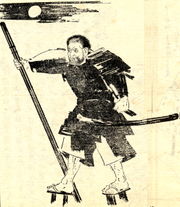
Warrior monk
The term Warrior monk may refer to:* Sōhei, a type of Japanese warrior* Knights Templar, Knights Hospitallers and Teutonic Knights, warriors during the Crusades* Shaolin Monastery, a Chinese monastery renowned for monks who were experts in the martial arts...
(sōhei
Sohei
were Buddhist warrior monks of feudal Japan. At certain points of history they held considerable power, obliging the imperial and military governments to collaborate....
) who served Minamoto no Yoshitsune
Minamoto no Yoshitsune
was a general of the Minamoto clan of Japan in the late Heian and early Kamakura period. Yoshitsune was the ninth son of Minamoto no Yoshitomo, and the third and final son and child that Yoshitomo would father with Tokiwa Gozen. Yoshitsune's older brother Minamoto no Yoritomo founded the Kamakura...
. He is commonly depicted as a man of great strength and loyalty, and a popular subject of Japanese folklore
Japanese folklore
The folklore of Japan is heavily influenced by both Shinto and Buddhism, the two primary religions in the country. It often involves humorous or bizarre characters and situations and also includes an assortment of supernatural beings, such as bodhisattva, kami , yōkai , yūrei ,...
.
Biography
Stories about Benkei's birth vary considerably. One tells how his father was the head of a temple shrine who had raped his mother, the daughter of a blacksmith. Another sees him as the offspring of a temple god. Many give him the attributes of a demonDemon
call - 1347 531 7769 for more infoIn Ancient Near Eastern religions as well as in the Abrahamic traditions, including ancient and medieval Christian demonology, a demon is considered an "unclean spirit" which may cause demonic possession, to be addressed with an act of exorcism...
, a monster child with wild hair and long teeth. In his youth Benkei may have been called —"demon/ogre child", and there are many famous Ukiyo-e works themed on 'Oniwakamaru' and his adventures.
He joined the cloister at an early age and travelled widely among the monasteries of Japan. During this period, the Buddhist monasteries of Japan were important centres of administration and culture, but also military powers in their own right. Like many other monks, Benkei was probably trained in the use of the naginata
Naginata
The naginata is one of several varieties of traditionally made Japanese blades in the form of a pole weapon. Naginata were originally used by the samurai class in feudal Japan, and naginata were also used by ashigaru and sōhei .-Description:A naginata consists of a wooden shaft with a curved...
. At the age of seventeen, he was said to have been over two metres (6.6 feet) tall. At this point, he left the Buddhist monastery and became a yamabushi
Yamabushi
' are Japanese mountain ascetic hermits with a long tradition as mighty warriors endowed with supernatural powers. They follow the Shugendō doctrine, an integration of mainly esoteric Buddhism of the Shingon sect, with Tendai and Shinto elements...
, a member of a sect of mountain monks who were recognisable by their black caps. Japanese prints often show Benkei wearing this cap.
Benkei is said to have posted himself at Gojō Bridge in Kyoto
Kyoto
is a city in the central part of the island of Honshū, Japan. It has a population close to 1.5 million. Formerly the imperial capital of Japan, it is now the capital of Kyoto Prefecture, as well as a major part of the Osaka-Kobe-Kyoto metropolitan area.-History:...
, where he disarmed every passing swordsman, eventually collecting 999 swords. On his 1000th duel, Benkei was defeated by Minamoto no Yoshitsune
Minamoto no Yoshitsune
was a general of the Minamoto clan of Japan in the late Heian and early Kamakura period. Yoshitsune was the ninth son of Minamoto no Yoshitomo, and the third and final son and child that Yoshitomo would father with Tokiwa Gozen. Yoshitsune's older brother Minamoto no Yoritomo founded the Kamakura...
, a son of the warlord
Warlord
A warlord is a person with power who has both military and civil control over a subnational area due to armed forces loyal to the warlord and not to a central authority. The term can also mean one who espouses the ideal that war is necessary, and has the means and authority to engage in war...
Minamoto no Yoshitomo
Minamoto no Yoshitomo
was the head of the Minamoto clan and a general of the late Heian period of Japanese history. His son Minamoto no Yoritomo became shogun and founded the Kamakura Shogunate, the first shogunate in the history of Japan.-Hōgen Rebellion:...
. Henceforth, he became a retainer of Yoshitsune and fought with him in the Genpei War
Genpei War
The was a conflict between the Taira and Minamoto clans during the late-Heian period of Japan. It resulted in the fall of the Taira clan and the establishment of the Kamakura shogunate under Minamoto Yoritomo in 1192....
against the Taira clan
Taira clan
The was a major Japanese clan of samurai in historical Japan.In reference to Japanese history, along with Minamoto, Taira was a hereditary clan name bestowed by the emperors of the Heian Period to certain ex-members of the imperial family when they became subjects...
. Yoshitsune is credited with most of the Minamoto clan's successes against the Taira, especially the final naval battle of Dannoura
Battle of Dan-no-ura
The ' was a major sea battle of the Genpei War, occurring at Dan-no-ura, in the Shimonoseki Strait off the southern tip of Honshū. On March 24, 1185, the Genji clan fleet, led by Minamoto no Yoshitsune, defeated the Heike clan fleet, during a half-day engagement.The Taira were outnumbered, but...
. After their ultimate triumph, however, Yoshitsune's elder brother Minamoto no Yoritomo
Minamoto no Yoritomo
was the founder and the first shogun of the Kamakura Shogunate of Japan. He ruled from 1192 until 1199.-Early life and exile :Yoritomo was the third son of Minamoto no Yoshitomo, heir of the Minamoto clan, and his official wife, a daughter of Fujiwara no Suenori, who was a member of the...
turned against him.
During the two year ordeal that followed, Benkei accompanied Yoshitsune as an outlaw. In the end, they were encircled in the castle of Koromogawa no tate. As Yoshitsune retired to the inner keep of the castle to commit ritual suicide (seppuku
Seppuku
is a form of Japanese ritual suicide by disembowelment. Seppuku was originally reserved only for samurai. Part of the samurai bushido honor code, seppuku was either used voluntarily by samurai to die with honor rather than fall into the hands of their enemies , or as a form of capital punishment...
) on his own, Benkei fought on at the bridge in front of the main gate to protect Yoshitsune. It is said that the soldiers were afraid to traverse the bridge to confront him, and all that did met swift death at the hands of the gigantic man. Long after the battle should have been over, the soldiers noticed that the arrow-riddled, wound-covered Benkei was standing still. When the soldiers dared to cross the bridge and look more closely, the giant fell to the ground, having died in a standing position. This is known as the "Standing Death of Benkei" .
It is Benkei's loyalty and honour which makes him most attractive in Japanese folklore. One kabuki play places Benkei in a moral dilemma, caught between lying and protecting his lord in order to cross a bridge. The critical moment of the drama is its climax, where the monk realises his situation and vows to do what he must. In another play, Benkei even slays his own child to save the daughter of a lord. In the Noh play Ataka
Ataka (play)
Ataka is a Noh play written in 1465, during the Muromachi Era of Japan by playwright Kanze Nobumitsu.It has been adapted as a Kabuki play, Kanjinchō, and as a movie, Tora no o wo fumu otokotachi, directed by Kurosawa Akira.-Synopsis:...
, Benkei must beat his own master (disguised as a porter) in order to avoid breaking his disguise. Ataka is later adapted as the kabuki play Kanjinchō
Kanjincho
Kanjinchō is a Japanese kabuki play by Namiki Gohei III, based on the Noh play Ataka. It is one of the most popular plays in the modern kabuki repertory....
, and filmed by Akira Kurosawa
Akira Kurosawa
was a Japanese film director, producer, screenwriter and editor. Regarded as one of the most important and influential filmmakers in the history of cinema, Kurosawa directed 30 filmsIn 1946, Kurosawa co-directed, with Hideo Sekigawa and Kajiro Yamamoto, the feature Those Who Make Tomorrow ;...
as The Men Who Tread on the Tiger's Tail
The Men Who Tread On the Tiger's Tail
is a 1945 film, written and directed by Akira Kurosawa. It is based on the kabuki play Kanjinchō, which is in turn based on the Noh play Ataka.The film stars Hanshiro Iwai, Susumu Fujita, Kenichi Enomoto, and Denjirō Ōkōchi....
.
In popular culture
- The Tale of Benkei was serialized in the first three issues of the short-lived BritishUnited KingdomThe United Kingdom of Great Britain and Northern IrelandIn the United Kingdom and Dependencies, other languages have been officially recognised as legitimate autochthonous languages under the European Charter for Regional or Minority Languages...
comic bookComic bookA comic book or comicbook is a magazine made up of comics, narrative artwork in the form of separate panels that represent individual scenes, often accompanied by dialog as well as including...
series Tornado in 1979.
- The third pilot of the original Getter teamGetter Robois a Super Robot manga series created by Go Nagai and Ken Ishikawa, as well as an anime series produced by Toei Animation. The series was broadcast on Fuji TV from April 4, 1974 to May 8, 1975, with a total of 51 episodes.- Plot :...
was Tomoe Musashi, and his successor after his death was Kuruma Benkei. The two characters are combined for a more direct tribute in the character of Musashibou Benkei in the OAV New Getter RoboNew Getter Robois an anime original video animation co-produced by Dynamic Planning and Bandai Visual. The series is a re-imagining of the 1970s manga Getter Robo, created by Go Nagai and Ken Ishikawa, that incorporates aspects of Japanese mythology like the Oni and Abe no Seimei.- Plot :An alternate retelling of...
, who is also a monk.
- In the video game OkamiOkamiis an action-adventure video game developed by Clover Studio and published by Capcom. It was released for Sony's PlayStation 2 video game console in 2006 in Japan and North America, and 2007 in Europe and Australia...
, Benkei is first seen on a bridge fishing for his 1000th sword. In this case, it was a legendary fish known as the "Living Sword" (a fish which has a sword-like appearance, named the Cutlass Fish). He prevents the protagonist (a wolf avatar of the Shinto sun god, Okami Amaterasu) from crossing the bridge until he catches it.
- He is a playable character in the video game, Genji: Dawn of the SamuraiGenji: Dawn of the SamuraiGenji: Dawn of the Samurai is a PlayStation 2 game released on September 20, 2005. It is loosely based on The Tale of the Heike.A sequel, Genji: Days of the Blade was released for PlayStation 3.-Storyline:...
, and the sequel Genji: Days of the BladeGenji: Days of the BladeGenji: Days of the Blade, known in Japan as , is an action game that was released on the PlayStation 3 platform.Genji: Days of the Blade takes place three years after the end of Genji: Dawn of the Samurai...
, where he is portrayed as a large club-wielding warrior monk, and a faithful companion to the main character, Yoshitsune.
- He also appears in the collectible card game, Yu-Gi-Oh!Yu-Gi-Oh!is a Japanese manga created by Kazuki Takahashi. It has produced a franchise that includes multiple anime shows, a trading card game and numerous video games...
, as a DARK-type Warrior monster by the name of "Armed Samurai - Ben Kei". The original Japanese version of the card depicted a warrior monk pierced with many arrows, referencing Benkei's famous death. The arrows were removed for the international release, ostensibly for being too graphic.
- A highly fictionalized version of Benkei is the central character of the ShikeShikeShike is a two-volume novel published in 1981 by Robert Shea. It fictionalises and compresses Japanese history in order to incorporate the Genpei War and attempted invasion of Japan by the Mongols within the lifespans of two characters: Jebu — a warrior monk of the Order of Zinja who is a highly...
saga of novels written by Robert SheaRobert SheaRobert Joseph Shea was an American novelist and former journalist best known as co-author with Robert Anton Wilson of the science fantasy trilogy Illuminatus!. It became a cult success and was later turned into a marathon-length stage show put on at the British National Theatre and elsewhere. In...
. In the novels, his name is Jebu, a warrior monk from the order of Zinja. The books detail his life from age 17 to his meeting with Yoshitsune, right through to the Mongol Invasions of Japan.
- Benkei is also the name of the main character in the noir manga Benkei in New YorkBenkei in New Yorkis a one-volume manga written by Jinpachi Mori and illustrated by Jiro Taniguchi. It is a collection of short stories revolving around a Japanese artist who moves to New York, but secretly works as a hitman in his spare time. It has been published in English by Viz Media....
by Jinpachi Mori and Jiro TaniguchiJiro Taniguchiis a Japanese manga artist.- Biography:He began to work as assistant of the late manga artist Kyota Ishikawa. He made his manga debut in 1970 with Kareta Heya , published in the magazine Young Comic....
.
External links
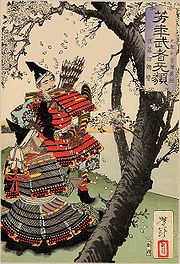
- Grunwald Center for the Graphic Arts, UCLA Hammer Museum: woodcut print -- "Ushiwaka and Benki duelling on Gojo Bridge" or "Gojo Bridge, an episode from the Life of Yoshitsune, Chronicles of Yoshitsune" by Tuskioka Yoshitoshi (1839-1892)