

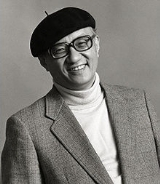
Osamu Tezuka

Encyclopedia
was a Japanese cartoonist
, manga artist
, animator
, producer, activist and medical doctor, although he never practiced medicine. Born in Osaka Prefecture
, he is best known as the creator of Astro Boy
, Kimba the White Lion
and Black Jack
. He is often credited as the "Godfather of Anime
", and is often considered the Japanese equivalent to Walt Disney
, who served as a major inspiration during his formative years. His prolific output, pioneering techniques, and innovative redefinitions of genres earned him such titles as "the father of manga
", "the god of comics" and "kami
sama of manga". His grave is located in Tokyo
's Souzen-ji Temple Cemetery.
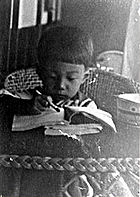 Osamu was born, as the eldest son of three children of Tezuka family, on November 3, 1928, in Toyonaka City
, Osaka
. His nickname was gashagasha-atama (gashagasha is slang for messy, atama means head). His mother often comforted him by telling him to look to the blue skies, giving him confidence. His mother's stories inspired his creativity as well. Tezuka grew up in Takarazuka City
, Hyōgo
and his mother often took him to the Takarazuka Theatre. The Takarazuka Revue
that performed at the theatre is made up in its entirety of women, and so male characters are also played by women. The Takarazuka Revue is known for its romantic musicals usually aimed at a female audience, thus having a large impact on the later works of Tezuka, including his costuming designs. He has said that he has a profound "spirit of nostalgia" for Takarazuka. His animation production company was named Mushi (insect) Production.
He started to draw comics around his second year of elementary school. Around his fifth year he found a bug named "Osamushi
". It so resembled his name that he adopted osamushi as his pen name. He came to the realization that he could use manga as a means of helping to convince people to care for the world. After World War II
, he created his first piece of work (at age 17), Diary of Ma-chan and then Shin Takarajima (New Treasure Island), which began the golden age of manga, a craze comparable to American comic book
s at the time.
Japanese manga artists call him "Manga-no-kami sama" [the god of manga].
was invented by Tezuka, drawing inspirations on cartoons of the time such as Betty Boop
and Walt Disney
's Bambi
and Mickey Mouse
. As an indication of his productivity, the Complete Manga Works of Tezuka Osamu (手塚治虫漫画全集, published in Japan) comprises some 400 volumes, over 80,000 pages; even so, it is not comprehensive. His complete oeuvre includes over 700 manga
with more than 150,000 pages. However, the vast majority of his work has never been translated from the original Japanese and is thus inaccessible to people who do not read Japanese.
When he was younger, Tezuka's arms swelled up and he became ill. He was treated and cured by a doctor which made him want to be a doctor. However, he began his career as a manga artist while a university student, drawing his first professional work while at school. At a crossing point, he asked his mother whether he should look into doing manga full time or whether he should become a doctor. At the time, being a manga author was not a particularly rewarding job. The answer his mother gave was: "You should work doing the thing you like most of all." Tezuka decided to devote himself to manga creation on a full-time basis. He graduated from Osaka University
and obtained his medical degree, but he would later use his medical and scientific knowledge to enrich his sci-fi manga, such as Black Jack
.
His creations include Astro Boy (Tetsuwan Atomu in Japan, literally translated to "Iron-armed Atom"), Black Jack
, Princess Knight
, Phoenix
(Hi no Tori in Japan), Kimba the White Lion
, Adolf
and Buddha
. His "life's work" was Phoenix
— a story of life and death that he began in the 1950s and continued until his death.
In January 1965, Tezuka received a letter from Stanley Kubrick
, who had watched Astro Boy and wanted to invite Tezuka to be the art director of his next movie 2001: A Space Odyssey
. Tezuka could not afford to leave his studio for an entire year to live in England, so he refused the invitation. Though he could not work on it, he loved the movie, and would play its soundtrack at maximum volume in his studio to keep him awake during the long nights of work.
Tezuka headed the animation production studio Mushi Production
("Bug Production"), which pioneered TV animation in Japan. The name of the studio derives from one of the kanji
(虫 - Japanese reading: mushi, English meaning: bug,insect) used to write his name.
Many young manga artists once lived in the apartment where Tezuka lived, Tokiwa-so
. (As the suffix -so indicates, this was probably a small, inexpensive apartment.) The residents included Shotaro Ishinomori
; Fujio Akatsuka
; and Abiko Motou and Hiroshi Fujimoto (who worked together under the pen name Fujiko Fujio
).
He was a personal friend (and apparent artistic influence) of Brazil
ian comic book artist Mauricio de Sousa
.
Tezuka died of stomach cancer
on February 9, 1989, at the age of 60. His death came about one month after the death of Hirohito
, the Shōwa
Emperor of Japan. In an afterword written by Takayuki Matsutani, president of Mushi Productions, that was published in Viz Media
's English language release of the Hi no Tori manga, it is said that his last words were, "I'm begging you, let me work!"
The city of Takarazuka, Hyōgo
, where Tezuka grew up, opened a museum in his memory. Stamps were issued in his honor in 1997. Also, beginning in 2003 the Japanese toy company Kaiyodo
began manufacturing a series of figurines of Tezuka's creations, including Princess Knight, Unico, the Phoenix, Dororo, Marvelous Melmo, Ambassador Magma and many others. To date three series of the figurines have been released. A separate Astro Boy series of figurines has also been issued, and continuing popularity for fans throughout Japan are annual Tezuka calendars with some of Tezuka's most famous artwork.
His legacy has continued to be honored among Manga artists and animators and many artists including Hayao Miyazaki
(Spirited Away
), Akira Toriyama
(Dragon Ball
), and Kazuki Takahashi
(Yu-Gi-Oh!
) have cited Tezuka an inspiration for their works.
. His work, like that of other manga creators, was sometimes gritty and violent. However, he stayed away from graphic violence in some titles such as Astro Boy.
The years cited beside each title refer to the period of manga serialization.
Museum
(宝塚市立手塚治虫記念館, Takarazuka's Tezuka Osamu Memorial Hall) was inaugurated on April 25 of 1994 and has three floors (15069.47 ft²). In the basement there is an "Animation Workshop" in which visitors can make their own animations, and a mockup of the city of Takarazuka
and a replica of the table where Osamu Tezuka worked.
On the ground floor on the way before the building's entrance, are imitations of the hands and feet of several characters from Tezuka (as in a true walk of fame) and on the inside, the entry hall, a replica of Princess Knight
's furniture. On the same floor, is a permanent exhibition of manga
and a room for the display of anime
. The exhibition is divided into two parts: Osamu Tezuka and the city of Takarazuka
and Osamu Tezuka, the author.
On the first floor are held several exhibitions and are available a Manga
Library
, with five hundred works of Tezuka (some foreign editions are also present), a video library and a lounge with a decor inspired by Kimba the White Lion
.
There is also a center of glass that represents the planet Earth
and is based on a book written by him in his childhood called "Our Earth of Glass".
and was made honorable chairman of the Superman Fan Club in Japan. His son Makoto Tezuka, would later become a film and anime director. He gave guidance to many known cartoonists such as Shotaro Ishinomori
and Go Nagai
.
Tezuka enjoyed bug collecting, entomology, Walt Disney, baseball, and licensed the "grown up" version of his character Kimba the White Lion as the logo for the Seibu Lions of the Nippon Professional Baseball League. Tezuka met Walt Disney in person, who wanted to hire Tezuka.
Tezuka is a descendent of Hattori Hanzo
, a famous ninja and samurai who faithfully served Tokugawa Ieyasu during the Sengoku period in Japan.
Cartoonist
A cartoonist is a person who specializes in drawing cartoons. This work is usually humorous, mainly created for entertainment, political commentary or advertising...
, manga artist
Mangaka
is the Japanese word for a comic artist or cartoonist. Outside of Japan, manga usually refers to a Japanese comic book and mangaka refers to the author of the manga, who is usually Japanese...
, animator
Animator
An animator is an artist who creates multiple images that give an illusion of movement called animation when displayed in rapid sequence; the images are called frames and key frames. Animators can work in a variety of fields including film, television, video games, and the internet. Usually, an...
, producer, activist and medical doctor, although he never practiced medicine. Born in Osaka Prefecture
Osaka Prefecture
is a prefecture located in the Kansai region on Honshū, the main island of Japan. The capital is the city of Osaka. It is the center of Osaka-Kobe-Kyoto area.- History :...
, he is best known as the creator of Astro Boy
Astro Boy (1960s)
is a Japanese manga series first published in 1952 and television program first broadcast in Japan in 1963. The story follows the adventures of a robot named Astro Boy and a selection of other characters along the way....
, Kimba the White Lion
Kimba the White Lion
, known in the United States as Kimba the White Lion, is an anime series from the 1960s. Created by Osamu Tezuka and based on his manga of the same title which began publication in 1950, it was the first color animated television series created in Japan. The manga was first published in serialized...
and Black Jack
Black Jack (manga)
is a manga written and illustrated by Osamu Tezuka in the 1970s, dealing with the medical adventures of the title character, doctor Black Jack....
. He is often credited as the "Godfather of Anime
Anime
is the Japanese abbreviated pronunciation of "animation". The definition sometimes changes depending on the context. In English-speaking countries, the term most commonly refers to Japanese animated cartoons....
", and is often considered the Japanese equivalent to Walt Disney
Walt Disney
Walter Elias "Walt" Disney was an American film producer, director, screenwriter, voice actor, animator, entrepreneur, entertainer, international icon, and philanthropist, well-known for his influence in the field of entertainment during the 20th century. Along with his brother Roy O...
, who served as a major inspiration during his formative years. His prolific output, pioneering techniques, and innovative redefinitions of genres earned him such titles as "the father of manga
Manga
Manga is the Japanese word for "comics" and consists of comics and print cartoons . In the West, the term "manga" has been appropriated to refer specifically to comics created in Japan, or by Japanese authors, in the Japanese language and conforming to the style developed in Japan in the late 19th...
", "the god of comics" and "kami
Kami
is the Japanese word for the spirits, natural forces, or essence in the Shinto faith. Although the word is sometimes translated as "god" or "deity", some Shinto scholars argue that such a translation can cause a misunderstanding of the term...
sama of manga". His grave is located in Tokyo
Tokyo
, ; officially , is one of the 47 prefectures of Japan. Tokyo is the capital of Japan, the center of the Greater Tokyo Area, and the largest metropolitan area of Japan. It is the seat of the Japanese government and the Imperial Palace, and the home of the Japanese Imperial Family...
's Souzen-ji Temple Cemetery.
Early life
Toyonaka, Osaka
is a city located in Osaka Prefecture, Japan.As of 2010, the city has an estimated population of 388,633 and a population density of 10,680 persons per km². The total area is 36.38 km²...
, Osaka
Osaka Prefecture
is a prefecture located in the Kansai region on Honshū, the main island of Japan. The capital is the city of Osaka. It is the center of Osaka-Kobe-Kyoto area.- History :...
. His nickname was gashagasha-atama (gashagasha is slang for messy, atama means head). His mother often comforted him by telling him to look to the blue skies, giving him confidence. His mother's stories inspired his creativity as well. Tezuka grew up in Takarazuka City
Takarazuka, Hyogo
is a city located in Hyōgo Prefecture, Japan.- Geography :Takarazuka is nestled between the Rokko Range to the west and Nagao Range to the north with the Muko River running through the center of the city....
, Hyōgo
Hyogo Prefecture
is a prefecture of Japan located in the Kansai region on Honshū island. The capital is Kobe.The prefecture's name was previously alternately spelled as Hiogo.- History :...
and his mother often took him to the Takarazuka Theatre. The Takarazuka Revue
Takarazuka Revue
The Takarazuka Revue is a Japanese all-female musical theater troupe based in Takarazuka, Hyōgo Prefecture, Japan. Women play all roles in lavish, Broadway-style productions of Western-style musicals, and sometimes stories adapted from shōjo manga and Japanese folktales. The troupe takes its name...
that performed at the theatre is made up in its entirety of women, and so male characters are also played by women. The Takarazuka Revue is known for its romantic musicals usually aimed at a female audience, thus having a large impact on the later works of Tezuka, including his costuming designs. He has said that he has a profound "spirit of nostalgia" for Takarazuka. His animation production company was named Mushi (insect) Production.
He started to draw comics around his second year of elementary school. Around his fifth year he found a bug named "Osamushi
Ground beetle
Ground beetles are a large, cosmopolitan family of beetles, Carabidae, with more than 40,000 species worldwide, approximately 2,000 of which are found in North America and 2,700 in Europe.-Description and ecology:...
". It so resembled his name that he adopted osamushi as his pen name. He came to the realization that he could use manga as a means of helping to convince people to care for the world. After World War II
World War II
World War II, or the Second World War , was a global conflict lasting from 1939 to 1945, involving most of the world's nations—including all of the great powers—eventually forming two opposing military alliances: the Allies and the Axis...
, he created his first piece of work (at age 17), Diary of Ma-chan and then Shin Takarajima (New Treasure Island), which began the golden age of manga, a craze comparable to American comic book
American comic book
An American comic book is a small magazine originating in the United States and containing a narrative in the form of comics. Since 1975 the dimensions have standardized at 6 5/8" x 10 ¼" , down from 6 ¾" x 10 ¼" in the Silver Age, although larger formats appeared in the past...
s at the time.
Japanese manga artists call him "Manga-no-kami sama" [the god of manga].
Works
The distinctive "large eyes" style of Japanese animationAnime
is the Japanese abbreviated pronunciation of "animation". The definition sometimes changes depending on the context. In English-speaking countries, the term most commonly refers to Japanese animated cartoons....
was invented by Tezuka, drawing inspirations on cartoons of the time such as Betty Boop
Betty Boop
Betty Boop is an animated cartoon character created by Max Fleischer, with help from animators including Grim Natwick. She originally appeared in the Talkartoon and Betty Boop film series, which were produced by Fleischer Studios and released by Paramount Pictures. She has also been featured in...
and Walt Disney
Walt Disney
Walter Elias "Walt" Disney was an American film producer, director, screenwriter, voice actor, animator, entrepreneur, entertainer, international icon, and philanthropist, well-known for his influence in the field of entertainment during the 20th century. Along with his brother Roy O...
's Bambi
Bambi
Bambi is a 1942 American animated film directed by David Hand , produced by Walt Disney and based on the book Bambi, A Life in the Woods by Austrian author Felix Salten...
and Mickey Mouse
Mickey Mouse
Mickey Mouse is a cartoon character created in 1928 by Walt Disney and Ub Iwerks at The Walt Disney Studio. Mickey is an anthropomorphic black mouse and typically wears red shorts, large yellow shoes, and white gloves...
. As an indication of his productivity, the Complete Manga Works of Tezuka Osamu (手塚治虫漫画全集, published in Japan) comprises some 400 volumes, over 80,000 pages; even so, it is not comprehensive. His complete oeuvre includes over 700 manga
Manga
Manga is the Japanese word for "comics" and consists of comics and print cartoons . In the West, the term "manga" has been appropriated to refer specifically to comics created in Japan, or by Japanese authors, in the Japanese language and conforming to the style developed in Japan in the late 19th...
with more than 150,000 pages. However, the vast majority of his work has never been translated from the original Japanese and is thus inaccessible to people who do not read Japanese.
When he was younger, Tezuka's arms swelled up and he became ill. He was treated and cured by a doctor which made him want to be a doctor. However, he began his career as a manga artist while a university student, drawing his first professional work while at school. At a crossing point, he asked his mother whether he should look into doing manga full time or whether he should become a doctor. At the time, being a manga author was not a particularly rewarding job. The answer his mother gave was: "You should work doing the thing you like most of all." Tezuka decided to devote himself to manga creation on a full-time basis. He graduated from Osaka University
Osaka University
, or , is a major national university located in Osaka, Japan. It is the sixth oldest university in Japan as the Osaka Prefectural Medical College, and formerly one of the Imperial Universities of Japan...
and obtained his medical degree, but he would later use his medical and scientific knowledge to enrich his sci-fi manga, such as Black Jack
Black Jack (manga)
is a manga written and illustrated by Osamu Tezuka in the 1970s, dealing with the medical adventures of the title character, doctor Black Jack....
.
His creations include Astro Boy (Tetsuwan Atomu in Japan, literally translated to "Iron-armed Atom"), Black Jack
Black Jack (manga)
is a manga written and illustrated by Osamu Tezuka in the 1970s, dealing with the medical adventures of the title character, doctor Black Jack....
, Princess Knight
Princess Knight
is a Japanese manga that ran through four serializations from 1954 to 1968, as well as a 1967 Japanese children's animated series. It was dubbed into English and brought over to Western audiences in 1970, where it was called Choppy and the Princess. In 1973, this series was dubbed in Portuguese and...
, Phoenix
Phoenix (manga)
is a manga series by Osamu Tezuka. Tezuka considered Phoenix his "life's work"; it consists of 12 books, each of which tells a separate, self-contained story and takes place in a different era. The plots go back and forth from the remote future to prehistoric times. The cycle remains unfinished...
(Hi no Tori in Japan), Kimba the White Lion
Kimba the White Lion
, known in the United States as Kimba the White Lion, is an anime series from the 1960s. Created by Osamu Tezuka and based on his manga of the same title which began publication in 1950, it was the first color animated television series created in Japan. The manga was first published in serialized...
, Adolf
Adolf (manga)
Adolf, known in Japan as is a manga series made by Dr. Osamu Tezuka.Adolf was published in English by Cadence Books and VIZ Media. The English manga is flipped to read left to right to conform to Western practice....
and Buddha
Buddha (manga)
is a manga drawn by Osamu Tezuka and is Tezuka's unique interpretation of the life of Gautama Buddha, the founder of Buddhism. The critically acclaimed series is often referred to as a gritty, even sexual, portrayal of the Buddha's life. Buddha received the 2004, 2005 Eisner Award...
. His "life's work" was Phoenix
Phoenix (manga)
is a manga series by Osamu Tezuka. Tezuka considered Phoenix his "life's work"; it consists of 12 books, each of which tells a separate, self-contained story and takes place in a different era. The plots go back and forth from the remote future to prehistoric times. The cycle remains unfinished...
— a story of life and death that he began in the 1950s and continued until his death.
In January 1965, Tezuka received a letter from Stanley Kubrick
Stanley Kubrick
Stanley Kubrick was an American film director, writer, producer, and photographer who lived in England during most of the last four decades of his career...
, who had watched Astro Boy and wanted to invite Tezuka to be the art director of his next movie 2001: A Space Odyssey
2001: A Space Odyssey (film)
2001: A Space Odyssey is a 1968 epic science fiction film produced and directed by Stanley Kubrick, and co-written by Kubrick and Arthur C. Clarke, partially inspired by Clarke's short story The Sentinel...
. Tezuka could not afford to leave his studio for an entire year to live in England, so he refused the invitation. Though he could not work on it, he loved the movie, and would play its soundtrack at maximum volume in his studio to keep him awake during the long nights of work.
Tezuka headed the animation production studio Mushi Production
Mushi Production
Mushi Production , or Mushi Pro for short, is a Japanese animation studio headquartered in Nerima, Tokyo, Japan....
("Bug Production"), which pioneered TV animation in Japan. The name of the studio derives from one of the kanji
Kanji
Kanji are the adopted logographic Chinese characters hanzi that are used in the modern Japanese writing system along with hiragana , katakana , Indo Arabic numerals, and the occasional use of the Latin alphabet...
(虫 - Japanese reading: mushi, English meaning: bug,insect) used to write his name.
Many young manga artists once lived in the apartment where Tezuka lived, Tokiwa-so
Tokiwa-so
was an apartment where Osamu Tezuka and many young manga artists once lived before they became famous. Tokiwa-sō was a small, inexpensive apartment in Toshima-ku, Tokyo. Residents included Shotaro Ishinomori, Fujio Akatsuka, Fujiko Fujio, Yoshiharu Tsuge...
. (As the suffix -so indicates, this was probably a small, inexpensive apartment.) The residents included Shotaro Ishinomori
Shotaro Ishinomori
was a Japanese manga artist who became an influential figure in manga, anime, and tokusatsu, creating several immensely popular long-running series such as Cyborg 009 and Himitsu Sentai Goranger, what would go on to become part of the Super Sentai series, and the Kamen Rider Series...
; Fujio Akatsuka
Fujio Akatsuka
was a pioneer Japanese artist of comical manga known as the Gag Manga King. His name at birth is 赤塚 藤雄, whose Japanese pronunciation is the same as 赤塚 不二夫....
; and Abiko Motou and Hiroshi Fujimoto (who worked together under the pen name Fujiko Fujio
Fujiko Fujio
was a nom de plume of a manga writing duo formed by two Japanese manga artists. Their real names are and . They formed their partnership in 1951, and used the Fujiko Fujio name from 1954 until dissolution of the partnership in 1987....
).
He was a personal friend (and apparent artistic influence) of Brazil
Brazil
Brazil , officially the Federative Republic of Brazil , is the largest country in South America. It is the world's fifth largest country, both by geographical area and by population with over 192 million people...
ian comic book artist Mauricio de Sousa
Mauricio de Sousa
Mauricio de Sousa is a Brazilian cartoonist who has created over 200 characters for his popular series of children's comic books....
.
Tezuka died of stomach cancer
Stomach cancer
Gastric cancer, commonly referred to as stomach cancer, can develop in any part of the stomach and may spread throughout the stomach and to other organs; particularly the esophagus, lungs, lymph nodes, and the liver...
on February 9, 1989, at the age of 60. His death came about one month after the death of Hirohito
Hirohito
, posthumously in Japan officially called Emperor Shōwa or , was the 124th Emperor of Japan according to the traditional order, reigning from December 25, 1926, until his death in 1989. Although better known outside of Japan by his personal name Hirohito, in Japan he is now referred to...
, the Shōwa
Showa period
The , or Shōwa era, is the period of Japanese history corresponding to the reign of the Shōwa Emperor, Hirohito, from December 25, 1926 through January 7, 1989.The Shōwa period was longer than the reign of any previous Japanese emperor...
Emperor of Japan. In an afterword written by Takayuki Matsutani, president of Mushi Productions, that was published in Viz Media
VIZ Media
VIZ Media, LLC, headquartered in San Francisco, is an anime, manga, and Japanese entertainment company. It was founded in 1986 as VIZ LLC. In 2005, VIZ LLC and ShoPro Entertainment merged to form the current VIZ Media LLC, which is jointly owned by Japanese publishers Shogakukan and Shueisha, and...
's English language release of the Hi no Tori manga, it is said that his last words were, "I'm begging you, let me work!"
The city of Takarazuka, Hyōgo
Takarazuka, Hyogo
is a city located in Hyōgo Prefecture, Japan.- Geography :Takarazuka is nestled between the Rokko Range to the west and Nagao Range to the north with the Muko River running through the center of the city....
, where Tezuka grew up, opened a museum in his memory. Stamps were issued in his honor in 1997. Also, beginning in 2003 the Japanese toy company Kaiyodo
Kaiyodo
thumb|320px|Kaiyodo Figure Museum Kurokabe is a Japanese company dedicated to figurines and garage kits. Its headquarters is in Kadoma, Osaka Prefecture. While the company mostly focuses on anime related characters, it recently has acquired other licenses, e.g...
began manufacturing a series of figurines of Tezuka's creations, including Princess Knight, Unico, the Phoenix, Dororo, Marvelous Melmo, Ambassador Magma and many others. To date three series of the figurines have been released. A separate Astro Boy series of figurines has also been issued, and continuing popularity for fans throughout Japan are annual Tezuka calendars with some of Tezuka's most famous artwork.
His legacy has continued to be honored among Manga artists and animators and many artists including Hayao Miyazaki
Hayao Miyazaki
is a Japanese manga artist and prominent film director and animator of many popular anime feature films. Through a career that has spanned nearly fifty years, Miyazaki has attained international acclaim as a maker of animated feature films and, along with Isao Takahata, co-founded Studio Ghibli,...
(Spirited Away
Spirited Away
is a 2001 Japanese animated fantasy-adventure film written and directed by Hayao Miyazaki and produced by Studio Ghibli. The film tells the story of Chihiro Ogino, a sullen ten-year-old girl who, while moving to a new neighborhood and after her parents are transformed into pigs by the witch Yubaba,...
), Akira Toriyama
Akira Toriyama
is a Japanese manga artist and game artist known mostly for his creation of Dragon Ball in 1984. Toriyama admires Osamu Tezuka's Astro Boy and was impressed by Walt Disney's One Hundred and One Dalmatians, which he remembers for the great art...
(Dragon Ball
Dragon Ball
is a Japanese manga series written and illustrated by Akira Toriyama. It was originally serialized in Weekly Shōnen Jump from 1984 to 1995; later the 519 individual chapters were published into 42 tankōbon volumes by Shueisha. Dragon Ball was inspired by the classical Chinese novel Journey to the...
), and Kazuki Takahashi
Kazuki Takahashi
is a manga artist, illustrator and game creator who created the manga Yu-Gi-Oh!, which led to the anime versions of it, Toei's Yu-Gi-Oh! and Yu-Gi-Oh! Duel Monsters , as well as a spinoff manga , three spinoff anime and several video games, novels and books...
(Yu-Gi-Oh!
Yu-Gi-Oh!
is a Japanese manga created by Kazuki Takahashi. It has produced a franchise that includes multiple anime shows, a trading card game and numerous video games...
) have cited Tezuka an inspiration for their works.
Style
Tezuka is known for his imaginative stories and stylized Japanese adaptations of western literature. He loved reading novels and watching films that came from the West. Tezuka's early works included manga versions of Disney movies such as BambiBambi
Bambi is a 1942 American animated film directed by David Hand , produced by Walt Disney and based on the book Bambi, A Life in the Woods by Austrian author Felix Salten...
. His work, like that of other manga creators, was sometimes gritty and violent. However, he stayed away from graphic violence in some titles such as Astro Boy.
Awards
- 1958 Shogakukan Manga AwardShogakukan Manga AwardThe is one of Japan's major manga awards, sponsored by Shogakukan Publishing. It has been awarded annually for serialized manga since 1955 and features candidates from a number of publishers.The current award categories are:...
for Manga Seminar on Biology and Biiko-chanBiiko-chanis a three volume manga picture book series created in 1957 by Osamu Tezuka for second year elementary school students. The series won the 3rd Shogakukan Manga Award in 1958.-External links:*... - 1975 BungeishunjūBungeishunju, established in 1923, is a Japanese publishing company known for its leading monthly magazine Bungeishunjū. It also grants the annual Akutagawa Prize, one of the most prestigious literary awards in Japan, as well as the annual Naoki Prize for popular novelists. It also grants the annual...
manga Award - 1975 Japan Mangaka Association Award — Special Award
- 1977 Kodansha Manga AwardKodansha Manga Awardis an annual award for serialized manga published in the previous year, sponsored by the publisher Kodansha. It is currently awarded in four categories: children's, shōnen, shōjo, and general. The awards began in 1977, initially with categories for shōnen and shōjo. The first award for the...
for Black JackBlack Jack (manga)is a manga written and illustrated by Osamu Tezuka in the 1970s, dealing with the medical adventures of the title character, doctor Black Jack....
and The Three-Eyed OneThe Three-Eyed Oneis a romance SF manga by Osamu Tezuka. It was originally serialized in Weekly Shōnen Magazine from 7 July 1974 through 19 March 1978 and was later published into thirteen tankoubon by Kodansha.... - 1983 Shogakukan Manga AwardShogakukan Manga AwardThe is one of Japan's major manga awards, sponsored by Shogakukan Publishing. It has been awarded annually for serialized manga since 1955 and features candidates from a number of publishers.The current award categories are:...
for Hidamari no KiHidamari no Kiis a Japanese manga series written an illustrated by Osamu Tezuka about a friendship between a samurai and a doctor in the final days of the Tokugawa Shogunate... - 1984 Animafest Zagreb Grand Prize for Jumping
- 1985 Hiroshima International Animation FestivalHiroshima International Animation FestivalThe International Animation Festival Hiroshima is a biannual animation festival hosted in Hiroshima, Japan.The festival was found in 1985 by Association International du Film d'Animation or ASIFA as International Animation Festival for the World Peace...
for Onboro-Film - 1986 Kodansha Manga AwardKodansha Manga Awardis an annual award for serialized manga published in the previous year, sponsored by the publisher Kodansha. It is currently awarded in four categories: children's, shōnen, shōjo, and general. The awards began in 1977, initially with categories for shōnen and shōjo. The first award for the...
for AdolfAdolf (manga)Adolf, known in Japan as is a manga series made by Dr. Osamu Tezuka.Adolf was published in English by Cadence Books and VIZ Media. The English manga is flipped to read left to right to conform to Western practice.... - 1989 Nihon SF Taisho AwardNihon SF Taisho AwardNihon SF Taishō Award is a Japanese science fiction award. It has been compared to the Nebula Award as it is given by the Science Fiction and Fantasy Writers of Japan or SFWJ...
- Special Award - 1989 ZuihōshoOrder of the Sacred TreasuresThe is a Japanese Order, established on January 4, 1888 by Emperor Meiji of Japan as the Order of Meiji. It is awarded in eight classes . It is generally awarded for long and/or meritorious service and considered to be the lowest of the Japanese orders of merit...
3rd class - 2004 Eisner AwardEisner AwardThe Will Eisner Comic Industry Awards, commonly shortened to the Eisner Awards, and sometimes referred to as the Oscar Awards of the Comics Industry, are prizes given for creative achievement in American comic books. The Eisner Awards were first conferred in 1988, created in response to the...
for BuddhaBuddha (manga)is a manga drawn by Osamu Tezuka and is Tezuka's unique interpretation of the life of Gautama Buddha, the founder of Buddhism. The critically acclaimed series is often referred to as a gritty, even sexual, portrayal of the Buddha's life. Buddha received the 2004, 2005 Eisner Award...
(vols. 1–2) - 2005 Eisner Award for Buddha (vols. 3–4)
- 2009 Eisner Award for DororoDororois a Japanese manga series from the critically acclaimed manga creator Osamu Tezuka in the late 1960s. The anime television series based on the manga consists of 26 half-hour episodes. It was made into a live-action film in 2007....
Selected manga and anime
For a more complete list, see List of Osamu Tezuka manga and List of Osamu Tezuka animeThe years cited beside each title refer to the period of manga serialization.
- MetropolisMetropolis (manga), also known as Osamu Tezuka's Metropolis or Robotic Angel is a Japanese manga by Osamu Tezuka published in 1949. It has been adapted into a feature length anime, released in 2001...
, 1949. One of Tezuka's early science fiction works, about a private detective, Higeoyaji, who tries to take care of Mitchy, a gender switching robot, after its creator is killed. It would be made into a 2001 animated film. The 2001 film was heavily influenced by the Fritz LangFritz LangFriedrich Christian Anton "Fritz" Lang was an Austrian-American filmmaker, screenwriter, and occasional film producer and actor. One of the best known émigrés from Germany's school of Expressionism, he was dubbed the "Master of Darkness" by the British Film Institute...
film Metropolis, as well as Tezuka's manga. It is said that Tezuka never even saw the 1927 film but was inspired by the poster of the film.
- Jungle Taitei (Jungle Emperor), 1950–54. Better known by these other names in the English speaking world as Kimba the White LionKimba the White Lion, known in the United States as Kimba the White Lion, is an anime series from the 1960s. Created by Osamu Tezuka and based on his manga of the same title which began publication in 1950, it was the first color animated television series created in Japan. The manga was first published in serialized...
, this manga established one of Tezuka's most iconic creations. His first full-scale long serial, Jungle Taitei follows the adventures of Leo the white lion as he seeks to succeed his father, killed by a hunter, as king of the jungle. In 1965, Tezuka's Mushi Productions, financed by NBC Enterprises, produced a 52-episode anime series loosely based on the manga. This was followed immediately by a 26-episode sequel, produced by Mushi Productions alone. This sequel was dubbed into English in 1984 under the title Leo the LionLeo the Lion (anime)is a sequel to the Japanese-American co-produced series "Jungle Emperor", or Kimba the White Lion. Osamu Tezuka had always wanted his story of Kimba to follow Kimba's entire life, and the Jungle Emperor/Kimba series was such a hit in Japan that Dr...
. A full-length animated film based on the last half of Tezuka's original manga was released theatrically in 1997 under the title Jungle Emperor LeoJungle Emperor LeoJungle Emperor Leo, known in Japan as is a 1997 animated movie focusing on the last half of Osamu Tezuka's epic manga, Jungle Taitei...
. A New 30 minute short was shown on Fuji TV on September 5, 2009. It was directed by Goro Taniguchi creator of Code Geass and Planetes.
- Tetsuwan ATOM (Astro Boy), 1952–68. A sequel to Captain ATOM (1951), with Atom (Atomu in Japanese, renamed Astro Boy in the U.S.) as its main character. Eventually, Astro Boy would become Tezuka's most famous creation. He created the nuclear-powered, yet peace-loving, boy robot first after being punched in the face by a drunken GI. In 1963, Astro Boy made its debut as the first domestically produced animated program on Japanese television. The 30-minute weekly program (of which 193 episodes were produced) led to the first craze for anime in Japan. In America, the TV series (which consisted of 104 episodes licensed from the Japanese run) was also a hit, becoming the first Japanese animation to be shown on U.S. television, although the U.S. producers downplayed and disguised the show's Japanese origins. Several other Astro Boy series have been made since, as well as a 2009 CGI-animatedComputer-generated imageryComputer-generated imagery is the application of the field of computer graphics or, more specifically, 3D computer graphics to special effects in art, video games, films, television programs, commercials, simulators and simulation generally, and printed media...
feature film Astro BoyAstro Boy (film)Astro Boy, also called in Japan, is a 2009 computer-animated film loosely based on the long-running Japanese series of the same name by Osamu Tezuka. It was produced by Imagi Animation Studios, the animation production company of TMNT. The studio announced the project in September 2006...
.
- Ribon no Kishi (Princess KnightPrincess Knightis a Japanese manga that ran through four serializations from 1954 to 1968, as well as a 1967 Japanese children's animated series. It was dubbed into English and brought over to Western audiences in 1970, where it was called Choppy and the Princess. In 1973, this series was dubbed in Portuguese and...
), 1953–56. A gender-bending adventure drama about Princess Sapphire, a girl who must pretend to be a boy—and whose body, in fact, has two human hearts; a boy's and a girl's. The manga was inspired by the themes and styles of musicals by the all-girl Takarazuka RevueTakarazuka RevueThe Takarazuka Revue is a Japanese all-female musical theater troupe based in Takarazuka, Hyōgo Prefecture, Japan. Women play all roles in lavish, Broadway-style productions of Western-style musicals, and sometimes stories adapted from shōjo manga and Japanese folktales. The troupe takes its name...
, which Tezuka had watched in his youth. Ribon no Kishi itself established many of the themes and styles of later shōjoShojoThe term refers to manga marketed to a female audience roughly between the ages of 10-18. The name romanizes the Japanese 少女 , literally: "little female". Shōjo manga covers many subjects in a variety of narrative and graphic styles, from historical drama to science fiction — often with a strong...
manga (girls' manga), such as its affinity for androgynous heroes, and is sometimes referred to as "the Mother of all shōjo manga." It was made into an anime TV series in 1967, and the anime has been dubbed into English and sporadically broadcast on TV in the United States and other English-speaking countries; also known in English as Choppy and the Princess. The series was the first anime produced in color, and the quality of the show's art is still impressive, even today. In spite of the series' obscurity in the United States due to legal and distribution problems, the series has turned out to be one of Tezuka's most popular creations practically everywhere else. It's known in Spanish-speaking countries as La princesa caballero, in Germany as Choppy und die Prinzessin, in Italy as La Principessa Zaffiro, in Portugal and Brazil as Princesa e o Cavaleiro, in France as "Prince Saphir" and in Poland under no less than five different titles, including Czopi i Księżniczka. A new musical version of Princess Knight was performed in August 2006 starring the members of the all-female pop group Morning MusumeMorning Musume, sometimes referred to as is a Japanese idol girl group, whose act generally revolves around singing and dancing to upbeat melodies. They are the lead group of Hello! Project, which is managed and produced by Tsunku, who composes nearly all the lyrics and melodies of their songs...
. An excerpt from the manga will be published in the June 19, 2007 issue of Shojo BeatShojo BeatShojo Beat is a shōjo manga magazine formerly published in North America by Viz Media. Released in June 2005 as a sister magazine to Shonen Jump, it featured serialized chapters from six manga series, as well as articles on Japanese culture, manga, anime, fashion and beauty...
from VIZVizViz. and the adverb videlicet are used as synonyms for "namely", "that is to say", and "as follows".-Etymology:...
. The entire manga had previously been released in bilingual (English/Japanese) volumes from Kodansha Bilingual ComicsKodansha, the largest Japanese publisher, produces the manga magazines Nakayoshi, Afternoon, Evening, and Weekly Shonen Magazine, as well as more literary magazines such as Gunzō, Shūkan Gendai, and the Japanese dictionary Nihongo Daijiten. The company has its headquarters in Bunkyō, Tokyo...
. As of 2011, Vertical acquired the rights to Princess Knight for the North American market.
- Hi no Tori (PhoenixPhoenix (manga)is a manga series by Osamu Tezuka. Tezuka considered Phoenix his "life's work"; it consists of 12 books, each of which tells a separate, self-contained story and takes place in a different era. The plots go back and forth from the remote future to prehistoric times. The cycle remains unfinished...
), 1956–89. Tezuka's most profound and ambitious work, dealing with man's quest for immortality, ranging from the distant past to the far future. The central character is the Phoenix, the physical manifestation of the cosmos, who carries within itself the power of immortality; either granted by the Phoenix or taken from the Phoenix by drinking a small amount of its blood. Other characters appear and reappear throughout the series; usually due to their reincarnation. The work remained unfinished at the time of Tezuka's death in 1989. Phoenix has been filmed several times, most notably as Phoenix 2772Phoenix 2772is an animated feature film directed by Taku Sugiyama and co-scripted by Osamu Tezuka, based on his manga series Hi no Tori. It was then released in the UK in 1980 under the title Space Firebird, and later in the United States in 1983, shortened to 79 minutes and dubbed by British voice-actors...
(1980).
- Twin Knight, 1958. Twin Knight was a sequel to Princess Knight, and takes place several years after the end of the original series. In Twin Knight Princess Sapphire is now Queen Sapphire and is married to Frantz, her love interest in the original series. The main characters in Twin Knight are the twin children of Sapphire and Frantz, Prince Daisy and Princess Violetta. In keeping with the theme of the original series, following Prince Daisy's kidnapping, Princess Violetta must pretend to be both of them, all the while trying to discover the whereabouts of her brother. Although Twin Knight was originally published under the same Ribon no Kishi title during its short run, the title was changed in 1960 when the series was collected into a single volume. Ever since then it has been regarded as a separate series. No television version has ever been produced.
- Kureopatora (Cleopatra: Queen of Sex), 1970. The movie told the story of Cleopatra and her numerous romantic encounters with Julius CaesarJulius CaesarGaius Julius Caesar was a Roman general and statesman and a distinguished writer of Latin prose. He played a critical role in the gradual transformation of the Roman Republic into the Roman Empire....
and the other men in her life. When the film was released in the United StatesUnited StatesThe United States of America is a federal constitutional republic comprising fifty states and a federal district...
, American distributors released it under the title Cleopatra: Queen of Sex with an XX-ratedIn some countries, X is or has been a motion picture rating reserved for the most explicit films. Films rated X are intended only for viewing by adults, usually legally defined as people over the age of 17.-United Kingdom:...
rating in an attempt to cash in on the success of Fritz the CatFritz the Cat (film)Fritz the Cat is a 1972 American animated comedy film written and directed by Ralph Bakshi as his feature film debut. Based on the comic strip of the same name by Robert Crumb, the film was the first animated feature film to receive an X rating in the United States...
. In actuality, the film had not been submitted to the MPAAMotion Picture Association of AmericaThe Motion Picture Association of America, Inc. , originally the Motion Picture Producers and Distributors of America , was founded in 1922 and is designed to advance the business interests of its members...
, and it is considered to be highly unlikely that it would have received an X rating if it had been submitted. One critic described it as "kid stuff with naked breasts.." The film was not a success in Japan (partly due to financial troubles Tezuka's film company was having at the time), and is rarely seen today.
- Black JackBlack Jack (manga)is a manga written and illustrated by Osamu Tezuka in the 1970s, dealing with the medical adventures of the title character, doctor Black Jack....
, 1973–83. The story of Black JackBlack Jack (character)is a fictional character created by Osamu Tezuka, introduced in Weekly Shōnen Champion on November 19, 1973.-Character:Black Jack is a medical mercenary, selling his skills to the highest bidder. He is a shadowy figure, with a black cape, eerie black-and-white hair, and stitched-up scars worming...
, a talented surgeon who operates illegally, using radical and supernatural techniques to combat rare afflictions. Black Jack received the Japan Cartoonists' Association Special Award in 1975 and the Koudansha Manga Award in 1977. Three Black Jack TV movies were released between 2000-01. In fall 2004, a TV anime was aired in Japan with 61 episodes, releasing another movie afterward. A new series, titled Black Jack 21, started broadcasting on April 10, 2006. In September 2008, the first volume of the manga had been published in English by Vertical Publishing and more volumes are being published to this day.
Museum
The Osamu Tezuka MangaManga
Manga is the Japanese word for "comics" and consists of comics and print cartoons . In the West, the term "manga" has been appropriated to refer specifically to comics created in Japan, or by Japanese authors, in the Japanese language and conforming to the style developed in Japan in the late 19th...
Museum
Museum
A museum is an institution that cares for a collection of artifacts and other objects of scientific, artistic, cultural, or historical importance and makes them available for public viewing through exhibits that may be permanent or temporary. Most large museums are located in major cities...
(宝塚市立手塚治虫記念館, Takarazuka's Tezuka Osamu Memorial Hall) was inaugurated on April 25 of 1994 and has three floors (15069.47 ft²). In the basement there is an "Animation Workshop" in which visitors can make their own animations, and a mockup of the city of Takarazuka
Takarazuka, Hyogo
is a city located in Hyōgo Prefecture, Japan.- Geography :Takarazuka is nestled between the Rokko Range to the west and Nagao Range to the north with the Muko River running through the center of the city....
and a replica of the table where Osamu Tezuka worked.
On the ground floor on the way before the building's entrance, are imitations of the hands and feet of several characters from Tezuka (as in a true walk of fame) and on the inside, the entry hall, a replica of Princess Knight
Princess Knight
is a Japanese manga that ran through four serializations from 1954 to 1968, as well as a 1967 Japanese children's animated series. It was dubbed into English and brought over to Western audiences in 1970, where it was called Choppy and the Princess. In 1973, this series was dubbed in Portuguese and...
's furniture. On the same floor, is a permanent exhibition of manga
Manga
Manga is the Japanese word for "comics" and consists of comics and print cartoons . In the West, the term "manga" has been appropriated to refer specifically to comics created in Japan, or by Japanese authors, in the Japanese language and conforming to the style developed in Japan in the late 19th...
and a room for the display of anime
Anime
is the Japanese abbreviated pronunciation of "animation". The definition sometimes changes depending on the context. In English-speaking countries, the term most commonly refers to Japanese animated cartoons....
. The exhibition is divided into two parts: Osamu Tezuka and the city of Takarazuka
Takarazuka, Hyogo
is a city located in Hyōgo Prefecture, Japan.- Geography :Takarazuka is nestled between the Rokko Range to the west and Nagao Range to the north with the Muko River running through the center of the city....
and Osamu Tezuka, the author.
On the first floor are held several exhibitions and are available a Manga
Manga
Manga is the Japanese word for "comics" and consists of comics and print cartoons . In the West, the term "manga" has been appropriated to refer specifically to comics created in Japan, or by Japanese authors, in the Japanese language and conforming to the style developed in Japan in the late 19th...
Library
Library
In a traditional sense, a library is a large collection of books, and can refer to the place in which the collection is housed. Today, the term can refer to any collection, including digital sources, resources, and services...
, with five hundred works of Tezuka (some foreign editions are also present), a video library and a lounge with a decor inspired by Kimba the White Lion
Kimba the White Lion
, known in the United States as Kimba the White Lion, is an anime series from the 1960s. Created by Osamu Tezuka and based on his manga of the same title which began publication in 1950, it was the first color animated television series created in Japan. The manga was first published in serialized...
.
There is also a center of glass that represents the planet Earth
Earth
Earth is the third planet from the Sun, and the densest and fifth-largest of the eight planets in the Solar System. It is also the largest of the Solar System's four terrestrial planets...
and is based on a book written by him in his childhood called "Our Earth of Glass".
Personal life
Tezuka was a fan of SupermanSuperman
Superman is a fictional comic book superhero appearing in publications by DC Comics, widely considered to be an American cultural icon. Created by American writer Jerry Siegel and Canadian-born American artist Joe Shuster in 1932 while both were living in Cleveland, Ohio, and sold to Detective...
and was made honorable chairman of the Superman Fan Club in Japan. His son Makoto Tezuka, would later become a film and anime director. He gave guidance to many known cartoonists such as Shotaro Ishinomori
Shotaro Ishinomori
was a Japanese manga artist who became an influential figure in manga, anime, and tokusatsu, creating several immensely popular long-running series such as Cyborg 009 and Himitsu Sentai Goranger, what would go on to become part of the Super Sentai series, and the Kamen Rider Series...
and Go Nagai
Go Nagai
, better known by the penname , is a Japanese manga artist and a prolific author of science fiction, fantasy, horror and erotica. He made his professional debut in 1967 with Meakashi Polikichi, but is best known for creating Cutie Honey, Devilman, and Mazinger Z in the 1970s. In 2005, he became a...
.
Tezuka enjoyed bug collecting, entomology, Walt Disney, baseball, and licensed the "grown up" version of his character Kimba the White Lion as the logo for the Seibu Lions of the Nippon Professional Baseball League. Tezuka met Walt Disney in person, who wanted to hire Tezuka.
Tezuka is a descendent of Hattori Hanzo
Hattori Hanzo
, also known as , was a famous samurai and ninja master of the Sengoku era, credited with saving the life of Tokugawa Ieyasu and then helping him to become the ruler of united Japan. Today, he is often a subject of modern popular culture.-Biography:...
, a famous ninja and samurai who faithfully served Tokugawa Ieyasu during the Sengoku period in Japan.
See also
- Makoto Tezuka
- List of Osamu Tezuka manga
- List of Osamu Tezuka anime
- Osamu Tezuka's Star SystemOsamu Tezuka's Star SystemOver the course of his career, Osamu Tezuka reused the same characters in different roles in different stories. The way that Tezuka used the characters in his "star system" can be seen as somewhat analoguous to a film director frequently casting members of a regular "stable" of actors in different...
- Tezuka AwardTezuka AwardThe is a semi-annual manga award offered by the Japanese publisher Shueisha , under the auspices of its Weekly Shonen Jump magazine. It awards new comic artists in the Story Manga category. Its counterpart award, Akatsuka Award, awards new comic artists in the Comedic Manga category...
- Tezuka Osamu Cultural Prize
External links
- TezukaOsamu.net Official site in Japanese and English
- Tezuka in English (works, characters, bibliography, and fan index)
- Osamu Tezuka at Anime.com
- Tezuka Osamu Manga Museum Information page at TezukaOsamu.net
- The Osamu Tezuka Manga Museum Information page on city of TakarazukaTakarazukaTakarazuka can refer to* Takarazuka, a city in Hyōgo Prefecture, Japan* Takarazuka Revue, a popular all-female acting troupe in Japan that takes place in Tokyo Takarazuka Theater.* Takarazuka Eiga, a film production company from Takarazuka Revue theater...
municipal site - Based on Osamu Tezuka movies or at Universal Videogame List (Video games based on Osamu Tezuka works)
- Interview: Osamu Tezuka speaks at Hartford at web.archive.org
- Osamu Tezuka, A Japanese Godfather of Modern Day Manga