


Palermo stone

Encyclopedia
The Palermo Stone is a large fragment of a stele
known as the Royal Annals of the Old Kingdom
of Ancient Egypt
. It contains records of the kings of Egypt from the first dynasty
through the fifth dynasty
.
The fragment is in the Salinas Regional Archaeological Museum in Palermo
, Italy
, from which it derives its name. The term "Palermo Stone" is sometimes incorrectly applied to the entire Royal Annals, which also includes other fragments located in museums in Cairo
and London
that have never been in Palermo.
The stele, made of black basalt
, was engraved toward the end of the fifth dynasty, in the 25th century BC. It lists the kings of ancient Egypt following the unification of Lower Egypt
(the region of the Nile River Delta in the north of Egypt) and Upper Egypt
(extending from the middle of modern Egypt to the southern border with Nubia
).
The text begins by listing several thousands of years of rulers — presumed by many to be mythical — predating the rise of the god Horus
, who, according to the text, conferred the kingship on Menes
, the first human ruler listed. The text credits Menes with the unification of Egypt. (Another name for Menes is thought to be Narmer
, but this could be the name of the next ruler.)
The text goes on to list the names of the kings who ruled Egypt up to King Neferirkare Kakai
, a ruler of the early fifth dynasty, although the original stela may have recorded events after his reign on portions that have since been lost. Importance is given on the stone to the kings' mothers, like Betrest
and Meresankh I
.
.
The Palermo Stone fragment first entered the collection of the Palermo Archaeological Museum in 1866.
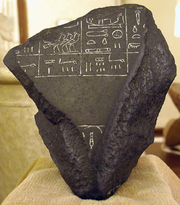 Other pieces of the stela are in the Egyptian Museum
in Cairo
and the Petrie Museum in London
. Most of the information on the stone concerning the first
and second
dynasties has not survived.
The ancient historian Manetho
may have used the complete stela to construct his chronology of the dynasties of Egypt, written in the third century BC.
. There are other sizeable pieces in the Egyptian Museum
in Cairo
, one discovered in 1910 and another purchased on the antiquities market in 1963, and in the museum of University College London
, given by Sir Flinders Petrie.
The original engraved stela must have been about 2.2 m long, 0.61 m wide and 6.5 cm thick, but most of it now is missing. There is no surviving information about its provenance, although another fragment of the stela was excavated at Memphis
.
list—formatted as a table, or outline, of the kings of ancient Egypt
before and after Menes, with regnal year
s and notations of events up until the time it was created, likely sometime during, or up until, the fifth dynasty since that is when its chronology ends. It also tabulates such information as the height of the Nile
flood, the Inundation
for some pharaohs (see Nilometer
), and information on the festivals (such as Sed festival
s), taxation, sculpture, buildings, and warfare for some.
Later lists, namely the Turin Canon
(13th century BC) and the Karnak king list
, identify Menes (c. 3100 or 3000) as the first king of the first dynasty and credit him with unifying Egypt. However, the Palermo stone, which is substantially older, lists rulers who predate Menes. This may indicate that the unification of Egypt occurred earlier than Menes's reign and that he simply reunited the nation after a period of fragmentation. However, scholars are divided on the implications of the stela. Some believe the earlier pharaohs existed historically, while others believe that their inclusion in the list has only ideological value (i.e., there must have been disorder before order).
Stele
A stele , also stela , is a stone or wooden slab, generally taller than it is wide, erected for funerals or commemorative purposes, most usually decorated with the names and titles of the deceased or living — inscribed, carved in relief , or painted onto the slab...
known as the Royal Annals of the Old Kingdom
Old Kingdom
Old Kingdom is the name given to the period in the 3rd millennium BC when Egypt attained its first continuous peak of civilization in complexity and achievement – the first of three so-called "Kingdom" periods, which mark the high points of civilization in the lower Nile Valley .The term itself was...
of Ancient Egypt
Ancient Egypt
Ancient Egypt was an ancient civilization of Northeastern Africa, concentrated along the lower reaches of the Nile River in what is now the modern country of Egypt. Egyptian civilization coalesced around 3150 BC with the political unification of Upper and Lower Egypt under the first pharaoh...
. It contains records of the kings of Egypt from the first dynasty
First dynasty of Egypt
The first dynasty of Ancient Egypt is often combined with the Dynasty II under the group title, Early Dynastic Period of Egypt...
through the fifth dynasty
Fifth dynasty of Egypt
The fifth dynasty of ancient Egypt is often combined with Dynasties III, IV and VI under the group title the Old Kingdom. Dynasty V dates approximately from 2494 to 2345 BC.-Rulers:...
.
The fragment is in the Salinas Regional Archaeological Museum in Palermo
Palermo
Palermo is a city in Southern Italy, the capital of both the autonomous region of Sicily and the Province of Palermo. The city is noted for its history, culture, architecture and gastronomy, playing an important role throughout much of its existence; it is over 2,700 years old...
, Italy
Italy
Italy , officially the Italian Republic languages]] under the European Charter for Regional or Minority Languages. In each of these, Italy's official name is as follows:;;;;;;;;), is a unitary parliamentary republic in South-Central Europe. To the north it borders France, Switzerland, Austria and...
, from which it derives its name. The term "Palermo Stone" is sometimes incorrectly applied to the entire Royal Annals, which also includes other fragments located in museums in Cairo
Cairo
Cairo , is the capital of Egypt and the largest city in the Arab world and Africa, and the 16th largest metropolitan area in the world. Nicknamed "The City of a Thousand Minarets" for its preponderance of Islamic architecture, Cairo has long been a centre of the region's political and cultural life...
and London
London
London is the capital city of :England and the :United Kingdom, the largest metropolitan area in the United Kingdom, and the largest urban zone in the European Union by most measures. Located on the River Thames, London has been a major settlement for two millennia, its history going back to its...
that have never been in Palermo.
The stele, made of black basalt
Basalt
Basalt is a common extrusive volcanic rock. It is usually grey to black and fine-grained due to rapid cooling of lava at the surface of a planet. It may be porphyritic containing larger crystals in a fine matrix, or vesicular, or frothy scoria. Unweathered basalt is black or grey...
, was engraved toward the end of the fifth dynasty, in the 25th century BC. It lists the kings of ancient Egypt following the unification of Lower Egypt
Lower Egypt
Lower Egypt is the northern-most section of Egypt. It refers to the fertile Nile Delta region, which stretches from the area between El-Aiyat and Zawyet Dahshur, south of modern-day Cairo, and the Mediterranean Sea....
(the region of the Nile River Delta in the north of Egypt) and Upper Egypt
Upper Egypt
Upper Egypt is the strip of land, on both sides of the Nile valley, that extends from the cataract boundaries of modern-day Aswan north to the area between El-Ayait and Zawyet Dahshur . The northern section of Upper Egypt, between El-Ayait and Sohag is sometimes known as Middle Egypt...
(extending from the middle of modern Egypt to the southern border with Nubia
Nubia
Nubia is a region along the Nile river, which is located in northern Sudan and southern Egypt.There were a number of small Nubian kingdoms throughout the Middle Ages, the last of which collapsed in 1504, when Nubia became divided between Egypt and the Sennar sultanate resulting in the Arabization...
).
The text begins by listing several thousands of years of rulers — presumed by many to be mythical — predating the rise of the god Horus
Horus
Horus is one of the oldest and most significant deities in the Ancient Egyptian religion, who was worshipped from at least the late Predynastic period through to Greco-Roman times. Different forms of Horus are recorded in history and these are treated as distinct gods by Egyptologists...
, who, according to the text, conferred the kingship on Menes
Menes
Menes was an ancient Egyptian pharaoh of the early dynastic period, credited by classical tradition with having united Upper and Lower Egypt, and as the founder of the first dynasty ....
, the first human ruler listed. The text credits Menes with the unification of Egypt. (Another name for Menes is thought to be Narmer
Narmer
Narmer was an ancient Egyptian pharaoh of the Early Dynastic Period . He is thought to be the successor to the Protodynastic pharaohs Scorpion and/or Ka, and he is considered by some to be the unifier of Egypt and founder of the First Dynasty, and therefore the first pharaoh of unified Egypt.The...
, but this could be the name of the next ruler.)
The text goes on to list the names of the kings who ruled Egypt up to King Neferirkare Kakai
Neferirkare Kakai
Neferirkare Kakai was the third Pharaoh of Egypt during the Fifth dynasty. His praenomen, Neferirkare, means "Beautiful is the Soul of Ra". His Horus name was Userkhau, his Golden Horus name Sekhemunebu and his Nebti name Khaiemnebty.- Family :...
, a ruler of the early fifth dynasty, although the original stela may have recorded events after his reign on portions that have since been lost. Importance is given on the stone to the kings' mothers, like Betrest
Betrest
Betrest was a Queen consort of ancient Egypt. She lived during the 1st dynasty.Flinders Petrie may have considered the first two glyphs as part of a title, and reads the name on the Palermo stone fragment as Tarset.- Biography :Betrest was the mother of Semerkhet...
and Meresankh I
Meresankh I
Meresankh I was Ancient Egyptian king's wife and the mother of King Sneferu. She may have been a wife of King Huni, the last king of the 3rd dynasty....
.
Description
The stone was inscribed on both sides with the earliest known Egyptian text. The stela was originally about 2.1 metres tall by 60 centimetres wide. It was broken into a number of pieces, many of which are missing. The original location of the stela is unknown, but a portion of it was found at an archaeological site in MemphisMemphis, Egypt
Memphis was the ancient capital of Aneb-Hetch, the first nome of Lower Egypt. Its ruins are located near the town of Helwan, south of Cairo.According to legend related by Manetho, the city was founded by the pharaoh Menes around 3000 BC. Capital of Egypt during the Old Kingdom, it remained an...
.
The Palermo Stone fragment first entered the collection of the Palermo Archaeological Museum in 1866.
Egyptian Museum
The Museum of Egyptian Antiquities, known commonly as the Egyptian Museum, in Cairo, Egypt, is home to an extensive collection of ancient Egyptian antiquities. It has 120,000 items, with a representative amount on display, the remainder in storerooms....
in Cairo
Cairo
Cairo , is the capital of Egypt and the largest city in the Arab world and Africa, and the 16th largest metropolitan area in the world. Nicknamed "The City of a Thousand Minarets" for its preponderance of Islamic architecture, Cairo has long been a centre of the region's political and cultural life...
and the Petrie Museum in London
London
London is the capital city of :England and the :United Kingdom, the largest metropolitan area in the United Kingdom, and the largest urban zone in the European Union by most measures. Located on the River Thames, London has been a major settlement for two millennia, its history going back to its...
. Most of the information on the stone concerning the first
First dynasty of Egypt
The first dynasty of Ancient Egypt is often combined with the Dynasty II under the group title, Early Dynastic Period of Egypt...
and second
Second dynasty of Egypt
The second dynasty of ancient Egypt is often combined with Dynasty I under the group title Early Dynastic Period. It dates approximately from 2890 to 2686 BC. The capital at that time was Thinis.-Rulers:...
dynasties has not survived.
The ancient historian Manetho
Manetho
Manetho was an Egyptian historian and priest from Sebennytos who lived during the Ptolemaic era, approximately during the 3rd century BC. Manetho wrote the Aegyptiaca...
may have used the complete stela to construct his chronology of the dynasties of Egypt, written in the third century BC.
Archaeological history
This largest fragment of the stela has been in Palermo since 1866, although its importance was not recognized immediately. It was noticed there by a visiting French archaeologist in 1895. Its contents were first published in 1902 by Heinrich Schäfer. It is currently in the collection of the Palermo Archaeological Museum in SicilySicily
Sicily is a region of Italy, and is the largest island in the Mediterranean Sea. Along with the surrounding minor islands, it constitutes an autonomous region of Italy, the Regione Autonoma Siciliana Sicily has a rich and unique culture, especially with regard to the arts, music, literature,...
. There are other sizeable pieces in the Egyptian Museum
Egyptian Museum
The Museum of Egyptian Antiquities, known commonly as the Egyptian Museum, in Cairo, Egypt, is home to an extensive collection of ancient Egyptian antiquities. It has 120,000 items, with a representative amount on display, the remainder in storerooms....
in Cairo
Cairo
Cairo , is the capital of Egypt and the largest city in the Arab world and Africa, and the 16th largest metropolitan area in the world. Nicknamed "The City of a Thousand Minarets" for its preponderance of Islamic architecture, Cairo has long been a centre of the region's political and cultural life...
, one discovered in 1910 and another purchased on the antiquities market in 1963, and in the museum of University College London
University College London
University College London is a public research university located in London, United Kingdom and the oldest and largest constituent college of the federal University of London...
, given by Sir Flinders Petrie.
The original engraved stela must have been about 2.2 m long, 0.61 m wide and 6.5 cm thick, but most of it now is missing. There is no surviving information about its provenance, although another fragment of the stela was excavated at Memphis
Memphis, Egypt
Memphis was the ancient capital of Aneb-Hetch, the first nome of Lower Egypt. Its ruins are located near the town of Helwan, south of Cairo.According to legend related by Manetho, the city was founded by the pharaoh Menes around 3000 BC. Capital of Egypt during the Old Kingdom, it remained an...
.
Significance
The stela is a hieroglyphicEgyptian hieroglyphs
Egyptian hieroglyphs were a formal writing system used by the ancient Egyptians that combined logographic and alphabetic elements. Egyptians used cursive hieroglyphs for religious literature on papyrus and wood...
list—formatted as a table, or outline, of the kings of ancient Egypt
Ancient Egypt
Ancient Egypt was an ancient civilization of Northeastern Africa, concentrated along the lower reaches of the Nile River in what is now the modern country of Egypt. Egyptian civilization coalesced around 3150 BC with the political unification of Upper and Lower Egypt under the first pharaoh...
before and after Menes, with regnal year
Regnal year
A regnal year is a year of the reign of a sovereign, from the Latin regnum meaning kingdom, rule.The oldest dating systems were in regnal years, and considered the date as an ordinal, not a cardinal number. For example, a monarch could have a first year of rule, a second year of rule, a third, and...
s and notations of events up until the time it was created, likely sometime during, or up until, the fifth dynasty since that is when its chronology ends. It also tabulates such information as the height of the Nile
Nile
The Nile is a major north-flowing river in North Africa, generally regarded as the longest river in the world. It is long. It runs through the ten countries of Sudan, South Sudan, Burundi, Rwanda, Democratic Republic of the Congo, Tanzania, Kenya, Ethiopia, Uganda and Egypt.The Nile has two major...
flood, the Inundation
Season of the Inundation
The Season of the Inundation is the first season in the ancient Egyptian calendar and corresponds roughly with early September to early January....
for some pharaohs (see Nilometer
Nilometer
A Nilometer was a means of measuring the River Nile's clarity and for measuring the water level of the Nile river during the annual flood season....
), and information on the festivals (such as Sed festival
Sed festival
The Sed festival was an ancient Egyptian ceremony that celebrated the continued rule of a pharaoh...
s), taxation, sculpture, buildings, and warfare for some.
Later lists, namely the Turin Canon
Turin King List
The Turin King List, also known as the Turin Royal Canon, is a hieratic papyrus thought to date from the reign of Ramesses II, now in the Museo Egizio at Turin...
(13th century BC) and the Karnak king list
Karnak king list
The Karnak king list was located in the southwest corner of the Akh-Menu Hall. Composed during the reign of Thutmose III, it lists sixty-one kings beginning with Sneferu from Egypt's Old Kingdom...
, identify Menes (c. 3100 or 3000) as the first king of the first dynasty and credit him with unifying Egypt. However, the Palermo stone, which is substantially older, lists rulers who predate Menes. This may indicate that the unification of Egypt occurred earlier than Menes's reign and that he simply reunited the nation after a period of fragmentation. However, scholars are divided on the implications of the stela. Some believe the earlier pharaohs existed historically, while others believe that their inclusion in the list has only ideological value (i.e., there must have been disorder before order).
Sources
- Partial and dated English translation of the text in J.H. BreastedJames Henry BreastedJames Henry Breasted was an American archaeologist and historian. After completing his PhD at the University of Berlin in 1894, he joined the faculty of the University of Chicago. In 1901 he became director of the Haskell Oriental Museum at the University of Chicago, where he continued to...
, Ancient Records of Egypt, vol. I sections 76-167. - St. John, Michael. 2003. The Palermo Stone : An Arithmetical View. London: University Museum London.
- Wilkinson, Tony A. H. 2000. Royal Annals of Ancient Egypt. New York: Columbia University Press). ISBN 0-7103-0667-9
External links
- Extract of a lecture given by T.A.H. Wilkinson, University College London 2000
- Picture of the so-called annals fragment of the stele to which the Palermo stone belonged, with translations of the hieroglyphs.
- Reconstruction of the Palermo stone and its assorted fragments by J.D. Degreef