
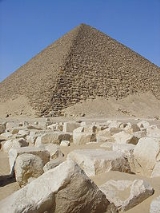
The
Red Pyramid, also called the
North Pyramid, is the largest of the three major
pyramidA pyramid is a structure whose outer surfaces are triangular and converge at a single point. The base of a pyramid can be trilateral, quadrilateral, or any polygon shape, meaning that a pyramid has at least three triangular surfaces...
s located at the
DahshurDahshur , is a royal necropolis located in the desert on the west bank of the Nile approximately 40 kilometres south of Cairo...
necropolisA necropolis is a large cemetery or burial ground, usually including structural tombs. The word comes from the Greek νεκρόπολις - nekropolis, literally meaning "city of the dead"...
. Named for the rusty reddish hue of its stones, it is also the third largest Egyptian pyramid, after those of Khufu and
KhafraKhafra — also Khafre — was an Egyptian pharaoh of the Fourth dynasty, who had his capital at Memphis. According to some authors he was the son and successor of Khufu, but it is more commonly accepted that Djedefre was Khufu's successor and Khafra was Djedefre's...
at
Giza. At the time of its completion, it was the tallest man-made structure in the world. It is also believed to be the world's first successful attempt at constructing a "true" smooth-sided pyramid. Local residents refer to the Red Pyramid as
el-haram el-watwat, meaning the Bat Pyramid.
The Red Pyramid was not always red. It used to be cased with white Tura limestone, but only a few of these now remain at the pyramid's base on the corner. During the Middle Ages much of the white Tura limestone was taken for buildings in
CairoCairo , is the capital of Egypt and the largest city in the Arab world and Africa, and the 16th largest metropolitan area in the world. Nicknamed "The City of a Thousand Minarets" for its preponderance of Islamic architecture, Cairo has long been a centre of the region's political and cultural life...
, revealing the reddish sandstone beneath.
History
It was the third pyramid built by
Old KingdomOld Kingdom is the name given to the period in the 3rd millennium BC when Egypt attained its first continuous peak of civilization in complexity and achievement – the first of three so-called "Kingdom" periods, which mark the high points of civilization in the lower Nile Valley .The term itself was...
PharaohPharaoh is a title used in many modern discussions of the ancient Egyptian rulers of all periods. The title originates in the term "pr-aa" which means "great house" and describes the royal palace...
SneferuSneferu, also spelled as Snephru, Snefru or Snofru , was the founder of the Fourth dynasty of Egypt. Estimates of his reign vary, with for instance The Oxford History of Ancient Egypt suggesting a reign from around 2613 BC to 2589 BC, a reign of 24 years, while Rolf Krauss suggests a 30-year reign...
, and is located approximately one kilometer to the north of the
Bent PyramidThe Bent Pyramid is an ancient Egyptian pyramid located at the royal necropolis of Dahshur, approximately 40 kilometres south of Cairo, built under the Old Kingdom Pharaoh Sneferu...
. It is built at the same shallow 43 degree angle as the upper section of the Bent Pyramid, which gives it a noticeably squat appearance compared to other Egyptian pyramids of comparable scale. Construction began during the thirtieth year of Sneferu's reign. Egyptologists disagree on the length of time it took to construct. Based on quarry marks found at various phases of construction,
Rainer StadelmannDr. Rainer Stadelmann is a German Egyptologist. He is considered an expert of the Giza Plateau.After studying in Neuburg an der Donau in 1953, he studied Egyptology, Orientalism and Archeology at the University of Munich. He participated in 1955 and 1956 in the excavations of the Userkaf Solar...
estimates the time of completion to be approximately 17 years while John Romer, based on this same graffiti, suggests it took only ten years and seven months to build.
Archaeologists speculate its design may be an outcome of engineering crises experienced during the construction of
SneferuSneferu, also spelled as Snephru, Snefru or Snofru , was the founder of the Fourth dynasty of Egypt. Estimates of his reign vary, with for instance The Oxford History of Ancient Egypt suggesting a reign from around 2613 BC to 2589 BC, a reign of 24 years, while Rolf Krauss suggests a 30-year reign...
's two earlier pyramids. The first of these, the Pyramid at
MeidumLocated about 100 km south of modern Cairo, Meidum or Maidum is the location of a large pyramid, and several large mud-brick mastabas.-Pyramid:...
, collapsed in antiquity, while the second — the
Bent PyramidThe Bent Pyramid is an ancient Egyptian pyramid located at the royal necropolis of Dahshur, approximately 40 kilometres south of Cairo, built under the Old Kingdom Pharaoh Sneferu...
— had the angle of its inclination dramatically altered — from 54 to 43 degrees — part-way through construction.
Some archaeologists now believe that the Meidum pyramid was the first attempt at building a smooth-sided pyramid, and that it may have collapsed when construction of the Bent Pyramid was already well underway — and that the pyramid may by then have already begun to show alarming signs of instability itself, as evidenced by the presence of large timber beams supporting its inner chambers. The outcome of this was the change in inclination of the Bent Pyramid, and the commencement of the later Red Pyramid at an inclination known to be less susceptible to instability and therefore less susceptible to catastrophic collapse.
Modern day
The Red Pyramid is 104 metres (341.2 ft) high. A rare
pyramidionA pyramidion is the uppermost piece or capstone of an Egyptian pyramid in archaeological parlance. They were called benbenet in the Ancient Egyptian language, which associated the pyramid as a whole with the sacred benben stone...
, or capstone, for the Red Pyramid has been uncovered and reconstructed, and is now on display at Dahshur. However, whether it was actually ever used is unclear, as its angle of inclination differs from that of the pyramid it was apparently intended for.
The Red Pyramid, along with the Bent Pyramid, was closed to tourists for many years because of a nearby army camp. It is now usually open for tourists and a somewhat intrusive ventilation has been installed which pipes air down the entrance shaft to the interior chambers.
Visitors climb steps cut in or built over the stones of the pyramid to an entrance high on the north side. A passage, 3 foot (0.9144 m) in height and 4 feet (1.2 m) wide, slopes down at 27° for 200 feet (61 m) to a short horizontal passage leading into a chamber whose corbelled roof is 40 feet (12.2 m) high and rises in eleven steps. At the southern end of the chamber, but offset to the west, another short horizontal passage leads into the second chamber. This passage was probably closed at one time and the offset was a measure intended to confuse potential robbers.
The second chamber is similar to the first and lies directly beneath the apex of the pyramid. High in the southern wall of the chamber is an entrance, now reached by a large wooden staircase built for the convenience of tourists. This gives onto a short horizontal passage that leads to the third and final chamber with a corbelled roof 50 feet (15.2 m) high. A body was found. The first two chambers have their long axis aligned north-south, but this chamber's long axis is aligned east-west. Unlike the first two chambers, which have fine smooth floors on the same level as the passages, the floor of the third chamber is very rough and sunk below the level of the access passage. It is believed that this is the work of robbers searching for treasure in what is thought to have been the burial chamber of the pyramid.
See also
- World's tallest free standing structure on land
- Great Pyramid of Giza
The Great Pyramid of Giza is the oldest and largest of the three pyramids in the Giza Necropolis bordering what is now El Giza, Egypt. It is the oldest of the Seven Wonders of the Ancient World, and the only one to remain largely intact...
- List of Egyptian pyramids
- List of megalithic sites
Further reading
- Verner, Miroslav, "The Pyramids Their Archaeology and History", Atlantic Books, 2001, ISBN 1-84354-171-8
External links