


Eve (Bible)

Encyclopedia
Eve was, according to the creation
of Abrahamic religions, the first woman created by God
. Her husband was Adam
.
, Eve (Hebrew
: חַוָּה, Ḥawwāh; , Hawwa'; Ge'ez
: ሕይዋን Hiywan; "living one" or "source of life", related to ḥāyâ, "to live"; ultimately from the Semitic
root ḥyw; Greek
: Εὕα, heúā) is Adam's wife. Her name occurs only four times in the Bible, the first being Genesis 3:20: "And Adam called his wife's name Ḥawwāh; because she was the mother of all living" (a title previously held by the Babylonian creatrix Tiamat
). In Vulgate
she appears as Hava in the Old Testament
, but Eva in the New Testament
.
The name may actually be derived from that of the Hurrian Goddess
"Kheba
", who was shown in the Amarna Letters
to be worshipped in Jerusalem during the Late Bronze Age
. It has been suggested that the name Kheba may derive from Kubau
, a woman who reigned as the first "king" of the Third Dynasty of Kish
Another name of Asherah
in the first millennium BCE was Chawat, Hawwah in Aramaic, (Eve in English).
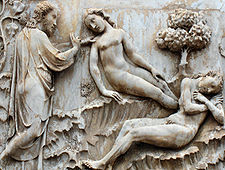 Eve is the first woman mentioned in the Bible
. Here it was Adam who gave her the name Eve. Eve lived with Adam in the Garden of Eden
during the time Adam was described as having walked with God. Eventually, however, with the Fall, the pair were removed from the garden because she was encouraged by a serpent to take a fruit of the Tree of the Knowledge of Good and Evil and with the Temptation
led Adam to eat of the Forbidden Fruit
.
In the Tyndale Bible
Adam's wife is called Heua in accordance with the Greek form Ἕυα (although in Genesis 3:20 the Septuagint says that Adam called her Ζωή).
Eve is not a saint's name, but the traditional name day
of Adam and Eve, the first man and woman, has been celebrated on December 24 since the Middle Ages in many European countries, e.g. Germany, the Netherlands, Hungary, Scandinavia, Estonia.
to be the wife of Adam. God decides that "It is not good that the man should be alone; I will make him a companion fit for him." and in Genesis 2:21–22 it states
After her creation, Adam names his companion Woman, "because she was taken out of Man." "Therefore shall a man leave his father and his mother, and shall cleave unto his wife: and they shall be one flesh."
Eve is also mentioned in the Book of Tobit
(viii, 8; Sept., viii, 6) where it is simply affirmed that she was given to Adam for a helper.
An alternate tradition, originating in a Jewish book called The Alphabet of Ben-Sira
which entered Europe from the East in the 6th century A.D suggests that Lilith
, not Eve, was Adam's first wife, created at the same time and from the same dust. The tradition goes that Lilith, claiming to be created equal, refused to sleep or serve "under him" (Adam). When Adam tried to force her into the "inferior" position, she flew away from Eden into the air, where she copulated with demons, conceiving hundreds more each day. God sent three angels after her, who threatened to kill her brood if she refused to return to Adam. But she did refuse. So God made Eve from Adam's rib to be his "second wife."
Controversy regarding the "rib" continues to the present day, regarding the Sumerian and the original Hebrew words for rib. The common translation, for example, that of the King James Version, is that אַחַת מִצַּלְעֹתָיו means "one of his ribs". The contrary position is that the term צלע ṣelaʿ, occurring forty-one times in the Tanakh, is most often translated as "side" in general.[7]. "Rib" is, however, the etymologically primary meaning of the term, which is from a root ṣ-l-ʿ, "bend", cognate to Assyrian ṣêlu "rib".[8] Also God took "one" ( ʾeḫad) of Adam's ṣelaʿ, suggesting an individual rib. The Septuagint has μίαν τῶν πλευρῶν αὐτοῦ, with ἡ πλευρά choosing a Greek term that like the Hebrew ṣelaʿ may mean either "rib", or, in the plural, "side [of a man or animal]" in general. The specification "one of the πλευρά" thus closely imitates the Hebrew text. The Aramaic form of the word is עלע ʿalaʿ, which appears, also in the meaning "rib", in Daniel 7:5.
An old story of the rib is told by Rabbi Joshua:
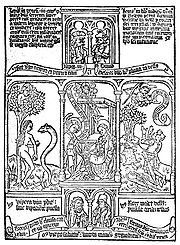 Anatomically, men and women have the same number of ribs - 24. When this fact was noted by the Flemish anatomist Vesalius
in 1524 it touched off a wave of controversy, as it seemed to contradict Genesis 2:21.
Some, for instance Samuel Noah Kramer
, hold that the origin of this motif is the Sumerian myth in which the goddess Ninhursag
created a beautiful garden full of lush vegetation and fruit trees, called Edinu, in Dilmun
, the Sumerian earthly Paradise, a place which the Sumerians believed to exist to the east of their own land, beyond the sea. Ninhursag charged Enki
, her lover and husband, with controlling the wild animals and tending the garden, but Enki became curious about the garden and his assistant, Adapa
, selected seven plants (8 in some version) and offered them to Enki, who ate them. (In other versions of the story he seduced in turn seven generations of the offspring of his divine marriage with Ninhursag). This enraged Ninhursag, and she caused Enki to fall ill. Enki felt pain in his rib, which is a pun in Sumerian, as the word "ti" means both "rib" and "life". The other gods persuaded Ninhursag to relent. Ninhursag then created a new goddess ( 7 or 8 to heal his 7 or 8 ailing organs including his rib) named Ninti, (a name made up of "Nin", or "lady", plus "ti", and which can be translated as both Lady of Living and Lady of the Rib), to cure Enki. Neither Ninhursag nor Ninti are exact parallels of Eve, since both differ from the character. However, given that the pun with rib is present only in Sumerian, linguistic criticism places the Sumerian account as the more ancient and therefore, a possible narrative influence on the Judeo-Christian story of creation.
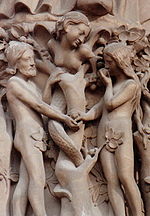 The serpent
tells the woman that she will not die if she eats the fruit of the tree: "For God doth know that in the day ye eat thereof, then your eyes shall be opened, and ye shall be as gods, knowing good and bad." So the woman eats, and gives to the man who also eats. "Then the eyes of both were opened, and they knew that they were naked; and they sewed fig leaves together and made themselves aprons." The man and woman hide themselves from God, the man blaming the woman for giving him the fruit, and the woman blaming the serpent. God curses the serpent, "upon your belly you shall go, and dust you shall eat all the days of your life;" the woman he punishes with childbirth (and the pain therein), and with subordination to man: "your desire shall be for your husband and he shall rule over you;" and Adam he punishes with a life of toil: "In the sweat of your face you shall eat bread till you return to the ground." The man names his wife Eve, "because she was the mother of all living."
"Behold," says God, "the man has become like one of us, knowing good and evil." God expels the couple from Eden, "lest he put forth his hand and take also of the tree of life
, and eat, and live for ever;" the gate of Eden is sealed by cherubim and a flaming sword "to guard the way to the tree of life."
(and thus the whole of modern humanity) is descended. According to the Bible, Eve states "God hath given me [literally, "put" or "appointed", in Hebrew "shāth"] another seed, for Abel whom Cain slew" (Genesis 4:25).
(Genesis 1:27), which has been assumed by critical scholars to imply simultaneous creation, whereas the second account states that God created Eve from Adam's rib because Adam was lonely (Genesis 2:18 ff.). Thus to resolve this apparent discrepancy, mediaeval rabbis suggested that Eve and the woman of the first account were two separate individuals.
Preserved in the Midrash
, and the mediaeval Alphabet of Ben Sira, this rabbinic tradition held that the first woman refused to take the submissive position to Adam in copulation, and eventually fled from him, consequently leaving him lonely. This first woman was identified in the Midrash as Lilith
, a figure elsewhere described as a night demon (the name Liyliyth being related to the Hebrew word for night, "layl").
The word liyliyth can also mean "screech owl", as it is translated in the King James Version
of Isaiah
34:14, although some scholars take this to be a reference to the same demonic entity as mentioned in the Talmud.
In the Talmud, Adam is said to have separated from Eve for 130 years, during which time his ejaculation
s gave rise to "ghouls, and demons." Elsewhere in the Talmud, Lilith is identified as the mother of these creatures. The demons were said to prey on newborn males before they had been circumcised, and so a tradition arose in which a protective amulet was placed around the neck of newborns. Traditions in the Midrash concerning Lilith, and her sexual appetite, have been compared to Sumerian mythology concerning the demon ki-sikil-lil-la-ke, by scholars who postulate an intermediate Akkadian
folk etymology interpreting the lil-la-ke portion of the name as a corruption of lîlîtu, literally meaning female night demon.
The Alphabet of Ben Sira Midrash goes even further and identifies a third wife, created after Lilith deserted Adam, but before Eve. This unnamed wife was purportedly made in the same way as Adam, from the "dust of the earth", but the sight of her being created proved too much for Adam to take and he refused to go near her. It is also said that she was created from nothing at all, and that God created into being a skeleton, then organs, and then flesh. The Midrash tells that Adam saw her as "full of blood and secretions," suggesting that he witnessed her creation and was horrified at seeing a body from the inside out. The Alphabet does not record this wife's fate. She was never named, and it assumed that she was allowed to leave the Garden a perpetual virgin, or was ultimately destroyed by God in favor of Eve, who was created when Adam was asleep and oblivious. It should be noted here, that both Lilith and the Second Wife are free from any curse of the Tree of Knowledge, as they left long before the event occurred.
Genesis does not tell for how long Adam and Eve were in the Garden of Eden
, but the Book of Jubilees states that they were removed from the garden on the new moon of the fourth month of the 8th year after creation (Jubilees 3:33); other Jewish sources assert that it was less than a day. Shortly after their expulsion, Eve brought forth her first-born child, and thereafter their second — Cain and Abel
, respectively.
Another Jewish tradition---also used to explain the "male and female He created them" line, is that God originally created Adam as a hermaphrodite
[Midrash Rabbah - Genesis VIII:1], and in this way was bodily and spiritually male and female. He later decided that "it is not good for [Adam] to be alone," and created the separate beings of Adam and Eve, thus creating the idea of two people joining together to achieve a union of the two separate spirits.
Only three of Adam's children (Cain, Abel, and Seth) are explicitly named in Genesis, although it does state that there were other sons and daughters as well (Genesis 5:4). In Jubilees, two daughters are named - Azûrâ being the first, and Awân, who was born after Seth, Cain, Abel, nine other sons, and Azûrâ. Jubilees goes on to state that Cain later married Awân and Seth married Azûrâ, thus, accounting for their descendants. However, according to Genesis Rabba
and other later sources, either Cain had a twin sister, and Abel had two twin sisters, or Cain had a twin sister named Lebuda, and Abel a twin sister named Qelimath. In the Conflict of Adam and Eve with Satan
, Cain's twin sister is named Luluwa, and Abel's twin sister is named Aklia.
Other pseudepigrapha give further details of their life outside of Eden, in particular, the Life of Adam and Eve
(also known as the Apocalypse of Moses) consists entirely of a description of their life outside Eden. Generally in Judaism Eve's sin was used as an example of what can happen to women who stray from their childbearing duties.
According to traditional Jewish belief, Eve is buried in the Cave of Machpelah, in Hebron
.
plays that role. Furthermore, the serpent that tempted Eve was interpreted within most Christian traditions to have been Satan
, although there is no mention of this identification in the Torah. In fact, Genesis does not even hint at any of these readings. While such ideas are found in some of the Jewish apocrypha
, their adoption by many Christians but not by modern Judaism marked the radical split between the two religions. Writings dealing with this subject are extant in Greek, Latin, Slavonic, Syriac, Armenian and Arabic. They go back undoubtedly to a Jewish basis, but in some of the forms in which they appear at present they are Christianized throughout. The oldest and for the most part Jewish portion of this literature is called Primary Adam Literature (see Life of Adam and Eve
). Before we discuss this Primary Adam Literature we shall mention other members of this literature, which, though derivable ultimately from Jewish sources, are Christian in their present form; The Book of Adam and Eve, also called the Conflict of Adam and Eve with Satan
and a Syriac work entitled Cave of Treasures
. This work has close affinities to the Conflict, but is said by Dillmann
to be more original.
Drawing upon the statement in II Cor., xi, 3, where reference is made to her deception by the serpent, and in I Tim., ii, 13-4, where the Apostle enjoins submission and silence upon women, arguing that "Adam was first formed, then Eve. And Adam was not deceived, but the woman being deceived was in the transgression", because Eve had tempted Adam to eat of the fatal fruit, some early Fathers of the Church held her and all subsequent women to be the first sinners, and especially responsible for the Fall because of the sin of Eve. She was also called "the lance of the demon", "the road of iniquity" "the sting of the scorpion", "a daughter of falsehood, the sentinel of Hell", "the enemy of peace" and "of the wild beast, the most dangerous." "You are the devil's gateway," Tertullian
told his female listeners in the early 2nd century, and went on to explain that all women were responsible for the death of Christ: "On account of your desert – that is, death – even the Son of God had to die." In this way Eve is compared with the Greco-Roman myth of Pandora
who was responsible for bringing evil into the world.
Saint Augustine, according to Elaine Pagels
, used the sin of Eve to justify his idiosyncratic view of humanity as permanently scarred by the Fall, which led to the Catholic doctrine of Original sin
.
In 1486 the Renaissance Dominicans
Heinrich Kramer
and Jacob Sprenger took this further as one of their justifications in the Malleus Maleficarum
("Hammer of the Witches"), a central text in three centuries of persecution of "witches". Such "Eve bashing" is much more common in Christianity than in Judaism or Islam, though major differences in the status of women does not seem to have been the result. This is often balanced by the typology of the Madonna, much as "Old Adam" is balanced by Christ - this is even the case in the Malleus whose authors were capable of writings things such as "Justly we may say with Cato of Utica: If the world could be rid of women, we should not be without God in our intercourse. For truly, without the wickedness of women, to say nothing of witchcraft, the world would still remain proof against innumerable dangers", but were aware that a large percentage of those accusing witches were female as well, and they perhaps feared losing their support:
"There are also others who bring forward yet other reasons, of which preachers should be very careful how they make use. For it is true that in the Old Testament the Scriptures have much that is evil to say about women, and this because of the first temptress, Eve, and her imitators; yet afterwards in the New Testament we find a change of name, as from Eva to Ave (as S. Jerome says), and the whole sin of Eve taken away by the benediction of Mary. Therefore preachers should always say as much praise of them as possible."
It is interesting to note that in pre-industrial times, misogynous authorities were often (such as in The Romance of the Rose feminist debate) just called "The Roman Books", due to the perceived paternalistic attitude of both Pagan & Christian Romans to gender problems.
In another example of "Eve bashing", Gregory of Tours report that in the Council of Macon (585 CE
), attended by 43 bishops, one bishop maintained that woman could not be included under the term "man", and as being responsible for Adam's sin, had a deficient soul. However, he accepted the reasoning of the other bishops and did not press his case, for the holy book of the Old Testament tells us that in the beginning, when God created man, "Male and female he created them" and the term used was Adam which means earthly man; he called the woman Eve, yet of both he used the word "man."
Eve in Christian Art is most usually portrayed as the temptress of Adam, and often during the Renaissance
the serpent in the Garden is portrayed as having a woman's face identical to that of Eve.
Some Christians claim monogamy
is implied in the story of Adam and Eve as one woman is created for one man. Eve's being taken from his side implies not only her secondary role in the conjugal state (1 Corinthians 11:9), but also emphasizes the intimate union between husband and wife, and the dependence of the latter on the former "Wherefore a man shall leave father and mother, and shall cleave to his wife: and they shall be two in one flesh."
Eve is commemorated as a matriarch in the Calendar of Saints
of the Lutheran Church - Missouri Synod
with Adam on December 19.
. For example she is often seen as the embodiment of the supreme feminine principle, called Barbelo
(from Arb-Eloh), barbeloth, or barthenos. As such she is equated with the Light-Maiden of Sophia (Wisdom), creator of the word (Logos) of God, the "thygater tou photos" or simply the Virgin Maiden, "parthenos". In other texts she is equated with Zoe (Life). Again, in conventional Christianity, this is a prefigurement of Mary, also sometimes called "the Second Eve". In other Gnostic texts, such as The Hypostasis of the Archons (The Reality of the Rulers), the Pistis Sophia is equated with Eve's daughter, Norea, the wife of Seth.
As a result of such Gnostic beliefs, especially among Marcionites, women were considered equal to men, being revered as prophets, teachers, travelling evangelists, faith healers, priests and even bishops.
(Hadith
), are similar but different to that of the Torah and Bible.
A similarity in particular, Sura 7 recounts:
(Surah Al-A`raf 7:22-23)
However, the Quran does not suggest that God created Eve independently from Adam, as opposed to some beliefs that she was. It is generally believed by Muslims that Eve was created from Adam's rib to be his partner and companion.
(Surah Al-Nisa 4:1)
Another difference is that Eve is not blamed for enticing adam to eat the forbidden fruit, and nor is there the concept of original sin. As a matter of fact, the Quran indicates that Adam initiated the eating of the fruit but God simply blames both of them for the transgression as they both ate the fruit.
Then Satan whispered to him (Adam); he said, "O Adam, shall I direct you to the tree of eternity and possession that will not deteriorate? And Adam and his wife ate of it, and their private parts became apparent to them, and they began to fasten over themselves from the leaves of Paradise. And Adam disobeyed his Lord and erred. (Quran - 20:121-122)
However, there are hadiths– which are contested –, saying the Prophet Mohammed (narrated by Abu Hurrairah) designates Eve as the epitome of female betrayal. “Narrated Abu Hurrairah: The Prophet said, ‘Were it not for Bani Israel, meat would not decay; and were it not for Eve, no woman would ever betray her husband.’" (Sahih Bukhari, Hadith 611, Volume 55) An identical but more explicit version is found in the second most respected book of prophetic narrations, Sahih Muslim. “Abu Hurrairah (May Allah be pleased with him) reported Allah's Messenger (May peace be upon him) as saying: Had it not been for Eve, woman would have never acted unfaithfully towards her husband.” (Hadith 3471, Volume 8). The above verses from the Quran (20:121-122) are the reason these accounts are disputed and the authenticity of these hadiths is challenged. As the Quran never blamed Eve for the sin that they both (Adam and Eve) committed together and to condemn all the women in the world for a sin that Eve committed is against a basic Quranic teaching which states that no soul is accountable for the sins of another, Say, is it other than Allah I should desire as a lord while He is the Lord of all things? And every soul earns not [blame] except against itself, and no bearer of burdens will bear the burden of another. Then to your Lord is your return, and He will inform you concerning that over which you used to differ. (6:164)
Traditionally, the final resting place of Eve is said to be the "Tomb of Eve" in Jeddah
, Saudi Arabia
.
Creation
Creation may refer to:In religion and philosophy:*Creation myth, stories of the supernatural creation of the Earth and its inhabitants*Genesis creation narrative, The Biblical account of creationIn science and technology:...
of Abrahamic religions, the first woman created by God
God
God is the English name given to a singular being in theistic and deistic religions who is either the sole deity in monotheism, or a single deity in polytheism....
. Her husband was Adam
Adam
Adam is a figure in the Book of Genesis. According to the creation myth of Abrahamic religions, he is the first human. In the Genesis creation narratives, he was created by Yahweh-Elohim , and the first woman, Eve was formed from his rib...
.
Name and origin
BibleBible
The Bible refers to any one of the collections of the primary religious texts of Judaism and Christianity. There is no common version of the Bible, as the individual books , their contents and their order vary among denominations...
, Eve (Hebrew
Hebrew language
Hebrew is a Semitic language of the Afroasiatic language family. Culturally, is it considered by Jews and other religious groups as the language of the Jewish people, though other Jewish languages had originated among diaspora Jews, and the Hebrew language is also used by non-Jewish groups, such...
: חַוָּה, Ḥawwāh; , Hawwa'; Ge'ez
Ge'ez language
Ge'ez is an ancient South Semitic language that developed in the northern region of Ethiopia and southern Eritrea in the Horn of Africa...
: ሕይዋን Hiywan; "living one" or "source of life", related to ḥāyâ, "to live"; ultimately from the Semitic
Semitic languages
The Semitic languages are a group of related languages whose living representatives are spoken by more than 270 million people across much of the Middle East, North Africa and the Horn of Africa...
root ḥyw; Greek
Greek language
Greek is an independent branch of the Indo-European family of languages. Native to the southern Balkans, it has the longest documented history of any Indo-European language, spanning 34 centuries of written records. Its writing system has been the Greek alphabet for the majority of its history;...
: Εὕα, heúā) is Adam's wife. Her name occurs only four times in the Bible, the first being Genesis 3:20: "And Adam called his wife's name Ḥawwāh; because she was the mother of all living" (a title previously held by the Babylonian creatrix Tiamat
Tiamat
In Babylonian mythology, Tiamat is a chaos monster, a primordial goddess of the ocean, mating with Abzû to produce younger gods. It is suggested that there are two parts to the Tiamat mythos, the first in which Tiamat is 'creatrix', through a "Sacred marriage" between salt and fresh water,...
). In Vulgate
Vulgate
The Vulgate is a late 4th-century Latin translation of the Bible. It was largely the work of St. Jerome, who was commissioned by Pope Damasus I in 382 to make a revision of the old Latin translations...
she appears as Hava in the Old Testament
Old Testament
The Old Testament, of which Christians hold different views, is a Christian term for the religious writings of ancient Israel held sacred and inspired by Christians which overlaps with the 24-book canon of the Masoretic Text of Judaism...
, but Eva in the New Testament
New Testament
The New Testament is the second major division of the Christian biblical canon, the first such division being the much longer Old Testament....
.
The name may actually be derived from that of the Hurrian Goddess
Goddess
A goddess is a female deity. In some cultures goddesses are associated with Earth, motherhood, love, and the household. In other cultures, goddesses also rule over war, death, and destruction as well as healing....
"Kheba
Hebat
Hebat, also transcribed Kheba or Khepat, was the mother goddess of the Hurrians, known as "the mother of all living".- Family :Hebat is the consort of Teshub and the mother of Sarruma. Originally, as Kheba or "Kubau" it is thought she may have had a Southern Mesopotamian origin, being the divinised...
", who was shown in the Amarna Letters
Amarna letters
The Amarna letters are an archive of correspondence on clay tablets, mostly diplomatic, between the Egyptian administration and its representatives in Canaan and Amurru during the New Kingdom...
to be worshipped in Jerusalem during the Late Bronze Age
Bronze Age
The Bronze Age is a period characterized by the use of copper and its alloy bronze as the chief hard materials in the manufacture of some implements and weapons. Chronologically, it stands between the Stone Age and Iron Age...
. It has been suggested that the name Kheba may derive from Kubau
Kubaba
Kubaba is the only queen on the Sumerian King List, which states she reigned for 100 years – roughly in the Early Dynastic III period of Sumerian history...
, a woman who reigned as the first "king" of the Third Dynasty of Kish
Kish (Sumer)
Kish is modern Tell al-Uhaymir , and was an ancient city of Sumer. Kish is located some 12 km east of Babylon, and 80 km south of Baghdad ....
Another name of Asherah
Asherah
Asherah , in Semitic mythology, is a Semitic mother goddess, who appears in a number of ancient sources including Akkadian writings by the name of Ashratum/Ashratu and in Hittite as Asherdu or Ashertu or Aserdu or Asertu...
in the first millennium BCE was Chawat, Hawwah in Aramaic, (Eve in English).
Bible
The Bible refers to any one of the collections of the primary religious texts of Judaism and Christianity. There is no common version of the Bible, as the individual books , their contents and their order vary among denominations...
. Here it was Adam who gave her the name Eve. Eve lived with Adam in the Garden of Eden
The Garden of Eden
The Garden of Eden is the second posthumously released novel of Ernest Hemingway, published in 1986. Begun in 1946, Hemingway worked on the manuscript for the next 15 years, during which time he also wrote The Old Man and the Sea, The Dangerous Summer, A Moveable Feast, and Islands in the...
during the time Adam was described as having walked with God. Eventually, however, with the Fall, the pair were removed from the garden because she was encouraged by a serpent to take a fruit of the Tree of the Knowledge of Good and Evil and with the Temptation
Temptation
A temptation is an act that looks appealing to an individual. It is usually used to describe acts with negative connotations and as such, tends to lead a person to regret such actions, for various reasons: legal, social, psychological , health, economic, etc...
led Adam to eat of the Forbidden Fruit
Forbidden fruit
Forbidden fruit is any object of desire whose appeal is a direct result of knowledge that cannot or should not be obtained or something that someone may want but is forbidden to have....
.
In the Tyndale Bible
Tyndale Bible
The Tyndale Bible generally refers to the body of biblical translations by William Tyndale. Tyndale’s Bible is credited with being the first English translation to work directly from Hebrew and Greek texts. Furthermore it was the first English biblical translation that was mass produced as a result...
Adam's wife is called Heua in accordance with the Greek form Ἕυα (although in Genesis 3:20 the Septuagint says that Adam called her Ζωή).
Eve is not a saint's name, but the traditional name day
Name day
A name day is a tradition in many countries in Europe and Latin America that consists of celebrating the day of the year associated with one's given name....
of Adam and Eve, the first man and woman, has been celebrated on December 24 since the Middle Ages in many European countries, e.g. Germany, the Netherlands, Hungary, Scandinavia, Estonia.
Creation of Eve
Eve was created in the Garden of EdenGarden of Eden
The Garden of Eden is in the Bible's Book of Genesis as being the place where the first man, Adam, and his wife, Eve, lived after they were created by God. Literally, the Bible speaks about a garden in Eden...
to be the wife of Adam. God decides that "It is not good that the man should be alone; I will make him a companion fit for him." and in Genesis 2:21–22 it states
- "And God caused a deep sleep to fall upon Adam, and he slept: and he took one of his ribs, and closed up the flesh instead thereof; And the rib, which God had taken from man, made he a woman, and brought her unto the man"
After her creation, Adam names his companion Woman, "because she was taken out of Man." "Therefore shall a man leave his father and his mother, and shall cleave unto his wife: and they shall be one flesh."
Eve is also mentioned in the Book of Tobit
Book of Tobit
The Book of Tobit is a book of scripture that is part of the Catholic and Orthodox biblical canon, pronounced canonical by the Council of Carthage of 397 and confirmed for Roman Catholics by the Council of Trent...
(viii, 8; Sept., viii, 6) where it is simply affirmed that she was given to Adam for a helper.
An alternate tradition, originating in a Jewish book called The Alphabet of Ben-Sira
The Alphabet of Ben-Sira
The Alphabet of Jesus ben Sirach is an anonymous medieval text attributed to Jesus ben Sirach, the author of the Wisdom of Sirach. It is dated to anywhere between A.D. 700 and 1000. It is a compilation of two lists of proverbs, 22 in Aramaic and 22 in Hebrew, both arranged as alphabetic acrostics...
which entered Europe from the East in the 6th century A.D suggests that Lilith
Lilith
Lilith is a character in Jewish mythology, found earliest in the Babylonian Talmud, who is generally thought to be related to a class of female demons Līlīṯu in Mesopotamian texts. However, Lowell K. Handy notes, "Very little information has been found relating to the Akkadian and Babylonian view...
, not Eve, was Adam's first wife, created at the same time and from the same dust. The tradition goes that Lilith, claiming to be created equal, refused to sleep or serve "under him" (Adam). When Adam tried to force her into the "inferior" position, she flew away from Eden into the air, where she copulated with demons, conceiving hundreds more each day. God sent three angels after her, who threatened to kill her brood if she refused to return to Adam. But she did refuse. So God made Eve from Adam's rib to be his "second wife."
Controversy regarding the "rib" continues to the present day, regarding the Sumerian and the original Hebrew words for rib. The common translation, for example, that of the King James Version, is that אַחַת מִצַּלְעֹתָיו means "one of his ribs". The contrary position is that the term צלע ṣelaʿ, occurring forty-one times in the Tanakh, is most often translated as "side" in general.[7]. "Rib" is, however, the etymologically primary meaning of the term, which is from a root ṣ-l-ʿ, "bend", cognate to Assyrian ṣêlu "rib".[8] Also God took "one" ( ʾeḫad) of Adam's ṣelaʿ, suggesting an individual rib. The Septuagint has μίαν τῶν πλευρῶν αὐτοῦ, with ἡ πλευρά choosing a Greek term that like the Hebrew ṣelaʿ may mean either "rib", or, in the plural, "side [of a man or animal]" in general. The specification "one of the πλευρά" thus closely imitates the Hebrew text. The Aramaic form of the word is עלע ʿalaʿ, which appears, also in the meaning "rib", in Daniel 7:5.
An old story of the rib is told by Rabbi Joshua:
- "God deliberated from what member He would create woman, and He reasoned with Himself thus: I must not create her from Adam's head, for she would be a proud person, and hold her head high. If I create her from the eye, then she will wish to pry into all things; if from the ear, she will wish to hear all things; if from the mouth, she will talk much; if from the heart, she will envy people; if from the hand, she will desire to take all things; if from the feet, she will be a gadabout. Therefore I will create her from the member which is hid, that is the rib, which is not even seen when man is naked."[9]
Vesalius
Andreas Vesalius was a Flemish anatomist, physician, and author of one of the most influential books on human anatomy, De humani corporis fabrica . Vesalius is often referred to as the founder of modern human anatomy. Vesalius is the Latinized form of Andries van Wesel...
in 1524 it touched off a wave of controversy, as it seemed to contradict Genesis 2:21.
Some, for instance Samuel Noah Kramer
Samuel Noah Kramer
Samuel Noah Kramer was one of the world's leading Assyriologists and a world renowned expert in Sumerian history and Sumerian language.-Biography:...
, hold that the origin of this motif is the Sumerian myth in which the goddess Ninhursag
Ninhursag
In Sumerian mythology, Ninhursag or Ninkharsag was the earth and mother goddess, one of the seven great deities of Sumer. She is principally a fertility goddess. Temple hymn sources identify her as the 'true and great lady of heaven' and kings of Sumer were 'nourished by Ninhursag's milk'...
created a beautiful garden full of lush vegetation and fruit trees, called Edinu, in Dilmun
Dilmun
Dilmun or Telmun is a land mentioned by Mesopotamian civilizations as a trade partner, a source of the metal copper, and an entrepôt of the Mesopotamia-to-Indus Valley Civilization trade route...
, the Sumerian earthly Paradise, a place which the Sumerians believed to exist to the east of their own land, beyond the sea. Ninhursag charged Enki
Enki
Enki is a god in Sumerian mythology, later known as Ea in Akkadian and Babylonian mythology. He was originally patron god of the city of Eridu, but later the influence of his cult spread throughout Mesopotamia and to the Canaanites, Hittites and Hurrians...
, her lover and husband, with controlling the wild animals and tending the garden, but Enki became curious about the garden and his assistant, Adapa
Adapa
Adapa was a Babylonian mythical figure who unknowingly refused the gift of immortality. The story is first attested in the Kassite period .-Roles:...
, selected seven plants (8 in some version) and offered them to Enki, who ate them. (In other versions of the story he seduced in turn seven generations of the offspring of his divine marriage with Ninhursag). This enraged Ninhursag, and she caused Enki to fall ill. Enki felt pain in his rib, which is a pun in Sumerian, as the word "ti" means both "rib" and "life". The other gods persuaded Ninhursag to relent. Ninhursag then created a new goddess ( 7 or 8 to heal his 7 or 8 ailing organs including his rib) named Ninti, (a name made up of "Nin", or "lady", plus "ti", and which can be translated as both Lady of Living and Lady of the Rib), to cure Enki. Neither Ninhursag nor Ninti are exact parallels of Eve, since both differ from the character. However, given that the pun with rib is present only in Sumerian, linguistic criticism places the Sumerian account as the more ancient and therefore, a possible narrative influence on the Judeo-Christian story of creation.
Temptation, fall, and expulsion from the garden
Serpent (Bible)
Serpent is the term used to translate a variety of words in the Hebrew bible, the most common being , , the generic word for "snake"....
tells the woman that she will not die if she eats the fruit of the tree: "For God doth know that in the day ye eat thereof, then your eyes shall be opened, and ye shall be as gods, knowing good and bad." So the woman eats, and gives to the man who also eats. "Then the eyes of both were opened, and they knew that they were naked; and they sewed fig leaves together and made themselves aprons." The man and woman hide themselves from God, the man blaming the woman for giving him the fruit, and the woman blaming the serpent. God curses the serpent, "upon your belly you shall go, and dust you shall eat all the days of your life;" the woman he punishes with childbirth (and the pain therein), and with subordination to man: "your desire shall be for your husband and he shall rule over you;" and Adam he punishes with a life of toil: "In the sweat of your face you shall eat bread till you return to the ground." The man names his wife Eve, "because she was the mother of all living."
"Behold," says God, "the man has become like one of us, knowing good and evil." God expels the couple from Eden, "lest he put forth his hand and take also of the tree of life
Tree of life
The concept of a tree of life, a many-branched tree illustrating the idea that all life on earth is related, has been used in science , religion, philosophy, mythology, and other areas...
, and eat, and live for ever;" the gate of Eden is sealed by cherubim and a flaming sword "to guard the way to the tree of life."
Eve as mother of humanity
According to the Bible, for her share in the transgression, Eve (and womankind after her) is sentenced to a life of sorrow and travail in childbirth, and to be under the power of her husband. While believers accept all subsequent humans have Eve as an ancestor, she is believed to be unique in that although all people after her were physically created from women, Eve herself was created from a man. Adam and Eve have two sons, Cain and Abel (or Habel), the first a tiller of the ground, the second a keeper of sheep. After the death of Abel, Eve gives birth to a third son, Seth (or Sheth), from whom NoahNoah
Noah was, according to the Hebrew Bible, the tenth and last of the antediluvian Patriarchs. The biblical story of Noah is contained in chapters 6–9 of the book of Genesis, where he saves his family and representatives of all animals from the flood by constructing an ark...
(and thus the whole of modern humanity) is descended. According to the Bible, Eve states "God hath given me [literally, "put" or "appointed", in Hebrew "shāth"] another seed, for Abel whom Cain slew" (Genesis 4:25).
Eve in Judaism
Even in ancient times, the presence of two distinct accounts was noted, and regarded with some curiosity. The first account says male and female [God] created them(Genesis 1:27), which has been assumed by critical scholars to imply simultaneous creation, whereas the second account states that God created Eve from Adam's rib because Adam was lonely (Genesis 2:18 ff.). Thus to resolve this apparent discrepancy, mediaeval rabbis suggested that Eve and the woman of the first account were two separate individuals.
Preserved in the Midrash
Midrash
The Hebrew term Midrash is a homiletic method of biblical exegesis. The term also refers to the whole compilation of homiletic teachings on the Bible....
, and the mediaeval Alphabet of Ben Sira, this rabbinic tradition held that the first woman refused to take the submissive position to Adam in copulation, and eventually fled from him, consequently leaving him lonely. This first woman was identified in the Midrash as Lilith
Lilith
Lilith is a character in Jewish mythology, found earliest in the Babylonian Talmud, who is generally thought to be related to a class of female demons Līlīṯu in Mesopotamian texts. However, Lowell K. Handy notes, "Very little information has been found relating to the Akkadian and Babylonian view...
, a figure elsewhere described as a night demon (the name Liyliyth being related to the Hebrew word for night, "layl").
The word liyliyth can also mean "screech owl", as it is translated in the King James Version
King James Version of the Bible
The Authorized Version, commonly known as the King James Version, King James Bible or KJV, is an English translation of the Christian Bible by the Church of England begun in 1604 and completed in 1611...
of Isaiah
Book of Isaiah
The Book of Isaiah is the first of the Latter Prophets in the Hebrew Bible, preceding the books of Ezekiel, Jeremiah and the Book of the Twelve...
34:14, although some scholars take this to be a reference to the same demonic entity as mentioned in the Talmud.
In the Talmud, Adam is said to have separated from Eve for 130 years, during which time his ejaculation
Ejaculation
Ejaculation is the ejecting of semen from the male reproductory tract, and is usually accompanied by orgasm. It is usually the final stage and natural objective of male sexual stimulation, and an essential component of natural conception. In rare cases ejaculation occurs because of prostatic disease...
s gave rise to "ghouls, and demons." Elsewhere in the Talmud, Lilith is identified as the mother of these creatures. The demons were said to prey on newborn males before they had been circumcised, and so a tradition arose in which a protective amulet was placed around the neck of newborns. Traditions in the Midrash concerning Lilith, and her sexual appetite, have been compared to Sumerian mythology concerning the demon ki-sikil-lil-la-ke, by scholars who postulate an intermediate Akkadian
Akkadian language
Akkadian is an extinct Semitic language that was spoken in ancient Mesopotamia. The earliest attested Semitic language, it used the cuneiform writing system derived ultimately from ancient Sumerian, an unrelated language isolate...
folk etymology interpreting the lil-la-ke portion of the name as a corruption of lîlîtu, literally meaning female night demon.
The Alphabet of Ben Sira Midrash goes even further and identifies a third wife, created after Lilith deserted Adam, but before Eve. This unnamed wife was purportedly made in the same way as Adam, from the "dust of the earth", but the sight of her being created proved too much for Adam to take and he refused to go near her. It is also said that she was created from nothing at all, and that God created into being a skeleton, then organs, and then flesh. The Midrash tells that Adam saw her as "full of blood and secretions," suggesting that he witnessed her creation and was horrified at seeing a body from the inside out. The Alphabet does not record this wife's fate. She was never named, and it assumed that she was allowed to leave the Garden a perpetual virgin, or was ultimately destroyed by God in favor of Eve, who was created when Adam was asleep and oblivious. It should be noted here, that both Lilith and the Second Wife are free from any curse of the Tree of Knowledge, as they left long before the event occurred.
Genesis does not tell for how long Adam and Eve were in the Garden of Eden
Garden of Eden
The Garden of Eden is in the Bible's Book of Genesis as being the place where the first man, Adam, and his wife, Eve, lived after they were created by God. Literally, the Bible speaks about a garden in Eden...
, but the Book of Jubilees states that they were removed from the garden on the new moon of the fourth month of the 8th year after creation (Jubilees 3:33); other Jewish sources assert that it was less than a day. Shortly after their expulsion, Eve brought forth her first-born child, and thereafter their second — Cain and Abel
Cain and Abel
In the Hebrew Bible, Cain and Abel are two sons of Adam and Eve. The Qur'an mentions the story, calling them the two sons of Adam only....
, respectively.
Another Jewish tradition---also used to explain the "male and female He created them" line, is that God originally created Adam as a hermaphrodite
Hermaphrodite
In biology, a hermaphrodite is an organism that has reproductive organs normally associated with both male and female sexes.Many taxonomic groups of animals do not have separate sexes. In these groups, hermaphroditism is a normal condition, enabling a form of sexual reproduction in which both...
[Midrash Rabbah - Genesis VIII:1], and in this way was bodily and spiritually male and female. He later decided that "it is not good for [Adam] to be alone," and created the separate beings of Adam and Eve, thus creating the idea of two people joining together to achieve a union of the two separate spirits.
Only three of Adam's children (Cain, Abel, and Seth) are explicitly named in Genesis, although it does state that there were other sons and daughters as well (Genesis 5:4). In Jubilees, two daughters are named - Azûrâ being the first, and Awân, who was born after Seth, Cain, Abel, nine other sons, and Azûrâ. Jubilees goes on to state that Cain later married Awân and Seth married Azûrâ, thus, accounting for their descendants. However, according to Genesis Rabba
Genesis Rabba
Genesis Rabba is a religious text from Judaism's classical period. It is a midrash comprising a collection of ancient rabbinical homiletical interpretations of the Book of Genesis ....
and other later sources, either Cain had a twin sister, and Abel had two twin sisters, or Cain had a twin sister named Lebuda, and Abel a twin sister named Qelimath. In the Conflict of Adam and Eve with Satan
Conflict of Adam and Eve with Satan
The Conflict of Adam and Eve with Satan is a Christian pseudepigraphical work found in Ge'ez, translated from an Arabic original and thought to date from the 5th or 6th century AD....
, Cain's twin sister is named Luluwa, and Abel's twin sister is named Aklia.
Other pseudepigrapha give further details of their life outside of Eden, in particular, the Life of Adam and Eve
Life of Adam and Eve
The Life of Adam and Eve, also known, in its Greek version, as the Apocalypse of Moses, is a Jewish pseudepigraphical group of writings. It recounts the lives of Adam and Eve from after their expulsion from the Garden of Eden to their deaths. It provides more detail about the Fall of Man, including...
(also known as the Apocalypse of Moses) consists entirely of a description of their life outside Eden. Generally in Judaism Eve's sin was used as an example of what can happen to women who stray from their childbearing duties.
According to traditional Jewish belief, Eve is buried in the Cave of Machpelah, in Hebron
Hebron
Hebron , is located in the southern West Bank, south of Jerusalem. Nestled in the Judean Mountains, it lies 930 meters above sea level. It is the largest city in the West Bank and home to around 165,000 Palestinians, and over 500 Jewish settlers concentrated in and around the old quarter...
.
Eve in Christianity
In Christian tradition Eve is often used as the exemplar of sexual temptation, a tendency not found in Judaism where LilithLilith
Lilith is a character in Jewish mythology, found earliest in the Babylonian Talmud, who is generally thought to be related to a class of female demons Līlīṯu in Mesopotamian texts. However, Lowell K. Handy notes, "Very little information has been found relating to the Akkadian and Babylonian view...
plays that role. Furthermore, the serpent that tempted Eve was interpreted within most Christian traditions to have been Satan
Satan
Satan , "the opposer", is the title of various entities, both human and divine, who challenge the faith of humans in the Hebrew Bible...
, although there is no mention of this identification in the Torah. In fact, Genesis does not even hint at any of these readings. While such ideas are found in some of the Jewish apocrypha
Jewish apocrypha
Jewish apocrypha includes texts written in the Jewish religious tradition either in the Intertestamental period or in the early Christian era, but outside the Christian tradition...
, their adoption by many Christians but not by modern Judaism marked the radical split between the two religions. Writings dealing with this subject are extant in Greek, Latin, Slavonic, Syriac, Armenian and Arabic. They go back undoubtedly to a Jewish basis, but in some of the forms in which they appear at present they are Christianized throughout. The oldest and for the most part Jewish portion of this literature is called Primary Adam Literature (see Life of Adam and Eve
Life of Adam and Eve
The Life of Adam and Eve, also known, in its Greek version, as the Apocalypse of Moses, is a Jewish pseudepigraphical group of writings. It recounts the lives of Adam and Eve from after their expulsion from the Garden of Eden to their deaths. It provides more detail about the Fall of Man, including...
). Before we discuss this Primary Adam Literature we shall mention other members of this literature, which, though derivable ultimately from Jewish sources, are Christian in their present form; The Book of Adam and Eve, also called the Conflict of Adam and Eve with Satan
Conflict of Adam and Eve with Satan
The Conflict of Adam and Eve with Satan is a Christian pseudepigraphical work found in Ge'ez, translated from an Arabic original and thought to date from the 5th or 6th century AD....
and a Syriac work entitled Cave of Treasures
Cave of Treasures
The Cave of Treasures, sometimes referred to simply as The Treasure, is a book of the New Testament apocrypha.-Origin:This text is attributed to Ephrem Syrus, who was born at Nisibis soon after AD 306 and died in 373, but it is now generally believed that its current form is 6th century or...
. This work has close affinities to the Conflict, but is said by Dillmann
August Dillmann
Christian Friedrich August Dillmann was a German orientalist and biblical scholar.-Life:The son of a Württemberg schoolmaster, he was born at Illingen. He was educated at the University of Tübingen, where he became a pupil and friend of Heinrich Ewald, and studied under Ferdinand Christian Baur,...
to be more original.
Drawing upon the statement in II Cor., xi, 3, where reference is made to her deception by the serpent, and in I Tim., ii, 13-4, where the Apostle enjoins submission and silence upon women, arguing that "Adam was first formed, then Eve. And Adam was not deceived, but the woman being deceived was in the transgression", because Eve had tempted Adam to eat of the fatal fruit, some early Fathers of the Church held her and all subsequent women to be the first sinners, and especially responsible for the Fall because of the sin of Eve. She was also called "the lance of the demon", "the road of iniquity" "the sting of the scorpion", "a daughter of falsehood, the sentinel of Hell", "the enemy of peace" and "of the wild beast, the most dangerous." "You are the devil's gateway," Tertullian
Tertullian
Quintus Septimius Florens Tertullianus, anglicised as Tertullian , was a prolific early Christian author from Carthage in the Roman province of Africa. He is the first Christian author to produce an extensive corpus of Latin Christian literature. He also was a notable early Christian apologist and...
told his female listeners in the early 2nd century, and went on to explain that all women were responsible for the death of Christ: "On account of your desert – that is, death – even the Son of God had to die." In this way Eve is compared with the Greco-Roman myth of Pandora
Pandora
In Greek mythology, Pandora was the first woman. As Hesiod related it, each god helped create her by giving her unique gifts...
who was responsible for bringing evil into the world.
Saint Augustine, according to Elaine Pagels
Elaine Pagels
Elaine Pagels, née Hiesey , is the Harrington Spear Paine Professor of Religion at Princeton University. The recipient of a MacArthur Fellowship, she is best known for her studies and writing on the Gnostic Gospels...
, used the sin of Eve to justify his idiosyncratic view of humanity as permanently scarred by the Fall, which led to the Catholic doctrine of Original sin
Original sin
Original sin is, according to a Christian theological doctrine, humanity's state of sin resulting from the Fall of Man. This condition has been characterized in many ways, ranging from something as insignificant as a slight deficiency, or a tendency toward sin yet without collective guilt, referred...
.
In 1486 the Renaissance Dominicans
Dominican Order
The Order of Preachers , after the 15th century more commonly known as the Dominican Order or Dominicans, is a Catholic religious order founded by Saint Dominic and approved by Pope Honorius III on 22 December 1216 in France...
Heinrich Kramer
Heinrich Kramer
Heinrich Kramer also known under the Latinized name Henricus Institoris, was a German churchman and inquisitor....
and Jacob Sprenger took this further as one of their justifications in the Malleus Maleficarum
Malleus Maleficarum
The Malleus Maleficarum is an infamous treatise on witches, written in 1486 by Heinrich Kramer, an Inquisitor of the Catholic Church, and was first published in Germany in 1487...
("Hammer of the Witches"), a central text in three centuries of persecution of "witches". Such "Eve bashing" is much more common in Christianity than in Judaism or Islam, though major differences in the status of women does not seem to have been the result. This is often balanced by the typology of the Madonna, much as "Old Adam" is balanced by Christ - this is even the case in the Malleus whose authors were capable of writings things such as "Justly we may say with Cato of Utica: If the world could be rid of women, we should not be without God in our intercourse. For truly, without the wickedness of women, to say nothing of witchcraft, the world would still remain proof against innumerable dangers", but were aware that a large percentage of those accusing witches were female as well, and they perhaps feared losing their support:
"There are also others who bring forward yet other reasons, of which preachers should be very careful how they make use. For it is true that in the Old Testament the Scriptures have much that is evil to say about women, and this because of the first temptress, Eve, and her imitators; yet afterwards in the New Testament we find a change of name, as from Eva to Ave (as S. Jerome says), and the whole sin of Eve taken away by the benediction of Mary. Therefore preachers should always say as much praise of them as possible."
It is interesting to note that in pre-industrial times, misogynous authorities were often (such as in The Romance of the Rose feminist debate) just called "The Roman Books", due to the perceived paternalistic attitude of both Pagan & Christian Romans to gender problems.
In another example of "Eve bashing", Gregory of Tours report that in the Council of Macon (585 CE
Common Era
Common Era ,abbreviated as CE, is an alternative designation for the calendar era originally introduced by Dionysius Exiguus in the 6th century, traditionally identified with Anno Domini .Dates before the year 1 CE are indicated by the usage of BCE, short for Before the Common Era Common Era...
), attended by 43 bishops, one bishop maintained that woman could not be included under the term "man", and as being responsible for Adam's sin, had a deficient soul. However, he accepted the reasoning of the other bishops and did not press his case, for the holy book of the Old Testament tells us that in the beginning, when God created man, "Male and female he created them" and the term used was Adam which means earthly man; he called the woman Eve, yet of both he used the word "man."
Eve in Christian Art is most usually portrayed as the temptress of Adam, and often during the Renaissance
Renaissance
The Renaissance was a cultural movement that spanned roughly the 14th to the 17th century, beginning in Italy in the Late Middle Ages and later spreading to the rest of Europe. The term is also used more loosely to refer to the historical era, but since the changes of the Renaissance were not...
the serpent in the Garden is portrayed as having a woman's face identical to that of Eve.
Some Christians claim monogamy
Monogamy
Monogamy /Gr. μονός+γάμος - one+marriage/ a form of marriage in which an individual has only one spouse at any one time. In current usage monogamy often refers to having one sexual partner irrespective of marriage or reproduction...
is implied in the story of Adam and Eve as one woman is created for one man. Eve's being taken from his side implies not only her secondary role in the conjugal state (1 Corinthians 11:9), but also emphasizes the intimate union between husband and wife, and the dependence of the latter on the former "Wherefore a man shall leave father and mother, and shall cleave to his wife: and they shall be two in one flesh."
Eve is commemorated as a matriarch in the Calendar of Saints
Calendar of Saints (Lutheran)
The Lutheran Calendar of Saints is a listing which details the primary annual festivals and events that are celebrated liturgically by some Lutheran Churches in the United States. The calendars of the Evangelical Lutheran Church in America and the Lutheran Church - Missouri Synod are from the...
of the Lutheran Church - Missouri Synod
Lutheran Church - Missouri Synod
The Lutheran Church–Missouri Synod is a traditional, confessional Lutheran denomination in the United States. With 2.3 million members, it is both the eighth largest Protestant denomination and the second-largest Lutheran body in the U.S. after the Evangelical Lutheran Church in America. The Synod...
with Adam on December 19.
Eve in Gnosticism
Eve too has different roles within GnosticismGnosticism
Gnosticism is a scholarly term for a set of religious beliefs and spiritual practices common to early Christianity, Hellenistic Judaism, Greco-Roman mystery religions, Zoroastrianism , and Neoplatonism.A common characteristic of some of these groups was the teaching that the realisation of Gnosis...
. For example she is often seen as the embodiment of the supreme feminine principle, called Barbelo
Barbelo
The Gnostic term Barbēlō refers to the first emanation of God in several forms of Gnostic cosmogony. Barbēlō is often depicted as a supreme female principle, the single passive antecedent of creation in its manifoldness...
(from Arb-Eloh), barbeloth, or barthenos. As such she is equated with the Light-Maiden of Sophia (Wisdom), creator of the word (Logos) of God, the "thygater tou photos" or simply the Virgin Maiden, "parthenos". In other texts she is equated with Zoe (Life). Again, in conventional Christianity, this is a prefigurement of Mary, also sometimes called "the Second Eve". In other Gnostic texts, such as The Hypostasis of the Archons (The Reality of the Rulers), the Pistis Sophia is equated with Eve's daughter, Norea, the wife of Seth.
As a result of such Gnostic beliefs, especially among Marcionites, women were considered equal to men, being revered as prophets, teachers, travelling evangelists, faith healers, priests and even bishops.
Eve in Islam
Eve is not mentioned by name in the Qur'an, she is nevertheless referred to as Adam's spouse, and Islamic tradition refers to her by an etymologically similar name - حواء (). Mention of Adam's spouse is found in verses 30-39 of Sura 2, verses 11-25 of Sura 7, verses 26-42 of Sura 15, verses 61-65 of Sura 17, verses 50-51 of Sura 18, verses 110-124 of Sura 20 and in verses 71-85 of Sura 38. Accounts of Adam and Eve in Islamic texts, which include the Quran and the books of SunnahSunnah
The word literally means a clear, well trodden, busy and plain surfaced road. In the discussion of the sources of religion, Sunnah denotes the practice of Prophet Muhammad that he taught and practically instituted as a teacher of the sharī‘ah and the best exemplar...
(Hadith
Hadith
The term Hadīth is used to denote a saying or an act or tacit approval or criticism ascribed either validly or invalidly to the Islamic prophet Muhammad....
), are similar but different to that of the Torah and Bible.
A similarity in particular, Sura 7 recounts:
(Surah Al-A`raf 7:22-23)
However, the Quran does not suggest that God created Eve independently from Adam, as opposed to some beliefs that she was. It is generally believed by Muslims that Eve was created from Adam's rib to be his partner and companion.
(Surah Al-Nisa 4:1)
Another difference is that Eve is not blamed for enticing adam to eat the forbidden fruit, and nor is there the concept of original sin. As a matter of fact, the Quran indicates that Adam initiated the eating of the fruit but God simply blames both of them for the transgression as they both ate the fruit.
Then Satan whispered to him (Adam); he said, "O Adam, shall I direct you to the tree of eternity and possession that will not deteriorate? And Adam and his wife ate of it, and their private parts became apparent to them, and they began to fasten over themselves from the leaves of Paradise. And Adam disobeyed his Lord and erred. (Quran - 20:121-122)
However, there are hadiths– which are contested –, saying the Prophet Mohammed (narrated by Abu Hurrairah) designates Eve as the epitome of female betrayal. “Narrated Abu Hurrairah: The Prophet said, ‘Were it not for Bani Israel, meat would not decay; and were it not for Eve, no woman would ever betray her husband.’" (Sahih Bukhari, Hadith 611, Volume 55) An identical but more explicit version is found in the second most respected book of prophetic narrations, Sahih Muslim. “Abu Hurrairah (May Allah be pleased with him) reported Allah's Messenger (May peace be upon him) as saying: Had it not been for Eve, woman would have never acted unfaithfully towards her husband.” (Hadith 3471, Volume 8). The above verses from the Quran (20:121-122) are the reason these accounts are disputed and the authenticity of these hadiths is challenged. As the Quran never blamed Eve for the sin that they both (Adam and Eve) committed together and to condemn all the women in the world for a sin that Eve committed is against a basic Quranic teaching which states that no soul is accountable for the sins of another, Say, is it other than Allah I should desire as a lord while He is the Lord of all things? And every soul earns not [blame] except against itself, and no bearer of burdens will bear the burden of another. Then to your Lord is your return, and He will inform you concerning that over which you used to differ. (6:164)
Traditionally, the final resting place of Eve is said to be the "Tomb of Eve" in Jeddah
Jeddah
Jeddah, Jiddah, Jidda, or Jedda is a city located on the coast of the Red Sea and is the major urban center of western Saudi Arabia. It is the largest city in Makkah Province, the largest sea port on the Red Sea, and the second largest city in Saudi Arabia after the capital city, Riyadh. The...
, Saudi Arabia
Saudi Arabia
The Kingdom of Saudi Arabia , commonly known in British English as Saudi Arabia and in Arabic as as-Sa‘ūdiyyah , is the largest state in Western Asia by land area, constituting the bulk of the Arabian Peninsula, and the second-largest in the Arab World...
.
Secondary sources
- Flood, John (2010) "Representations of Eve in Antiquity and the English Middle Ages" (Routledge)
- Pamela Norris (1998) "The Story of Eve" (MacMillan Books)
- Elaine Pagels (1989) "Adam, Eve and the Serpent" (Vintage Books)