


Name day

Encyclopedia
Europe
Europe is, by convention, one of the world's seven continents. Comprising the westernmost peninsula of Eurasia, Europe is generally 'divided' from Asia to its east by the watershed divides of the Ural and Caucasus Mountains, the Ural River, the Caspian and Black Seas, and the waterways connecting...
and Latin America
Latin America
Latin America is a region of the Americas where Romance languages – particularly Spanish and Portuguese, and variably French – are primarily spoken. Latin America has an area of approximately 21,069,500 km² , almost 3.9% of the Earth's surface or 14.1% of its land surface area...
that consists of celebrating the day of the year associated with one's given name
Given name
A given name, in Western contexts often referred to as a first name, is a personal name that specifies and differentiates between members of a group of individuals, especially in a family, all of whose members usually share the same family name...
.
The custom originated with the Catholic
Roman Catholic Church
The Catholic Church, also known as the Roman Catholic Church, is the world's largest Christian church, with over a billion members. Led by the Pope, it defines its mission as spreading the gospel of Jesus Christ, administering the sacraments and exercising charity...
and Orthodox
Eastern Orthodox Church
The Orthodox Church, officially called the Orthodox Catholic Church and commonly referred to as the Eastern Orthodox Church, is the second largest Christian denomination in the world, with an estimated 300 million adherents mainly in the countries of Belarus, Bulgaria, Cyprus, Georgia, Greece,...
calendar of saints
Calendar of saints
The calendar of saints is a traditional Christian method of organizing a liturgical year by associating each day with one or more saints and referring to the feast day of said saint...
, where believers, named after a particular saint
Saint
A saint is a holy person. In various religions, saints are people who are believed to have exceptional holiness.In Christian usage, "saint" refers to any believer who is "in Christ", and in whom Christ dwells, whether in heaven or in earth...
, would celebrate that saint's feast day. In many countries, however, there is no longer any explicit connection to Christianity
Christianity
Christianity is a monotheistic religion based on the life and teachings of Jesus as presented in canonical gospels and other New Testament writings...
.
History
The celebration of name days has been a tradition in Catholic and Orthodox countries since the Middle AgesMiddle Ages
The Middle Ages is a periodization of European history from the 5th century to the 15th century. The Middle Ages follows the fall of the Western Roman Empire in 476 and precedes the Early Modern Era. It is the middle period of a three-period division of Western history: Classic, Medieval and Modern...
, and has also continued in some measure in those countries, such as England and the Scandinavian countries, whose Protestant
Protestantism
Protestantism is one of the three major groupings within Christianity. It is a movement that began in Germany in the early 16th century as a reaction against medieval Roman Catholic doctrines and practices, especially in regards to salvation, justification, and ecclesiology.The doctrines of the...
established church retains certain Catholic traditions. The name days originate in the list of holidays celebrated in commemoration of saints and martyr
Martyr
A martyr is somebody who suffers persecution and death for refusing to renounce, or accept, a belief or cause, usually religious.-Meaning:...
s of the church. For example, the name Karl or Carl is celebrated in Sweden on January 28, the anniversary of the death of Charlemagne
Charlemagne
Charlemagne was King of the Franks from 768 and Emperor of the Romans from 800 to his death in 814. He expanded the Frankish kingdom into an empire that incorporated much of Western and Central Europe. During his reign, he conquered Italy and was crowned by Pope Leo III on 25 December 800...
(Charles magnus, i.e., 'the great'). The church promoted celebration of name days (or rather saints' feast days) over birthday
Birthday
A birthday is a day or anniversary where a person celebrates his or her date of birth. Birthdays are celebrated in numerous cultures, often with a gift, party or rite of passage. Although the major religions celebrate the birth of their founders , Christmas – which is celebrated widely by...
s, as the latter was seen as a pagan tradition.
Where name days occur an official list is held containing the current assignations of names to days. There are different lists for Finnish
Finnish language
Finnish is the language spoken by the majority of the population in Finland Primarily for use by restaurant menus and by ethnic Finns outside Finland. It is one of the two official languages of Finland and an official minority language in Sweden. In Sweden, both standard Finnish and Meänkieli, a...
, Swedish
Swedish language
Swedish is a North Germanic language, spoken by approximately 10 million people, predominantly in Sweden and parts of Finland, especially along its coast and on the Åland islands. It is largely mutually intelligible with Norwegian and Danish...
, Sami, and other countries that celebrate namedays, though some names are celebrated on the same day in many countries. From the 18th century and onwards the list of name days has been modified in Sweden
Sweden
Sweden , officially the Kingdom of Sweden , is a Nordic country on the Scandinavian Peninsula in Northern Europe. Sweden borders with Norway and Finland and is connected to Denmark by a bridge-tunnel across the Öresund....
and Finland
Finland
Finland , officially the Republic of Finland, is a Nordic country situated in the Fennoscandian region of Northern Europe. It is bordered by Sweden in the west, Norway in the north and Russia in the east, while Estonia lies to its south across the Gulf of Finland.Around 5.4 million people reside...
, but not in other countries.
Bulgaria
Name days (именни дни) in Bulgaria are associated almost always with BulgariaBulgaria
Bulgaria , officially the Republic of Bulgaria , is a parliamentary democracy within a unitary constitutional republic in Southeast Europe. The country borders Romania to the north, Serbia and Macedonia to the west, Greece and Turkey to the south, as well as the Black Sea to the east...
n Eastern Orthodox celebrations. Some names can be celebrated on more than one day and some have even started following foreign traditions (like Valentina being celebrated on the Catholic
Catholic
The word catholic comes from the Greek phrase , meaning "on the whole," "according to the whole" or "in general", and is a combination of the Greek words meaning "about" and meaning "whole"...
St. Valentine's Day).
St.George's day (Гергьовден, celebrated on 6 May) and St. Ivan's day (Ивановден, celebrated on 7 January) are two of the most popular name days in Bulgaria.
Another example of a name day connected with Christianity is Tsvetnitsa (Цветница, Palm Sunday
Palm Sunday
Palm Sunday is a Christian moveable feast that falls on the Sunday before Easter. The feast commemorates Jesus' triumphal entry into Jerusalem, an event mentioned in all four Canonical Gospels. ....
). On this day people with names derived from flowers, trees, herbs, etc., celebrate. Name days are frequently connected with some year or season features like Dimitrovden (Dimitar's day, 26 Oct.) being the beginning of winter and Gergyovden (George's day, 6 May) being the end of it according to traditional folklore.
Name days in Bulgaria are important and widely celebrated. By an ancient Bulgarian tradition, everybody is welcome on name days; there is no need to invite guests. Presents are given.
Common well-wishes include "May you hear your name from grandchildren and great-grandchildren!" (Да чуеш името си на внуци и правнуци!), "May you hear your name only in good things!" (Да ти се чува името само за добро!) and "May your name be healthy and well!" (Да ти е живо и здраво името!).
Croatia
In CroatiaCroatia
Croatia , officially the Republic of Croatia , is a unitary democratic parliamentary republic in Europe at the crossroads of the Mitteleuropa, the Balkans, and the Mediterranean. Its capital and largest city is Zagreb. The country is divided into 20 counties and the city of Zagreb. Croatia covers ...
, name day (Croatian
Croatian language
Croatian is the collective name for the standard language and dialects spoken by Croats, principally in Croatia, Bosnia and Herzegovina, the Serbian province of Vojvodina and other neighbouring countries...
: imendan) is a day corresponding to a date in the Catholic calendar when the respective saint's day
Calendar of saints
The calendar of saints is a traditional Christian method of organizing a liturgical year by associating each day with one or more saints and referring to the feast day of said saint...
is celebrated. Even though celebration of the name day is less usual than celebrating birthday, the name day is more often congratulated by broader number of acquaintances. This is due to the fact that the date of birth is seldom known and the person's name is known to many.
The names that are celebrated on the certain saint's day are all the names that correspond to the respective name and all the derivative names. For example, if there is different version of the same name in different languages (e.g. John
John (given name)
John is a masculine given name in the English language. The name is derived from the Latin Ioannes, Iohannes, which is in turn a form of the Greek , Iōánnēs. This Greek name is a form of the Hebrew name , , which means "God is generous"...
), i.e. different versions in Slavic
Slavic languages
The Slavic languages , a group of closely related languages of the Slavic peoples and a subgroup of Indo-European languages, have speakers in most of Eastern Europe, in much of the Balkans, in parts of Central Europe, and in the northern part of Asia.-Branches:Scholars traditionally divide Slavic...
, Romance
Romance languages
The Romance languages are a branch of the Indo-European language family, more precisely of the Italic languages subfamily, comprising all the languages that descend from Vulgar Latin, the language of ancient Rome...
, Germanic
Germanic languages
The Germanic languages constitute a sub-branch of the Indo-European language family. The common ancestor of all of the languages in this branch is called Proto-Germanic , which was spoken in approximately the mid-1st millennium BC in Iron Age northern Europe...
or other language groups, all the respective names are celebrated.
Czech Republic
In the Czech Republic, each day of the year corresponds to a personal name (or several names). People celebrate their name day (svátek or more formally jmeniny) on the date corresponding to their own given name.Name days are commonly of less importance than birthdays to Czech people. However, name day celebrations can be, and often are, held together with friends or co-workers of the same name and in this way it can grow in size and importance.
In the past, by law, parents were not allowed to choose just any name for a child. This has changed, although it is still common to choose the name from the name day "calendar" and any highly unusual name has to be approved by a special office. The original list was the Roman Catholic calendar of saints, but changes have been made to reflect the present-day usage of names.
England
The most important name day in England is St. George's Day - 23 April. St. George is the Patron SaintPatron saint
A patron saint is a saint who is regarded as the intercessor and advocate in heaven of a nation, place, craft, activity, class, clan, family, or person...
of England.
Names are not restricted to any official list; parents may choose any name they like. This means that not everyone will have a name day. Birthday
Birthday
A birthday is a day or anniversary where a person celebrates his or her date of birth. Birthdays are celebrated in numerous cultures, often with a gift, party or rite of passage. Although the major religions celebrate the birth of their founders , Christmas – which is celebrated widely by...
s are considered the main celebration of advancing age and name days are not normally marked. Possibly because of an influx of many Polish immigrants, the name day tradition has increased. http://www.bbc.co.uk/coventry/features/stories/polish/polish-valentines.shtml
A modern source of English name days that is based around Saint's days can be found on the happy name day website.
Finland
Finns celebrate their name days (or nimipäivä) according to their given nameGiven name
A given name, in Western contexts often referred to as a first name, is a personal name that specifies and differentiates between members of a group of individuals, especially in a family, all of whose members usually share the same family name...
on the date given by the calendar published by the University of Helsinki
University of Helsinki
The University of Helsinki is a university located in Helsinki, Finland since 1829, but was founded in the city of Turku in 1640 as The Royal Academy of Turku, at that time part of the Swedish Empire. It is the oldest and largest university in Finland with the widest range of disciplines available...
Almanac Office (Almanakkatoimisto). Every day except New Year's Day
New Year's Day
New Year's Day is observed on January 1, the first day of the year on the modern Gregorian calendar as well as the Julian calendar used in ancient Rome...
, Christmas Day and February 29 is a name day. For each day there are names in both Finnish and Swedish; the names are frequently, but not always, cognate
Cognate
In linguistics, cognates are words that have a common etymological origin. This learned term derives from the Latin cognatus . Cognates within the same language are called doublets. Strictly speaking, loanwords from another language are usually not meant by the term, e.g...
s.
Women are slightly underrepresented in the calendar: approximately 45 per cent of name days celebrate only women while some 49 per cent are name days of men. The rest are those of names that may be given to either sex, such as Rauni (July 15), or have both a man's and a woman's name, such as Oliver and Olivia (May 29).
Many traditional beliefs attach to various name days, especially involving the weather and the appropriate times to perform seasonal agricultural tasks such as planting some particular crop. For example there is a saying that "Jaakko (James) casts a cold rock into the water", meaning that on Jaakko's day, the 25th of July, the waters start getting colder, which is not far from true on average. The seven days from July 18 to 24th, being all women's name days, are known as the women's week. It is popularly believed to be an especially rainy week, and this is to some extent supported by statistics, as late July and early August are the rainiest time of the year in Finland.
The Almanac Office reviews the lists at intervals of 5–10 years, adding new names as they gain popularity and striking others that have faded into disuse. The university owns the copyright to the lists of names and their corresponding dates.
The Finnish Orthodox Church
Finnish Orthodox Church
The Finnish Orthodox Church is an autonomous Orthodox archdiocese of the Patriarchate of Constantinople. The Church has a legal position as a national church in the country, along with the Evangelical Lutheran Church of Finland....
has its own calendar of name days, corresponding to the feasts of Orthodox saint
Saint
A saint is a holy person. In various religions, saints are people who are believed to have exceptional holiness.In Christian usage, "saint" refers to any believer who is "in Christ", and in whom Christ dwells, whether in heaven or in earth...
s.
France
In FranceFrance
The French Republic , The French Republic , The French Republic , (commonly known as France , is a unitary semi-presidential republic in Western Europe with several overseas territories and islands located on other continents and in the Indian, Pacific, and Atlantic oceans. Metropolitan France...
name days (in French
French language
French is a Romance language spoken as a first language in France, the Romandy region in Switzerland, Wallonia and Brussels in Belgium, Monaco, the regions of Quebec and Acadia in Canada, and by various communities elsewhere. Second-language speakers of French are distributed throughout many parts...
: fête) have long been very important in everyday culture and it is still traditional to give a small gift to a friend or family member on their name day.....
Germany
- A list of name days in Germany
In Germany
Germany
Germany , officially the Federal Republic of Germany , is a federal parliamentary republic in Europe. The country consists of 16 states while the capital and largest city is Berlin. Germany covers an area of 357,021 km2 and has a largely temperate seasonal climate...
Name days (in German
German language
German is a West Germanic language, related to and classified alongside English and Dutch. With an estimated 90 – 98 million native speakers, German is one of the world's major languages and is the most widely-spoken first language in the European Union....
: Namenstag) are widely popular, but especially so in more traditionally Catholic southern and western regions. Historically they were as important as birthdays.
Greece
In GreeceGreece
Greece , officially the Hellenic Republic , and historically Hellas or the Republic of Greece in English, is a country in southeastern Europe....
and Cyprus
Cyprus
Cyprus , officially the Republic of Cyprus , is a Eurasian island country, member of the European Union, in the Eastern Mediterranean, east of Greece, south of Turkey, west of Syria and north of Egypt. It is the third largest island in the Mediterranean Sea.The earliest known human activity on the...
, a name day (Greek
Greek language
Greek is an independent branch of the Indo-European family of languages. Native to the southern Balkans, it has the longest documented history of any Indo-European language, spanning 34 centuries of written records. Its writing system has been the Greek alphabet for the majority of its history;...
: εορτή, eortē, or γιορτή, yiortí, "feast") is celebrated in a similar way to a birthday
Birthday
A birthday is a day or anniversary where a person celebrates his or her date of birth. Birthdays are celebrated in numerous cultures, often with a gift, party or rite of passage. Although the major religions celebrate the birth of their founders , Christmas – which is celebrated widely by...
. It is a strong Greek tradition since antiquity for newborn children to be named
Greek name
-Given names:Greek given names can be derived from the Greco-Roman gods, along with Ancient Greek traditions, or from the Byzantine Empire as well as the Old and the New Testament and early Christian traditions...
after one of their grandparents. This results in a continuation of names in the family line.
According to the Orthodox Church, every day of the year is dedicated to the memory of at least one (usually more than one) saint
Saint
A saint is a holy person. In various religions, saints are people who are believed to have exceptional holiness.In Christian usage, "saint" refers to any believer who is "in Christ", and in whom Christ dwells, whether in heaven or in earth...
or martyr
Martyr
A martyr is somebody who suffers persecution and death for refusing to renounce, or accept, a belief or cause, usually religious.-Meaning:...
. If someone is named after a saint, then there is a big celebration on his or her name day. In Greece and Cyprus many names derive from long pagan tradition (Greek antiquity), and there may not be a Christian saint by the same name. In such a case the person is said "not to have" a name day, or they may choose to celebrate on All Saints
All Saints
All Saints' Day , often shortened to All Saints, is a solemnity celebrated on 1 November by parts of Western Christianity, and on the first Sunday after Pentecost in Eastern Christianity, in honour of all the saints, known and unknown...
' Day. The vast majority of name days are on the same date every year
Name days in Greece
This is the current Greek Orthodox name day calendar.Some of the names below are linked to the original saints or martyrs from which they originate.- January :*1.Basilius, Telemachus*2.Serafim Sylvestros*3.Genovefa*4.*5. Theoni...
; the few exceptions are names directly or indirectly associated with Easter
Easter
Easter is the central feast in the Christian liturgical year. According to the Canonical gospels, Jesus rose from the dead on the third day after his crucifixion. His resurrection is celebrated on Easter Day or Easter Sunday...
, and are floating. This facilitates social interaction, as all Greek language
Greek language
Greek is an independent branch of the Indo-European family of languages. Native to the southern Balkans, it has the longest documented history of any Indo-European language, spanning 34 centuries of written records. Its writing system has been the Greek alphabet for the majority of its history;...
calendars include detailed name day lists. Some name days coincide with major Christian feasts, for example people whose names are Chrēstos or Christine have their name day on Christmas
Christmas
Christmas or Christmas Day is an annual holiday generally celebrated on December 25 by billions of people around the world. It is a Christian feast that commemorates the birth of Jesus Christ, liturgically closing the Advent season and initiating the season of Christmastide, which lasts twelve days...
, people named after St. Basil have their name day on New Year's Day, Anastásios and Anastasía on Easter Sunday, María and Mários on the Dormition
Dormition of the Theotokos
The Dormition of the Theotokos is a Great Feast of the Eastern Orthodox, Oriental Orthodox and Eastern Catholic Churches which commemorates the "falling asleep" or death of the Theotokos , and her bodily resurrection before being taken up into heaven. It is celebrated on August 15 The Dormition...
or on the Presentation
Presentation of Mary
The Presentation of the Blessed Virgin Mary , or The Entry of the Most Holy Theotokos into the Temple , is a liturgical feast celebrated by the Roman Catholic, Eastern Catholic, and Orthodox Churches....
, etc.
The traditional format of a name day celebration is an open house
Open House
Open House may refer to:*Open house , a common school event held in the United States and Canada*Open House , a 1960 album by jazz organist Jimmy Smith*Open House , a 2004 independent film...
: no specific invitations are extended and all well-wishers are welcomed. This is not uniformly observed: a family or person may choose to celebrate with invited guests only, at home, at a restaurant, a bar or a club, or not celebrate at all (e.g. following a recent bereavement). Name day celebrations are similar to birthdays, except for expected differences (e.g. there is no cake with candles on a name day). Children celebrate their birthdays and name days equally festively; as the person grows up the emphasis shifts decisively to the name day and birthdays become lower-key, family affairs.
Entertainment provided by the celebrating host may include formal or informal meals, drinks, desserts, music, dancing, etc. It is the person being celebrated that arranges the party and serves the guests, instead of the guests fussing over the celebrant. It is poor form for a guest to arrive at such a celebration "empty-handed", although the gift offered may be something as financially trivial as a card or a few flowers. Money gifts are also considered poor form, except if the celebrant is a child or teenager and the gift is offered by an adult relative or a godparent
Godparent
A godparent, in many denominations of Christianity, is someone who sponsors a child's baptism. A male godparent is a godfather, and a female godparent is a godmother...
. It is poor form to celebrate birthdays and name days in too grand a fashion if the two days are close to each other. In such cases the celebrations are best merged. It is also common to shift a name day celebration to the following Friday or Saturday evening if a dinner party is planned.
Hungary
Name days (in HungarianHungarian language
Hungarian is a Uralic language, part of the Ugric group. With some 14 million speakers, it is one of the most widely spoken non-Indo-European languages in Europe....
: névnap) in Hungary
Hungary
Hungary , officially the Republic of Hungary , is a landlocked country in Central Europe. It is situated in the Carpathian Basin and is bordered by Slovakia to the north, Ukraine and Romania to the east, Serbia and Croatia to the south, Slovenia to the southwest and Austria to the west. The...
are very popular, often as much as a person's actual birthdate. A woman is typically given flowers on her name day by acquaintances, including in the workplace, and the price of flowers often rises around the dates of popular names because of demand. A bottle of alcohol is a common gift for men on their name day. Children frequently bring sweets to school to celebrate their name days. Name days are more often celebrated than birthdays in workplaces, presumably because it is simpler to know the date since most calendars contain a list of name days. You can also find the name day on daily newspapers by the date and on Hungarian websites. Some highly popular names have several name days; in that case, the person chooses on which day he or she wishes to celebrate. The list of the name days is, as usual in name day celebrating cultures, based on the traditional Catholic saints' feasts, but the link of the secular name days calendar to the Catholic calendar is not maintained any more. For example, even religious Catholic people named Gergely (Gregory) after Pope Gregory the Great still celebrate their name days on 12 March, although the Church moved the feast of that saint to 3 September in 1969.
Ireland
Despite having a largely Roman Catholic tradition, in IrelandIreland
Ireland is an island to the northwest of continental Europe. It is the third-largest island in Europe and the twentieth-largest island on Earth...
name days (in Irish
Irish language
Irish , also known as Irish Gaelic, is a Goidelic language of the Indo-European language family, originating in Ireland and historically spoken by the Irish people. Irish is now spoken as a first language by a minority of Irish people, as well as being a second language of a larger proportion of...
: lá na n-ainmeacha) have not generally been very celebrated for a very long time unlike in Continental Europe and it is rather birthdays that are very popularly celebrated. However, perhaps due to the recent influx of Polish migrants this is beginning to change and interest has been steadily growing again, which is not unsurprising given the importance attached to various saint's days in the country. For example, St Brigid's Day on 1 February, St David's Day on March 1, St Patrick's Day on 17 March, St Joseph's Day on 19 March, St Brendan's Day on 16 May, St Kevin's Day on 3 June and St Stephen's Day on 26 December.
Italy
In ItalyItaly
Italy , officially the Italian Republic languages]] under the European Charter for Regional or Minority Languages. In each of these, Italy's official name is as follows:;;;;;;;;), is a unitary parliamentary republic in South-Central Europe. To the north it borders France, Switzerland, Austria and...
, one's name day is referred to as his or her "Onomastico" and is viewed as almost as important as a birthday, at least in the Southern regions (where there are historically, stronger Greek influences). Often people receive small gifts on their Onomastico. In Italy (especially in the South), children are often named after saints. Some children are named after the saint on whose feast day they were born, others are named after the patron saint of the town they live in, while still others are named after a saint that the parents feel a connection with.
Latvia
In LatviaLatvia
Latvia , officially the Republic of Latvia , is a country in the Baltic region of Northern Europe. It is bordered to the north by Estonia , to the south by Lithuania , to the east by the Russian Federation , to the southeast by Belarus and shares maritime borders to the west with Sweden...
, name days (in Latvian
Latvian language
Latvian is the official state language of Latvia. It is also sometimes referred to as Lettish. There are about 1.4 million native Latvian speakers in Latvia and about 150,000 abroad. The Latvian language has a relatively large number of non-native speakers, atypical for a small language...
"vārdadienas") are settled on certain date
Calendar date
A date in a calendar is a reference to a particular day represented within a calendar system. The calendar date allows the specific day to be identified. The number of days between two dates may be calculated. For example, "24 " is ten days after "14 " in the Gregorian calendar. The date of a...
s; each day (except for February 29 in leap year
Leap year
A leap year is a year containing one extra day in order to keep the calendar year synchronized with the astronomical or seasonal year...
) is a name day. Usually Latvian
Latvians
Latvians or Letts are the indigenous Baltic people of Latvia.-History:Latvians occasionally refer to themselves by the ancient name of Latvji, which may have originated from the word Latve which is a name of the river that presumably flowed through what is now eastern Latvia...
calendars list up to four names each day - around 1,000 names a year. Recently an extended calendar with around 5,000 names was published, and there are also a few extended calendars found on the Internet
Internet
The Internet is a global system of interconnected computer networks that use the standard Internet protocol suite to serve billions of users worldwide...
listing names even on February 29. February 29 is a popular date to celebrate name days of people who do not have a name day; another such date is May 22. People who do not have name days in ordinary calendars can enjoy many variations when to celebrate - on February 29 or May 22 and, if they have their name in an extended calendar or in the church calendar, on the date listed there (so in leap year such a person can choose from 2 to 4 dates when to celebrate). The Latvian name days calendar is updated at one or two-year intervals; anyone can suggest a name for the calendar, usually by sending an application to the State Language Centre ("Valsts valodas centrs").
Celebrations are very much like birthday celebrations. It is popular to celebrate name days in one's workplace - usually the one that has a name day prepares snacks for well-wishers, and during the day colleagues arrive one after another with flowers, sweets and small presents to greet him. Sometimes, especially in smaller companies, a certain time is set for the main celebrations. It is normal to come to a name day celebration without an invitation. At school one is expected to arrive with candy for classmates and teachers. Celebrating name days at home is not as popular as celebrating a birthday, although it may vary depending on the period of time between one's birthday and name day; usually one will eat cake with household members and receive presents.
Poland
Traditionally, name day celebrations have enjoyed a celebratory emphasis greater than that of birthday celebrations in Poland. However, birthday celebrations are increasingly popular and important, particularly among the young. involve the gathering and socializing of friends and family at the celebrant's home, as well as the giving of gifts and flowers at home and elsewhere, such as at the workplace. Local calendars often contain the names celebrated on a given day.Republic of Macedonia
Name-days (Именден)in the Republic of MacedoniaRepublic of Macedonia
Macedonia , officially the Republic of Macedonia , is a country located in the central Balkan peninsula in Southeast Europe. It is one of the successor states of the former Yugoslavia, from which it declared independence in 1991...
are celebrated throughout the new history of this country. It has some similarities with the other Balkan countries but there are some name-days unique for the country. The name-days are scheduled according to the Christian Orthodox church following the Julian calendar. Each month there are several name-days which are celebrated by the people with the same name. Some of the name-days that are more significant to the history and culture are non-working days for the whole country. At these days everyone's invited or would like to say „Кој дојде - Добредојде“ ("Whoever comes - is welcomed") at the topic language.
There is no need for bringing presents but if you like you can bring some (usually wine or something symbolic). You salute the celebrant by saying "Let your name lasts forever" („Нека ти е вечно името“) or "For years to come" („За многу години“). The most celebrated name-days in the Republic of Macedonia are St. Stefan (January, 9th), Bogojavlenie (January, 19), St, Jovan (January, 20), Blagovec (April, 7), Gjurgjovden (May, 06), Ss. Cyril and Methodius (May, 24), St. Kostadin and Elena (June, 03), St. Petar (July, 12), St. Pavle (July, 13), St.Dimitar (November, 8th)
Romania
Name days (onomastica) in Romania are associated with the Orthodox saints celebrations. Name days are almost as important as birthdays, and only those who have the name of that particular saint get celebrated in that day. Some of the most important celabration days are: January, 7 - Sf. Ion (St. John), June, 29 - Sf. Petru si Pavel (St. Peter and Paul), August, 15 - Sf. Maria (St. Mary), November, 8 - Sf. Mihail si Gavril (St, Michael and Gabriel), November, 30 - Sf. Andrei (St. Andrew).Russia
In RussiaRussia
Russia or , officially known as both Russia and the Russian Federation , is a country in northern Eurasia. It is a federal semi-presidential republic, comprising 83 federal subjects...
, name days (именины (imeniny) in Russian
Russian language
Russian is a Slavic language used primarily in Russia, Belarus, Uzbekistan, Kazakhstan, Tajikistan and Kyrgyzstan. It is an unofficial but widely spoken language in Ukraine, Moldova, Latvia, Turkmenistan and Estonia and, to a lesser extent, the other countries that were once constituent republics...
) have been celebrated apart from birthdays. Some calendars contain name days, but usually one must buy a special name day calendar. Celebrations range from cards and flowers to full-blown celebrations similar to birthday parties. Such a celebration begins with attendance at the divine services marking that day (in the Russian tradition, the All-Night Vigil
All-Night Vigil
The All-Night Vigil , Opus 37, is an a cappella choral composition by Sergei Rachmaninoff,written and premiered in 1915. It consists of settings of texts taken from the Russian Orthodox All-night vigil ceremony. It has been praised as Rachmaninoff's finest achievement and "the greatest musical...
and Divine Liturgy
Divine Liturgy
Divine Liturgy is the common term for the Eucharistic service of the Byzantine tradition of Christian liturgy. As such, it is used in the Eastern Orthodox and Eastern Catholic Churches. Armenian Christians, both of the Armenian Apostolic Church and of the Armenian Catholic Church, use the same term...
), and usually with a festive party thereafter. Before the October Revolution
October Revolution
The October Revolution , also known as the Great October Socialist Revolution , Red October, the October Uprising or the Bolshevik Revolution, was a political revolution and a part of the Russian Revolution of 1917...
, the name day was considered as important as, or more important than, the celebration of the birthday. The rationale for this importance is that one's baptism is the event by which they are "born anew" in Christ. In modern times, however, few people know the traditions associated with it.
In royal tradition, gifts would be given, such as a diamond or a pearl.
One of the most popular references of a Russian name day is the entire first act of Anton Chekhov
Anton Chekhov
Anton Pavlovich Chekhov was a Russian physician, dramatist and author who is considered to be among the greatest writers of short stories in history. His career as a dramatist produced four classics and his best short stories are held in high esteem by writers and critics...
's Three Sisters
Three Sisters (play)
Three Sisters is a play by Russian author and playwright Anton Chekhov, perhaps partially inspired by the situation of the three Brontë sisters, but most probably by the three Zimmermann sisters in Perm...
, where Irina is celebrating her name day.
Another literary depiction of a formal Russian name day ceremony occurs in Alexander Pushkin's "Eugene Onegin" where Tatiana's name day is celebrated. Name days are also mentioned in Leo Tolstoy
Leo Tolstoy
Lev Nikolayevich Tolstoy was a Russian writer who primarily wrote novels and short stories. Later in life, he also wrote plays and essays. His two most famous works, the novels War and Peace and Anna Karenina, are acknowledged as two of the greatest novels of all time and a pinnacle of realist...
's War and Peace
War and Peace
War and Peace is a novel by the Russian author Leo Tolstoy, first published in 1869. The work is epic in scale and is regarded as one of the most important works of world literature...
, such as Book I, chapter 7 where both mother and youngest daughter of the Rostov family are celebrating the same name day of Natalya. Name day is mentioned in passing in "Anastasia: The Last Grand Duchess," published by The Royal Diaries.
Note: although name day ("именины"/"imeniny") celebration is not as popular as birthday celebration, the Russian word for a birthday ("день рождения"/"djen' rozhdenia") person is still "именинник"/"imeninnik" (a person whose name day is being celebrated).
Scandinavia
During medieval times name days were of little significance in the Nordic countriesNordic countries
The Nordic countries make up a region in Northern Europe and the North Atlantic which consists of Denmark, Finland, Iceland, Norway and Sweden and their associated territories, the Faroe Islands, Greenland and Åland...
, except for the celebration of patron saint
Patron saint
A patron saint is a saint who is regarded as the intercessor and advocate in heaven of a nation, place, craft, activity, class, clan, family, or person...
s for various guilds. A more widespread celebration of name days began in the 17th century in Sweden
Sweden
Sweden , officially the Kingdom of Sweden , is a Nordic country on the Scandinavian Peninsula in Northern Europe. Sweden borders with Norway and Finland and is connected to Denmark by a bridge-tunnel across the Öresund....
, at first in the royal court and among aristocracy, but successively also among the general population. The Church of Sweden
Church of Sweden
The Church of Sweden is the largest Christian church in Sweden. The church professes the Lutheran faith and is a member of the Porvoo Communion. With 6,589,769 baptized members, it is the largest Lutheran church in the world, although combined, there are more Lutherans in the member churches of...
promoted celebration of name days over birthdays, as the latter was seen as a pagan tradition. Although the name day tradition never gained similar popularity in Denmark
Denmark
Denmark is a Scandinavian country in Northern Europe. The countries of Denmark and Greenland, as well as the Faroe Islands, constitute the Kingdom of Denmark . It is the southernmost of the Nordic countries, southwest of Sweden and south of Norway, and bordered to the south by Germany. Denmark...
and Norway
Norway
Norway , officially the Kingdom of Norway, is a Nordic unitary constitutional monarchy whose territory comprises the western portion of the Scandinavian Peninsula, Jan Mayen, and the Arctic archipelago of Svalbard and Bouvet Island. Norway has a total area of and a population of about 4.9 million...
, it is occasionally celebrated.
Slovakia
In Slovakia name days (SlovakSlovak language
Slovak , is an Indo-European language that belongs to the West Slavic languages .Slovak is the official language of Slovakia, where it is spoken by 5 million people...
: meniny) are widely celebrated. Name days are more often celebrated than birthdays in workplaces, presumably because it is simpler to know the date since most calendars contain a list of name days. You can also find the name day in the header of daily newspapers. Celebrations in elementary schools are different than those within the family as the celebrant gives candies to his or her classmates. Within the family, birthday-like celebrations are often held with cakes, presents and toasts. Flowers are sometimes sold out for popular name days. In the past, by law, parents were not allowed to choose just any name for their child. This has changed, although it is still common to choose the name from the nameday list in the calendar. The original list was the Roman Catholic calendar of saints, but changes have been made to reflect the present-day usage of names.
Slovenia
Name days (called god, n., m., sing.) were widely celebrated, and preferred over birthdayBirthday
A birthday is a day or anniversary where a person celebrates his or her date of birth. Birthdays are celebrated in numerous cultures, often with a gift, party or rite of passage. Although the major religions celebrate the birth of their founders , Christmas – which is celebrated widely by...
celebrations, until after World War II
World War II
World War II, or the Second World War , was a global conflict lasting from 1939 to 1945, involving most of the world's nations—including all of the great powers—eventually forming two opposing military alliances: the Allies and the Axis...
and the advent of Communism
Communism
Communism is a social, political and economic ideology that aims at the establishment of a classless, moneyless, revolutionary and stateless socialist society structured upon common ownership of the means of production...
. In rural
Rural
Rural areas or the country or countryside are areas that are not urbanized, though when large areas are described, country towns and smaller cities will be included. They have a low population density, and typically much of the land is devoted to agriculture...
areas as well as among certain strata of town people the custom of celebrating name days lasted longer. Nowadays, while the tradition has not been completely obliterated, name days are celebrated mostly among older people.
Spain and Latin America
Until recently, name days in Spain and Latin America (called onomásticas or día de mi/su santo) were widely celebrated and had more importance than birthdayBirthday
A birthday is a day or anniversary where a person celebrates his or her date of birth. Birthdays are celebrated in numerous cultures, often with a gift, party or rite of passage. Although the major religions celebrate the birth of their founders , Christmas – which is celebrated widely by...
celebrations. Onomásticas are not limited to saints but also include the celebration days of the different representations of the Virgin Mary. For example, the name day of a woman named Carmen would be July 16, day of Our Lady of Mount Carmel
Our Lady of Mount Carmel
Our Lady of Mount Carmel is the title given to the Blessed Virgin Mary in her role as patroness of the Carmelite Order. The first Carmelites were Christian hermits living on Mount Carmel in the Holy Land during the late 12th and early to mid 13th centuries...
. Currently, onomásticas are still remembered in more traditional families but are not generally celebrated with festive parties and presents as they were in the past. To celebrate name days, practicing Catholics typically attend mass and have some intimate family celebration.
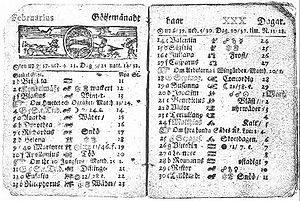
Sweden
From the 18th century onwards, names used by the royal family were introduced to the Swedish list of name days, followed by other common names. In 1901 a comprehensive modernization was made to make the list up to date with current names. The monopoly on almanacs, held by the Royal Swedish Academy of SciencesRoyal Swedish Academy of Sciences
The Royal Swedish Academy of Sciences or Kungliga Vetenskapsakademien is one of the Royal Academies of Sweden. The Academy is an independent, non-governmental scientific organization which acts to promote the sciences, primarily the natural sciences and mathematics.The Academy was founded on 2...
, expired in 1972 and so did the official name day list. Competing name day lists began to emerge but the official list was still in general use until 1986 when consensus of a new list with three names on each day was reached. This list was revised in 1993 and reduced to two names on each day. However, widespread dissatisfaction with the list prompted the Swedish Academy
Swedish Academy
The Swedish Academy , founded in 1786 by King Gustav III, is one of the Royal Academies of Sweden.-History:The Swedish Academy was founded in 1786 by King Gustav III. Modelled after the Académie française, it has 18 members. The motto of the Academy is "Talent and Taste"...
to compile a new two-name list which was finally accepted and brought into use in 2001. Although it does not have the official status of the 1901 or older lists, it is now universally used in Sweden.
Turkey
Mixture of many traditions, Name Day is partly celebrated in Turkey. Here are some examples of the "name birthdays": Ayşe March 15, Kemal 21 June, Selim 3 December, Zeynep 7 April, Abdullah 5 December, Ali 30 January. etc.Ukraine
Name days in Ukraine are usually associated with Ukrainian Orthodox Church celebrations of a day when a saint was born.USA
The particular mix of cultures in the United StatesUnited States
The United States of America is a federal constitutional republic comprising fifty states and a federal district...
allows a wide variety of name days to be celebrated. Many people rely on the name day calendar of their home culture. A variety of name day calendars have been published locally, some of which do not rely on the usual raison d'être for name days—a feast for a saint after whom a person with a Christian name is named. Some of these calendars are secular, and are a compilation of anniversaries based on such things as the names of celebrities or U.S. presidents. Name days, however, are not a prominent feature of the shared culture in the United States. However, as an exception, Saint Patrick's Day
Saint Patrick's Day
Saint Patrick's Day is a religious holiday celebrated internationally on 17 March. It commemorates Saint Patrick , the most commonly recognised of the patron saints of :Ireland, and the arrival of Christianity in Ireland. It is observed by the Catholic Church, the Anglican Communion , the Eastern...
is often celebrated on March 17 across the U.S., though mostly for secular reasons involving street parades, food, and alcohol.
See also
- Calendar of saintsCalendar of saintsThe calendar of saints is a traditional Christian method of organizing a liturgical year by associating each day with one or more saints and referring to the feast day of said saint...
- Celebrate Your Name WeekCelebrate Your Name WeekCelebrate Your Name Week is a holiday established in 1997 by American onomatology hobbyist Jerry Hill. Hill prescribed the first full week in March as a week for everyone worldwide to embrace and celebrate his or her name. It's also a week for appreciating names in general, and to have fun...
- SlavaSlavaThe Slava , also called Krsna Slava and Krsno ime , is the Serbian Orthodox tradition of the ritual celebration and veneration of a family's own patron saint. The family celebrates the Slava annually on the patron saint's feast day...
- Swedish calendarSwedish calendarThe Swedish calendar was a calendar in use in Sweden and its possessions from 1 March 1700 until 30 February 1712; it was one day ahead of the Julian calendar and ten days behind the Gregorian calendar...
External links
- Name days calendar for many countries Name days for 18 countries by date. How to say Happy Name Day in Latvian. The first name day calendar in which most of the name days are based on both Saint's days and American history, was published in the United States in 1982, and all of its original pages are viewable on calendar's 1982 Edition page: American Nameday Calendar of First Names - 1982 Edition Hungarian Name Days by date. Swedish Name Days by date. Name Day Calendar by country/date.