


Rafflesiaceae

Encyclopedia
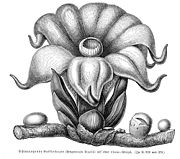
Rafflesia arnoldii
Rafflesia arnoldii is a member of the genus Rafflesia. It is noted for producing the largest individual flower on earth, and a strong odor of decaying flesh - the latter point earning it the nickname of "corpse flower". It is an endemic plant that occurs only in the rainforest of Bengkulu and...
, the plant with the largest flower of all plants. The plants are endoparasites of vines in the genus Tetrastigma
Tetrastigma
Tetrastigma is a genus of plants in the grape family, Vitaceae. The plants are vines that climb with tendrils and have palmately compound leaves. The species are found in subtropical and tropical regions of Asia, Malesia, and Australia, where they grow in primary rainforest, gallery forest and...
(Vitaceae
Vitaceae
Vitaceae are a family of dicotyledonous flowering plants including the grapevine and Virginia creeper. The family name is derived from the genus Vitis...
) and lack stems, leaves, roots, and any photosynthetic tissue. Only the flowers emerge from the roots or lower stems of the host plants.
Relationships
Past taxonomic works have varied as to the classification of Rafflesiaceae. Most traditional classifications that were based entirely on morphological features considered Rafflesiaceae sensu lato (in the broad sense) to include nine genera. But the heterogeneity among these genera caused early workers such as Harms (1935) to recognize four distinct groups that were then classified as tribes (still within Rafflesiaceae). This tribal system was followed by Takhtajan et al. (1985).The first molecular phylogenetic study (using DNA sequences) that showed two of these tribes were not related was by Barkman et al. (2004). This study showed that three genera (corresponding to tribe Rafflesieae, i.e. Rafflesia, Rhizanthes, and Sapria) were components of the eudicot order Malpighiales. The genus Mitrastema (tribe Mitrastemeae) was shown to be unrelated and a member of the order Ericales. Later that year, Nickrent et al. (2004) using additional molecular data confirmed the placements by Barkman et al. (2004) and also examined the positions of the two other tribes, Cytineae (Bdallophyton and Cytinus) and Apodantheae (Apodanthes, Berlinianche,and Pilostyles). Nickrent et al. (2004) showed that Cytineae was related to Malvales and Apodantheae to either Malvales or Cucurbitales. Thus, the group traditionally classified as a single family, Rafflesiaceae, was actually composed of at least three distinct and distantly related clades. A goal of taxonomy is to classify together only plants that all share a common ancestor (i.e. are monophyletic).
Families
Thus, Rafflesiaceae sensu lato should be "split" into four families:- Rafflesiaceae (sensu stricto): RafflesiaRafflesiaRafflesia is a genus of parasitic flowering plants. It contains approximately 28 species , all found in southeastern Asia, on the Malay Peninsula, Borneo, Sumatra, Thailand and the Philippines.Rafflesia was found in the Indonesian rain forest by an Indonesian guide working for Dr...
, Rhizanthes, SapriaSapriaSapria is a genus of parasitic flowering plants. It grows within roots of Vitis and Tetrastigma. The genus is limited to the tropical forests of South and South-east Asia....
-- order Malpighiales - Mitrastemonaceae: MitrastemaMitrastemaMitrastema is a genus of two widely disjunct species of parasitic plants. It is the only genus within the family Mitrastemonaceae. Mitrastema are root endoparasites, which grow on Fagaceae.-Taxonomy:...
-- order Ericales - CytinaceaeCytinaceaeCytinaceae is a family of parasitic flowering plant. It comprised two genera, Cytinus and Bdallophytum, totalling ten species.These two genera were formerly placed in family Rafflesiaceae, order Malpighiales. When they were first split out into a separate family, it was placed in Malpighiales, but...
: Bdallophyton, CytinusCytinusCytinus is a genus of parasitic flowering plants. Species in this genus do not produce chlorophyll, but rely fully on its host plant. Cytinus only parasitizes Cistus and Halimium, two genera of plants in the Cistaceae family....
-- order Malvales - ApodanthaceaeApodanthaceaeThe family Apodanthaceae comprises 22 to 30 species of endoparasitic herbs. They live in branches or roots of their host , emerging only to flower. The only leaves present are several bracts at the base of each flower. The plants do not carry out any photosynthesis...
: Apodanthes, Berlinianche, PilostylesPilostylesPilostyles is a genus of flowering plants placed in the family Apodanthaceae, or alternately, the Rafflesiaceae. It includes several species of parasitic plants that live inside the stems of other plants and produce tiny flowers that burst through the surface of the host plants' tissue...
-- order Malvales or Cucurbitales
These four families can be easily distinguished by floral and inflorescence features:
- Rafflesiaceae: inferior ovary, large flowers occurring singly
- Mitrastemonaceae: superior ovary, flowers occurring singly
- Cytinaceae: inferior ovary, flowers in inflorescences
- Apodanthaceae: inferior ovary, small flowers occurring singly (but arising in clusters from host bark).
Phylogenetic analysis
Malpighiales
Malpighiales is one of the largest orders of flowering plants, containing about 16000 species, approximately 7.8% of the eudicots. The order is very diverse and hard to recognize except with molecular phylogenetic evidence. It is not part of any of the classification systems that are based only on...
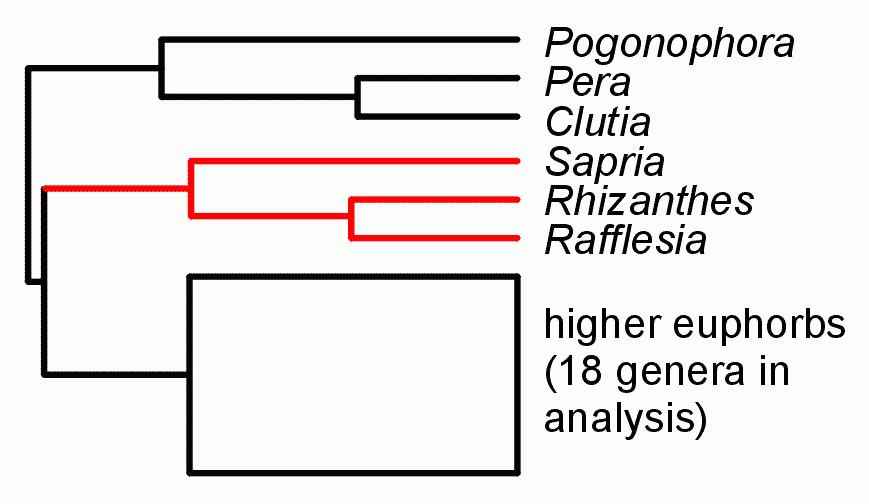
, but was not able to resolve the closest ancestor within the order. A more recent phylogenetic analysis found strong support for Rafflesiaceae being derived from within Euphorbiaceae
Euphorbiaceae
Euphorbiaceae, the Spurge family are a large family of flowering plants with 300 genera and around 7,500 species. Most are herbs, but some, especially in the tropics, are also shrubs or trees. Some are succulent and resemble cacti....
, which is surprising as members of that family typically have very small flowers. According to their analysis, the rate of flower size evolution was more or less constant throughout the family except at the origin of Rafflesiaceae - a period of about 46 million years between when the group split from the higher Euphorbiaceae, and when the existing Rafflesiaceae split from each other - where the flowers rapidly evolved to become much larger before reverting to the slower rate of change. If this hypothesis is confirmed, in order to maintain monophyly
Monophyly
In common cladistic usage, a monophyletic group is a taxon which forms a clade, meaning that it contains all the descendants of the possibly hypothetical closest common ancestor of the members of the group. The term is synonymous with the uncommon term holophyly...
of Euphorbiaceae, either the basal clade (represented by Pogonophora
Pogonophora (plant)
Pogonophora is a plant genus of the family Euphorbiaceae and the only genus of its tribe .-Synonymy:This genus is also known as:*Poraresia Gleason...
, Pera
Pera (genus)
Pera is a genus of the flowering plant family Euphorbiaceae and the only genus of its tribe . Pera differs from other Euphorbiaceae in several characteristics and some classifications place it in its own family, Peraceae....
, and Clutia
Clutia
Clutia is a plant genus of the family Euphorbiaceae. There are about 70 species, found in Africa and Arabia.-Synonyms:*Altora Adans.*Cluytia Aiton orth. var.*Clytia Stokes orth. var....
in the tree) will have to be split off as a separate family (and in fact Pera is recognized in the separate family Peraceae in some classifications), or Rafflesiaceae will have to be included in the Euphorbiaceae.
Horizontal gene transfer
A number of mitochondrial genes in the Rafflesiaceae appear to have come from their hosts. Because the hosts are not closely related to the parasites (as shown by molecular phylogenyMolecular phylogeny
Molecular phylogenetics is the analysis of hereditary molecular differences, mainly in DNA sequences, to gain information on an organism's evolutionary relationships. The result of a molecular phylogenetic analysis is expressed in a phylogenetic tree...
results for other parts of the genome), this is believed to be the result of horizontal gene transfer
Horizontal gene transfer
Horizontal gene transfer , also lateral gene transfer , is any process in which an organism incorporates genetic material from another organism without being the offspring of that organism...
.
Sources
- Barkman, T.J., S.-H. Lim, K. Mat Salleh and J. Nais. 2004. Mitochondrial DNA sequences reveal the photosynthetic relatives of Rafflesia, the world's largest flower. Proceedings of the National Academy of Sciences of USA 101:787–792.
- Charles C. Davis, Maribeth Latvis, Daniel L. Nickrent, Kenneth J. Wurdack, David A. Baum. 2007. Floral gigantism in Rafflesiaceae. Science Express, published online January 11, 2007 (online abstract here).
- Meijer, W. 1997. Rafflesiaceae, in Flora Malesiana I, 13: 1–42.
- Nickrent, D.L., A. Blarer, Y.-L. Qiu, R. Vidal-Russell and F.E. Anderson. 2004. Phylogenetic inference in Rafflesiales: the influence of rate heterogeneity and horizontal gene transfer. BMC Evolutionary Biology 4:40 (HTML abstract PDF fulltext).