
Encyclopedia
Centrifugal force is a term which may refer to two
different forces which are related to
rotation. Both of them are oriented away from the
axis of rotation, but the object on which they are exerted differs.
- The pseudo or fictitious centrifugal force appears when a rotating reference frame is used for analyzing the system. The centrifugal force is exerted on all objects, and directed away from the axis of rotation.
- The reactive centrifugal force is the reaction to the centripetal force. This is equal in magnitude to the centripetal force, directed away from the center of rotation, and is exerted by the rotating object upon the object which exerts the centripetal force. As this centrifugal force is an actual force, it is always present, independent of the choice of reference frame. Although this sense was used by Isaac Newton , it is only occasionally used in modern discussions.
Both of the above can be observed in action on a passenger riding in a car. If the car swerves around a corner, the passenger's body pushes against the outer edge of the car. This is the reactive centrifugal force, which is called a reaction force because it results from passive interaction with the car which actively pushes against the body.
Using a reference frame which is fixed relative to the car and while ignoring its rotation, it looks like an external force is pulling the passenger out of the car. This is the fictitious centrifugal force, so called because it is not an actual force exerted by some other object.
Reactive centrifugal force
When viewed from an inertial frame of reference, the application of
Newton's laws of motion is simple. The passenger's inertia resists
acceleration, keeping the passenger moving with constant speed and direction as the car begins to turn. From this point of view, the passenger does not gravitate toward the outside of the car; instead, the car curves to meet the passenger.
Once the car contacts the passenger, it then applies a sideways force to accelerate him or her around the turn with the car. This force is called a centri
petal force because its vector changes direction to continue to point toward the center of the car's arc as the car traverses it.
If the car is acting upon the passenger, then the passenger must be acting upon the car with an equal and opposite force. Being opposite, this reaction force is directed
away from the center, therefore centri
fugal. It is critical to realize that this centrifugal force acts upon the car, not the passenger.
The
centrifugal reaction force with which the passenger pushes back against the door of the car is given by:
where is the mass of the rotating object.
Rotating reference frames
In the classical approach, the inertial frame remains the true reference for the laws of mechanics and analysis. When using a rotating reference frame, the laws of physics are mapped from the most convenient inertial frame to that rotating frame. Assuming a constant rotation speed, this is achieved by adding to every object two
coordinate accelerations which correct for the rotation of the coordinate axes.
where is the acceleration relative to the rotating frame, is the acceleration relative to the inertial frame, is the
angular velocity vector describing the rotation of the reference frame, is the velocity of the body relative to the rotating frame, and is a vector from an arbitrary point on the rotation axis to the body. A derivation can be found in the article fictitious force.
The last term is the centrifugal acceleration, so we have:
where is the component of perpendicular to the axis of rotation.
Derivation
If we have two frames, one inertial and one rotating with a constant angular velocity , a time derivative of a vector in the rotating frame, , is transformed to the time derivative in the inertial frame, , by the following relation:
This relationship is one between two operators. Now, acceleration is the second derivative of position with respect to time. So, applying the above transformation to the position vector once gets you:
Putting back into the transformation, you get:
Because is a contant vector - that is the rotating reference frame is rotating constantly in the same direction - its time derivative is zero. So, simplifying:
Finally, putting in for and for , we get the following:
Moving things to the other side, but reversing one cross-product in each term, you find:
This tells us that , the acceleration of some object at as observed by someone at rest in the rotating frame is equal to the acceleration, , as observed by an observer in the inertial, non-rotating frame, plus , which is the
coriolis effect's contribution to the acceleration, and , which is the
centrifugal acceleration term.
Pseudo forces
An alternative way of dealing with a rotating frame of reference is to make Newton's laws of motion artificially valid by adding pseudo forces to be the cause of the above acceleration terms. In particular, the centrifugal acceleration is added to the motion of every object, and attributed to a centrifugal force, given by:
where is the mass of the object.
This centrifugal force is a sufficient correction to Newton's second law only if the body is stationary in the rotating frame. For bodies that move with respect to the rotating frame it must be supplemented with a second pseudo force "
Coriolis force":
For example, a body that is stationary relative to the
non-rotating frame, will be rotating when viewed from the rotating frame. The
centripetal force of required to account for this apparent rotation is the sum of the centrifugal force and the Coriolis force
. Since this centripetal force includes contributions from only pseudo forces, it has no reactive counterpart.
Potential energy
The fictitious centrifugal force can be described by a potential energy of the form
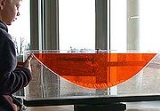
This is useful, for example, in calculating the form of the water surface in a rotating bucket: requiring the potential energy per unit mass on the surface to be constant, we obtain the
parabolic form .
Similarly, the potential energy of the centrifugal force is often used in the calculation of the height of the
tides on the Earth .
The principle of operation of the
centrifuge also can be simply understood in terms of this expression for the potential energy, which shows that it is favorable energetically when the volume far from the axis of rotation is occupied by the heavier substance.
The coriolis force has no equivalent potential, as it acts perpendicular to the velocity vector and hence rotates the direction of motion, but does not change the energy of a body.
Centrifugal forces in statics
Consider a ball that swings around a stationary pivot to which it is
tethered by a light, strong rope. There is tension in the rope, pulling inwards on the ball and simultaneously pulling outwards on the pivot . The tension is real, so these two forces still exist if we move to a corotating frame. However, in the rotating frame there is also a fictitious centrifugal force that pulls outwards on the
ball. It is distinct from the reactive centrifugal force that pulls outward on the
pivot.
When solving statics problems in a rotating frame it is convenient to think of the fictitious centrifugal force as being transmitted through the rope and
becoming the pull on the pivot. In statics one often considers a force "the same" before and after it has been conveyed by a structural element, so according to this view the reaction force on the pivot
is the fictitious force.
This identification often leads to confusion about the "fictitious" nature of the centrifugal force, because the pull on the pivot is a perfectly real force. The confusion can be resolved by noting that the distinction between fictitious and real forces depends on the frame of reference that one chooses for the laws of physics. On the other hand, considering the reaction force to
be the fictitious force is only valid in statics, that is, once we have decided to always use that particular reference frame in which the entire system is stationary. The convenience of viewing a transmitted force as the same as the original force comes at the cost of a meaningful distinction between whether a force is real or fictitious.
Confusion and misconceptions
Centrifugal force can be a confusing term because it is used in more than one instance, and because sloppy labeling can obscure which forces are acting upon which objects in a system . When diagramming forces in a system, one must describe each object separately, attaching only those forces acting
upon it .
One can avoid dealing with pseudo forces entirely by analyzing systems using inertial frames of reference for the physics; and when convenient, one simply maps to a rotating frame without forgetting about the frame rotation, as shown above. Such is standard practice in mechanics textbooks.
Because rotating frames are not vital for understanding mechanics, science teachers often de-emphasize the centrifugal forces that appear to exist in a rotating reference frame. However, in their zeal to stamp out the misunderstanding of the term in this one case, they may try to expunge it from the language entirely.
Applications
- A Centrifugal governor regulates the speed of an engine by using spinning masses that respond to centrifugal force generated by the engine. If the engine increases in speed, the masses move and trigger a cut in the throttle.
- Centrifugal forces can be used to generate artificial gravity. Proposals have been made to have gravity generated in space stations designed to rotate. The Mars Gravity Biosatellite will use study the effects of Mars level gravity on mice with simulated gravity from centrifugal force.
- Centrifuges are used in science and industry to separate substances by their relative masses.
- Some Amusement park rides make use of centrifugal forces. For instance, a Gravitron’s spin forces riders against a wall and allows riders to be elevated above the machine’s floor in defiance of Earth’s gravity.
See also
...
References and external links
-
- - Columbia electronic encyclopedia
- - from ScienceWorld
- about Centrifugal Force.
- M. Alonso and E.J. Finn, Fundamental university physics, Addison-Wesley
- vs. - from an online Regents Exam physics tutorial by the Oswego City School District
-