
All Topics  
Superconducting magnet

 
Superconducting Magnet

   Email Print
   Bookmark   Link


Superconducting magnet


A superconducting magnet is an electromagnet
Electromagnet

An electromagnet is a type of magnet in which the magnetic field is produced by the flow of electric Current . The magnetic field disappears when the current ceases....
 that is built using superconducting
Superconductivity

Superconductivity is a phenomenon occurring in certain materials generally at very low temperatures, characterized by exactly zero electrical resistance and the exclusion of the interior magnetic field ....
 coils. They must be cooled to cryogenic temperatures during operation. Their advantages are that they can produce stronger magnetic field
Magnetic field

A magnetism field is a vector field which can exert a magnetic force on moving electric charges and on magnetic dipoles . When placed in a magnetic field, magnetic dipoles tend to align their axes parallel to the magnetic field....
s than ordinary iron-core electromagnets, and can be cheaper to operate, since no power is lost to ohmic resistance in the windings.


Cooling
Liquid helium
Liquid helium

Helium exists in liquid form only at very low temperatures. The boiling point and critical point depend on the isotope of the helium; see the table below for values....
 is used as a coolant
Heat pump

A heat pump is a machine or device that moves heat from one location to another location using mechanical work. Most heat pump technology moves heat from a low temperature heat source to a higher temperature heat sink....
 for most superconductive windings, even those with critical temperatures far above its boiling point of 4.2 K.


Discussion
Ask a question about 'Superconducting magnet'
Start a new discussion about 'Superconducting magnet'
Answer questions from other users
Full Discussion Forum


Recent Posts


Encyclopedia


A superconducting magnet is an electromagnet
Electromagnet

An electromagnet is a type of magnet in which the magnetic field is produced by the flow of electric Current . The magnetic field disappears when the current ceases....
 that is built using superconducting
Superconductivity

Superconductivity is a phenomenon occurring in certain materials generally at very low temperatures, characterized by exactly zero electrical resistance and the exclusion of the interior magnetic field ....
 coils. They must be cooled to cryogenic temperatures during operation. Their advantages are that they can produce stronger magnetic field
Magnetic field

A magnetism field is a vector field which can exert a magnetic force on moving electric charges and on magnetic dipoles . When placed in a magnetic field, magnetic dipoles tend to align their axes parallel to the magnetic field....
s than ordinary iron-core electromagnets, and can be cheaper to operate, since no power is lost to ohmic resistance in the windings.

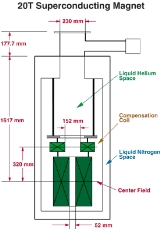
20mag


Construction


Cooling


Liquid helium
Liquid helium

Helium exists in liquid form only at very low temperatures. The boiling point and critical point depend on the isotope of the helium; see the table below for values....
 is used as a coolant
Heat pump

A heat pump is a machine or device that moves heat from one location to another location using mechanical work. Most heat pump technology moves heat from a low temperature heat source to a higher temperature heat sink....
 for most superconductive windings, even those with critical temperatures far above its boiling point of 4.2 K. The magnet and coolant are contained in a thermally insulated container (dewar) called a cryostat
Cryostat

A Cryostat is a vessel, similar in construction to a vacuum flask, or Dewar used to maintain cold cryogenic temperatures....
. To keep the helium from boiling away, the cryostat is usually constructed with an outer jacket containing (significantly cheaper) liquid nitrogen
Liquid nitrogen

Liquid nitrogen is a liquefied atmospheric gas produced industrially in large quantities by fractional distillation of liquid air. It is pure nitrogen in a liquid state at very low temperature....
 at 77 K. One of the goals of the search for high temperature superconductors is to build magnets that can be cooled by liquid nitrogen alone. At temperatures above about 20 K cooling can be achieved without boiling off cryogenic liquids.

Materials


The maximum magnetic field achievable in a superconducting magnet is limited by the field at which the winding material ceases to be superconducting, its 'critical field', Hc. Another limiting factor is the 'critical current', Ic at which the winding material also ceases to be superconducting. So advances in magnets have focused on better winding materials. The superconducting portions of current magnets are composed of niobium-titanium
Niobium-titanium

Niobium-titanium is an alloy of niobium and titanium, used industrially as a Type_II_superconductor wire for superconducting magnets . Normally as Nb-Ti fibres in an aluminium or copper matrix....
. This material has critical temperature
Superconductivity

Superconductivity is a phenomenon occurring in certain materials generally at very low temperatures, characterized by exactly zero electrical resistance and the exclusion of the interior magnetic field ....
 of 10 kelvin
Kelvin

The kelvin is a Units of measurement of temperature and is one of the seven SI base units. The Kelvin scale is a Thermodynamic temperature scale where absolute zero, the theoretical absence of all thermal energy, is zero ....
 and remains in this state until about 15 teslas
Tesla (unit)

The tesla is the SI derived unit of magnetic flux density B . The tesla is equal to one weber per square metre and was defined in 1960 in honor of inventor, scientist and electrical engineer Nikola Tesla....
. More expensive magnets
Electromagnet

An electromagnet is a type of magnet in which the magnetic field is produced by the flow of electric Current . The magnetic field disappears when the current ceases....
 can be made of niobium-tin
Niobium-tin

Niobium-tin or Triniobium-tin is a metallic chemical compound of niobium and tin , used industrially as a superconductivity. This intermetallic compound...
 (Nb3Sn). These have a Tc
Superconductivity

Superconductivity is a phenomenon occurring in certain materials generally at very low temperatures, characterized by exactly zero electrical resistance and the exclusion of the interior magnetic field ....
 of 18 K. When operating at 4.2 K they are able to withstand a much higher magnetic field intensity
Field strength

In physics, the field strength of a field is the magnitude of its vector value.In theoretical physics, field strength is another name for the curvature form....
, up to 25 to 30 teslas. Unfortunately, it is far more difficult to make the required filaments from this material. This is why sometimes a combination of Nb3Sn for the high field sections and Nb3Ti for the lower field sections is used. High temperature superconductors (BSCCO or YBCO) may be used for high-field inserts when magnetic fields are required which are higher than Nb3Sn can manage. BSCCO, YBCO or magnesium diboride
Magnesium diboride

Magnesium diboride is an inexpensive and simple superconductor. Its superconductivity was announced in the journal Nature in March 2001. Its critical temperature#Superconductivity of is the highest amongst conventional superconductors....
 may also be used for current leads, conducting high currents from room temperature into the cold magnet without an accompanying large heat leak.

Coil windings


The coil windings of a superconducting magnet
Magnet

A magnet is a material or object that produces a magnetic field. This magnetic field is invisible but is responsible for the most notable property of a magnet: a force that pulls on other ferromagnetic materials and attracts or repels other magnets....
 are made of wires or tapes of Type II
Type-II superconductor

A Type II superconductor is a superconductor characterised by its gradual transition from the superconducting to the normal state within an increasing magnetic field....
 superconductor
Superconductivity

Superconductivity is a phenomenon occurring in certain materials generally at very low temperatures, characterized by exactly zero electrical resistance and the exclusion of the interior magnetic field ....
s (e.g.niobium-titanium
Niobium-titanium

Niobium-titanium is an alloy of niobium and titanium, used industrially as a Type_II_superconductor wire for superconducting magnets . Normally as Nb-Ti fibres in an aluminium or copper matrix....
 or niobium-tin
Niobium-tin

Niobium-tin or Triniobium-tin is a metallic chemical compound of niobium and tin , used industrially as a superconductivity. This intermetallic compound...
). The wire or tape itself may be made of tiny filaments (about 20 micrometers
Micrometre

A micrometre or micron is one Micro- of a metre, or equivalently one thousandth of a millimetre. It is also commonly known as a micron....
 thick) of superconductor
Superconductivity

Superconductivity is a phenomenon occurring in certain materials generally at very low temperatures, characterized by exactly zero electrical resistance and the exclusion of the interior magnetic field ....
 in a copper
Copper

Copper is a chemical element with the symbol Cu and atomic number 29.It is a ductile metal with very high thermal and electrical conductivity....
 matrix. The copper is needed to add mechanical stability, and to provide a low resistance path for the large currents in case the temperature rises above Tc or the current rises above Ic
Superconductivity

Superconductivity is a phenomenon occurring in certain materials generally at very low temperatures, characterized by exactly zero electrical resistance and the exclusion of the interior magnetic field ....
 and superconductivity is lost. These filaments need to be this small because in this type of superconductor the current only flows skin-deep
London penetration depth

In superconductor, London penetration depth characterizes the typical distance to which a magnetic field penetrates into a superconductor.Typical values of...
. The coil must be carefully designed to withstand (or counteract) magnetic pressure
Magnetic pressure

Magnetic pressure is an energy density associated with the magnetic field. It is identical to any other physical pressure except that it is carried by the magnetic field rather than kinetic energy of the gas molecules....
 and Lorentz force
Lorentz force

In physics, the Hendrik Lorentz force is the force on a point charge due to electromagnetic fields. It is given by the following equation in terms of the electric field and magnetic fields:...
s that could otherwise cause wire fracture or crushing of insulation between adjacent turns.

Operation


Power supply


The current to the coil windings is provided by a high current, low voltage power supply
Power supply

Power supply is a reference to a source of electrical power. A device or system that supplies electrical or other types of energy to an output External electric load or group of loads is called a power supply unit or PSU....
, since in steady state the only voltage across the magnet is due to the resistance of the feeder wires. Any change to the current through the magnet must be done very slowly, first because electrically the magnet is a large inductor
Inductor

An inductor is a Passive component Electronic component that can store energy in a magnetic field created by the electric current passing through it....
 and an abrupt current change will result in a large voltage spike across the windings, and more importantly because fast changes in current can cause eddy current
Eddy current

An eddy current is an Electricity phenomenon discovered by France physics L?on Foucault in 1851. It is caused when a conductor is exposed to a changing magnetic field due to relative motion of the field source and conductor; or due to variations of the field with time....
s and mechanical stresses in the windings that can precipitate a quench (see below). So the power supply is usually microprocessor-controlled, programmed to accomplish current changes in gentle ramps. It usually takes several minutes to energize a laboratory sized magnet.

Persistent mode


An alternate operating mode, once the magnet has been energized, is to short-circuit the windings with a piece of superconductor. The windings become a closed superconducting loop, the power supply can be turned off, and persistent currents will flow for months, preserving the magnetic field. The advantage of this persistent mode is that stability of the magnetic field is better than is achievable with the best power supplies, and no energy is needed to power the windings. The short circuit is made by a 'persistent switch', a piece of superconductor inside the magnet connected across the winding ends, attached to a small heater. In normal mode, the switch wire is heated above its transition temperature, so it is resistive. Since the winding itself has no resistance, no current flows through the switch wire. To go to persistent mode, the current is adjusted until the desired magnetic field is obtained, then the heater is turned off. The persistent switch cools to its superconducting temperature, short circuiting the windings. The current and the magnetic field will not actually persist forever, but will decay slowly according to a normal L/R time constant:

where is a small residual resistance in the superconducting windings due to joints or a phenomenon called flux motion resistance. Nearly all commercial superconducting magnets are equipped with persistent switches.

Magnet quench


A quench is an abnormal termination of magnet operation that occurs when part of the superconducting coil enters the normal (resistive) state. This can be because the field inside the magnet is too great, the rate of change of field is too great (causing eddy current
Eddy current

An eddy current is an Electricity phenomenon discovered by France physics L?on Foucault in 1851. It is caused when a conductor is exposed to a changing magnetic field due to relative motion of the field source and conductor; or due to variations of the field with time....
s and resultant heating
Joule heating

Joule heating, also known as ohmic heating and resistive heating, is the process by which the passage of an electric current through a conductor releases heat....
 in the copper support matrix), or a combination of the two. More rarely a defect in the magnet can cause a quench. When this happens, that particular spot is subject to rapid Joule heating
Joule heating

Joule heating, also known as ohmic heating and resistive heating, is the process by which the passage of an electric current through a conductor releases heat....
, which raises the temperature
Temperature

In physics, temperature is a physical property of a Physical system that underlies the common notions of hot and cold; something that feels hotter generally has the greater temperature....
 of the surrounding regions. This pushes these into the normal state as well, which leads to more heating in a chain reaction. The entire magnet rapidly (can take several seconds, depending on the size of the superconducting coil) becomes normal. This is accompanied by a loud bang as the energy in the magnetic field is converted to heat, and rapid boil-off of the cryogenic fluid. The abrupt decrease of current can result in kilovolt inductive voltage spikes and arcing. Permanent damage to the magnet is rare, but components can be damaged by localised heating or large mechanical forces. Practical magnets usually have safety devices to remove the current or limit it when the beginning of a quench is detected.

History


Although the idea of making electromagnets with superconducting wire was proposed by Heike Kamerlingh Onnes
Heike Kamerlingh Onnes

Heike Kamerlingh Onnes was a Netherlands physicist. His scientific career was spent exploring extremely cold refrigeration techniques and the associated phenomena....
 shortly after he discovered superconductivity in 1911, a practical superconducting electromagnet had to await the discovery of superconductors that could stand high magnetic fields. The first successful superconducting magnet was built by George Yntema in 1954 using niobium
Niobium

Niobium , or columbium , is a chemical element with symbol Nb and atomic number 41. A rare, soft, grey, ductile transition metal, niobium is found in the minerals pyrochlore and columbite....
 wire and achieved a field of 0.71 T at 4.2 K. Widespread interest was sparked by Kunzler's 1961 discovery of the advantages of niobium-tin as a high Hc, high current winding material.

In 1986, the discovery of high temperature superconductors by Georg Bednorz and Karl Muller energized the field, raising the possibility of magnets that could by cooled by liquid nitrogen instead of the more difficult to work with helium.

In 2007 a magnet with windings of YBCO achieved a world record field of 26.8 tesla
Tesla (unit)

The tesla is the SI derived unit of magnetic flux density B . The tesla is equal to one weber per square metre and was defined in 1960 in honor of inventor, scientist and electrical engineer Nikola Tesla....
s. The US National Research Council
National Research Council

National Research Council may refer to:* National Research Council , Canada's leading organization for scientific research and development* National Scientific and Technical Research Council, an Argentine government agency which directs and co-ordinates most of the scientific and technical research done in public universities and institute...
 has a goal of creating a 30 tesla superconducting magnet.

Uses


Superconducting magnets have a number of advantages over resistive
Electrical resistance

The electrical resistance of an object is a measure of its opposition to the passage of a steady electrical current. An object of uniform cross section will have a resistance proportional to its length and inversely proportional to its cross-sectional area, and proportional to the resistivity of the material....
 electromagnets. They can achieve an order of magnitude stronger field than ordinary ferromagnetic-core electromagnets
Electromagnet

An electromagnet is a type of magnet in which the magnetic field is produced by the flow of electric Current . The magnetic field disappears when the current ceases....
, which are limited to fields of around 2 T. The field is generally more stable, resulting in less noisy measurements. They can be smaller, and the area at the center of the magnet where the field is created is empty rather than being occupied by an iron core. Most importantly, for large magnets they can consume much less power. In the persistent state (above), the only power the magnet consumes is that needed for any refrigeration equipment to preserve the cryogenic temperature. Higher fields, however can be achieved with special cooled resistive electromagnets, as the superconducting coils will enter the normal (non-superconducting) state (see quench, above) at high fields.

Superconducting magnets are widely used in MRI machines, NMR
NMR

NMR may refer to:Applications of Nuclear Magnetic Resonance:* Nuclear Magnetic Resonance.* NMR Spectroscopy.* Proton NMR.* Carbon-13 NMR....
 equipment, mass spectrometers, magnetic separation processes, and particle accelerator
Particle accelerator

A particle accelerator is a device that uses electric fields to propel electric charge Elementary particles to high speeds and to contain them....
s.

One of the most challenging use of SC magnets is in the LHC
LHC

LHC may refer to:* Large Hadron Collider, a particle accelerator and collider located on the Franco-Swiss border near Geneva, SwitzerlandLHC also may refer to:...
 particle accelerator
Particle accelerator

A particle accelerator is a device that uses electric fields to propel electric charge Elementary particles to high speeds and to contain them....
. The niobium-titanium
Niobium-titanium

Niobium-titanium is an alloy of niobium and titanium, used industrially as a Type_II_superconductor wire for superconducting magnets . Normally as Nb-Ti fibres in an aluminium or copper matrix....
 (Nb-Ti) magnets will operate at 1.9 K to allow them to run safely at 8.3 T. Each magnet will store 7 MJ. In total the magnets will store 10.4 GJ. Once or twice a day, as the protons are accelerated from 450 GeV to 7 TeV, the field of the superconducting bending magnets will be increased from 0.54 T to 8.3 T.

The central solenoid and toroidal field superconducting magnets designed for the ITER
ITER

ITER is an international tokamak research/engineering proposal for an experimental project that could help to make the transition from today's studies of plasma physics to future electricity-producing fusion power plants....
 fusion reactor use niobium-tin
Niobium-tin

Niobium-tin or Triniobium-tin is a metallic chemical compound of niobium and tin , used industrially as a superconductivity. This intermetallic compound...
 (Nb3Sn) as a superconductor. The Central Solenoid coil will carry 46 kA and produce a field of 13.5 teslas. The 18 Toroidal Field coils at max field of 11.8 T will store 41 GJ (total?). They have been tested at a record 80 kA. Other lower field ITER magnets (PF and CC) will use niobium-titanium
Niobium-titanium

Niobium-titanium is an alloy of niobium and titanium, used industrially as a Type_II_superconductor wire for superconducting magnets . Normally as Nb-Ti fibres in an aluminium or copper matrix....
. Most of the ITER magnets will have their field varied many times per hour.

Further reading

  • Martin N. Wilson, Superconducting Magnets (Monographs on Cryogenics), Oxford University Press, New edition (1987), ISBN 978-0198548102.
  • Yukikazu Iwasa, Case Studies in Superconducting Magnets: Design and Operational Issues (Selected Topics in Superconductivity), Kluwer Academic / Plenum Publishers, (Oct 1994), ISBN 978-0306448812.
  • Habibo Brechna, Superconducting magnet systems, New York, Springer-Verlag New York, Inc., 1973, ISBN 3-540-06103-7, ISBN 0-387-06103-7


See also

Fault current limiter

A Fault Current Limiter is a device which limits the prospective fault current when a fault occurs . The term is generally applied to superconductivity, whereas non-superconducting devices are typically termed Fault Current Controllers....