
Home      Discussion      Topics      Dictionary      Almanac
Signup       Login
Rouen Cathedral

Rouen Cathedral

Overview
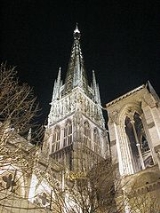
Rouen Cathedral is a Roman Catholic Gothic
Gothic architecture
Gothic architecture is a style of architecture that flourished during the high and late medieval period. It evolved from Romanesque architecture and was succeeded by Renaissance architecture....

 cathedral
Cathedral
A cathedral is a Christian church that contains the seat of a bishop...

 in Rouen
Rouen
Rouen , in northern France on the River Seine, is the capital of the Haute-Normandie region and the historic capital city of Normandy. Once one of the largest and most prosperous cities of medieval Europe , it was the seat of the Exchequer of Normandy in the Middle Ages...

, in northwestern France
France
The French Republic , The French Republic , The French Republic , (commonly known as France , is a unitary semi-presidential republic in Western Europe with several overseas territories and islands located on other continents and in the Indian, Pacific, and Atlantic oceans. Metropolitan France...

. It is the seat of the Archbishop of Rouen
Archbishop of Rouen
The Roman Catholic Archdiocese of Rouen is an Archdiocese of the Latin Rite of the Roman Catholic Church in France. As one of the fifteen Archbishops of France, the ecclesiastical province of the archdiocese comprises the majority of Normandy....

 and Normandy
Normandy
Normandy is a geographical region corresponding to the former Duchy of Normandy. It is in France.The continental territory covers 30,627 km² and forms the preponderant part of Normandy and roughly 5% of the territory of France. It is divided for administrative purposes into two régions:...

.
Discussion
Ask a question about 'Rouen Cathedral'
Start a new discussion about 'Rouen Cathedral'
Answer questions from other users
Full Discussion Forum
 
Unanswered Questions
Encyclopedia
Rouen Cathedral is a Roman Catholic Gothic
Gothic architecture
Gothic architecture is a style of architecture that flourished during the high and late medieval period. It evolved from Romanesque architecture and was succeeded by Renaissance architecture....

 cathedral
Cathedral
A cathedral is a Christian church that contains the seat of a bishop...

 in Rouen
Rouen
Rouen , in northern France on the River Seine, is the capital of the Haute-Normandie region and the historic capital city of Normandy. Once one of the largest and most prosperous cities of medieval Europe , it was the seat of the Exchequer of Normandy in the Middle Ages...

, in northwestern France
France
The French Republic , The French Republic , The French Republic , (commonly known as France , is a unitary semi-presidential republic in Western Europe with several overseas territories and islands located on other continents and in the Indian, Pacific, and Atlantic oceans. Metropolitan France...

. It is the seat of the Archbishop of Rouen
Archbishop of Rouen
The Roman Catholic Archdiocese of Rouen is an Archdiocese of the Latin Rite of the Roman Catholic Church in France. As one of the fifteen Archbishops of France, the ecclesiastical province of the archdiocese comprises the majority of Normandy....

 and Normandy
Normandy
Normandy is a geographical region corresponding to the former Duchy of Normandy. It is in France.The continental territory covers 30,627 km² and forms the preponderant part of Normandy and roughly 5% of the territory of France. It is divided for administrative purposes into two régions:...

.

History


A church was already present at the location in late 4th century, and eventually a cathedral was established in Rouen
Rouen
Rouen , in northern France on the River Seine, is the capital of the Haute-Normandie region and the historic capital city of Normandy. Once one of the largest and most prosperous cities of medieval Europe , it was the seat of the Exchequer of Normandy in the Middle Ages...

 as in Poitiers
Poitiers
Poitiers is a city on the Clain river in west central France. It is a commune and the capital of the Vienne department and of the Poitou-Charentes region. The centre is picturesque and its streets are interesting for predominant remains of historical architecture, especially from the Romanesque...

. It was enlarged by St. Ouen in 650, visited by Charlemagne
Charlemagne
Charlemagne was King of the Franks from 768 and Emperor of the Romans from 800 to his death in 814. He expanded the Frankish kingdom into an empire that incorporated much of Western and Central Europe. During his reign, he conquered Italy and was crowned by Pope Leo III on 25 December 800...

 in 769.

All the buildings perished during a Viking
Viking
The term Viking is customarily used to refer to the Norse explorers, warriors, merchants, and pirates who raided, traded, explored and settled in wide areas of Europe, Asia and the North Atlantic islands from the late 8th to the mid-11th century.These Norsemen used their famed longships to...

 raid in the 9th century, Rollo
Rollo
Rollo has multiple meanings. It may mean:a first name*Rollo Armstrong, member of British dance act Faithless* Rollo May, American psychologist...

 was baptized here in 915 and buried in 931, Richard I further enlarged it in 950, St. Romain's tower was built in 1035. The buildings of Archbishop Robert II were consecrated in 1065. The cathedral was struck by lightning
Lightning strike
Lightning strikes are electrical discharges caused by lightning, typically during thunderstorms.Humans can be hit by lightning directly when outdoors. Contrary to popular notion, there is no 'safe' location outdoors. People have been struck in sheds and makeshift shelters...

 in 1110.

Construction on the current building began in the 12th century in the Early gothic style for Saint Romain's tower, front side porches and part of the nave
Nave
In Romanesque and Gothic Christian abbey, cathedral basilica and church architecture, the nave is the central approach to the high altar, the main body of the church. "Nave" was probably suggested by the keel shape of its vaulting...

. The cathedral was burnt in 1200. Others were built in the High gothic style for the mainworks: nave, transept, choir and first floor of the lantern tower in the 13th century; side chapels, lady's chapel and side doorways in the 14th century. Some windows are still decorated with stained glass of the 13th century, famous because of a special cobalt blue colour, known as "the blue from Chartres
Chartres
Chartres is a commune and capital of the Eure-et-Loir department in northern France. It is located southwest of Paris.-Geography:Chartres is built on the left bank of the Eure River, on a hill crowned by its famous cathedral, the spires of which are a landmark in the surrounding country...

". The north transept end commenced in 1280.

The cathedral was again struck by lightning in 1284. In 1302, the old Lady chapel
Lady chapel
A Lady chapel, also called Mary chapel or Marian chapel, is a traditional English term for a chapel inside a cathedral, basilica, or large church dedicated to the Blessed Virgin Mary...

 taken down and the new Lady chapel was built in 1360. The spire was blown down in 1353, choir windows were enlarged in 1430, the upper storey of the north-west tower was added in 1477, gable of the north transept built in 1478.

Some more were built in the Late gothic style, these include the last storey of Saint Romain's tower (15th century), butter tower, main porch of the front and the two storeys of the lantern tower (16th century). Construction of the south-west tower began in 1485 and was built in 1507. The Butter Tower was erected in the early 16th century. Butter was banned during Lent and those who did not wish to forgo this indulgence would donate monies of six deniers Tournois from each diocesan for this permission.

The remainder of the cathedral was built in the Renaissance style. The realization of the Butter Tower caused disturbances in the facade, which caused the reconstruction of the central portal and the west front, which begun in 1509 and finished in 1530. The original gothic spire suffered a fire in 1514, nevertheless the project of a stone spire was denied and a wooden construction covered with gold-plated plumb was begun in 1515, a parapet
Parapet
A parapet is a wall-like barrier at the edge of a roof, terrace, balcony or other structure. Where extending above a roof, it may simply be the portion of an exterior wall that continues above the line of the roof surface, or may be a continuation of a vertical feature beneath the roof such as a...

 was added in 1580.

In the late 16th century the cathedral was badly damaged during the French Wars of Religion
French Wars of Religion
The French Wars of Religion is the name given to a period of civil infighting and military operations, primarily fought between French Catholics and Protestants . The conflict involved the factional disputes between the aristocratic houses of France, such as the House of Bourbon and House of Guise...

: the Calvinists damaged much of the furniture, tombs, stained-glass windows and statuary. The cathedral was again struck by lightning in 1625 and 1642, then damaged by a hurricane in 1683, the wood-work of the choir burnt in 1727 and the bell broke in 1786. In the 18th century, the state nationalized
Nationalization
Nationalisation, also spelled nationalization, is the process of taking an industry or assets into government ownership by a national government or state. Nationalization usually refers to private assets, but may also mean assets owned by lower levels of government, such as municipalities, being...

 the building and sold some of its furniture and statues to make money and the chapel fences were melted down to make guns.

The spire was destroyed by lightning in 1822. The cathedral was named the tallest building (the lantern tower with the cast iron spire of the 19th century) in the world (151 m) from 1876 to 1880. In the 20th century, during World War II
World War II
World War II, or the Second World War , was a global conflict lasting from 1939 to 1945, involving most of the world's nations—including all of the great powers—eventually forming two opposing military alliances: the Allies and the Axis...

, the cathedral was bombed in April 1944. Seven bombs fell on the building, narrowly missing destroying a key pillar of the lantern tower, but damaging much of the south aisle and destroying two rose windows. One of the bombs did not explode. A second bombing (before the Normandy Landings in June 1944) burned the oldest tower, called the North Tower. During the fire the bells melted, leaving molten remains on the floor. In 1999, during a violent wind storm
Lothar (storm)
Lothar is the name of a low-pressure system that resulted in a violent extratropical cyclone sweeping across Central Europe on December 26, 1999, causing major damage in France, southern Germany, and Switzerland. Wind speeds reached around 150 km/h in lower areas and more than 250 km/h on...

, a copper-clad wooden turret, which weighed 26 tons, fell into the church and damaged the choir.

Musical tradition


The cathedral had a strong musical tradition since the Middle Ages. Its choir was famous up to the French Revolution
French Revolution
The French Revolution , sometimes distinguished as the 'Great French Revolution' , was a period of radical social and political upheaval in France and Europe. The absolute monarchy that had ruled France for centuries collapsed in three years...

 for singing from memory. The first major organist to work here was Jean Titelouze
Jean Titelouze
Jean Titelouze was a French composer, poet and organist of the early Baroque period. His style was firmly rooted in the Renaissance vocal tradition, and as such was far removed from the distinctly French style of organ music that developed during the mid-17th century...

, the so-called father of the French organ school, who occupied the post of the titular organist in 1588–1633. Around 1600 in collaboration with the famous Franco-Flemish organ builder Crespin Carlier, Titelouze transformed the organ of the cathedral to one of the best instruments in France. Some 80 years later the legendary organ builder Robert Clicquot
Robert Clicquot
Robert Clicquot was a French organ builder from Paris. His most notable organs are in the Chapel of the Palace of Versailles, the churches of Saint-Quentin and Saint-Louis des Invalides in Paris and Rouen Cathedral....

 restored and enhanced the instrument; organists who played the new organ included distinguished composers such as Jacques Boyvin
Jacques Boyvin
Jacques Boyvin was a French Baroque composer and organist.He was probably born in Paris, and studied there. One of his first jobs was that of organist of the parisian church des Quinze-Vingts, and in 1674 he was appointed titular organist of the Rouen Cathedral, where Jean Titelouze served as...

 (in 1674–1706), and François d'Agincourt
François d'Agincourt
François d'Agincourt was a French harpsichordist, organist, and composer. He spent most of his life in Rouen, his native city, where he worked as organist of the Rouen Cathedral and of three smaller churches. Highly regarded during his lifetime, d'Agincourt was one of the organists of the royal...

 (1706–1758). New organs were built by Merklin & Schütze (1858–60) and, after World War II, by Jacquot-Lavergne.

In art


The most famous paintings of the cathedral were produced by the Impressionist
Impressionism
Impressionism was a 19th-century art movement that originated with a group of Paris-based artists whose independent exhibitions brought them to prominence during the 1870s and 1880s...

 painter Claude Monet
Claude Monet
Claude Monet was a founder of French impressionist painting, and the most consistent and prolific practitioner of the movement's philosophy of expressing one's perceptions before nature, especially as applied to plein-air landscape painting. . Retrieved 6 January 2007...

, who painted a large series of paintings of the building, the same scenes at different times of the day. Two paintings are in the National Gallery of Art
National Gallery of Art
The National Gallery of Art and its Sculpture Garden is a national art museum, located on the National Mall between 3rd and 9th Streets at Constitution Avenue NW, in Washington, DC...

 in Washington, D.C.
Washington, D.C.
Washington, D.C., formally the District of Columbia and commonly referred to as Washington, "the District", or simply D.C., is the capital of the United States. On July 16, 1790, the United States Congress approved the creation of a permanent national capital as permitted by the U.S. Constitution....

; one is in the Getty Center
Getty Center
The Getty Center, in Brentwood, Los Angeles, California, is a campus for cultural institutions founded by oilman J. Paul Getty. The $1.3 billion center, which opened on December 16, 1997, is also well known for its architecture, gardens, and views overlooking Los Angeles...

 in Los Angeles, CA; one is in the National Museum of Serbia
National Museum of Serbia
The National Museum is the largest and oldest museum in Serbia. It is located in Republic Square, Belgrade, Serbia. The museum was established on May 10, 1844. Since it was founded, its collections have to over 400,000 objects including many foreign masterpieces...

 in Belgrade
Belgrade
Belgrade is the capital and largest city of Serbia. It is located at the confluence of the Sava and Danube rivers, where the Pannonian Plain meets the Balkans. According to official results of Census 2011, the city has a population of 1,639,121. It is one of the 15 largest cities in Europe...

; one is in a museum of Cologne
Cologne
Cologne is Germany's fourth-largest city , and is the largest city both in the Germany Federal State of North Rhine-Westphalia and within the Rhine-Ruhr Metropolitan Area, one of the major European metropolitan areas with more than ten million inhabitants.Cologne is located on both sides of the...

; one in the Rouen fine art museum and five in the musée d'Orsay
Musée d'Orsay
The Musée d'Orsay is a museum in Paris, France, on the left bank of the Seine. It is housed in the former Gare d'Orsay, an impressive Beaux-Arts railway station built between 1898 and 1900. The museum holds mainly French art dating from 1848 to 1915, including paintings, sculptures, furniture,...

 in Paris. The estimated value of one painting is over $40 million. Other painters inspired by the building included John Ruskin
John Ruskin
John Ruskin was the leading English art critic of the Victorian era, also an art patron, draughtsman, watercolourist, a prominent social thinker and philanthropist. He wrote on subjects ranging from geology to architecture, myth to ornithology, literature to education, and botany to political...

, who selected as an example of good architecture in The Seven Lamps of Architecture
The Seven Lamps of Architecture
The Seven Lamps of Architecture, published in May 1849, is an extended essay written by the English art critic and theorist John Ruskin. The 'lamps' of the title are Ruskin's principles of architecture, which he later enlarged upon in the three-volume The Stones of Venice. To an extent, they...

, and Roy Lichtenstein
Roy Lichtenstein
Roy Lichtenstein was a prominent American pop artist. During the 1960s his paintings were exhibited at the Leo Castelli Gallery in New York City and along with Andy Warhol, Jasper Johns, James Rosenquist and others he became a leading figure in the new art movement...

, who produced a series of pictures representing the cathedral's front. Mae Babitz, known for illustrations of the Watts Towers and Victorian era buildings in Los Angeles, illustrated the Cathedral in the 1960s. Those works are held UCLA library
University of California, Los Angeles Library System
The library system of the University of California, Los Angeles is among the top 10 academic research libraries in North America and has in its collection over eight million books and 70,000 serials...

 Special Collections.
In literature, Gustave Flaubert
Gustave Flaubert
Gustave Flaubert was a French writer who is counted among the greatest Western novelists. He is known especially for his first published novel, Madame Bovary , and for his scrupulous devotion to his art and style.-Early life and education:Flaubert was born on December 12, 1821, in Rouen,...

 was inspired by the stained glass windows of St. Julian and the bas-relief
Relief
Relief is a sculptural technique. The term relief is from the Latin verb levo, to raise. To create a sculpture in relief is thus to give the impression that the sculpted material has been raised above the background plane...

 of Salome
Salome
Salome , the Daughter of Herodias , is known from the New Testament...

, and based two of his Three Tales
Three Tales (Flaubert)
Three Tales is a work by Gustave Flaubert that was originally published in French in 1877. It consists of the short stories "A Simple Heart", "Saint Julian" and "Hérodias"...

on them. Joris-Karl Huysmans
Joris-Karl Huysmans
Charles-Marie-Georges Huysmans was a French novelist who published his works as Joris-Karl Huysmans . He is most famous for the novel À rebours...

 wrote La Cathédrale about the cathedral, a novel based on an intensive examination of the building. Willa Cather sets a key scene in the development of the protagonist Claude Wheeler of One of Ours
One of Ours
One of Ours is a novel by Willa Cather that won the 1923 Pulitzer Prize. It tells the story of the life of Claude Wheeler, a Nebraska native around the turn of the 20th century. The son of a successful Midwestern farmer and an intensely pious mother, he is guaranteed a comfortable livelihood...

 in the cathedral.

Burials


It contains a tomb of Richard the Lionheart
Richard I of England
Richard I was King of England from 6 July 1189 until his death. He also ruled as Duke of Normandy, Duke of Aquitaine, Duke of Gascony, Lord of Cyprus, Count of Anjou, Count of Maine, Count of Nantes, and Overlord of Brittany at various times during the same period...

 which contained his heart. His bowels were probably buried within the church of the Chateau of Châlus-Chabrol in the Limousin. It was from the walls of the Chateau of Châlus-Chabrol that the crossbow bolt was fired, which led to his death once the wound became septic. His corporeal remains were buried next to his father at Fontevraud Abbey
Fontevraud Abbey
Fontevraud Abbey or Fontevrault Abbey is a religious building hosting a cultural centre since 1975, the Centre Culturel de l'Ouest, in the village of Fontevraud-l'Abbaye, near Chinon, in Anjou, France. It was founded by the itinerant reforming preacher Robert of Arbrissel, who had just created a...

 near Chinon
Chinon
Chinon is a commune in the Indre-et-Loire department in central France well known for Château de Chinon.In the Middle Ages, Chinon developed especially during the reign of Henry II . The castle was rebuilt and extended, becoming one of his favorite residences...

 and Saumur
Saumur
Saumur is a commune in the Maine-et-Loire department in western France.The historic town is located between the Loire and Thouet rivers, and is surrounded by the vineyards of Saumur itself, Chinon, Bourgueil, Coteaux du Layon, etc...

, France
France
The French Republic , The French Republic , The French Republic , (commonly known as France , is a unitary semi-presidential republic in Western Europe with several overseas territories and islands located on other continents and in the Indian, Pacific, and Atlantic oceans. Metropolitan France...

. Richard's effigy is on top of the tomb, and his name is inscribed in Latin on the side.

The Cathedral also contains the tomb of Rollo
Rollo
Rollo has multiple meanings. It may mean:a first name*Rollo Armstrong, member of British dance act Faithless* Rollo May, American psychologist...

 (Hrólfr, Rou(f) or Robert), one of Richard's ancestors, the founder and first ruler of the Viking principality in what soon became known as Normandy.

The cathedral contained the black marble tomb of John Plantagenet or John Lancaster, Duke of Bedford, who is considered to be Joan of Arc
Joan of Arc
Saint Joan of Arc, nicknamed "The Maid of Orléans" , is a national heroine of France and a Roman Catholic saint. A peasant girl born in eastern France who claimed divine guidance, she led the French army to several important victories during the Hundred Years' War, which paved the way for the...

's murderer. He became a canon priest of the cathedral after her death. His original tomb was destroyed by the calvinists in the 16th century but there remains a commemorative plaque .

Other burials include:
  • Poppa, wife of Rollo of Normandy
    Rollo of Normandy
    Rollo , baptised Robert and so sometimes numbered Robert I to distinguish him from his descendants, was a Norse nobleman of Norwegian or Danish descent and founder and first ruler of the Viking principality in what soon became known as Normandy...

     and mother of Duke William I
  • William I, Duke of Normandy (also known as William Longsword)
  • Matilda of England (also known as the Empress Matilda
    Empress Matilda
    Empress Matilda , also known as Matilda of England or Maude, was the daughter and heir of King Henry I of England. Matilda and her younger brother, William Adelin, were the only legitimate children of King Henry to survive to adulthood...

    )
  • William FitzEmpress
  • Arthur I, Duke of Brittany
    Arthur I, Duke of Brittany
    Arthur I was Duke of Brittany between 1194 and 1202. He was the posthumous son of Geoffrey II, Duke of Brittany and Constance, Duchess of Brittany...

  • Henry the Young King
    Henry the Young King
    Henry, known as the Young King was the second of five sons of King Henry II of England and Eleanor of Aquitaine but the first to survive infancy. He was officially King of England; Duke of Normandy, Count of Anjou and Maine.-Early life:Little is known of the young prince Henry before the events...

  • Georges d'Amboise
    Georges d'Amboise
    Georges d'Amboise was a French Roman Catholic cardinal and minister of state. He belonged to the house of Amboise, a noble family possessed of considerable influence: of his nine brothers, four were bishops. His father, Pierre d'Amboise, seigneur de Chaumont, was chamberlain to Charles VII and...

  • Pierre de Brézé
    Pierre de Brézé
    Pierre de Brézé was a French soldier and politician in the service of King Charles VII. He had made his name in the English wars when in 1433 he joined with Yolande, queen of Sicily, the constable Richmond and others, in chasing from power Charles VII's minister La Trémoille...

  • Louis de Brézé, seigneur d'Anet
    Louis de Brézé, seigneur d'Anet
    Louis de Brézé, seigneur d'Anet and comte de Maulevrier was a French nobleman, the grandson of King Charles VII of France by his natural daughter with his mistress Agnès Sorel.- Birthright, marriage, political intrigues :...


Dimensions

Dimensions
interior length 136.86 m
exterior length 144 m
height of northern crossing 28 m
height of southern crossing 28 m
central spire
Spire
A spire is a tapering conical or pyramidal structure on the top of a building, particularly a church tower. Etymologically, the word is derived from the Old English word spir, meaning a sprout, shoot, or stalk of grass....

total height of spire 151 m
weight of spire 8 000 t
choir choir length 34.30 m
choir height 28 m
choir width 12.68 m
crossing tower height of crossing tower 51 m
facade width of western facade 61.60 m
nave width of nave 24.20 m
length of nave 60 m
height of vaults of main aisle 28 m
height of vaults of second aisle 14 m
width of central aisle 11.30 m
tower Beurre height 75 m
tower Saint-Romain height 82 m
transept width of transept 24.60 m
exterior length of transept 57 m
interior length of transept 53.65 m

See also