

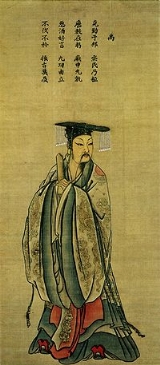
Yu the Great

Encyclopedia
Yu the Great was a legendary ruler of Ancient China famed for his introduction of flood control
, inaugurating dynastic rule in China by founding the Xia Dynasty
, and for his upright moral character.
Few, if any, records exist from the period of Chinese history when Yu reigned. Because of this, the vast majority of information about his life and reign comes from collected pieces of oral tradition and stories that were passed down in various areas of China, many of which were collected in Sima Qian
's famous Records of the Grand Historian
. Yu and other "sage-kings" of Ancient China were lauded by Confucius
and other Chinese teachers, who praised their virtues and morals.
Yu is one of the few Chinese rulers posthumously honored with the appellation "the Great".
: Yu's father Gun
was the 5th great-grandson of King Zhuanxu
; Zhuanxu's father Changyi was the second son of the Yellow Emperor. Yu was said to be born at Mount Wen , in modern day Beichuan County, Sichuan Province, though there are debates as to whether he was born in Shifang
instead. Yu's mother was a woman of the Youxin clan named either Nüzhi or Nüxi .
As a child, Yu's father Gun moved the people east toward the Chinese heartland. King Yao
enfeoffed Gun as lord of Chong, usually identified as the middle peak of Mount Song
. Yu is thus believed to have grown up on the slopes of Mount Song, just south of the Yellow River
. He later married a woman from Mount Tu who is generally referred to as Tushan-shi . They had a son named Qi
, a name literally meaning "revelation
".

During the reign of king Yao
, the Chinese heartland was frequently plagued by floods
that prevented further economic and social development. Yu's father, Gun, was tasked with devising a system to control the flooding. He spent nine years building a series of dikes and dams along the riverbanks, but they were ineffective. As an adult, Yu continued his father's work and made a careful study of the river systems in an attempt to learn why his father's efforts had failed.
Collaborating with Houji - a semi-mythical agricultural master about whom little is concretely known - Yu successfully devised a system of flood controls that were crucial in establishing the prosperity of the Chinese heartland. Instead of directly damming the rivers' flow, Yu made a system of irrigation canal
s that relieved floodwater into fields, as well as spending great effort dredging the riverbeds. Yu is said to have eaten and slept with the common workers and spent most of his time personally assisting the work of dredging the silty beds of the rivers for the 13 years the projects took to complete. The dredging and irrigation were successful, and allowed ancient Chinese culture to flourish along the Yellow River
, Wei River
, and other waterways of the Chinese heartland. The project earned Yu renown throughout Chinese history, and is referred to in Chinese history as "Great Yu Controls the Waters" . In particular, Mount Longmen
along the Yellow River
had a very narrow channel which blocked water from flowing freely east toward the ocean. Yu is said to have brought a large number of workers to open up this channel, which has been known ever since as "Yu's Gateway" .
's 4th century AD work Shi Yi Ji
, Yu is assisted in his work by a yellow dragon and a black turtle (not necessarily related to the Black Tortoise of Chinese mythology). Another local myth says that Yu created the Sanmenxia
"Three Passes Gorge" of the Yangzi River by cutting a mountain ridge with a divine battle-axe to control flooding.
Traditional stories say that Yu sacrificed a great deal of his body to control the floods. For example, his hands were said to be thickly callus
ed, and his feet were completely covered with callus. In one common story, Yu had only been married only four days when he was given the task of fighting the flood. He said goodbye to his wife, saying that he did not know when he would return. During the 13 years of flooding, he passed by his own family's doorstep three times, but each time he did not return inside his own home. The first time he passed, he heard that his wife was in labor
. The second time he passed by, his son could already call out to his father. His family urged him to return home, but he said it was impossible as the flood was still going on. The third time Yu was passing by, his son was older than 10 years old. Each time, Yu refused to go in the door, saying that as the flood was rendering countless numbers of people homeless, he could not rest.
King Shun
, who reigned after his father Yao, was so impressed by Yu's engineering work and diligence that he passed the throne to Yu instead of to his own son. Yu is said to have initially declined the throne, but was so popular with other local lords and chiefs that he agreed to become the new emperor, at the age of 53. He established a capital at Anyi - the ruins of which are in modern Xia County, in southern Shanxi Province - and founded what would be called the Xia Dynasty
, traditionally considered China's first dynasty.
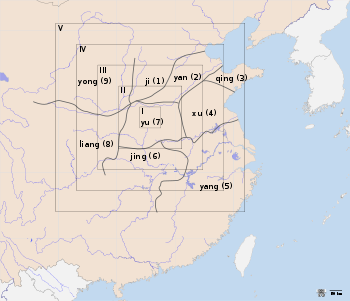
Yu's flood control work is said to have made him intimately familiar with all regions of what was then Han Chinese
territory. According to the Book of History, Yu divided the Chinese "world" into nine zhou or provinces. These were Jizhou
(冀州), Yanzhou
(兗州), Qingzhou
(青州), Xuzhou
(徐州), Yangzhou
(揚州), Jingzhou
(荊州), Yuzhou
(豫州), Liangzhou (梁州) and Yongzhou (雍州).
According to the Rites of Zhou
there was no Xuzhou or Liangzhou, instead there was Youzhou (幽州) and Bingzhou
(并州), but according to the Erya
there was no Qingzhou or Liangzhou, instead there was Youzhou (幽州) and Yingzhou (營州). Either way there were nine divisions. Once he had received bronze
from these nine territories, he created ding vessel
s called the Nine Tripod Cauldrons
. Yu then established his capital at Yang City
(陽城). According to the Bamboo Annals
, Yu killed one of the northern leaders, Fangfeng (防風) to reinforce his hold on the throne.
, while on a hunting tour to the eastern frontier of his empire, and was buried there. The Yu mausoleum (大禹陵) known today was first built in the 6th century CE during the Southern dynasty
in his honor. It is located four kilometers southeast of Shaoxing city. Most of the structure was rebuilt many times in later periods. The three main parts of the mausoleum are the Yu tomb (禹陵), temple (禹廟) and memorial (禹祠). In many statues he is seen carrying an ancient plow (耒耜). A number of emperors in imperial times have travelled there to perform ceremonies in his honor, notably Qin Shi Huang
.
era Sun Yat-sen
envisioned great plans for water control like Yu the Great including a 30 million horsepower
dam
across the Yangtze River
. However the plans did not come into being as the Kuomintang
were at war with Japan
and the Communist Party of China
.
Beichuan, Wenchuan and Dujiangyan towns in Sichuan
have all made claims to be the birthplace of Yu the great.
. He did not assume the role of a god, but rather one of China's earliest emperors, and is notable for several positive influences made during his reign. In the show, he has been introduced as Yu the Great in Fair Game, and the Jade Emperor, the exalted Yu Huang Shang Ti
in Summit, who are separate figures in Chinese mythology.
Flood control
In communications, flood control is a feature of many communication protocols designed to prevent overwhelming of a destination receiver. Such controls can be implemented either in software or in hardware, and will often request that the message be resent after the receiver has finished...
, inaugurating dynastic rule in China by founding the Xia Dynasty
Xia Dynasty
The Xia Dynasty is the first dynasty in China to be described in ancient historical chronicles such as Bamboo Annals, Classic of History and Records of the Grand Historian. The Xia Dynasty was established by the legendary Yu the Great after Shun, the last of the Five Emperors gave his throne to him...
, and for his upright moral character.
Few, if any, records exist from the period of Chinese history when Yu reigned. Because of this, the vast majority of information about his life and reign comes from collected pieces of oral tradition and stories that were passed down in various areas of China, many of which were collected in Sima Qian
Sima Qian
Sima Qian was a Prefect of the Grand Scribes of the Han Dynasty. He is regarded as the father of Chinese historiography for his highly praised work, Records of the Grand Historian , a "Jizhuanti"-style general history of China, covering more than two thousand years from the Yellow Emperor to...
's famous Records of the Grand Historian
Records of the Grand Historian
The Records of the Grand Historian, also known in English by the Chinese name Shiji , written from 109 BC to 91 BC, was the Magnum opus of Sima Qian, in which he recounted Chinese history from the time of the Yellow Emperor until his own time...
. Yu and other "sage-kings" of Ancient China were lauded by Confucius
Confucius
Confucius , literally "Master Kong", was a Chinese thinker and social philosopher of the Spring and Autumn Period....
and other Chinese teachers, who praised their virtues and morals.
Yu is one of the few Chinese rulers posthumously honored with the appellation "the Great".
Ancestry and early life
According to several ancient Chinese records, Yu was the 8th great-grandson of the Yellow EmperorYellow Emperor
The Yellow Emperor or Huangdi1 is a legendary Chinese sovereign and culture hero, included among the Three Sovereigns and Five Emperors. Tradition holds that he reigned from 2697–2597 or 2696–2598 BC...
: Yu's father Gun
Gun (Chinese)
Gun was the father of Yu the Great, the founder of the Xia Dynasty. He was appointed by Yao to control the flooding rivers. He used dikes to stop the rivers from flooding, but they eventually collapsed after nine years and killed many people.- In mythology :...
was the 5th great-grandson of King Zhuanxu
Zhuanxu
Zhuanxu , also known as Gaoyang is a mythological monarch of ancient China.A grandson of the Yellow Emperor, Zhuanxu led the Shi clan in an eastward migration to present-day Shandong, where intermarriages with the Dongyi clan enlarged and augmented their tribal influences...
; Zhuanxu's father Changyi was the second son of the Yellow Emperor. Yu was said to be born at Mount Wen , in modern day Beichuan County, Sichuan Province, though there are debates as to whether he was born in Shifang
Shifang
Shifang is a county-level city in Sichuan, China under the municipal administration of Deyang. It is located about 50 km from Chengdu. It has an area of 863 km² and a population of 430,000 in 2004....
instead. Yu's mother was a woman of the Youxin clan named either Nüzhi or Nüxi .
As a child, Yu's father Gun moved the people east toward the Chinese heartland. King Yao
Yao (ruler)
Yao , was a legendary Chinese ruler, one of the Three Sovereigns and the Five Emperors. His ancestral name (姓)is Yi Qi (伊祁) or Qi(祁),clan name (氏)is Taotang , given name is Fangxun , as the second son to Emperor Ku and Qingdu...
enfeoffed Gun as lord of Chong, usually identified as the middle peak of Mount Song
Mount Song
Mount Song, known in Chinese as Song Shan , is one of the Five Sacred Mountains of Taoism and is located in Henan province on the south bank of the Yellow River in China...
. Yu is thus believed to have grown up on the slopes of Mount Song, just south of the Yellow River
Yellow River
The Yellow River or Huang He, formerly known as the Hwang Ho, is the second-longest river in China and the sixth-longest in the world at the estimated length of . Originating in the Bayan Har Mountains in Qinghai Province in western China, it flows through nine provinces of China and empties into...
. He later married a woman from Mount Tu who is generally referred to as Tushan-shi . They had a son named Qi
Qi of Xia
Qi was the son of Yu the Great and the second sovereign of the Xia Dynasty. He ruled for approximately nine or ten years.According to legend, Yu married Nu Jiao and stayed at home for only three days before going back to stop a flood. While Yu was stopping the flood, Yu's wife had a son. He named...
, a name literally meaning "revelation
Revelation
In religion and theology, revelation is the revealing or disclosing, through active or passive communication with a supernatural or a divine entity...
".
Great Yu Controls the Waters
During the reign of king Yao
Yao (ruler)
Yao , was a legendary Chinese ruler, one of the Three Sovereigns and the Five Emperors. His ancestral name (姓)is Yi Qi (伊祁) or Qi(祁),clan name (氏)is Taotang , given name is Fangxun , as the second son to Emperor Ku and Qingdu...
, the Chinese heartland was frequently plagued by floods
Great Flood (of China)
The Great Flood of China , traditionally dated to the Third Millennium, BCE, during the reign of the Emperor Yao, according to historical sources, was a major flood event that continued for many years, resulting in great population displacements and in association with various related disasters,...
that prevented further economic and social development. Yu's father, Gun, was tasked with devising a system to control the flooding. He spent nine years building a series of dikes and dams along the riverbanks, but they were ineffective. As an adult, Yu continued his father's work and made a careful study of the river systems in an attempt to learn why his father's efforts had failed.
Collaborating with Houji - a semi-mythical agricultural master about whom little is concretely known - Yu successfully devised a system of flood controls that were crucial in establishing the prosperity of the Chinese heartland. Instead of directly damming the rivers' flow, Yu made a system of irrigation canal
Surface irrigation
Surface irrigation is defined as the group of application techniques where water is applied and distributed over the soil surface by gravity. It is by far the most common form of irrigation throughout the world and has been practiced in many areas virtually unchanged for thousands of years.Surface...
s that relieved floodwater into fields, as well as spending great effort dredging the riverbeds. Yu is said to have eaten and slept with the common workers and spent most of his time personally assisting the work of dredging the silty beds of the rivers for the 13 years the projects took to complete. The dredging and irrigation were successful, and allowed ancient Chinese culture to flourish along the Yellow River
Yellow River
The Yellow River or Huang He, formerly known as the Hwang Ho, is the second-longest river in China and the sixth-longest in the world at the estimated length of . Originating in the Bayan Har Mountains in Qinghai Province in western China, it flows through nine provinces of China and empties into...
, Wei River
Wei River
The Wei River is a major river in west-central China's Gansu and Shaanxi provinces. It is the largest tributary of the Yellow River and very important in the early development of Chinese civilization....
, and other waterways of the Chinese heartland. The project earned Yu renown throughout Chinese history, and is referred to in Chinese history as "Great Yu Controls the Waters" . In particular, Mount Longmen
Mount Longmen (Shanxi)
Lóngmén Shān, Mount Longmen or Longmen Mountain is a mountain in Shanxi province, China. In March-April 2010, the Wangjialing coal mine flood occurred here.-Geography:...
along the Yellow River
Yellow River
The Yellow River or Huang He, formerly known as the Hwang Ho, is the second-longest river in China and the sixth-longest in the world at the estimated length of . Originating in the Bayan Har Mountains in Qinghai Province in western China, it flows through nine provinces of China and empties into...
had a very narrow channel which blocked water from flowing freely east toward the ocean. Yu is said to have brought a large number of workers to open up this channel, which has been known ever since as "Yu's Gateway" .
Apocryphal stories
In a mythical version of this story, presented in Wang JiaWang Jia
Wang Jia , courtesy name Zinian , was a Chinese Taoist hermit and scholar.He is known as the compiler of 拾遺記 , whose title has been variously translated as Record of Heretofore Lost Works, Researches into Lost Records,...
's 4th century AD work Shi Yi Ji
Shi Yi Ji
Shi Yi Ji is a Chinese mythological / historical treatise compiled by the Taoist scholar Wang Jia . The title of the work has been variously translated into English as Record of Heretofore Lost Works, Researches into Lost Records,...
, Yu is assisted in his work by a yellow dragon and a black turtle (not necessarily related to the Black Tortoise of Chinese mythology). Another local myth says that Yu created the Sanmenxia
Sanmenxia
-Administration:The prefecture-level city of Sanmenxia administers one district, two county-level cities and three counties.*Hubin District*Lingbao City*Yima City*Lushi County*Shan County*Mianchi County*Sanmenxia Development Zone...
"Three Passes Gorge" of the Yangzi River by cutting a mountain ridge with a divine battle-axe to control flooding.
Traditional stories say that Yu sacrificed a great deal of his body to control the floods. For example, his hands were said to be thickly callus
Callus
A callus is an especially toughened area of skin which has become relatively thick and hard in response to repeated friction, pressure, or other irritation. Rubbing that is too frequent or forceful will cause blisters rather than allow calluses to form. Since repeated contact is required, calluses...
ed, and his feet were completely covered with callus. In one common story, Yu had only been married only four days when he was given the task of fighting the flood. He said goodbye to his wife, saying that he did not know when he would return. During the 13 years of flooding, he passed by his own family's doorstep three times, but each time he did not return inside his own home. The first time he passed, he heard that his wife was in labor
Childbirth
Childbirth is the culmination of a human pregnancy or gestation period with the birth of one or more newborn infants from a woman's uterus...
. The second time he passed by, his son could already call out to his father. His family urged him to return home, but he said it was impossible as the flood was still going on. The third time Yu was passing by, his son was older than 10 years old. Each time, Yu refused to go in the door, saying that as the flood was rendering countless numbers of people homeless, he could not rest.
The Nine Provinces
King Shun
Shun
Shun was a 23rd-22nd century BC leader of ancient China, among the Three Sovereigns and Five Emperors, whose half-century of rule was one of the longest in Chinese history.-Life of Shun:...
, who reigned after his father Yao, was so impressed by Yu's engineering work and diligence that he passed the throne to Yu instead of to his own son. Yu is said to have initially declined the throne, but was so popular with other local lords and chiefs that he agreed to become the new emperor, at the age of 53. He established a capital at Anyi - the ruins of which are in modern Xia County, in southern Shanxi Province - and founded what would be called the Xia Dynasty
Xia Dynasty
The Xia Dynasty is the first dynasty in China to be described in ancient historical chronicles such as Bamboo Annals, Classic of History and Records of the Grand Historian. The Xia Dynasty was established by the legendary Yu the Great after Shun, the last of the Five Emperors gave his throne to him...
, traditionally considered China's first dynasty.
Yu's flood control work is said to have made him intimately familiar with all regions of what was then Han Chinese
Han Chinese
Han Chinese are an ethnic group native to China and are the largest single ethnic group in the world.Han Chinese constitute about 92% of the population of the People's Republic of China , 98% of the population of the Republic of China , 78% of the population of Singapore, and about 20% of the...
territory. According to the Book of History, Yu divided the Chinese "world" into nine zhou or provinces. These were Jizhou
Jizhou
Jìzhōu is a city in Hengshui, Hebei province, China. It shares its name with a province of old, Jizhou , which covered parts of Hebei, Henan, and Shandong Provinces.-Administrative Divisions:Towns:...
(冀州), Yanzhou
Yanzhou
Yanzhou is a county-level city of Jining, in the southwest of Shandong province, People's Republic of China.-Administration:The County-level city of Yanzhou administers 10 township-level divisions.-Transportation:*Beijing-Shanghai Railway...
(兗州), Qingzhou
Qingzhou
Qingzhou , formerly Yidu County , is a county-level city, which is located in the west of Weifang City, Shandong Province, China. Qingzhou is a dynamic industry city, and also grows a great number of farm products...
(青州), Xuzhou
Xuzhou
Xuzhou , otherwise known as Pengcheng in ancient times, is a major city in and the fourth largest prefecture-level city of Jiangsu province, People's Republic of China...
(徐州), Yangzhou
Yangzhou
Yangzhou is a prefecture-level city in central Jiangsu Province, People's Republic of China. Sitting on the northern bank of the Yangtze River, it borders the provincial capital of Nanjing to the southwest, Huai'an to the north, Yancheng to the northeast, Taizhou to the east, and Zhenjiang across...
(揚州), Jingzhou
Jingzhou
Jingzhou is a prefecture-level city in Hubei Province, People's Republic of China. The city is located on the banks of the Yangtze River.Its population is 5,691,707 at the 2010 census whom 1,154,086 in the built up area made of 3 urban districts.-Geography:Jingzhou occupies an area of...
(荊州), Yuzhou
Yuzhou (nine ancient provinces)
Yuzhou was one of the Nine Provinces in ancient China. It was located near present day Henan and Anhui provinces, China.- History / Romance :...
(豫州), Liangzhou (梁州) and Yongzhou (雍州).
According to the Rites of Zhou
Rites of Zhou
The Rites of Zhou , also known as Zhouguan, is one of three ancient ritual texts listed among the classics of Confucianism. It was later renamed Zhouli by Liu Xin to differentiate it from a chapter in the Classic of History which was also known as Zhouguan.Though tradition ascribed the text of the...
there was no Xuzhou or Liangzhou, instead there was Youzhou (幽州) and Bingzhou
Bing (province)
Bing was a province of China during the Han Dynasty, in the approximate area of modern Shanxi and western Hebei. At the end of the Han Dynasty, during a succession dispute among heirs of Yuan Shao , Bing was one of the first provinces to come under control of the warlord Cao Cao...
(并州), but according to the Erya
Erya
The Erya is the oldest extant Chinese dictionary or Chinese encyclopedia. Bernhard Karlgren concluded that "the major part of its glosses must reasonably date from" the 3rd century BC....
there was no Qingzhou or Liangzhou, instead there was Youzhou (幽州) and Yingzhou (營州). Either way there were nine divisions. Once he had received bronze
Bronze
Bronze is a metal alloy consisting primarily of copper, usually with tin as the main additive. It is hard and brittle, and it was particularly significant in antiquity, so much so that the Bronze Age was named after the metal...
from these nine territories, he created ding vessel
Ding (vessel)
A ding is an ancient Chinese cauldron with legs, a lid and two handles opposite each other. They were made in two shapes with round vessels having three legs and rectangular ones four....
s called the Nine Tripod Cauldrons
Nine Tripod Cauldrons
According to legend the Nine Tripod Cauldrons were created following the foundation of the Xia Dynasty by Yu the Great, using tribute metal presented by the governors of the Nine Provinces of ancient China....
. Yu then established his capital at Yang City
Dengfeng
Dengfeng is a county-level city in Zhengzhou, Henan province. In ancient times, it was known as Yangcheng .Dengfeng has an area of 1220 square kilometers and a population of 630,000....
(陽城). According to the Bamboo Annals
Bamboo Annals
The Bamboo Annals is a chronicle of ancient China. It begins at the earliest legendary times and extends to the Warring States Period , particularly the history of the Wei state...
, Yu killed one of the northern leaders, Fangfeng (防風) to reinforce his hold on the throne.
Death
According to the Bamboo Annals, Yu ruled the Xia Dynasty for 45 years, and according to Yue Jueshu (越絕書), he died of an illness. It is said that he died at Kuaiji Mountain (會稽山), south of present day ShaoxingShaoxing
Shaoxing is a prefecture-level city in northeastern Zhejiang province, People's Republic of China. Located on the south bank of the Qiantang River estuary, it borders Ningbo to the east, Taizhou to the southeast, Jinhua to the southwest, and Hangzhou to the west. It was once known as "越"...
, while on a hunting tour to the eastern frontier of his empire, and was buried there. The Yu mausoleum (大禹陵) known today was first built in the 6th century CE during the Southern dynasty
Southern and Northern Dynasties
The Southern and Northern Dynasties was a period in the history of China that lasted from 420 to 589 AD. Though an age of civil war and political chaos, it was also a time of flourishing arts and culture, advancement in technology, and the spreading of Mahayana Buddhism and Daoism...
in his honor. It is located four kilometers southeast of Shaoxing city. Most of the structure was rebuilt many times in later periods. The three main parts of the mausoleum are the Yu tomb (禹陵), temple (禹廟) and memorial (禹祠). In many statues he is seen carrying an ancient plow (耒耜). A number of emperors in imperial times have travelled there to perform ceremonies in his honor, notably Qin Shi Huang
Qin Shi Huang
Qin Shi Huang , personal name Ying Zheng , was king of the Chinese State of Qin from 246 BC to 221 BC during the Warring States Period. He became the first emperor of a unified China in 221 BC...
.
Modern
In the Republic of ChinaRepublic of China
The Republic of China , commonly known as Taiwan , is a unitary sovereign state located in East Asia. Originally based in mainland China, the Republic of China currently governs the island of Taiwan , which forms over 99% of its current territory, as well as Penghu, Kinmen, Matsu and other minor...
era Sun Yat-sen
Sun Yat-sen
Sun Yat-sen was a Chinese doctor, revolutionary and political leader. As the foremost pioneer of Nationalist China, Sun is frequently referred to as the "Father of the Nation" , a view agreed upon by both the People's Republic of China and the Republic of China...
envisioned great plans for water control like Yu the Great including a 30 million horsepower
Horsepower
Horsepower is the name of several units of measurement of power. The most common definitions equal between 735.5 and 750 watts.Horsepower was originally defined to compare the output of steam engines with the power of draft horses in continuous operation. The unit was widely adopted to measure the...
dam
Dam
A dam is a barrier that impounds water or underground streams. Dams generally serve the primary purpose of retaining water, while other structures such as floodgates or levees are used to manage or prevent water flow into specific land regions. Hydropower and pumped-storage hydroelectricity are...
across the Yangtze River
Yangtze River
The Yangtze, Yangzi or Cháng Jiāng is the longest river in Asia, and the third-longest in the world. It flows for from the glaciers on the Tibetan Plateau in Qinghai eastward across southwest, central and eastern China before emptying into the East China Sea at Shanghai. It is also one of the...
. However the plans did not come into being as the Kuomintang
Kuomintang
The Kuomintang of China , sometimes romanized as Guomindang via the Pinyin transcription system or GMD for short, and translated as the Chinese Nationalist Party is a founding and ruling political party of the Republic of China . Its guiding ideology is the Three Principles of the People, espoused...
were at war with Japan
Japan
Japan is an island nation in East Asia. Located in the Pacific Ocean, it lies to the east of the Sea of Japan, China, North Korea, South Korea and Russia, stretching from the Sea of Okhotsk in the north to the East China Sea and Taiwan in the south...
and the Communist Party of China
Communist Party of China
The Communist Party of China , also known as the Chinese Communist Party , is the founding and ruling political party of the People's Republic of China...
.
Beichuan, Wenchuan and Dujiangyan towns in Sichuan
Sichuan
' , known formerly in the West by its postal map spellings of Szechwan or Szechuan is a province in Southwest China with its capital in Chengdu...
have all made claims to be the birthplace of Yu the great.
In popular culture
Yu, played by Vince Crestejo, is the eldest of the System Lords, as seen in the science fiction television series Stargate SG-1Stargate SG-1
Stargate SG-1 is a Canadian-American adventure and military science fiction television series and part of Metro-Goldwyn-Mayer's Stargate franchise. The show, created by Brad Wright and Jonathan Glassner, is based on the 1994 feature film Stargate by Dean Devlin and Roland Emmerich...
. He did not assume the role of a god, but rather one of China's earliest emperors, and is notable for several positive influences made during his reign. In the show, he has been introduced as Yu the Great in Fair Game, and the Jade Emperor, the exalted Yu Huang Shang Ti
Jade Emperor
The Jade Emperor in Chinese folk culture, is the ruler of Heaven and all realms of existence below including that of Man and Hell, according to a version of Taoist mythology. He is one of the most important gods of the Chinese traditional religion pantheon...
in Summit, who are separate figures in Chinese mythology.
See also
- Chinese emperors family tree (ancient)
- Flood myth
- Great Flood (China)
- Natural disasters in ChinaNatural disasters in ChinaChina is one of the countries most affected by natural disasters. It had 5 of the world's top 10 deadliest natural disasters; the top 3 occurred in China: the 1931 China floods, death toll 3 million to 4 million, the 1887 Yellow River flood, death toll 0.9 million to 2 million, and the 1556...