

Washington and Lee University

Encyclopedia
Washington and Lee University (also known as W&L) is a private liberal arts college
in Lexington, Virginia
, United States.
The classical school from which Washington and Lee descended was established in 1749 as Augusta Academy, about 20 miles (32.2 km) north of its present location. In 1776 it was renamed Liberty Hall in a burst of revolutionary fervor. The academy moved to Lexington in 1780, when it was chartered as Liberty Hall Academy, and built its first facility near town in 1782.
In 1796, George Washington
endowed the academy with the largest gift ever given to an educational institution at that time: $20,000 in stock. The gift rescued Liberty Hall from near-certain insolvency. In gratitude, the trustees changed the school's name to Washington Academy; in 1813 it was chartered as Washington College. Dividends from Washington's gift continue to help pay part of the cost of each student's education. Robert E. Lee
was its president after the Civil War in 1865 until his death in 1870, after which the school was renamed Washington and Lee University.
Washington and Lee's motto is Non incautus futuri, meaning "Not unmindful of the future." It is an adaptation of the Lee family motto.
One quarter of W&L's undergraduates participate in varsity athletics, three quarters in club or intramural programs. There are more than 120 student organizations and publications, and approximately 80 percent of undergraduates belong to fraternities or sororities.
Washington and Lee consists of three schools: The College; the Williams School of Commerce, Economics, and Politics; and the Washington and Lee University School of Law
.
W&L is a member of the Associated Colleges of the South
.
gave the school its first significant endowment
in 1796, $20,000, at the time the largest gift ever given to an educational institution in the United States, and Washington's gift continues to provide nearly $1.87 a year toward every student's tuition. Trustees changed the name of the school to Washington Academy, and later Washington College, to honor him. Among many alumni who have followed in Washington's footsteps by donating generously, Rupert Johnson, a 1962 graduate who is vice chairman of the $600-billion Franklin Templeton investment management firm, gave $100 million to Washington and Lee in June 2007, establishing a merit-based financial aid and curriculum enrichment program.
Liberty Hall is said to have admitted its first African-American student when John Chavis
, a free black, enrolled in 1795. Chavis accomplished much in his life including fighting in the American Revolution
, studying at both Liberty Hall and the College of New Jersey (now Princeton University
), becoming an ordained Presbyterian minister, and opening a school that instructed white and poor black students in North Carolina
. He is believed to be the first black student to enroll in higher education in the United States, although he did not receive a degree. Washington and Lee enrolled its next African-American student in 1966 in the law school.
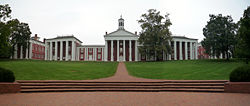
The campus took its current architectural form in the 1820s when a local merchant, "Jockey" John Robinson, an uneducated Irish immigrant, donated funds to build a central building. For the dedication celebration in 1824, Robinson supplied a huge barrel of whiskey, which he intended for the dignitaries in attendance. But according to a contemporary history, the rabble broke through the barriers and created pandemonium, which ended only when college officials demolished the whiskey barrel with an ax. A justice of the Virginia State Supreme Court, Christian Compton ('50 undergraduate, '53 law), re-created the episode in 1976 for the dedication of the new law school by having several barrels of Scotch imported (without the unfortunate dénouement).
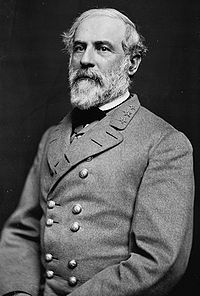
, General Robert E. Lee
turned down several financially tantalizing offers of employment that would merely have traded on his name, and instead accepted the post of college president for three reasons. First, he had been superintendent of West Point, so higher education was in his background. Second, and more important, he believed that it was a position in which he could actually make a contribution to the reconciliation of the nation. Third, the Washington family were his in-laws: his wife was the great-granddaughter of Martha Washington. Lee had long looked on George Washington as a hero and role model, so it is hardly surprising that he welcomed the challenge of leading a college endowed by and named after the first president.
Arguably Lee's finest achievement was transforming a small, not particularly distinguished Latin academy into a forward-looking institution of higher education ("not unmindful of the future"). He established the first journalism courses (which didn't last long, if offered at all)http://www.wlu.edu/x52085.xml, and he added both a business school and a law school to the college curriculum, under the conviction that those occupations should be intimately and inextricably linked with the liberal arts. That was a radical idea: Journalism and law had always been considered technical crafts, not intellectual endeavors, and business was even worse. Yet Lee's concept has become universally accepted, and today it would seem subversive if anyone suggested that education in journalism, business, and law should be kept separate from the liberal arts and sciences.
Lee was also the father of an Honor System and a speaking tradition at Washington College that continue to the present time. And, ardent about restoring national unity, he successfully recruited students from the North as well as the South
.
Lee died on October 12, 1870, after just five years as Washington College president. The school's name was almost immediately changed to link his with Washington's. His son, George Washington Custis Lee
, followed as the school's next president. General Lee and much of his family - including his wife, his seven children, and his father, the Revolutionary War hero "Light Horse Harry" Lee - are buried in the Lee Chapel
on campus, which faces the main row of antebellum college buildings. Robert E. Lee's beloved horse, Traveller
, is buried outside, near the wall of the Chapel.
. Separately, the Lee Chapel
is also a National Historic Landmark.
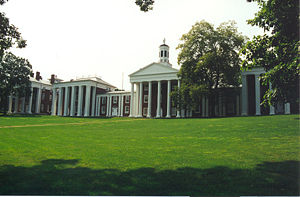
The noted British writer John Cowper Powys
once called W&L the "most beautiful college campus in America". The poet and dramatist John Drinkwater remarked, "If this scene were set down in the middle of Europe, the whole continent would flock to see it!"
Since the '70s, the university has invested massively in upgrading and expanding its academic, residential, athletic, research, arts and extracurricular facilities. The new facilities include an undergraduate library, gymnasium, art/music/theater complex, dorms, student center, student activities pavilion and tennis pavilion, as well as renovation of the journalism and commerce buildings and renovation of every fraternity house and construction of several sorority houses. Lewis Hall, the 30-year-old home of the law school, as well as athletic fields and the antebellum
Historic Front Campus buildings, are all currently undergoing major renovation.
In 1977, The New Yorker
published a cartoon showing a family in a car in front of the Washington and Lee campus. The caption was: "The College of Your Choice".
The undergraduate calendar is an unusual three-term system with 12-week fall and winter terms followed by a four-week spring term. The spring-term courses include topical, often unique, seminars, faculty-supervised study abroad, and some domestic and international internships. The law calendar consists of the more traditional early-semester system.
; the first female undergraduates enrolled in 1985.
As of 2006, the University's undergraduate population was equally divided between men and women. In 2006, the number of women receiving undergraduate degrees exceeded the number of men for the first time in the school's history. The law school population is more generally 40 percent women, 60 percent men.
In 1795, the first known Black
was admitted to the school, John Chavis, who became a teacher and Presbyterian minister. Walter Blake and Carl Linwood Smothers become the first African-American students to graduate from Washington and Lee University in 1972, the same year women were first admitted. The University has worked to increase the number of minority faculty and students. Minority students now comprise approximately 15 percent of the student body.
 Washington and Lee maintains a rigorous honor system
that traces directly to Robert E. Lee, who said, "We have but one rule here, and it is that every student must be a gentleman." Students, upon entering the university, vow to act honorably in all academic and nonacademic endeavors.
The honor system is administered by students through the Executive Committee of the Student Body (and has been since 1905). Any student found guilty of an Honor Violation by his or her peers is subject to a single sanction: expulsion. The Honor System is defined solely by students, and there is an appeal process. Appeals are heard by juries composed of students drawn randomly by the University Registrar. A formal assessment of the Honor System's "White Book," occasionally including referenda, is held every three years to review the tenets of the Honor System. Overwhelmingly, students continue to support the Honor System and its single sanction, and they and alumni point to the Honor System as one of the distinctive marks they carry with them from their W&L experience.
Washington and Lee's Honor System is distinct from others such as those found at the neighboring Virginia Military Institute
and the University of Virginia
because it is not codified. That is to say, unlike those others, Washington and Lee's does not have a list of rules that define punishable behavior—beyond the traditional guide of the offenses lying, cheating or stealing. Exams at W&L are ordinarily unproctored and self-scheduled. It is not unusual for professors to assign take-home, closed-book finals with an explicit trust in their students not to cheat.
 The Honor System is strongly enforced. In most years, only a few students withdraw in the face of an honor charge or after investigations and closed hearings conducted by the Executive Committee of the Student Body, the University's elected student government (with the accused counseled by Honor Advocates, often law students). In recent years, four or five students have left each year. Students found guilty in a closed hearing may appeal the verdict to an open hearing before the entire student body, although this option is rarely exercised. If found guilty at an open trial, the student is dismissed from the university permanently.
In addition to the student-run honor system, the Student-Faculty Hearing Board hears allegations of prohibited student discrimination, harassment, sexual misconduct, and hazing by individuals and retaliation.
 Today the university has about 1,780 undergraduate students and 400 in the School of Law. Both the undergraduate and law schools are near the top of the U.S. News and World Report rankings (2007) for national liberal arts colleges and law schools, respectively. In the 2012 guide, the undergraduate college is ranked No. 12. The 2011 Forbes Magazine college rankings place W&L 25th, twenty one places ahead of nearby academic rival University of Virginia
.
The admissions rate for the class of 2012 was 15.1 percent, a record-high selectivity for the university.
Washington and Lee is divided into three schools: (1) The College, where all undergraduates begin their studies, encompassing the liberal arts, humanities and hard sciences, with notable interest among students in pre-health and pre-law studies; (2) the Williams School of Commerce, Economics, and Politics, which offers majors in accounting, business administration, economics, politics, and public accounting; and (3) the School of Law, which offers Juris Doctor and Master of Laws degrees.
More than 1,100 undergraduate courses are offered. There are no graduate or teaching assistants; every course is taught by a faculty member. The university libraries contain has more than 700,000 volumes (and a vast electronic network). The law library has an additional 400,000 volumes as well as extensive electronic resources.
Washington and Lee offers 42 undergraduate majors (including interdisciplinary majors in neuroscience
, medieval
and Renaissance
studies, and Russian area studies), 20 minors, and additional interdisciplinary programs in African-American studies, East Asian studies
, environmental studies
, Latin American
and Caribbean studies, poverty
and human capability studies (Shepherd Program), and women's and gender studies.
Princeton Reviews 2006 edition of The Best 357 Colleges ranked W&L highly in its for "Best Overall Academic Experience," "Professors Get High Marks," and "Professor Accessibility". In the 2007 edition, Washington and Lee was ranked fourth in "Professors Get High Marks" and sixth in "Professor Accessibility". Combining academics with an active social culture, Washington and Lee ranked 14th in "Best Overall Academic Experience for Undergraduates".
Division III in the Old Dominion Athletic Conference
. Washington and Lee has 11 men's teams (baseball, basketball, cross country, football, golf, lacrosse, soccer, swimming, tennis, track & field, and wrestling) and 10 women's teams(basketball, cross country, field hockey, lacrosse, riding, soccer, swimming, tennis, track & field, and volleyball). Washington and Lee will be adding a women's golf team in 2012. Washington and Lee holds two NCAA National Championship titles. In 1988, the men's tennis team won the NCAA Division III National Championship title. In 2007, the women's tennis team claimed the NCAA Division III National Championship title.
for whichever political party (Democratic or Republican) does not hold the Presidency. The Convention has received gavel-to-gavel coverage on C-SPAN and attention from many other national media outlets. The convention has correctly picked the out-of-power nominee for 18 of the past 23 national elections. It has been wrong twice since 1948, including its incorrect choice of Hillary Clinton in 2008. In 1984, the failure of the scoreboard significantly slowed the vote tally process and almost led to a wrong selection. The Washington Post declared Washington and Lee's Mock Convention "one of the nation’s oldest and most prestigious mock conventions."
Washington and Lee University has several mysterious societies including the Cadaver Society
, the Sigma Society
, and the Mongolian Minks.
The Kappa Alpha Order, one of the Lexington Triad, was founded at W&L.
Dormant fraternity chapters at Washington and Lee also include Alpha Chi Rho
, Alpha Tau Omega
, Chi Phi
, Delta Sigma Phi
, Delta Tau Delta
, Delta Upsilon
, Theta Delta Chi
. Phi Kappa Sigma
, Psi Upsilon
, Phi Epsilon Pi and Zeta Beta Tau
.
got her start at Washington and Lee, photographing the construction of the law school while a university employee. The photos eventually became the basis of a one-woman exhibition at the Corcoran Gallery in Washington, D.C.
Secretariat, who holds the record for the fastest time in the Kentucky Derby and winner of the Triple Crown in 1973, wore blue and white (as vividly shown in the 2010 Disney movie) because his owner, Christopher Chenery, was a graduate and trustee of Washington and Lee.
A Washington and Lee art history professor, Pamela Hemenway Simpson, in 1999 wrote the only scholarly book on linoleum, giving it the title Cheap, Quick and Easy. The book also examines other home-design materials once used by the lower classes to emulate their betters. More recently, she has become an expert, perhaps the leading academic expert, on butter sculpture
.
Washington and Lee is home to a collection of 18th- and 19th-century Chinese and European porcelain, the gift of Euchlin Dalcho Reeves, a 1927 graduate of the law school, and his wife, Louise Herreshoff. In 1967, Mr. Reeves contacted Washington and Lee about making "a small gift," which turned out to be a collection of porcelain so vast that it filled two entire houses which he and his wife owned in Providence, Rhode Island. A number of dirt-covered picture frames, found in the two houses, were put on the van along with the porcelain. Soon it was discovered that the frames actually contained Impressionist-like paintings created by Louise as a young woman in the early days of the century. Mrs. Reeves had, it turned out, been a painter of stupendous talent, certified when in 1976 the Corcoran Gallery in Washington mounted a posthumous one-woman exhibition of her works. Their story is helped by the fact that he ("Boy") was almost 30 years younger than she ("Dol").
The world's first recorded streaker — George William Crump
— was a student at Washington College, in 1804. He later became a U.S. Congressman.
and bluegrass
standard, "The Washington and Lee Swing
" was one of the most well known — and widely borrowed — football marches ever written, according to Robert Lissauer
's Encyclopedia of Popular Music in America. Schools and colleges from Tulane to Slippery Rock copied it (sometimes with attribution). It was written in 1910 by Mark W. Sheafe, '06, Clarence A. (Tod) Robbins
, '11, and Thornton W. Allen, '13. It has been recorded by virtually every important jazz and swing musician, including Glenn Miller (with Tex Beneke on vocals), Louis Armstrong, Kay Kyser, Hal Kemp and the Dukes of Dixieland. "The Swing" was a trademark of the New Orleans showman Pete Fountain
. The trumpeter Red Nichols played it (and Danny Kaye pretended to play it) in the 1959 movie The Five Pennies. (Here is an audio excerpt from a 1944 recording by Jan Garber, a prominent dance-band leader of the era. Here is an exuberant instrumental version by a group called the Dixie Boys, which YouTube dates to 2006.)
The "Swing" was parodied in "The Dummy Song" by Ray Brown and Lew Henderson. "Dummy" was recorded by NRBQ, Louis Armstrong, Louis Prima and Glenn Miller's vocal jazz group, the Modernaires, among many others, and was used in the movie You've Got Mail.
Liberal arts colleges in the United States
Liberal arts colleges in the United States are certain undergraduate institutions of higher education in the United States. The Encyclopædia Britannica Concise offers a definition of the liberal arts as a "college or university curriculum aimed at imparting general knowledge and developing general...
in Lexington, Virginia
Lexington, Virginia
Lexington is an independent city within the confines of Rockbridge County in the Commonwealth of Virginia. The population was 7,042 in 2010. Lexington is about 55 minutes east of the West Virginia border and is about 50 miles north of Roanoke, Virginia. It was first settled in 1777.It is home to...
, United States.
The classical school from which Washington and Lee descended was established in 1749 as Augusta Academy, about 20 miles (32.2 km) north of its present location. In 1776 it was renamed Liberty Hall in a burst of revolutionary fervor. The academy moved to Lexington in 1780, when it was chartered as Liberty Hall Academy, and built its first facility near town in 1782.
In 1796, George Washington
George Washington
George Washington was the dominant military and political leader of the new United States of America from 1775 to 1799. He led the American victory over Great Britain in the American Revolutionary War as commander-in-chief of the Continental Army from 1775 to 1783, and presided over the writing of...
endowed the academy with the largest gift ever given to an educational institution at that time: $20,000 in stock. The gift rescued Liberty Hall from near-certain insolvency. In gratitude, the trustees changed the school's name to Washington Academy; in 1813 it was chartered as Washington College. Dividends from Washington's gift continue to help pay part of the cost of each student's education. Robert E. Lee
Robert E. Lee
Robert Edward Lee was a career military officer who is best known for having commanded the Confederate Army of Northern Virginia in the American Civil War....
was its president after the Civil War in 1865 until his death in 1870, after which the school was renamed Washington and Lee University.
Washington and Lee's motto is Non incautus futuri, meaning "Not unmindful of the future." It is an adaptation of the Lee family motto.
One quarter of W&L's undergraduates participate in varsity athletics, three quarters in club or intramural programs. There are more than 120 student organizations and publications, and approximately 80 percent of undergraduates belong to fraternities or sororities.
Washington and Lee consists of three schools: The College; the Williams School of Commerce, Economics, and Politics; and the Washington and Lee University School of Law
Washington and Lee University School of Law
The Washington and Lee University School of Law is a private American Bar Association-accredited law school located in Lexington in the Shenandoah Valley region of Virginia. Facilities are currently on the campus of Washington and Lee University in Sydney Lewis Hall...
.
W&L is a member of the Associated Colleges of the South
Associated Colleges of the South
The Associated Colleges of the South is a consortium of 16 liberal arts colleges in the southern United States. It was formed in 1991.-Members:*Birmingham-Southern College - Birmingham, Alabama...
.
History
Liberty Hall Academy became a college when it granted its first bachelor of arts degree in 1785, making it the ninth oldest institution of higher education in the country. George WashingtonGeorge Washington
George Washington was the dominant military and political leader of the new United States of America from 1775 to 1799. He led the American victory over Great Britain in the American Revolutionary War as commander-in-chief of the Continental Army from 1775 to 1783, and presided over the writing of...
gave the school its first significant endowment
Financial endowment
A financial endowment is a transfer of money or property donated to an institution. The total value of an institution's investments is often referred to as the institution's endowment and is typically organized as a public charity, private foundation, or trust....
in 1796, $20,000, at the time the largest gift ever given to an educational institution in the United States, and Washington's gift continues to provide nearly $1.87 a year toward every student's tuition. Trustees changed the name of the school to Washington Academy, and later Washington College, to honor him. Among many alumni who have followed in Washington's footsteps by donating generously, Rupert Johnson, a 1962 graduate who is vice chairman of the $600-billion Franklin Templeton investment management firm, gave $100 million to Washington and Lee in June 2007, establishing a merit-based financial aid and curriculum enrichment program.
Liberty Hall is said to have admitted its first African-American student when John Chavis
John Chavis
John Chavis was a black educator and Presbyterian minister in the American South during the early 19th century.-Early life:The exact date of Chavis's birth is not known. It is believed that he was born in either 1762 or 1763...
, a free black, enrolled in 1795. Chavis accomplished much in his life including fighting in the American Revolution
American Revolution
The American Revolution was the political upheaval during the last half of the 18th century in which thirteen colonies in North America joined together to break free from the British Empire, combining to become the United States of America...
, studying at both Liberty Hall and the College of New Jersey (now Princeton University
Princeton University
Princeton University is a private research university located in Princeton, New Jersey, United States. The school is one of the eight universities of the Ivy League, and is one of the nine Colonial Colleges founded before the American Revolution....
), becoming an ordained Presbyterian minister, and opening a school that instructed white and poor black students in North Carolina
North Carolina
North Carolina is a state located in the southeastern United States. The state borders South Carolina and Georgia to the south, Tennessee to the west and Virginia to the north. North Carolina contains 100 counties. Its capital is Raleigh, and its largest city is Charlotte...
. He is believed to be the first black student to enroll in higher education in the United States, although he did not receive a degree. Washington and Lee enrolled its next African-American student in 1966 in the law school.
The campus took its current architectural form in the 1820s when a local merchant, "Jockey" John Robinson, an uneducated Irish immigrant, donated funds to build a central building. For the dedication celebration in 1824, Robinson supplied a huge barrel of whiskey, which he intended for the dignitaries in attendance. But according to a contemporary history, the rabble broke through the barriers and created pandemonium, which ended only when college officials demolished the whiskey barrel with an ax. A justice of the Virginia State Supreme Court, Christian Compton ('50 undergraduate, '53 law), re-created the episode in 1976 for the dedication of the new law school by having several barrels of Scotch imported (without the unfortunate dénouement).
The Lee years
After the American Civil WarAmerican Civil War
The American Civil War was a civil war fought in the United States of America. In response to the election of Abraham Lincoln as President of the United States, 11 southern slave states declared their secession from the United States and formed the Confederate States of America ; the other 25...
, General Robert E. Lee
Robert E. Lee
Robert Edward Lee was a career military officer who is best known for having commanded the Confederate Army of Northern Virginia in the American Civil War....
turned down several financially tantalizing offers of employment that would merely have traded on his name, and instead accepted the post of college president for three reasons. First, he had been superintendent of West Point, so higher education was in his background. Second, and more important, he believed that it was a position in which he could actually make a contribution to the reconciliation of the nation. Third, the Washington family were his in-laws: his wife was the great-granddaughter of Martha Washington. Lee had long looked on George Washington as a hero and role model, so it is hardly surprising that he welcomed the challenge of leading a college endowed by and named after the first president.
Arguably Lee's finest achievement was transforming a small, not particularly distinguished Latin academy into a forward-looking institution of higher education ("not unmindful of the future"). He established the first journalism courses (which didn't last long, if offered at all)http://www.wlu.edu/x52085.xml, and he added both a business school and a law school to the college curriculum, under the conviction that those occupations should be intimately and inextricably linked with the liberal arts. That was a radical idea: Journalism and law had always been considered technical crafts, not intellectual endeavors, and business was even worse. Yet Lee's concept has become universally accepted, and today it would seem subversive if anyone suggested that education in journalism, business, and law should be kept separate from the liberal arts and sciences.
Lee was also the father of an Honor System and a speaking tradition at Washington College that continue to the present time. And, ardent about restoring national unity, he successfully recruited students from the North as well as the South
Southern United States
The Southern United States—commonly referred to as the American South, Dixie, or simply the South—constitutes a large distinctive area in the southeastern and south-central United States...
.
Lee died on October 12, 1870, after just five years as Washington College president. The school's name was almost immediately changed to link his with Washington's. His son, George Washington Custis Lee
George Washington Custis Lee
George Washington Custis Lee , also known as Custis Lee, was the eldest son of Robert E. Lee and Mary Anna Custis Lee...
, followed as the school's next president. General Lee and much of his family - including his wife, his seven children, and his father, the Revolutionary War hero "Light Horse Harry" Lee - are buried in the Lee Chapel
Lee Chapel
Lee Chapel is a National Historic Landmark in Lexington, Virginia, on the campus of Washington and Lee University. It was constructed during 1867-68 at the request of Robert E. Lee, who was President of the University at the time, and after whom the building is named...
on campus, which faces the main row of antebellum college buildings. Robert E. Lee's beloved horse, Traveller
Traveller (horse)
Traveller was Confederate General Robert E. Lee's most famous horse during the American Civil War.-Birth and war service:...
, is buried outside, near the wall of the Chapel.
Campus
The row of brick buildings that form the Colonnade, which traces to 1824, is a U.S. National Historic LandmarkNational Historic Landmark
A National Historic Landmark is a building, site, structure, object, or district, that is officially recognized by the United States government for its historical significance...
. Separately, the Lee Chapel
Lee Chapel
Lee Chapel is a National Historic Landmark in Lexington, Virginia, on the campus of Washington and Lee University. It was constructed during 1867-68 at the request of Robert E. Lee, who was President of the University at the time, and after whom the building is named...
is also a National Historic Landmark.
The noted British writer John Cowper Powys
John Cowper Powys
-Biography:Powys was born in Shirley, Derbyshire, in 1872, the son of the Reverend Charles Francis Powys , who was vicar of Montacute, Somerset for thirty-two years, and Mary Cowper Johnson, a descendent of the poet William Cowper. He came from a family of eleven children, many of whom were also...
once called W&L the "most beautiful college campus in America". The poet and dramatist John Drinkwater remarked, "If this scene were set down in the middle of Europe, the whole continent would flock to see it!"
Since the '70s, the university has invested massively in upgrading and expanding its academic, residential, athletic, research, arts and extracurricular facilities. The new facilities include an undergraduate library, gymnasium, art/music/theater complex, dorms, student center, student activities pavilion and tennis pavilion, as well as renovation of the journalism and commerce buildings and renovation of every fraternity house and construction of several sorority houses. Lewis Hall, the 30-year-old home of the law school, as well as athletic fields and the antebellum
Antebellum architecture
Antebellum architecture is a term used to describe the characteristic neoclassical architectural style of the Southern United States, especially the Old South, from after the birth of the United States in the American Revolution, to the start of the American Civil War...
Historic Front Campus buildings, are all currently undergoing major renovation.
In 1977, The New Yorker
The New Yorker
The New Yorker is an American magazine of reportage, commentary, criticism, essays, fiction, satire, cartoons and poetry published by Condé Nast...
published a cartoon showing a family in a car in front of the Washington and Lee campus. The caption was: "The College of Your Choice".
Organization and administration
The school is governed by a Board of Trustees that has a maximum of 34 members. Trustees are elected to four-year terms, and are allowed to serve a second-four year term. Trustees shall be nominated by the Committee on Trusteeship and elected by the Board. The Rector is the presiding officer of the Board of Trustees and is a trustee elected by the board for a four-year term. The Board meets in February, May, and October.The undergraduate calendar is an unusual three-term system with 12-week fall and winter terms followed by a four-week spring term. The spring-term courses include topical, often unique, seminars, faculty-supervised study abroad, and some domestic and international internships. The law calendar consists of the more traditional early-semester system.
Demographics
Washington and Lee was essentially all male until 1972, when women were admitted to the law schoolLaw school
A law school is an institution specializing in legal education.- Law degrees :- Canada :...
; the first female undergraduates enrolled in 1985.
As of 2006, the University's undergraduate population was equally divided between men and women. In 2006, the number of women receiving undergraduate degrees exceeded the number of men for the first time in the school's history. The law school population is more generally 40 percent women, 60 percent men.
In 1795, the first known Black
Black
Black is the color of objects that do not emit or reflect light in any part of the visible spectrum; they absorb all such frequencies of light...
was admitted to the school, John Chavis, who became a teacher and Presbyterian minister. Walter Blake and Carl Linwood Smothers become the first African-American students to graduate from Washington and Lee University in 1972, the same year women were first admitted. The University has worked to increase the number of minority faculty and students. Minority students now comprise approximately 15 percent of the student body.
Honor system
Honor system
An honor system or honesty system is a philosophical way of running a variety of endeavors based on trust, honor, and honesty. Something that operates under the rule of the "honor system" is usually something that does not have strictly enforced rules governing its principles...
that traces directly to Robert E. Lee, who said, "We have but one rule here, and it is that every student must be a gentleman." Students, upon entering the university, vow to act honorably in all academic and nonacademic endeavors.
The honor system is administered by students through the Executive Committee of the Student Body (and has been since 1905). Any student found guilty of an Honor Violation by his or her peers is subject to a single sanction: expulsion. The Honor System is defined solely by students, and there is an appeal process. Appeals are heard by juries composed of students drawn randomly by the University Registrar. A formal assessment of the Honor System's "White Book," occasionally including referenda, is held every three years to review the tenets of the Honor System. Overwhelmingly, students continue to support the Honor System and its single sanction, and they and alumni point to the Honor System as one of the distinctive marks they carry with them from their W&L experience.
Washington and Lee's Honor System is distinct from others such as those found at the neighboring Virginia Military Institute
Virginia Military Institute
The Virginia Military Institute , located in Lexington, Virginia, is the oldest state-supported military college and one of six senior military colleges in the United States. Unlike any other military college in the United States—and in keeping with its founding principles—all VMI students are...
and the University of Virginia
University of Virginia
The University of Virginia is a public research university located in Charlottesville, Virginia, United States, founded by Thomas Jefferson...
because it is not codified. That is to say, unlike those others, Washington and Lee's does not have a list of rules that define punishable behavior—beyond the traditional guide of the offenses lying, cheating or stealing. Exams at W&L are ordinarily unproctored and self-scheduled. It is not unusual for professors to assign take-home, closed-book finals with an explicit trust in their students not to cheat.
In addition to the student-run honor system, the Student-Faculty Hearing Board hears allegations of prohibited student discrimination, harassment, sexual misconduct, and hazing by individuals and retaliation.
Academics
University of Virginia
The University of Virginia is a public research university located in Charlottesville, Virginia, United States, founded by Thomas Jefferson...
.
The admissions rate for the class of 2012 was 15.1 percent, a record-high selectivity for the university.
Washington and Lee is divided into three schools: (1) The College, where all undergraduates begin their studies, encompassing the liberal arts, humanities and hard sciences, with notable interest among students in pre-health and pre-law studies; (2) the Williams School of Commerce, Economics, and Politics, which offers majors in accounting, business administration, economics, politics, and public accounting; and (3) the School of Law, which offers Juris Doctor and Master of Laws degrees.
More than 1,100 undergraduate courses are offered. There are no graduate or teaching assistants; every course is taught by a faculty member. The university libraries contain has more than 700,000 volumes (and a vast electronic network). The law library has an additional 400,000 volumes as well as extensive electronic resources.
Washington and Lee offers 42 undergraduate majors (including interdisciplinary majors in neuroscience
Neuroscience
Neuroscience is the scientific study of the nervous system. Traditionally, neuroscience has been seen as a branch of biology. However, it is currently an interdisciplinary science that collaborates with other fields such as chemistry, computer science, engineering, linguistics, mathematics,...
, medieval
Medieval studies
-Development:The term 'medieval studies' began to be adopted by academics in the opening decades of the twentieth century, initially in the titles of books like G. G. Coulton's Ten Medieval Studies , to emphasize a greater interdisciplinary approach to a historical subject...
and Renaissance
Renaissance
The Renaissance was a cultural movement that spanned roughly the 14th to the 17th century, beginning in Italy in the Late Middle Ages and later spreading to the rest of Europe. The term is also used more loosely to refer to the historical era, but since the changes of the Renaissance were not...
studies, and Russian area studies), 20 minors, and additional interdisciplinary programs in African-American studies, East Asian studies
East Asian studies
East Asian Studies is a distinct multidisciplinary field of scholarly enquiry and education that promotes a broad humanistic understanding of East Asia past and present...
, environmental studies
Environmental studies
Environmental studies is the academic field which systematically studies human interaction with the environment. It is a broad interdisciplinary field of study that includes the natural environment, built environment, and the sets of relationships between them...
, Latin American
Latin American Studies
Latin American studies is an academic discipline dealing with the study of Latin America and Latin Americans.-Definition:Latin American studies critically examines the history, culture, politics, and experiences of Latin Americans in Latin America and often also elsewhere .Latin American studies...
and Caribbean studies, poverty
Poverty
Poverty is the lack of a certain amount of material possessions or money. Absolute poverty or destitution is inability to afford basic human needs, which commonly includes clean and fresh water, nutrition, health care, education, clothing and shelter. About 1.7 billion people are estimated to live...
and human capability studies (Shepherd Program), and women's and gender studies.
Princeton Reviews 2006 edition of The Best 357 Colleges ranked W&L highly in its for "Best Overall Academic Experience," "Professors Get High Marks," and "Professor Accessibility". In the 2007 edition, Washington and Lee was ranked fourth in "Professors Get High Marks" and sixth in "Professor Accessibility". Combining academics with an active social culture, Washington and Lee ranked 14th in "Best Overall Academic Experience for Undergraduates".
Research
The school offers undergraduate students research opportunities. The R.E. Lee Undergraduate Research Program funds summer research under the supervision of faculty members. The Student Summer Independent Research program supports seniors conducting independent research in the social sciences, humanities and the arts. The Leyburn Scholars Program in Anthropology provides stipends supporting student research in anthropology during both the academic year and summer. The school also conducts a biannual undergraduate research conference called Science, Society, and the Arts.Athletics
The school's teams are known as "The Generals" and compete in NCAANational Collegiate Athletic Association
The National Collegiate Athletic Association is a semi-voluntary association of 1,281 institutions, conferences, organizations and individuals that organizes the athletic programs of many colleges and universities in the United States...
Division III in the Old Dominion Athletic Conference
Old Dominion Athletic Conference
The Old Dominion Athletic Conference is an NCAA Division III athletic conference. Its member schools are located primarily in Virginia, with other members in North Carolina and Washington, DC. Only the American Southwest Conference in Texas is larger in Division III. -History:The conference was...
. Washington and Lee has 11 men's teams (baseball, basketball, cross country, football, golf, lacrosse, soccer, swimming, tennis, track & field, and wrestling) and 10 women's teams(basketball, cross country, field hockey, lacrosse, riding, soccer, swimming, tennis, track & field, and volleyball). Washington and Lee will be adding a women's golf team in 2012. Washington and Lee holds two NCAA National Championship titles. In 1988, the men's tennis team won the NCAA Division III National Championship title. In 2007, the women's tennis team claimed the NCAA Division III National Championship title.
Student activities
Every four years, the school sponsors the Washington and Lee Mock ConventionWashington and Lee Mock Convention
Washington and Lee Mock Convention is a simulated Presidential nominating convention and is held once every four years, during the early stages of the U.S. Presidential Primary, at Washington and Lee University...
for whichever political party (Democratic or Republican) does not hold the Presidency. The Convention has received gavel-to-gavel coverage on C-SPAN and attention from many other national media outlets. The convention has correctly picked the out-of-power nominee for 18 of the past 23 national elections. It has been wrong twice since 1948, including its incorrect choice of Hillary Clinton in 2008. In 1984, the failure of the scoreboard significantly slowed the vote tally process and almost led to a wrong selection. The Washington Post declared Washington and Lee's Mock Convention "one of the nation’s oldest and most prestigious mock conventions."
Washington and Lee University has several mysterious societies including the Cadaver Society
Cadaver Society
The “Cadaver Society” is a secret society of students at Washington and Lee University in Lexington, Virginia, United States. The group's membership and organizational structure are unknown. Cadaver has been in continuous operation since its founding in 1957...
, the Sigma Society
Sigma Society
The Sigma Society is a secret society at Washington and Lee University in Lexington, Virginia. Founded in 1880, it is one of the older secret societies in the United States, and remains "one of the oldest continuous social organizations at Washington and Lee." The Sigma Society is roughly 70 years...
, and the Mongolian Minks.
Fraternities and sororities
Greek letter organizations play a major role in Washington and Lee's social scene. The following is a list of active, recognized fraternities and sororities.Fraternities
- Alpha Phi AlphaAlpha Phi AlphaAlpha Phi Alpha is the first Inter-Collegiate Black Greek Letter fraternity. It was founded on December 4, 1906 at Cornell University in Ithaca, New York. Its founders are known as the "Seven Jewels". Alpha Phi Alpha developed a model that was used by the many Black Greek Letter Organizations ...
- Beta Theta PiBeta Theta PiBeta Theta Pi , often just called Beta, is a social collegiate fraternity that was founded in 1839 at Miami University in Oxford, Ohio, USA, where it is part of the Miami Triad which includes Phi Delta Theta and Sigma Chi. It has over 138 active chapters and colonies in the United States and Canada...
- Alpha Rho - Chi PsiChi PsiChi Psi Fraternity is a fraternity and secret society consisting of 29 active chapters at American colleges and universities. It was founded on Thursday May 20, 1841, by 10 students at Union College with the idea of emphasizing the fraternal and social principles of a brotherhood...
- Alpha Omicron Delta - Kappa Alpha OrderKappa Alpha OrderKappa Alpha Order is a social fraternity and fraternal order. Kappa Alpha Order has 124 active chapters, 3 provisional chapters, and 2 commissions...
- Alpha - Kappa SigmaKappa SigmaKappa Sigma , commonly nicknamed Kappa Sig, is an international fraternity with currently 282 active chapters and colonies in North America. Kappa Sigma has initiated more than 240,000 men on college campuses throughout the United States and Canada. Today, the Fraternity has over 175,000 living...
- Lambda Chi AlphaLambda Chi AlphaLambda Chi Alpha is one of the largest men's secret general fraternities in North America, having initiated more than 280,000 members and held chapters at more than 300 universities. It is a member of the North-American Interfraternity Conference and was founded by Warren A. Cole, while he was a...
- Gamma Phi Zeta - Phi Beta SigmaPhi Beta SigmaPhi Beta Sigma is a predominantly African-American fraternity which was founded at Howard University in Washington, D.C. on January 9, 1914, by three young African-American male students. The founders A. Langston Taylor, Leonard F. Morse, and Charles I...
- Beta Beta Nu - Phi Delta ThetaPhi Delta ThetaPhi Delta Theta , also known as Phi Delt, is an international fraternity founded at Miami University in 1848 and headquartered in Oxford, Ohio. Phi Delta Theta, Beta Theta Pi, and Sigma Chi form the Miami Triad. The fraternity has about 169 active chapters and colonies in over 43 U.S...
- Virginia Zeta - Phi Gamma DeltaPhi Gamma DeltaThe international fraternity of Phi Gamma Delta is a collegiate social fraternity with 120 chapters and 18 colonies across the United States and Canada. It was founded at Jefferson College, Pennsylvania, in 1848, and its headquarters are located in Lexington, Kentucky, USA...
- Zeta Deuteron - Phi Kappa PsiPhi Kappa PsiPhi Kappa Psi is an American collegiate social fraternity founded at Jefferson College in Canonsburg, Pennsylvania on February 19, 1852. There are over a hundred chapters and colonies at accredited four year colleges and universities throughout the United States. More than 112,000 men have been...
- Virginia Beta - Pi Kappa AlphaPi Kappa AlphaPi Kappa Alpha is a Greek social fraternity with over 230 chapters and colonies and over 250,000 lifetime initiates in the United States and Canada.-History:...
- Pi - Pi Kappa PhiPi Kappa PhiPi Kappa Phi is an American social fraternity. It was founded by Andrew Alexander Kroeg, Jr., Lawrence Harry Mixson, and Simon Fogarty, Jr. on December 10, 1904 at the College of Charleston in Charleston, South Carolina...
- Rho - Omega Psi PhiOmega Psi PhiOmega Psi Phi is a fraternity and is the first African-American national fraternal organization to be founded at a historically black college. Omega Psi Phi was founded on November 17, 1911, at Howard University in Washington, D.C.. The founders were three Howard University juniors, Edgar Amos...
- Beta Delta Delta (through James Madison University) - Sigma Alpha EpsilonSigma Alpha EpsilonSigma Alpha Epsilon is a North American Greek-letter social college fraternity founded at the University of Alabama on March 9, 1856. Of all existing national social fraternities today, Sigma Alpha Epsilon is the only one founded in the Antebellum South...
- Virginia Sigma - Sigma ChiSigma ChiSigma Chi is the largest and one of the oldest college Greek-letter secret and social fraternities in North America with 244 active chapters and more than . Sigma Chi was founded on June 28, 1855 at Miami University in Oxford, Ohio when members split from Delta Kappa Epsilon...
- Zeta - Sigma NuSigma NuSigma Nu is an undergraduate, college fraternity with chapters in the United States, Canada and the United Kingdom. Sigma Nu was founded in 1869 by three cadets at the Virginia Military Institute in Lexington, Virginia...
- Lambda (Honorary Alpha Chapter) - Sigma Phi EpsilonSigma Phi EpsilonSigma Phi Epsilon , commonly nicknamed SigEp or SPE, is a social college fraternity for male college students in the United States. It was founded on November 1, 1901, at Richmond College , and its national headquarters remains in Richmond, Virginia. It was founded on three principles: Virtue,...
- Virginia Epsilon
The Kappa Alpha Order, one of the Lexington Triad, was founded at W&L.
Dormant fraternity chapters at Washington and Lee also include Alpha Chi Rho
Alpha Chi Rho
Alpha Chi Rho is a men's collegiate fraternity founded on June 4, 1895 at Trinity College in Hartford, Connecticut by the Reverend Paul Ziegler, his son Carl Ziegler, and Carl's friends William Rouse, Herbert T. Sherriff and William A.D. Eardeley. It is a charter member of the North-American...
, Alpha Tau Omega
Alpha Tau Omega
Alpha Tau Omega is a secret American leadership and social fraternity.The Fraternity has more than 250 active and inactive chapters, more than 200,000 initiates, and over 7,000 active undergraduate members. The 200,000th member was initiated in early 2009...
, Chi Phi
Chi Phi
The Chi Phi ' Fraternity is an American College Social Fraternity that was established as the result of the merger of three separate organizations that were each known as Chi Phi. The oldest active organization that took part in the union was originally founded in 1824 at Princeton...
, Delta Sigma Phi
Delta Sigma Phi
Delta Sigma Phi is a fraternity established at the City College of New York in 1899 and is a charter member of the North-American Interfraternity Conference. The headquarters of the fraternity is the Taggart Mansion located in Indianapolis, Indiana...
, Delta Tau Delta
Delta Tau Delta
Delta Tau Delta is a U.S.-based international secret letter college fraternity. Delta Tau Delta was founded in 1858 at Bethany College, Bethany, Virginia, . It currently has around 125 student chapters nationwide, as well as more than 25 regional alumni groups. Its national community service...
, Delta Upsilon
Delta Upsilon
Delta Upsilon is the sixth oldest international, all-male, college Greek-letter organization, and is the oldest non-secret fraternity in North America...
, Theta Delta Chi
Theta Delta Chi
Theta Delta Chi is a social fraternity that was founded in 1847 at Union College. While nicknames differ from institution to institution, the most common nicknames for the fraternity are Theta Delt, Thete, TDX, and TDC. Theta Delta Chi brothers refer to their local organization as Charges rather...
. Phi Kappa Sigma
Phi Kappa Sigma
Phi Kappa Sigma is an international all-male college social fraternity. Its members are known as "Phi Kaps", "Skulls" and sometimes "Skullhouse", the latter two because of the skull and crossbones on the Fraternity's badge and coat of arms. Phi Kappa Sigma was founded by Dr. Samuel Brown Wylie...
, Psi Upsilon
Psi Upsilon
Psi Upsilon is the fifth oldest college fraternity in the United States, founded at Union College in 1833. It has chapters at colleges and universities throughout North America. For most of its history, Psi Upsilon, like most social fraternities, limited its membership to men only...
, Phi Epsilon Pi and Zeta Beta Tau
Zeta Beta Tau
Zeta Beta Tau was founded in 1898 as the nation's first Jewish fraternity, although it is no longer sectarian. Today the merged Zeta Beta Tau Brotherhood is one of the largest, numbering over 140,000 initiated Brothers, and over 90 chapter locations.-Founding:The Zeta Beta Tau fraternity was...
.
Sororities
- Alpha Delta PiAlpha Delta PiAlpha Delta Pi is a fraternity founded on May 15, 1851 at Wesleyan College in Macon, Georgia. The Executive office for this sorority is located on Ponce de Leon Avenue in Atlanta, Georgia. Alpha Delta Pi is one of the two "Macon Magnolias," a term used to celebrate the bonds it shares with Phi Mu...
- Theta Zeta Chapter - Alpha Kappa AlphaAlpha Kappa AlphaAlpha Kappa Alpha is the first Greek-lettered sorority established and incorporated by African American college women. The sorority was founded on January 15, 1908, at Howard University in Washington, D.C., by a group of nine students, led by Ethel Hedgeman Lyle...
- Chi OmegaChi OmegaChi Omega is a women's fraternity and the largest member of the National Panhellenic Conference. Chi Omega has 174 active collegiate chapters and over 230 alumnae chapters. Chi Omega's national headquarters is located in Memphis, Tennessee....
- Xi Lambda Chapter - Delta Sigma ThetaDelta Sigma ThetaDelta Sigma Theta is a non-profit Greek-lettered sorority of college-educated women who perform public service and place emphasis on the African American community. Delta Sigma Theta Sorority was founded on January 13, 1913 by twenty-two collegiate women at Howard University...
- Tau Omega Chapter - Kappa Alpha ThetaKappa Alpha ThetaKappa Alpha Theta , also known as Theta, is an international fraternity for women founded on January 27, 1870 at DePauw University, formerly Indiana Asbury...
- Zeta Iota Chapter - Kappa DeltaKappa DeltaKappa Delta was the first sorority founded at the State Female Normal School , in Farmville, Virginia. It is one of the "Farmville Four" sororities founded at the university...
- Zeta Tau Chapter - Kappa Kappa GammaKappa Kappa GammaKappa Kappa Gamma is a collegiate women's fraternity, founded at Monmouth College, in Monmouth, Illinois, USA. Although the groundwork of the organization was developed as early as 1869, the 1876 Convention voted that October 13, 1870 should be recognized at the official Founders Day, because no...
- Zeta Tau Chapter - Pi Beta PhiPi Beta PhiPi Beta Phi is an international fraternity for women founded as I.C. Sorosis on April 28, 1867, at Monmouth College in Monmouth, Illinois. Its headquarters are located in Town and Country, Missouri, and there are 134 active chapters and over 330 alumnae organizations across the United States and...
- Virginia Theta Chapter
Media and culture
The eminent photographer Sally MannSally Mann
Sally Mann is an American photographer, best known for her large black-and-white photographs—at first of her young children, then later of landscapes suggesting decay and death.-Early life and education:...
got her start at Washington and Lee, photographing the construction of the law school while a university employee. The photos eventually became the basis of a one-woman exhibition at the Corcoran Gallery in Washington, D.C.
Secretariat, who holds the record for the fastest time in the Kentucky Derby and winner of the Triple Crown in 1973, wore blue and white (as vividly shown in the 2010 Disney movie) because his owner, Christopher Chenery, was a graduate and trustee of Washington and Lee.
A Washington and Lee art history professor, Pamela Hemenway Simpson, in 1999 wrote the only scholarly book on linoleum, giving it the title Cheap, Quick and Easy. The book also examines other home-design materials once used by the lower classes to emulate their betters. More recently, she has become an expert, perhaps the leading academic expert, on butter sculpture
Butter sculpture
Butter sculptures often depict animals, people, buildings and other objects. They are best known as attractions at state fairs in the United States as lifesize cows and people, but can also be found on banquet tables and even small decorative butter pats. The earliest documented butter sculptures...
.
Washington and Lee is home to a collection of 18th- and 19th-century Chinese and European porcelain, the gift of Euchlin Dalcho Reeves, a 1927 graduate of the law school, and his wife, Louise Herreshoff. In 1967, Mr. Reeves contacted Washington and Lee about making "a small gift," which turned out to be a collection of porcelain so vast that it filled two entire houses which he and his wife owned in Providence, Rhode Island. A number of dirt-covered picture frames, found in the two houses, were put on the van along with the porcelain. Soon it was discovered that the frames actually contained Impressionist-like paintings created by Louise as a young woman in the early days of the century. Mrs. Reeves had, it turned out, been a painter of stupendous talent, certified when in 1976 the Corcoran Gallery in Washington mounted a posthumous one-woman exhibition of her works. Their story is helped by the fact that he ("Boy") was almost 30 years younger than she ("Dol").
The world's first recorded streaker — George William Crump
George William Crump
George William Crump was a member of the United States House of Representatives in the 19th United States Congress.-Biography:...
— was a student at Washington College, in 1804. He later became a U.S. Congressman.
Music
Before it morphed into a swing, DixielandDixieland
Dixieland music, sometimes referred to as Hot jazz, Early Jazz or New Orleans jazz, is a style of jazz music which developed in New Orleans at the start of the 20th century, and was spread to Chicago and New York City by New Orleans bands in the 1910s.Well-known jazz standard songs from the...
and bluegrass
Bluegrass music
Bluegrass music is a form of American roots music, and a sub-genre of country music. It has mixed roots in Scottish, English, Welsh and Irish traditional music...
standard, "The Washington and Lee Swing
Washington and Lee Swing
Washington and Lee Swing is the official fight song of Washington & Lee University. Before it morphed into a swing, Dixieland and bluegrass standard, "The Washington and Lee Swing" was one of the most well known — and widely borrowed — football marches ever written, according to Robert...
" was one of the most well known — and widely borrowed — football marches ever written, according to Robert Lissauer
Robert Lissauer
Robert Lissauer was an American composer, author, and musicologist.Born in New York City Lissauer attended the Juilliard School and then worked with Irving Berlin on his musical This Is the Army. From this production "Yanks A Poppin" was developed as a show that could be performed for troops in...
's Encyclopedia of Popular Music in America. Schools and colleges from Tulane to Slippery Rock copied it (sometimes with attribution). It was written in 1910 by Mark W. Sheafe, '06, Clarence A. (Tod) Robbins
Tod Robbins
Clarence Aaron "Tod" Robbins was an American author of horror and mystery fiction. Robbins attended Washington and Lee University and—along with Mark W...
, '11, and Thornton W. Allen, '13. It has been recorded by virtually every important jazz and swing musician, including Glenn Miller (with Tex Beneke on vocals), Louis Armstrong, Kay Kyser, Hal Kemp and the Dukes of Dixieland. "The Swing" was a trademark of the New Orleans showman Pete Fountain
Pete Fountain
Pete Fountain , is an American clarinetist based in New Orleans. He has played jazz, Dixieland and Creole music.-Early life and education:...
. The trumpeter Red Nichols played it (and Danny Kaye pretended to play it) in the 1959 movie The Five Pennies. (Here is an audio excerpt from a 1944 recording by Jan Garber, a prominent dance-band leader of the era. Here is an exuberant instrumental version by a group called the Dixie Boys, which YouTube dates to 2006.)
The "Swing" was parodied in "The Dummy Song" by Ray Brown and Lew Henderson. "Dummy" was recorded by NRBQ, Louis Armstrong, Louis Prima and Glenn Miller's vocal jazz group, the Modernaires, among many others, and was used in the movie You've Got Mail.
Eighteenth century
- Thomas ToddThomas ToddThomas Todd was an American attorney and U.S. Supreme Court justice. Raised in the Colony of Virginia, he studied law and later participated in the founding of Kentucky, where he served as a clerk, judge, and justice. He was married twice and had a total of eight children. Todd joined the U.S...
1783 — United States Supreme Court Justice nominated by Thomas JeffersonThomas JeffersonThomas Jefferson was the principal author of the United States Declaration of Independence and the Statute of Virginia for Religious Freedom , the third President of the United States and founder of the University of Virginia... - Meriwether LewisMeriwether LewisMeriwether Lewis was an American explorer, soldier, and public administrator, best known for his role as the leader of the Lewis and Clark Expedition also known as the Corps of Discovery, with William Clark...
1793 — soldier, private secretary to Thomas Jefferson, and explorer who was sent by Jefferson to explore the lands the United States had recently acquired through the Louisiana PurchaseLouisiana PurchaseThe Louisiana Purchase was the acquisition by the United States of America of of France's claim to the territory of Louisiana in 1803. The U.S...
. This expedition is now remembered as the Lewis and Clark Expedition.
Nineteenth century
- Robert H. AdamsRobert H. AdamsRobert Huntington Adams was a Mississippi lawyer and politician who, in the final months of his life, briefly served as United States senator from Mississippi....
1806 — United States Senator from Mississippi. - Newton D. BakerNewton D. BakerNewton Diehl Baker, Jr. was an American politician who belonged to the Democratic Party. He served as the 37th mayor of Cleveland, Ohio from 1912 to 1915 and as U.S. Secretary of War from 1916 to 1921.-Early years:...
1894 — Secretary of War under President Woodrow WilsonWoodrow WilsonThomas Woodrow Wilson was the 28th President of the United States, from 1913 to 1921. A leader of the Progressive Movement, he served as President of Princeton University from 1902 to 1910, and then as the Governor of New Jersey from 1911 to 1913... - William Alexander Caruthers author of novels, including The Kentuckian in New York (1834)
- Edward CooperEdward Cooper (congressman)Edward Cooper was a lawyer and Republican politician who represented West Virginia in the United States House of Representatives during the 64th and 65th United States Congressesfrom 1915 to 1919....
1892 — member of the United States House of RepresentativesUnited States House of RepresentativesThe United States House of Representatives is one of the two Houses of the United States Congress, the bicameral legislature which also includes the Senate.The composition and powers of the House are established in Article One of the Constitution...
. - John J. CrittendenJohn J. CrittendenJohn Jordan Crittenden was a politician from the U.S. state of Kentucky. He represented the state in both the U.S. House of Representatives and the U.S. Senate and twice served as United States Attorney General in the administrations of William Henry Harrison and Millard Fillmore...
1805 — Speaker of the Kentucky House of Representatives, U.S. Senator, Governor of KentuckyGovernor of KentuckyThe Governor of the Commonwealth of Kentucky is the head of the executive branch of government in the U.S. state of Kentucky. Fifty-six men and one woman have served as Governor of Kentucky. The governor's term is four years in length; since 1992, incumbents have been able to seek re-election once...
, U.S. Attorney GeneralUnited States Attorney GeneralThe United States Attorney General is the head of the United States Department of Justice concerned with legal affairs and is the chief law enforcement officer of the United States government. The attorney general is considered to be the chief lawyer of the U.S. government...
under Presidents William Henry HarrisonWilliam Henry HarrisonWilliam Henry Harrison was the ninth President of the United States , an American military officer and politician, and the first president to die in office. He was 68 years, 23 days old when elected, the oldest president elected until Ronald Reagan in 1980, and last President to be born before the...
and Millard FillmoreMillard FillmoreMillard Fillmore was the 13th President of the United States and the last member of the Whig Party to hold the office of president...
, proposed the Crittenden CompromiseCrittenden CompromiseThe Crittenden Compromise was an unsuccessful proposal introduced by Kentucky Senator John J. Crittenden on December 18, 1860. It aimed to resolve the U.S...
to keep the Union intact. - John W. DavisJohn W. DavisJohn William Davis was an American politician, diplomat and lawyer. He served as a United States Representative from West Virginia , then as Solicitor General of the United States and US Ambassador to the UK under President Woodrow Wilson...
1892, 1895L — 1924 DemocraticDemocratic Party (United States)The Democratic Party is one of two major contemporary political parties in the United States, along with the Republican Party. The party's socially liberal and progressive platform is largely considered center-left in the U.S. political spectrum. The party has the lengthiest record of continuous...
nominee for U.S. President, U.S. Ambassador to BritainUnited Kingdom of Great Britain and IrelandThe United Kingdom of Great Britain and Ireland was the formal name of the United Kingdom during the period when what is now the Republic of Ireland formed a part of it....
, U.S. Solicitor GeneralUnited States Solicitor GeneralThe United States Solicitor General is the person appointed to represent the federal government of the United States before the Supreme Court of the United States. The current Solicitor General, Donald B. Verrilli, Jr. was confirmed by the United States Senate on June 6, 2011 and sworn in on June...
, argued more cases before the U.S. Supreme CourtSupreme Court of the United StatesThe Supreme Court of the United States is the highest court in the United States. It has ultimate appellate jurisdiction over all state and federal courts, and original jurisdiction over a small range of cases...
than anyone else in the 20th century (including, on the losing side, Brown v. Board of Education in 1954). - David Gardiner TylerDavid Gardiner TylerDavid Gardiner Tyler , was a U.S. Democratic Party politician.-Early life:He was born in East Hampton, New York and was the first child born to former President John Tyler and his second wife, Julia Gardiner Tyler. He was named after his late maternal grandfather, David Gardiner. As a child, he...
1869 — U.S. Congressman; son of President John TylerJohn TylerJohn Tyler was the tenth President of the United States . A native of Virginia, Tyler served as a state legislator, governor, U.S. representative, and U.S. senator before being elected Vice President . He was the first to succeed to the office of President following the death of a predecessor... - Julius KruttschnittJulius KruttschnittJulius Kruttschnitt was a German American railroad executive. The son of the German consul in New Orleans, he graduated from Washington and Lee University in 1873 and worked briefly as a schoolteacher before beginning his railroad career...
1873 — Southern Pacific RailroadSouthern Pacific RailroadThe Southern Pacific Transportation Company , earlier Southern Pacific Railroad and Southern Pacific Company, and usually simply called the Southern Pacific or Espee, was an American railroad....
executive - Joseph Rucker LamarJoseph Rucker LamarJoseph Rucker Lamar was an Associate Justice of the United States Supreme Court appointed by President William Howard Taft...
1880 — Associate JusticeAssociate JusticeAssociate Justice or Associate Judge is the title for a member of a judicial panel who is not the Chief Justice in some jurisdictions. The title "Associate Justice" is used for members of the United States Supreme Court and some state supreme courts, and for some other courts in Commonwealth...
of the United States Supreme Court - Jackson MortonJackson MortonJackson Morton was an antebellum United States Senator from Florida and then a member of the Congress of the Confederate States during the American Civil War.-Early life:...
1814 — U.S. Senator from Florida
Twentieth century
- J. Bowyer BellJ. Bowyer BellJ. Bowyer Bell was an American historian, artist and art critic.-Background and early life:Bell was born into an Episcopalian family on 15 November 1931 in New York City. The family later moved to Alabama, from where Bell attended Washington and Lee University in Lexington, Virginia, majoring in...
1953 — historian, artist and art critic. - William E. Brock 1953 — former Senator from Tennessee (1971–77), chairman of the National Republican Party (1977–81), U.S. Trade Representative (1981–85), and Secretary of Labor (1985–87)
- Terry BrooksTerry BrooksTerence Dean "Terry" Brooks is an American writer of fantasy fiction. He writes mainly epic fantasy, and has also written two movie novelizations. He has written 23 New York Times bestsellers during his writing career, and has over 21 million copies of his books in print...
1969 (law) — Author of fantasy fiction; 12 million copies in print - T. Kenneth Cribb Jr.T. Kenneth Cribb Jr.T. Kenneth Cribb Jr. is a former Presidential advisor—to President Ronald Reagan—and currently the president of the traditionalist conservative Intercollegiate Studies Institute....
1970 — former Reagan aide, now president of the Intercollegiate Studies InstituteIntercollegiate Studies InstituteThe Intercollegiate Studies Institute, Inc., or ', is a non-profit educational organization founded in 1953 as the Intercollegiate Society of Individualists...
* - Fielder CookFielder CookFielder Cook was an American television and film director, producer, and writer whose 1971 television movie The Homecoming: A Christmas Story spawned the series The Waltons....
1946 — three-time Emmy AwardEmmy AwardAn Emmy Award, often referred to simply as the Emmy, is a television production award, similar in nature to the Peabody Awards but more focused on entertainment, and is considered the television equivalent to the Academy Awards and the Grammy Awards .A majority of Emmys are presented in various...
-winning director and producer. Director of The Homecoming (TV, 1971), which begat the long-running series The WaltonsThe WaltonsThe Waltons is an American television series created by Earl Hamner, Jr., based on his book Spencer's Mountain, and a 1963 film of the same name. The show centered on a family growing up in a rural Virginia community during the Great Depression and World War II. The series pilot was a television... - Dom FloraDom FloraDominick A. "Dom" Flora is a former American college basketball standout at Washington & Lee University , located in Lexington, Virginia. Flora played for the W&L Generals from 1954–55 to 1957–58. Dom Flora was a native of Jersey City, New Jersey and played high school basketball for William L...
1958 — basketball stand-out - Kenn GeorgeKenn GeorgeKenneth S. George, known as Kenn George , is a self-employed businessman in Dallas, Texas, who served from 1999-2003 as a Republican member of the Texas House of Representatives from District 108, which covers the heart of Dallas County. He left the legislature in an unsuccessful bid for Texas land...
1970 — businessman/investor and former member of the Texas House of RepresentativesTexas House of RepresentativesThe Texas House of Representatives is the lower house of the Texas Legislature. The House is composed of 150 members elected from single-member districts across the state. The average district has about 150,000 people. Representatives are elected to two-year terms with no term limits... - Joseph L. GoldsteinJoseph L. GoldsteinJoseph L. Goldstein from Kingstree, South Carolina is a Nobel Prize winning biochemist and geneticist, and a pioneer in the study of cholesterol metabolism.-Biography:...
1962 — Won Nobel Prize for Medicine for research in cholesterol metabolism and discovery that human cells have low-density lipoprotein (LDL) receptors that extract cholesterol from the bloodstream. - Jay HandlanJay HandlanJohn Bernard "Jay" Handlan was an American former college basketball star at Washington and Lee University in Lexington, Virginia from 1948 to 1952. He was born in Wheeling, West Virginia...
1952 — basketball stand-out who once scored 66 points in a single game - Mike Henry American writer, comedian and producer, notably of the animated comedy Family GuyFamily GuyFamily Guy is an American animated television series created by Seth MacFarlane for the Fox Broadcasting Company. The series centers on the Griffins, a dysfunctional family consisting of parents Peter and Lois; their children Meg, Chris, and Stewie; and their anthropomorphic pet dog Brian...
- Rupert H. JohnsonRupert Johnson, Jr.Rupert Harris Johnson, Jr. is the Vice-Chairman of the Board of Franklin Resources.-Biography:Rupert Johnson graduated from Washington and Lee University, then served as a Marine. In 1965, he joined Franklin Resources. He now serves as its Vice-Chairman. His brother Charles, is the Chairman of...
1962 — vice chairman of Franklin Resources; donor of $100 million, the largest gift in Washington and Lee's history, mostly directed to honors scholarships. - Alex S. JonesAlex Jones (journalist)Alex S. Jones is a Pulitzer Prize-winning journalist who has been director of the Joan Shorenstein Center on the Press, Politics and Public Policy at Harvard's John F. Kennedy School of Government since July 1, 2000. Jones is also a lecturer at the school, occupying the Laurence M...
1968 — Pulitzer Prize-winning ex-reporter for the New York Times; director of Harvard University's Shorenstein Center for Press, Politics and Public Policy. - H. F. LenfestH. F. Lenfest-Early Life and Career:He was born in Jacksonville, Florida, then later grew up in Scarsdale, New York and Hunterdon County, New Jersey. After attending Flemington High School, and graduating from Mercersburg Academy, Lenfest went on to receive his BA from Washington and Lee University in 1953 and...
1953 — philanthropist and CEO of Lenfest Group; gave the second largest donation in W&L's history, a $33 million challenge gift requiring a 1:1 match, on March 21, 2007 (As of December 31, 2009, over $20 million of the $33 million goal had been.) - Sydney LewisSydney LewisSydney Lewis was a prominent Virginia businessman, philanthropist, and art collector.Born in Richmond, Virginia, he was the founder of Best Products Co. . He is the namesake of Lewis Hall at the Washington and Lee University School of Law, whose construction he and his wife, Frances, funded in...
1940 — founder of Best Products, which invented the big-box retail concept; recipient with his wife, Frances, in 1987, of the National Medal of the Arts - J. Michael LuttigJ. Michael LuttigJ. Michael Luttig is an American lawyer and a former federal appellate court judge.-Education and early work:Born in Tyler, Texas, Luttig graduated from Washington and Lee University in 1976. He then attended the University of Virginia School of Law, where he received his Juris Doctor degree in...
1976 — Assistant Attorney General, Office of Legal Council and Counselor to the Attorney General. Former United States Circuit Court of Appeals judge; twice considered by President George W. BushGeorge W. BushGeorge Walker Bush is an American politician who served as the 43rd President of the United States, from 2001 to 2009. Before that, he was the 46th Governor of Texas, having served from 1995 to 2000....
for nomination to the U.S. Supreme Court. Current Executive Vice President and General Counsel; The Boeing Company. - Hayes McClerkinHayes McClerkinHayes C. McClerkin is a commercial and environmental law attorney in Texarkana, Arkansas, who served as a member of the Arkansas House of Representatives from 1961–1970 and as Speaker from 1969-1970. He succeeded Speaker Sterling R...
1953 — former SpeakerSpeaker (politics)The term speaker is a title often given to the presiding officer of a deliberative assembly, especially a legislative body. The speaker's official role is to moderate debate, make rulings on procedure, announce the results of votes, and the like. The speaker decides who may speak and has the...
of the Arkansas House of RepresentativesArkansas House of RepresentativesThe Arkansas House of Representatives is the lower house of the Arkansas General Assembly, the state legislature of the U.S. state of Arkansas. The House is composed of 100 members elected from an equal amount of constituencies across the state. Each district has an average population of 26,734...
, TexarkanaTexarkana, ArkansasAs of the census of 2000, there were 26,448 people, 10,384 households, and 7,040 families residing in the city. The population density was 830.5 people per square mile . There were 11,721 housing units at an average density of 368.1 per square mile...
, ArkansasArkansasArkansas is a state located in the southern region of the United States. Its name is an Algonquian name of the Quapaw Indians. Arkansas shares borders with six states , and its eastern border is largely defined by the Mississippi River...
, attorney - Walt MichaelsWalt MichaelsWalt Michaels was a former professional football player and coach who is best remembered for his six-year tenure as head coach of the NFL's New York Jets from 1977-1982.-Collegiate and early NFL career:...
1951 — head coach of the NFL's New York JetsNew York JetsThe New York Jets are a professional football team headquartered in Florham Park, New Jersey, representing the New York metropolitan area. The team is a member of the Eastern Division of the American Football Conference in the National Football League...
from 1977-1982. As a fullback for the Generals football team, he led it to the 1951 Gator BowlGator BowlThe Gator Bowl is an annual college football bowl game played at EverBank Field in Jacksonville, Florida. Held continuously since 1946, it is the sixth oldest college bowl, as well as the first one ever televised nationally...
against WyomingWyoming Cowboys footballThe Wyoming Cowboys are a college football team that represents the University of Wyoming. They compete in the Mountain West Conference of the Football Bowl Subdivision of NCAA Division I. The team has won 15 conference titles...
. - Bill MillerBill Miller (finance)Bill Miller is Chairman and Chief Investment Officer of Legg Mason Capital Management, a subsidiary of Legg Mason, Inc. He is currently the portfolio manager of the Legg Mason Capital Management Value Trust and the Legg Mason Capital Management Opportunity Trust mutual funds...
1972 — president and chief investment officer of Legg MasonLegg MasonLegg Mason, Inc. is an American-based global investment management firm with a focus on asset management. The company’s business is divided in two divisions: Americas and International... - Ned Moore 1972 — Executive Director of the Foundation for Independent Higher Education ( FIHE )Foundation for Independent Higher Education ( FIHE )The Foundation for Independent Higher Education is the national partner for a network of state-based private college fundraising associations in the United States...
- Ralph Morrissey 1931; Literary Editor The Nashville Tennessean
- Robert MosbacherRobert MosbacherRobert Adam Mosbacher, Sr. , was an American businessman, accomplished yacht racer, and a Republican politician. In sailing, Sports Illustrated called him "the unquestioned master of fleet racing." In business in 1954, he found a million-dollar field of natural gas in South Texas...
1947 Undergraduate 1949 Law School — Secretary of Commerce between 1989 and 1992 - Roger MuddRoger MuddRoger Mudd is a U.S. television journalist and broadcaster, most recently as the primary anchor for The History Channel. Previously, Mudd was weekend and weekday substitute anchor of CBS Evening News, co-anchor of the weekday NBC Nightly News, and hosted NBC's Meet the Press, and NBC's American...
1950 — Congressional Correspondent for CBSCBSCBS Broadcasting Inc. is a major US commercial broadcasting television network, which started as a radio network. The name is derived from the initials of the network's former name, Columbia Broadcasting System. The network is sometimes referred to as the "Eye Network" in reference to the shape of...
and PBS; Host on the History Channel He was a member of the Delta Tau DeltaDelta Tau DeltaDelta Tau Delta is a U.S.-based international secret letter college fraternity. Delta Tau Delta was founded in 1858 at Bethany College, Bethany, Virginia, . It currently has around 125 student chapters nationwide, as well as more than 25 regional alumni groups. Its national community service...
fraternity. - Lewis Franklin Powell, Jr.Lewis Franklin Powell, Jr.Lewis Franklin Powell, Jr. was an Associate Justice of the Supreme Court of the United States. He developed a reputation as a judicial moderate, and was known as a master of compromise and consensus-building. He was also widely well regarded by contemporaries due to his personal good manners and...
1929 Undergraduate 1931 Law School — Associate Justice of the U.S. Supreme Court, 1972-87. - Mike PresslerMike PresslerMike Pressler is an American lacrosse coach. He is currently the head coach of the Bryant University Bulldogs as well as the 2010 United States national lacrosse team. He served as the head coach of the Duke Blue Devils for 16 seasons until he was fired during the 2006 Duke University lacrosse...
1982 — Head lacrosse coach at Bryant UniversityBryant UniversityBryant University is a private university located in Smithfield, Rhode Island, U.S., that grants the degrees of bachelor of arts, bachelor of science, and master's degrees in business, taxation and accounting. Until August 2004, it was known as Bryant College...
and former coach at Duke UniversityDuke UniversityDuke University is a private research university located in Durham, North Carolina, United States. Founded by Methodists and Quakers in the present day town of Trinity in 1838, the school moved to Durham in 1892. In 1924, tobacco industrialist James B...
who resigned in the midst of the Duke lacrosse case. - Mark RichardMark RichardMark Richard is an American short story writer, novelist, screenwriter, and poet. He is the author of two award-winning short story collections, The Ice at the Bottom of the World and Charity, and a bestselling novel, Fishboy....
1986 — Author and Winner of the PEN/Ernest Hemingway Foundation Award* - Tom RobbinsTom RobbinsThomas Eugene "Tom" Robbins Thomas Eugene "Tom" Robbins Thomas Eugene "Tom" Robbins (born July 22, 1936 is an American author. His best-selling novels are serio-comic, often wildly poetic stories with a strong social and philosophical undercurrent, an irreverent bent, and scenes extrapolated from...
— Author of Even Cowgirls Get the Blues (did not graduate, but attended for two years before moving to New York to become a poet). - Pat RobertsonPat RobertsonMarion Gordon "Pat" Robertson is a media mogul, television evangelist, ex-Baptist minister and businessman who is politically aligned with the Christian Right in the United States....
1950 — Christian televangelist; founder of several organizations, including Christian Broadcasting NetworkChristian Broadcasting NetworkThe Christian Broadcasting Network, or CBN, is a fundamentalist Christian television broadcasting network in the United States. Its headquarters and main studios are in Virginia Beach, Virginia.-Background:...
, the Christian Coalition, the American Center for Law and JusticeAmerican Center for Law and JusticeThe American Center for Law & Justice is a conservative Christian, pro-life group that was founded in 1990 by evangelical Pat Robertson.-History:...
, and Regent UniversityRegent UniversityRegent University is a private coeducational interdenominational Christian university located in Virginia Beach, Virginia, United States. The school was founded by the American televangelist Pat Robertson in 1978 as Christian Broadcasting Network University. A satellite campus located in...
; host of The 700 ClubThe 700 ClubThe 700 Club is the flagship news talk show of the Christian Broadcasting Network, airing in syndication throughout the United States and Canada. In production since 1966, it is currently hosted by Pat Robertson, Terry Meeuwsen, Kristi Watts, and Gordon P. Robertson, two of whom will host on any...
; candidate for the Republican nomination for President in 1988. - Paul S. Trible, Jr.Paul S. Trible, Jr.Paul Seward Trible, Jr. is a former Representative and Senator in the United States Congress from Virginia and current president of Christopher Newport University. Trible graduated from Hampden-Sydney College in 1968 where he received his Bachelor of Arts in History...
'71L — Former U.S. Senator from Virginia and current president of Christopher Newport UniversityChristopher Newport UniversityChristopher Newport University, or CNU, is a public liberal arts university located in Newport News, Virginia, United States. CNU is the youngest comprehensive university in the Commonwealth of Virginia... - Cy TwomblyCy TwomblyEdwin Parker "Cy" Twombly, Jr. was an American artist well known for his large-scale, freely scribbled, calligraphic-style graffiti paintings, on solid fields of mostly gray, tan, or off-white colors...
1953 — noted abstract artist - Justin WalkerJustin Walker (actor)Justin Walker is an American actor best known for his portrayal of Christian Stovitz in the 1995 comedy film Clueless.He has one son, named T'Dell "Sparky" Sparks. As of 2010, he is currently the owner of Teddy Teadle's Grill in Rancho Mirage, California...
best known for his portrayal of Christian Stovitz in the 1995 comedy filmComedy filmComedy film is a genre of film in which the main emphasis is on humour. They are designed to elicit laughter from the audience. Comedies are mostly light-hearted dramas and are made to amuse and entertain the audiences...
Clueless. - John W. Warner Jr.John WarnerJohn William Warner, KBE is an American Republican politician who served as Secretary of the Navy from 1972 to 1974 and as a five-term United States Senator from Virginia from January 2, 1979, to January 3, 2009...
1949 — former secretary of the Navy and retired U.S. Senator from Virginia; for a time, a husband of Elizabeth Taylor. - Joe WilsonJoe Wilson (U.S. politician)Addison Graves Wilson, Sr., most commonly known as Joe Wilson , is the U.S. Representative for , serving since 2001. He is a member of the Republican Party...
1969 — Congressman from South Carolina who shouted "You lie!" at President Obama during the 2010 State of the Union address.. - John Minor WisdomJohn Minor WisdomJohn Minor Wisdom , one of the "Fifth Circuit Four", and a liberal Republican from Louisiana, was a judge of the United States Court of Appeals for the Fifth Circuit during the 1950s and 1960s, when that court became known for a series of decisions crucial in advancing the civil rights of...
1925 — judge, United States Court of Appeals for the Fifth CircuitUnited States Court of Appeals for the Fifth CircuitThe United States Court of Appeals for the Fifth Circuit is a federal court with appellate jurisdiction over the district courts in the following districts:* Eastern District of Louisiana* Middle District of Louisiana...
. - Tom WolfeTom WolfeThomas Kennerly "Tom" Wolfe, Jr. is a best-selling American author and journalist. He is one of the founders of the New Journalism movement of the 1960s and 1970s.-Early life and education:...
1951 — writer (creator of New JournalismNew JournalismNew Journalism was a style of 1960s and 1970s news writing and journalism which used literary techniques deemed unconventional at the time. The term was codified with its current meaning by Tom Wolfe in a 1973 collection of journalism articles he published as The New Journalism, which included...
) and author of numerous books including The Electric Kool Aid Acid Test and The Bonfire of the VanitiesThe Bonfire of the VanitiesThe Bonfire of the Vanities is a 1987 novel by Tom Wolfe. The story is a drama about ambition, racism, social class, politics, and greed in 1980s New York City and centers on four main characters: WASP bond trader Sherman McCoy, Jewish assistant district attorney Larry Kramer, British expatriate...
, with his most recent novel, I Am Charlotte SimmonsI Am Charlotte SimmonsI Am Charlotte Simmons is a 2004 novel by Tom Wolfe, concerning sexual and status relationships at the fictional Dupont University, closely modeled after Duke University, the University of Pennsylvania and Stanford University...
, chronicling college life. A former trustee, he is a frequent visitor to campus and, in 2005, became the only outside speaker in recent times to deliver the undergraduate commencement address.
In literature
A fictionalized representation of the University appears in L'Étudiant étranger by Philippe LabroPhilippe Labro
Philippe Labro, is a French author, journalist and film director, born in Montauban on 27 August 1936. He has worked for RTL, Paris Match, TF1 and Antenne 2...