

.gif)
Cyme (Aeolis)

Encyclopedia
Cyme was an Aeol city in Aeolis
(Asia Minor
) close to the kingdom of Lydia
. The Aeolians
regarded Cyme as the largest and most important of their twelve cities, which were located on the coastline of Asia Minor
(modern day Turkey
). As a result of their direct access to the sea, unlike most non-landlocked settlements of the ancient world, trade is believed to have prospered. In his Histories, Herodotus
makes reference to Cyme (or Phriconis) as being one of the cities in which the rebel Lydian governor Pactyes sought refuge, following his attempted rebellion against the Persian King Cyrus the Great
:
' and Strabo
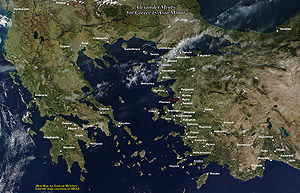
the ancient geographer, locate Cyme north of the Hermus river on the Asia Minor coastline, modern day "Nemrut Limanı"(in Turkish)
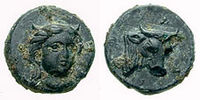
Archaeological finds such as coins give reference also to a river, believed to be that of the Hyllus
.
) migrated across the Aegean Sea
during the Late Bronze Age as waves of Dorian-speaking invaders brought an end to the once mighty Mycenaean
civilization some time around 1050 BC. During the Late Bronze Age and early Greek Dark Ages the dialect of Cyme and the surrounding region of Aeolis, like that of neighboring island Lesbos closely resembled the local dialect of Thessalia and Boetia.
 The colony was founded during the Greek Dark Ages by settlers from Locris in central Greece who began by reducing the Pelasgian citadel of Larisa near the river Hermus
Cyme developed into a regional metropolis to some thirty other towns and settlements in Aeolis. The Cymeans were later ridiculed as a people who had for three hundred years lived on the coast and not once exacted harbor taxes on ships making port. Hesiod’s father is said to have started his journey across the Aegean from Cyme. The cities of southern Aeolis in the region surrounding Cyme occupied a good belt of land with rough mountains in the background yet Cyme like other colonies along the coast did not trade with the native Anatolians further inland who had occupied Asia Minor for thousands of years. Cyme consequently played no significant role in the history of western Asia Minor prompting the historian Ephorus, himself a native of the city, to comment repeatedly in his narrative of Greek history that while the events he wrote about were taking place his fellow Cymeans had for centuries sat idly by and kept the peace.
Politically, Cyme is assumed to have started as a settler democracy following in the tradition of other established colonies in the region although Aristotle concluded that by the 7th and 6th centuries BC the once great democracies in the Greek world (including Cyme) evolved not from democracies to oligarchies as was the natural custom but from democracies to tyrannies.
Cyme was an important settlement long before the prominent events of the Greco-Persian wars. Evidence has pointed to Cyme establishing itself not as a democracy but rather a monarchy under King Agamemnon of Cyme who supposedly married his daughter to King Midas of Lydia
is the principal source for this period in Greek history and has paid a great deal of attention to events taking place in Ionia and Aeolis.
When Pactyes, the Lydian general sought refuge in Cyme from the Persians the citizens were between a rock and a hard place. As Herodotus
records, they consulted the Greek god Apollo
(supporting the claim that they were of Ionic not eastern culture), who said after much confusion through an oracle that he should be handed over. However, a native of Cyme questioned Apollo's word and went back to the oracle himself to confirm if indeed Apollo
wanted the Cymians to surrender Pactyes. Not wanting to come to grief over the surrender of Pactyes, nor wanting the ill-effects of a Persian siege (confirms Cyme was a fortified city capable of self defence) they avoided dealing with the Persians by simply sending him off to Mytilene
on the island of Lesbos, not far from their city.
After the Persian naval defeat at Salamis, Xerxes moored the surviving ships at Cyme. Before 480 BC, Cyme had been the principle naval base for the Royal Fleet. Later accounts of Cyme's involvement in the Ionian Revolt
which triggered the Persian Wars confirm their allegiance to the Ionian Greek cause. During this time, Herodotus states that due to the size of the Persian army, Darius the Great was able to launch a devastating three-pronged attack on the Ionian cities. The third army which he sent north to take Sardis
was under the command of his son-in-law Otanes who promptly captured Cyme and Clazomenae
in the process. However, later accounts reveal how Sandoces, the supposed Ionian governor of Cyme helped draft a fleet of fifteen ships for Xerxes I great expedition against mainland Greece c. 480 BC. Cyme is also believed to have been the port in which the Persian survivors of the Battle of Salamis
wintered and lends considerable weight to the argument that Cyme was not only well served by defensive walls, but enjoyed the benefits of a large port capable of wintering and supplying a large wartime fleet. As a result, Cyme, like most Ionian cities at the time was a maritime power and a valuable asset to the Persian Empire.
Once Aristagoras
of Miletus
roused the Ionians to rebel against Darius, Cyme joined the insurrection. However, the revolts at Cyme were quelled once the city was recovered by the Persians. Sandoces, the governor of Cyme at the time of Xerxes
, commanded fifteen ships in the Persian military expedition against Greece (480 BC). Herodotus believes that Sandoces may have been a Greek. After the Battle of Salamis
, the remnants of Xerxes's fleet wintered at Cyme. Thucydides does not provide any significant mention of place is hardly more than mentioned in the history of Thucydides
.
records that Cyme obtained freedom from taxation following the defeat of Antiochus III
, later being incorporated into Roman
Asia province. During the reign of Tiberius
, the city is believed to have suffered from a great earthquake, common in the Aegean. Other Roman sources such as Pliny the Elder
mention Cyme as one of the cities of Aeolia
which supports Herodotus
' similar claim:
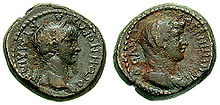
Archaeological coinage exists from the Roman Imperial era from Nero
to Gallienus
. The river god Hermos, horse with their forefoot raised and victorious athletes are typical symbols commonly found on period coinage minted at Cyme.
Later under the leadership of the Eastern Roman Empire
, Cyme became a bishop
's see.
, a Roman porticus and what is believed to be a 'potter's house'. Encouraged by their successes, Turkish archaeologist E. Akurgal began his own project in 1955 which uncovered an Orientalising ceramic on the southern hill. Between 1979-1984, the Izmir Museum carried out similar excavations at various locations around the site, uncovering further inscriptions and structures on the southern hill.
Geophysical studies at Cyme in more recent years, have given archaeologists a much greater knowledge of the site without being as intrusive. Geomagnetic surveys of the terrain reveal additional structures beneath the soil, as yet untouched by excavations.

; and Hesiod
's father, according to the poet (Op. et D. 636), sailed from Cyme to settle at Ascra in Boeotia
; which does not prove, as such compilers as Stephanus and Suidas suppose, that Hesiod
was a native of Cyme.
Aeolis
Aeolis or Aeolia was an area that comprised the west and northwestern region of Asia Minor, mostly along the coast, and also several offshore islands , where the Aeolian Greek city-states were located...
(Asia Minor
Asia Minor
Asia Minor is a geographical location at the westernmost protrusion of Asia, also called Anatolia, and corresponds to the western two thirds of the Asian part of Turkey...
) close to the kingdom of Lydia
Lydia
Lydia was an Iron Age kingdom of western Asia Minor located generally east of ancient Ionia in the modern Turkish provinces of Manisa and inland İzmir. Its population spoke an Anatolian language known as Lydian....
. The Aeolians
Aeolians
The Aeolians were one of the four major ancient Greek tribes comprising Ancient Greeks. Their name derives from Aeolus, the mythical ancestor of the Aeolic branch and son of Hellen, the mythical patriarch of the Greek nation...
regarded Cyme as the largest and most important of their twelve cities, which were located on the coastline of Asia Minor
Asia Minor
Asia Minor is a geographical location at the westernmost protrusion of Asia, also called Anatolia, and corresponds to the western two thirds of the Asian part of Turkey...
(modern day Turkey
Turkey
Turkey , known officially as the Republic of Turkey , is a Eurasian country located in Western Asia and in East Thrace in Southeastern Europe...
). As a result of their direct access to the sea, unlike most non-landlocked settlements of the ancient world, trade is believed to have prospered. In his Histories, Herodotus
Herodotus
Herodotus was an ancient Greek historian who was born in Halicarnassus, Caria and lived in the 5th century BC . He has been called the "Father of History", and was the first historian known to collect his materials systematically, test their accuracy to a certain extent and arrange them in a...
makes reference to Cyme (or Phriconis) as being one of the cities in which the rebel Lydian governor Pactyes sought refuge, following his attempted rebellion against the Persian King Cyrus the Great
Cyrus the Great
Cyrus II of Persia , commonly known as Cyrus the Great, also known as Cyrus the Elder, was the founder of the Achaemenid Empire. Under his rule, the empire embraced all the previous civilized states of the ancient Near East, expanded vastly and eventually conquered most of Southwest Asia and much...
:
Pactyes, when he learnt that an army was already on his tracks and near, took fright and fled to Cyme, and MazaresMazaresMazares was a Median general who defected to Cyrus the Great when the latter overthrew his grandfather, Astyages and formed the Persian Empire.-Mazares in Herodotus' Histories:...
the Mede marched to SardisSardisSardis or Sardes was an ancient city at the location of modern Sart in Turkey's Manisa Province...
with a detachment of Cyrus' troops. Finding Pactyes and his supporters gone, the first thing he did was to compel the Lydians to carry out Cyrus' orders — as a result of which they altered from that moment their whole way of life; he then sent a demand to Cyme that Pactyes should be surrendered, and the men of the town decided to consult the oracle at Branchidae as to whether they should obey...The messengers returned home to report, and the citizens of Cyme were prepared in consequence to give up the wanted man.
Location
Both the author of the 'life of HomerHomer
In the Western classical tradition Homer , is the author of the Iliad and the Odyssey, and is revered as the greatest ancient Greek epic poet. These epics lie at the beginning of the Western canon of literature, and have had an enormous influence on the history of literature.When he lived is...
' and Strabo
Strabo
Strabo, also written Strabon was a Greek historian, geographer and philosopher.-Life:Strabo was born to an affluent family from Amaseia in Pontus , a city which he said was situated the approximate equivalent of 75 km from the Black Sea...
the ancient geographer, locate Cyme north of the Hermus river on the Asia Minor coastline, modern day "Nemrut Limanı"(in Turkish)
After crossing the HyllusHyllusIn Greek mythology, Hyllus was the son of Heracles and Deianira, husband of Iole, nursed by Abia....
, the distance from Larissa to Cyme was 70 stadia, and from Cyme to Myrina was 40 stadia. (Strabo: 622)
Archaeological finds such as coins give reference also to a river, believed to be that of the Hyllus
Hyllus
In Greek mythology, Hyllus was the son of Heracles and Deianira, husband of Iole, nursed by Abia....
.
Early history
Little is known about the foundation of the city to supplement the traditional founding legend. Settlers from mainland Greece (most likely EuboeaEuboea
Euboea is the second largest Greek island in area and population, after Crete. The narrow Euripus Strait separates it from Boeotia in mainland Greece. In general outline it is a long and narrow, seahorse-shaped island; it is about long, and varies in breadth from to...
) migrated across the Aegean Sea
Aegean Sea
The Aegean Sea[p] is an elongated embayment of the Mediterranean Sea located between the southern Balkan and Anatolian peninsulas, i.e., between the mainlands of Greece and Turkey. In the north, it is connected to the Marmara Sea and Black Sea by the Dardanelles and Bosporus...
during the Late Bronze Age as waves of Dorian-speaking invaders brought an end to the once mighty Mycenaean
Mycenaean Greece
Mycenaean Greece was a cultural period of Bronze Age Greece taking its name from the archaeological site of Mycenae in northeastern Argolis, in the Peloponnese of southern Greece. Athens, Pylos, Thebes, and Tiryns are also important Mycenaean sites...
civilization some time around 1050 BC. During the Late Bronze Age and early Greek Dark Ages the dialect of Cyme and the surrounding region of Aeolis, like that of neighboring island Lesbos closely resembled the local dialect of Thessalia and Boetia.
Cyme developed into a regional metropolis to some thirty other towns and settlements in Aeolis. The Cymeans were later ridiculed as a people who had for three hundred years lived on the coast and not once exacted harbor taxes on ships making port. Hesiod’s father is said to have started his journey across the Aegean from Cyme. The cities of southern Aeolis in the region surrounding Cyme occupied a good belt of land with rough mountains in the background yet Cyme like other colonies along the coast did not trade with the native Anatolians further inland who had occupied Asia Minor for thousands of years. Cyme consequently played no significant role in the history of western Asia Minor prompting the historian Ephorus, himself a native of the city, to comment repeatedly in his narrative of Greek history that while the events he wrote about were taking place his fellow Cymeans had for centuries sat idly by and kept the peace.
Politically, Cyme is assumed to have started as a settler democracy following in the tradition of other established colonies in the region although Aristotle concluded that by the 7th and 6th centuries BC the once great democracies in the Greek world (including Cyme) evolved not from democracies to oligarchies as was the natural custom but from democracies to tyrannies.
Cyme was an important settlement long before the prominent events of the Greco-Persian wars. Evidence has pointed to Cyme establishing itself not as a democracy but rather a monarchy under King Agamemnon of Cyme who supposedly married his daughter to King Midas of Lydia
5th Century BC
By the 5th century BC, Cyme was one of the 12 established Ionian colonies in Aeolis. Herodotus (4.138) mentions that one of the esteemed voters deciding whether or not to support Militiades the Athenian in his plan to liberate the Ionian Coast from Persian rule in (year BC) was Aristagoras of Cyme. Aristagorus campaigned on the side of Histiaeus the Milesian with the tyrants Strattis of Chios, Aeaces of Samos and Laodamas of Phocaea in opposing such an initiative arguing instead that each tyrant along the Ionian Coast owed their position to Darius King of Persia and that liberating their own cities would encourage democracy over tyranny. Cyme eventually came under the control of the Persian Empire following the collapse of the Lydian Kingdom at the hands of Cyrus the Great. HerodotusHerodotus
Herodotus was an ancient Greek historian who was born in Halicarnassus, Caria and lived in the 5th century BC . He has been called the "Father of History", and was the first historian known to collect his materials systematically, test their accuracy to a certain extent and arrange them in a...
is the principal source for this period in Greek history and has paid a great deal of attention to events taking place in Ionia and Aeolis.
When Pactyes, the Lydian general sought refuge in Cyme from the Persians the citizens were between a rock and a hard place. As Herodotus
Herodotus
Herodotus was an ancient Greek historian who was born in Halicarnassus, Caria and lived in the 5th century BC . He has been called the "Father of History", and was the first historian known to collect his materials systematically, test their accuracy to a certain extent and arrange them in a...
records, they consulted the Greek god Apollo
Apollo
Apollo is one of the most important and complex of the Olympian deities in Greek and Roman mythology...
(supporting the claim that they were of Ionic not eastern culture), who said after much confusion through an oracle that he should be handed over. However, a native of Cyme questioned Apollo's word and went back to the oracle himself to confirm if indeed Apollo
Apollo
Apollo is one of the most important and complex of the Olympian deities in Greek and Roman mythology...
wanted the Cymians to surrender Pactyes. Not wanting to come to grief over the surrender of Pactyes, nor wanting the ill-effects of a Persian siege (confirms Cyme was a fortified city capable of self defence) they avoided dealing with the Persians by simply sending him off to Mytilene
Mytilene
Mytilene is a town and a former municipality on the island of Lesbos, North Aegean, Greece. Since the 2011 local government reform it is part of the municipality Lesbos, of which it is a municipal unit. It is the capital of the island of Lesbos. Mytilene, whose name is pre-Greek, is built on the...
on the island of Lesbos, not far from their city.
After the Persian naval defeat at Salamis, Xerxes moored the surviving ships at Cyme. Before 480 BC, Cyme had been the principle naval base for the Royal Fleet. Later accounts of Cyme's involvement in the Ionian Revolt
Ionian Revolt
The Ionian Revolt, and associated revolts in Aeolis, Doris, Cyprus and Caria, were military rebellions by several regions of Asia Minor against Persian rule, lasting from 499 BC to 493 BC...
which triggered the Persian Wars confirm their allegiance to the Ionian Greek cause. During this time, Herodotus states that due to the size of the Persian army, Darius the Great was able to launch a devastating three-pronged attack on the Ionian cities. The third army which he sent north to take Sardis
Sardis
Sardis or Sardes was an ancient city at the location of modern Sart in Turkey's Manisa Province...
was under the command of his son-in-law Otanes who promptly captured Cyme and Clazomenae
Clazomenae
Klazomenai was an ancient Greek city of Ionia and a member of the Ionian Dodecapolis , it was one of the first cities to issue silver coinage.-Location:Klazomenai is located in modern Urla on the western coast of...
in the process. However, later accounts reveal how Sandoces, the supposed Ionian governor of Cyme helped draft a fleet of fifteen ships for Xerxes I great expedition against mainland Greece c. 480 BC. Cyme is also believed to have been the port in which the Persian survivors of the Battle of Salamis
Battle of Salamis
The Battle of Salamis was fought between an Alliance of Greek city-states and the Persian Empire in September 480 BCE, in the straits between the mainland and Salamis, an island in the Saronic Gulf near Athens...
wintered and lends considerable weight to the argument that Cyme was not only well served by defensive walls, but enjoyed the benefits of a large port capable of wintering and supplying a large wartime fleet. As a result, Cyme, like most Ionian cities at the time was a maritime power and a valuable asset to the Persian Empire.
Once Aristagoras
Aristagoras
Aristagoras was the leader of Miletus in the late 6th century BC and early 5th century BC.- Background :Aristagoras served as deputy governor of Miletus, a polis on the western coast of Anatolia around 500 BC. He was the son of Molpagoras, and son-in-law of Histiaeus, whom the Persians had set up...
of Miletus
Miletus
Miletus was an ancient Greek city on the western coast of Anatolia , near the mouth of the Maeander River in ancient Caria...
roused the Ionians to rebel against Darius, Cyme joined the insurrection. However, the revolts at Cyme were quelled once the city was recovered by the Persians. Sandoces, the governor of Cyme at the time of Xerxes
Xerxes I of Persia
Xerxes I of Persia , Ḫšayāršā, ), also known as Xerxes the Great, was the fifth king of kings of the Achaemenid Empire.-Youth and rise to power:...
, commanded fifteen ships in the Persian military expedition against Greece (480 BC). Herodotus believes that Sandoces may have been a Greek. After the Battle of Salamis
Battle of Salamis
The Battle of Salamis was fought between an Alliance of Greek city-states and the Persian Empire in September 480 BCE, in the straits between the mainland and Salamis, an island in the Saronic Gulf near Athens...
, the remnants of Xerxes's fleet wintered at Cyme. Thucydides does not provide any significant mention of place is hardly more than mentioned in the history of Thucydides
Thucydides
Thucydides was a Greek historian and author from Alimos. His History of the Peloponnesian War recounts the 5th century BC war between Sparta and Athens to the year 411 BC...
.
Roman and Byzantine eras
PolybiusPolybius
Polybius , Greek ) was a Greek historian of the Hellenistic Period noted for his work, The Histories, which covered the period of 220–146 BC in detail. The work describes in part the rise of the Roman Republic and its gradual domination over Greece...
records that Cyme obtained freedom from taxation following the defeat of Antiochus III
Antiochus III the Great
Antiochus III the Great Seleucid Greek king who became the 6th ruler of the Seleucid Empire as a youth of about eighteen in 223 BC. Antiochus was an ambitious ruler who ruled over Greater Syria and western Asia towards the end of the 3rd century BC...
, later being incorporated into Roman
Ancient Rome
Ancient Rome was a thriving civilization that grew on the Italian Peninsula as early as the 8th century BC. Located along the Mediterranean Sea and centered on the city of Rome, it expanded to one of the largest empires in the ancient world....
Asia province. During the reign of Tiberius
Tiberius
Tiberius , was Roman Emperor from 14 AD to 37 AD. Tiberius was by birth a Claudian, son of Tiberius Claudius Nero and Livia Drusilla. His mother divorced Nero and married Augustus in 39 BC, making him a step-son of Octavian...
, the city is believed to have suffered from a great earthquake, common in the Aegean. Other Roman sources such as Pliny the Elder
Pliny the Elder
Gaius Plinius Secundus , better known as Pliny the Elder, was a Roman author, naturalist, and natural philosopher, as well as naval and army commander of the early Roman Empire, and personal friend of the emperor Vespasian...
mention Cyme as one of the cities of Aeolia
Aeolis
Aeolis or Aeolia was an area that comprised the west and northwestern region of Asia Minor, mostly along the coast, and also several offshore islands , where the Aeolian Greek city-states were located...
which supports Herodotus
Herodotus
Herodotus was an ancient Greek historian who was born in Halicarnassus, Caria and lived in the 5th century BC . He has been called the "Father of History", and was the first historian known to collect his materials systematically, test their accuracy to a certain extent and arrange them in a...
' similar claim:
The above-mentioned, then, are the twelve towns of the Ionians. The Aeolic cities are the following:- Cyme, called also Phriconis, LarissaLarissa, TurkeyLarissa is an ancient city in western Anatolia, Turkey. It is in the immediate vicinity of Menemen, in the district of İzmir province. The ruins of the city are on a hill top next to today's Buruncuk village. The main road to Çanakkale from İzmir skirts the same hill, making a considerable curve to...
, Neonteichus, TemnusTemnusTemnos was a small Greek city-state, on the western coast of Anatolia. The name survives as a Catholic titular see. When Temnos was a functioning diocese, its bishop was a suffragan of Ephesus....
, CillaCillaCilla is an English female given name, originally the diminutive form of Priscilla and less frequently Drusilla. It first appeared in the 20th century.People named Cilla include:*Cilla Black , English singer, actress and entertainer...
, Notium, Aegiroessa, PitanePitanePitane may refer to:* Pitane , an ancient coastal city of Aeolis, currently the site of Çandarlı, İzmir Province, Turkey* Pitane , a nymph* Pitane , mythological eponym of Pitane * Pitane , a moth genus...
, Aegaeae, MyrinaMyrina (Mysia)Myrina , was one of the Aeolian cities on the western coast of Mysia, about 40 stadia to the southwest of Gryneion. Its site is believed to be occupied by the modern Sandarlik at the mouth of the Koca Çay....
, and Gryneia. These are the eleven ancient cities of the AeoliansAeoliansThe Aeolians were one of the four major ancient Greek tribes comprising Ancient Greeks. Their name derives from Aeolus, the mythical ancestor of the Aeolic branch and son of Hellen, the mythical patriarch of the Greek nation...
. Originally, indeed, they had twelve cities upon the mainland, like the IoniansIoniansThe Ionians were one of the four major tribes into which the Classical Greeks considered the population of Hellenes to have been divided...
, but the IoniansIoniansThe Ionians were one of the four major tribes into which the Classical Greeks considered the population of Hellenes to have been divided...
deprived them of SmyrnaSmyrnaSmyrna was an ancient city located at a central and strategic point on the Aegean coast of Anatolia. Thanks to its advantageous port conditions, its ease of defence and its good inland connections, Smyrna rose to prominence. The ancient city is located at two sites within modern İzmir, Turkey...
, one of the number. The soil of AeolisAeolisAeolis or Aeolia was an area that comprised the west and northwestern region of Asia Minor, mostly along the coast, and also several offshore islands , where the Aeolian Greek city-states were located...
is better than that of IoniaIoniaIonia is an ancient region of central coastal Anatolia in present-day Turkey, the region nearest İzmir, which was historically Smyrna. It consisted of the northernmost territories of the Ionian League of Greek settlements...
, but the climate is less agreeable.
Archaeological coinage exists from the Roman Imperial era from Nero
Nero
Nero , was Roman Emperor from 54 to 68, and the last in the Julio-Claudian dynasty. Nero was adopted by his great-uncle Claudius to become his heir and successor, and succeeded to the throne in 54 following Claudius' death....
to Gallienus
Gallienus
Gallienus was Roman Emperor with his father Valerian from 253 to 260, and alone from 260 to 268. He took control of the Empire at a time when it was undergoing great crisis...
. The river god Hermos, horse with their forefoot raised and victorious athletes are typical symbols commonly found on period coinage minted at Cyme.
Later under the leadership of the Eastern Roman Empire
Byzantine Empire
The Byzantine Empire was the Eastern Roman Empire during the periods of Late Antiquity and the Middle Ages, centred on the capital of Constantinople. Known simply as the Roman Empire or Romania to its inhabitants and neighbours, the Empire was the direct continuation of the Ancient Roman State...
, Cyme became a bishop
Bishop
A bishop is an ordained or consecrated member of the Christian clergy who is generally entrusted with a position of authority and oversight. Within the Catholic Church, Eastern Orthodox, Oriental Orthodox Churches, in the Assyrian Church of the East, in the Independent Catholic Churches, and in the...
's see.
Archaeology
Archaeologists first started taking an interest in the site in the middle of the 19th century as the wealthy landowner D. Baltazzi and later S. Reinach began excavation on the southern necropolis. In 1925, A. Salaç, working out of the Bohemian Mission, uncovered many interesting finds, including a small temple to IsisIsis
Isis or in original more likely Aset is a goddess in Ancient Egyptian religious beliefs, whose worship spread throughout the Greco-Roman world. She was worshipped as the ideal mother and wife as well as the matron of nature and magic...
, a Roman porticus and what is believed to be a 'potter's house'. Encouraged by their successes, Turkish archaeologist E. Akurgal began his own project in 1955 which uncovered an Orientalising ceramic on the southern hill. Between 1979-1984, the Izmir Museum carried out similar excavations at various locations around the site, uncovering further inscriptions and structures on the southern hill.
Geophysical studies at Cyme in more recent years, have given archaeologists a much greater knowledge of the site without being as intrusive. Geomagnetic surveys of the terrain reveal additional structures beneath the soil, as yet untouched by excavations.
The northwest side of the southern hill was utilized as a residential neighborhood during the entire existence of the city. Only a limited area of the hill has been investigated. It has been verified that there were at least five successive phases of building.
1. A long and straight wall going from north to southeast represented the most ancient building phase. In the wall there are visible traces of a threshold linking two rooms. There is uncertainty as to the chronology of the wall, but what is sure is that is was built before the end of the 5th century BC.
2. Two rooms (A and B), that were part of a building dating back to the end of the 5th century BC, belong to the second phase. The building appears to be complete on the northern side, but could have also had other rooms on the southern side, where the entrance to room A opened up. The western wall of room A, was constructed with squared limestone blocks, and also acted as a terracing wall connecting the strong natural difference on the side of the hill. At the foot of this wall there was a cistern excavated in the rock that gathered water coming from the roof of the house. The cistern was filled with debris and great amounts of black and plain pottery dating back to the late Hellenistic Age.
3. Some walls that belonged to the Imperial Roman Period were constructed by means of white mortar and bricks. During this phase a service room east of room A, with a floor that was made of leveled rock, was built. In the area of the cistern, by now filled, a new room decorated by wall paintings was also built.
4. A large house occupied the area during the Late Roman Period. The rooms were constructed using reused materials, but without the use of mortar, and often enriched by polychrome mosaics. Access was gained by a ramp placed at the edge of the southwestern part of the excavation. Still, what needs to be clarified is the extent of the building, whose destruction is placed between the end of the 6th century to the beginning of the 7th century AD.
5. The final phase is represented by some superficial structures found at the northern part of the excavation. There is a long wall going from the northwest to the southeast and a ramp built with reused blocks, with the same orientation as the wall. The wall and the ramp could be proof that this area was utilized during the Byzantine Age.
Trivia
Cyme was the birthplace of the historian EphorusEphorus
Ephorus or Ephoros , of Cyme in Aeolia, in Asia Minor, was an ancient Greek historian. Information on his biography is limited; he was the father of Demophilus, who followed in his footsteps as a historian, and to Plutarch's claim that Ephorus declined Alexander the Great's offer to join him on his...
; and Hesiod
Hesiod
Hesiod was a Greek oral poet generally thought by scholars to have been active between 750 and 650 BC, around the same time as Homer. His is the first European poetry in which the poet regards himself as a topic, an individual with a distinctive role to play. Ancient authors credited him and...
's father, according to the poet (Op. et D. 636), sailed from Cyme to settle at Ascra in Boeotia
Boeotia
Boeotia, also spelled Beotia and Bœotia , is one of the regional units of Greece. It is part of the region of Central Greece. It was also a region of ancient Greece. Its capital is Livadeia, the second largest city being Thebes.-Geography:...
; which does not prove, as such compilers as Stephanus and Suidas suppose, that Hesiod
Hesiod
Hesiod was a Greek oral poet generally thought by scholars to have been active between 750 and 650 BC, around the same time as Homer. His is the first European poetry in which the poet regards himself as a topic, an individual with a distinctive role to play. Ancient authors credited him and...
was a native of Cyme.
Sources
- Herodotus, The Histories 1954-1972, trans. Aubrey de Selincourt, edit. John Marincola, ISBN 0-14-044908-6, Penguin Classics
- Missioni Archeologiche Italiane in Turchia, Modern day archaeological survey
- Archaeological Atlas of the Aegean, 163. AliağaAliagaAliaga can refer to:* Aliaga, Aragon, Spain* Aliağa, Turkey* the Filipino municipality of Aliaga, Nueva Ecija on Luzon* a family name, as in the case of the Peruvian writer Felipe Pardo y Aliaga...
/ Cyme (Kyme) - Non-Destructive Geophysical surveys: Archaeological feedback paper, M. Ciminale and D. Gallo (Department of Geology and Geophysics, University of Bari)
- Current Archaeology in Turkey, Last updated: 2007-01-30
External links
- Overview of Herodotus, Book One
- Detailed article on Cyme, sourced from Mythography.com forums
- History of Greece, at the University of Lund, Sweden
- Catalogue of Greek Coinage (Wildwinds): Cyme Mint
- Forvm Ancient Coins, The Collaborative Numistimatics project: Aeolis Catalogue