

Christianity in Medieval Scotland

Encyclopedia
Christianity in Medieval Scotland pertains to the Christian
religion
in Scotland
in the Middle Ages
. Prior to the Reformation
in the early modern period
, Scotland was a Roman Catholic
country.
in Scotland is as obscure as it is in Ireland. The earliest missionaries are traditionally Saint Ninian
and Saint Columba
. Ninian himself is now regarded as largely a construct of the Northumbrian church, after the Bernicia
n takeover of Whithorn
and conquest of southern Galloway
. The name itself is a scribal corruption of Uinniau ('n's and 'u's look almost identical in early insular calligraphy), a saint of probable British extraction who is also known by the Gaelic equivalent of his name, Finnian. St Columba, the most important saint of medieval Scots, was certainly Uinniau's disciple. However, the earliest evidence of Christianity in northern Britain predates the respective floruit
of either missionary. We can be sure that at least all of northern Britain, except the Scandinavian far north and west was Christian by the tenth century. The most important factors for the conversion of Scotland were the Roman province of Britannia
to the south, and later the so-called Gaelic or Celtic Christianity
, an interlinked system of monasteries and aristocratic networks which combined to spread both Christianity and the Gaelic language
amongst the Picts.

is a controversial term which is used by scholars both for the Gaelic church and for the religious establishment of northern Britain prior to the twelfth century, when new religious institutions and ideologies of primarily French origin began to take root in Scotland. The typical features of native Scottish Christianity are relaxed ideas of clerical celibacy
, intense secularization of ecclesiastical institutions, and the lack of a dioscesan structure
. Instead of bishops and archbishops, the most important offices of the native Scottish church were abbot
s (or coarbs). Some early Scottish establishments are famous for their dynasties of abbots, the most famous being Dunkeld
and Brechin
; but these existed all over Scotland north of the Forth. Some, such as Portmahomack
, Mortlach, and Abernethy suffered diminution in importance in the Norman period and are now not as famous.
until the late eleventh century. Instead, monasticism was dominated by monk
s called Céli Dé (lit. "vassals of God"), anglicised
as culdees. In most cases, these monks were not replaced by new continental monks in the Norman period, but usually survived, even gaining the patronage of Queen Margaret, a figure traditionally seen as hostile to Gaelic culture. At St Andrews, the Céli Dé establishment endured throughout the period, and even enjoyed rights over the election of its bishop. (Barrow, St Andrews) In fact, Gaelic monasticism was vibrant and expansionary for much of the period. For instance, dozens of monasteries, often called Schottenklöster, were founded by Gaelic monks on the continent, and many Scottish monks, such as St Cathróe of Metz
, became local saints.
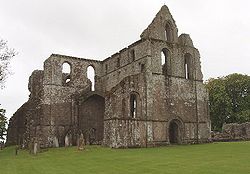 The continental type of monasticism was first introduced to Scotland when King Máel Coluim III persuaded Lanfranc
to provide a few monks from Canterbury
for a new Benedictine
abbey at Dunfermline
(c. 1070). However, traditional Benedictine monasticism had little future in Scotland. Instead, the monastic establishments which followed were almost universally either Augustinians
or of the Reformed Benedictine type. The first Augustinian priory was established at Scone
by Alexander I
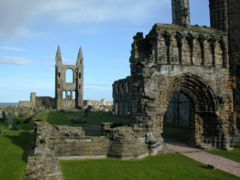
in 1115. By the early thirteenth century, Augustinians had settled alongside, taken-over or reformed Céli Dé establishments at St Andrews, St Serf's Inch
, Inchcolm
, Inchmahome
, Inchaffray, Restenneth and Iona, and had created numerous new establishments, such as Holyrood Abbey
. The most important of the reformed Benedictine orders were the Cistercians, who achieved two important Scottish foundations, at Melrose
(1136) and Dundrennan
(1142)., and the Tironensian
s, who achieved foundations at Arbroath
and Lindores
, as well as Selkirk, Kelso
and Glasgow
. Cluniacs (e.g. Paisley
), Premonstratensian
s (e.g. Whithorn
), Valliscaulians (e.g. Pluscarden) were also important.
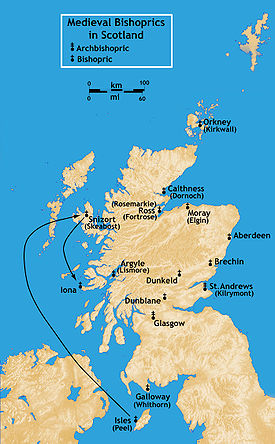 The Ecclesia Scoticana (lit. "Scottish church") as a system has no known starting point, although Causantín II
's alleged Scotticisation of the "Pictish" Church might be taken as one. Before the Norman period, Scotland had little dioscesan structure, being primarily monastic after the fashion of Ireland. After the Norman Conquest of England
, the Archbishop
s of both Canterbury and York each claimed superiority over the Scottish church. The church in Scotland attained independent status after the Papal Bull
of Celestine III (Cum universi, 1192) by which all Scottish bishoprics except Galloway were formally independent of York and Canterbury. However, unlike Ireland which had been granted four Archbishoprics in the same century, Scotland received no Archbishop and the whole Ecclesia Scoticana, with individual Scottish bishoprics (except Whithorn/Galloway), became the "special daughter of Rome". The following is a table of Bishoprics present in "Scotland-proper" in the thirteenth century:
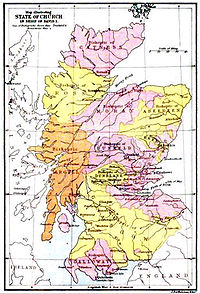 Outside of Scotland-proper, Glasgow
managed to secure its existence in the twelfth century with a vibrant church community who gained the favour of the Scottish kings. The Bishopric of Whithorn was resurrected by Fergus
, King of Galloway
, and Thurstan
, Archbishop of York
. The isles, under the nominal jurisdiction of Trondheim
(and sometimes York), had its Episcopal seat at Peel, Isle of Man. Lothian had no bishop. Its natural overlord was the Bishopric of Durham, and that bishopric continued to be important in Lothian, especially through the cult of St Cuthbert; however, once conquered by the Gaels, its diocesan jurisdiction was parcelled out between various Scottish bishoprics. Orkney, also under nominal Norwegian jurisdiction, was governed from Kirkwall
.
 Like every other Christian country, one of the main features of Scottish Christianity is the Cult of Saints
. Saints were the middle men between the ordinary worshipper and God
. Every locality, church and burgh tended to have its own particular saint. Burgh saints tended to be continental or simply biblical, as in the case of St John
at Perth
. Typically, local saints were ones associated with the area, as with St Duthac in Easter Ross
. In Scotland north of the Forth
, these local saints were either Pictish or Gaelic. The national saint of the Scottish Gaels was Colum Cille or Columba
(in Latin, lit. dove), in Strathclyde it was St Kentigern (in Gaelic, lit. Chief Lord), in Lothian, St Cuthbert.
Later, owing to learned confused between the Latin words Scotia
and Scythia
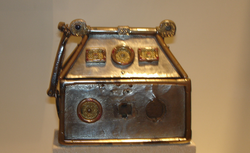
, the Scottish kings adopted St Andrew, a saint who had more appeal to incoming Normans and was attached to the ambitious bishopric that is now known by the saint's name, St Andrews. However, Columba's status was still supreme in the early fourteenth century, when King Robert I
carried the brecbennoch (or Monymusk reliquary) into battle at Bannockburn
. Around the same period, a cleric on Inchcolm
wrote the following Latin poem:
The poem illustrates both the role of saints, in this case as the representative of the Scottish (or perhaps just Gaelic) people in heaven, and the importance of Columba to the Scottish people.
Christianity
Christianity is a monotheistic religion based on the life and teachings of Jesus as presented in canonical gospels and other New Testament writings...
religion
Religion
Religion is a collection of cultural systems, belief systems, and worldviews that establishes symbols that relate humanity to spirituality and, sometimes, to moral values. Many religions have narratives, symbols, traditions and sacred histories that are intended to give meaning to life or to...
in Scotland
Scotland
Scotland is a country that is part of the United Kingdom. Occupying the northern third of the island of Great Britain, it shares a border with England to the south and is bounded by the North Sea to the east, the Atlantic Ocean to the north and west, and the North Channel and Irish Sea to the...
in the Middle Ages
Middle Ages
The Middle Ages is a periodization of European history from the 5th century to the 15th century. The Middle Ages follows the fall of the Western Roman Empire in 476 and precedes the Early Modern Era. It is the middle period of a three-period division of Western history: Classic, Medieval and Modern...
. Prior to the Reformation
Scottish Reformation
The Scottish Reformation was Scotland's formal break with the Papacy in 1560, and the events surrounding this. It was part of the wider European Protestant Reformation; and in Scotland's case culminated ecclesiastically in the re-establishment of the church along Reformed lines, and politically in...
in the early modern period
Early modern period
In history, the early modern period of modern history follows the late Middle Ages. Although the chronological limits of the period are open to debate, the timeframe spans the period after the late portion of the Middle Ages through the beginning of the Age of Revolutions...
, Scotland was a Roman Catholic
Roman Catholicism in Scotland
Roman Catholicism in Scotland , overseen by the Scottish Bishops' Conference, is part of the worldwide Catholic Church, the Christian Church in full communion with the Pope, currently Pope Benedict XVI. After being firmly established in Scotland for a millennium, Catholicism was outlawed following...
country.
Early Christianity
The story of early ChristianityChristianity
Christianity is a monotheistic religion based on the life and teachings of Jesus as presented in canonical gospels and other New Testament writings...
in Scotland is as obscure as it is in Ireland. The earliest missionaries are traditionally Saint Ninian
Saint Ninian
Saint Ninian is a Christian saint first mentioned in the 8th century as being an early missionary among the Pictish peoples of what is now Scotland...
and Saint Columba
Columba
Saint Columba —also known as Colum Cille , Colm Cille , Calum Cille and Kolban or Kolbjørn —was a Gaelic Irish missionary monk who propagated Christianity among the Picts during the Early Medieval Period...
. Ninian himself is now regarded as largely a construct of the Northumbrian church, after the Bernicia
Bernicia
Bernicia was an Anglo-Saxon kingdom established by Anglian settlers of the 6th century in what is now southeastern Scotland and North East England....
n takeover of Whithorn
Whithorn
Whithorn is a former royal burgh in Dumfries and Galloway, Scotland, about ten miles south of Wigtown. The town was the location of the first recorded Christian church in Scotland, Candida Casa : the 'White [or 'Shining'] House', built by Saint Ninian about 397.-Eighth and twelfth centuries:A...
and conquest of southern Galloway
Galloway
Galloway is an area in southwestern Scotland. It usually refers to the former counties of Wigtownshire and Kirkcudbrightshire...
. The name itself is a scribal corruption of Uinniau ('n's and 'u's look almost identical in early insular calligraphy), a saint of probable British extraction who is also known by the Gaelic equivalent of his name, Finnian. St Columba, the most important saint of medieval Scots, was certainly Uinniau's disciple. However, the earliest evidence of Christianity in northern Britain predates the respective floruit
Floruit
Floruit , abbreviated fl. , is a Latin verb meaning "flourished", denoting the period of time during which something was active...
of either missionary. We can be sure that at least all of northern Britain, except the Scandinavian far north and west was Christian by the tenth century. The most important factors for the conversion of Scotland were the Roman province of Britannia
Britannia
Britannia is an ancient term for Great Britain, and also a female personification of the island. The name is Latin, and derives from the Greek form Prettanike or Brettaniai, which originally designated a collection of islands with individual names, including Albion or Great Britain. However, by the...
to the south, and later the so-called Gaelic or Celtic Christianity
Celtic Christianity
Celtic Christianity or Insular Christianity refers broadly to certain features of Christianity that were common, or held to be common, across the Celtic-speaking world during the Early Middle Ages...
, an interlinked system of monasteries and aristocratic networks which combined to spread both Christianity and the Gaelic language
Old Irish language
Old Irish is the name given to the oldest form of the Goidelic languages for which extensive written texts are extant. It was used from the 6th to the 10th centuries, by which time it had developed into Middle Irish....
amongst the Picts.
Celtic church
The so-called Celtic churchCeltic Christianity
Celtic Christianity or Insular Christianity refers broadly to certain features of Christianity that were common, or held to be common, across the Celtic-speaking world during the Early Middle Ages...
is a controversial term which is used by scholars both for the Gaelic church and for the religious establishment of northern Britain prior to the twelfth century, when new religious institutions and ideologies of primarily French origin began to take root in Scotland. The typical features of native Scottish Christianity are relaxed ideas of clerical celibacy
Clerical celibacy
Clerical celibacy is the discipline by which some or all members of the clergy in certain religions are required to be unmarried. Since these religions consider deliberate sexual thoughts, feelings, and behavior outside of marriage to be sinful, clerical celibacy also requires abstension from these...
, intense secularization of ecclesiastical institutions, and the lack of a dioscesan structure
Diocese
A diocese is the district or see under the supervision of a bishop. It is divided into parishes.An archdiocese is more significant than a diocese. An archdiocese is presided over by an archbishop whose see may have or had importance due to size or historical significance...
. Instead of bishops and archbishops, the most important offices of the native Scottish church were abbot
Abbot
The word abbot, meaning father, is a title given to the head of a monastery in various traditions, including Christianity. The office may also be given as an honorary title to a clergyman who is not actually the head of a monastery...
s (or coarbs). Some early Scottish establishments are famous for their dynasties of abbots, the most famous being Dunkeld
Dunkeld
Dunkeld is a small town in Strathtay, Perth and Kinross, Scotland. It is about 15 miles north of Perth on the eastern side of the A9 road into the Scottish Highlands and on the opposite side of the Tay from the Victorian village of Birnam. Dunkeld and Birnam share a railway station, on the...
and Brechin
Brechin
Brechin is a former royal burgh in Angus, Scotland. Traditionally Brechin is often described as a city because of its cathedral and its status as the seat of a pre-Reformation Roman Catholic diocese , but that status has not been officially recognised in the modern era...
; but these existed all over Scotland north of the Forth. Some, such as Portmahomack
Portmahomack
Portmahomack is a small fishing village in Easter Ross, Scotland. It is situated in the Tarbat Peninsula in the parish of Tarbat. Tarbat Ness Lighthouse is about three miles from the village at the end of the Tarbat Peninsula. Ballone Castle lies about a mile from the village...
, Mortlach, and Abernethy suffered diminution in importance in the Norman period and are now not as famous.
Gaelic Monasticism
Scotland was untouched by continental forms of monasticismMonasticism
Monasticism is a religious way of life characterized by the practice of renouncing worldly pursuits to fully devote one's self to spiritual work...
until the late eleventh century. Instead, monasticism was dominated by monk
Monk
A monk is a person who practices religious asceticism, living either alone or with any number of monks, while always maintaining some degree of physical separation from those not sharing the same purpose...
s called Céli Dé (lit. "vassals of God"), anglicised
Anglicisation
Anglicisation, or anglicization , is the process of converting verbal or written elements of any other language into a form that is more comprehensible to an English speaker, or, more generally, of altering something such that it becomes English in form or character.The term most often refers to...
as culdees. In most cases, these monks were not replaced by new continental monks in the Norman period, but usually survived, even gaining the patronage of Queen Margaret, a figure traditionally seen as hostile to Gaelic culture. At St Andrews, the Céli Dé establishment endured throughout the period, and even enjoyed rights over the election of its bishop. (Barrow, St Andrews) In fact, Gaelic monasticism was vibrant and expansionary for much of the period. For instance, dozens of monasteries, often called Schottenklöster, were founded by Gaelic monks on the continent, and many Scottish monks, such as St Cathróe of Metz
Cathróe of Metz
Saint Cathróe was a monk and abbot. His life is recorded in a hagiography written soon after his death by a monk at the monastery of Saint Felix at Metz, where Cathróe was abbot...
, became local saints.
Continental Monasticism
Lanfranc
Lanfranc was Archbishop of Canterbury, and a Lombard by birth.-Early life:Lanfranc was born in the early years of the 11th century at Pavia, where later tradition held that his father, Hanbald, held a rank broadly equivalent to magistrate...
to provide a few monks from Canterbury
Canterbury
Canterbury is a historic English cathedral city, which lies at the heart of the City of Canterbury, a district of Kent in South East England. It lies on the River Stour....
for a new Benedictine
Benedictine
Benedictine refers to the spirituality and consecrated life in accordance with the Rule of St Benedict, written by Benedict of Nursia in the sixth century for the cenobitic communities he founded in central Italy. The most notable of these is Monte Cassino, the first monastery founded by Benedict...
abbey at Dunfermline
Dunfermline Abbey
Dunfermline Abbey is as a Church of Scotland Parish Church located in Dunfermline, Fife, Scotland. In 2002 the congregation had 806 members. The minister is the Reverend Alastair Jessamine...
(c. 1070). However, traditional Benedictine monasticism had little future in Scotland. Instead, the monastic establishments which followed were almost universally either Augustinians
Augustinians
The term Augustinians, named after Saint Augustine of Hippo , applies to two separate and unrelated types of Catholic religious orders:...
or of the Reformed Benedictine type. The first Augustinian priory was established at Scone
Scone Abbey
Scone Abbey was a house of Augustinian canons based at Scone, Perthshire , Scotland. Varying dates for the foundation have been given, but it was certainly founded between 1114 and 1122....
by Alexander I
Alexander I of Scotland
Alexander I , also called Alaxandair mac Maíl Coluim and nicknamed "The Fierce", was King of the Scots from 1107 to his death.-Life:...
in 1115. By the early thirteenth century, Augustinians had settled alongside, taken-over or reformed Céli Dé establishments at St Andrews, St Serf's Inch
St Serf's Inch
St Serf's Inch or St Serf's Island is an island in Loch Leven, in south-eastern Perth and Kinross, Scotland. It was the home of a Culdee and then an Augustinian monastic community, St Serf's Inch Priory.-History:...
, Inchcolm
Inchcolm
Inchcolm is an island in the Firth of Forth in Scotland. Repeatedly attacked by English raiders during the Wars of Scottish Independence, it was fortified during both World Wars to defend nearby Edinburgh...
, Inchmahome
Inchmahome
Inchmahome, an anglicisation of Innis Mo Cholmaig , is the largest of three islands in the Lake of Menteith, in Stirlingshire.- History :...
, Inchaffray, Restenneth and Iona, and had created numerous new establishments, such as Holyrood Abbey
Holyrood Abbey
Holyrood Abbey is a ruined abbey of the Canons Regular in Edinburgh, Scotland. The abbey was founded in 1128 by King David I of Scotland. During the 15th century, the abbey guesthouse was developed into a royal residence, and after the Scottish Reformation the Palace of Holyroodhouse was expanded...
. The most important of the reformed Benedictine orders were the Cistercians, who achieved two important Scottish foundations, at Melrose
Melrose, Scotland
Melrose is a small town and civil parish in the Scottish Borders, historically in Roxburghshire. It is in the Eildon committee area.-Etymology:...
(1136) and Dundrennan
Dundrennan
Dundrennan is a village in Dumfries and Galloway, Scotland, about five miles east of Kirkcudbright. Its population is around 230. It is most notable for the ruins of Dundrennan Abbey, a 12th century Cistercian monastery...
(1142)., and the Tironensian
Tironensian
The Tironensian Order or the Order of Tiron was a Roman Catholic monastic order named after the location of the mother abbey in the woods of Tiron in Perche, some 35 miles west of Chartres in France)...
s, who achieved foundations at Arbroath
Arbroath
Arbroath or Aberbrothock is a former royal burgh and the largest town in the council area of Angus in Scotland, and has a population of 22,785...
and Lindores
Lindores
Lindores is a small village in Fife, Scotland, about 2 miles south-east of Newburgh. It is situated on the north-east shore of Lindores Loch, a 44 ha freshwater loch. A possible derivation of the name Lindores is 'church by the water'...
, as well as Selkirk, Kelso
Kelso Abbey
Kelso Abbey is what remains of a Scottish abbey founded in the 12th century by a community of Tironensian monks first brought to Scotland in the reign of Alexander I. It occupies ground overlooking the confluence of the Tweed and Teviot waters, the site of what was once the Royal Burgh of Roxburgh...
and Glasgow
Glasgow
Glasgow is the largest city in Scotland and third most populous in the United Kingdom. The city is situated on the River Clyde in the country's west central lowlands...
. Cluniacs (e.g. Paisley
Paisley Abbey
Paisley Abbey is a former Cluniac monastery, and current Church of Scotland parish kirk, located on the east bank of the White Cart Water in the centre of the town of Paisley, Renfrewshire, in west central Scotland.-History:...
), Premonstratensian
Premonstratensian
The Order of Canons Regular of Prémontré, also known as the Premonstratensians, the Norbertines, or in Britain and Ireland as the White Canons , are a Catholic religious order of canons regular founded at Prémontré near Laon in 1120 by Saint Norbert, who later became Archbishop of Magdeburg...
s (e.g. Whithorn
Whithorn
Whithorn is a former royal burgh in Dumfries and Galloway, Scotland, about ten miles south of Wigtown. The town was the location of the first recorded Christian church in Scotland, Candida Casa : the 'White [or 'Shining'] House', built by Saint Ninian about 397.-Eighth and twelfth centuries:A...
), Valliscaulians (e.g. Pluscarden) were also important.
Ecclesia Scoticana
Constantine II of Scotland
Constantine, son of Áed was an early King of Scotland, known then by the Gaelic name Alba. The Kingdom of Alba, a name which first appears in Constantine's lifetime, was in northern Great Britain...
's alleged Scotticisation of the "Pictish" Church might be taken as one. Before the Norman period, Scotland had little dioscesan structure, being primarily monastic after the fashion of Ireland. After the Norman Conquest of England
Norman conquest of England
The Norman conquest of England began on 28 September 1066 with the invasion of England by William, Duke of Normandy. William became known as William the Conqueror after his victory at the Battle of Hastings on 14 October 1066, defeating King Harold II of England...
, the Archbishop
Archbishop
An archbishop is a bishop of higher rank, but not of higher sacramental order above that of the three orders of deacon, priest , and bishop...
s of both Canterbury and York each claimed superiority over the Scottish church. The church in Scotland attained independent status after the Papal Bull
Papal bull
A Papal bull is a particular type of letters patent or charter issued by a Pope of the Catholic Church. It is named after the bulla that was appended to the end in order to authenticate it....
of Celestine III (Cum universi, 1192) by which all Scottish bishoprics except Galloway were formally independent of York and Canterbury. However, unlike Ireland which had been granted four Archbishoprics in the same century, Scotland received no Archbishop and the whole Ecclesia Scoticana, with individual Scottish bishoprics (except Whithorn/Galloway), became the "special daughter of Rome". The following is a table of Bishoprics present in "Scotland-proper" in the thirteenth century:
Glasgow
Glasgow is the largest city in Scotland and third most populous in the United Kingdom. The city is situated on the River Clyde in the country's west central lowlands...
managed to secure its existence in the twelfth century with a vibrant church community who gained the favour of the Scottish kings. The Bishopric of Whithorn was resurrected by Fergus
Fergus
Fergus may refer to:people*Fergus places*Fergus, Ontario, Canada*Fergus, California, United States*Fergus County, Montana, United States*Fergus Falls, Minnesota, United States*Fergus Falls Township, Minnesota, United States...
, King of Galloway
Lords of Galloway
The Lords, or Kings of Galloway ruled over Galloway, in south west Scotland, for a large part of the High Middle Ages.Many regions of Scotland, including Galloway and Moray, periodically had kings or subkings, similar to those in Ireland during the Middle Ages. The Scottish monarch was seen as...
, and Thurstan
Thurstan
Thurstan or Turstin of Bayeux was a medieval Archbishop of York, the son of a priest. He served kings William II and Henry I of England before his election to the see of York in 1114. Once elected, his consecration was delayed for five years while he fought attempts by the Archbishop of Canterbury...
, Archbishop of York
Archbishop of York
The Archbishop of York is a high-ranking cleric in the Church of England, second only to the Archbishop of Canterbury. He is the diocesan bishop of the Diocese of York and metropolitan of the Province of York, which covers the northern portion of England as well as the Isle of Man...
. The isles, under the nominal jurisdiction of Trondheim
Trondheim
Trondheim , historically, Nidaros and Trondhjem, is a city and municipality in Sør-Trøndelag county, Norway. With a population of 173,486, it is the third most populous municipality and city in the country, although the fourth largest metropolitan area. It is the administrative centre of...
(and sometimes York), had its Episcopal seat at Peel, Isle of Man. Lothian had no bishop. Its natural overlord was the Bishopric of Durham, and that bishopric continued to be important in Lothian, especially through the cult of St Cuthbert; however, once conquered by the Gaels, its diocesan jurisdiction was parcelled out between various Scottish bishoprics. Orkney, also under nominal Norwegian jurisdiction, was governed from Kirkwall
Kirkwall
Kirkwall is the biggest town and capital of Orkney, off the coast of northern mainland Scotland. The town is first mentioned in Orkneyinga saga in the year 1046 when it is recorded as the residence of Rögnvald Brusason the Earl of Orkney, who was killed by his uncle Thorfinn the Mighty...
.
Saints
Saint
A saint is a holy person. In various religions, saints are people who are believed to have exceptional holiness.In Christian usage, "saint" refers to any believer who is "in Christ", and in whom Christ dwells, whether in heaven or in earth...
. Saints were the middle men between the ordinary worshipper and God
God
God is the English name given to a singular being in theistic and deistic religions who is either the sole deity in monotheism, or a single deity in polytheism....
. Every locality, church and burgh tended to have its own particular saint. Burgh saints tended to be continental or simply biblical, as in the case of St John
John the Apostle
John the Apostle, John the Apostle, John the Apostle, (Aramaic Yoħanna, (c. 6 - c. 100) was one of the Twelve Apostles of Jesus. He was the son of Zebedee and Salome, and brother of James, another of the Twelve Apostles...
at Perth
Perth, Scotland
Perth is a town and former city and royal burgh in central Scotland. Located on the banks of the River Tay, it is the administrative centre of Perth and Kinross council area and the historic county town of Perthshire...
. Typically, local saints were ones associated with the area, as with St Duthac in Easter Ross
Easter Ross
Easter Ross is a loosely defined area in the east of Ross, Highland, Scotland.The name is used in the constituency name Caithness, Sutherland and Easter Ross, which is the name of both a British House of Commons constituency and a Scottish Parliament constituency...
. In Scotland north of the Forth
River Forth
The River Forth , long, is the major river draining the eastern part of the central belt of Scotland.The Forth rises in Loch Ard in the Trossachs, a mountainous area some west of Stirling...
, these local saints were either Pictish or Gaelic. The national saint of the Scottish Gaels was Colum Cille or Columba
Columba
Saint Columba —also known as Colum Cille , Colm Cille , Calum Cille and Kolban or Kolbjørn —was a Gaelic Irish missionary monk who propagated Christianity among the Picts during the Early Medieval Period...
(in Latin, lit. dove), in Strathclyde it was St Kentigern (in Gaelic, lit. Chief Lord), in Lothian, St Cuthbert.
Later, owing to learned confused between the Latin words Scotia
Scotia
Scotia was originally a Roman name for Ireland, inhabited by the people they called Scoti or Scotii. Use of the name shifted in the Middle Ages to designate the part of the island of Great Britain lying north of the Firth of Forth, the Kingdom of Alba...
and Scythia
Scythia
In antiquity, Scythian or Scyths were terms used by the Greeks to refer to certain Iranian groups of horse-riding nomadic pastoralists who dwelt on the Pontic-Caspian steppe...
, the Scottish kings adopted St Andrew, a saint who had more appeal to incoming Normans and was attached to the ambitious bishopric that is now known by the saint's name, St Andrews. However, Columba's status was still supreme in the early fourteenth century, when King Robert I
Robert I of Scotland
Robert I , popularly known as Robert the Bruce , was King of Scots from March 25, 1306, until his death in 1329.His paternal ancestors were of Scoto-Norman heritage , and...
carried the brecbennoch (or Monymusk reliquary) into battle at Bannockburn
Battle of Bannockburn
The Battle of Bannockburn was a significant Scottish victory in the Wars of Scottish Independence...
. Around the same period, a cleric on Inchcolm
Inchcolm
Inchcolm is an island in the Firth of Forth in Scotland. Repeatedly attacked by English raiders during the Wars of Scottish Independence, it was fortified during both World Wars to defend nearby Edinburgh...
wrote the following Latin poem:
| Latin | English |
| Os mutorum, lux cecorum, pes clausorum, porrige lapsis manum, Firma vanum et insanum corrige O Columba spes Scottorum nos tuorum meritorum interventu beatorum fac consortes angelorum Alleluia |
Mouth of the dumb people, light of the blind people foot of the lame people to the fallen [people] Stretch out thy hand strengthen the vain people and the insane [people] Invigorate! O Columba Hope of the Scots/Gaels by thy standing by mediation make us the companions of the beautiful Angels Halleluia. |
The poem illustrates both the role of saints, in this case as the representative of the Scottish (or perhaps just Gaelic) people in heaven, and the importance of Columba to the Scottish people.