

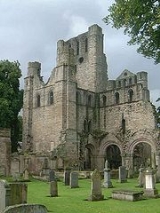
Kelso Abbey

Encyclopedia
Kelso Abbey is what remains of a Scottish abbey founded in the 12th century by a community of Tironensian
monks first brought to Scotland
in the reign of Alexander I
. It occupies ground overlooking the confluence of the Tweed
and Teviot
water
s, the site of what was once the Royal Burgh
of Roxburgh
and the intended southern centre for the developing Scottish kingdom at that time. Kelso thus became the seat of a pre-eminently powerful abbacy in the heart of the Scottish Borders
.
In the 14th century, Roxburgh became a focus for periodic attack and occupation by English forces
and Kelso's monastic community survived a number of fluctuations in control over the area, restoring the abbey infrastructure after episodes of destruction and ultimately retaining Scottish identity. From 1460 onwards, life for the abbey was probably relatively settled, but came once again under attack in the early sixteenth century. By the mid-century, through a turbulent combination of events, the abbey effectively ceased to function and the building fell into ruin.
Although the site of Kelso Abbey has not been fully excavated in modern times, evidence suggests that it was a major building with two crossing
s. The only remains standing today are the west tower crossing and part of the infirmary. The massive design and solid romanesque
style of the tower indicate a very large building of formidable, semi-military construction and appearance, evidence of the importance with which Roxburgh was regarded when the abbacy was at the height of its power.
 Kelso abbey was founded at Roxburgh in 1128 by a community of monks of the Tironesian order, from Tiron, near Chartres
, in France
. The community had first entered Scotland, c. 1113, under the patronage of David I
as Prince of the Cumbrians during the reign of his brother, Alexander I, when the monks were given a commission to found their community at a site near Selkirk. It is not known for certain why the community came to abandon this first site in 1128, although David, now King of Scots, was developing Roxburgh as a major economic and administrative centre for Southern Scotland. Other institutions established by David at Roxburgh included the royal mint
.
Construction of the abbey is believed to have commenced immediately, and by 1143 progress was sufficiently advanced for the building to be dedicated to The Blessed Virgin and Saint John
. The King's son, Henry, Earl of Northumbria, who predeceased his father, was inter
red in the abbey in 1152.
across the Tweed
water, soon grew to be one of the wealthiest and grandest in Scotland
, with much of its income coming from its vast estates in the Border country
. John, abbot of Kelso
from 1160 to 1180, was the first abbot
in Scotland to be granted the mitre
.
After Scotland's royal dynasty began lose the overlordship of Northhumbria during the reign of William I
, David's southern "capital" came into close proximity to the border with England
and was subject to attack during the Wars of Scottish Independence
. In 1299, the abbot of Kelso was the English appointee, Thomas de Durham (1299 - 1307), but the abbey defended its Scottish identity. Throughout this turbulent period, Roxburgh Castle and Berwick upon Tweed, the major Scottish port serving the area, were frequently under English occupation. Whenever the abbey was subject to attack, the damage was repaired by the monks.
In 1460, James II
was killed within sight of the abbey as the result of a fatal accident during the campaign which secured repossession of Roxburgh castle that same year. Kelso Abbey was the venue for the hasty coronation of the infant king, James III
, which quickly followed. During the period 1460 to 1540, political and military control in the area was more stable and life for the abbey was probably relatively settled.
, Dryburgh
and Jedburgh
, were targeted for destruction by forces under the command of the Earl of Hertford
. This physical assault was followed around ten years later, in 1560, by monastic disestablishment under the Scottish Reformation
, from which time the Tironensian community at Kelso was no longer officially recognised.
, to the last commendator of the abbey, Robert Ker of Cesford
.
Between 1647 and 1771, part of the abbey ruins were occupied by a parish kirk
, with other parts of the structure being dismantled and used as a source of stone by locals for buildings in the town of Kelso. The post-reformation kirk appears to have been a compact vaulted structure intruded within the west transept
s in about 1748. This adapted structure included a vaulted gaol.
In 1805, huge parts of the ruins
were cleared away, including the parish church and the gaol, leaving only the abbey's west tower and transept
remaining to this day. A more recent addition (1933) has been a memorial cloister
to the 8th Duke of Roxburghe built in the original style of the cloisters when the abbey was first built, and designed by Reginald Fairlie
.
, a double-cruciform design that was relatively rare in Europe. The high altar of the abbey would have been at the east tower crossing. Although the east end does not survive, it may have been in a rounded form if, as would be expected, the firm romanesque design of the extant western tower was consistent throughout the building.
The gable of the north transept of the west tower crossing (pictured right) presents the most intact surviving face. The earliest remains of the abbey are the two bays of the south arcade
of the nave
(partly visible at the far left of the picture). These have rounded arches dating from about 1128. Later additions above this are a triforium
from the late 12th Century, and above this clerestory
is a continuous arcade. There is no regular vertical pattern between three levels of arcading, a feature which is unique in Scotland or England. The masonry above the clerestory suggests that there was no nave vaulting
.
The south and west faces of the west tower still rise high to the level of the belfry openings and this structure is not earlier than the beginning of the 13th Century. The west transepts and the west vestibule
also survive, though only the north jamb survives of the west crossing's doorways.
Tironensian
The Tironensian Order or the Order of Tiron was a Roman Catholic monastic order named after the location of the mother abbey in the woods of Tiron in Perche, some 35 miles west of Chartres in France)...
monks first brought to Scotland
Kingdom of Scotland
The Kingdom of Scotland was a Sovereign state in North-West Europe that existed from 843 until 1707. It occupied the northern third of the island of Great Britain and shared a land border to the south with the Kingdom of England...
in the reign of Alexander I
Alexander I of Scotland
Alexander I , also called Alaxandair mac Maíl Coluim and nicknamed "The Fierce", was King of the Scots from 1107 to his death.-Life:...
. It occupies ground overlooking the confluence of the Tweed
River Tweed
The River Tweed, or Tweed Water, is long and flows primarily through the Borders region of Great Britain. It rises on Tweedsmuir at Tweed's Well near where the Clyde, draining northwest, and the Annan draining south also rise. "Annan, Tweed and Clyde rise oot the ae hillside" as the Border saying...
and Teviot
River Teviot
The River Teviot, or Teviot Water, is a river of the Scottish Borders area of Scotland, and a tributary of the River Tweed.It rises in the western foothills of Comb Hill on the border of Dumfries and Galloway...
water
River
A river is a natural watercourse, usually freshwater, flowing towards an ocean, a lake, a sea, or another river. In a few cases, a river simply flows into the ground or dries up completely before reaching another body of water. Small rivers may also be called by several other names, including...
s, the site of what was once the Royal Burgh
Royal burgh
A royal burgh was a type of Scottish burgh which had been founded by, or subsequently granted, a royal charter. Although abolished in 1975, the term is still used in many of the former burghs....
of Roxburgh
Roxburgh
Roxburgh , also known as Rosbroch, is a village, civil parish and now-destroyed royal burgh. It was an important trading burgh in High Medieval to early modern Scotland...
and the intended southern centre for the developing Scottish kingdom at that time. Kelso thus became the seat of a pre-eminently powerful abbacy in the heart of the Scottish Borders
Scottish Borders
The Scottish Borders is one of 32 local government council areas of Scotland. It is bordered by Dumfries and Galloway in the west, South Lanarkshire and West Lothian in the north west, City of Edinburgh, East Lothian, Midlothian to the north; and the non-metropolitan counties of Northumberland...
.
In the 14th century, Roxburgh became a focus for periodic attack and occupation by English forces
English Army
The English Army existed while England was an independent state and was at war with other states, but it was not until the Interregnum and the New Model Army that England acquired a peace time professional standing army...
and Kelso's monastic community survived a number of fluctuations in control over the area, restoring the abbey infrastructure after episodes of destruction and ultimately retaining Scottish identity. From 1460 onwards, life for the abbey was probably relatively settled, but came once again under attack in the early sixteenth century. By the mid-century, through a turbulent combination of events, the abbey effectively ceased to function and the building fell into ruin.
Although the site of Kelso Abbey has not been fully excavated in modern times, evidence suggests that it was a major building with two crossing
Crossing (architecture)
A crossing, in ecclesiastical architecture, is the junction of the four arms of a cruciform church.In a typically oriented church , the crossing gives access to the nave on the west, the transept arms on the north and south, and the choir on the east.The crossing is sometimes surmounted by a tower...
s. The only remains standing today are the west tower crossing and part of the infirmary. The massive design and solid romanesque
Romanesque architecture
Romanesque architecture is an architectural style of Medieval Europe characterised by semi-circular arches. There is no consensus for the beginning date of the Romanesque architecture, with proposals ranging from the 6th to the 10th century. It developed in the 12th century into the Gothic style,...
style of the tower indicate a very large building of formidable, semi-military construction and appearance, evidence of the importance with which Roxburgh was regarded when the abbacy was at the height of its power.
Foundation
Chartres
Chartres is a commune and capital of the Eure-et-Loir department in northern France. It is located southwest of Paris.-Geography:Chartres is built on the left bank of the Eure River, on a hill crowned by its famous cathedral, the spires of which are a landmark in the surrounding country...
, in France
France
The French Republic , The French Republic , The French Republic , (commonly known as France , is a unitary semi-presidential republic in Western Europe with several overseas territories and islands located on other continents and in the Indian, Pacific, and Atlantic oceans. Metropolitan France...
. The community had first entered Scotland, c. 1113, under the patronage of David I
David I of Scotland
David I or Dabíd mac Maíl Choluim was a 12th-century ruler who was Prince of the Cumbrians and later King of the Scots...
as Prince of the Cumbrians during the reign of his brother, Alexander I, when the monks were given a commission to found their community at a site near Selkirk. It is not known for certain why the community came to abandon this first site in 1128, although David, now King of Scots, was developing Roxburgh as a major economic and administrative centre for Southern Scotland. Other institutions established by David at Roxburgh included the royal mint
Royal Mint
The Royal Mint is the body permitted to manufacture, or mint, coins in the United Kingdom. The Mint originated over 1,100 years ago, but since 2009 it operates as Royal Mint Ltd, a company which has an exclusive contract with HM Treasury to supply all coinage for the UK...
.
Construction of the abbey is believed to have commenced immediately, and by 1143 progress was sufficiently advanced for the building to be dedicated to The Blessed Virgin and Saint John
John the Apostle
John the Apostle, John the Apostle, John the Apostle, (Aramaic Yoħanna, (c. 6 - c. 100) was one of the Twelve Apostles of Jesus. He was the son of Zebedee and Salome, and brother of James, another of the Twelve Apostles...
. The King's son, Henry, Earl of Northumbria, who predeceased his father, was inter
Burial
Burial is the act of placing a person or object into the ground. This is accomplished by excavating a pit or trench, placing an object in it, and covering it over.-History:...
red in the abbey in 1152.
Development and defence
Kelso Abbey, which was situated in sight of Roxburgh CastleRoxburgh Castle
Roxburgh Castle was a castle sited near Kelso, in the Borders region of Scotland, in the former Roxburghshire.-History:The castle was founded by King David I. In 1174 it was surrendered to England after the capture of William I at Alnwick, and was often in English hands thereafter. The Scots made...
across the Tweed
River Tweed
The River Tweed, or Tweed Water, is long and flows primarily through the Borders region of Great Britain. It rises on Tweedsmuir at Tweed's Well near where the Clyde, draining northwest, and the Annan draining south also rise. "Annan, Tweed and Clyde rise oot the ae hillside" as the Border saying...
water, soon grew to be one of the wealthiest and grandest in Scotland
Scotland
Scotland is a country that is part of the United Kingdom. Occupying the northern third of the island of Great Britain, it shares a border with England to the south and is bounded by the North Sea to the east, the Atlantic Ocean to the north and west, and the North Channel and Irish Sea to the...
, with much of its income coming from its vast estates in the Border country
Border Country
Border Country is a novel by Raymond Williams. The book was re-published in December 2005 as one of the first group of titles in the Library of Wales series, having been out of print for several years. Written in English, the novel was first published in 1960.It is set in rural South Wales, close...
. John, abbot of Kelso
Abbot of Kelso
The Abbot of Kelso was the head of the Tironensian monastic community at Kelso Abbey in the Scottish Borders. Originally, he was the Abbot of Selkirk, because from its foundation in 1113 by David, Prince of the Cumbrians until it was moved to Kelso by David and John, bishop of Glasgow in 1127...
from 1160 to 1180, was the first abbot
Abbot
The word abbot, meaning father, is a title given to the head of a monastery in various traditions, including Christianity. The office may also be given as an honorary title to a clergyman who is not actually the head of a monastery...
in Scotland to be granted the mitre
Mitre
The mitre , also spelled miter, is a type of headwear now known as the traditional, ceremonial head-dress of bishops and certain abbots in the Roman Catholic Church, as well as in the Anglican Communion, some Lutheran churches, and also bishops and certain other clergy in the Eastern Orthodox...
.
After Scotland's royal dynasty began lose the overlordship of Northhumbria during the reign of William I
William I of Scotland
William the Lion , sometimes styled William I, also known by the nickname Garbh, "the Rough", reigned as King of the Scots from 1165 to 1214...
, David's southern "capital" came into close proximity to the border with England
England
England is a country that is part of the United Kingdom. It shares land borders with Scotland to the north and Wales to the west; the Irish Sea is to the north west, the Celtic Sea to the south west, with the North Sea to the east and the English Channel to the south separating it from continental...
and was subject to attack during the Wars of Scottish Independence
Wars of Scottish Independence
The Wars of Scottish Independence were a series of military campaigns fought between the independent Kingdom of Scotland and the Kingdom of England in the late 13th and early 14th centuries....
. In 1299, the abbot of Kelso was the English appointee, Thomas de Durham (1299 - 1307), but the abbey defended its Scottish identity. Throughout this turbulent period, Roxburgh Castle and Berwick upon Tweed, the major Scottish port serving the area, were frequently under English occupation. Whenever the abbey was subject to attack, the damage was repaired by the monks.
In 1460, James II
James II of Scotland
James II reigned as King of Scots from 1437 to his death.He was the son of James I, King of Scots, and Joan Beaufort...
was killed within sight of the abbey as the result of a fatal accident during the campaign which secured repossession of Roxburgh castle that same year. Kelso Abbey was the venue for the hasty coronation of the infant king, James III
James III of Scotland
James III was King of Scots from 1460 to 1488. James was an unpopular and ineffective monarch owing to an unwillingness to administer justice fairly, a policy of pursuing alliance with the Kingdom of England, and a disastrous relationship with nearly all his extended family.His reputation as the...
, which quickly followed. During the period 1460 to 1540, political and military control in the area was more stable and life for the abbey was probably relatively settled.
Sixteenth century destruction
Kelso Abbey effectively ceased to function as the result of a combination of events in the mid sixteenth century. First, in the 1540s, the building sustained major damage in attacks perpetrated under the orders of the English king, Henry VIII, part of the so-called Rough Wooing, in which most of southern Scotland's abbeys, including those at MelroseMelrose Abbey
Melrose Abbey is a Gothic-style abbey in Melrose, Scotland. It was founded in 1136 by Cistercian monks, on the request of King David I of Scotland. It was headed by the Abbot or Commendator of Melrose. Today the abbey is maintained by Historic Scotland...
, Dryburgh
Dryburgh Abbey
Dryburgh Abbey, near Dryburgh on the banks of the River Tweed in the Scottish Borders, was nominally founded on 10 November 1150 in an agreement between Hugh de Morville, Lord of Lauderdale and Constable of Scotland, and the Premonstratensian canons regular from Alnwick Abbey in Northumberland...
and Jedburgh
Jedburgh Abbey
Jedburgh Abbey, a ruined Augustinian abbey which was founded in the 12th century is situated in the town of Jedburgh, in the Scottish Borders just north of the border with England at Carter Bar...
, were targeted for destruction by forces under the command of the Earl of Hertford
Edward Seymour, 1st Duke of Somerset
Edward Seymour, 1st Duke of Somerset, 1st Earl of Hertford, 1st Viscount Beauchamp of Hache, KG, Earl Marshal was Lord Protector of England in the period between the death of Henry VIII in 1547 and his own indictment in 1549....
. This physical assault was followed around ten years later, in 1560, by monastic disestablishment under the Scottish Reformation
Scottish Reformation
The Scottish Reformation was Scotland's formal break with the Papacy in 1560, and the events surrounding this. It was part of the wider European Protestant Reformation; and in Scotland's case culminated ecclesiastically in the re-establishment of the church along Reformed lines, and politically in...
, from which time the Tironensian community at Kelso was no longer officially recognised.
Post-reformation end
A small remaining contingent of monks may have continued at the site for a number of years following the 1560 dissolution, but after further attacks and damage the abbey was declared officially derelict in 1587. By the late 16th century the estates of the former monastery came under fully secular control when, in 1607, they were finally granted as a secular lordship, titled HolydeanHolydean
Holydean is a Scottish feudal Crown Barony and Lordship which lies in Roxburghshire in the neighbourhood of Kelso, in the Borderlands of Scotland, along the River Tweed...
, to the last commendator of the abbey, Robert Ker of Cesford
Robert Ker, 1st Earl of Roxburghe
Robert Ker, 1st Earl of Roxburghe was a Scottish nobleman. He was the eldest son of William Ker of Cessford , and grandson of Sir Walter Ker of Cessford , who fought against Mary, Queen of Scots, both at Carberry Hill and at Langside.He helped James VI against Bothwell...
.
Between 1647 and 1771, part of the abbey ruins were occupied by a parish kirk
Reformed churches
The Reformed churches are a group of Protestant denominations characterized by Calvinist doctrines. They are descended from the Swiss Reformation inaugurated by Huldrych Zwingli but developed more coherently by Martin Bucer, Heinrich Bullinger and especially John Calvin...
, with other parts of the structure being dismantled and used as a source of stone by locals for buildings in the town of Kelso. The post-reformation kirk appears to have been a compact vaulted structure intruded within the west transept
Transept
For the periodical go to The Transept.A transept is a transverse section, of any building, which lies across the main body of the building. In Christian churches, a transept is an area set crosswise to the nave in a cruciform building in Romanesque and Gothic Christian church architecture...
s in about 1748. This adapted structure included a vaulted gaol.
In 1805, huge parts of the ruins
Ruins
Ruins are the remains of human-made architecture: structures that were once complete, as time went by, have fallen into a state of partial or complete disrepair, due to lack of maintenance or deliberate acts of destruction...
were cleared away, including the parish church and the gaol, leaving only the abbey's west tower and transept
Transept
For the periodical go to The Transept.A transept is a transverse section, of any building, which lies across the main body of the building. In Christian churches, a transept is an area set crosswise to the nave in a cruciform building in Romanesque and Gothic Christian church architecture...
remaining to this day. A more recent addition (1933) has been a memorial cloister
Cloister
A cloister is a rectangular open space surrounded by covered walks or open galleries, with open arcades on the inner side, running along the walls of buildings and forming a quadrangle or garth...
to the 8th Duke of Roxburghe built in the original style of the cloisters when the abbey was first built, and designed by Reginald Fairlie
Reginald Fairlie
Reginald Francis Joseph Fairlie was a Scottish architect.Born at Kincaple, Fife, he was educated in Birmingham....
.
Architectural Notes
Little of the ground plan of this once large abbey exists, but the surviving ruin of the west tower, together with its crossing, is impressive and shows a building that was strong and fortress like. Evidence from Vatican archives, dated 1517, indicates that the complete building had two crossings, west and east, each with single towersSteeple (architecture)
A steeple, in architecture, is a tall tower on a building, often topped by a spire. Steeples are very common on Christian churches and cathedrals and the use of the term generally connotes a religious structure...
, a double-cruciform design that was relatively rare in Europe. The high altar of the abbey would have been at the east tower crossing. Although the east end does not survive, it may have been in a rounded form if, as would be expected, the firm romanesque design of the extant western tower was consistent throughout the building.
The gable of the north transept of the west tower crossing (pictured right) presents the most intact surviving face. The earliest remains of the abbey are the two bays of the south arcade
Arcade (architecture)
An arcade is a succession of arches, each counterthrusting the next, supported by columns or piers or a covered walk enclosed by a line of such arches on one or both sides. In warmer or wet climates, exterior arcades provide shelter for pedestrians....
of the nave
Nave
In Romanesque and Gothic Christian abbey, cathedral basilica and church architecture, the nave is the central approach to the high altar, the main body of the church. "Nave" was probably suggested by the keel shape of its vaulting...
(partly visible at the far left of the picture). These have rounded arches dating from about 1128. Later additions above this are a triforium
Triforium
A triforium is a shallow arched gallery within the thickness of inner wall, which stands above the nave of a church or cathedral. It may occur at the level of the clerestory windows, or it may be located as a separate level below the clerestory. It may itself have an outer wall of glass rather than...
from the late 12th Century, and above this clerestory
Clerestory
Clerestory is an architectural term that historically denoted an upper level of a Roman basilica or of the nave of a Romanesque or Gothic church, the walls of which rise above the rooflines of the lower aisles and are pierced with windows. In modern usage, clerestory refers to any high windows...
is a continuous arcade. There is no regular vertical pattern between three levels of arcading, a feature which is unique in Scotland or England. The masonry above the clerestory suggests that there was no nave vaulting
Vault (architecture)
A Vault is an architectural term for an arched form used to provide a space with a ceiling or roof. The parts of a vault exert lateral thrust that require a counter resistance. When vaults are built underground, the ground gives all the resistance required...
.
The south and west faces of the west tower still rise high to the level of the belfry openings and this structure is not earlier than the beginning of the 13th Century. The west transepts and the west vestibule
Vestibule (architecture)
A vestibule is a lobby, entrance hall, or passage between the entrance and the interior of a building.The same term can apply to structures in modern or ancient roman architecture. In modern architecture vestibule typically refers to a small room or hall between an entrance and the interior of...
also survive, though only the north jamb survives of the west crossing's doorways.
See also
- Kelso
- Abbot of KelsoAbbot of KelsoThe Abbot of Kelso was the head of the Tironensian monastic community at Kelso Abbey in the Scottish Borders. Originally, he was the Abbot of Selkirk, because from its foundation in 1113 by David, Prince of the Cumbrians until it was moved to Kelso by David and John, bishop of Glasgow in 1127...
(for a list of abbots and commendators) - List of religious houses in Scotland
- List of places in the Scottish Borders
- List of places in Scotland
- Borders Abbeys WayBorders Abbeys WayThe Borders Abbeys Way is a long-distance footpath in the Scottish Borders area of Scotland. It is a circular walkway and is 68 miles long....
- Kilwinning AbbeyKilwinning AbbeyKilwinning Abbey is a ruined abbey located in the centre of the town of Kilwinning, North Ayrshire.-The establishment of the Abbey:The ancient name of the town is 'Segdoune' or 'Saigtown', probably derived from 'Sanctoun', meaning the 'town of the saint'. Saint Winnings festival was on 21 January...
External links
- Online version of the Chartulary of Kelso Abbey: Liber S. Marie de Calchou: registrum cartarum abbacie tironensis de Kelso, 1113-1567, Bannatyne Club, 1846.