
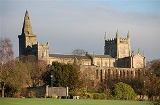
Dunfermline Abbey is as a
Church of ScotlandThe Church of Scotland, known informally by its Scots language name, the Kirk, is a Presbyterian church, decisively shaped by the Scottish Reformation....
Parish Church located in
DunfermlineDunfermline is a town and former Royal Burgh in Fife, Scotland, on high ground from the northern shore of the Firth of Forth. According to a 2008 estimate, Dunfermline has a population of 46,430, making it the second-biggest settlement in Fife. Part of the town's name comes from the Gaelic word...
,
FifeFife is a council area and former county of Scotland. It is situated between the Firth of Tay and the Firth of Forth, with inland boundaries to Perth and Kinross and Clackmannanshire...
,
ScotlandScotland is a country that is part of the United Kingdom. Occupying the northern third of the island of Great Britain, it shares a border with England to the south and is bounded by the North Sea to the east, the Atlantic Ocean to the north and west, and the North Channel and Irish Sea to the...
. In 2002 the congregation had 806 members. The minister (since 1991) is the Reverend Alastair Jessamine. The church occupies the site of the ancient chancel and transepts of a large medieval
BenedictineBenedictine refers to the spirituality and consecrated life in accordance with the Rule of St Benedict, written by Benedict of Nursia in the sixth century for the cenobitic communities he founded in central Italy. The most notable of these is Monte Cassino, the first monastery founded by Benedict...
abbey, which was sacked in 1560 during the
Scottish ReformationThe Scottish Reformation was Scotland's formal break with the Papacy in 1560, and the events surrounding this. It was part of the wider European Protestant Reformation; and in Scotland's case culminated ecclesiastically in the re-establishment of the church along Reformed lines, and politically in...
and permitted to fall into disrepair. Part of the old abbey church continued in use at that time and some parts of the abbey infrastructure still remain to this day. Dunfermline Abbey is one of Scotland's most important cultural sites.
Early history
The abbey was founded in 1128 by King
David I of ScotlandDavid I or Dabíd mac Maíl Choluim was a 12th-century ruler who was Prince of the Cumbrians and later King of the Scots...
, but the monastic establishment was based on an earlier foundation dating back to the reign of King
Máel Coluim mac DonnchadaMáel Coluim mac Donnchada , was King of Scots...
(i.e. "Malcolm III" or "Malcolm Canmore", r. 1058-93) and his queen. It was administered by the
Abbot of DunfermlineThe Prior, then Abbot and then Commendator of Dunfermline was the head of the Benedictine monastic community of Dunfermline Abbey, Fife, Scotland. The abbey itself was founded in 1128 by King David I of Scotland, but was of earlier origin. King Máel Coluim mac Donnchada had founded a church there...
, its first being
Geoffrey of CanterburyGeoffrey was a twelfth-century Anglo-Norman Benedictine monk and abbot. Of Anglo-Norman origin, he became monastic head of the Benedictine priory at Canterbury, before moving to Scotland to be the first Abbot of Dunfermline...
, former
priorPrior is an ecclesiastical title, derived from the Latin adjective for 'earlier, first', with several notable uses.-Monastic superiors:A Prior is a monastic superior, usually lower in rank than an Abbot. In the Rule of St...
of Christ Church, Canterbury, the Kent religious house that probably supplied Dunfermline's first Benedictine monks. At the peak of its power it controlled four burghs, three courts of
regalityA regality was a territorial jurisdiction in old Scots law which might be created by the King only, by granting lands to a subject in liberam regalitatem, and also the tract of land over which such a right extended....
and a large portfolio of lands from
MorayMoray is one of the 32 council areas of Scotland. It lies in the north-east of the country, with coastline on the Moray Firth, and borders the council areas of Aberdeenshire and Highland.- History :...
in the north down into
BerwickshireBerwickshire or the County of Berwick is a registration county, a committee area of the Scottish Borders Council, and a lieutenancy area of Scotland, on the border with England. The town after which it is named—Berwick-upon-Tweed—was lost by Scotland to England in 1482...
.
In the decades after its foundation the abbey gained power and wealth with the dedication of 26 altars gifted by individuals and
guildA guild is an association of craftsmen in a particular trade. The earliest types of guild were formed as confraternities of workers. They were organized in a manner something between a trade union, a cartel, and a secret society...
s and was a lucrative centre of pilgrimage after Dunfermline became a centre for the well-promoted cult of
St MargaretSaint Margaret of Scotland , also known as Margaret of Wessex and Queen Margaret of Scotland, was an English princess of the House of Wessex. Born in exile in Hungary, she was the sister of Edgar Ætheling, the short-ruling and uncrowned Anglo-Saxon King of England...
(Malcolm's wife and David's mother), from whom the monastery later claimed foundation and for which an earlier foundation charter was fabricated. The foundations of the earliest church (the Church of the Holy Trinity) are under the present superb
RomanesqueRomanesque architecture is an architectural style of Medieval Europe characterised by semi-circular arches. There is no consensus for the beginning date of the Romanesque architecture, with proposals ranging from the 6th to the 10th century. It developed in the 12th century into the Gothic style,...
nave built in the 12th century.
During the winter of 1303 the court of
Edward I of EnglandEdward I , also known as Edward Longshanks and the Hammer of the Scots, was King of England from 1272 to 1307. The first son of Henry III, Edward was involved early in the political intrigues of his father's reign, which included an outright rebellion by the English barons...
was held in the abbey, and on his departure next year most of the buildings were burned.
Later history
During the
Scottish ReformationThe Scottish Reformation was Scotland's formal break with the Papacy in 1560, and the events surrounding this. It was part of the wider European Protestant Reformation; and in Scotland's case culminated ecclesiastically in the re-establishment of the church along Reformed lines, and politically in...
, the abbey church was sacked in March 1560. Some parts of the abbey infrastructure still remain, principally the vast refectory and rooms over the gatehouse which was part of the former city wall. The nave was also spared and it was repaired in 1570 by
Robert Drummond of CarnockSir Robert Drummond of Carnock was Master of Work to the Crown of Scotland from 1579 to 1583. This was the responsibility for building and repair of palaces and castles. His appointment was made to be "as Sir James Hamilton of Finnart had it."...
. It served as the parish church till the 19th century, and now forms the vestibule of a new church. This edifice, in the Perpendicular style, opened for public worship in 1821, occupies the site of the ancient chancel and transepts, though differing in style and proportions from the original structure. Also of the monastery there still remains the south wall of the refectory, with a fine window. Next to the abbey is the ruin of
Dunfermline PalaceDunfermline Palace is a former Scottish royal palace in Dunfermline, Fife. It is currently a ruin under the care of Historic Scotland and an important tourist attraction in Dunfermline....
, also part of the original abbey complex and connected to it via the gatehouse.
Dunfermline Abbey, one of
ScotlandScotland is a country that is part of the United Kingdom. Occupying the northern third of the island of Great Britain, it shares a border with England to the south and is bounded by the North Sea to the east, the Atlantic Ocean to the north and west, and the North Channel and Irish Sea to the...
's most important cultural sites, has received more of Scotland’s royal dead than any other place in the kingdom, excepting
IonaIona is a small island in the Inner Hebrides off the western coast of Scotland. It was a centre of Irish monasticism for four centuries and is today renowned for its tranquility and natural beauty. It is a popular tourist destination and a place for retreats...
. One of the most notable non-royal names to be associated with the abbey is the
northern renaissanceThe Northern Renaissance is the term used to describe the Renaissance in northern Europe, or more broadly in Europe outside Italy. Before 1450 Italian Renaissance humanism had little influence outside Italy. From the late 15th century the ideas spread around Europe...
poet,
Robert HenrysonRobert Henryson was a poet who flourished in Scotland in the period c. 1460–1500. Counted among the Scots makars, he lived in the royal burgh of Dunfermline and is a distinctive voice in the Northern Renaissance at a time when the culture was on a cusp between medieval and renaissance sensibilities...
. The tomb of
Saint MargaretSaint Margaret of Scotland , also known as Margaret of Wessex and Queen Margaret of Scotland, was an English princess of the House of Wessex. Born in exile in Hungary, she was the sister of Edgar Ætheling, the short-ruling and uncrowned Anglo-Saxon King of England...
and Malcolm Canmore, within the ruined walls of the Lady chapel, was restored and enclosed by command of Queen
VictoriaVictoria was the monarch of the United Kingdom of Great Britain and Ireland from 20 June 1837 until her death. From 1 May 1876, she used the additional title of Empress of India....
.
Today
The current building on the site of the choir of the old Abbey church is a Parish Church of the
Church of ScotlandThe Church of Scotland, known informally by its Scots language name, the Kirk, is a Presbyterian church, decisively shaped by the Scottish Reformation....
, still with the name Dunfermline Abbey. In 2002 the congregation had 806 members. The minister (since 1991) is the Reverend Alastair Jessamine.
Architecture
The old building was a fine example of simple and massive
NormanThe Normans were the people who gave their name to Normandy, a region in northern France. They were descended from Norse Viking conquerors of the territory and the native population of Frankish and Gallo-Roman stock...
, as the nave testifies, and has a beautiful doorway in its west front. Another rich Norman doorway was exposed in the south wall in 1903, when masons were cutting a site for the
memorialA memorial is an object which serves as a focus for memory of something, usually a person or an event. Popular forms of memorials include landmark objects or art objects such as sculptures, statues or fountains, and even entire parks....
to the soldiers who had fallen in the
Second Boer WarThe Second Boer War was fought from 11 October 1899 until 31 May 1902 between the British Empire and the Afrikaans-speaking Dutch settlers of two independent Boer republics, the South African Republic and the Orange Free State...
. A new site was found for this monument in order that the ancient and beautiful entrance might be preserved. The venerable structure is maintained publicly, and private munificence has provided several stained-glass windows.
Famous Births, Marriages, & Burials
- Saint Margaret of Scotland
Saint Margaret of Scotland , also known as Margaret of Wessex and Queen Margaret of Scotland, was an English princess of the House of Wessex. Born in exile in Hungary, she was the sister of Edgar Ætheling, the short-ruling and uncrowned Anglo-Saxon King of England...
was buried here in 1093; on 19 June 1250 following her CanonizationCanonization is the act by which a Christian church declares a deceased person to be a saint, upon which declaration the person is included in the canon, or list, of recognized saints. Originally, individuals were recognized as saints without any formal process...
her remains were disinterred and placed in a reliquary at the high altar. Her husband Malcolm'sMáel Coluim mac Donnchada , was King of Scots...
remains were also disinterred, and buried next to Margaret.
- Both Duncan II of Scotland
Donnchad mac Maíl Coluim was king of Scots...
1094, and his wife Ethelreda, were buried here
- Donald III of Scotland
Domnall mac Donnchada , anglicised as Donald III, and nicknamed Domnall Bán, "Donald the Fair" , was King of Scots from 1093–1094 and 1094–1097...
1099
- Edgar of Scotland
Edgar or Étgar mac Maíl Choluim , nicknamed Probus, "the Valiant" , was king of Alba from 1097 to 1107...
was buried here in 1107
- Both Alexander I of Scotland
Alexander I , also called Alaxandair mac Maíl Coluim and nicknamed "The Fierce", was King of the Scots from 1107 to his death.-Life:...
1124, and his queen Sybilla de NormandySybilla of Normandy was queen consort of Scotland, wife to Alexander I.Sybilla was the first child of Henry I of England and his mistress Lady Sybilla Corbet of Alcester . Her maternal grandfather was Robert, Count of Mortain, Earl of Cornwall...
1122, were buried here
- David I of Scotland
David I or Dabíd mac Maíl Choluim was a 12th-century ruler who was Prince of the Cumbrians and later King of the Scots...
was buried here (1153) along with his queen Maud, Countess of Huntingdon (1130)
- Malcolm IV of Scotland
Malcolm IV , nicknamed Virgo, "the Maiden" , King of Scots, was the eldest son of Earl Henry and Ada de Warenne...
was buried here in 1165
- Alexander III of Scotland
Alexander III was King of Scots from 1249 to his death.-Life:...
(1286), was buried here, with his first wife Margaret of EnglandMargaret of England was a medieval English princess who became Queen of Scots. A daughter of the Plantagenet king Henry III of England and his queen, Eleanor of Provence, she was Queen consort to Alexander III "the Glorious", King of the Scots.- Family :She was the second child of Henry III of...
(1275) and their sons David of Scotland (1281) and Alexander of Scotland (1284)
- Elizabeth de Burgh
Elizabeth de Burgh was the second wife and the only queen consort of King Robert I of Scotland.-Life:She was born in Dunfermline, Fife in Scotland, the daughter of the powerful Richard Óg de Burgh, 2nd Earl of Ulster and his wife Margarite de Burgh...
, wife of Robert I of ScotlandRobert I , popularly known as Robert the Bruce , was King of Scots from March 25, 1306, until his death in 1329.His paternal ancestors were of Scoto-Norman heritage , and...
, was buried here in 1327
- Robert the Bruce
Robert I , popularly known as Robert the Bruce , was King of Scots from March 25, 1306, until his death in 1329.His paternal ancestors were of Scoto-Norman heritage , and...
was buried, in 1329, in the choir, now the site of the present parish church. Bruce’s heart rests in MelroseMelrose is a small town and civil parish in the Scottish Borders, historically in Roxburghshire. It is in the Eildon committee area.-Etymology:...
, but his bones lie in Dunfermline Abbey, where (after the discovery of the skeleton in 1818) they were reinterred with fitting pomp below the pulpit of the New church. In 1891 the pulpit was moved back and a monumental brassMonumental brass is a species of engraved sepulchral memorial which in the early part of the 13th century began to partially take the place of three-dimensional monuments and effigies carved in stone or wood...
inserted in the floor to indicate the royal vault.
- Matilda of Scotland, daughter of Robert I of Scotland
Robert I , popularly known as Robert the Bruce , was King of Scots from March 25, 1306, until his death in 1329.His paternal ancestors were of Scoto-Norman heritage , and...
, was buried here in 1353
- Anabella Drummond
Anabella Drummond was the Queen Consort of Scotland as the wife of Robert III of Scotland.-Family:She was the daughter of Sir John Drummond, of Stobhall, near Perth, 11th Thane of Lennox and Chief of Clan Drummond, and Mary Montifex...
, wife of Robert IIIRobert III was King of Scots from 1390 to his death. His given name was John Stewart, and he was known primarily as the Earl of Carrick before ascending the throne at age 53...
and mother of James IJames I, King of Scots , was the son of Robert III and Annabella Drummond. He was probably born in late July 1394 in Dunfermline as youngest of three sons...
was buried here in 1401
- Robert Stewart, Duke of Albany was buried here in 1420
- Birthplace, in 1600, of Charles I
Charles I was King of England, King of Scotland, and King of Ireland from 27 March 1625 until his execution in 1649. Charles engaged in a struggle for power with the Parliament of England, attempting to obtain royal revenue whilst Parliament sought to curb his Royal prerogative which Charles...
, the last British monarch born in Scotland.
- William Schaw
William Schaw was Master of Works to James VI of Scotland, and is claimed to have been an important figure in the development of freemasonry.-Biography:...
, Master of Work to the Crown of ScotlandThe Master of Works to the Crown of Scotland was responsible for the construction, repair and maintenance of royal palaces, castles and other crown property in Scotland. The main buildings were; Holyroodhouse; Edinburgh Castle; Stirling Castle; Linlithgow Palace; and Falkland Palace. The position...
, was buried here in 1602: his tomb can still be seen.
- David Lindsay, 1st Lord Balcarres
Sir David Lindsay, 1st Lord Lindsay of Balcarres was a Scottish nobleman. He was born in Edinburgh, the son of John Lindsay of Balcarres, Lord Menmuir and Marion Guthrie....
, son of John Lindsay of Balcarres, Lord Menmuir-Life:He was second son of David Lindsay, 9th Earl of Crawford, by his wife Catherine Campbell, daughter of Sir John Campbell of Lorn. Along with his brother David Lindsay, lord Edzell, he was sent under the care of James Lawson to complete his education on the continent...
and father of Alexander Lindsay, 1st Earl of BalcarresAlexander Lindsay, 2nd Lord Balcarres and 1st Earl of Balcarres was a Scottish nobleman.The eldest son of David Lindsay, 1st Lord Balcarres, and grandson of John Lindsay, Lord Menmuir....
, was married here in 1611
- Bishop James Bruce
James Bruce was a 15th century cleric who was bishop of Dunkeld, Chancellor of Scotland, and bishop of Glasgow. He was the son of one Robert Bruce, a middling landowner in Clackmannanshire. He was rector of Kilmany , and Archdeacon of Dunkeld...
See also
- Abbot of Dunfermline
The Prior, then Abbot and then Commendator of Dunfermline was the head of the Benedictine monastic community of Dunfermline Abbey, Fife, Scotland. The abbey itself was founded in 1128 by King David I of Scotland, but was of earlier origin. King Máel Coluim mac Donnchada had founded a church there...
- Abbeys and priories in Scotland
List of religious houses in Scotland is a link page to any abbey, priory, friary or other religious house in Scotland.-Abbreviations and Key:-Aberdeen:-Aberdeenshire:-Angus:-Argyll & Bute:-Dumfries and Galloway:...
- List of Church of Scotland parishes
- List of places in Fife
- Robert Henryson
Robert Henryson was a poet who flourished in Scotland in the period c. 1460–1500. Counted among the Scots makars, he lived in the royal burgh of Dunfermline and is a distinctive voice in the Northern Renaissance at a time when the culture was on a cusp between medieval and renaissance sensibilities...
External links